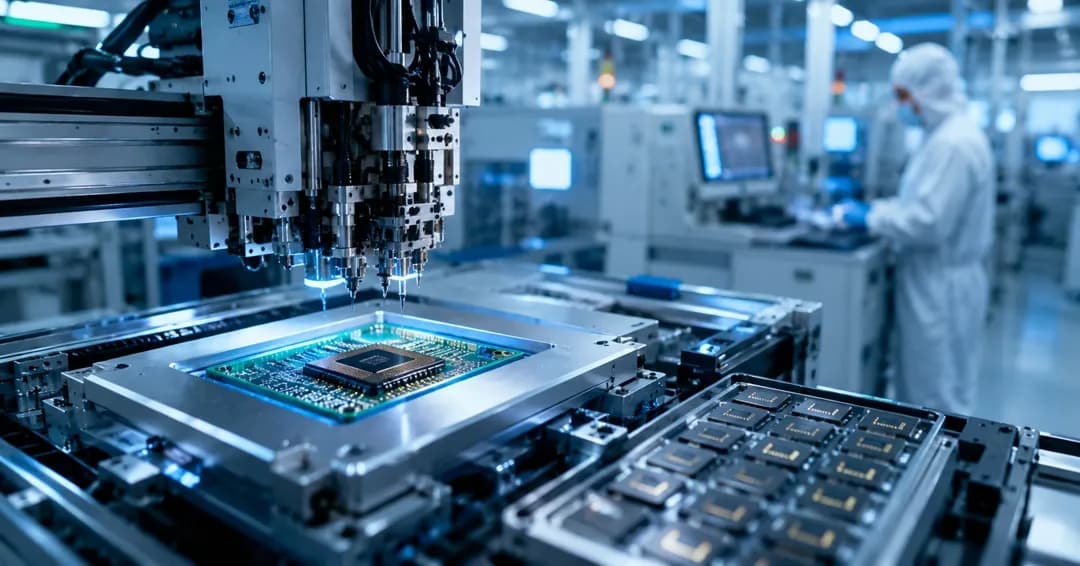
Outsourced Semiconductor Assembly and Test (OSAT) companies play a critical role in AI by enabling advanced chip packaging, testing, and integration. As AI accelerators, chiplets, and high-bandwidth memory drive semiconductor innovation, leading OSAT providers are becoming strategic partners, benefiting from growing demand, government investments, and next-generation packaging technologies.
What is an OSAT and Why Does It Matter for AI?
The outsourced semiconductor assembly and test (OSAT) companies are the specialists who convert bare silicon wafers, manufactured by a fab such as TSMC or Samsung, into complete, packaged chips ready to be added to devices and systems. The main functions they perform are die attachment, wire bonding or flip-chip interconnects, protection by moulding compounds and final electrical testing. At the front-end, fabrication often gets the headlines, but OSAT operations are a vital part of the semiconductor supply chain that in recent years has grown in strategic significance with the emergence of new architectures for chip designs that were unimaginable just 10 years ago with the advent of AI and HPC workloads.
Advanced packaging technologies such as 2.5D stacking (CoWoS, or chip-on-wafer-on-substrate), 3D IC integration, and system-in-package (SiP) modules that stack multiple specialised dies in extremely close proximity to each other, are required for the AI accelerators, NVIDIA GPUs, AMD Instinct chips, and custom ASICs for cloud hyperscalers. This connection significantly boosts the bandwidth between compute and memory, which is crucial for HPC applications and large language models. Consequently, the packaging step is no longer a simple assembly operation but actually a performance constraint, with a lot of value and pricing power moving from the middle to the top-tier of OSATs.
Market Landscape: Size, Growth, and Key Technologies
In 2026, the advanced semiconductor packaging market is estimated to be valued at USD 40.3 billion, as a fundamental change in the philosophy of chip design from monolithic SoC to chiplet-based, heterogeneous architectures has led to packaging serving as the integration layer.
The main technology drivers are, AI accelerators with high-bandwidth memory (HBM) integration through 2.5D silicon interposers; HPC and data-centre processors with 3D IC stacking to achieve maximum compute density; chiplet architectures which break up large SoCs into smaller, specialised dies that must be co-packaged; 5G infrastructure which calls for high-density RF packaging. High power AI chips create heat, and OSATs that have proven experience with thermal interface materials and heat spreading substrates offer a meaningful competitive advantage.
Advanced Packaging Technology Landscape
Technology | Description | Key OSATs | Primary AI Application |
2.5D (CoWoS / EMIB) | Multiple dies on shared silicon or glass interposer; shorter interconnects than PCB | ASE, Amkor, JCET | NVIDIA H100/H200/B200 GPUs; AMD Instinct MI300 |
3D IC Stacking | Dies stacked vertically with through-silicon vias (TSVs) or hybrid bonding; maximum density | ASE (LEAP), SPIL | HBM memory on logic; CPU+SRAM stacks |
System-in-Package (SiP) | Multiple heterogeneous components (logic, memory, RF, PMICs) in one package | ASE, SPIL, Amkor | Apple silicon; edge AI devices; wearables |
Fan-Out Wafer-Level (FOWLP) | Chip embedded in reconstituted wafer; thinner and lower-cost than interposer approaches | JCET (XDFOI), ASE, Amkor | Mobile AP packaging; AI inference at edge |
HBM Packaging | High-Bandwidth Memory stacked with TSVs and integrated with logic die | PTI, ASE | AI training accelerators; HPC nodes |
Co-Packaged Optics (CPO) | Optical components integrated directly into chip package for high-speed data movement | Amkor, ASE (emerging) | Next-generation data-centre interconnects |
Top OSAT Companies: Profiles and AI / HPC Positioning
Currently, the global OSAT market is extremely concentrated with the top three players dominating it, while the remaining competitors make up the rest of the market. The revenue of the firms listed below accounts for the overwhelming majority of the advanced packaging market worldwide, and they are by far the most obvious strategic exposure to the markets for AI and HPC chips.
[1] ASE Technology Holding | Taiwan
• FY 2025 consolidated revenue: NT¥645.4B (~US$20B)
• CapEx (2025): US$3.4B (machinery) + US$2.1B (facilities)
ASE Technology is the world's largest OSAT (Original System Assembler), and one of the top suppliers of advanced semiconductor packaging and testing services. The company has a LEAP (Leading-Edge Advanced Packaging) portfolio that features 2.5D and 3D integration, fan-out packaging, heterogeneous integration, and advanced testing solutions. Advanced packaging is playing a vital role in the development of higher performance, bandwidth and power efficient processors in the field of AI, HPC and chiplet-based architectures, which are increasingly being popularized. With continued investments in capacity growth and technology enhancements, ASE is well equipped to take advantage of the long-term demand for semiconductors powered by AI.
Key technologies: 2.5D / 3D packaging | HBM integration | Fan-out WLP | Final test for AI chips | SiP
[2] Amkor Technology | USA (HQ) / Asia operations
• FY 2025 net sales: US$6.32B
• Arizona campus investment: US$7B planned across two phases (171 acres; 750,000 sq ft cleanroom)
Amkor Technology is the largest U.S.-based OSAT and is also one of the most affected companies by the increasing demand for advanced semiconductor packaging. The company is continuing to grow their advanced packaging business in Arizona, supported by U.S. CHIPS Act funding, to enhance domestic packaging capability for AI, HPC and next-generation semiconductor applications. The plant will offer cutting-edge 2.5D packaging solutions and contribute to alleviating supply chain constraints in the U.S. semiconductor industry. Amkor has built relationships with the leading semiconductor and technology companies, and it looks set to gain from the growing demand for advanced packaging and heterogeneous integration solutions.
Key technologies: CHIPS Act funded | 2.5D packaging | US domestic capacity | Advanced SiP record revenue
[3] JCET Group | China
• FY 2025 revenue: RMB 38,871 Million
• Mar 2026 development: Increased R&D focus on 2.5D/3D integration and chiplet architectures for HPC
This is China's biggest OSAT, which was acquired back in 2015 from STATS ChipPAC. JCET has 6 locations in China, Singapore and South Korea. It has a proprietary XDFOI (high density fanout cross layer interconnect) platform that supports multi chiplet 2.5D and 3D packaging for its AI and HPC clients, giving it real advanced packaging credentials.
Key technologies: XDFOI fan-out platform | 2.5D / SiP | Automotive test | Multi-chiplet integration
[4] Powertech Technology | Taiwan
• Specialisation: Memory packaging and testing (DRAM, NAND, HBM)
• Feb 2026 development: Expanded HBM and DRAM capacity for AI accelerator platforms
• AI tailwind: HBM demand growing with every generation of AI training accelerator
PTI is a market leader in memory-specific OSAT, and has extensive experience in DRAM and NAND packaging and testing. PTI's strength is that it provides the specialisation needed to meet the unparalleled demand for High-Bandwidth Memory, with 80GB of HBM3 per NVIDIA H100 GPU and across 6 stacks of it. In February 2026 the company spoke about its capacity increases targeting AI accelerator platforms with HBM and DRAM solutions.
Key technologies: HBM / DRAM specialist | Memory test | AI accelerator memory
[5] Siliconware Precision Industries | Taiwan (ASE-affiliated)
• Jan 2026 development: Expanded advanced SiP production lines for AI and mobile fabless clients
• NVIDIA partnership: Four-year chip packaging collaboration announced Nov 2025 (alongside Amkor)
SPIL is Taiwan's OSAT that is closely related to ASE Technology and focuses on system-in-package (SiP) and heterogeneous integration. NVIDIA CFO confirms partnership in November 2025 to package NVIDIA AI accelerators and GPUs over a four-year period with Amkor and SPIL, confirming the role of SPIL in the most challenging packaging programmes. SPIL is growing its SiP production lines for the 2026 to meet the rising outsourcing demand of fabless companies in mobile, wearable and AI device sectors.
Key technologies: SiP specialist | NVIDIA partner | Heterogeneous integration | Mobile / wearable AI
[6] Tongfu Microelectronics (TFME) | China
TFME is China's second largest OSAT, and benefits from AMD's ongoing partnership in specific package types. Revenue has bounced back in 2024, due to communications and consumer electronics demand and the AMD relationship is expected to offer exposure to AI PC packaging volumes. The US export controls, similar to JCET, restrict TFME's addressable market at the most advanced AI chip packaging programmes across the world.
Key technologies: AMD partner | Volume assembly | Communications packaging
Companies and AI/HPC Positioning
Rank | Company | HQ | AI/HPC Positioning | Key Risk |
1 | ASE Technology | Taiwan | NVIDIA/AMD/Broadcom client base | Taiwan geopolitical concentration; CapEx intensity |
2 | Amkor Technology | USA | Arizona 2.5D campus; CHIPS Act funded; Apple + NVIDIA + AMD lead customers; US-only advanced packaging | Volume production delayed to 2028; margin below ASE |
3 | JCET Group | China | XDFOI fan-out; genuine 2.5D/3D credentials; strong China AI PC volumes; automotive growth | US export controls limit leading-edge AI access globally |
4 | SPIL | Taiwan | NVIDIA 4-year packaging partnership; SiP leader; ASE group synergies | Mobile/consumer volume dependence; customer concentration |
5 | Powertech (PTI) | Taiwan | HBM/DRAM specialist; capacity expansion for AI accelerator platforms (Feb 2026) | Memory cycle volatility; limited logic/compute exposure |
Government Policy: The CHIPS Act and Advanced Packaging
The U.S. government has underscored advanced packaging as a clear and dedicated priority in the CHIPS and Science Act, acknowledging packaging capacity as a strategic choke point for their domestic AI supply chains, beyond wafer manufacturing.
Initiative | Amount | Key Details | Source |
CHIPS NAPMP Awards | US$1.4B (finalized) | National Advanced Packaging Manufacturing Program; awarded Jan 2025 to build domestic advanced packaging ecosystem at scale | NIST.gov, Jan 2025 |
Amkor Arizona CHIPS Award | Up to US$407M direct funding | For Peoria, AZ advanced packaging campus; supports 2,000 mfg. jobs + 2,000 construction jobs; 2.5D technology focus | NIST.gov / Amkor press release, Dec 2024 |
Substrate & Materials R&D | US$300M | Awarded to Absolics, Applied Materials, Arizona State University under CHIPS NAPMP for advanced substrate/glass-core R&D | NIST.gov, Jan 2025 |
Total CHIPS Direct Funding | ~US$33.7B committed | Across all CHIPS Incentive Program awards as of early 2025; covering logic, memory, advanced packaging, materials | US Dept. of Commerce OIG, 2025 |
Sources: NIST CHIPS Program Office (nist.gov); Semiconductor Industry Association (semiconductors.org, Dec 2025); US Department of Commerce Office of Inspector General report (2025); Amkor Technology investor relations (amkor.com)
Key Developments: 2025–2026
NVIDIA multi-year OSAT partnerships (November 2025)
NVIDIA's CFO has made a deal to package chips for NVIDIA's next-generation AI accelerators and GPUs with Amkor Technology and SPIL, both on a four-year basis. The news drove Amkor's stock price higher by over 8%, just reflecting the market's confidence in the longer-term value of named relationships with top-tier designers of AI chips. The partnership aims to strengthen advanced packaging technology and capacity in the supply chain to support NVIDIA's continued roadmap of GPUs.
ASE Technology price increases (early 2026)
Morgan Stanley stated that the world's largest OSAT, ASE, started talks to raise back end wafer packaging prices by 5-20% for 2026 deals. This is materially higher than the market is expecting, and directly driven by the demand from AI Market Advanced Packaging capacity utilisation was around 90% in 2025, and long equipment qualification timeframes often take 12-18 months, allowing time for equipment to be in place before a market response begins, giving ASE an unusual pricing leverage situation heading into 2026.
Amkor Arizona groundbreaking (October 2025)
Amkor opened its offices in Peoria, Arizona in October 2025. The site is 171 acres, and the total project will eventually include more than 750,000 square feet of cleanroom space and US$7 billion will be invested in two phases of construction. It is the first high-volume, outsourced, advanced packaging campus in the U.S. that is located next to TSMC's Arizona wafer fabs to form an end-to-end domestic semiconductor manufacturing ecosystem. Apple and NVIDIA were the first to announce their partnership with AMD, who has been announced as a named partner in May 2026.
JCET 3D IC roadmap expansion (March 2026)
The 2.5D/3D integration and chiplet-based architectures are the new directions of the R&D focus announced by JCET Group for automotive and high-performance computing semiconductor customers. The company's own XDFOI (Xtreme Dynamic Flip-on Insulator) platform is the major advantage it offers in the advanced packaging arena, offering multi-chiplet integration for AI and HPC designs.
SPIL SiP production expansion (January 2026)
Siliconware Precision Industries rolled out the system-in-package (SiP) manufacturing lines to accommodate the rising demand from fabless semiconductor customers in mobile, wearable and AI edge devices.
Challenges and Structural Risks
While AI and high-performance computing promise significant growth prospects for OSAT companies, there are several structural issues to address. Among the most important is the growing vertical integration of advanced packaging by the major foundries and IDMs. TSMC, Samsung Electronics, and Intel are just a few companies that are investing in developing advanced packaging facilities and capabilities within their own walls, especially for cutting-edge AI and HPC applications. This has made the market more competitive, as OSATs must stand out based on their technological prowess, scale of manufacturing, and their customer base.
Consequently, the industry has become more segmented with traditional high volume packaging services and complex packaging solutions serving the chiplet architecture, heterogeneous integration and high bandwidth memory (HBM). Increased investments in advanced packaging platforms has bolstered the position of companies like ASE Technology and Amkor Technology, while companies like the JCET Group are ramping up their capabilities to meet the increasing demand for AI and HPC applications.
There are also high capital needs that are associated with the industry, where the advanced packaging technologies need a continuous investment of production capacity, process development, testing facilities and specialized equipment. As demand for advanced packaging continues to rise, companies that can make these investments without compromising the customer relationship are likely to be best suited.
Geopolitics and supply-chain are still significant factors. The Taiwanese companies, such as ASE, Siliconware Precision Industries, and Powertech Technology, benefit from a robust semiconductor ecosystem integration, but there are risks related to their geographic concentration. However, the Chinese OSAT manufacturers, like JCET and Tongfu Microelectronics, are facing changing trade policies and technology restrictions. Further, packaging and testing engineers with advanced skills and availability of advanced materials are still potential constraints that may limit future growth of the industry.
Which OSATs Are Best Positioned?
With a large footprint, diverse technology mix and a very strong focus on advanced packaging and testing, ASE Technology is regarded as the industry leader of the OSAT providers. The company's LEAP platform has been enhanced to include several of the most recent and significant technologies for AI and HPC, including 2.5D and 3D integration, heterogeneous packaging, fan-out solutions, and even advanced testing services. With the evolution of the semiconductor makers moving towards chiplet designs and increased level of integration, ASE is poised to benefit from the rising demand for advanced packaging solutions. Its worldwide manufacturing footprint, large customer base, and ongoing investment in cutting-edge packaging technology adds to its competitiveness in the fast-changing semiconductor value chain.
Investors looking at supply-chain resilience in the U.S. have the most options with Amkor Technology. The CHIPS Act support (US$407M, NIST), proximity to TSMC's Arizona chip factories, and confirmed demand commitments from Apple, NVIDIA and AMD de-risk the demand side of the investment.
SPIL's NVIDIA four-year packaging agreement and SiP specialisation make for long-term AI revenue streams. Powertech (PTI) is the only pure-play on HBM demand, as the demand for memory in AI accelerators keeps growing with each generation of GPUs. While all of these solutions have advanced packaging capabilities, the major drawback of their architecture is exposure to export controls, the main obstacle for JCET in the global AI/HPC market.
Have questions?
More Blogs
Top U.S. Healthcare Industry Trends to Watch in 2026 for the Global Healthcare Market
The global healthcare industry in 2026 is shifting toward AI-driven efficiency, stronger cybersecurity, outpatient care expansion, and domestic pharmaceutical manufacturing. U.S. healthcare leaders are prioritizing workforce support, operational resilience, value-based care, and integrated digital systems to improve patient outcomes while controlling costs.
How AI Is Reshaping the American Healthcare Industry
The U.S. healthcare industry is rapidly integrating artificial intelligence across clinical, administrative, and pharmaceutical operations. AI is improving diagnostics, automating workflows, reducing clinician burden, accelerating drug discovery, and enhancing personalized care. With strong adoption by hospitals and tech companies, AI is transforming healthcare delivery while driving the U.S. AI healthcare market toward significant growth by 2031.
Top Companies Leading the Silicon-Based Capacitor Revolution
Introduction: The Rise of Silicon-Based Capacitors: Electronic circuits use basic capacitors as storage devices to handle three essential tasks including filtering, decoupling, and signal coupling. High-performance silicon capacitors h...