
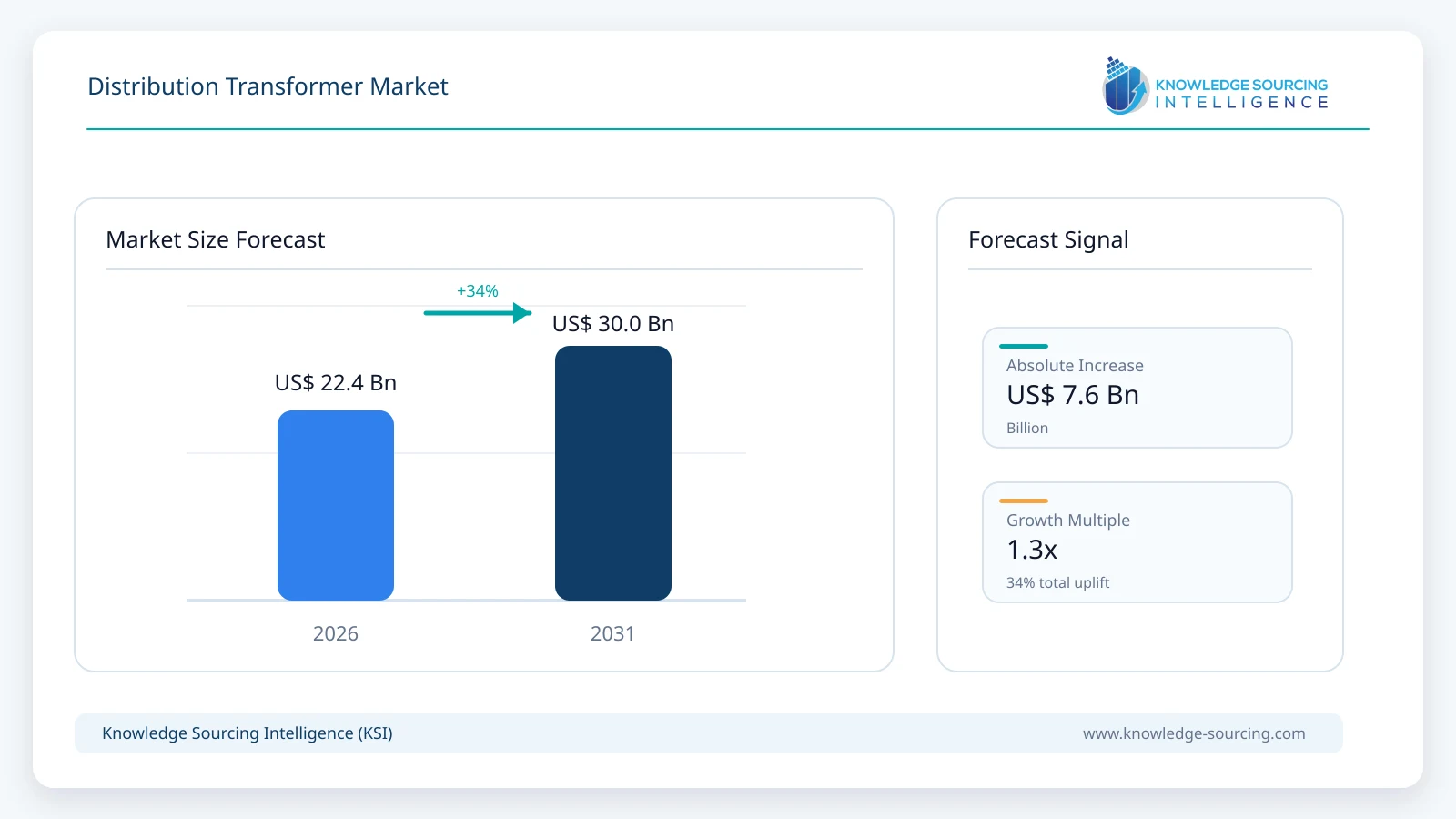
The Distribution Transformer market is forecast to grow at a CAGR of 6.0%, reaching USD 30.0 billion in 2031 from USD 22.4 billion in 2026.
Highlights:
- 1Pad-mounted transformers account for approximately 55% of global market revenue in 2026.
- 2Three-phase distribution transformers are projected to grow at approximately 6.5% annually through 2031.
- 3Utilities account for approximately 55% of global distribution-transformer revenue in 2026.
- 4Asia Pacific represents roughly 45% of global distribution-transformer revenue in 2026.
- 5Manufacturing expansion is gradually easing supply constraints, but delivery certainty remains strategically important.
Distribution transformers sit at the point where medium-voltage networks are converted to usable voltages for local utility, commercial, residential and industrial customers. The market therefore follows distribution-grid expansion more closely than generation investment alone. New substations, feeder upgrades, renewable interconnections, electric-vehicle charging, industrial electrification and data centers all create transformer requirements, while the existing installed base generates a recurring replacement market because aging, overloaded or inefficient units must be refurbished or replaced.
The current cycle is distinguished by unusually strong pressure on transformer supply chains. The IEA estimates that global grid spending is approaching USD 550 billion in 2026, up nearly 20% year on year, while connection queues and electricity-demand growth are forcing utilities to accelerate both new construction and equipment replacement. Manufacturers are responding with substantial capacity additions. Hitachi Energy announced a USD 528 million Mississippi transformer facility in September 2026 that will more than double production capacity at its local distribution-transformer operations, while Eaton is investing USD 340 million in a new U.S. three-phase transformer plant and GE Vernova completed its USD 5.275 billion acquisition of the remaining stake in Prolec GE in February 2026.
Market Trends
Transformer manufacturing is shifting toward regional capacity and shorter supply chains
Transformer shortages have moved manufacturing capacity from a back-office issue to a strategic purchasing consideration for utilities and large electrical customers. Extended lead times have encouraged major suppliers to localize production, secure insulation and component inputs, and add regional manufacturing capacity. Hitachi Energy is expanding transformer production across the United States, India, China and Latin America, while Eaton is adding a third U.S. facility for three-phase transformers and GE Vernova has consolidated Prolec GE into its Electrification business. Hammond Power Solutions is also increasing custom-transformer capacity through 2026 and early 2027. These investments should gradually improve availability, but qualification requirements and long equipment life cycles mean utilities continue to value established suppliers with proven regional service and manufacturing support.
Digital monitoring and efficiency are moving into mainstream transformer procurement
Utilities and industrial users are increasingly evaluating distribution transformers as monitored grid assets rather than passive electrical equipment. Sensor-enabled systems can track loading, temperature, oil condition and other operating parameters, helping asset owners identify overloaded units, extend service life and plan replacement before failure. Hitachi Energy's TXpert platform illustrates this shift by adding monitoring and analytics to both new and existing liquid-filled and dry-type distribution transformers. Efficiency requirements are also tightening. In the United States, amended Department of Energy distribution-transformer efficiency standards take effect in April 2029, increasing the importance of core materials, design optimization and manufacturing process control across future product portfolios.
Market Drivers
Grid expansion and replacement are increasing transformer procurement
Distribution networks face simultaneous expansion and replacement requirements. Electricity demand is rising from data centers, electric vehicles, cooling, industrial electrification and broader use of electricity across end markets, while many mature networks are operating transformers installed decades ago. The IEA estimates that more than 2,500 GW of generation, storage and large-load projects are currently stalled in grid connection queues worldwide and that grid investment must increase materially through 2030. Every new feeder, substation expansion and high-load connection can create incremental demand for distribution transformers, while replacement programs add a comparatively stable recurring market. This combination makes transformer procurement less dependent on any single generation technology and supports sustained demand even if renewable installation growth varies from year to year.
Data centers and industrial electrification are raising the value of three-phase distribution equipment
Large commercial and industrial loads are creating a higher-value transformer demand pool because data centers, semiconductor plants, battery factories, logistics facilities and electrified industrial sites require reliable multi-megawatt distribution architectures. Eaton explicitly cites data centers, grid modernization, electrification and industrialization as drivers behind its new U.S. three-phase transformer factory, while major transformer manufacturers are expanding broader grid-equipment capacity around the same demand cycle. These customers place greater emphasis on efficiency, redundancy, footprint, thermal performance and delivery certainty than conventional low-capacity residential applications, increasing the commercial importance of three-phase and pad-mounted units in developed markets.
Market Restraint
Material constraints and long qualification cycles limit how quickly supply can respond
Transformer production depends on specialized electrical steel, copper, aluminum, insulation materials, bushings, tap changers and skilled manufacturing labor. Even when demand is visible, adding qualified production capacity takes time because transformer plants require specialized winding, core-processing, drying, testing and quality-control equipment. The IEA continues to identify transformers and cables as important grid-supply-chain bottlenecks, while manufacturers are investing heavily to reduce those constraints. New capacity will improve supply availability during the forecast period, but qualification requirements, utility specifications and long product lives prevent the market from responding as quickly as commodity electrical-equipment markets. This can delay projects and create volatile pricing, especially for specialized three-phase and higher-capacity units.
Segment Analysis
By Mounting Type - Pad-Mounted
Pad-mounted transformers account for approximately 55% of global distribution-transformer revenue in 2026 and are projected to generate about USD 16.8 billion by 2031. The segment benefits from underground distribution networks, commercial developments, industrial campuses, residential subdivisions and data centers where enclosed ground-level equipment is preferred to pole-mounted installations. Revenue intensity is also higher because pad-mounted configurations frequently serve larger three-phase loads and require secure enclosures, switching arrangements and protection equipment. Pole-mounted transformers remain essential in rural, suburban and lower-density networks, particularly across North America, Latin America and parts of Asia, but urban undergrounding and high-load commercial connections are supporting stronger value growth for pad-mounted systems.
By Phase - Three Phase
Three-phase distribution transformers are projected to expand at approximately 6.5% annually between 2026 and 2031, reaching about USD 18.1 billion by 2031. Demand is concentrated in industrial plants, commercial buildings, data centers, renewable-energy facilities and utility distribution substations where higher power requirements make three-phase equipment the standard architecture. Manufacturing investment also reflects this demand shift: Eaton's new South Carolina facility is being developed specifically to increase U.S. production of three-phase transformers. Single-phase units retain a large installed base in residential and lower-load utility networks, but their lower average selling value means they contribute less incremental revenue than larger three-phase equipment.
By End User - Utilities
Utilities account for approximately 55% of global distribution-transformer revenue in 2026 and are projected to generate about USD 16.8 billion by 2031. Their purchasing requirements span new network expansion, replacement of aging fleets, storm recovery, voltage upgrades, renewable interconnections and reliability programs. Procurement is increasingly influenced by equipment availability as much as initial purchase price because transformer lead times can directly affect connection schedules and network-reinforcement programs. Industrial customers form the next major demand pool, while commercial and residential applications contribute through new construction and local load growth. Utility demand is also the segment most directly affected by efficiency regulation and digital asset-management requirements.
By Geography - Asia Pacific
Asia Pacific remains the largest regional market, accounting for roughly 45% of global distribution-transformer revenue in 2026 and projected to approach USD 13.8 billion by 2031. The region is supported by rapid electricity-demand growth, distribution-network investment, manufacturing expansion and continuing urbanization. China has the largest installed power system and a substantial domestic transformer manufacturing base, while India is investing heavily in transmission and distribution infrastructure to accommodate industrial growth and rising non-fossil generation capacity. Hitachi Energy's 2026 investments in India and China illustrate the strategic importance of the region to the global transformer supply chain. North America records strong value growth because data-center demand, replacement requirements and constrained domestic supply are driving unusually high equipment investment.
Competitive Environment
The competitive landscape combines global grid-equipment groups, regional utility-transformer specialists and manufacturers focused on commercial and industrial applications. Hitachi Energy, GE Vernova, Eaton, Schneider Electric and Siemens Energy compete across broad transformer and grid portfolios, while CG Power, Hyosung Heavy Industries, Mitsubishi Electric, Toshiba, WEG and TBEA maintain substantial regional manufacturing positions. North America also contains specialist suppliers such as Howard Industries, ERMCO, MGM Transformer, Hammond Power Solutions and Virginia Transformer.
Manufacturing capacity has become a central competitive variable because utilities and large electrical customers increasingly prioritize delivery certainty alongside efficiency and lifecycle performance. GE Vernova's acquisition of Prolec GE substantially increased its North American transformer footprint, while Hitachi Energy and Eaton are making major capacity additions in the United States. Product differentiation is also expanding through digital monitoring, natural-ester fluids, lower-loss cores and more efficient dry-type designs. Suppliers able to combine qualified regional manufacturing, field service and shorter lead times are positioned to capture a disproportionate share of current demand.
Recent Developments
September 2026: Hitachi Energy announced a USD 528 million new transformer manufacturing facility in Gallman, Mississippi, which will more than double local production capacity and expand U.S. supply of distribution transformers.
June 2026: Hitachi Energy signed an agreement to acquire Canduct Group, expanding North American transformer insulation and component capacity to address a key supply-chain bottleneck.
February 2026: GE Vernova completed the USD 5.275 billion acquisition of the remaining 50% stake in Prolec GE, bringing its transformer manufacturing operations fully into GE Vernova's Electrification segment.
2026: Hammond Power Solutions continued a roughly USD 100 million custom-transformer capacity expansion program running through 2026 and early 2027 to support electrification and digital-infrastructure demand.
February 2025: Eaton announced a USD 340 million investment in a new South Carolina plant for three-phase transformers, with production expected to begin in 2027.
Distribution Transformer Market Scope
| Report Metric | Details |
|---|---|
| Total Market Size in 2026 | USD 22.4 billion |
| Total Market Size in 2031 | USD 30.0 billion |
| Forecast Unit | Billion |
| Growth Rate | 6.0% |
| Study Period | 2021 to 2031 |
| Historical Data | 2021 to 2024 |
| Base Year | 2025 |
| Forecast Period | 2026 – 2031 |
| Segmentation | Mounting Type, Phase, End-User, Geography |
| Companies |
|
Market Segmentation
By Mounting Type
Pad-Mounted
Pole-Mounted
By Phase
Single Phase
Three Phase
By End User
Utilities
Industrial
Commercial
Residential
By Geography
North America
United States
Canada
Mexico
South America
Brazil
Argentina
Others
Europe
Germany
United Kingdom
France
Spain
Italy
Others
Middle East and Africa
Saudi Arabia
UAE
South Africa
Others
Asia Pacific
China
India
Japan
South Korea
Australia
Others
Table of Contents
1. EXECUTIVE SUMMARY
2. MARKET SNAPSHOT
2.1. Market Overview
2.2. Market Definition
2.3. Scope of the Study
2.4. Market Segmentation
3. BUSINESS LANDSCAPE
3.1. Market Drivers
3.1.1. Grid Expansion and Replacement Are Increasing Transformer Procurement
3.1.2. Data Centers and Industrial Electrification Are Raising the Value of Three-Phase Distribution Equipment
3.2. Market Restraint
3.2.1. Material Constraints and Long Qualification Cycles Limit How Quickly Supply Can Respond
3.3. Market Opportunities
3.4. Porter's Five Forces Analysis
3.5. Industry Value Chain Analysis
3.6. Policies and Regulations
3.7. Strategic Recommendations
4. TECHNOLOGICAL OUTLOOK
4.1. Digital Transformer Monitoring
4.2. High-Efficiency Core Materials
4.3. Natural-Ester and Lower-Impact Insulation Systems
5. DISTRIBUTION TRANSFORMER MARKET BY MOUNTING TYPE
5.1. Introduction
5.2. Pad-Mounted
5.3. Pole-Mounted
6. DISTRIBUTION TRANSFORMER MARKET BY PHASE
6.1. Introduction
6.2. Single Phase
6.3. Three Phase
7. DISTRIBUTION TRANSFORMER MARKET BY END USER
7.1. Introduction
7.2. Utilities
7.3. Industrial
7.4. Commercial
7.5. Residential
8. DISTRIBUTION TRANSFORMER MARKET BY GEOGRAPHY
8.1. Introduction
8.2. North America
8.2.1. United States
8.2.2. Canada
8.2.3. Mexico
8.3. South America
8.3.1. Brazil
8.3.2. Argentina
8.3.3. Others
8.4. Europe
8.4.1. Germany
8.4.2. United Kingdom
8.4.3. France
8.4.4. Spain
8.4.5. Italy
8.4.6. Others
8.5. Middle East and Africa
8.5.1. Saudi Arabia
8.5.2. UAE
8.5.3. South Africa
8.5.4. Others
8.6. Asia Pacific
8.6.1. China
8.6.2. India
8.6.3. Japan
8.6.4. South Korea
8.6.5. Australia
8.6.6. Others
9. COMPETITIVE ENVIRONMENT AND ANALYSIS
9.1. Major Players and Strategy Analysis
9.2. Market Share Analysis
9.3. Mergers, Acquisitions, Agreements and Collaborations
9.4. Competitive Dashboard
10. COMPANY PROFILES
10.1. Hitachi Energy
10.2. GE Vernova
10.3. Eaton Corporation plc
10.4. Schneider Electric SE
10.5. Siemens Energy AG
10.6. Mitsubishi Electric Corporation
10.7. Toshiba Energy Systems & Solutions Corporation
10.8. Hyosung Heavy Industries Corporation
10.9. CG Power and Industrial Solutions Limited
10.10. WEG S.A.
10.11. Hammond Power Solutions Inc.
10.12. Howard Industries, Inc.
10.13. ERMCO, Inc.
10.14. MGM Transformer Company
10.15. Virginia Transformer Corp.
10.16. SGB-SMIT Group
10.17. TBEA Co., Ltd.
10.18. Kirloskar Electric Company Limited
11. APPENDIX
11.1. Currency
11.2. Assumptions
11.3. Base and Forecast Years Timeline
11.4. Key Benefits for Stakeholders
11.5. Research Methodology
11.6. Abbreviations
LIST OF FIGURES
LIST OF TABLES
Navigate
Trusted by the world's leading organizations











