
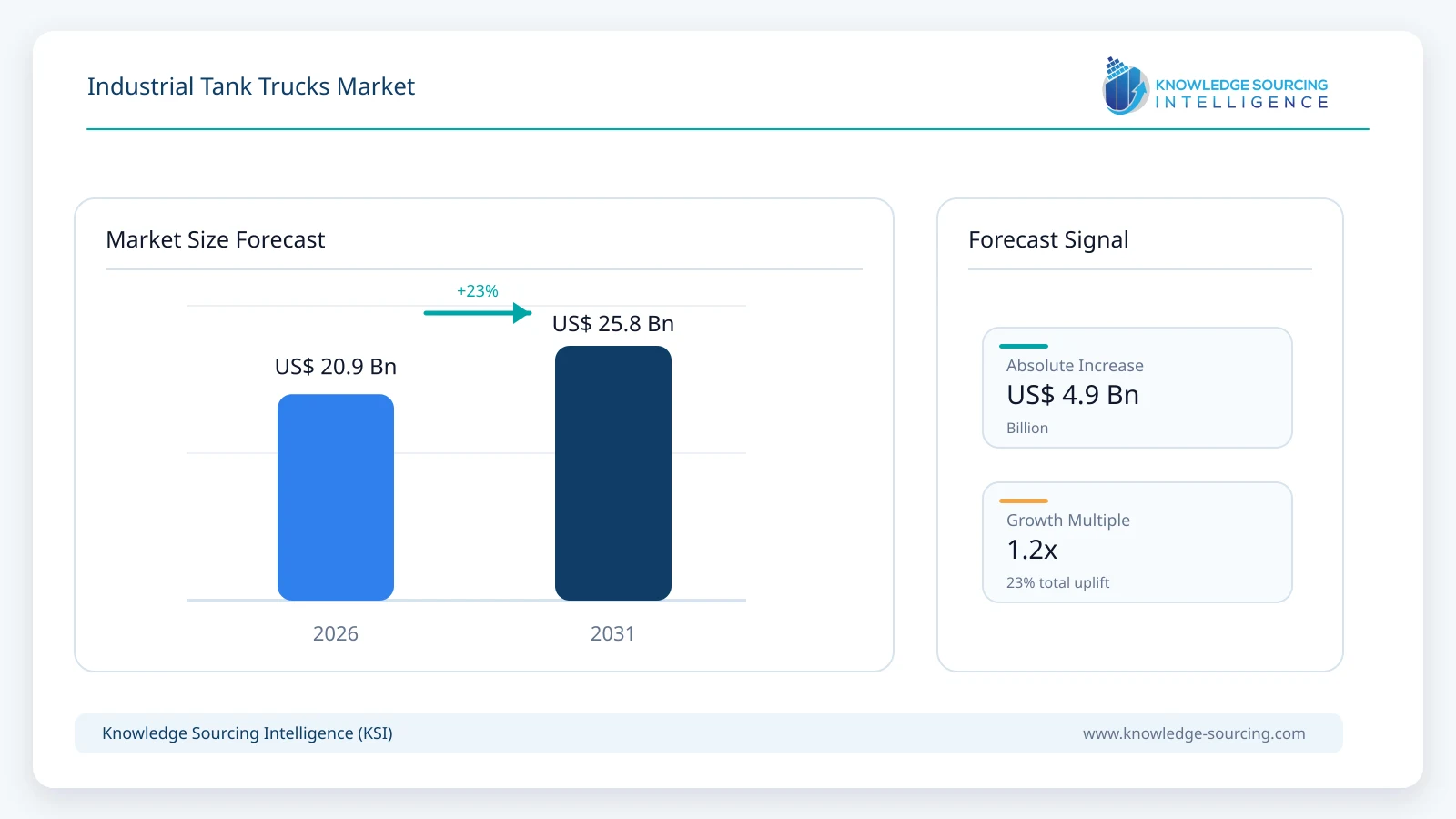
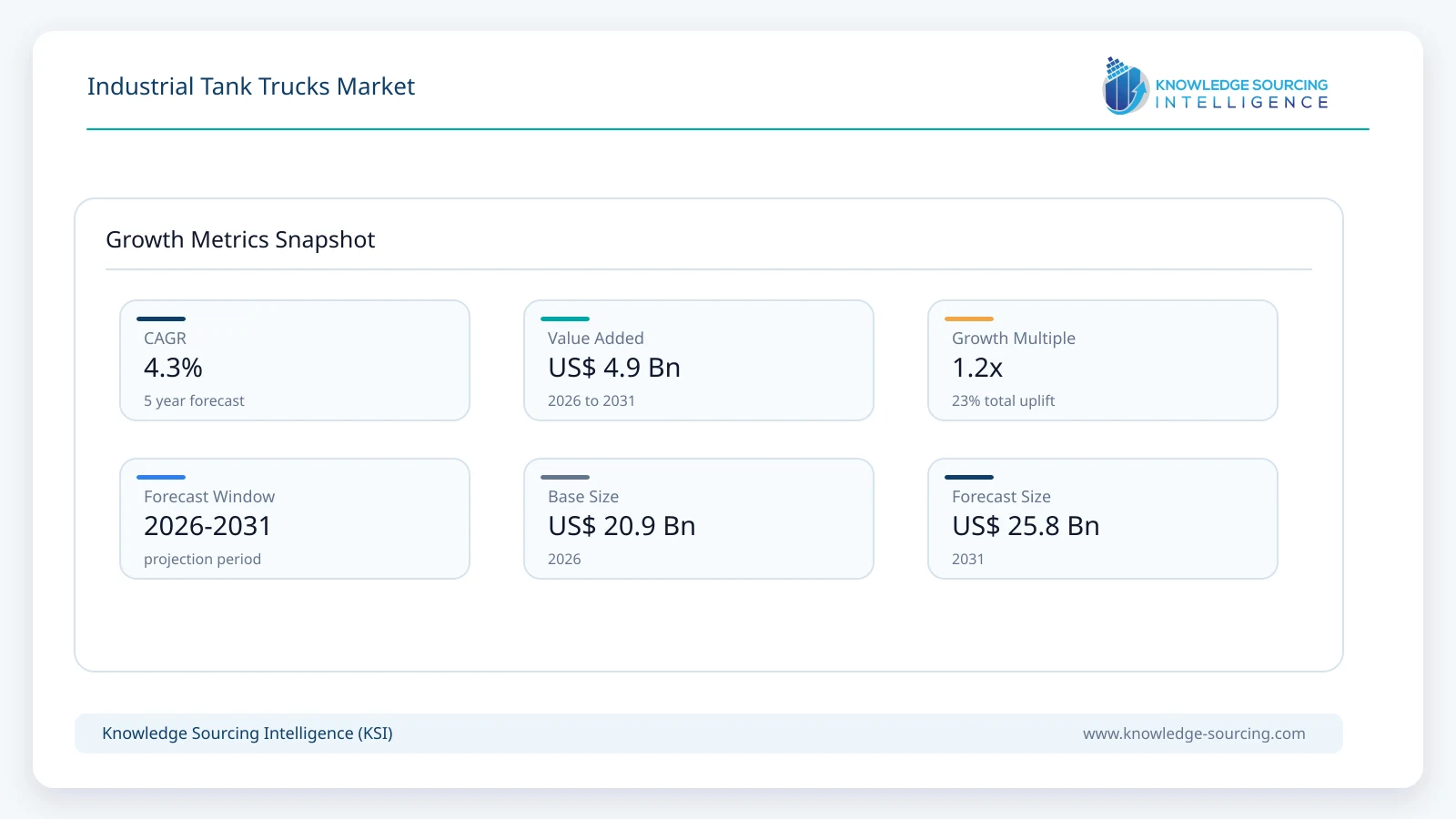
The industrial tank trucks market is estimated at USD 20.9 billion in 2026 and is projected to reach USD 25.8 billion by 2031, representing a CAGR of approximately 4.3% during the forecast period.
Highlights:
- 1Asia Pacific accounts for approximately 41% of global industrial tank truck market value in 2026.
- 2Heavy-duty tank trucks remain the largest capacity class because petroleum and chemical routes favor higher payloads.
- 3Diesel remains the dominant propulsion technology, but electric, LNG and hybrid chassis are entering specialized fleets.
- 4Digital metering, geofencing and compartment-level monitoring are becoming standard productivity and safety features.
- 5India's AIS 163 tanker requirements strengthen construction, mounting and roadworthiness standards for specialized tanker vehicles.
- 6The U.S. 2027 heavy-duty NOx standards are accelerating 2026 fleet-order timing for custom tank-truck operators.
Industrial tank trucks are specialized vocational vehicles whose economics depend on both the base commercial-vehicle platform and the tank system mounted on it. Fuel-delivery trucks may use multiple compartments, pumps, meters and vapor-recovery equipment; food-grade units prioritize stainless-steel construction and hygienic cleanability; water and waste tankers require corrosion resistance and purpose-specific pumping systems; and chemical vehicles must satisfy cargo compatibility and hazardous-goods requirements. The product is therefore engineered around the transported fluid rather than around chassis tonnage alone.
Regulation materially shapes vehicle design. UNECE ADR 2025 sets requirements for the international road transport of dangerous goods and includes provisions covering vehicle construction, tanks, operation and safety responsibilities. India is tightening its own special-purpose vehicle framework through AIS 163 Part 2 Annex 6, which specifies requirements for tanker trucks carrying non-hazardous liquids such as milk and water, including tank mounting, restraint, material suitability and vehicle roadworthiness. In the United States, tank builders and fleet operators are also preparing for model-year 2027 heavy-duty engine standards, which materially reduce allowable NOx emissions and affect chassis cost and procurement timing.
The market is supplied through two interdependent groups. Global truck OEMs provide rigid chassis, drivetrains, cabs, braking systems and telematics, while specialist tank manufacturers design and integrate the vessel, compartments, pumps, meters and safety systems. Tata Motors, Mahindra, BharatBenz, Volvo, Scania/MAN, Isuzu, Hino and Chinese heavy-truck manufacturers participate through tanker-capable chassis and complete regional offerings. Specialist manufacturers such as Amthor International, Westmor, Seneca Tank, Road Tankers Northern, WILLIG and Whale Tankers add application-specific engineering. Competitive analysis therefore needs to distinguish platform suppliers from completed-vehicle integrators rather than treating every participant as an identical manufacturer.
Market Trends
Lightweight Aluminum and Stainless-Steel Designs Are Increasing Payload Efficiency
Tank material is increasingly selected to maximize usable payload while meeting cargo-compatibility requirements. Aluminum is widely used in refined-fuel distribution because lower tare weight can increase delivered volume per trip, while stainless steel remains important for food-grade liquids, DEF and corrosive products. Amthor currently offers aluminum, stainless-steel and carbon-steel tank constructions across fuel, water, vacuum and DEF applications. European manufacturers such as WILLIG similarly emphasize lightweight aluminum tank bodies for petroleum distribution. The commercial benefit is direct: every kilogram removed from the vehicle can potentially be converted into additional payload within axle and gross-weight limits.
Digital Metering and Telematics Are Becoming Part of the Tank System
Tank trucks are increasingly connected assets rather than purely mechanical transport equipment. Modern systems can combine electronic meters, delivery-ticket data, GPS, geofencing, compartment monitoring, overfill protection and remote fleet diagnostics. These features reduce product-loss risk, support proof of delivery and improve route productivity. The trend is especially important in multi-stop refined-fuel delivery, where operators need accurate product reconciliation across several compartments and customers. Digitalization also strengthens regulatory traceability for hazardous products and creates service revenue for tank integrators.
Alternative-Powertrain Chassis Are Entering Specialized Tank Applications
Diesel remains dominant because tank trucks operate at high payloads and often need long daily duty cycles, but new commercial-vehicle platforms are broadening propulsion options. Tata Motors launched a next-generation truck range in January 2026 that included new battery-electric heavy trucks, while its LNG Prima platform is explicitly offered for tanker transport. Volvo introduced next-generation heavy electric trucks in April 2026 and started series production in September, extending electric range toward 700 km in long-haul configurations. SHACMAN also introduced a plug-in-hybrid oilfield chassis in 2026. Adoption in hazardous-liquid transport will remain slower than in general freight because payload, charging, certification and power-take-off requirements are more demanding.
Tank-Body Integration Is Becoming More Application-Specific
Operators increasingly specify complete vehicles around route type rather than purchasing a generic cylindrical tank. Westmor offers distinct configurations for refined fuel, agricultural delivery, direct-to-locomotive fueling and bulk lubricants, while Seneca Tank offers compartment layouts and pumping systems matched to fleet fueling, construction and commercial delivery. Amthor provides separate refined-fuel, propane, DEF, water and vacuum tanker families. This specialization raises engineering content per truck and makes service, inspection and parts support an increasingly important part of supplier selection.
Market Drivers
Petroleum and Chemical Distribution Sustain Core Heavy-Duty Demand
Refined fuels, lubricants and industrial chemicals remain the largest demand base for industrial tank trucks. Distribution networks require repeated movement from terminals and bulk storage facilities to fuel stations, industrial customers, construction sites and fleets. Hazardous-liquid transport also favors dedicated, purpose-built vehicles with compartment isolation, grounding, pressure control and emergency shutoff systems. Even as long-term transport decarbonization reduces petroleum demand in some mature markets, emerging economies continue to add fuel distribution infrastructure and industrial chemical capacity, supporting vehicle replacement and fleet expansion.
Municipal Water, Waste and Infrastructure Services Broaden the Market
Tank truck demand extends well beyond fuel transport. Municipalities and contractors use water tankers for drinking-water delivery, dust suppression, road construction and emergency supply, while vacuum tankers support wastewater, septic and industrial-liquid collection. Infrastructure investment increases demand for job-site fuel, water and lubrication trucks because dispersed equipment must be serviced in the field. These applications reduce dependence on a single commodity cycle and support medium- and heavy-duty vehicle demand across developing and developed markets.
Tighter Safety Standards Drive Replacement and Higher Specification Content
Tank trucks operate under stricter construction and inspection requirements than general freight vehicles because cargo movement can create rollover, contamination, leakage and fire risks. ADR rules in Europe, DOT requirements in the United States and evolving Indian standards require purpose-designed tanks, mounting systems, overfill protection, valves and inspection regimes. Compliance therefore creates a recurring replacement and refurbishment market. It also favors established manufacturers with certified welding, engineering and inspection capability because fleet operators need documented compliance rather than only low acquisition cost.
Market Restraints
High Customization, Long Replacement Cycles and Chassis Costs Limit Faster Revenue Growth
Tank trucks are capital-intensive and often custom engineered, which lengthens lead times and makes fleet buyers sensitive to financing costs and chassis availability. Unlike general cargo trucks, a tanker body can remain in service for many years and may be remounted onto a new chassis, extending the effective replacement cycle. Environmental and engine regulations can also increase vehicle cost. U.S. model-year 2027 NOx standards are substantially tighter than prior requirements, while tank-builder commentary in 2026 indicates operators are considering earlier chassis purchases to manage expected cost and lead-time changes. Alternative-powertrain models face an additional challenge because battery weight can reduce liquid payload unless vehicle weight allowances or battery density improve.
Segment Analysis
By Capacity - Heavy Duty, More Than 4,000 Gallons
Heavy-duty tank trucks above 4,000 gallons are estimated at approximately USD 12.1 billion in 2026 and form the largest capacity segment. They are widely used in refined-fuel, chemical, water and industrial distribution where high payload lowers delivery cost per liter. North American tank builders such as Seneca Tank market rigid products in the 3,500- to 5,800-gallon range, while emerging-market manufacturers offer 20,000-liter and larger rigid tankers on multi-axle chassis. Medium-duty trucks remain important for urban routes and food-grade distribution, while small-duty units serve local LPG, fuel, sanitation and municipal applications.
By Propulsion - Diesel
Diesel-powered tank trucks are estimated at approximately USD 18.4 billion in 2026 and remain the dominant propulsion segment. Diesel combines high energy density, established service networks and predictable payload economics for heavy vocational duty. Electric tankers are emerging first in regional, municipal and controlled-route applications, while LNG, CNG and plug-in-hybrid platforms provide intermediate decarbonization options in selected markets. The fastest growth is expected outside conventional diesel, but alternative powertrains remain a minority of market value through most of the forecast period.
By End User - Oil & Gas / Refined Fuel Distribution
Oil and gas and refined-fuel distribution are estimated at approximately USD 8.8 billion in 2026, making them the largest end-user segment. The market includes terminal-to-retail movement, heating-oil delivery, fleet fueling, aviation refueling and job-site fuel distribution. Chemical transport is another major high-specification segment because cargo compatibility and hazardous-goods rules increase tank-system value. Food and beverage, water and waste applications collectively provide a large diversified base and are less directly exposed to the long-term transition away from road fuels.
By Geography - Asia Pacific
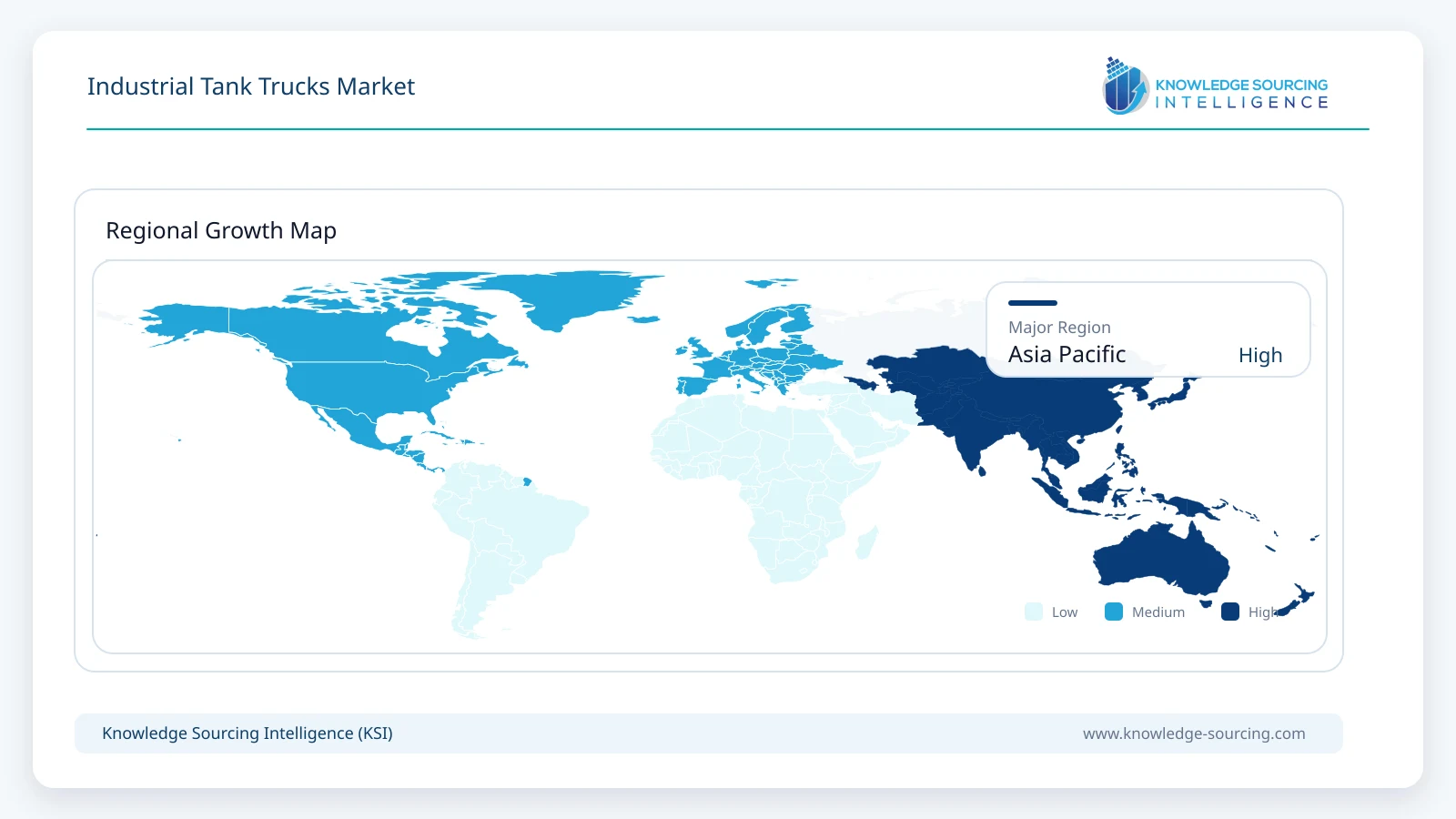
Asia Pacific is the largest regional market, supported by high commercial-vehicle production, expanding petroleum and chemical distribution, infrastructure construction and rapid urban growth. China and India lead regional demand, while Southeast Asian markets require tankers for fuel, water, food-grade liquids and industrial projects. North America is a high-value market for custom fuel, propane, vacuum and water tank trucks, with significant specialist manufacturing capability. Europe has a mature fleet but maintains high value per vehicle because ADR compliance, lightweight aluminum designs and advanced metering systems are widely adopted.
Competitive Environment
Competition is split between global chassis manufacturers and specialist tank-body integrators. Truck OEMs compete on payload capacity, fuel efficiency, alternative powertrains, safety systems, service networks and telematics. Tank specialists compete on vessel design, material selection, compartment architecture, pumping and metering equipment, hazardous-goods certification and after-sales service. This structure means a completed tank truck may combine a chassis from one company with a tank and delivery system from another, and market-share analysis should therefore avoid double counting the same completed vehicle.
Recent Developments
September 2026: Volvo Trucks began series production of its new heavy-duty electric range, including configurations with up to 700 km driving range for demanding vocational and regional applications.
August 2026: Amthor International highlighted 2026 fleet-order acceleration ahead of U.S. model-year 2027 heavy-duty NOx requirements and expanded pre-emission chassis availability for custom tank trucks.
May 2026: A 10,000-liter stainless-steel Isuzu NPR fuel transport truck was delivered for Mongolian operations, illustrating continued export demand for medium-duty rigid tankers.
Early 2026: SHACMAN launched a 6x4 20,000-liter aluminum fuel tanker and a plug-in-hybrid oilfield operation chassis for energy logistics.
January 2026: Tata Motors launched 17 next-generation trucks, including new battery-electric heavy-truck platforms alongside upgraded Prima, Signa and Ultra ranges used across tanker applications.
Industrial Tank Trucks Market Scope
| Report Metric | Details |
|---|---|
| Total Market Size in 2026 | USD 20.9 billion |
| Total Market Size in 2031 | USD 25.8 billion |
| Forecast Unit | Billion |
| Growth Rate | 4.3% |
| Study Period | 2021 to 2031 |
| Historical Data | 2021 to 2024 |
| Base Year | 2025 |
| Forecast Period | 2026 – 2031 |
| Segmentation | Capacity, Propulsion, End-User, Geography |
| Companies |
|
Market Segmentation
By Capacity
Small Duty - Less Than 1,000 Gallons
Medium Duty - 1,000 to 4,000 Gallons
Heavy Duty - More Than 4,000 Gallons
By Propulsion
Diesel
Electric
Other Propulsion - LNG, CNG and Hybrid
By End User
Oil & Gas / Refined Fuel Distribution
Chemical
Food & Beverages
Water & Waste
Construction, Agriculture and Other Industrial Applications
By Geography
North America
United States
Canada
Mexico
South America
Brazil
Argentina
Others
Europe
Germany
France
United Kingdom
Italy
Spain
Others
Middle East & Africa
Saudi Arabia
UAE
South Africa
Others
Asia Pacific
China
India
Japan
South Korea
Indonesia
Thailand
Australia
Others
Table of Contents
1. EXECUTIVE SUMMARY
2. MARKET SNAPSHOT
2.1. Market Overview
2.2. Market Definition
2.3. Scope of the Study
2.4. Market Segmentation
3. BUSINESS LANDSCAPE
3.1. Market Drivers
3.1.1. Petroleum and Chemical Distribution Sustain Core Heavy-Duty Demand
3.1.2. Municipal Water, Waste and Infrastructure Services Broaden the Market
3.1.3. Tighter Safety Standards Drive Replacement and Higher Specification Content
3.2. Market Restraints
3.2.1. High Customization, Long Replacement Cycles and Chassis Costs Limit Faster Revenue Growth
3.3. Market Opportunities
3.4. Porter's Five Forces Analysis
3.5. Industry Value Chain Analysis
3.6. Policies and Regulations
3.7. Strategic Recommendations
4. TECHNOLOGICAL OUTLOOK
4.1. Lightweight Aluminum and Stainless-Steel Tank Construction
4.2. Digital Metering and Delivery Reconciliation
4.3. Telematics, Geofencing and Compartment Monitoring
4.4. Electric, LNG and Hybrid Vocational Chassis
4.5. Pumping, Valve and Overfill Protection Systems
5. INDUSTRIAL TANK TRUCKS MARKET BY CAPACITY
5.1. Introduction
5.2. Small Duty - Less Than 1,000 Gallons
5.3. Medium Duty - 1,000 to 4,000 Gallons
5.4. Heavy Duty - More Than 4,000 Gallons
6. INDUSTRIAL TANK TRUCKS MARKET BY PROPULSION
6.1. Introduction
6.2. Diesel
6.3. Electric
6.4. Other Propulsion - LNG, CNG and Hybrid
7. INDUSTRIAL TANK TRUCKS MARKET BY END USER
7.1. Introduction
7.2. Oil & Gas / Refined Fuel Distribution
7.3. Chemical
7.4. Food & Beverages
7.5. Water & Waste
7.6. Construction, Agriculture and Other Industrial Applications
8. INDUSTRIAL TANK TRUCKS MARKET BY GEOGRAPHY
8.1. Introduction
8.2. North America
8.2.1. United States
8.2.2. Canada
8.2.3. Mexico
8.3. South America
8.3.1. Brazil
8.3.2. Argentina
8.3.3. Others
8.4. Europe
8.4.1. Germany
8.4.2. France
8.4.3. United Kingdom
8.4.4. Italy
8.4.5. Spain
8.4.6. Others
8.5. Middle East & Africa
8.5.1. Saudi Arabia
8.5.2. UAE
8.5.3. South Africa
8.5.4. Others
8.6. Asia Pacific
8.6.1. China
8.6.2. India
8.6.3. Japan
8.6.4. South Korea
8.6.5. Indonesia
8.6.6. Thailand
8.6.7. Australia
8.6.8. Others
9. COMPETITIVE ENVIRONMENT AND ANALYSIS
9.1. Major Chassis OEMs and Tank Integrators
9.2. Capacity, Material and Application Positioning
9.3. Alternative-Powertrain and Digital Technology Strategy
9.4. Product Launches, Fleet Orders and Capacity Developments
9.5. Competitive Dashboard
10. COMPANY PROFILES
10.1. Tata Motors Commercial Vehicles
10.2. Daimler Truck AG (Mercedes-Benz Trucks / BharatBenz)
10.3. Volvo Group (Volvo Trucks)
10.4. TRATON SE (Scania / MAN Truck & Bus)
10.5. Isuzu Motors Limited
10.6. Hino Motors, Ltd.
10.7. Ashok Leyland Limited
10.8. Mahindra & Mahindra Ltd. - Truck and Bus Division
10.9. Shaanxi Automobile Holding Group (SHACMAN)
10.10. China National Heavy Duty Truck Group Co., Ltd. (SINOTRUK)
10.11. FAW Jiefang Group Co., Ltd.
10.12. Dongfeng Commercial Vehicle Co., Ltd.
10.13. Amthor International
10.14. Westmor Industries
10.15. Seneca Tank
10.16. Road Tankers Northern Ltd.
10.17. Kurt Willig GmbH & Co. KG
10.18. Whale Tankers Ltd.
11. APPENDIX
11.1. Currency
11.2. Assumptions
11.3. Base and Forecast Years Timeline
11.4. Key Benefits for Stakeholders
11.5. Research Methodology
11.6. Abbreviations
LIST OF FIGURES
LIST OF TABLES
Navigate
Trusted by the world's leading organizations











