
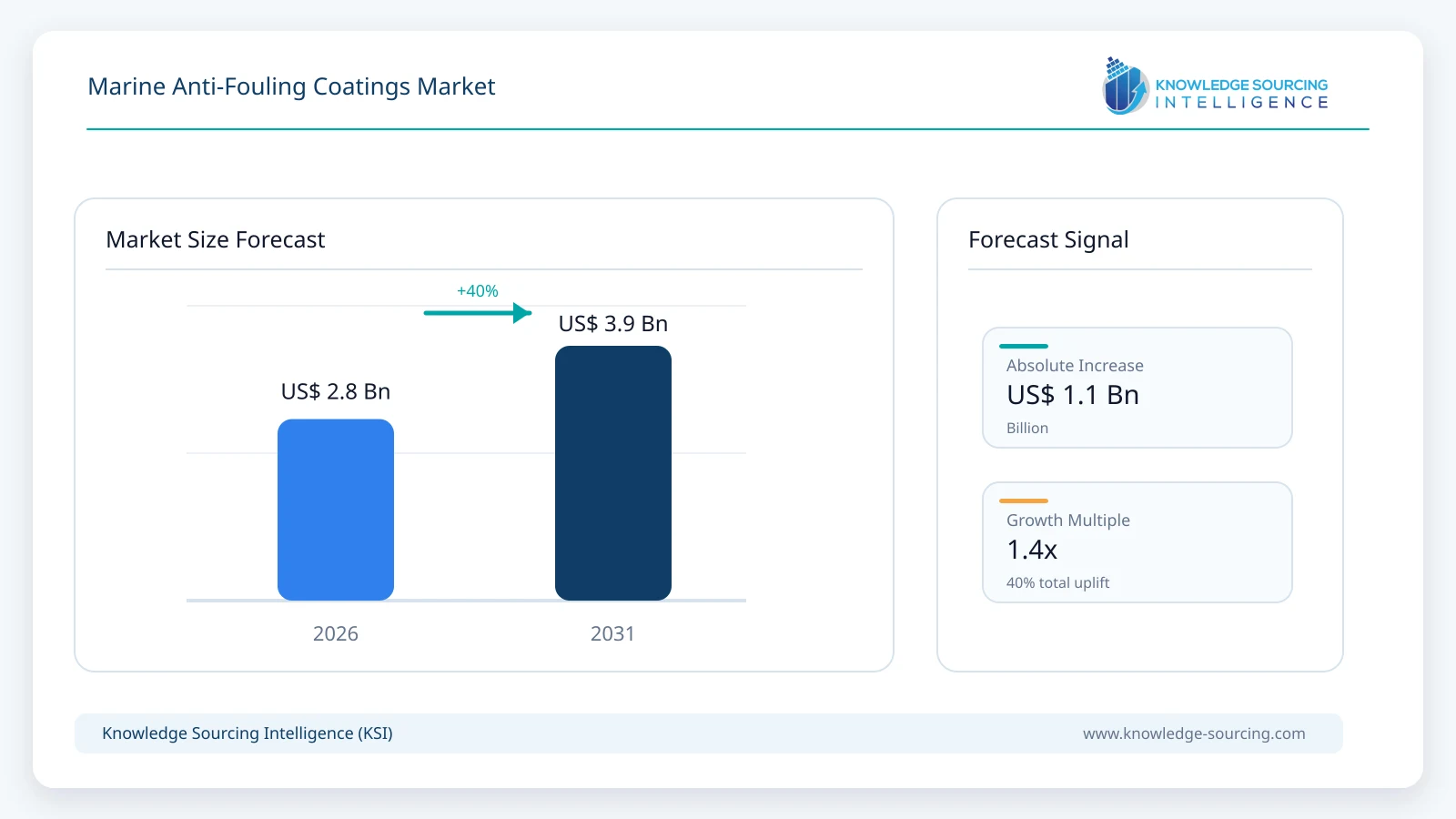
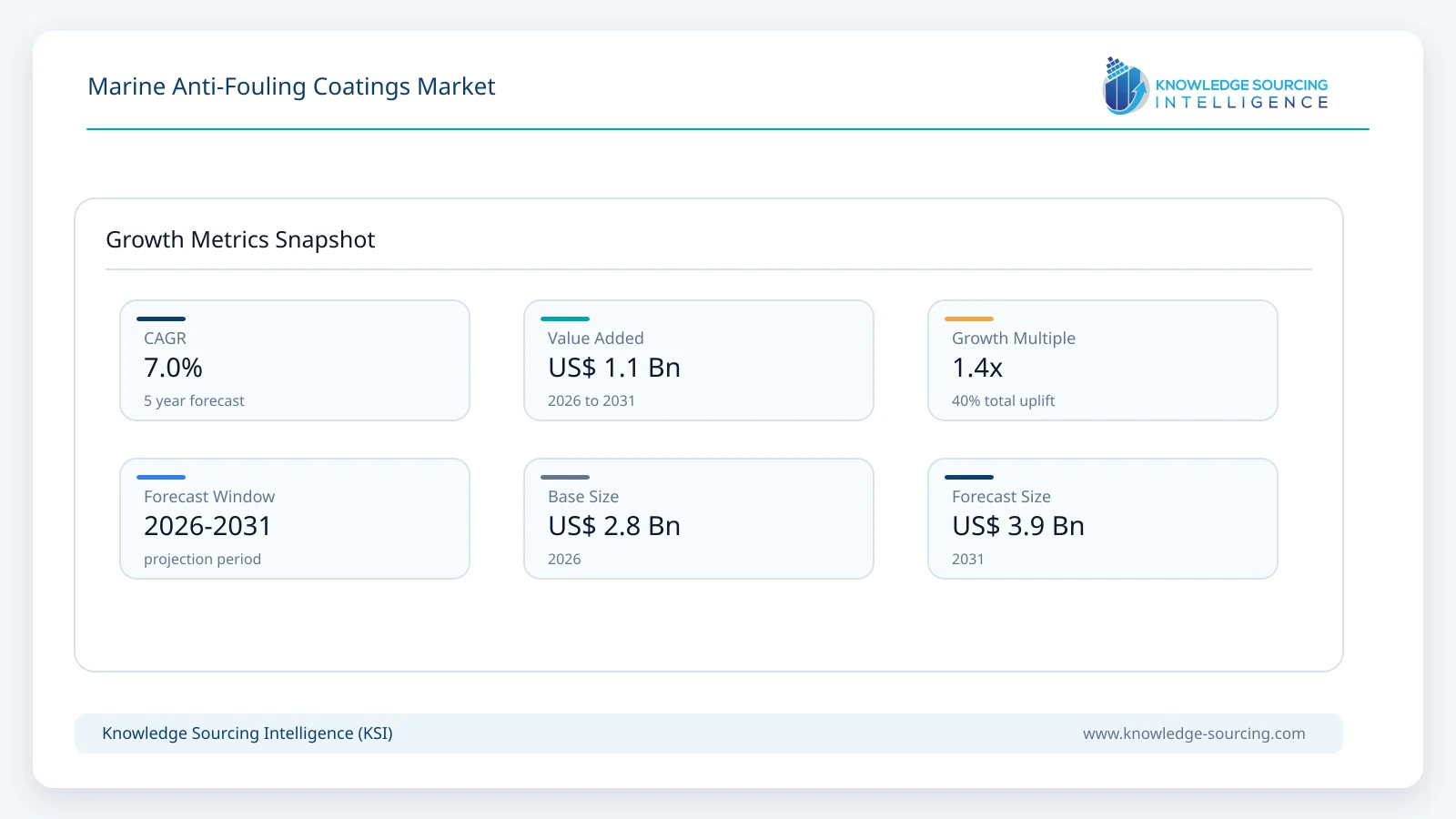
The Marine Anti-Fouling Coatings Market is forecast to grow at a CAGR of 7.0%, reaching USD 3.86 billion in 2031 from USD 2.75 billion in 2026.
Highlights:
- 1Fuel and emissions economicsFouling-control performance has become closely linked with vessel fuel efficiency, particularly as shipowners manage carbon-intensity requirements and operating-cost pressure.
- 2SPC remains commercially importantSelf-polishing copolymer systems remain a major technology class because they provide controlled surface renewal and predictable performance across different vessel operating profiles.
- 3Silicone adoption is gaining strategic importanceBiocide-free and low-friction foul-release technologies are attracting buyers seeking reduced hull resistance, longer service intervals, and lower environmental burdens.
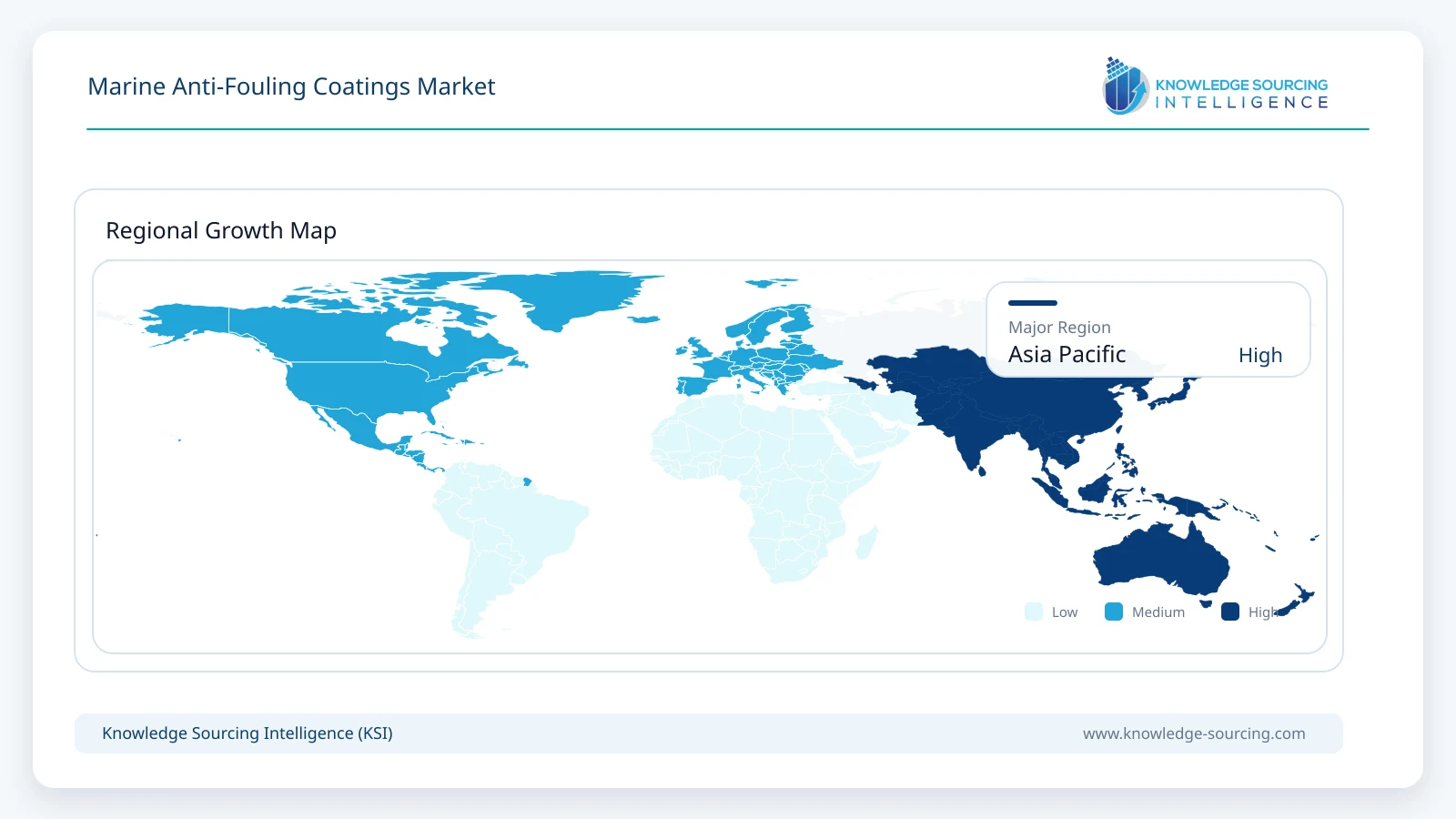
- 4Asia-Pacific is central to demandChina, Japan, South Korea, Singapore, and other Asian maritime hubs combine shipbuilding, fleet operations, dry-docking, and marine coating supply capabilities.
- 5Regulation influences formulation choicesIMO restrictions on organotin compounds and cybutryne, together with national chemical controls, constrain formulation and product registration decisions.
- 6Competition is increasingly performance-basedSuppliers differentiate through fuel-saving evidence, coating lifetime, idle-period protection, application productivity, dry-dock compatibility, regulatory compliance, and technical service.
The Marine Anti-Fouling Coatings Market covers coatings and related fouling-control systems applied to submerged vessel surfaces to prevent or reduce the attachment and accumulation of algae, barnacles, molluscs, slime, tubeworms, and other marine organisms. Commercial demand is concentrated in ocean-going and coastal vessels where hull condition directly affects hydrodynamic resistance, fuel consumption, voyage economics, maintenance schedules, and environmental performance. The market also includes coatings applied to propellers, rudders, sea chests, niche areas, and other submerged components where fouling can create operational or maintenance problems.
Anti-fouling coatings occupy an unusual position within marine procurement because the buyer is not purchasing only a protective paint. The coating becomes part of the vessel's operating-cost strategy. A shipowner or fleet manager evaluates the system against expected speed profile, trading route, idle periods, dry-docking interval, seawater temperature, fouling intensity, cleaning requirements, application conditions, and regulatory constraints. This makes product selection more technical than a conventional coating purchase.
The economic rationale begins with surface condition. IMO notes that biofouling can slow vessels and increase fuel consumption, while the severity of fouling depends on vessel design, operating profile, trading routes, water conditions, coating age, and maintenance practices. A coating that maintains a smoother underwater surface can therefore influence both direct fuel expenditure and the vessel's emissions performance.
The buyer base is broad but concentrated around shipowners, ship managers, shipyards, fleet operators, naval organizations, offshore operators, and specialized marine maintenance contractors. Newbuilding projects create specification-driven demand, while the installed fleet generates recurring dry-dock demand. These two channels behave differently. Newbuilding procurement is influenced by shipyard schedules, coating application windows, specification agreements, and lifetime operating economics. Dry-dock procurement is more strongly influenced by vessel history, coating condition, docking interval, route, previous performance, and owner experience.
The industry is also moving beyond a simple distinction between conventional biocidal antifouling and silicone foul-release technology. Product development increasingly addresses the complete relationship between fouling, surface smoothness, fuel consumption, emissions, idle periods, cleaning, and environmental compliance. PPG, for example, currently markets both biocide-free silicone foul-release technologies and copper-free, low-friction antifouling systems. Nippon Marine Paint similarly offers biocide-free self-polishing and advanced fouling-control technologies.
Market Drivers
Fuel Efficiency and Vessel Operating Economics
The most direct commercial driver is the relationship between underwater hull condition and vessel energy consumption. Marine fouling increases surface roughness and resistance, forcing propulsion systems to consume more energy to maintain a given speed. IMO explicitly recognizes the connection between hull cleanliness, fuel efficiency, and greenhouse-gas emissions.
This mechanism changes the purchasing conversation. Fleet managers increasingly evaluate anti-fouling coatings against expected lifetime operating costs rather than coating price alone. A coating that costs more per square metre can still win a specification if it reduces speed loss, delays cleaning, extends docking intervals, or lowers fuel expenditure.
Suppliers therefore increasingly present technical evidence around friction, speed loss, fuel savings, and service intervals. Jotun's current SeaQuantum Classic III documentation, for example, reports independently verified speed-loss performance and associated fuel-saving estimates based on ISO 19030 measurement methods.
The commercial implication is a gradual shift from price-per-litre purchasing toward total-cost-of-ownership evaluation. This favors suppliers capable of documenting performance under defined operating conditions rather than relying solely on generic antifouling claims.
Expansion and Renewal of the Global Commercial Fleet
New vessel construction creates a substantial specification opportunity because the coating system is selected before the vessel enters service. Newbuilding contracts allow suppliers to establish relationships with shipowners, shipyards, coating applicators, and technical managers simultaneously.
Hempel reported that its Marine segment achieved 9.8% organic sales growth in 2025 to EUR 750 million, with double-digit volume growth in both dry-dock and newbuilding activity. The company also linked performance to the global newbuilding cycle.
For coating suppliers, newbuild demand is strategically valuable because a successful specification can influence several vessels within a series. The commercial opportunity extends beyond initial application because the owner may continue with the same technology during future dry-dock cycles.
This makes shipyard access, technical approval, application support, and fleet-level relationships important competitive variables.
Regulatory Pressure on Harmful Biocides and Coating Formulations
Environmental regulation is reshaping the product mix. The IMO AFS Convention prohibits harmful organotin compounds and provides a formal mechanism for assessing and controlling additional substances. Cybutryne controls became effective in 2023, increasing the importance of compliant product inventories and documentation.
Regulatory pressure does not eliminate biocidal antifouling. Instead, it increases demand for compliant active ingredients, controlled-release systems, alternative fouling-control mechanisms, and biocide-free technologies.
This creates product-development opportunities but also raises formulation and registration costs. Suppliers must demonstrate that products satisfy applicable environmental and performance requirements across the jurisdictions in which vessels operate.
Longer Dry-Docking Intervals
Shipowners have a strong financial incentive to extend intervals between dry-dockings when this can be achieved without sacrificing hull performance. Dry-docking removes a vessel from revenue-generating service and creates costs associated with yard charges, labor, logistics, inspection, coating application, and lost operating time.
Consequently, coatings designed for long service intervals can command premium positioning. Hempel states that its Hempaguard portfolio has accumulated thousands of applications, while its Hempaguard NB technology targets newbuilding application without requiring a post-delivery dry dock.
Longer service intervals also increase the importance of application quality. A technically advanced coating cannot deliver its expected lifecycle economics if surface preparation, film thickness, curing, or application conditions are inadequate. Suppliers therefore compete through application guidance and technical service as much as formulation.
Increasing Attention to Biofouling Management
Biofouling is no longer treated solely as a coating-performance issue. It is also connected with invasive aquatic species, hull-cleaning practices, and environmental management.
The IMO's revised 2023 Biofouling Guidelines provide a more structured approach to managing fouling and recommend practices covering biofouling management plans, records, cleaning, inspection, and maintenance.
In April 2025, the IMO approved guidance on in-water cleaning of ships' biofouling. The organization specifically recognized that cleaning can damage coatings, shorten coating service life, and potentially release harmful waste substances or invasive organisms if poorly controlled.
This reinforces demand for coating systems that can tolerate appropriate cleaning regimes while maintaining their surface properties.
Market Restraints and Challenges
High Performance Expectations Increase Product Development Costs
Marine coatings operate under highly variable conditions. A system suitable for a slow-steaming tanker may not be optimal for a fast container ship, while a vessel with extended idle periods presents a different fouling challenge from a continuously operating ship.
Suppliers therefore need extensive testing across temperatures, salinity levels, speeds, idle periods, cleaning conditions, and vessel classes. This increases R&D expenditure and makes performance validation expensive.
For buyers, the consequence is a wider product-selection process. Owners increasingly need technical assessments before adopting a new coating across an entire fleet.
Environmental Restrictions Limit Formulation Flexibility
The anti-fouling function of many conventional systems depends on active ingredients that affect marine organisms. Regulatory authorities therefore scrutinize their environmental fate, toxicity, persistence, and release.
The IMO framework already controls organotin compounds and cybutryne. National and regional requirements can add further restrictions on chemical use, emissions, waste handling, and product registration.
Suppliers must consequently balance efficacy with environmental acceptability. This can increase formulation complexity and create regional differences in product availability.
Application Quality Can Determine Commercial Performance
Anti-fouling coating performance depends heavily on substrate preparation, coating compatibility, film thickness, curing, application conditions, and subsequent maintenance.
A product may have strong laboratory performance but underperform when applied incorrectly in a busy shipyard. Temperature, humidity, contamination, overcoating windows, and flooding schedules can all affect the result.
This creates a practical barrier to technology adoption. Shipowners may favor proven systems with established application procedures over technically promising products that require unfamiliar processes.
In-Water Cleaning Creates a Coating-Management Trade-Off
Cleaning can restore hull performance, but improper cleaning can damage the coating. IMO specifically identifies the potential for in-water cleaning to damage anti-fouling systems, shorten service life, and release harmful waste or invasive species.
The challenge is particularly relevant as biofouling management receives more attention. Owners need cleaning methods that preserve coating integrity while satisfying environmental requirements.
Suppliers therefore increasingly need to consider coating-cleaning compatibility when developing products and service recommendations.
Maritime Market Cyclicality
Marine coatings depend partly on shipbuilding activity, vessel utilization, and dry-docking cycles. These activities can fluctuate because of freight rates, shipyard capacity, geopolitical disruptions, trade-route changes, financing conditions, and vessel availability.
Hempel's 2024 results illustrate this exposure: the company reported postponed vessel dockings, partly associated with the Red Sea crisis, although its marine business still generated EUR 709 million in revenue that year.
Coating suppliers therefore need diversified exposure across newbuilding, dry-docking, vessel categories, and geographies to reduce dependence on a single demand channel.
Major Segment Analysis:
By Product Type
Self-Polishing Copolymer (SPC) coatings represent one of the most commercially established technology classes within marine anti-fouling. Their importance comes from the ability to maintain a controlled surface renewal mechanism as the vessel operates in seawater.
The commercial advantage of SPC systems lies in predictability. As the coating interacts with seawater, the surface gradually renews and exposes a fresh layer containing the active antifouling components. This enables suppliers to design products around specific vessel operating profiles and expected service intervals.
SPC technology remains relevant across tankers, bulk carriers, container vessels, offshore vessels, and other commercial ships because fleet managers value consistent performance across long voyages and changing operating conditions. Nippon Paint Marine describes its ECOLOFLEX range as a TBT-free SPC technology, illustrating the industry's long-standing movement toward alternatives to organotin-based systems.
The technology is also becoming more sophisticated. Nippon Paint Marine's current A-LF-Sea system combines a self-smoothing copper-silyl-acrylate copolymer with ultra-low-friction performance, linking antifouling protection with hydrodynamic efficiency.
The buyer's decision therefore depends on more than fouling resistance. Operators assess expected speed profile, docking interval, idle periods, trading route, seawater conditions, application requirements, and total fuel economics.
SPC also retains an advantage in fleet standardization. A shipowner operating many vessels can specify a recognized system across multiple classes while adjusting product grades for different speeds and service conditions. This reduces procurement complexity and supports established technical relationships with coating suppliers.
However, SPC faces growing competition from biocide-free foul-release and advanced surface technologies. The competitive issue is not simply whether SPC remains effective. Rather, suppliers must demonstrate that its lifecycle economics remain attractive when owners account for environmental requirements, fuel costs, cleaning practices, and alternative technologies.
The commercial relevance of SPC will therefore remain substantial through 2031, but its competitive position will increasingly depend on lower friction, controlled biocide release, reduced VOC content, longer service intervals, and compatibility with evolving cleaning practices.
Regional Analysis
North America
North American demand is supported by commercial shipping, naval and government vessels, offshore activity, coastal fleets, ship repair, and recreational marine applications. The United States also maintains a substantial ecosystem of marine coating suppliers, shipyards, ports, and regulatory agencies.
The U.S. regulatory environment places considerable emphasis on registered products and environmental compliance. EPA registration is relevant for antifouling products sold into the U.S. market, while IMO requirements apply to qualifying internationally trading vessels.
Product differentiation is increasingly visible around copper-free and lower-VOC systems. Sherwin-Williams, for example, markets SeaVoyage as a copper- and tin-free ablative antifoulant using organic biocide technology and lists an EPA registration number.
The regional market therefore rewards suppliers that combine regulatory documentation with application support and established distribution.
Europe
Europe remains an important market because of its large shipowning base, ship-management sector, marine equipment ecosystem, and strong environmental policy framework.
European buyers generally place substantial emphasis on lifecycle performance, emissions, chemical compliance, and documentation. This supports demand for silicone foul-release systems, advanced SPC technologies, and products with lower environmental impact.
The region is also an important technology-development center. Hempel's marine business is headquartered in Denmark, while Jotun has developed major fouling-control technologies for global use. Hempel's 2025 marine performance and product launches illustrate the commercial importance of premium coating systems in the European supplier base.
The main constraint is cost sensitivity among owners operating in competitive freight markets. Premium coatings must demonstrate measurable lifecycle value to justify higher upfront expenditure.
Asia-Pacific
Asia-Pacific is expected to remain the central demand center because it combines large shipbuilding capacity, major trading fleets, extensive dry-docking infrastructure, and concentrated marine coating production.
China, South Korea, and Japan are particularly important for newbuilding-related demand. Singapore functions as a major maritime services and repair hub, while India, Indonesia, Thailand, Taiwan, and Australia contribute through regional shipping, offshore activity, ship repair, and fleet operations.
Recent supplier activity reinforces this concentration. Hempel's first Hempaguard NB application was completed at Yangzijiang Shipyard in China on a Maersk newbuilding, demonstrating how advanced coating adoption is becoming integrated into Asian shipyard workflows.
AkzoNobel also expanded its cooperation with Winning Shipping in China, with coatings planned for multiple dry-docking projects in 2026.
Asia-Pacific therefore offers both volume and technology opportunities. The principal constraints include intense supplier competition, variable environmental conditions, price-sensitive procurement in some markets, and differences in regulatory requirements between countries.
Middle East and Africa
Demand across the Middle East and Africa is supported by tanker traffic, offshore oil and gas, port infrastructure, ship repair, coastal shipping, and maritime logistics.
The region creates demanding coating conditions because vessels can experience high seawater temperatures and heavy fouling pressure. Product selection consequently depends strongly on local water conditions and operating patterns.
Offshore support vessels and energy-related marine assets can create attractive specialist opportunities because downtime carries a high economic cost. However, demand can be uneven because marine coating expenditure is closely linked with offshore investment cycles, shipyard availability, and energy-sector activity.
South America
South American demand is centered on Brazil, Argentina, and regional maritime activity. Brazil is particularly relevant because of offshore oil and gas operations, tanker activity, support vessels, ship repair, and associated marine infrastructure.
The region's warmer waters can increase fouling pressure, making effective underwater protection commercially important. Buyers also evaluate coating systems based on availability, technical support, dry-dock access, and compatibility with local application capabilities.
Cost sensitivity remains an important constraint. Suppliers with local technical service and reliable product availability can therefore have an advantage over vendors that compete primarily through technology claims without regional support.
Competitive Landscape
The competitive structure includes global coatings companies, specialist marine coating suppliers, and companies providing formulation ingredients and antifouling technologies. The supplied competitive set comprises PPG Industries, Inc., Hempel A/S, AkzoNobel N.V., Jotun A/S, Nippon Paint Marine Coatings Co., Ltd., Kansai Paint Co., Ltd., The Sherwin-Williams Company, Chugoku Marine Paints, Ltd., Transocean Coatings, and LANXESS AG.
Competition is increasingly based on a combination of coating performance, technical service, application productivity, regulatory compliance, global availability, and documented operating economics.
Hempel and Jotun have strong positions in silicone and self-polishing technologies, while AkzoNobel's International portfolio spans both foul-release and biocidal antifouling technologies. AkzoNobel's current product documentation shows continued development around fouling-control performance and regulatory compliance.
Nippon Paint Marine competes through SPC, low-friction, nanotechnology, and biocide-free technologies. Its AQUATERRAS range demonstrates the strategic direction toward surface-based fouling control rather than relying exclusively on conventional biocide release.
Kansai Paint combines antifouling chemistry with service profiling and global marine partnerships. Its marine business states that fouling varies according to vessel type, size, cruising speed, route, seawater temperature, and port conditions, supporting more customized coating selection.
PPG competes through antifouling and foul-release systems, including biocide-free silicone and copper-free technologies. Sherwin-Williams maintains both ablative and copper-free antifouling products for different vessel and regulatory requirements.
Transocean Coatings differentiates its portfolio through tin-free and cybutryne-free systems spanning traditional ablative, silyl-acrylate self-polishing, and silicone foul-release technologies.
LANXESS participates further upstream through marine antifouling biocide technologies, supplying active ingredients used in formulations. Its portfolio includes SEA-NINE 211N, positioned for commercial vessels, naval vessels, superyachts, buoys, and offshore structures.
The competitive model consequently favors suppliers that can connect chemistry, application, technical monitoring, regulatory compliance, and vessel-level performance data. Fleet relationships and shipyard specifications remain difficult-to-replicate advantages because successful coating selection often leads to repeat procurement across vessel series and docking cycles.
Recent Developments
August 2026: Jotun and MSC expanded their partnership with Hull Skating Solutions on MSC Daniela, combining SeaQuantum Skate antifouling coating with robotic hull inspection and cleaning.
July 2026: PPG’s SIGMAGLIDE 2390 biocide-free silicone fouling-release coating received the 2026 Green Chemistry Challenge Award from the American Chemical Society.
June 2026: Jotun COSCO Marine Coatings signed an agreement with COSCO SHIPPING Bulk covering 125 newbuilding bulk carriers equipped with high-performance antifouling coating systems.
February 2026: Hempel confirmed successful applications of Hempaguard NB on Maersk's newbuilding vessels at Yangzijiang Shipyard in China, demonstrating integration of advanced silicone coating application into newbuilding workflows without affecting launch schedules.
Regulatory and Policy Environment
The principal international regulatory instrument is the International Convention on the Control of Harmful Anti-Fouling Systems on Ships, adopted by IMO in 2001 and entering into force in 2008. The convention prohibits harmful organotin compounds and provides a mechanism for adding controls on other substances.
For vessels of 400 gross tonnage and above engaged in international voyages, IMO requirements include an International Anti-Fouling System Certificate. Smaller qualifying vessels of at least 24 metres in length have associated declaration and documentation requirements.
Cybutryne is an important recent regulatory example. Following MEPC adoption of relevant amendments in 2021, controls entered into force on 1 January 2023. Vessels cannot apply or reapply affected systems, while removal or sealing requirements apply under specified circumstances and timelines.
The IMO also adopted revised guidelines for controlling and managing ship biofouling in 2023. Unlike the AFS Convention, these guidelines address the transfer of invasive aquatic species and remain voluntary. They nevertheless influence ship-management practices, coating selection, inspection, cleaning, and documentation.
In January 2025, IMO's PPR Sub-Committee advanced guidance on in-water cleaning, including considerations for environmental risks and potential coating damage. The guidance was subsequently approved by MEPC in April 2025.
For manufacturers, the regulatory environment has three commercial consequences. First, formulations containing controlled substances require replacement or reformulation. Second, product documentation and certification become part of the sales proposition. Third, coating manufacturers must consider the downstream environmental effects of cleaning and coating removal.
Regulatory requirements also encourage differentiation through biocide-free technologies. However, biocide-free products must still demonstrate adequate fouling control under actual operating conditions. Consequently, environmental credentials alone are insufficient for large commercial fleets; buyers continue to prioritize measurable operational performance.
Outlook and Strategic Implications
The 2026–2031 market outlook will be shaped by the economics of vessel efficiency rather than coating consumption alone. Shipowners are under pressure to control fuel expenditure, manage carbon intensity, reduce unnecessary dry-docking, and maintain vessel availability. Anti-fouling coatings directly interact with each of these objectives.
Investment priorities will favor performance validation. Suppliers are likely to devote more resources to hydrodynamic testing, field monitoring, surface chemistry, application systems, and coating-cleaning compatibility. Product claims supported by actual vessel data should carry greater weight in fleet procurement.
Silicone and other low-friction technologies will receive continued attention. Hempel's newbuilding-focused silicone system, AkzoNobel's foul-release technologies, and Nippon Paint Marine's biocide-free surface technologies demonstrate that suppliers are competing beyond conventional antifouling mechanisms.
SPC will remain important rather than disappear. Its established application base, predictable self-polishing behavior, and suitability for commercial vessels give it a durable position. Future competition will focus on lower friction, reduced biocide loading, extended docking intervals, and better environmental profiles.
Procurement will become more vessel-specific. Coating specifications are likely to incorporate vessel speed, trading route, idle periods, seawater conditions, dry-docking schedule, cleaning regime, and historical hull-performance data. A single coating specification across every vessel in a fleet may become less attractive where operational profiles differ substantially.
Shipyard integration will become strategically important. Hempel's Hempaguard NB application on Maersk newbuildings demonstrates the commercial value of adapting advanced coating systems to shipyard construction processes. Suppliers that can reduce application complexity without disrupting vessel schedules gain an advantage in newbuilding specifications.
Environmental compliance will remain a continuing product-development constraint. The AFS Convention and restrictions such as cybutryne demonstrate that formulation requirements can change over the life of a coating system. Suppliers therefore need regulatory monitoring, alternative chemistry pipelines, and strong documentation capabilities.
In-water cleaning will become more closely connected with coating selection. The 2025 IMO guidance makes it increasingly important to evaluate how coatings behave when cleaned and what materials may be released. This creates opportunities for coatings designed around controlled cleaning, inspection, and maintenance programs.
Regional competition will remain uneven. Asia-Pacific should remain central because shipbuilding, dry-docking, and maritime trade are heavily concentrated there. Europe should retain importance in premium technology and sustainability-led procurement, while North America remains relevant through commercial, government, offshore, and regulatory-driven demand.
For suppliers, the strongest strategic opportunity lies in selling measurable vessel performance rather than paint volume. Product portfolios that combine fouling protection, low friction, long service intervals, regulatory compliance, and documented fuel or emissions benefits should command greater attention from technically sophisticated fleet buyers.
The principal risk is that performance claims become commoditized while environmental requirements become more demanding. Suppliers unable to substantiate lifecycle benefits may face pricing pressure, while companies dependent on restricted active ingredients could face higher reformulation costs.
The market should therefore be viewed as a technology-and-service business embedded within marine asset management. Coating chemistry remains fundamental, but competitive differentiation increasingly depends on how effectively suppliers connect formulation science with vessel operating economics, shipyard application, dry-dock planning, regulatory compliance, and measurable hull performance.
Marine Anti-Fouling Coatings Market Scope
| Report Metric | Details |
|---|---|
| Total Market Size in 2026 | USD 2.75 billion |
| Total Market Size in 2031 | USD 3.86 billion |
| Forecast Unit | Billion |
| Growth Rate | 7.0% |
| Study Period | 2021 to 2031 |
| Historical Data | 2021 to 2024 |
| Base Year | 2025 |
| Forecast Period | 2026 – 2031 |
| Segmentation | Coating Chemistry/Resin Type, Product Type, Vessel Type, Application, Geography |
| Companies |
|
Market Segmentation
By Coating Chemistry/resin Type
By Product Type
By Vessel Type
By Application
By Geography
Table of Contents
1. EXECUTIVE SUMMARY
2. MARKET SNAPSHOT
2.1. Market Overview
2.2. Market Definition
2.3. Scope of the Study
2.4. Market Segmentation
3. BUSINESS LANDSCAPE
3.1. Market Drivers
3.2. Market Restraints
3.3. Market Opportunities
3.4. Porter’s Five Forces Analysis
3.5. Industry Value Chain Analysis
3.6. Policies, Regulations, and Environmental Standards
3.7. Strategic Recommendations
4. TECHNOLOGICAL OUTLOOK
5. MARINE ANTI-FOULING COATINGS MARKET BY COATING CHEMISTRY/RESIN TYPE
5.1. Introduction
5.2. Acrylic/Silyl Acrylate
5.3. Silicone
5.4. Rosin-Based
5.5. Polyurethane
5.6. Epoxy
5.7. Others
6. MARINE ANTI-FOULING COATINGS MARKET BY PRODUCT TYPE
6.1. Introduction
6.2. Self-Polishing Copolymer (SPC)
6.3. Controlled Depletion Polymer (CDP)
6.4. Foul-Release Coatings
6.5. Ablative/Hydration-Based Coatings
6.6. Others
7. MARINE ANTI-FOULING COATINGS MARKET BY VESSEL TYPE
7.1. Introduction
7.2. Bulk Carriers
7.3. Container Ships
7.4. Tankers
7.5. Cruise/Passenger Ships
7.6. Offshore Support Vessels
7.7. General Cargo Ships
7.8. Others
8. MARINE ANTI-FOULING COATINGS MARKET BY APPLICATION
8.1. Introduction
8.2. Hull
8.3. Propellers
8.4. Rudders
8.5. Sea Chests and Niche Areas
8.6. Other Submerged Components
9. MARINE ANTI-FOULING COATINGS MARKET BY GEOGRAPHY
9.1. Introduction
9.2. North America
9.2.1. By Coating Chemistry/Resin Type
9.2.2. By Product Type
9.2.3. By Vessel Type
9.2.4. By Application
9.2.5. By Country
9.2.5.1. USA
9.2.5.2. Canada
9.2.5.3. Mexico
9.3. South America
9.3.1. By Coating Chemistry/Resin Type
9.3.2. By Product Type
9.3.3. By Vessel Type
9.3.4. By Application
9.3.5. By Country
9.3.5.1. Brazil
9.3.5.2. Argentina
9.3.5.3. Others
9.4. Europe
9.4.1. By Coating Chemistry/Resin Type
9.4.2. By Product Type
9.4.3. By Vessel Type
9.4.4. By Application
9.4.5. By Country
9.4.5.1. Germany
9.4.5.2. France
9.4.5.3. United Kingdom
9.4.5.4. Spain
9.4.5.5. Others
9.5. Middle East and Africa
9.5.1. By Coating Chemistry/Resin Type
9.5.2. By Product Type
9.5.3. By Vessel Type
9.5.4. By Application
9.5.5. By Country
9.5.5.1. Saudi Arabia
9.5.5.2. UAE
9.5.5.3. Israel
9.5.5.4. Others
9.6. Asia-Pacific
9.6.1. By Coating Chemistry/Resin Type
9.6.2. By Product Type
9.6.3. By Vessel Type
9.6.4. By Application
9.6.5. By Country
9.6.5.1. China
9.6.5.2. India
9.6.5.3. Japan
9.6.5.4. South Korea
9.6.5.5. Indonesia
9.6.5.6. Thailand
9.6.5.7. Taiwan
9.6.5.8. Singapore
9.6.5.9. Australia
9.6.5.10. Others
10. COMPETITIVE ENVIRONMENT AND ANALYSIS
10.1. Major Players and Strategy Analysis
10.2. Competitive Positioning and Market Share Analysis
10.3. Mergers, Acquisitions, Agreements, and Collaborations
10.4. Recent Developments
10.5. Competitive Dashboard
11. COMPANY PROFILES
11.1. PPG Industries, Inc.
11.2. Hempel A/S
11.3. AkzoNobel N.V.
11.4. Jotun A/S
11.5. Nippon Paint Marine Coatings Co., Ltd.
11.6. Kansai Paint Co., Ltd.
11.7. The Sherwin-Williams Company
11.8. Chugoku Marine Paints, Ltd.
11.9. Transocean Coatings
11.10. LANXESS AG
12. APPENDIX
12.1. Currency
12.2. Assumptions
12.3. Base and Forecast Years Timeline
12.4. Key Benefits for Stakeholders
12.5. Research Methodology
12.6. Abbreviations
LIST OF FIGURES
LIST OF TABLES
Navigate
Trusted by the world's leading organizations











