AI, or artificial intelligence, is a fast-expanding area at the confluence of computer science, mathematics, and engineering that tries to construct computers or systems capable of doing activities that normally require human intelligence. These activities include a wide range of abilities, from pro...

Top Two Countries Investing In Artificial Intelligence In 2022, In Billion
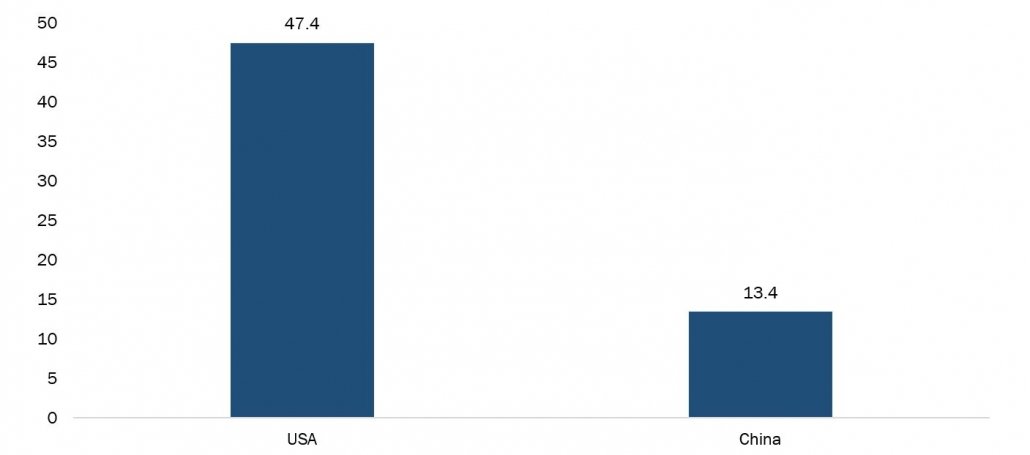 According to the Artificial Intelligence Index Report 2023, the USA and China were the highest investors investing in the development and usage of AI in the coming years. In 2022, the USA invested US$47.4 billion in AI enhancement and China invested US$13.4 billion in enhancing AI. Hence such increasing investment by countries can be one of the reasons pushing the market growth for AI and aiding the growth of artificial intelligence (AI) in the projected period.
Artificial Intelligence Applications in E-commerce.
E-commerce has been one of the industries utilizing AI for a considerable amount of time. AI and ML use cases in e-commerce are exciting and have the potential to revolutionize online shopping. Businesses can use artificial intelligence (AI) to discover e-commerce predictive analytics, offer smart website searches using images, and give their customers more personalized product recommendations. Additional applications of artificial intelligence in business contexts include demand forecasting, which increases sales efficiency through better forecasts, appropriate scheduling of human resources, decreased overstocking risks, and useful market insights.
Artificial Intelligence Applications in Manufacturing Industry
With its transformational qualities, artificial intelligence is transforming the manufacturing industry. Manufacturing companies are harnessing the potential of AI to improve efficiency, accuracy, and production across a variety of operations. Artificial intelligence in manufacturing has a wide range of applications, including predictive maintenance, supply chain optimization, quality control, and demand forecasting. In the manufacturing business, supply chain management is critical, and artificial intelligence has emerged as a game changer in this field. Companies are transforming their supply chain operations and realizing major gains in efficiency, accuracy, and cost-effectiveness by using the potential of AI and ML in manufacturing. Artificial intelligence is also transforming the industrial warehouse management business. The introduction of AI-powered industrial solutions and machine learning in manufacturing has altered warehouse operations, resulting in increased productivity, accuracy, and cost savings.
Artificial Intelligence Application in the Retail Industry
For many years, the retail industry has been undergoing digital transformation. It has increased speed, efficiency, and accuracy across all retail channels, attributed in large part to enhanced data and predictive analytics tools that support firms in making data-driven business decisions. None of these findings would be possible without the Internet of Things (IoT), and in particular without artificial intelligence. AI in retail has provided businesses with access to high-level data and information, which can be used to enhance retail operations and create new business prospects. AI services in retail are expected to grow from $5 billion to more than $31 billion by 2028. AI in retail is improving demand forecasting. AI business intelligence systems anticipate industry moves and make proactive modifications to a company's advertising, merchandising, and business plans by extracting insights from marketplace, customer, and competitor data. This has an impact on supply chain planning as well as pricing and promotional activities.
Artificial Intelligence Application in the Construction Industry
The worldwide industry is being transformed by artificial intelligence. Construction, being one of the least digitalized industries in the world, stands to profit greatly from AI adoption. AI in construction may help firms increase productivity, improve quality, boost performance, and improve site safety. It makes building one of the world's major industries. AI and machine learning technologies are transforming the construction industry at every level, from design to operations and asset management. This technical progress is resulting in considerable time and cost-effectiveness benefits, notably in the planning and design sub-segment. AI in construction management improves the safety, speed, accuracy, and efficiency of activities. Companies may use AI construction solutions to proactively monitor job sites for possible dangers and handle crucial issues to avoid accidents. In the building industry, machine learning can evaluate massive amounts of data to improve designs for energy efficiency and cost savings.
According to the Artificial Intelligence Index Report 2023, the USA and China were the highest investors investing in the development and usage of AI in the coming years. In 2022, the USA invested US$47.4 billion in AI enhancement and China invested US$13.4 billion in enhancing AI. Hence such increasing investment by countries can be one of the reasons pushing the market growth for AI and aiding the growth of artificial intelligence (AI) in the projected period.
Artificial Intelligence Applications in E-commerce.
E-commerce has been one of the industries utilizing AI for a considerable amount of time. AI and ML use cases in e-commerce are exciting and have the potential to revolutionize online shopping. Businesses can use artificial intelligence (AI) to discover e-commerce predictive analytics, offer smart website searches using images, and give their customers more personalized product recommendations. Additional applications of artificial intelligence in business contexts include demand forecasting, which increases sales efficiency through better forecasts, appropriate scheduling of human resources, decreased overstocking risks, and useful market insights.
Artificial Intelligence Applications in Manufacturing Industry
With its transformational qualities, artificial intelligence is transforming the manufacturing industry. Manufacturing companies are harnessing the potential of AI to improve efficiency, accuracy, and production across a variety of operations. Artificial intelligence in manufacturing has a wide range of applications, including predictive maintenance, supply chain optimization, quality control, and demand forecasting. In the manufacturing business, supply chain management is critical, and artificial intelligence has emerged as a game changer in this field. Companies are transforming their supply chain operations and realizing major gains in efficiency, accuracy, and cost-effectiveness by using the potential of AI and ML in manufacturing. Artificial intelligence is also transforming the industrial warehouse management business. The introduction of AI-powered industrial solutions and machine learning in manufacturing has altered warehouse operations, resulting in increased productivity, accuracy, and cost savings.
Artificial Intelligence Application in the Retail Industry
For many years, the retail industry has been undergoing digital transformation. It has increased speed, efficiency, and accuracy across all retail channels, attributed in large part to enhanced data and predictive analytics tools that support firms in making data-driven business decisions. None of these findings would be possible without the Internet of Things (IoT), and in particular without artificial intelligence. AI in retail has provided businesses with access to high-level data and information, which can be used to enhance retail operations and create new business prospects. AI services in retail are expected to grow from $5 billion to more than $31 billion by 2028. AI in retail is improving demand forecasting. AI business intelligence systems anticipate industry moves and make proactive modifications to a company's advertising, merchandising, and business plans by extracting insights from marketplace, customer, and competitor data. This has an impact on supply chain planning as well as pricing and promotional activities.
Artificial Intelligence Application in the Construction Industry
The worldwide industry is being transformed by artificial intelligence. Construction, being one of the least digitalized industries in the world, stands to profit greatly from AI adoption. AI in construction may help firms increase productivity, improve quality, boost performance, and improve site safety. It makes building one of the world's major industries. AI and machine learning technologies are transforming the construction industry at every level, from design to operations and asset management. This technical progress is resulting in considerable time and cost-effectiveness benefits, notably in the planning and design sub-segment. AI in construction management improves the safety, speed, accuracy, and efficiency of activities. Companies may use AI construction solutions to proactively monitor job sites for possible dangers and handle crucial issues to avoid accidents. In the building industry, machine learning can evaluate massive amounts of data to improve designs for energy efficiency and cost savings.Need specialized data cuts or competitive intelligence?
Our analyst team provides bespoke market sizing, supplier audits, and country-level feasibility reports tailored to your enterprise roadmap.
Speak With an Industry Analyst →Ask an Industry Analyst
Have questions regarding this briefing or market projections? Inquire with our sector lead.
Related Thought Articles
View All →
From Highways to Cities: How Top Companies Are Expanding EV Charging Across India
Aug 20, 2026
How AI Is Revolutionizing EV Range Prediction in India
Aug 19, 2026
Make in India and the Rise of Local EV Motor Controller Manufacturing
Aug 18, 2026
Why EV Conversion Kits Are Becoming a New Manufacturing Opportunity in India
Aug 17, 2026
How Advanced Power Electronics Are Reshaping India’s EV Powertrain Market
Aug 14, 2026More Thought Articles
Why Electric Recreational Vehicles Could Become India’s Next Mobility Opportunity
India’s electric recreational vehicle opportunity is likely to emerge through commercial tourism applications rather than mass private ownership. Growing domestic tourism, caravan policies, expanding EV supply chains, destination charging, and modular campervan designs could enable rental fleets, resorts, eco-tourism operators, and travel companies to test high-utilisation models before consumer adoption.
Can Battery Recycling Make India’s EV Growth More Sustainable?
India’s EV battery recycling ecosystem is moving from waste management toward critical-mineral security. Battery Waste Management Rules, EPR obligations, recycled-content requirements, recycling incentives and EU-India cooperation are strengthening the framework. However, limited near-term feedstock, fragmented collection, underused capacity, chemistry differences and domestic refining gaps remain key challenges to scale sustainably.
EV Tires Are Changing Fast: What India’s Electric Mobility Boom Means for Tire Makers
India’s electric mobility growth is reshaping tire engineering, with EVs creating new requirements for rolling resistance, durability, noise, torque handling, load capacity and efficiency. Electric two-wheelers and three-wheelers offer major volume opportunities, while passenger EVs drive premium innovation. Tire makers are increasingly focusing on localized testing, OE partnerships and application-specific technologies.