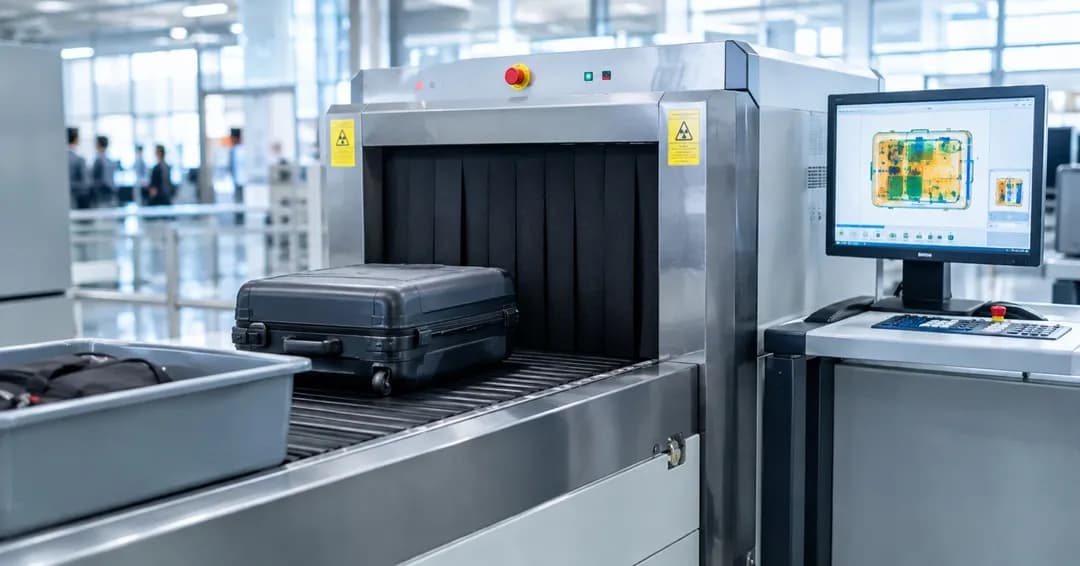
X-ray inspection technology is advancing through higher-resolution 3D imaging, intelligent material identification, and faster inline inspection. Recent launches from Rigaku, 3DX-RAY, and Eagle Product Inspection demonstrate expanding applications across electronics, batteries, food production, security, and manufacturing, supporting more detailed defect detection, quality control, and non-destructive inspection.
Many of the world's leading manufacturers of X-ray inspection & screening technologies are introducing newer systems, indicating a paradigm shift in the state-of-the-art capabilities for assisting customers with optimized, higher-resolution imaging, 3D non-destructive inspection, intelligent material identification, and applications across manufacturing, food, defense, and security environments.
Rigaku CT Lab HR160 High-Resolution 3D Inspection. On 1 September 2026, Rigaku launches its advanced high-resolution 3D X-ray inspection capability with its new CT Lab HR160, which gives companies the power to accurately assess microelectronic components down to 2.9 µm and larger components at a higher resolution. Rigaku introduced the system, developed in collaboration with Excillum, for battery, semiconductor, electronic, mechanical component, and advanced-material analysis. The system is capable of up to 160 kV operation with true 250 nm spatial resolution for non-destructive 3D internal high-resolution imaging, even down to defects.
Using cone-beam geometry, the field of view and resolution can be accommodated in the CT Lab HR160 without changing the X-ray source/detector. It focuses on the use of solid-state batteries, semiconductor devices, multilayer ceramic capacitors, and power electronics, in addition to research support, quality evaluation, and mechanical reliability for failure analysis where rapidly evolving and complex internal structures require high-resolution inspection.
3DX-RAY grows security X-ray inspection with AXIS CXi deployed in Lithuania. 3DX-RAY is driving advances in X-ray screening with the installation of its AXIS CXi system at a Lithuanian government sitein June 2026. The system can offer colour imaging that enables operators to identify organic, metallic and inorganic materials, along with greyscale imaging for shape identification. Performance characteristics studied include detection/resolution, penetration, and identification of advanced mail, including other materials simulating the UK Mail Screening Test Piece.
Integrating a large inspection chamber with a compact, fully mobile design, the AXIS CXi is capable of inspecting mail, parcels, bags and even aircraft cabin luggage in high security environments including government offices, corporate facilities and financial institutions.
Eagle product inspection reinforces high-speed food inspection with Pack 1000 PRO. Eagle Product Inspection is evolvng food inspection into the automated arena with the Pack 1000 PRO X-ray inspection system for secondary packaging. Launched on 1 July,2026 the system is suited for medium boxes, cases, and mixed-case applications with a 1,000 mm inspection width and image acquisition speed up to 76 m/min.
The device is equipped to do inline checks on mass measurement, package integrity, broken-product detection, and component counting while supporting mixed-case and multilane inspection. This illustrates the way X-ray inspection is finding its place in high-speed food production and packaging lines, rather than merely as stand-alone contaminant detectors.
Market Impact of These Developments
All three developments are signs of the X-ray inspection systems industry evolving into a higher-resolution imaging environment involving 3D non-destructive inspection, intelligent material identification, faster inline quality control, and wider inspections across industrial and security applications that also see inspection technologies being further integrated into manufacturing and screening workflows.
The effects that these advancements have on the market is listed below:
This technology for 3D X-ray inspection is becoming more valuable with manufacturers demanding to see internal structures and defects because it visualizes the part details without breaking components apart.
Digital and intelligent imaging capabilities are increasing, allowing better detection of materials, contaminants, and contraband.
High-speed X-ray systems are combining contaminant detection with quality and packaging checks, pushing food inspection even closer to the production line.
Mobile and compact X-ray systems expanded into mail, parcel, baggage, and government-facility screening are increasing security applications widen the addressable market.
Global X-Ray Inspection Systems Market Outlook
These developments is part of the Global X-Ray Inspection Systems Market report of the Knowledge Sourcing Intelligence (KSI). According to the KSI research report, the Global X-ray Inspection Systems Market is projected to grow from USD 1.47 billion in 2026 to USD 1.98 billion in 2031, at a CAGR of around 6.1%.
KSI Global X-Ray Inspection Systems Market is a deep analysis report by product type, technology, industry vertical, and geography that delivers a compelling vision of how advanced imaging, computed tomography, food safety requirements, manufacturing quality control, and security screening are driving market growth.
Market Segmentation
Segment | Sub-Segments |
|---|---|
Type | 2D X-Ray Inspection Systems, 3D X-Ray Inspection Systems |
Technology | Digital Radiography, Computed Tomography, Computed Radiography, Film-Based Radiography |
Industry Vertical | Food and Beverage, Electronics and Semiconductor, Automotive and Electric Vehicles, Aerospace and Defense, Pharmaceuticals and Medical Devices, General Manufacturing, Others |
Geography | North America, South America, Europe, Middle East and Africa, Asia Pacific |
High-resolution internal inspection enables 3D X-Ray Inspection Systems to gain momentum
This segment of the 3D X-ray inspection system is significant due to the compact nature of 3D data collection, which manufacturers are increasingly using in order to allow non-destructive visualization of complex internal structures. An example of this development is offered by Rigaku's CT Lab HR160, which delivers 250 nm spatial resolution in actual use while also allowing the user to specify field-of-view and resolution for batteries, semiconductor devices, electronic components, and novel materials.
High-Speed X-Ray Inspection Continues to Grow in the Food Industry
The high-speed X-ray inspection is gradually being adopted in the food processing segment for contamination detection while mass-checking, package integrity assessment, broken product analysis, and counting components during production and packaging.
X-Ray Inspection Systems Market Key Players
Mettler-Toledo International Inc.
Anritsu Corporation
Ishida Co., Ltd.
Minebea Intec GmbH
Sesotec GmbH
Thermo Fisher Scientific Inc.
Nikon Corporation (Nikon Metrology)
Comet Holding AG (Comet Yxlon)
Carl Zeiss AG (ZEISS Industrial Quality Solutions)
Nordson Corporation (Nordson Test & Inspection)
VisiConsult X-ray Systems & Solutions GmbH
Illinois Tool Works Inc.
Shimadzu Corporation
GÖPEL electronic GmbH
VJ Technologies, Inc.
Hitachi High-Tech Corporation
Explore More Reports:
Have questions?
More Press Releases
How Abbott’s Libre Duo Launch Could Impact the Continuous Glucose Monitoring (CGM) Market, Expected to Reach USD 19.4 Billion by 2031
Abbott’s Libre Duo 10 Day Continuous Dual Glucose Ketone Monitoring System represents a significant development in the continuous glucose monitoring (CGM) market by combining glucose and ketone monitoring within a single wearable device. In August 2026, the U.S. Food and Drug Administration (FDA) authorized Libre Duo for people aged 2 years and older living with diabetes, making it the first wearable device in the U.S. to continuously monitor ketone levels and the first globally to continuously monitor both glucose and ketones in one device. The system measures glucose and ketones every minute for up to 10 days and can transmit readings wirelessly to a compatible smartphone.
Voith and Jungheinrich’s Recent Automation and Electrification Developments Will Affect the Material Handling Market, Estimated to Reach USD 328.6 Billion by 2031
Material handling is advancing through electrification, automation, and digitally enabled operations. Voith’s PowerDrive Mining, Jungheinrich’s ETV 4i reach truck, and Reitar Logtech’s cooperation with Cainiao highlight developments in conveyor systems, warehouse productivity, and logistics infrastructure, supporting higher throughput, operational efficiency, integrated controls, and technology-driven material movement across industries.
How LG's Next Evolution of AI Home at IFA 2026 Will Impact the Smart Homes Market, Expected to Reach USD 376.8 Billion by 2031
At IFA 2026, LG Electronics announced the next generation of its AI Home, ThinQ Claw, a text-chat AI agent that can comprehend user intent and context to orchestrate appliances and connected services, among other enhancements for its Homey-powered ecosystem and the launch of ThinQ Pro in Europe. The announcement comes as a reinforcement of the trend towards the agentic AI in residential ecosystems outlined in a new report by Knowledge Sourcing Intelligence, which forecasts the global smart home market size at USD 167.5 billion by 2026, rising to USD 376.8 billion by 2031.