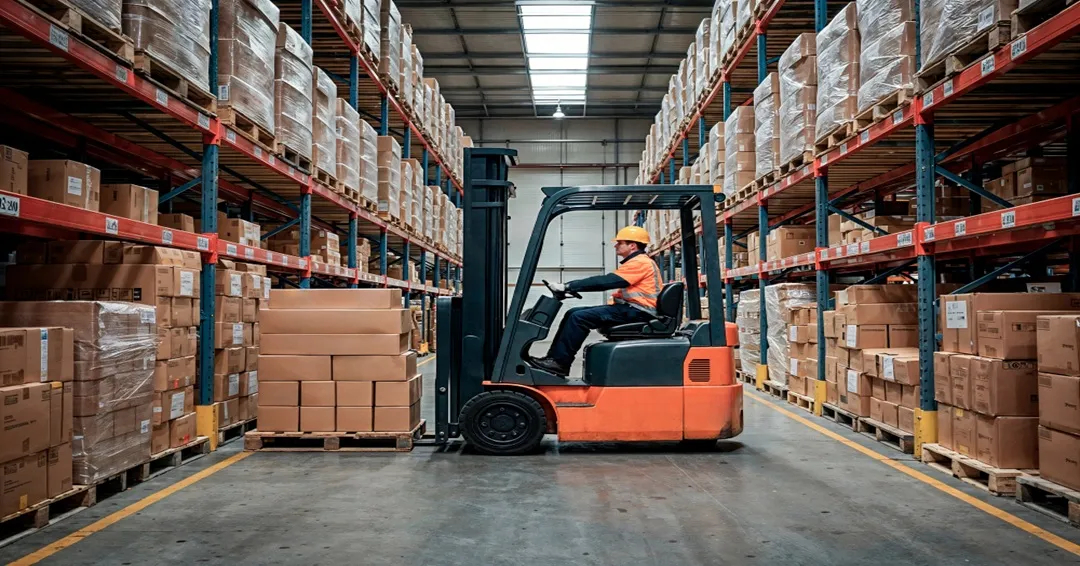
Material handling is advancing through electrification, automation, and digitally enabled operations. Voith’s PowerDrive Mining, Jungheinrich’s ETV 4i reach truck, and Reitar Logtech’s cooperation with Cainiao highlight developments in conveyor systems, warehouse productivity, and logistics infrastructure, supporting higher throughput, operational efficiency, integrated controls, and technology-driven material movement across industries.
Several top players in material handling and logistics technology are launching new solutions that signal a significant shift in the industry towards electrification, higher productivity in warehouses, automated material movement, more integrated logistics infrastructure, and digitally enabled handling operations.
Voith is pushing electrified conveyor systems to the next level with its PowerDrive Mining, a new system for high-end bulk-material handling applications. Voith introduced PowerDrive Mining, which is a fully integrated electric drive system for belt conveyors, on September 7th 2026, at Electra Mining Africa 2026 in Johannesburg. It is integrated with BeltControl, the special controller that drives, brakes, and backstops the entire system for smooth start-up and synchronised multi-drive system-controlled operation.
PowerDrive Mining is delivered as an assembled and factory-tested package to decrease engineering requirements and speed up installation and commissioning. The compact design is also designed to facilitate retrofits in space-constrained conveyor galleries, while remote diagnostics and integrated safety features promote uptime and serviceability in challenging mining workplaces.
Likewise, Jungheinrich introduced a new electric ETV 4i reach truck to boost warehouse productivity. On September 1st 2026, Jungheinrich introduced the new generation of electric reach trucks, ETV 4i. It is designed for use as high-bay warehouse trucks for distribution centers, multi-shift operation, and production supply. It reaches 14 meters in height with a load capacity of 1.4–2.5 tonnes.
The ETV 4i offers lifting speeds of up to 1.6 m/s and lowering speeds of up to 1.2 m/s, resulting in up to 20% higher productivity than the standard unit, while its integrated lithium-ion battery also enables fast and intermediate charging and supports compact working environments for narrow-aisle operations. A range of assistance systems, such as load-capacity monitoring and positioning lasers, as well as optional camera technology, contribute to the safe and precise storage and retrieval process.
Besides, Reitar's Jingxing HK and Cainiao are cooperating to strengthen infrastructure for global logistics. Reitar Logtech Group announced a supply-chain and global logistics focus of strategic cooperation with Cainiao on September 2nd 2026. The partnership provides a prime example of an integrated approach to logistics facility assets coupled with technology-enabled material movement, which continues to gain significance with growing international e-commerce and cross-border logistics networks.
Market Impact of These Developments
These three movements demonstrate that the material handling sector is headed for electrified equipment, higher throughput, automated and digitally supported operations, and integrated logistics infrastructure.
These developments impact the market in some critical points:
Electrification is a major trend, with electric conveyor drives and lithium-ion-fueled processor equipment upholding operators' asset efficiency and also equipment accessibility.
Boosting warehouse productivity is becoming a key equipment-selection consideration, with lifting, lowering, reach, and retrieval speed that enable more material to be handled in each operating shift.
The material handling systems are supported by automation and intelligent control, which aim to minimize manual intervention by offering coordinated drives and assistance systems, remote diagnostics, as well as digitally supported operations.
Modern logistics infrastructure, such as warehouse, distribution, conveyor, and fulfillment systems, is developed around higher-throughput and global supply-chain imperatives.
Material Handling Market Outlook
These updates have a strong relation to the Material Handling Market report by Knowledge Sourcing Intelligence (KSI). According to the KSI research, the Material Handling Market is projected to grow at a CAGR of 6.6% during this forecast period and reach USD 328.6 billion in 2031 from USD 238.4 billion in 2026.
The KSI Material Handling Market report offers in-depth data analysis on industry growth enablers across product, application, industry vertical, and geography, along with competition among major players and key trends influencing the market growth.
Market Segmentation
Segmentation | Sub-segments |
|---|---|
By Product | Automated Guided Vehicles, Automated Storage and Retrieval Systems, Trucks and Lifts, Cranes & Hoists, Conveyor System, Others |
By Application | Warehousing and Distribution, Airport Baggage Handling, Bulk Handling, Postal and Parcel Delivery, Assembly, Packaging |
By Industry Vertical | Manufacturing, Healthcare, Chemical, Paper, Food and Beverage, Warehousing, Others |
By Geography | North America, South America, Europe, Middle East and Africa, Asia Pacific |
Conveyor Systems Segment is an Emerging Trend in Bulk Material Handling
The conveyor system segment is a growing segment with more electrified and coordinated drive technologies, including in highly demanding bulk-handling applications. Voith's PowerDrive Mining is an example, as it brings the conveyor drivetrain, braking, backstop, and control functions together as an integrated electric system. Additionally, its BeltControl technology enables synchronized multi-drive operation and smoother acceleration and braking.
Warehousing and Distribution Segment is growing with Rise in Automation
The warehousing and distribution segment continues to adopt a range of automated and high-productivity material handling solutions. With rising throughput demands, minimize manual handling whilst facilitating more rapid order fulfilment. An example of this trend is offered in Jungheinrich's ETV 4i series of electric reach trucks that are designed for the needs of the distribution centres and for multi-shift warehouse operations.
Material Handling Market Key Players
Daifuku Co., Ltd.
Schaefer Systems International Pvt Ltd
Honeywell Intelligrated
KION Group (Dematic)
Toyota Industries Corporation
Beumer Group
Material Handling Systems
KUKA Group (Swisslog Holding AG)
LIEBHERR
Alta Equipment Group Inc. (PeakLogix)
Explore More Reports:
Have questions?
More Press Releases
Modular AI Data Center Infrastructure Market to Reach USD 8.71 Billion by 2032, Driven by Rapid Deployment of Prefabricated AI Data Centers
The global modular AI data center infrastructure market is expanding as demand for high-density computing and faster AI infrastructure deployment increases. Prefabricated power modules, integrated cooling systems, and turnkey AI factory solutions are gaining traction among hyperscale operators and neocloud providers seeking scalable, energy-efficient infrastructure to support increasingly complex AI workloads.
Autonomous Vehicle Interior Market to Reach USD 26.53 Billion by 2031, Driven by AI-Powered Smart Cockpits and Human-Machine Interfaces
The global autonomous vehicle interior market is expanding as AI-powered smart cockpits, advanced human-machine interfaces, and occupant monitoring technologies transform in-vehicle experiences. Growing adoption of software-defined vehicle architectures, connected infotainment, and personalized cabin systems is creating opportunities for automotive suppliers as higher-level vehicle automation advances across global markets.
Data Center Silicon Photonics Market to Reach USD 23.1 Billion by 2032, Driven by AI Infrastructure and Co-Packaged Optics Adoption
The global data center silicon photonics market is expanding as AI infrastructure, hyperscale computing, and high-bandwidth networking increase demand for advanced optical connectivity. Innovations in co-packaged optics, photonic integrated circuits, and energy-efficient interconnects are creating growth opportunities, while manufacturing scalability, thermal management, and integration costs remain important industry considerations.