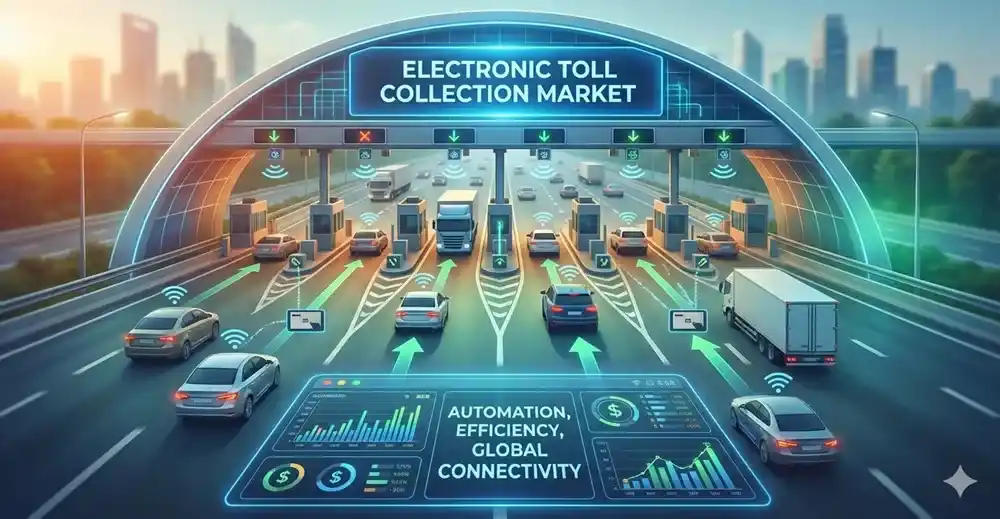
The Electronic Toll Collection (ETC) market has undergone a major transformation, as it has moved from manual and cash-based systems to automated and technologically driven solutions that enhance efficie...
Market Overview
Current Market Size and Growth Forecast
The market for ETC systems has been growing rapidly in the last few years, and one of the major factors for the growth has been the digital transformation of the transportation sector. The increasing demand for technology, including hardware components (like transponders, readers, roadside antennas) and related communication infrastructure, is still dominating the market, but slowly software, services, and back-office systems (for billing, data processing, maintenance) are also coming up. Unevenly but consistently, regional growth reflects the trends:- North America is the leader in the ETC market with a large share, and this is due to the extensive highway networks and the wide system adoption.
- Asia Pacific is turning into a region of very high growth, due to the government, urbanization, and transport in the area, where projects like the adoption of tolling systems in India and China are taking place.
- The European market is being powered by the demand for interoperable tolling systems, smart transport policies, and regulatory frameworks that promote modern toll collection practices.
- Traffic Congestion & Efficiency: The operation of traditional toll booths leads to traffic jams that usually extend to peak hours. The use of ETC allows for no-stop or open-roads tolling, which in turn results in significant cuts in stays and travel time. This can become very crucial in areas with high population density and rapid urbanization.
- Government action, and smart infrastructure push: a lot of countries are pouring money into modern highways, smart road systems, and transport digital transformation. Such things as public-private partnerships, subsidies, and regulatory support for cashless tolling all make the ETC adoption easier.
- Environmental and Sustainability Goals: The ETC systems aid in the reduction of fuel consumption and emissions, and that they are contribute to the climate and air quality objectives, all these by allowing more natural traffic and less idling at the toll booths.
- Technological Developments & Integration: The rise of ETC has been supported by communication, satellite navigation, data processing, and back-office software improvements—sometimes even with AI or real-time data analytics—making the technology more reliable, scalable, and rich in features, along with traffic monitoring and dynamic pricing.
- Increase in Car Ownership and Road Use: Along with the increase in car ownership, the need for an efficient toll collection system also increases because of the rise in freight volumes and global road connectivity.
Restraints and Opportunities
Further, the ETC industry is still in a state of uncertainty and is facing challenges, but at the same time presents significant opportunities:Restraints / Challenges:
- High Initial Capital Expenditures: The setting up of a roadside DSRC infrastructure, GNSS-based tolling, or retrofitting of cars with transponders can incur high costs, particularly for developing countries or routes with low traffic.
- Interoperability Problems: Use of different standards (RFID, DSRC frequencies vary, GNSS vs. DSRC) in different areas can result in the complex situation of cross-border and even inter-state toll sharing.
- Technical Limitations & Maintenance: Certain problems like signal loss (e.g., tunnels or urban canyons for GNSS), reader mistakes, the effect of the environment on RFID readers, or interference in DSRC—Can all cause unreliability.
- Hybrid & Multi-Technology Systems: The combination of RFID, DSRC, and GNSS in hybrid systems allows for the benefit from the strengths of each technology and, at the same time, to compensate for their weaknesses. This results in flexibility, resilience, and better efficiency.
- Expansion in Emerging Economies: Numerous nations across Asia, Latin America, and the Middle East are still at the stage of constructing toll infrastructure; these countries will be able to modernize their tolling through ETC without passing through the previous stages, which presents them with a huge growth potential.
RFID in Electronic Toll Collection
How RFID Works in Tolling
Tolling with Radio Frequency Identification (RFID) systems normally requires attaching a small transponder (tag) to the vehicle (e.g., on the windshield). The roadside reader emits radio waves as the vehicle gets closer to the toll lane. When the tag is close enough, it identifies itself by sending an identification code. Then, the system charges the tolls to the corresponding account. This all happens automatically and wirelessly, allowing vehicles to move through the designated toll lanes without coming to a halt. ETC based on RFID is frequently used in combination with “open tolling” or non-barrier tolling, and sometimes in conjunction with other methods, such as Automatic Number Plate Recognition (ANPR), for double-checking or enforcing purposes. Advantages- Cost-effectiveness: The cost of RFID tags is low relative to the other methods, and they are easy to copy; the infrastructure cost is lower when compared to that of complicated gantries or satellite-based systems. Over the years, several surveys have identified that RFID has remained the technology of choice in most of the ETC markets.
- Being Mature and Having Mass Acceptance: RFID is a good technology to be used for highways, bridges, tunnels, and even regular toll plazas. It is easy to implement and maintain.
- High-Volume, Dedicated Lanes Reliable: Properly set up (dedicated lanes, controlled environment), RFID-based tolling can produce very high throughput and significantly lower waiting times.
- Less Complicated: RFID does not need high positioning, continuous connectivity, or complicated overhead installations as GNSS or DSRC, which means easier maintenance and lower operational costs.
- Infrastructure Limitations: Need for Dedicated Lanes: Usually, RFID-based tolling works best with dedicated lanes; full-free-flow or MLFF without physical lanes or barriers is more difficult to implement.
- Scalability & Interoperability Challenges: The different jurisdictions may use different RFID standards/frequencies, making the cross-border or inter-regional interoperability difficult.
DSRC in Electronic Toll Collection
How DSRC Works in Tolling
Dedicated Short-Range Communication (DSRC) performs the wireless communication using standards such as IEEE 802.11p (a modified version of Wi-Fi, which is used for communication between vehicles). A typical DSRC system works in the 5.8-5.9 GHz frequency range; however, this can vary according to regions. In a DSRC-based automated toll collection setup, the vehicle is equipped with an onboard unit (OBU) that communicates wirelessly with the roadside units located on gantries or at toll plazas. Communication is done through the DSRC link when the vehicle is either passing or close to the RSU. The vehicle sends its identity, vehicle class (number of axles, type of vehicle), and sometimes even emissions class, and in return, it receives either a confirmation of payment or directions. DSRC technology has been chosen for systems built for heavy-duty vehicles (HDVs) and toll management of large networks, where high-speed communication and data interchange are advantageous for more than just payments (e.g., traffic data, safety, enforcement). Advantages- Multi-Lane Free-Flow (MLFF) Support: DSRC makes it possible to charge the tolls without any barriers across several lanes, even if vehicles are moving fast; this is done without the need for separate toll lanes or physical barriers. Thus, it prevents congestion and guarantees an uninterrupted flow of traffic.
- Communications with Rich Data Exchange Capabilities: The fact that DSRC allows for very fast two-way communication means that the tolling systems can pass on extra information (like the nature of the vehicle, its emissions category, and the state of the traffic), which will allow their cooperation with the vast transport system.
- Better Suitability for Freight / Heavy-Vehicle Tolling: A case where tolling based on DSRC is concerned is the heavy-duty and commercial vehicles, where classification, axle count, and accurate charging matter the most.
- Potential for Safety / ITS Integration: DSRC can be incorporated into a bigger vehicle-to-infrastructure (V2I) ecosystem; this may allow for the provision of other services in addition to tolling - including traffic warnings, vehicle monitoring, enforcement, or data collection.
- High Initial Infrastructure Cost: The installation of DSRC-based tolling involves the development of gantries or RSUs along the roads and the fitting out of the vehicles with OBUs, which altogether make up a high CapEx, particularly when large road networks are to be covered.
- Spectrum & Regulatory Issues: DSRC requires the radio spectrum to be allocated; different regions may have different frequency allocations or regulations, which may lead to complications in cross-border interoperability.
GNSS in Electronic Toll Collection
How GNSS Works in Tolling
GNSS-based tolling (which is sometimes called differently, for example, as satellite-based or GPS-based road-user charging) is a type of tolling system that depends on in-vehicle devices (OBUs or GNSS receivers) to determine a vehicle's exact location, time, and mileage non-stop through satellite navigation (like GPS, Galileo, etc.). The devices keep track of when and where the vehicle is moving; data - either in real-time or batch-uploaded - is sent to a central server through cellular or other communication networks. The central system correlates the recorded data with a map, computes tolls (based on distance, time, road category, zone, or other criteria), and bills the vehicle’s owner correspondingly. In contrast to RFID or DSRC, GNSS-based tolling does not necessitate roadside equipment (gantries, readers, antennas) throughout the entire road network. By contrast, the main part of the infrastructure is in the backend (servers, data processing, billing), plus the in-vehicle OBUs. Advantages- Independence from Infrastructure and Scalability: GNSS abolishes the need for toll booths, roadside equipment, and other physical installations everywhere on the road network where tolls are imposed, thus the infrastructure costs are minimized considerably, and at the same time are easier to handle for new roads.
- Varied Tolling Models: GNSS can monitor the real-time vehicle motion, which means the charge for the toll can be calculated after the charge depending on the distance traveled (distance-based charging), time of day, road usage, congestion levels, or zone-based policies (e.g., urban congestion pricing)—thus, presenting more sophisticated and fair tolling models.
- Preferred for Nationwide or Big Networks: In the case of countries or regions with large road networks consisting of both rural and urban areas, GNSS provides a more feasible, scalable method of tolling implementation that is less than deploying readers/gantries everywhere.
- Possible Integration with Smart Mobility & ITS: The GNSS-based tolling has the capacity of integrating with vehicle telematics, traffic management systems, emission-based charging, and other smart mobility applications — thus providing a base for progressive transport policies and sustainability targets.
- Privacy Issues & Data Safety: The GNSS-based tolling system will always need to know the location of the vehicle, thus raising the issue of data privacy and security at the front. The public will be resistant to such systems if there is no strong governance, anonymization, and protection of data.
- Signal Limitations and Accuracy Problems: GNSS is prone to signal interference or inaccurate location in tunnels, urban canyons, or under dense tree canopies. Some errors are offset by using map-matching algorithms, yet the issue of gaps in coverage is still a problem.
Use Cases and Emerging Adoption
GNSS-based tolling, which is also known as road-user charging, distance-based tolling, or satellite-based tolling, is becoming more and more popular, especially in regions where governments are planning to go beyond the traditional toll booths and adopt a high-scalability, flexible model that is good for the whole country or area road networks. Areas that are thinking about or trying out GNSS tolling often talk up the benefits, such as charging based on distance traveled, fees based on emissions, pricing determined by time of day or traffic situation, and linking with smart mobility platforms. Germany’s LKW-Maut, which was introduced in 2005, charges trucks through GNSS, earning €4.5 billion every year as of the 2019 report. Singapore's ERP2, which is planned to shift to GNSS by 2025, will allow for dynamic urban pricing.Comparative Analysis: RFID vs DSRC vs GNSS
Here is a comparative summary of the three technologies in the context of their use for ETC: RFID vs DSRC vs GNSS| Technology | Main elements | Tolling infrastructure required | Key advantages |
| RFID | Sticker tag (read/write) + roadside RFID readers (short range) | RFID readers at lanes/gantries; ANPR is often used for enforcement. | Low unit cost; no battery; low capital & operational cost; widely used globally; easy integration. |
| DSRC | OBU (read/write) + roadside DSRC readers (bi-directional short range) | DSRC readers & gantries at roadside; camera enforcement (ANPR). | High security; good for value-added services |
| GNSS | GNSS OBU in vehicle + mobile data communication to back office; map-matching in back office. No roadside tolling equipment required. | No roadside tolling equipment required (GNSS + back office). Enforcement still needs ANPR/other tech. | No roadside infrastructure; flexible for large/fully distance-based charging; virtual changes possible in the back office. |
Have questions?
More Thought Articles
From Data Centers to EV Charging: Where Low-Voltage DC Distribution Is Making an Impact
Low-voltage DC distribution is gaining relevance as AI data centers, EV charging hubs, solar systems, and battery storage increase demand for efficient power architectures. The article examines 800 VDC standardization, conversion losses, protection challenges, and greenfield opportunities, highlighting why hybrid AC/DC systems could become increasingly important across high-power infrastructure applications.
How EV Charger Manufacturers Can Capitalize on India’s Home Charging Revolution
India’s residential EV charging opportunity is expanding as policy support, EV adoption, and private parking infrastructure develop. Manufacturers can capture value beyond AC chargers through installation, smart charging, load management, solar integration, software, and after-sales services. Housing societies, automakers, and property developers offer scalable routes to residential charging customers.
Second-Life EV Battery Market in India: What Is Driving Demand from Manufacturers?
India’s second-life EV battery market is gaining relevance as electric vehicle adoption expands and batteries retain useful capacity after automotive service. Growing stationary-storage demand, battery data, refurbishment capabilities, EPR obligations, and critical-mineral policies are encouraging manufacturers to extend battery value through reuse before eventual recycling within India’s emerging circular battery ecosystem.