Fairness, accountability, openness, and the welfare of society are given top priority in ethical AI. It guarantees that AI systems protect privacy, don't have prejudices, and respect human rights. Diverse viewpoints, thorough testing, and ongoing oversight are all necessary for ethical AI design to minimize potential risks. It encourages the ethical application of AI technologies, building confidence among developers, consumers, and impacted communities. In the end, ethical AI seeks to match technical advancement with moral standards and social ideals to enhance humanity rather than exploit it.
Top Ethical AI Tools
- Privacy
- Accountability
- Human Oversight
- Transparency
- Diversity, non-discrimination, and bias mitigation
Let’s discuss each one in detail.
1. Privacy
In ethical AI, privacy refers to protecting people's data through the AI lifecycle. It demands unambiguous permission procedures, minimal data gathering, and, when practical, data anonymization or pseudonymization. Strong security measures are also necessary for ethical AI to prevent breaches or unwanted access. To give users clear explanations of data usage and AI decision-making processes, transparency is essential. Constant assessment and auditing guarantee adherence to ethical norms and privacy laws. Additionally, giving people authority over their data promotes accountability and trust in AI systems, helping society strike a healthy balance between technical growth and privacy rights.
The Federal Trade Commission released the preliminary schedule for its annual PrivacyCon event on February 27, 2024. The event will be held virtually on March 6, 2024, and will include talks on a range of privacy and data security research topics.
2. Accountability
To ensure ethical AI, accountability must be established for the creation, implementation, testing, and results of AI systems. It entails defining the parties involved and what their responsibilities are to uphold moral conduct throughout the AI lifespan. Accountability is facilitated by transparent documentation of AI algorithms and decision-making processes, which allows relevant stakeholders to examine and supervise the process. Mechanisms for addressing and resolving possible damages caused by AI systems are included in ethical AI frameworks. Accountability also includes following the law, moral principles, and professional standards. Trust and confidence in the usage of AI systems are fostered by regular audits, impact assessments, and feedback mechanisms that assist track the performance of AI systems and rectify any departures from ethical principles.
In June 2023, The Everyday AI platform, Dataiku, revealed advancements in tools, safety, and enterprise applications of Generative AI. These breakthroughs go beyond the capabilities of typical chatbots and open up the possibility of significant, practical workplace applications. They are developed from the invaluable expertise obtained from working with over 500 customers.
3. Human Oversight
For ethical AI to be implemented responsibly and reliably, human oversight is necessary. It entails incorporating human judgment and intervention at pivotal AI lifecycle stages, like decision-making, model construction, and data collection. Human oversight provides the contextual understanding and ethical reasoning that machines cannot, so mitigating the biases, errors, and unintended effects inherent in AI algorithms. It makes it possible to monitor AI systems for accountability, justice, and adherence to moral and legal requirements. Furthermore, human oversight makes it easier to intervene when AI systems behave unethically or produce undesirable results, enabling the implementation of corrective measures or modifications. By encouraging openness, responsibility, and public acceptance of AI technology, this person-in-the-loop strategy fosters a cooperative interaction between people and machines while respecting human rights.
In February 2024, a Leading provider of AI-driven medical documentation solutions, DeepScribe, unveiled its new Trust and Safety Suite. The cutting-edge capabilities of DeepScribe's most recent ambient AI technology showcase the company's commitment to establishing industry norms for safety, ethics, and transparency in
AI in healthcare and making sure that technological developments in this field are as reliable as they are ground-breaking. Users and administrators will have access to DeepScribe's experienced human audits team by sending created notes to the team. After going over the notes and grading the outputs using DeepScribe's clinical accuracy approach, this team will offer tailored recommendations to raise the output accuracy.
4. Transparency
To foster mutual respect and understanding among stakeholders, ethical AI must be transparent. It entails clearly and understandably revealing details regarding AI systems, such as their goals, data sources, algorithms, and decision-making procedures. Users may evaluate AI systems' dependability, understand how they work, and foresee any biases or limitations thanks to transparent AI design. Furthermore, open documentation promotes accountability by permitting outside examination and verification of the actions and results of AI systems. Ethical AI frameworks support openness in data gathering, use, and sharing procedures, enabling people to make knowledgeable decisions about their personal information. Transparent communication of AI's capabilities and limitations also aids in controlling expectations and preventing misuse or over-reliance.
Transparency is further improved by routine reporting and disclosure of AI performance indicators and effects, enabling constant development and adherence to moral standards and cultural norms. In general, openness, accountability, and reliability are encouraged by transparency in the creation and application of AI technologies. To protect people's rights in the era of artificial intelligence, the General Data Protection Regulation (GDPR) of the European Union contains measures for automated decision-making and profiling.
Due to growing awareness of potential biases and ethical concerns, North America has seen a considerable surge in ethical AI. Policymakers, academics, and tech corporations work together to create frameworks that guarantee AI systems are transparent, accountable, and fair. Research and development expenditures are directed toward improving privacy protections, reducing biases, and encouraging the responsible application of AI. The goals of programs like AI ethics boards and regulatory guidelines are to promote public confidence and set industry standards. This expansion is a result of a concerted effort across North America to maintain ethical standards while utilizing AI's promise.
Figure 1: AI Adoption Rate Around the World
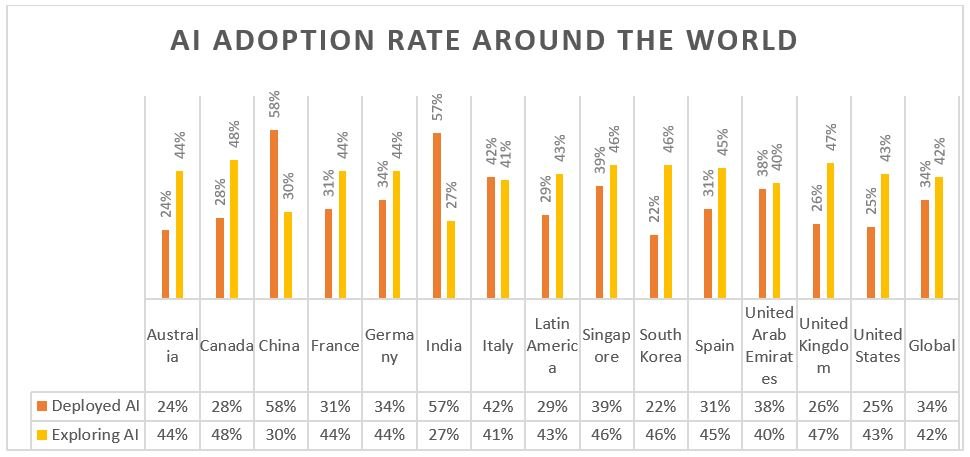 Source: IBM
5. Diversity, non-discrimination, and bias mitigation
Source: IBM
5. Diversity, non-discrimination, and bias mitigation
AI programs should interact with a wide range of users to prevent inadvertent bias. If AI is allowed to run amok, it may result in bias or marginalization of some populations. Because not all groups are represented in the development of AI and because not all groups may use AI in the same way or to the same extent, bias might be challenging to eradicate. One crucial first step in reducing discrimination is to encourage inclusion and guarantee that everyone has access to it. Throughout the development and deployment phases, bias can be further mitigated by ongoing evaluations and modifications. Data publication can also encourage the use of impartial AI. It has also been demonstrated that utilizing a variety of data sets reduces the likelihood of bias.
Industry titans including Block, Canva, Carlyle, The Estée Lauder Companies, PwC, and Zapier are already utilizing Open AI's ChatGPT Enterprise, which was introduced a few months ago, to completely transform the way their businesses run. Introducing ChatGPT Team as a new self-serve option today. Access to sophisticated models, such as GPT-4 and DALL·E 3, and tools, such as Advanced Data Analysis, is provided by the chatGPT Team. It also comes with admin tools to manage a team and a specific collaborative workspace. One can own and control business data, just like with ChatGPT Enterprise.
Find some of our related studies: