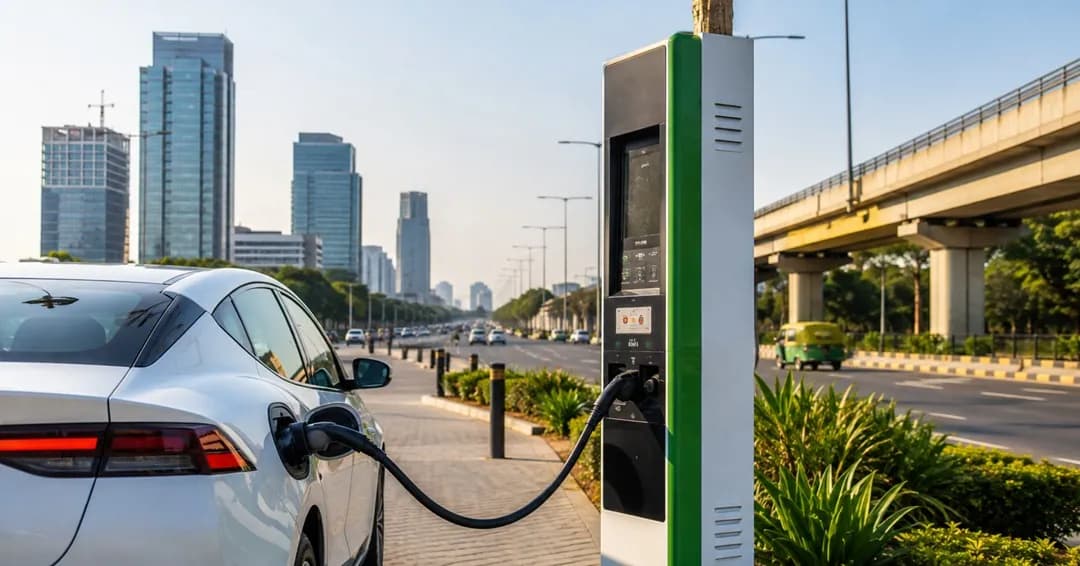
India’s EV charging network is expanding across highways and cities, supported by government funding and private investment. Growth depends on site availability, grid capacity, utilisation, uptime and interoperability. Leading operators are expanding diverse charging networks, while PM E-DRIVE funding supports further deployment toward a broader and more reliable national charging ecosystem.
India's electric vehicle (EV) sector is expanding its public charging footprint, but the available counts depend on the reporting agency and definition used. The Ministry of Heavy Industries reported 29,151 public EV charging stations installed nationwide as of February 10, 2026, while a separate Ministry of Power/OMC dataset reported installations and operational status as of March 1, 2026. Earlier claims of 27,737 total stations and 22,753 consistently functional stations could not be independently verified and have therefore been removed. The expansion increasingly spans both high-traffic highway corridors and dense urban centres, where site economics and grid constraints differ.
Globally, charging strategies vary with housing patterns, vehicle usage, grid capacity and urban density. India's charging build-out similarly requires coordination among charge point operators (CPOs), landowners, distribution companies and public authorities. In practice, access to suitable sites and timely grid connections can be as important as charger hardware in determining how quickly a network can expand.
The Economics of Transition: Highways vs. Cities
For charge point operators (CPOs), the economics of a highway site can differ materially from those of an urban location. Highway sites often use higher-power DC chargers to reduce en-route charging time, while utilisation can vary by route, season and traffic patterns. Urban networks, by contrast, commonly combine DC fast charging with AC charging at workplaces, retail destinations and residential locations, where longer parking durations can support lower-power charging.
Urban charging also presents local grid-integration and real-estate challenges. In major metros, available electrical capacity, transformer requirements and site permissions can affect deployment timelines. AC chargers in the 7.4 kW to 22 kW range are widely used for destination and residential applications, while higher-power DC chargers are deployed where faster turnaround is required.
Distribution companies may need to manage coincident charging demand as EV adoption increases. Smart charging, load management and interoperable communication standards can help operators monitor and control charging where supported by the site and equipment. However, claims that such systems will prevent blackouts or eliminate the need for transformer upgrades are too broad; the outcome depends on local network capacity and operating conditions.
Global Parallels in the Decarbonization Journey
India's public policy framework has moved from broad targets towards implementation rules and funding mechanisms. The PM E-DRIVE scheme has a Rs. 2,000 crore allocation for public charging infrastructure, including public charging, battery swapping and battery charging stations. In May 2025, the Ministry of Heavy Industries stated that the scheme was expected to support approximately 72,000 public charging stations; subsequent implementation guidelines and approvals should not be treated as proof that all of these chargers have already been installed.
Leading Players Restructuring India’s EV Grid
To understand the practical realities of this infrastructure rollout, we examine four key companies driving India's EV charging landscape.
1. Tata Power EZ Charge
Tata Power is one of India's largest integrated power utilities and operates an extensive EV charging network. Rather than retaining the article's unverified figure of 5,300+ public and semi-public charging points, the network is described here without a fixed count because company and government datasets use different definitions for chargers, charging points and stations.
Tata Power's integrated power-sector presence can support charging deployment through its relationships with distribution networks and its experience in energy infrastructure. The practical advantage, however, varies by location and applicable electricity-distribution arrangements; it is not accurate to suggest that the company automatically avoids all grid-connection or approval delays.
Its partnerships within the Tata Group also support charging initiatives linked to Tata EV customers, while the public network serves compatible vehicles beyond a single brand. The earlier references to proprietary telemetry and a 'captive customer base' were not sufficiently supported and have been removed.
2. ChargeZone
ChargeZone focuses on DC fast-charging infrastructure and serves passenger EV and commercial-use cases. The earlier claim of more than 2,200 active charging stations could not be independently confirmed from a current primary source and has therefore been removed. Its strategy includes partnerships and site development across intercity and commercial locations, where utilisation is central to the economics of high-power equipment.
Commercial fleets can provide more predictable charging demand than purely discretionary long-distance travel, although fleet utilisation and charging patterns differ by route and vehicle duty cycle. ChargeZone's positioning in high-power charging therefore aligns with use cases where turnaround time and vehicle availability are commercially important.
The earlier assertion that ChargeZone provides 'carbon-neutral transit options' through direct integration of solar generation at highway pit stops was not supported by sufficient primary evidence. Remote-site uptime and electricity-supply reliability remain practical operating considerations for highway charging networks.
3. Jio-BP Pulse
Jio-bp is a joint venture between Reliance Industries Limited and bp, combining fuel-retail infrastructure with mobility and energy services. Jio-bp Pulse is its EV charging brand. The earlier figure of more than 700 public charging points could not be independently verified from a current primary source and has therefore been removed.
Using existing fuel-retail sites can reduce the need to acquire entirely new charging locations, although each installation still depends on site layout, electrical capacity and local approvals.
The earlier statement that Jio-bp plans to integrate battery swapping alongside DC fast chargers as a defined network strategy could not be verified from a current primary source and has been removed. The company continues to position charging as part of a broader mobility and retail network.
4. Statiq
Statiq operates a national EV charging network and offers both public and private charging solutions. Its current website reports more than 10,000 installed chargers across more than 1,014 cities, although the company uses charger counts rather than the article's earlier '2,000 charging stations' figure, so the two measures should not be treated as equivalent.
Statiq combines its own charging products with network discovery, payments and charging-management features. Its footprint spans cities and highway routes rather than being limited to northern India, and its portfolio includes AC and DC charging options.
As with other networks that combine equipment, software and multiple site partners, service quality and uptime depend on maintenance arrangements, connectivity and local power conditions. The earlier claim that third-party hardware quality control is the company's main challenge was too specific to retain without supporting evidence.
Global Benchmarks: Product Implementations
The table below has been retained as a technology comparison, but unsupported city-specific deployment claims have been removed. Charger specifications can vary by model revision and configuration.
Brand & Product Name | Core Technology Profile | Primary Use | Strategic System Integration |
ABB Terra 360 | Up to 360 kW DC charging; dynamic power distribution | High-throughput public and fleet charging | High-power charging where site electrical capacity permits |
Siemens SICHARGE D | Modular DC charging architecture; output varies by configuration | Public, fleet and commercial sites | Scalable power modules and site-level integration |
Kempower Satellite System | Distributed DC charging architecture with dynamic power management | Fleet and multi-bay charging | Power can be allocated across multiple charging points |
Tesla V4 Supercharger | High-power DC architecture; capability varies by market and site | Tesla and compatible EV charging where access is supported | Network integration and route planning within Tesla's charging ecosystem |
Alpitronic HYC300 | Up to 300 kW DC charging; configuration-dependent | Public and fleet fast charging | Compact high-power hardware for commercial deployments |
Market Developments in the Indian EV Market
The earlier claim that a 'Unified Bharat eCharge' platform was officially launched in May 2026, supported by BHEL and NPCI, could not be independently verified through the Ministry of Heavy Industries, BHEL or NPCI and has been removed. Verified PM E-DRIVE implementation data available in 2026 instead show that Rs. 689 crore had been approved for deployment of 6,562 chargers as of July 1, 2026.
In September 2025, Tata Motors announced that more than 25,000 public charging stations were already accessible to customers of its electric small commercial vehicles (SCVs). The company also signed MoUs with 13 CPOs to add 25,000 public chargers over the following 12 months, with locations to be integrated into its Fleet Edge platform.
In September 2025, Tata Power and Tata Passenger Electric Mobility Ltd. inaugurated a large TATA.ev MegaCharger hub near Terminal 2 of Chhatrapati Shivaji Maharaj International Airport in Mumbai. Tata Motors said the site could charge up to 16 EVs simultaneously and included a 120 kW fast charger.
Soft Infrastructure: Software and Roaming
Charging-network fragmentation remains a practical issue because discovery, payment and roaming arrangements differ across operators. The earlier example claiming that a Delhi-Mumbai driver might need five separate apps and pre-funded wallets was illustrative rather than verified and has been replaced with a more measured description.
This digital friction is being tackled on two fronts:
1. The Open Charge Point Interface (OCPI)
OCPI is an open protocol designed to support information exchange and roaming between EV charging-service providers. Its adoption can facilitate interoperability where participating operators implement compatible commercial and technical arrangements. It does not, by itself, guarantee that every network will support roaming or that a customer can use one app at every charger.
2. Interoperability and common platforms
Government policy and industry efforts continue to emphasise connected and interoperable charging infrastructure. The Ministry of Power's 2024 charging-infrastructure guidelines and subsequent PM E-DRIVE implementation framework provide a policy basis for interoperability, but a nationwide 'UPI of EV charging' platform with the capabilities described in the original article could not be independently confirmed as operational as of August 20, 2026.
Analytical Outlook: The Road to 2030
India's charging infrastructure is moving from an early build-out phase towards a larger and more diverse network, but expansion is uneven across regions and use cases. Government support includes the Rs. 2,000 crore PM E-DRIVE allocation for public charging infrastructure, while private operators continue to develop sites in cities, along highways and at commercial destinations. The pace of deployment will depend on utilisation, site economics, grid capacity and execution under public programmes rather than on a single national mandate to electrify a fixed share of the vehicle fleet by 2030.
EV sales and charging infrastructure are expanding together, although the two do not move in a fixed one-to-one relationship. Greater charger availability can reduce practical barriers for some users, particularly on intercity routes and in areas without convenient home charging, but reliability, pricing, location and payment convenience remain important determinants of user confidence.
The next phase of competition is likely to place greater emphasis on utilisation, uptime, interoperability and grid integration. As networks expand, operators will need to match charger power and site design to actual dwell times and vehicle demand while maintaining reliable customer access across a growing mix of charging locations.
Explore More Reports:
Have questions?
More Thought Articles
How EV Charger Manufacturers Can Capitalize on India’s Home Charging Revolution
India’s residential EV charging opportunity is expanding as policy support, EV adoption, and private parking infrastructure develop. Manufacturers can capture value beyond AC chargers through installation, smart charging, load management, solar integration, software, and after-sales services. Housing societies, automakers, and property developers offer scalable routes to residential charging customers.
Second-Life EV Battery Market in India: What Is Driving Demand from Manufacturers?
India’s second-life EV battery market is gaining relevance as electric vehicle adoption expands and batteries retain useful capacity after automotive service. Growing stationary-storage demand, battery data, refurbishment capabilities, EPR obligations, and critical-mineral policies are encouraging manufacturers to extend battery value through reuse before eventual recycling within India’s emerging circular battery ecosystem.
The Rise of Locally Manufactured Battery Separators in India’s EV Ecosystem
India’s battery industry is progressing from pack assembly toward domestic cell and material manufacturing, creating opportunities for lithium-ion battery separators. Policy support, ACC capacity expansion and R&D initiatives are strengthening the ecosystem. However, technical complexity, manufacturing yields, qualification requirements and economics mean localisation will likely advance gradually through coatings, testing and finishing.