
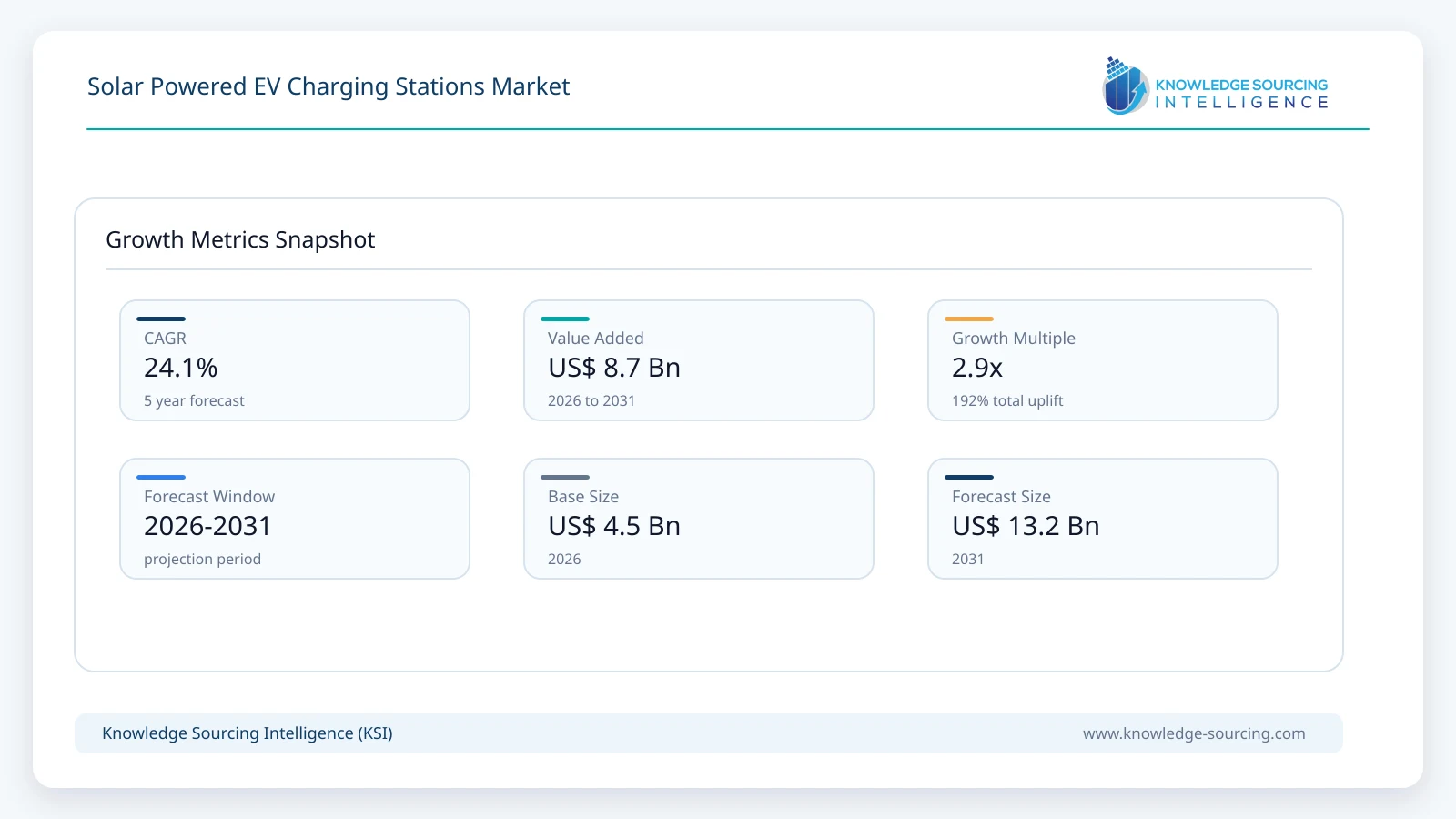
The Solar Powered EV Charging Stations Market is forecast to grow at a CAGR of 24.1%, reaching USD 13.17 billion in 2031 from USD 4.51 billion in 2026.
Highlights:
- 1Integration of solar PV systems is helping to neutralise carbon emissions from EV charging by coupling with EV charging stations.
- 2The growing penetration of renewable sources of energy is necessitating the inclusion of BESS as part of an amplified effort to optimize utilization of renewables and improve hybrid charging reliability.
- 3The fast-track commercial deployment of hybrid solar charging stations is leading to the integration of grid connectivity and renewable energy generation.
- 4AI-enabled energy management platforms are constantly being optimized from solar generation, through battery storage usage and charging schedules.
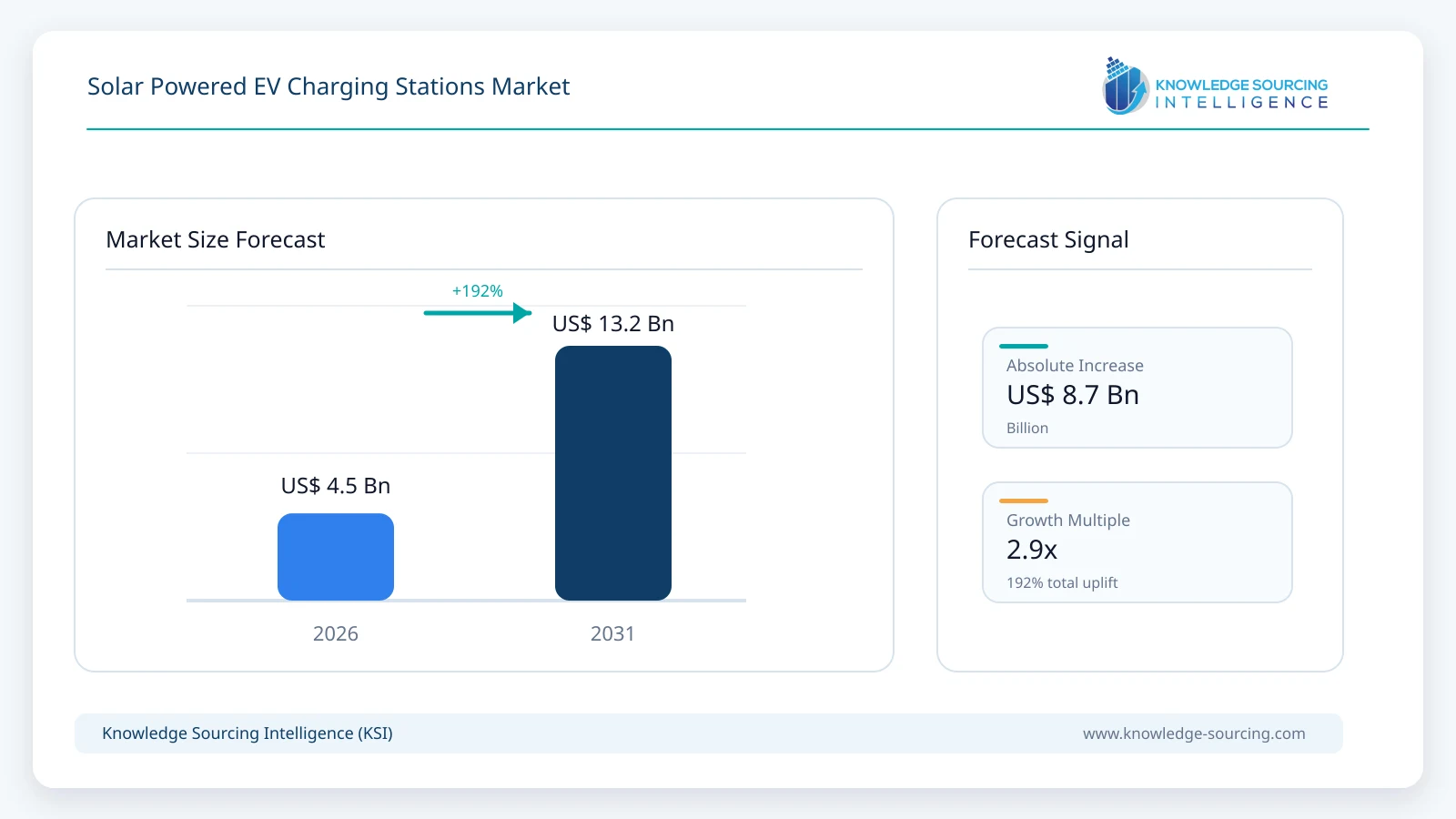
The market is witnessing a rapid rise with the increase in demand for the decarbonisation of transport along with renewable energy generation and distributed energy resources.
Traditional EV charging infrastructure relies heavily on electricity that is typically provided via centralized grids. However, with rising electricity needs, grid congestion, as well as sustainability targets, is leading to the installation of solar-based charging systems that can produce clean power at the location itself. Solar EV charging stations center photovoltaic panels, power electronics, battery storage systems, smart controllers, and EV chargers into integrated energy ecosystems that reduce operational costs while augmenting energy resilience.
This is fueling a major investment in solar-powered charging technologies as EV fleets, commercial logistics electrification, and the rollout of public charging infrastructure are growing. Further, to lower energy costs while meeting corporate sustainability targets, a growing number of fleet operators, commercial real estate owners, and municipalities are installing solar charging stations.
The market system is transitioning to smart charging infrastructure implemented with dynamic load balancing, predictive energy management capabilities, AI-based charging-optimization solutions & RE forecasting. Battery Energy Storage Systems (BESS) are an essential part of the ecosystem as they allow solar to be used when there is no sunlight, either using stored energy during nighttime charging or from lower solar generation hours.
Governments around the world continue to implement incentives for both renewable energy and EV charging infrastructure development. And net-zero carbon commitments, renewable energy mandates, and transportation electrification policies are all rapidly driving market adoption in both developed economies and developing economies.
Asia-pacific dominants global deployment with strong government support in China and India, while Europe relies on renewable-powered city-based public charging networks. With continued commercial charging infrastructure expansions in North America, federally supported clean energy programs, and corporate sustainability investments.
Solar Powered EV Charging Stations Market Key Highlights
Market Dynamics
Market Drivers
Fast Upsurge in the Adoption of EVs: Global adoption of EVs combined with rising demand for sustainable charging infrastructure is driving greater demand for large-scale vehicle electrification. Solar-charged charging stations are sustainable, and they also minimize reliance on traditional cost programs. Further, to power long-term transport decarbonization, more governmental and private enterprises invest in renewable-powered charging networks.
Expansion of Renewable Energy Deployment: Falling solar PV installation costs combined with increased investment in renewable energy are fast-tracking deployment of solar-powered EV charging stations. Onsite solar generation helps to lower the total cost of your electricity while enabling greater energy independence now, and also helping to demonstrate corporate sustainability efforts.
Policies on Clean Mobility and Government Incentives: National governments are also rolling out financial incentives, tax benefits, and infrastructure funding programs backing the deployment of renewable-powered EV charging. Climate neutrality commitments and transportation electrification strategies are enabling installation of solar charging systems across public and private sectors.
Market Restraints & Opportunities
High upfront price of solar panels, battery storage systems, and charging infrastructure continues to be a significant hurdle for widespread implementation. Weather conditions lead to performance variability and also affect the viability of projects due to space requirements for photovoltaic installations.
However, innovations in storage technologies and battery prices, energy optimization automation using AI systems, and rising commercialization of Vehicle-to-Grid (V2G) systems are delivering large market potential. These long-term growth trends should appear particularly strong in emerging markets where solar access is abundant, and EV adoption is projected to surge.
Key Developments
May 2026: Tata Power's EV Charging Solutions and Indian Oil Corporation installed ultra-fast electric vehicle (EV) charging stations at the 63rd and the 69th milestones on the Haryana stretch of Delhi-Mumbai. The 240 kW stations aim to enable longer, faster, and more reliable long-distance EV journeys in India.
May 2025: SolarEdge introduced the ONE EV Charger and an accompanying solution to manage energy consumption for commercial and industrial clients. This system is designed to maximize self-consumption of solar energy, use direct excess power from the solar unit for EV charging, and provide optimal fleet EV charger costs.
Market Segmentation
The market is segmented by component, charging type, vehicle type, charging station type, application, and geography.
By Component: Solar Photovoltaic (PV) Panels
Solar photovoltaic (PV) panels hold the highest market share because they are the main source of renewable energy that drives solar EV charging stations. Panel efficiencies, bifacial technologies, and installation costs are still improving, driving greater market adoption.
Tata Power Solar Solutions delivers holistic solar PV solutions powering commercial and community EV charging networks. Its combination of PV modules with high-efficiency and energy management solutions creates sustainable charging applications.
Visaka Industries ATUM Solar Roof provides integrated solar roof technologies that can back decentralized EV charging infrastructure by producing renewable electricity on site, at the point of charging.
EcoStruxure EV Charging Solutions offer a smart integration between solar PV, battery storage and energy management platforms for optimal charging operations.
By Charging Type: DC Charging Stations
The market is dominated by DC charging stations as fast-charging stations are critical for commercial operations, public charging networks and highway corridor deployments. High-power DC chargers significantly reduce charging times for long-distance electric mobility.
Designed to fit in with current distributed energy generation systems and smart energy management platforms, ABB Terra DC Fast Chargers support solar charging infrastructure powered by renewable energy.
The Delta Electronics DC Charging Solutions provide ultra-high charger-efficiency fast charging technologies, featuring high-efficiency, commercial-grade solutions for ideal use in EVSE facilities and electrification projects.
The expansion of EV adoption and the requirement for fast and convenient public charging infrastructure are leading to an increase in the deployment of solar-powered DC charging systems.
By Vehicle Type: Passenger Electric Vehicles
Passenger electric vehicles make up the biggest vehicle type segment given the rapidly growing consumer EV uptake supported by government incentives, increasing volume availability of models, and developing charging infrastructure.
Ather Energy Grid Network enables fast charging for passenger EVs through a rapidly expanding ecosystem of high-performing and competitively priced DC EV charging stations, designed for urban electric mobility applications. Likewise, Bolt.Earth Charging Platform is a smart charging infrastructure solution that helps passenger EV users with connected charging management and digital payment solutions.
Continuing strong demand for solar passenger automobile charging solutions is driven by the expansion of residential charging infrastructure, workplace charging, and public charging networks.
Regional Analysis
North America Market Analysis
North America is a significant market fueled by large EV adoption, investment in renewable energy, and expansion of public charging infrastructure. Federal funding programs for EV charging deployment and renewable energy integration ensure that the United States continues to invest heavily in clean transportation.
South America Market Analysis
In South America, the gradual growth of the market is being backed by rapidly rising renewable investments and growing electric mobility initiatives. Brazil and Chile are deploying solar charging infrastructure as these two countries represent strong solar resources alongside supportive clean energy policies.
Europe Market Analysis
Europe is one of the most sophisticated solar EV charging station markets due to aggressive climate policies, renewables deployment, and transportation electrification. This includes countries like Germany, France, the Netherlands, Norway, and the United Kingdom, which are increasingly investing in renewable-powered mobility infrastructure and growing EV adoption.
Middle East and Africa Market Analysis
The Middle East and Africa are well-positioned as lucrative markets, with years of solar resources and growing investments in automotive sustainable infrastructure. Countries like the UAE and Saudi Arabia are introducing renewable energy into transportation systems in smart city and clean mobility funding.
Asia Pacific Market Analysis
Asia-Pacific leads the global market through far more rapid uptake of EVs, deployment of solar energy and other clean mobility measures, coupled with strong government support. China dominates the industry with massive investments across renewable and EV charging infrastructure across the region.
List of Companies
Tata Power
ElectriVa
Ather Energy
Visaka Industries
Bolt.Earth
ABB
Delta Electronics
Schneider Electric
Exicom Group
Eaton Corporation
Tata Power
Tata Power is India's largest integrated power company and a prominent player in EV charging infrastructure through its EZ Charge network. Expanding solar-integrated EV charging stations and renewable-powered mobility solutions for residential, commercial, and highway applications
ABB
ABB is a global leader in EV charging technologies, providing AC and DC fast chargers as stand-alone, integrated with renewable energy generation, and optimizing management platforms. The company that focuses on intelligent charging infrastructure for commercial fleets, public charging networks, and sustainable transportation ecosystems.
Exicom Group
Exicom Group designs intelligent EV charging systems, battery energy storage systems, and renewable-powered charging infrastructure to support power electronics. The company is steadily growing its high-power charging offering for commercial and public sectors.
Analyst View
The growth trajectory of the solar-powered EV charging stations market is robust in the long term, as renewable energy deployment converges with transportation electrification. Hybridisation of charging systems and integrated battery energy storage with AI-led management of energy will be a significant competitive edge. Global market growth will remain led by increasing investments in commercial charging infrastructure, fleet electrification and smart energy ecosystems.
Solar Powered EV Charging Stations Market Scope:
| Report Metric | Details |
|---|---|
| Total Market Size in 2026 | USD 4.51 billion |
| Total Market Size in 2031 | USD 13.17 billion |
| Forecast Unit | Billion |
| Growth Rate | 24.1% |
| Study Period | 2021 to 2031 |
| Historical Data | 2021 to 2024 |
| Base Year | 2025 |
| Forecast Period | 2026 – 2031 |
| Segmentation | Component, Charging Type, Vehicle Type, Charging Station Type, Application, Geography |
| Companies |
|
Market Segmentation
By Component
By Charging Type
By Vehicle Type
By Charging Station Type
By Application
By Geography
Table of Contents
1. EXECUTIVE SUMMARY
2. MARKET SNAPSHOT
2.1. Market Overview
2.2. Market Definition
2.3. Scope of the Study
2.4. Market Segmentation
3. BUSINESS LANDSCAPE
3.1. Market Drivers
3.2. Market Restraints
3.3. Market Opportunities
3.4. Porter’s Five Forces Analysis
3.5. Industry Value Chain Analysis
3.6. Policies and Regulations
3.7. Strategic Recommendations
4. TECHNOLOGICAL OUTLOOK
5. SOLAR POWERED EV CHARGING STATIONS MARKET BY COMPONENT
5.1. Introduction
5.2. Solar Photovoltaic (PV) Panels
5.3. EV Chargers & MPPT Charge Controller
5.3. Battery Energy Storage System (BESS)
5.4. Power Inverter
5.5. Others
6. SOLAR POWERED EV CHARGING STATIONS MARKET BY CHARGING TYPE
6.1. Introduction
6.2. AC Charging Stations
6.3. DC Charging Stations
7. SOLAR POWERED EV CHARGING STATIONS MARKET BY VEHICLE TYPE
7.1. Introduction
7.2. Passenger Electric Vehicles
7.3. Commercial Vehicles
7.4. Electric Buses
7.5. Others
8. SOLAR POWERED EV CHARGING STATIONS MARKET BY CHARGING STATION TYPE
8.1. Introduction
8.2. Off-Grid Solar EV Charging Station
8.3. Grid-Tied Solar EV Charging Station
8.4. Hybrid Solar EV Charging Station
9. SOLAR POWERED EV CHARGING STATIONS MARKET BY APPLICATION
9.1. Introduction
9.2. Residential
9.3. Commercial
9.4. Fleet Charging
9.5. Highway & Transit Corridor Charging
9.6. Others
10. SOLAR POWERED EV CHARGING STATIONS MARKET BY GEOGRAPHY
10.1. Introduction
10.2. North America
10.2.1. USA
10.2.2. Canada
10.2.3. Mexico
10.3. South America
10.3.1. Brazil
10.3.2. Argentina
10.3.3. Others
10.4. Europe
10.4.1. United Kingdom
10.4.2. Germany
10.4.3. France
10.4.4. Italy
10.4.5. Others
10.5. Middle East and Africa
10.5.1. Saudi Arabia
10.5.2. UAE
10.5.3. Others
10.6. Asia Pacific
10.6.1. China
10.6.2. Japan
10.6.3. South Korea
10.6.4. India
10.6.5. Indonesia
10.6.6. Thailand
10.6.7. Others
11. COMPETITIVE ENVIRONMENT AND ANALYSIS
11.1. Major Players and Strategy Analysis
11.2. Market Share Analysis
11.3. Mergers, Acquisitions, Agreements, and Collaborations
11.4. Competitive Dashboard
12. COMPANY PROFILES
12.1. Tata Power
12.2. ElectriVa
12.3. Ather Energy
12.4. Visaka Industries
12.5. BoltEarth
12.6. ABB
12.7. Delta Electronics
12.8. Schneider Electric
12.9. Exicom Group
12.10. Eaton Corporation
13. APPENDIX
13.1. Currency
13.2. Assumptions
13.3. Base and Forecast Years Timeline
13.4. Key benefits for the stakeholders
13.5. Research Methodology
13.6. Abbreviations
Navigate
Trusted by the world's leading organizations











