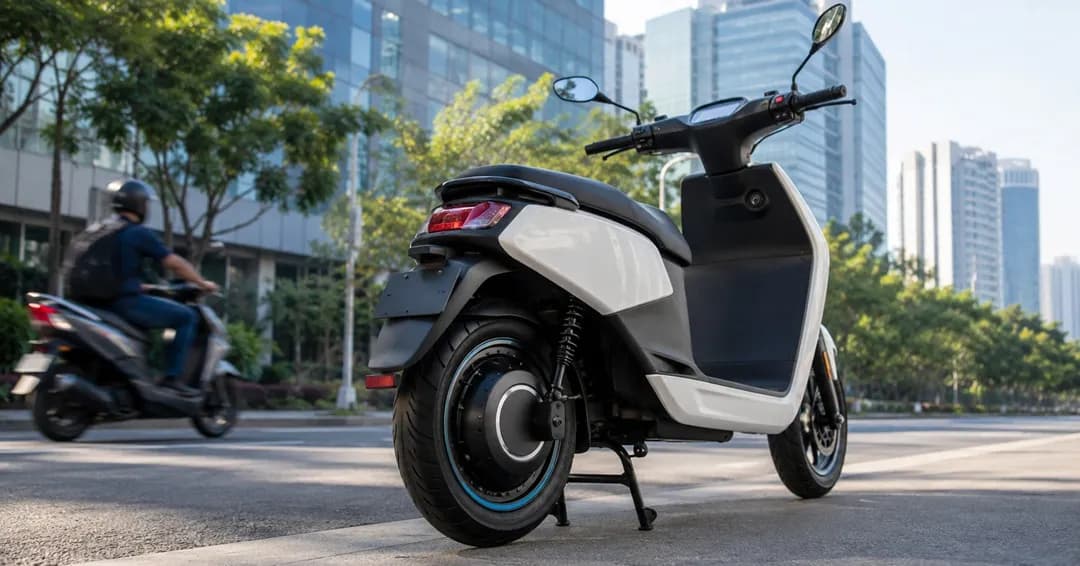
India’s electric two-wheeler market is increasingly prioritizing cost, efficiency, localization, and reliability. Hub motors are gaining relevance for commuter, fleet, and urban scooters because their simpler drivetrain architecture can reduce mechanical complexity and maintenance exposure. However, mid-drive systems will remain important for premium and performance-focused electric two-wheelers, supporting differentiated applications.
India’s electric two-wheeler industry is entering a more mature phase in which product economics are becoming as important as electrification itself. Early adoption was driven by fuel savings, government incentives, rising consumer awareness, and the availability of increasingly capable electric scooters. The competitive question is now changing. Manufacturers have to deliver better range, acceptable performance, reliable service, and attractive pricing while controlling production costs and building supply chains that can withstand fluctuations in imported components.
That is putting greater attention on a part of the vehicle that consumers rarely see: the drivetrain. Hub motors are becoming increasingly relevant because they offer a relatively simple way to convert electrical energy into wheel torque. Instead of placing the motor centrally and transferring power through a belt, chain, or gearbox, a hub motor is integrated into the wheel itself. This arrangement removes several mechanical interfaces and can simplify the architecture of a scooter designed primarily for urban mobility.
The technology is not new, and it should not be presented as a universal replacement for mid-drive systems. Its importance comes from something more practical. Hub motors match many of the requirements of India’s largest electric two-wheeler applications, particularly commuter scooters, entry-level products, and commercial vehicles where purchase price, maintenance, and operating reliability carry substantial weight.
The scale of the underlying market makes this increasingly important. The Ministry of Heavy Industries’ PM E-DRIVE reporting showed 26.59 lakh EVs had been supported or sold under PM E-DRIVE as of June 30, 2026; this is a total-EV figure, not an e-2W-only count. The e-2W component was subsequently expanded by the August 10, 2026 amendment, which raised its support allocation and extended the applicable incentive framework through March 31, 2028. The government has also continued to emphasize domestic manufacturing and progressive localization of EV components through its phased manufacturing requirements.
For manufacturers, therefore, the hub motor is becoming less of a component-level decision and more of a vehicle-platform decision.
Why the Hub Motor Architecture Fits India’s Electric Scooter Market
India’s two-wheeler market has always been strongly shaped by practical transportation requirements. Most buyers are not looking for extreme acceleration or motors capable of sustaining high speeds for long periods. They want a vehicle that can handle daily commuting, traffic, occasional rough roads, and routine errands without imposing a high ownership cost. That distinction matters when comparing electric drivetrain architectures.
A centrally mounted motor can offer advantages in performance, mass distribution, and demanding applications. It becomes particularly attractive when manufacturers want to build motorcycles with higher power outputs or sophisticated torque delivery. A hub motor, by contrast, is well suited to applications where moderate performance and mechanical simplicity are more commercially important.
The architecture eliminates the conventional power-transfer path between a centrally mounted motor and the driven wheel. Depending on the design, manufacturers can remove or reduce components such as chains, belts, sprockets, and transmission mechanisms. This can simplify both assembly and maintenance.
For an Indian electric scooter manufacturer competing in a price-sensitive segment, that is a meaningful advantage. The question is not whether a hub motor delivers the highest possible performance. The more relevant question is whether it provides sufficient performance while reducing the number of components that have to be manufactured, sourced, assembled, serviced, and replaced. In many commuter applications, it does.
Manufacturing Cost Is Becoming a Strategic Differentiator
The economics of electric two-wheelers are changing as the market becomes more competitive. Battery packs remain a major contributor to vehicle cost, but manufacturers cannot treat the rest of the bill of materials as secondary. Motor, controller, wiring, chassis, electronics, thermal management, and braking systems all provide opportunities for cost optimization.
Hub motors can contribute to this effort by reducing mechanical drivetrain complexity. The effect is particularly significant at scale. A manufacturer producing several thousand vehicles may tolerate a modest increase in assembly complexity if it creates a meaningful performance advantage. A manufacturer producing hundreds of thousands of scooters has a different calculation. Small savings in component count, assembly time, inspection requirements, or service interventions can accumulate into substantial financial benefits.
The broader policy environment is also encouraging this approach. Under the current PM E-DRIVE framework, eligible electric two-wheelers can receive demand support through March 31, 2028, subject to the scheme’s eligibility, price, funding, and phased manufacturing requirements. The Ministry of Heavy Industries has explicitly linked localization requirements to strengthening India’s domestic EV manufacturing ecosystem.
This creates an incentive for manufacturers to look beyond the lowest-cost imported component and consider how drivetrain design can support a localized supply chain.
Hub Motor and Mid-Drive Economics at a Glance
Factor | Hub Motor | Mid-Drive Motor |
Mechanical architecture | Relatively simple because the motor drives the wheel directly | More complex because motor output must be transferred to the wheel |
Component count | Potentially lower across the mechanical drivetrain | Generally higher because of transmission components |
Assembly complexity | Attractive for high-volume commuter scooters | Higher, particularly where a transmission system is required |
Maintenance exposure | Fewer conventional drivetrain wear components | Additional belt, chain, gear, or transmission components may require service |
Performance flexibility | Well suited to moderate-power urban applications | Better suited to applications requiring higher performance and torque optimization |
Vehicle packaging | Frees central frame space for other components | Centralized motor can improve mass distribution |
Unsprung mass | Higher because motor weight is carried by the wheel | Lower at the wheel because the motor is centrally positioned |
Commercial sweet spot | Entry-level, commuter, fleet, and urban electric scooters | Premium scooters and performance-oriented motorcycles |
The commercial advantage becomes clearer when the entire vehicle is considered rather than the motor in isolation. A hub motor that costs slightly more than another motor may still produce a lower total vehicle cost if it eliminates other drivetrain components and reduces assembly requirements.
Localization Could Magnify the Advantage
India’s EV manufacturing strategy increasingly depends on domestic value addition. A localized hub motor supply chain could therefore create benefits that extend beyond the price of the motor itself. A hub motor ecosystem requires capabilities in permanent magnets, copper windings, laminations, motor housings, bearings, shafts, sensors, connectors, power electronics, controllers, and testing. As domestic suppliers become more capable, OEMs can increasingly specify motors around their vehicle requirements instead of depending entirely on standardized imported products. This can improve supply security as well.
A related policy development could affect the long-term economics of permanent-magnet hub motors. In November 2025, the Union Cabinet approved a Rs. 7,280 crore scheme to establish 6,000 metric tonnes per annum of integrated sintered rare earth permanent-magnet manufacturing capacity in India. The initiative is intended to reduce import dependence in sectors including electric mobility. For hub-motor suppliers, a stronger domestic magnet supply chain could improve sourcing resilience, although the scheme’s capacity is still being established.
The experience of the past several years has demonstrated that dependence on concentrated international supply chains can expose vehicle manufacturers to delays, price volatility, and unexpected component shortages. Local sourcing does not eliminate these risks, but it can reduce lead times and give OEMs greater control over engineering changes.
Government-supported electric-drive development in India has also included research involving hub-and-spoke electric drive systems for two- and three-wheelers. Projects under the former FAME program involved automotive companies, engineering institutions, and technology organizations working on electric drive technologies.
That history is relevant because it shows that the development of electric drivetrain capability in India is not solely dependent on imported technology. Domestic engineering capacity has been developing alongside the market.
Fleet Operators Could Become an Important Growth Engine
Commercial use provides an especially strong case for hub motors because fleet economics are driven by utilization rather than showroom appeal.
Delivery scooters may operate for many hours each day and accumulate significantly more mileage than privately owned vehicles. For these users, a drivetrain that reduces routine mechanical maintenance can have a direct impact on operating expenses.
A delivery operator does not evaluate a scooter only on its purchase price. The operator also considers vehicle uptime, service intervals, spare-parts availability, energy consumption, tyre wear, battery degradation, and the cost of keeping technicians and vehicles in service. Hub motors can help simplify one part of that equation.
The absence of a conventional chain or belt transmission means there are fewer mechanical components connecting the motor to the driven wheel. This does not make the vehicle maintenance-free, since wheel bearings, brakes, suspension components, tyres, electrical connections, and the motor itself still require attention. However, reducing drivetrain wear points can improve the predictability of maintenance.
For fleet operators, predictability has value because unplanned downtime can be more expensive than a modest difference in component price.
India’s expanding delivery economy therefore represents a potentially important demand pool for hub-motor-based electric two-wheelers, particularly where the vehicle is designed around urban routes and moderate speeds.
Battery Efficiency Makes Motor Design More Important
The motor cannot be separated from the battery when evaluating electric vehicle economics. Battery packs remain expensive, heavy, and space-intensive. If improvements in motor efficiency reduce energy consumption over a real-world duty cycle, manufacturers may be able to achieve a desired range without continuously increasing battery capacity.
The relationship is not straightforward because range also depends on vehicle weight, tyres, aerodynamics, rider behavior, road conditions, temperature, regenerative braking, and software calibration. Even so, a more efficient motor and controller combination can contribute to lower energy consumption and potentially better vehicle economics.
This is where hub motor development is becoming more sophisticated. Modern systems increasingly rely on improved permanent-magnet designs, optimized electromagnetic characteristics, better controllers, regenerative braking strategies, and more precise software calibration. These improvements allow manufacturers to extract greater practical performance without necessarily increasing motor size. For a mass-market scooter, that can be more valuable than simply increasing rated power.
The Controller Is Becoming Part of the Competitive Advantage
One of the less visible changes in electric two-wheelers is the increasing importance of motor-controller integration. Two motors with similar nominal power ratings can behave very differently depending on how the controller manages current, torque, regenerative braking, thermal protection, and rider inputs. Software therefore has a growing influence on the actual riding experience.
This gives manufacturers another reason to adopt a more integrated approach to hub motor development. Instead of treating the motor, controller, battery management system, and vehicle software as independent components, OEMs can optimize them as a single propulsion system. Such integration can improve efficiency, diagnostics, acceleration characteristics, and thermal protection.
It also creates room for differentiation. When motor hardware becomes relatively standardized, manufacturers can compete through calibration, software, energy management, riding modes, connected diagnostics, and predictive maintenance. The motor remains essential, but the value increasingly comes from how the complete system is controlled.
Hub Motors Still Have Real Technical Limitations
The commercial case for hub motors should not be confused with a claim that they are technically superior in every situation. Unsprung mass remains a significant consideration. Because the motor is part of the wheel assembly, its weight moves with the wheel. On roads with potholes, broken surfaces, or frequent speed breakers, additional unsprung mass can influence suspension response and ride quality.
Thermal management can also become more demanding in certain applications. The motor sits within a compact wheel environment, limiting the available space for heat dissipation. A system designed for moderate urban use may perform adequately, while the same architecture could become less attractive for sustained high-power operation.
Performance is another dividing line. Mid-drive systems can provide stronger opportunities for centralizing mass and optimizing torque through gearing or transmission arrangements. This makes them more compelling for performance motorcycles, high-speed applications, and vehicles expected to operate under demanding gradients or loads. The industry should therefore expect coexistence rather than complete technological replacement.
Different Vehicle Categories Will Favor Different Drivetrains
The strongest future for hub motors is likely to remain concentrated in segments where affordability and simplicity matter most.
Vehicle Segment | Likely Hub Motor Potential | Principal Reason |
Entry-level electric scooters | Very high | Low-cost architecture can support aggressive retail pricing |
Urban commuter scooters | High | Moderate speeds and predictable daily usage suit direct-drive systems |
Delivery and fleet scooters | High | Reduced drivetrain complexity can support lower maintenance exposure |
Shared mobility vehicles | High | Operators benefit from simpler service requirements and high utilization |
Mid-market electric scooters | High | Performance requirements can often be met without a complex transmission |
Premium electric scooters | Moderate | Buyers may accept higher drivetrain cost for better performance |
Performance electric motorcycles | Low to moderate | Handling, torque delivery, and mass centralization become more important |
High-power electric motorcycles | Lower | Thermal and drivetrain demands reduce the relative advantage of hub motors |
This segmentation is important because it prevents the market from becoming an unnecessary debate between two technologies. The likely outcome is specialization. Hub motors will remain attractive where their cost and simplicity provide a clear commercial advantage, while mid-drive architectures will retain their position in products where performance justifies additional complexity.
Policy Support Is Moving Toward Manufacturing Discipline
India’s electric two-wheeler market has benefited significantly from government support, but the policy framework is increasingly emphasizing manufacturing capability and localization alongside demand creation.
PM E-DRIVE provides incentives for eligible electric two-wheelers and includes private and corporate-owned registered e-2Ws within the eligible category. The August 10, 2026 amendment extends the e-2W incentive framework through March 31, 2028, and raises the e-2W support allocation to Rs. 2,767 crore, while retaining applicable phased manufacturing requirements.
The scale of support is substantial. As of July 22, 2026, 20,56,831 e-2Ws had been incentivized under PM E-DRIVE, with Rs. 1,505.30 crore reimbursed to OEMs. The August 10, 2026 amendment subsequently increased the e-2W support allocation from Rs. 1,772 crore to Rs. 2,767 crore and expanded the maximum number of supported registered e-2Ws from 24,79,120 to 45,79,120.
The scheme has subsequently been extended. On August 10, 2026, the Ministry amended PM E-DRIVE to raise the overall scheme outlay to Rs. 11,900 crore and extend the e-2W incentive framework through March 31, 2028. The scheme remains fund-limited, so the relevant component can close earlier if its allocated funds are exhausted.
For manufacturers, the message is increasingly clear: scale matters, but cost discipline and domestic value addition matter as well.
The Export Opportunity Adds Another Dimension
India’s hub motor opportunity does not necessarily end with domestic electric scooters. Many emerging markets share characteristics with India, including extensive two-wheeler usage, congested cities, short-distance commuting, and significant consumer sensitivity to purchase and operating costs. A drivetrain developed for these requirements could potentially be adapted for selected markets in Southeast Asia, Africa, and Latin America.
Export success would require far more than an inexpensive motor. Certification, battery standards, financing, service infrastructure, local regulations, and supply-chain support would all influence the outcome. Nevertheless, a cost-efficient and locally manufacturable drivetrain can provide Indian OEMs and component suppliers with a useful foundation. If domestic manufacturers achieve sufficient scale, the hub motor could therefore become an exportable component platform rather than merely a feature of Indian-market scooters.
What Manufacturers Should Prioritize
The next stage of hub motor development should focus less on increasing headline power and more on improving the characteristics that determine long-term ownership economics.
Manufacturers should prioritize efficiency across real-world duty cycles, robust thermal performance, water and dust resistance, bearing durability, weight reduction, controller integration, and diagnostic capability. These attributes are likely to create more commercial value than simply advertising a higher peak power figure.
The operating environment should also remain central to engineering decisions. Indian electric two-wheelers have to deal with potholes, water exposure, dust, high ambient temperatures, traffic congestion, frequent stop-start operation, and varying maintenance quality. A drivetrain that performs well in controlled testing but struggles under these conditions will eventually create warranty and service costs. Supplier quality will become equally important as volumes rise.
The winners may not be the companies that develop the most sophisticated hub motor. They are more likely to be the manufacturers that achieve a dependable balance between efficiency, durability, cost, localization, and production consistency. That balance is difficult to achieve, but it is precisely where the competitive advantage lies.
Hub Motors Could Change How Electric Scooters Are Designed
The longer-term impact of hub motors could extend beyond motor selection. A simpler drivetrain gives vehicle engineers greater freedom to rethink the scooter platform. Space previously required for mechanical transmission components can be allocated differently, while battery placement, storage capacity, frame design, service access, and electronics packaging can be optimized around the electric architecture.
This matters because the electric scooter is not simply a petrol scooter with an engine removed. As manufacturers gain confidence with electric platforms, they can design vehicles around the characteristics of electric propulsion from the beginning. Hub motors can contribute to that transition because their architecture is inherently different from conventional two-wheeler drivetrains.
The resulting vehicles can be designed around the actual requirements of electric urban mobility rather than around legacy mechanical layouts.
Conclusion: The Game Changer Is the Economics, Not the Novelty
Hub motors are unlikely to become the universal drivetrain for every electric two-wheeler sold in India. That would ignore their limitations in high-performance applications and overlook the advantages offered by centrally mounted motors. Their importance lies elsewhere.
They offer manufacturers a practical architecture for building large volumes of affordable electric scooters with fewer mechanical drivetrain components, potentially lower assembly complexity, reduced conventional transmission maintenance, and strong compatibility with localized production. Those advantages become more compelling when the vehicle is designed for urban commuting, delivery operations, shared mobility, or other applications where moderate performance and low ownership cost matter more than maximum power.
India’s policy environment reinforces this commercial logic by combining electric vehicle demand support with progressive localization requirements. The latest PM E-DRIVE amendment increases the scheme’s overall outlay to Rs. 11,900 crore and extends e-2W support through March 31, 2028, while the programme continues to tie incentive eligibility to prescribed manufacturing requirements. The scale of e-2W adoption and the expansion of the support framework strengthen the case for deeper domestic component specialization.
The next competitive phase will therefore be less about finding a single drivetrain architecture that defeats all others and more about matching the right architecture to the right customer. For premium electric motorcycles, mid-drive systems may continue to offer stronger performance advantages. For mass-market scooters, however, the calculation is different. A vehicle that delivers adequate acceleration, useful range, dependable operation, low maintenance exposure, and competitive pricing can create greater commercial value than one that carries a more sophisticated drivetrain without a corresponding willingness to pay from the customer.
That is why hub motors are becoming a game changer for India’s electric two-wheeler manufacturers. Their significance comes from simplicity applied at scale. As Indian OEMs move from an incentive-led market toward a manufacturing-led and increasingly competitive industry, that combination of simplicity, localization, and cost efficiency could prove considerably more powerful than the technology’s relatively modest appearance suggests.
Have questions?
More Thought Articles
From Data Centers to EV Charging: Where Low-Voltage DC Distribution Is Making an Impact
Low-voltage DC distribution is gaining relevance as AI data centers, EV charging hubs, solar systems, and battery storage increase demand for efficient power architectures. The article examines 800 VDC standardization, conversion losses, protection challenges, and greenfield opportunities, highlighting why hybrid AC/DC systems could become increasingly important across high-power infrastructure applications.
How EV Charger Manufacturers Can Capitalize on India’s Home Charging Revolution
India’s residential EV charging opportunity is expanding as policy support, EV adoption, and private parking infrastructure develop. Manufacturers can capture value beyond AC chargers through installation, smart charging, load management, solar integration, software, and after-sales services. Housing societies, automakers, and property developers offer scalable routes to residential charging customers.
Second-Life EV Battery Market in India: What Is Driving Demand from Manufacturers?
India’s second-life EV battery market is gaining relevance as electric vehicle adoption expands and batteries retain useful capacity after automotive service. Growing stationary-storage demand, battery data, refurbishment capabilities, EPR obligations, and critical-mineral policies are encouraging manufacturers to extend battery value through reuse before eventual recycling within India’s emerging circular battery ecosystem.