5G Subscriber Data Management Market - Strategic Insights and Forecasts (2026-2031)
5G Subscriber Data Management Market Size, Share, Forecasts and Trends Analysis By Functional Layer (Unified Data Repository & Shared Network Data Layer, Unified Data Management & Authentication, Subscriber Provisioning & Profile Management, Converged Multi-Generation Subscriber Data Management), By Component (Software, Services), By Deployment Environment (Telco & Private Cloud, Public & Hyperscale Cloud, Virtualized / Conventional On-Premises Infrastructure), and Region
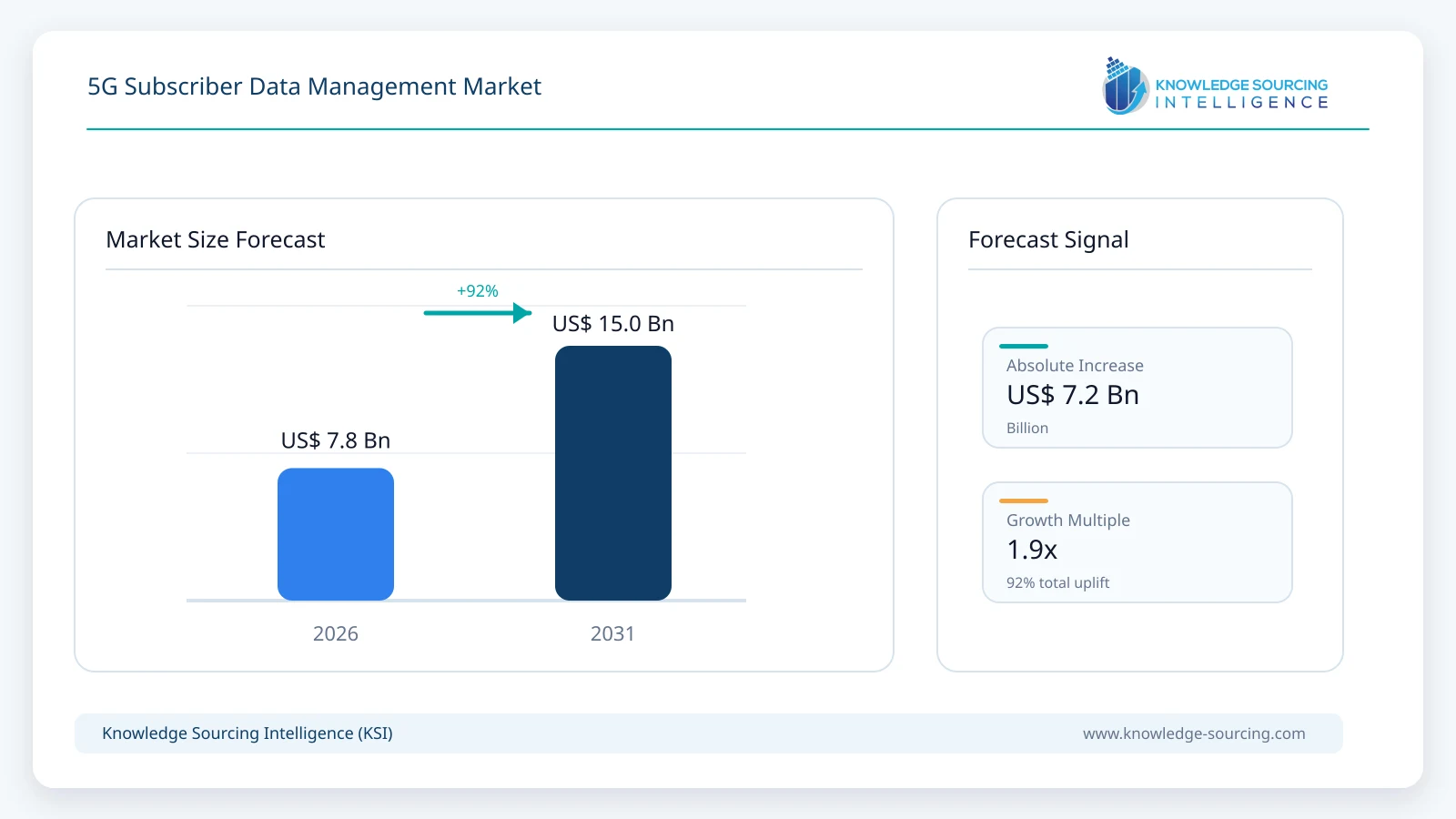
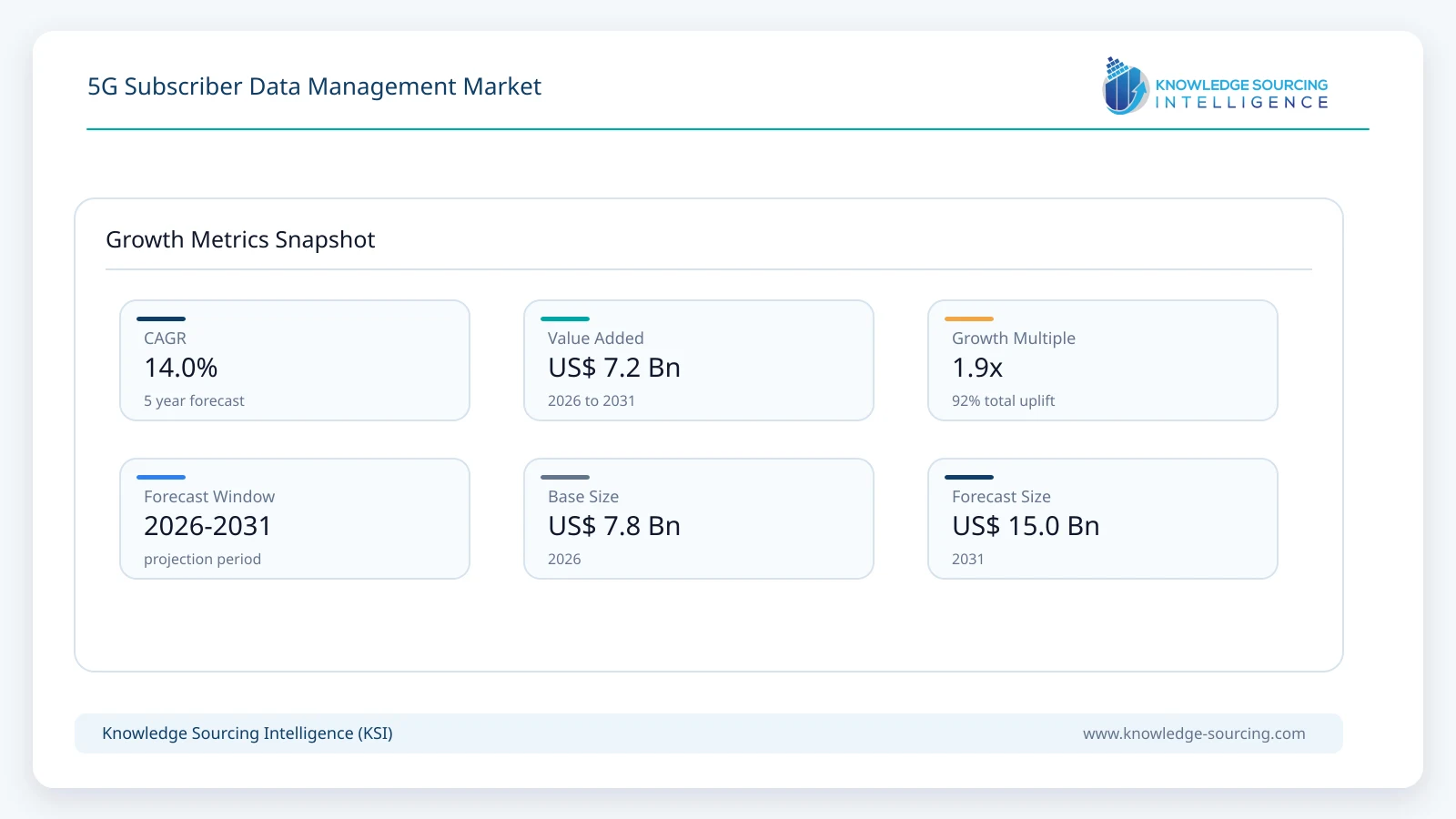
The 5G subscriber data management market is forecast to grow at a CAGR of 14.0%, reaching USD 15.0 billion in 2031 from USD 7.8 billion in 2026.
Highlights:
1
Unified Data Repository and shared network data-layer solutions account for an estimated 35.0% of market revenue in 2026
reflecting the movement toward decoupled storage and stateless network functions.
2
Software represents approximately 72.0% of market revenue in 2026
with implementation, migration and optimization services comprising the remaining share.
3
Telco and private-cloud environments account for approximately 58.0% of deployment revenue in 2026
as operators retain direct control of mission-critical subscriber records while adopting cloud-native architectures.
4
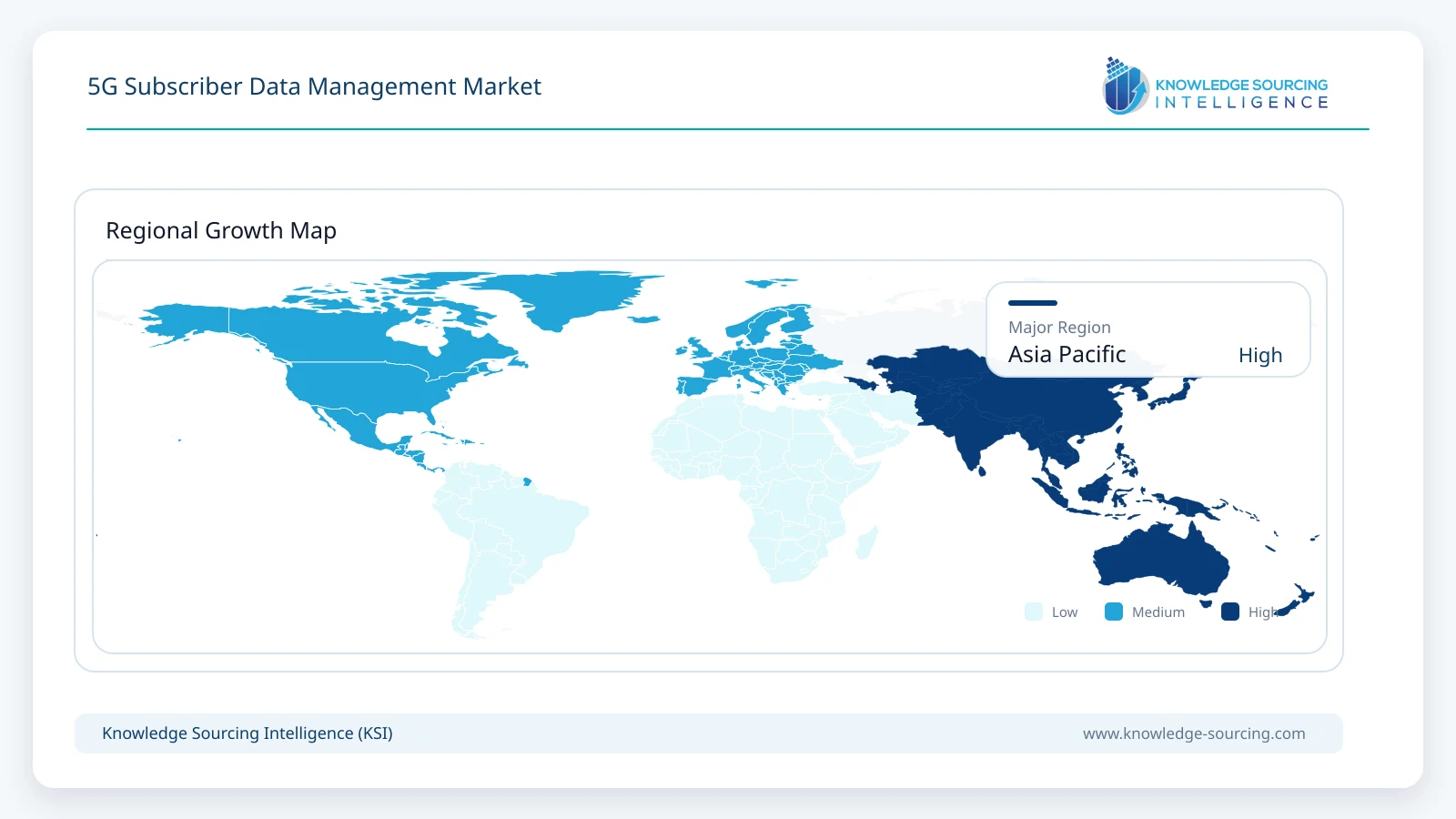
Asia Pacific accounts for an estimated 34.0% of global revenue in 2026
supported by large subscriber populations and 5G core modernization in China, Japan, South Korea and India.
5
3.1 billion during Q1 2026
Global 5G subscriptions exceeded and are forecast to reach 6.4 billion by 2031. More than 90 of approximately 390 operators offering commercial 5G have launched 5G Standalone networks.
6
multi-generation convergence, distributed cloud-native data layers and active-active geo-redundancy
Subscriber data architecture is moving toward , rather than separate subscriber databases for each access technology.
Growth is supported by migration toward 5G Standalone networks, expansion of cloud-native telecom cores, increasing subscriber and connected-device volumes, consolidation of fragmented HLR/HSS databases, and stronger requirements for real-time authentication, subscriber profiles and policy data across distributed networks.
Subscriber data management sits within the control and data layers of the mobile core network. It maintains identities, authentication credentials, subscription profiles, service entitlements and other information required to determine how subscribers and devices access network services. In a 5G Service-Based Architecture, functions such as Unified Data Management, Authentication Server Function and Unified Data Repository separate subscriber-processing logic from persistent data storage, allowing network functions to scale independently and access authoritative subscriber information through standardized interfaces. Ericsson notes that modern mobile networks execute millions of subscriber-related data transactions every second, making availability and performance of the data layer fundamental to 5G core operations.
The market includes UDM and authentication functions, unified subscriber repositories and shared network data layers, subscriber provisioning and profile management, converged HSS/HLR migration solutions and directly associated implementation and migration services. Generic CRM, billing, charging, OSS analytics and customer-experience platforms are excluded unless they form part of a subscriber data management deployment.
Market Overview
Subscriber data management is becoming more important as mobile-core architecture shifts from relatively centralized, appliance-based systems toward distributed cloud-native software. Legacy networks frequently maintained subscriber information in separate Home Location Registers, Home Subscriber Servers, policy databases and service-specific applications. That architecture created duplicated records and complicated provisioning as operators introduced new technologies.
5G changes this model by separating the processing of subscriber information from its persistent storage. The Unified Data Management function processes subscriber-related information and works with the Authentication Server Function, while the Unified Data Repository provides a common location for subscription, authentication, service-authorization and policy information. Oracle’s cloud-native UDR, for example, stores subscription, authentication, service authorization, policy, session-binding and application-state information through standardized interfaces.
The market is being driven less by basic 5G coverage than by the transition from Non-Standalone to Standalone architecture. NSA networks can continue relying heavily on the existing 4G core, whereas 5G SA introduces a new service-based core in which subscriber data must be exposed reliably to multiple cloud-native network functions. More than 90 operators had commercially launched 5G SA by mid-2026, leaving a substantial proportion of the world’s 5G operators still to complete that transition.
Large commercial deployments during 2026 demonstrate that subscriber data management is being procured as a distinct element of these core transformations. SoftBank selected Ericsson’s User Data Consolidation architecture as part of a major Japanese core modernization, MasOrange selected Ericsson cloud-native Subscriber Data Management for its unified Spanish 5G Core, Wind Tre included User Data Management in a seven-year core modernization program, and Proximus selected Nokia’s Subscriber Data Management solution alongside its new voice core and charging architecture.
Market Drivers
Migration toward 5G Standalone creates native demand for UDM, UDR and authentication functions
The transition to 5G SA is the most direct market driver. In NSA networks, much of the subscriber-management architecture remains tied to the LTE core. Standalone introduces a new cloud-native core in which standardized network functions communicate through service-based interfaces and subscriber information becomes available to multiple functions in real time.
Global SA penetration still has considerable room to expand. Ericsson reported more than 90 commercial SA launches by mid-2026 compared with approximately 390 commercial 5G operators. This means most operators have deployed 5G radio access but have not yet completed the architectural transition that creates the strongest requirement for native UDM, UDR, AUSF and associated subscriber-management platforms.
The scale of announced projects indicates that this transition is moving beyond early adopters. MasOrange’s February 2026 program will consolidate its group brands onto a unified 5G SA core, while Wind Tre’s seven-year modernization covers subscribers across 4G, 5G NSA and 5G SA. Both explicitly include subscriber-data functions rather than treating data management as a peripheral element of the core.
Subscriber growth increases authentication and profile-management workloads
Global 5G subscriptions are expected to more than double between early 2026 and 2031. Subscriber count alone does not determine SDM expenditure, but each additional user, SIM, IoT device or enterprise profile creates authentication, authorization, mobility and provisioning transactions that must be processed reliably.
The data burden also grows as subscriptions become more complex. A subscriber record can include access credentials, network-slice entitlements, device information, roaming parameters, service profiles and policy data. Enterprise and IoT deployments can add large numbers of devices that require authentication despite generating relatively little user-plane traffic.
HPE’s Integrated Subscriber Data Management architecture, whose Telco Solutions business subsequently transferred to HCLTech, was designed to support UDM, AUSF, UDR, UDSF, HSS, HLR, AAA and policy functions across multiple network generations. HPE reported more than one billion connected devices and 65 telecom customers for the platform in its published product material.
Operators are consolidating duplicated subscriber databases
Telecommunications networks commonly contain subscriber information distributed across several generations of infrastructure. Separate HLR, HSS, authentication, policy and application databases increase operational complexity and create the risk of inconsistent information between systems.
The commercial response is a converged data layer. Alepo’s current SDM platform consolidates HLR, HSS and UDR functionality while supporting both 4G and 5G subscriptions. Enea’s Stratum similarly provides a distributed telecom database intended to consolidate subscriber and session information across core-network and business applications.
Consolidation is particularly valuable during long migration periods because operators rarely replace all legacy infrastructure simultaneously. A unified platform allows old and new network functions to access consistent subscriber records while technologies are phased out over several years.
Cloud-native architecture creates demand for distributed, highly available data layers
5G network functions increasingly run as containers across distributed infrastructure rather than on dedicated appliances. This improves scalability but creates new requirements for subscriber data because a network function running in one cloud location must be able to retrieve consistent information even if another location fails.
Subscriber databases therefore increasingly use active-active replication, multi-site architectures and stateless application layers. Nokia describes its SDM architecture as multi-site and multi-master, while Enea’s network data layer is designed to maintain high availability and horizontal scale across distributed telecom environments.
Public-cloud deployment also becomes more important as operators gain experience running selected core workloads on hyperscale platforms. The public and hyperscale-cloud portion of the market is projected to expand at approximately 24.6% annually through 2031, although telco private cloud remains the largest deployment environment.
Network slicing and service personalization increase profile complexity
5G SA allows operators to provide differentiated network characteristics to different users and applications. Subscriber systems therefore need to store and expose more detailed service entitlements than a conventional mobile subscription.
Ericsson reported 84 commercially available differentiated-connectivity offerings based on 5G SA slicing in June 2026, up from 65 six months earlier. As slicing moves into commercial services, subscriber databases need to maintain information describing which users or devices can access specific slices and service levels.
The same requirement applies to enterprise private networks, IoT services and converged fixed-mobile offerings. Subscriber data becomes an active input to service orchestration rather than merely a record of SIM identity.
Market Restraints and Challenges
Migration errors can interrupt live subscriber services
Subscriber databases are among the most operationally sensitive systems in a telecom network. Incorrect authentication credentials, corrupted profiles or synchronization failures can prevent subscribers from registering or accessing services.
Migration from legacy HLR/HSS systems to cloud-native UDM and UDR architecture therefore requires extensive testing, staged migration and rollback capability. Operators may retain incumbent platforms longer than theoretically necessary because the operational cost of a failed migration is considerably higher than the savings associated with accelerating replacement.
This slows adoption and favors vendors with established migration tooling and experience handling very large live subscriber populations.
5G SA does not immediately eliminate 4G, and many operators will continue supporting LTE for a significant part of the forecast period. Roaming arrangements can also require interaction with older network generations after an operator’s domestic network has migrated.
Subscriber platforms must consequently support several generations simultaneously. This creates demand for converged systems but also allows existing HSS and HLR infrastructure to remain in service longer, moderating the pace at which pure 5G functions completely replace legacy databases.
A unified subscriber repository contains authentication credentials, identifiers, service entitlements and other highly sensitive information. Consolidating these records simplifies operations but also increases the potential impact of unauthorized access.
Cloud-native service interfaces create additional security considerations because multiple functions access subscriber information through APIs. Encryption, role-based access, secure identity management, network-function authentication and comprehensive audit controls therefore become fundamental purchasing requirements.
Privacy regulation further increases complexity when operators need to control where subscriber data is stored or processed across distributed clouds and national boundaries.
Telecommunications operators frequently face national requirements concerning the storage and processing of subscriber data. These restrictions can limit the ability to move SDM workloads freely across multinational public-cloud regions.
Public cloud still grows rapidly because hyperscale platforms can provide elastic infrastructure and automated lifecycle management, but many operators maintain subscriber records on sovereign or private telco cloud infrastructure. This explains why private/telco cloud remains the largest deployment environment despite faster public-cloud growth.
Vendor migration remains technically difficult
Subscriber-management systems interact with many parts of the mobile core, including mobility functions, policy systems, charging platforms and provisioning systems. Replacing one vendor’s SDM solution can therefore require extensive interoperability testing and data transformation.
Open standards reduce this dependence but do not remove it completely. Vendor-neutral data layers and standardized APIs consequently become increasingly important competitive differentiators.
Major Segment Analysis
By Functional Layer
Unified Data Repository and shared data-layer solutions represent the largest functional category in 2026. The segment benefits from the architectural move toward separating persistent subscriber information from application logic. Revenue is projected to reach approximately USD 5.55 billion by 2031, with demand supported by UDR, UDSF and distributed network-data-layer implementations.
UDM and authentication functions grow slightly faster, at approximately 15.4% annually through 2031, as operators migrate from LTE-dependent NSA architecture toward full 5G SA. UDM processes subscription information used by other network functions, while AUSF supports subscriber authentication. These functions become increasingly important as SA subscriber populations and IoT device counts increase.
Subscriber provisioning and profile-management platforms remain an important part of the market but grow more slowly as operators consolidate provisioning functions into broader cloud-native SDM suites.
Converged legacy and multi-generation solutions continue to generate demand because 4G and 5G will coexist throughout the forecast period. Their relative share declines as the installed base gradually shifts toward native 5G architecture.
By Component
Software accounts for the majority of market revenue and includes UDM, AUSF, UDR, UDSF, shared data-layer software, subscriber-provisioning applications and management tools. Its share rises gradually through 2031 as cloud-native licensing and subscription models become more common.
Services remain substantial because subscriber-data migration carries unusually high operational risk. System integration, database migration, testing, optimization and ongoing support are particularly important for Tier-1 operators managing tens or hundreds of millions of subscriber records.
By Deployment Environment
Telco and private cloud remain the dominant deployment environment because operators require predictable performance, strong security controls and direct governance of sensitive subscriber data. The category continues growing but gradually loses share to hyperscale deployments.
Public and hyperscale cloud are projected to be the fastest-growing deployment category. Operators increasingly run cloud-native telecom functions on platforms including AWS, Google Cloud and distributed horizontal telco-cloud environments, although regulatory requirements mean the pace differs substantially by country.
Virtualized and conventional on-premises infrastructure remains relevant where operators continue running legacy HSS, HLR and earlier virtual-network-function architectures, but its share declines through 2031.
Regional Analysis
Asia Pacific is the largest regional market and is projected to expand at approximately 16.5% annually through 2031. China operates one of the world’s largest mobile subscriber environments, while Japan and South Korea are progressing toward increasingly advanced 5G core architectures. SoftBank’s March 2026 modernization provides direct evidence of continued subscriber-data investment in Japan, with Ericsson deploying a complete cloud-native data-management layer encompassing provisioning, storage and subscription management.
India adds another large growth opportunity as 5G adoption expands and operators eventually move a greater proportion of subscribers toward SA architecture. The region’s scale also creates particularly strong requirements for horizontal database scaling and distributed authentication.
North America accounts for an estimated 31.0% of revenue in 2026 and remains a major market for cloud-native subscriber platforms. Nokia currently identifies itself as the leading Subscriber Data Management supplier in North America, while the region also contains major vendors including Oracle, HCLTech and Mavenir.
Europe is undergoing substantial core-network consolidation. MasOrange in Spain, Wind Tre in Italy and Proximus in Belgium all announced significant core transformations incorporating subscriber-data capabilities during the first quarter of 2026. These projects demonstrate that European demand increasingly centers on consolidating fragmented legacy systems into common cloud-native platforms.
Middle East and Africa and South America remain smaller in absolute revenue but benefit from continuing 5G SA deployment, subscriber growth and gradual retirement of legacy networks.
Technology Outlook
Unified Multi-Generation Network Data Layers
Subscriber architecture is shifting from separate databases attached to individual applications toward common data layers accessible by several network functions. UDR, UDSF and vendor-specific network data layers allow processing functions to become increasingly stateless while maintaining a consistent authoritative subscriber record.
This architecture also facilitates gradual migration because 4G and 5G applications can share a common data foundation during the transition.
Distributed Cloud-Native and Geo-Redundant SDM
Operators increasingly deploy subscriber functions across several sites or cloud regions to improve resilience and latency. Active-active replication and multi-master architectures allow a network to continue authenticating and provisioning subscribers even when an individual data center or software instance becomes unavailable.
The technical challenge moves from simply storing subscriber information toward synchronizing it reliably across geographically distributed infrastructure while maintaining transaction consistency.
Slice-Aware and AI-Ready Subscriber Profiles
Subscriber information is becoming more dynamic as 5G services incorporate network slices, enterprise entitlements, IoT device classes and differentiated connectivity. SDM platforms therefore need to expose richer profile information to orchestration, policy and analytics systems in real time.
AI-enabled network automation further increases the value of accurate subscriber context because automated systems need reliable information concerning service entitlements, device behavior and network policy before taking actions affecting individual subscribers.
Recent Developments
August 3, 2026: HCLTech announced completion of its acquisition of HPE’s Telco Solutions business. The acquired portfolio specifically includes Operations Support Systems (OSS), Home Subscriber Server (HSS), and 5G Subscriber Data Management (SDM) software and services, transferring HPE’s intellectual property and telecom engineering capabilities to HCLTech.
March 26, 2026: SoftBank and Ericsson announced a multi-year framework agreement for the expansion and modernization of SoftBank’s core network in Japan. The agreement specifically includes a full cloud-native subscriber data management capability based on Ericsson's User Data Consolidation (UDC) solution deployed on the Ericsson Cloud Native Infrastructure Solution (CNIS), combining Ericsson Dynamic Activation (EDA) for data provisioning, Cloud Core Data-Storage Manager (CCDM) for data storage, and Cloud Core Subscription Manager (CCSM) for subscription management to ensure subscriber data handling across 4G and 5G.
March 4, 2026: Wind Tre selected Ericsson for a seven-year core-network modernization program covering 2026–2032. The deployment specifically includes User Data Management alongside packet core, IMS, signaling, provisioning and other core-network capabilities serving 4G, 5G NSA and 5G SA subscribers.
February 26, 2026: MasOrange and Ericsson announced deployment of a unified 5G Standalone core across MasOrange’s brands in Spain. The project specifically includes cloud-native Subscriber Data Management, supporting real-time personalized services, management of connected IoT devices and stronger subscriber privacy.
January 20, 2026: Proximus selected Nokia for a cloud-native core modernization in Belgium. In addition to charging and voice-core systems, Proximus will implement Nokia Subscriber Data Management and Policy solutions to improve network automation and scalable subscriber management.
Competitive Landscape
Ericsson and Nokia remain major suppliers of Tier-1 subscriber-data platforms as part of broader 5G core portfolios. Ericsson’s architecture combines data provisioning, persistent cloud-core storage, subscription management and multi-generation User Data Consolidation. Nokia provides Subscriber Data Management, One-NDS, shared data-layer, HSS and AAA capabilities within its cloud-native core portfolio.
Huawei offers integrated subscriber-management functions spanning UDM, AUSF, legacy HSS and unified data architecture, while ZTE provides equivalent functions through its 5G Core portfolio. These vendors benefit from their ability to bundle subscriber data with wider packet-core deployments.
HCLTech becomes a more significant direct participant following completion of its HPE Telco Solutions acquisition in August 2026. The acquired assets explicitly include HSS and 5G Subscriber Data Management intellectual property, software and associated engineering capabilities.
Enea differentiates through a vendor-neutral network data layer. Its Stratum architecture can consolidate subscriber and session data across telecom core functions and IT/OSS/BSS applications while coexisting with standardized SDM and UDR environments.
Oracle provides a cloud-native Unified Data Repository designed around 3GPP service-based architecture and capable of storing subscription, authentication, service-authorization, policy and application-state data. Mavenir’s MAVcore similarly integrates UDM, UDR, HSS, AUSF and UDSF into its converged core architecture.
Alepo targets both mobile operators and private 5G networks with a converged HLR/HSS/UDR platform supporting 4G and 5G subscriber management. Its positioning illustrates an important competitive opportunity outside Tier-1 national operators, where smaller service providers require lower-footprint and simpler deployment models.
Competition through 2031 increasingly centers on migration capability, database performance, cloud portability, multi-vendor interoperability, active-active resilience and the ability to maintain one subscriber record across several access technologies rather than on basic UDM functionality alone.
Analyst View
Subscriber data management is becoming a strategic control point in 5G core architecture because almost every differentiated service ultimately depends on knowing who or what is connected, what that subscriber is entitled to use and how those entitlements should be applied in real time. The commercial opportunity therefore grows with architectural complexity rather than simply with the number of mobile subscriptions.
The transition to Standalone is the clearest trigger. Radio-network 5G adoption is already widespread, but most operators have not yet completed their SA migration. As those migrations accelerate, UDM, UDR and authentication functions move from supporting selected deployments to becoming fundamental production infrastructure.
The more consequential long-term change is the decoupling of data from individual network applications. Operators increasingly want one authoritative data layer that can be consumed by several core functions rather than maintaining overlapping databases inside proprietary application stacks. Vendors that can manage migration without disrupting live subscribers are consequently in a stronger competitive position than suppliers offering a technically capable database without established telecom migration processes.
Cloud strategy will remain mixed. Public-cloud adoption grows rapidly, but subscriber data is unusually sensitive and tightly regulated. Private and sovereign telco clouds will therefore remain central to the market even as software becomes completely cloud native. Cloud native should not be interpreted as synonymous with public cloud.
The acquisition of HPE’s Telco Solutions business by HCLTech also illustrates the changing supplier landscape. Subscriber data software is increasingly combined with engineering, migration, automation and managed-services capability because operators need long-duration transformation programs rather than isolated software licenses.
Commercial differentiation should increasingly come from multi-generation convergence, migration reliability, data portability, distributed resilience and real-time subscriber context. Basic storage of SIM credentials is becoming commoditized; managing subscriber identity consistently across 4G, 5G, private networks, slices and future access technologies is where the strategic value is moving.
The 5G Subscriber Data Management market is forecast to grow at a Compound Annual Growth Rate (CAGR) of 14.0%. It is projected to increase significantly from USD 7.8 billion in 2026 to USD 15.0 billion by 2031, driven by factors like the increasing global 5G subscriptions which are expected to reach 6.4 billion by 2031.
In 2026, Unified Data Repository and shared network data-layer solutions are estimated to account for 35.0% of market revenue, reflecting a shift towards decoupled storage and stateless network functions. Software components represent the largest share at approximately 72.0% of market revenue, with implementation, migration, and optimization services comprising the remaining portion.
Telco and private-cloud environments collectively account for approximately 58.0% of deployment revenue in 2026. This indicates operators' preference to maintain direct control over mission-critical subscriber records while simultaneously adopting cloud-native architectures for their 5G core networks.
Asia Pacific accounts for an estimated 34.0% of global revenue in 2026, making it the leading region. This dominance is supported by its large subscriber populations and significant 5G core modernization initiatives underway in key countries such as China, Japan, South Korea, and India.
Growth is primarily supported by the migration towards 5G Standalone networks, the expansion of cloud-native telecom cores, and increasing subscriber and connected-device volumes. Architecturally, the market is moving towards multi-generation convergence, distributed cloud-native data layers, and active-active geo-redundancy, departing from separate subscriber databases for each access technology.
The market analysis includes Unified Data Management (UDM) and authentication functions, unified subscriber repositories and shared network data layers, subscriber provisioning and profile management, and converged HSS/HLR migration solutions. It also covers directly associated implementation and migration services, focusing on core elements for managing identities, authentication credentials, and service entitlements in 5G networks.