
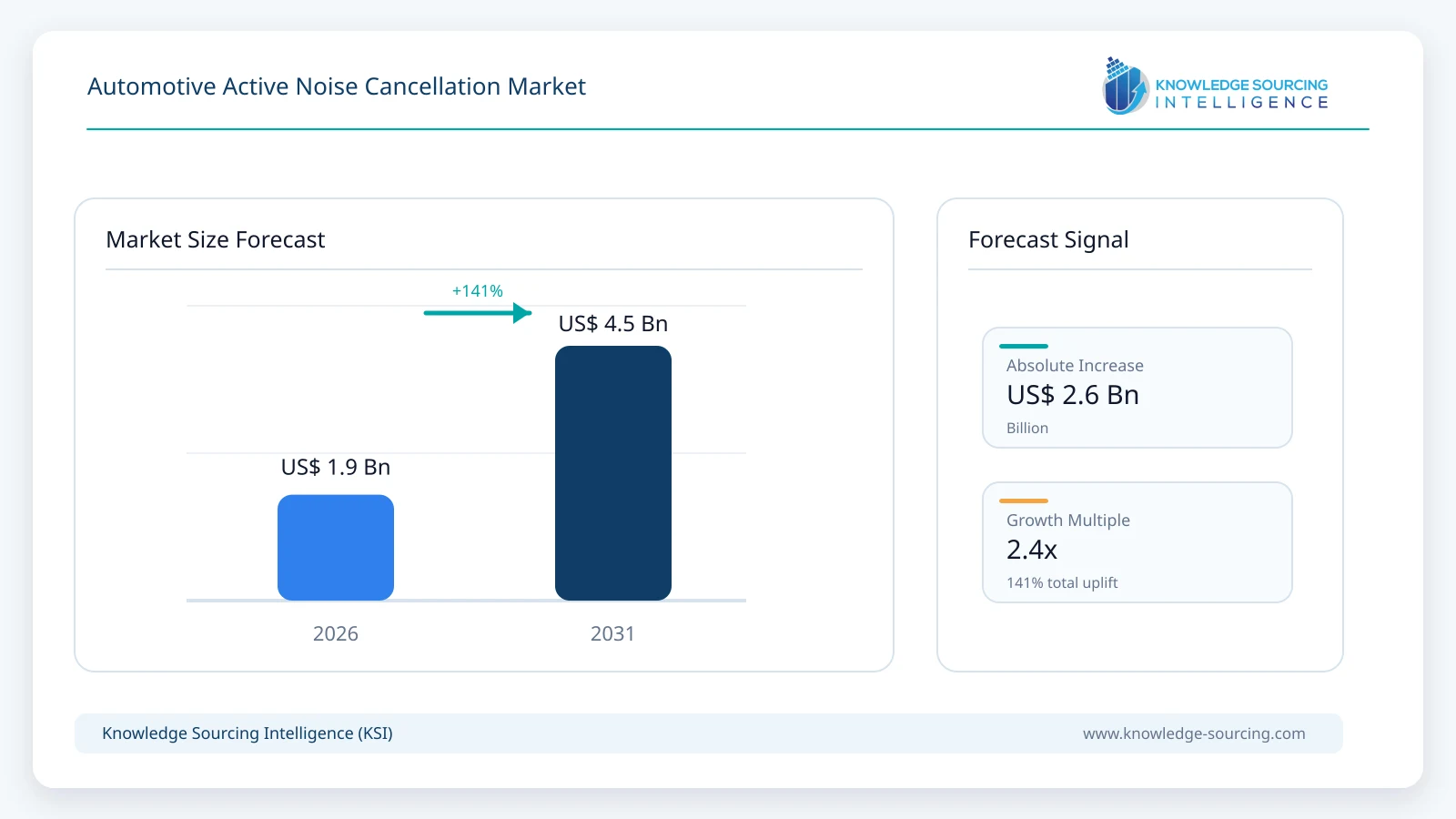
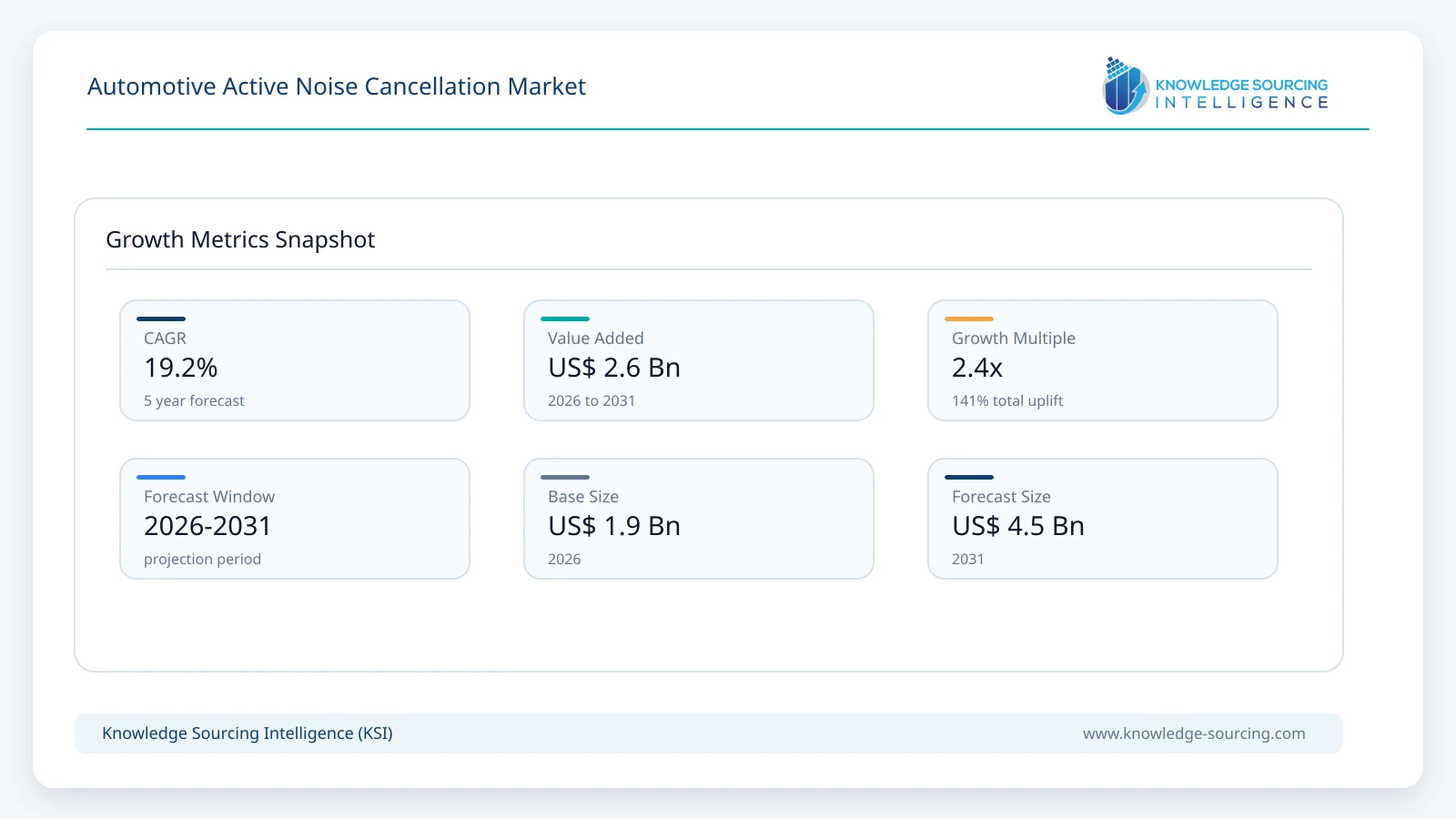
The Automotive Active Noise Cancellation Market is forecast to grow at a CAGR of 19.2%, reaching USD 4.45 billion in 2031 from USD 1.85 billion in 2026.
Highlights:
- 1Hybrid feedforward-feedback ANC accounts for approximately 60% of global market value in 2026 because it combines predictive reference signals with cabin error correction across changing vehicle conditions.
- 2Road and tire noise cancellation represents approximately 57% of 2026 market value, equivalent to about USD 1.05 billion and aligned with the separately modelled Automotive Road Noise Cancellation Market.
- 3Hardware and embedded electronics account for approximately 54% of 2026 market value, while software and algorithms are gaining share as microphones, speakers and compute are reused across vehicle functions.
- 4Internal-combustion vehicles account for approximately 48% of 2026 market value because engine harmonic cancellation has an established production base, although electrified vehicles provide the strongest incremental growth.
- 5Passenger vehicles represent approximately 96% of global ANC market value in 2026, reflecting the concentration of advanced active acoustics in premium cars, SUVs and higher-content electrified vehicles.
- 6Asia Pacific represents approximately 46% of global market value in 2026, supported by production programs in Japan and South Korea and expanding smart-cabin and EV content across China.
The market is moving from narrow engine-order cancellation and premium road-noise control toward integrated active-acoustic platforms that manage several noise sources through shared microphones, speakers, and compute.
Production systems increasingly combine feedforward references from engine speed, accelerometers, or other vehicle signals with cabin microphones that measure residual error. Algorithms then generate anti-phase sound through the existing audio system, while newer architectures add broadband control, virtual microphones, occupant-zone targeting, and processing hosted in amplifiers or centralized cockpit computers.
The market includes only hardware, software, calibration, and integration value attributable to active cancellation of unwanted road, tire, engine, driveline, motor, HVAC, and related cabin noise. The previously established road-noise-cancellation market is treated as a direct subset. Passive acoustic materials, glazing, tire foam, and sound synthesis or enhancement are excluded unless required specifically for the ANC function.
Market Overview
Active noise cancellation reduces unwanted cabin sound electronically rather than relying only on mass, insulation, and structural tuning. Road and tire noise is broadband and typically uses vibration references plus cabin microphones, while engine and driveline cancellation can use rotational-speed information to target predictable harmonics. HVAC and auxiliary sources can be controlled either through the main cabin audio system or close to the noise source.
Feedforward control predicts noise from an upstream reference before it reaches the occupant, while feedback control reacts to residual sound measured inside the cabin. Most advanced automotive systems combine both approaches because changing road surfaces, seating positions, tire wear, and cabin conditions make a purely fixed transfer model insufficient.
The commercial direction is toward one active-acoustics layer that can manage road, engine and auxiliary noise across multiple seating zones. Panasonic introduced integrated road-and-engine ANC for the Nissan Elgrand in 2026, while HARMAN, Bose, Silentium and Hyundai-related platforms illustrate the broader move toward software-defined noise control that can share microphones, speakers and centralized processing.
Market Trends
Integrated Multi-Source ANC Is Replacing Single-Function Control
Early production ANC often targeted one predictable source, particularly engine-order noise. Newer systems are combining broadband road and engine control so the same sensing, processing, and loudspeaker architecture can manage several acoustic problems without separate controllers.
Panasonic Automotive Systems introduced an integrated system for Nissan in 2026 that reduces both road and engine noise in a series-hybrid vehicle. This architecture increases software and calibration value while improving the economics of shared sensors and audio hardware.
Broadband and High-Frequency Cancellation Are Expanding the Useful Range
Traditional automotive ANC is strongest at low frequencies where wavelengths are long and passive treatments become heavy. Suppliers are now extending control toward higher-frequency road, tire, and HVAC content using faster processing, localized sensing, and more precise speaker placement.
HARMAN positions High-Frequency RNC for operation up to 1 kHz, while Silentium describes automotive ANC across a similarly broad range. Wider bandwidth raises the importance of latency, adaptive filtering and vehicle-specific acoustic modelling.
ANC Is Moving onto Shared Audio and Software-Defined Compute Platforms
A dedicated ANC ECU is no longer required on every architecture. Modern automotive audio processors and centralized cockpit computers can host cancellation alongside immersive audio, voice processing and sound synthesis when deterministic latency and workload isolation are maintained.
The next generation of SHARC automotive audio processing developed by Analog Devices with Cadence increases available DSP performance for RNC, engine-order cancellation and other in-vehicle audio workloads. Shared compute can lower incremental electronics cost as ANC spreads beyond flagship vehicles.
Virtual Microphones and Occupant-Aware Zones Are Personalizing Quietness
Physical microphones cannot be placed at every occupant ear position, particularly in adjustable seats and multi-row cabins. Virtual microphone algorithms estimate acoustic conditions near the ear from sensors placed elsewhere and can improve cancellation depth without a proportional increase in hardware.
Nissan has added zone control that can focus noise reduction on occupied or selected seating areas. Combining this approach with seat occupancy or cabin-monitoring information supports personalized quiet zones and more efficient use of speakers and processing resources.
Active and Passive NVH Are Being Co-Optimized
ANC is increasingly engineered together with passive insulation, damping, acoustic glazing and tire treatments rather than as an isolated feature. Active control is most valuable where low-frequency countermeasures would otherwise require additional mass or create chassis and packaging trade-offs.
The strongest vehicle programs retain passive treatment for high-frequency leakage and broad isolation while using software to target selected low-frequency and tonal problems. This makes acoustic performance per kilogram a more important design metric than either passive or active content alone.
Segment Analysis
By Control Architecture: Hybrid Feedforward-Feedback ANC
Hybrid feedforward-feedback systems lead because predictive reference signals provide fast control while cabin microphones correct for changing transfer paths. The architecture can accommodate road vibration, engine speed, and other references while continuously adapting to actual residual noise.
The segment is estimated at approximately USD 1.11 billion in 2026 and could reach about USD 2.89 billion by 2031. Its share increases as multi-source and broadband ANC require both rapid prediction and closed-loop correction.
By Noise Source: Road and Tire Noise Cancellation
Road and tire noise cancellation is the largest application because low-frequency structure-borne rumble is difficult to suppress efficiently with lightweight passive materials and becomes more apparent as powertrains become quieter. Premium EVs and SUVs have provided a visible production base.
The segment is estimated at approximately USD 1.05 billion in 2026 and is projected to reach about USD 2.75 billion by 2031. This value is kept identical to the established Automotive Road Noise Cancellation Market so the parent-child model reconciles without double counting.
By Offering: Hardware and Embedded Electronics
Hardware remains the largest value pool because ANC requires microphones, accelerometers or other references, audio amplification, speakers and processing capacity even when many components are shared with infotainment. Production validation also depends on automotive-grade signal-chain performance.
Hardware and embedded electronics account for approximately USD 1.00 billion in 2026 and could reach around USD 2.00 billion by 2031. Software grows faster as centralized compute and reusable audio hardware shift more incremental value toward algorithms, tuning and lifecycle support.
By Propulsion: Internal-Combustion Engine Vehicles
Internal-combustion vehicles remain the largest propulsion segment in 2026 because engine-order and harmonic cancellation has been deployed for years on premium sedans and SUVs. ANC can reduce low-frequency engine and driveline boom without adding large passive mass or mechanical countermeasures.
ICE vehicles account for approximately USD 0.89 billion in 2026. Their share falls substantially through 2031 as battery-electric and hybrid vehicles adopt more road-noise and auxiliary-noise control, even though engine-related ANC remains relevant on downsized and cylinder-deactivation powertrains.
By Vehicle Type: Passenger Vehicles
Passenger vehicles dominate because active acoustics is closely linked to cabin refinement, premium audio, and occupant sensitivity to road, engine, and HVAC noise. Luxury sedans, SUVs and high-content EVs have been the earliest adopters, with gradual migration toward upper-mainstream platforms.
Passenger vehicles represent approximately USD 1.78 billion in 2026 and are expected to exceed USD 4.18 billion by 2031. Commercial-vehicle adoption remains smaller but can expand where long duty cycles create a business case for fatigue reduction and clearer in-cabin communication.
Market Drivers
Electrification Is Changing the Cabin Noise Mix
Electric propulsion removes continuous combustion masking and makes road, tire, wind, HVAC, and auxiliary sounds more noticeable. Hybrid vehicles create an additional challenge because the acoustic environment changes as the engine cycles on and off across different operating states.
ANC gives OEMs a software-based way to manage this changing noise signature. Road-noise control grows with BEV penetration, while integrated road-and-engine systems improve refinement in hybrids without relying solely on heavier passive packages.
Lightweighting and Efficiency Targets Favor Active Control
Traditional low-frequency countermeasures can require dense barriers, dampers, and tuned mechanical solutions that add weight. Added mass works against fuel economy, electric range, and vehicle dynamics, particularly on premium EVs with large battery packs.
Bose, HARMAN and Silentium all position ANC as a complement to or partial substitute for selected passive measures. The value proposition strengthens when a vehicle already contains the microphones, speakers, and compute needed for other cabin functions.
Premium Cabin Refinement Is Becoming a Stronger Differentiator
Quietness influences perceived vehicle quality, speech intelligibility, phone-call clarity, and the performance of premium audio. As powertrain performance and digital features converge, a controlled acoustic environment becomes a visible part of luxury and smart-cabin differentiation.
ANC can reduce unwanted sound without making the cabin unnaturally silent. Modern systems increasingly preserve conversation, music and warning tones while selectively suppressing the frequencies and zones that create fatigue or reduce perceived refinement.
Shared Audio Compute and Sensor Reuse Are Improving System Economics
Centralized audio processors can host ANC together with immersive sound, voice, communication, and sound-synthesis functions. Shared microphones, amplifiers and speaker channels reduce the incremental hardware needed to add cancellation to an already high-content cockpit.
Higher DSP performance also supports wider bandwidth and more zones. This lowers the cost per function and makes software licensing, calibration and platform portability increasingly important parts of supplier value creation.
Complex Vehicle Architectures Create More Acoustic Problems for Software to Solve
Larger wheels, low-profile tires, lightweight body structures, downsized engines, cylinder deactivation and electrified auxiliaries can create noise signatures that are difficult to address with one passive package. The mix also changes substantially by drive mode and road condition.
Active control gives engineers another tuning variable late in development and over the vehicle lifecycle. Software can target specific harmonics or conditions without redesigning the complete body or acoustic package, improving flexibility across derivatives.
Market Restraints
Vehicle-Specific Calibration and Transfer-Path Complexity
ANC performance depends on body stiffness, suspension layout, powertrain configuration, speaker response, seat position, and cabin acoustics. A control model that works well in one derivative can require substantial retuning when wheel, tire, trim, or powertrain specifications change.
This creates a meaningful engineering burden before production approval. Calibration must remain stable across road surfaces, temperatures, vehicle loading, component aging, and audio configurations, limiting the economics on low-volume platforms.
Latency and Stability Requirements Are Difficult to Maintain
Effective cancellation requires sensing, processing and speaker output to occur within tight timing limits. Shared processors and vehicle networks can introduce variable delay, while wider bandwidth makes phase error increasingly damaging to cancellation performance.
Poorly controlled adaptive filters can create audible artifacts or even amplify noise. Suppliers therefore need deterministic processing, stable algorithms and careful resource management when ANC shares compute with other cockpit workloads.
Incremental Sensors, Microphones and Audio-System Capability Add Cost
ANC can reuse much of the vehicle audio system, but robust implementations still need sufficient microphone coverage, reference sensing, processing headroom and amplifier output. Entry vehicles may not already contain the required speaker architecture or compute capability.
The cost barrier declines as microphones and audio processors become standard for voice and smart-cabin functions. Until then, penetration remains concentrated in vehicles where cabin refinement and premium audio can justify the additional engineering and hardware.
Cancellation Remains Limited by Frequency and Occupant Position
Active cancellation is strongest at lower frequencies and around controlled listening positions. At higher frequencies the acoustic field changes over shorter distances, making it harder to generate the correct anti-noise simultaneously for multiple occupants.
Virtual microphones, headrest speakers and zone control improve this limitation but increase complexity. Passive materials remain necessary for many airborne and high-frequency paths, so ANC cannot replace the broader NVH package.
Music, Speech and Safety-Relevant Sounds Must Remain Intact
ANC operates in the same cabin used for entertainment, navigation prompts, phone calls, emergency sirens and warning tones. Algorithms must suppress unwanted sound without cancelling or distorting desirable information in overlapping frequency ranges.
The requirement becomes more demanding as functions are updated over the air. Audio integrity, cybersecurity, regression testing and clear separation of safety-relevant signals are necessary over a vehicle lifecycle that can exceed a decade.
Regional Outlook
Asia Pacific
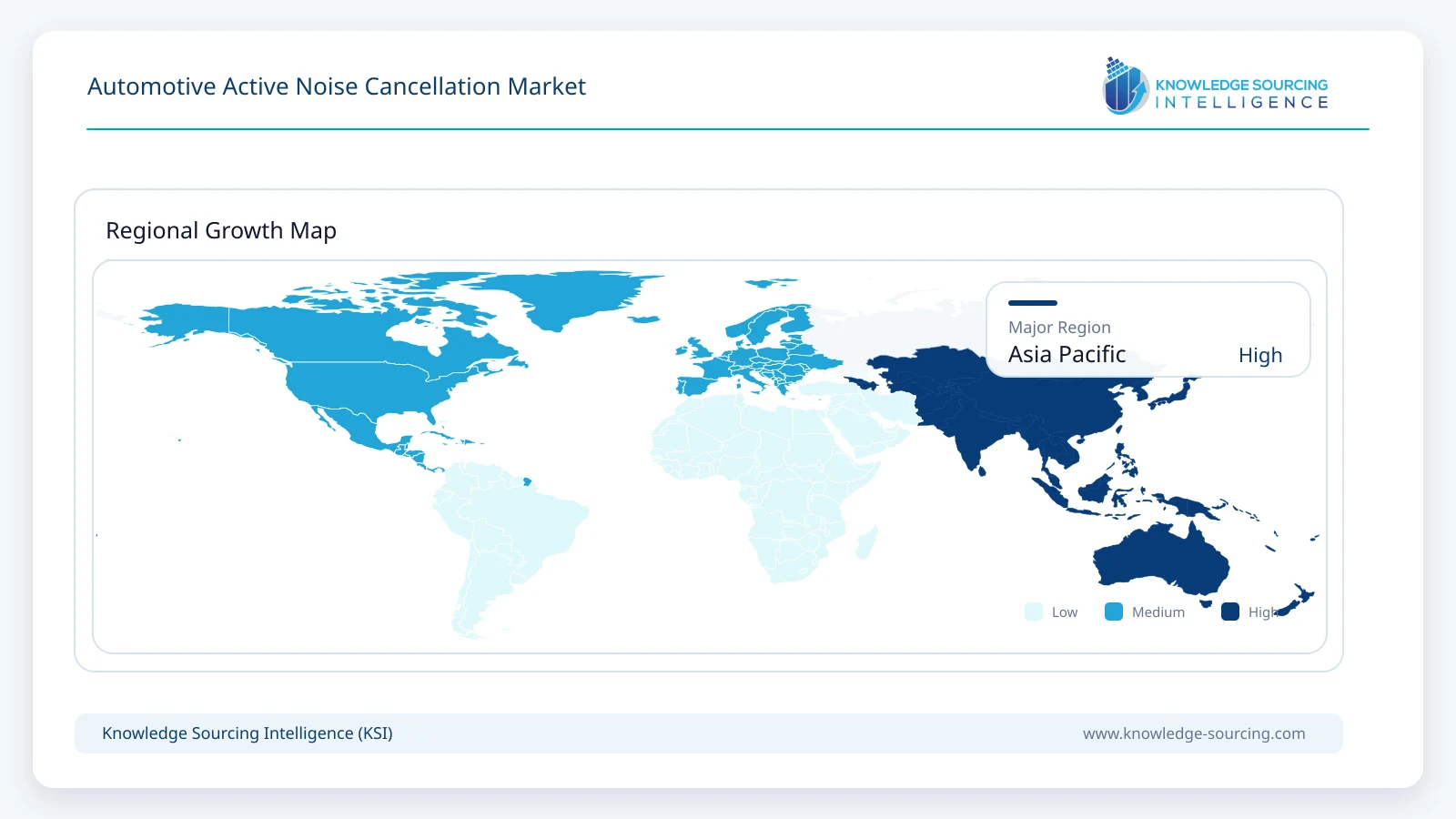
Asia Pacific is the largest regional ANC market, accounting for approximately 46% of global value in 2026. Japan and South Korea have visible production programs spanning road and engine cancellation, while China is rapidly increasing smart-cabin, premium-audio and EV content.
Panasonic Automotive Systems reports ANC adoption across more than 60 vehicle models from five or more automakers, while Nissan, Hyundai Motor Group, Genesis and Hyundai Mobis continue to expand active acoustic functions. Regional growth through 2031 will be supported by EV production scale and fast cockpit-electronics adoption.
North America
North America is the second-largest high-value market, supported by premium SUVs, pickup-derived luxury vehicles and long-standing integration of engine harmonic cancellation with branded audio systems. Bose and HARMAN also provide strong local technology and vehicle-program support.
Growth will increasingly shift toward broadband road-noise cancellation as EV and hybrid penetration rises. The region also benefits from high premium-audio fitment, giving OEMs more opportunity to reuse existing speakers, microphones and amplifiers for ANC rather than install a stand-alone acoustic system.
Competitive Landscape
The automotive ANC market combines automotive audio suppliers, specialist active-acoustic software companies, Tier 1 electronics providers and semiconductor vendors. HARMAN and Bose offer broad road- and engine-noise management portfolios, while Panasonic Automotive Systems has expanded production ANC across Japanese and global OEM programs.
Silentium competes through software-centric road and engine cancellation that can be embedded in existing audio and compute platforms; its October 2026 filing disclosed deployment across approximately 1.8 million vehicles and 26 models from five OEMs. Hyundai Mobis adds system integration, while Analog Devices and NXP provide signal-processing and automotive compute foundations.
Competitive advantage is moving toward broader cancellation bandwidth, multi-source control, calibration efficiency, and portability across vehicle electronics. Suppliers able to reuse existing microphones, speakers, and processors while supporting virtual sensing, zone control and OTA lifecycle tuning can lower incremental cost and scale ANC beyond premium flagship models.
Recent Developments
6 October 2026: Silentium disclosed that its commercialized road- and engine-noise cancellation software had been deployed in approximately 1.8 million vehicles across 26 vehicle models and five automakers as of September 30, 2026.
18 September 2026: Panasonic Automotive Systems announced an integrated Advanced Active Noise Control system that simultaneously reduces road and engine noise in series-hybrid vehicles, with first production adoption on Nissan's all-new Elgrand.
15 September 2026: Cadence announced that its Tensilica DSP IP was integrated into Analog Devices' next-generation SHARC automotive audio architecture, providing substantially higher processing performance for RNC, engine-order cancellation and other audio workloads.
July 2026: Nissan detailed its Advanced Active Noise Control technology, combining simultaneous road- and engine-noise reduction with Zone Control that can concentrate cancellation around occupied or selected seating areas.
25 March 2026: Genesis detailed the GV60 Magma NVH package with Active Noise Control-Road, using accelerometers, cabin microphones and the vehicle speaker system to suppress low-frequency road noise in a high-performance EV.
Market Outlook
The automotive active noise cancellation market is expected to expand from approximately USD 1.850 billion in 2026 to about USD 4.452 billion by 2031. Road and tire cancellation remains the largest application and reaches the previously established USD 2.75 billion by 2031, while integrated engine, powertrain, and auxiliary-noise control adds incremental value.
The largest structural change will be the migration from dedicated single-source ANC toward shared active-acoustic software running on audio amplifiers or centralized vehicle compute. Hardware remains important, but software algorithms, calibration and reusable platform integration capture a larger share as microphones and speakers are shared across cabin functions.
Asia Pacific is expected to remain the largest regional market, with North America retaining a strong premium-audio and active-sound-management base. Supplier success will depend on low-latency execution, multi-source control, wider bandwidth, efficient vehicle calibration and the ability to preserve music, speech and safety sounds while suppressing unwanted noise.
Automotive Active Noise Cancellation Market Scope:
| Report Metric | Details |
|---|---|
| Total Market Size in 2026 | USD 1.85 billion |
| Total Market Size in 2031 | USD 4.45 billion |
| Forecast Unit | USD Billion |
| Growth Rate | 19.2% |
| Study Period | 2021 to 2031 |
| Historical Data | 2021 to 2024 |
| Base Year | 2025 |
| Forecast Period | 2026 – 2031 |
| Segmentation | Control Architecture, Noise Source, Offering, Propulsion |
| Companies |
|
Market Segmentation
By Control Architecture
Hybrid Feedforward-Feedback ANC
Feedforward-Dominant ANC
Feedback and Adaptive Acoustic-Reference ANC
By Noise Source
Road and Tire Noise Cancellation
Engine and Powertrain Noise Cancellation
HVAC and Auxiliary Noise Cancellation
By Offering
Hardware and Embedded Electronics
Software and ANC Algorithms
Calibration, Integration and Engineering Services
By Propulsion
Internal-Combustion Engine Vehicles
Hybrid and Plug-In Hybrid Vehicles
Battery Electric and Fuel-Cell Electric Vehicles
By Vehicle Type
Passenger Vehicles
Light Commercial Vehicles
Medium and Heavy Commercial Vehicles and Buses
By Geography
North America
United States
Canada
Mexico
South America
Brazil
Argentina
Others
Europe
Germany
United Kingdom
France
Italy
Spain
Others
Middle East and Africa
Saudi Arabia
UAE
South Africa
Others
Asia Pacific
China
Japan
South Korea
India
Indonesia
Thailand
Others
Table of Contents
Table of Contents
1. INTRODUCTION
1.1. Market Overview
1.2. Market Definition
1.3. Scope of the Study
1.4. Market Segmentation
1.5. Currency
1.6. Assumptions
1.7. Base and Forecast Years
1.8. Key Benefits to Stakeholders
2. RESEARCH METHODOLOGY
2.1. Research Design
2.2. Secondary Research
2.3. Primary Research
2.4. Market Estimation
2.5. Segment Modelling
2.6. Data Triangulation and Validation
3. EXECUTIVE SUMMARY
3.1. Key Findings
3.2. Automotive Active Noise Cancellation Market Size, 2026-2031
3.3. Control Architecture Outlook
3.4. Noise Source Outlook
3.5. Offering Outlook
3.6. Propulsion Outlook
3.7. Vehicle Type Outlook
3.8. Regional Opportunity Summary
4. MARKET DYNAMICS
4.1. Market Drivers
4.1.1. Electrification Is Changing the Cabin Noise Mix
4.1.2. Lightweighting and Efficiency Targets Favor Active Control
4.1.3. Premium Cabin Refinement Is Becoming a Stronger Differentiator
4.1.4. Shared Audio Compute and Sensor Reuse Are Improving System Economics
4.1.5. Complex Vehicle Architectures Create More Acoustic Problems for Software to Solve
4.2. Market Restraints
4.2.1. Vehicle-Specific Calibration and Transfer-Path Complexity
4.2.2. Latency and Stability Requirements Are Difficult to Maintain
4.2.3. Incremental Sensors, Microphones and Audio-System Capability Add Cost
4.2.4. Cancellation Remains Limited by Frequency and Occupant Position
4.2.5. Music, Speech and Safety-Relevant Sounds Must Remain Intact
4.3. Market Opportunities
4.4. Porter's Five Forces Analysis
4.5. Industry Value Chain Analysis
4.6. ANC Hardware, Software and Calibration Economics
4.7. Cabin Acoustic Safety, Audio Integrity and Functional Validation
5. TECHNOLOGY OUTLOOK
5.1. Road Noise Cancellation and Broadband Feedforward Control
5.2. Engine Order and Harmonic Cancellation
5.3. HVAC and Auxiliary Noise Cancellation
5.4. Cabin Microphones and Error Sensing
5.5. Accelerometers and Vibration Reference Sensors
5.6. Low-Latency DSP and Automotive Audio Processors
5.7. Hybrid Feedforward-Feedback ANC Algorithms
5.8. Virtual Microphone and Ear-Position Estimation
5.9. High-Frequency ANC and Extended Bandwidth Control
5.10. Zone-Based and Seat-Specific Cancellation
5.11. Automotive Audio Networking and Shared Speaker Architectures
5.12. Software-Defined ANC, OTA Calibration and Lifecycle Tuning
6. AUTOMOTIVE ACTIVE NOISE CANCELLATION MARKET BY CONTROL ARCHITECTURE
6.1. Introduction
6.2. Hybrid Feedforward-Feedback ANC
6.3. Feedforward-Dominant ANC
6.4. Feedback and Adaptive Acoustic-Reference ANC
7. AUTOMOTIVE ACTIVE NOISE CANCELLATION MARKET BY NOISE SOURCE
7.1. Introduction
7.2. Road and Tire Noise Cancellation
7.3. Engine and Powertrain Noise Cancellation
7.4. HVAC and Auxiliary Noise Cancellation
8. AUTOMOTIVE ACTIVE NOISE CANCELLATION MARKET BY OFFERING
8.1. Introduction
8.2. Hardware and Embedded Electronics
8.3. Software and ANC Algorithms
8.4. Calibration, Integration and Engineering Services
9. AUTOMOTIVE ACTIVE NOISE CANCELLATION MARKET BY PROPULSION
9.1. Introduction
9.2. Internal-Combustion Engine Vehicles
9.3. Hybrid and Plug-In Hybrid Vehicles
9.4. Battery Electric and Fuel-Cell Electric Vehicles
10. AUTOMOTIVE ACTIVE NOISE CANCELLATION MARKET BY VEHICLE TYPE
10.1. Introduction
10.2. Passenger Vehicles
10.3. Light Commercial Vehicles
10.4. Medium and Heavy Commercial Vehicles and Buses
11. AUTOMOTIVE ACTIVE NOISE CANCELLATION MARKET BY GEOGRAPHY
11.1. North America
11.1.1. United States
11.1.2. Canada
11.1.3. Mexico
11.2. South America
11.2.1. Brazil
11.2.2. Argentina
11.2.3. Others
11.3. Europe
11.3.1. Germany
11.3.2. United Kingdom
11.3.3. France
11.3.4. Italy
11.3.5. Spain
11.3.6. Others
11.4. Middle East and Africa
11.4.1. Saudi Arabia
11.4.2. UAE
11.4.3. South Africa
11.4.4. Others
11.5. Asia Pacific
11.5.1. China
11.5.2. Japan
11.5.3. South Korea
11.5.4. India
11.5.5. Indonesia
11.5.6. Thailand
11.5.7. Others
12. COMPETITIVE ENVIRONMENT AND ANALYSIS
12.1. Major Players and Strategy Analysis
12.2. Market Share Analysis
12.3. Road-Noise versus Engine/Powertrain ANC Benchmarking
12.4. Feedforward versus Hybrid Control Architecture Comparison
12.5. Hardware versus Software Value Architecture Benchmarking
12.6. Sensor, Microphone and Audio-Compute Architecture Benchmarking
12.7. OEM Programs and Production Readiness
12.8. Competitive Dashboard
13. COMPANY PROFILES
13.1. HARMAN International
13.2. Bose Corporation
13.3. Panasonic Automotive Systems Co., Ltd.
13.4. Silentium Ltd.
13.5. Hyundai Mobis Co., Ltd.
13.6. Analog Devices, Inc.
13.7. NXP Semiconductors N.V.
13.8. Nissan Motor Co., Ltd.
13.9. Hyundai Motor Company
13.10. Genesis Motor
14. APPENDIX
14.1. Currency
14.2. Assumptions
14.3. Base and Forecast Years Timeline
14.4. Key Benefits for Stakeholders
14.5. Research Methodology
14.6. Abbreviations
14.7. Data Sources
Navigate
Trusted by the world's leading organizations











