
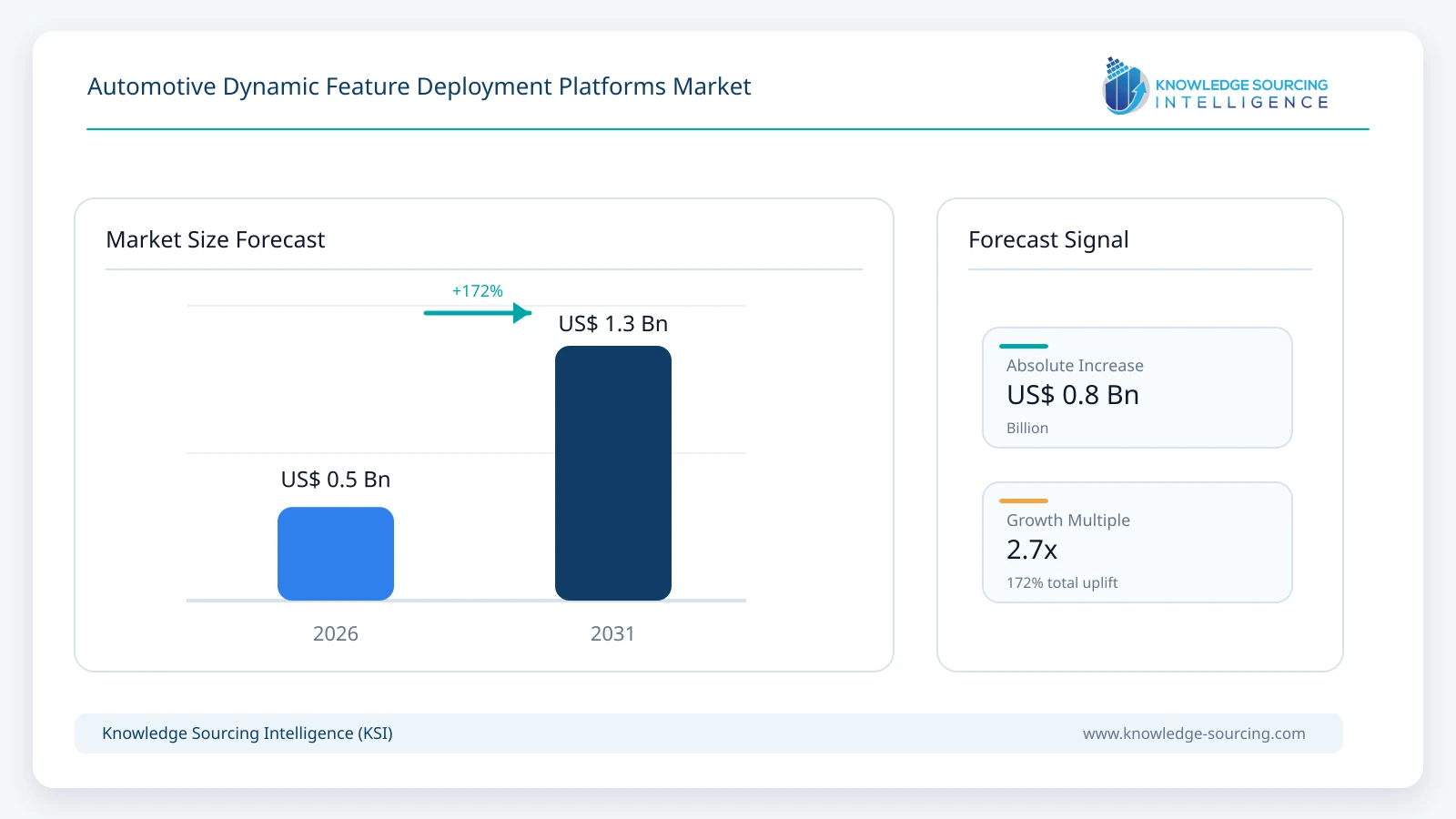
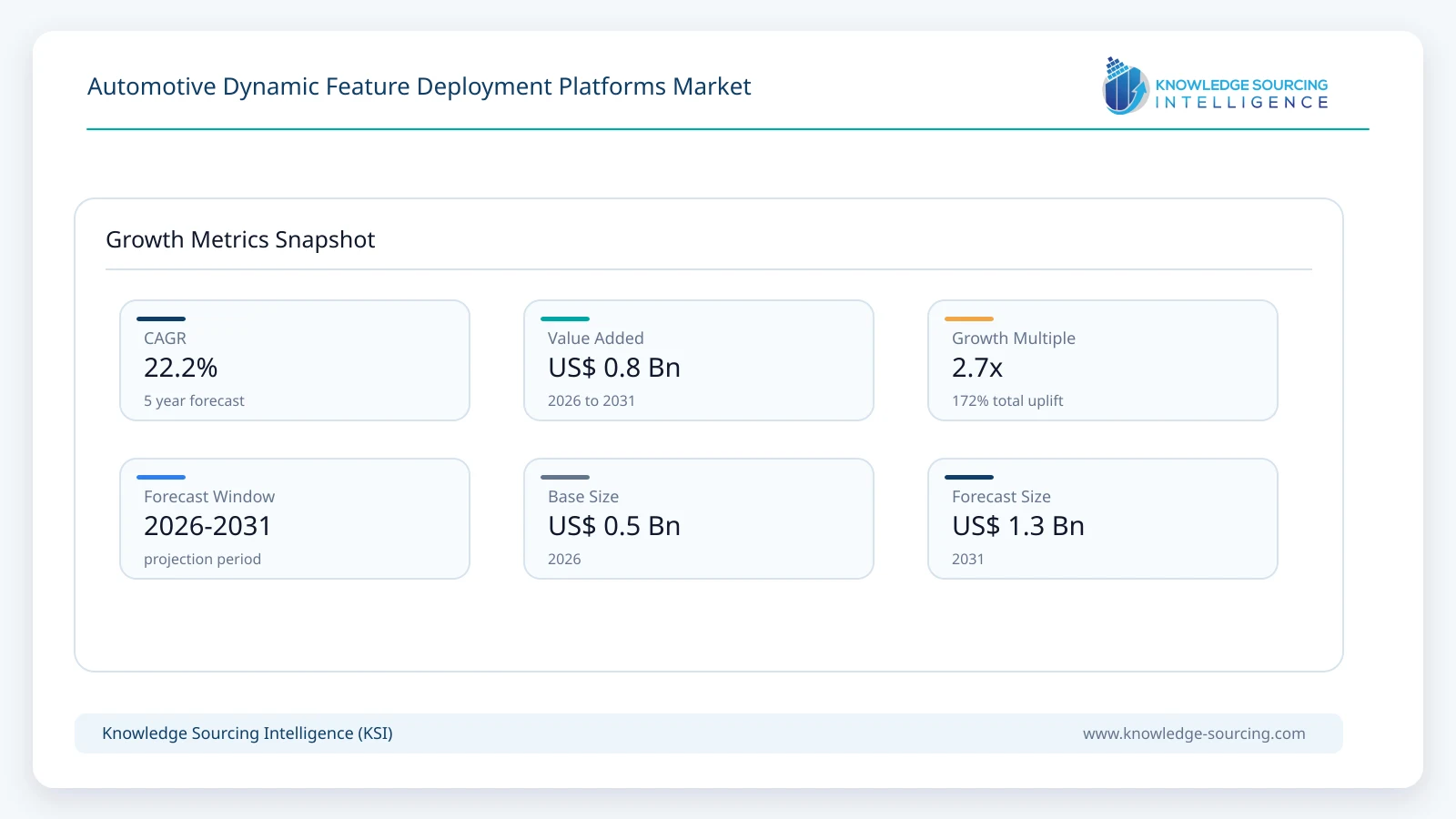
The automotive dynamic feature deployment platforms market is projected to grow from USD 0.47 billion in 2026 to USD 1.28 billion by 2031, expanding at an annual rate of approximately 22.2% during the forecast period.
Highlights:
- 1The market is estimated at USD 470 million in 2026 and USD 1.28 billion in 2031, equivalent to 22.2% annual growth.
- 2Vehicle feature policy and remote configuration form the largest platform-capability segment in 2026.
- 3Feature entitlement and activation gains share as automakers introduce paid upgrades, trials and market-specific software variants.
- 4Passenger vehicles account for approximately 90% of market revenue in 2026, while commercial fleets gain relevance through 2031.
- 5Asia Pacific represents the largest regional value pool, supported by software-rich vehicles produced in China, South Korea and Japan.
- 6Release governance, safety evidence and reliable rollback remain as important to platform purchasing as deployment speed.
Dynamic feature deployment platforms allow automakers to activate or change vehicle functions after production through software entitlements, configuration rules and targeted packages. An existing capability can be enabled without new code, while a new application may need a signed package and installation checks. Each method depends on accurate vehicle inventories, compatibility testing and release controls. Manufacturers can therefore manage functions across model variants without changing the underlying hardware.
Sonatus Automator and Updater illustrate the difference between changing operating rules and managing software-package dependencies. Excelfore's eSync handles feature authorization and package management, while HARMAN connects update infrastructure with its Ready Link Marketplace and Aptiv LINC supports application lifecycles. Hyundai's IONIQ 9 demonstrates the customer-facing result through downloadable display themes, lighting patterns and a virtual gear-shift function. These tools cover different parts of delivery rather than offering identical products.
Automakers decide which functions can be enabled, how they may operate and what evidence is needed to approve a change. OTA specialists, middleware providers and Tier 1 integrators support configuration checks, release records and long-term maintenance. UNECE Regulation No. 156 sets software-update management requirements for vehicle programs within its scope. Competition therefore depends on compatibility, traceability and dependable integration, not simply the ability to transmit an update.
Market Trends
Remote configuration is reducing dependence on full software releases
Remote configuration works when a feature is already present and has approved software controls. Sonatus Automator distributes condition-based routines without rebuilding complete firmware images. Smaller policies can change selected comfort settings and service workflows while reducing data transfer for narrowly targeted releases.
Many functions still require firmware or application changes, particularly where underlying control logic is missing. Suppliers must select the release method that suits each feature. Platforms that combine remote configuration with signed application and firmware packages are better suited to diverse production fleets.
Feature rights are becoming part of vehicle software management
Post-sale digital upgrades require software rights to remain tied to the correct vehicle. Hyundai's Bluelink Store provides selected IONIQ 9 upgrades, while Excelfore manages package installation and subscribed feature authorization. Both approaches depend on accurate ownership, entitlement and configuration records.
An entitlement system must remain consistent when a car changes ownership, travels between countries or loses network access. Suppliers need durable vehicle identity, offline authorization and reconciled storefront records. These are distinct software functions from the feature itself, which may be developed by the automaker or another supplier.
Central computers are changing how features reach different ECUs
Centralized vehicle computing allows an individual feature to depend on several software services rather than code residing on one dedicated controller. Aptiv LINC manages container-based application lifecycles, while ETAS supplies foundations intended to improve software portability across vehicle programs. A deployment platform consequently needs to check service dependencies, available computing resources and startup sequences before changing an application.
Legacy CAN-linked controllers will remain in the vehicle fleet for years, so OEMs also need gateways into traditional ECU update methods. The same feature may need configuration on a new platform but a binary replacement on an older ECU. Platform reuse is valuable only when these differences are managed explicitly.
Controlled release and recovery are taking priority over rollout speed
Automakers need to verify software releases before distributing them to a wider fleet. HARMAN's January 2026 announcement combined OTA and Smart Delta technology with deployment validation, while Sonatus Updater supports campaign dry runs, dependencies and traceability. These controls help limit the consequences of a failed package or incompatible vehicle configuration.
Feature rollout has to handle a vehicle that loses power, enters a fault state or is in use when an update is scheduled. Staged deployment, health checks and rollback conditions can reduce field incidents, but safety-related functions may also require formal reassessment. Suppliers compete on release control and verifiable results.
Software platforms are reaching additional vehicle functions
Software deployment tools are extending toward vehicle functions beyond entertainment and cabin settings. Schaeffler and Sonatus announced a June 2026 partnership covering control units, AI model deployment and data collection. The agreement broadens the development pipeline but does not establish series-production adoption across fleets.
Functions touching energy management, driver assistance or motion control impose more demanding qualification requirements than display themes or entertainment settings. Convenience functions will therefore scale before deeply integrated vehicle controls are fully qualified.
Automotive Dynamic Feature Deployment Platforms Market Segment Analysis
By Platform Capability
Vehicle Feature Policy and Remote Configuration
Vehicle feature policy and remote configuration represent approximately 37% of global platform revenue in 2026. These tools adjust authorized settings, trigger defined routines and manage existing capabilities without replacing application code. Sonatus Automator is relevant where an OEM already provides stable vehicle interfaces, allowing a common platform to support numerous small customer and service changes.
Configuration changes have relatively low transfer and installation requirements, which helps this segment retain a leading position. Their use is nevertheless limited by the functions already available in the vehicle and the range of parameters an OEM permits to be changed. Suppliers must validate those boundaries and prevent unauthorized access, particularly when configuration affects vehicle-control behavior.
By Platform Capability
Entitlement and Feature Activation
Entitlement and feature activation account for an estimated 28% of platform revenue in 2026 and around 31% in 2031. The platform connects a purchase, trial or subscription with the capabilities authorized for an individual vehicle. Excelfore's feature-on-demand tools and Hyundai's digital upgrades illustrate the need to align customer rights with installed packages, vehicle identity and activation records.
Growth follows the number of vehicles enabled for post-sale upgrades. Users may buy performance, comfort or content features at widely different prices, but the deployment platform captures only its software and service consideration. OEMs will evaluate suppliers on the reliability of activation, entitlement transfer and cancellation handling.
By Delivery Method
Installable Feature and Container Packages
Installable applications and feature packages represent approximately 31% of revenue within the 2026 primary delivery-method model. This approach is required when functionality is absent from the original vehicle software or spans several components. HARMAN's OTA technology supports different software asset types, while Aptiv's container management addresses the lifecycle of modular applications on shared computing platforms.
The installable-package share is projected to reach approximately 36% by 2031 as consolidated computing makes modular application deployment more practical. Containerization can simplify software packaging, but it does not remove qualification work for each processor, operating system and safety configuration. Inventory control, prerequisite checks and reliable rollback remain necessary for production use.
By Vehicle Type
Passenger Vehicles
Passenger vehicles account for roughly 90% of platform revenue in 2026 because higher-volume connected car programs and premium digital services create a broad first-fit software base. Hyundai, BMW and other brands sell or provide post-sale features, while suppliers deliver enabling software behind the customer interface. OEM vehicle-software teams usually make the purchasing decision.
Commercial vehicle share expands gradually as fleet operators seek remote configuration of operating policies, diagnostics and selective software functions. Unlike consumer subscriptions, fleet purchasers typically value uptime, consistent vehicle configuration and maintenance efficiency. The same platform can serve both segments under different contracts.
Market Drivers
Manufacturers are shipping vehicles with upgradeable software architectures
Automakers that standardize vehicle software interfaces can introduce selected functions after production rather than fixing every configuration at the factory. ETAS and Aptiv supply development and lifecycle technologies that support this separation of software and hardware. A reusable deployment framework reduces the number of bespoke releases required across a manufacturer's vehicle lines.
Deployment spending grows when an OEM moves from a single connected model to a common vehicle platform serving several brands or regions. One framework must then track hardware readiness, software version and feature availability for each model. The commercial value comes from lower integration effort per subsequent vehicle program and more dependable post-sale changes.
Post-sale digital upgrades require dependable entitlement management
Digital upgrade stores need a link between the customer purchase and the vehicle software eligible to run the function. Hyundai's IONIQ 9 and HARMAN's Ready Link Marketplace illustrate customer-facing delivery, but the transaction also needs authorization, successful activation and a reliable vehicle record.
As automakers extend trials and paid upgrades across more models, activation reliability and account reconciliation become recurring operating requirements. Suppliers able to integrate vehicle entitlement records with existing service platforms can support this expansion without capturing the full retail value of the underlying options.
Smaller software changes improve vehicle lifecycle economics
Large software images are not always necessary to change how an existing vehicle function operates. Sonatus uses policy routines for authorized configuration changes, while HARMAN's differential update technology reduces the data transferred for suitable software replacements. Targeted delivery can lower mobile-data usage and help manufacturers control which vehicles receive a change.
Cost savings are most meaningful when deployment volume is high and the targeted function already exists in vehicle software. Completely new code still requires signed packages, memory capacity and validation. OEMs consequently prefer suppliers that can select efficiently between configuration, entitlement-only activation and full software installation.
Software update governance is becoming a regular vehicle requirement
UNECE Regulation No. 156 sets requirements for software updates and their management systems in applicable vehicle approvals. Manufacturers must preserve records, control compatibility and manage update effects, making release governance more than a convenience function. This raises the value of traceable vehicle software inventories and documented deployment outcomes.
Staged campaigns, software dependencies and recovery procedures are especially important when an upgrade interacts with regulated vehicle systems. Suppliers with automotive validation and cybersecurity experience are better positioned than generic application deployment tools that lack the required vehicle-specific controls.
Software-rich regional programs are broadening the production base
More connected vehicle programs in China, South Korea, Japan, Europe and the United States support post-sale feature deployment. Sonatus described use across several million production vehicles in January 2026, while HARMAN has reported extensive OTA fleet experience. These installed-base claims support commercialization, not a direct estimate of annual deployment-platform revenue.
Broader platform use supports licensing revenue from additional vehicle programs and long-term engineering support. The strongest demand is expected where OEMs control a common software stack and plan continued feature enhancement, rather than relying on one-off service-center programming.
Market Restraints
Mixed vehicle electronics make features hard to reproduce consistently
Vehicle fleets combine legacy ECUs, domain computers and zonal controllers that use different software packaging and update methods. A function available on one model may be absent on another because the necessary hardware or control software was never installed. Automakers must therefore validate eligibility at vehicle and equipment-variant level before offering the same feature across a fleet.
Supporting several generations increases integration and regression-testing expense. Generic deployment frameworks can move files, but automotive specialists must also verify hardware dependencies, diagnostic responses and vehicle-state conditions. This slows the introduction of features across older fleets.
Safety-relevant changes extend qualification and approval work
Deploying new convenience settings is not equivalent to changing a steering, braking or driver-assistance function. Updates affecting safety behavior require evidence that permitted operating limits, timing and failure responses remain valid. Automakers may delay a planned feature while engineering and approval teams resolve these questions.
The additional work restricts how rapidly suppliers can extend feature deployment into core vehicle-control systems. Staged campaigns and rollback tools reduce operational risk but do not replace formal validation, safety cases or regulatory obligations. This limits the revenue available from advanced features in the near term.
Consumer acceptance of paid upgrades remains uneven
Subscription eligibility, ownership transfers and the difference between a purchased function and a temporary entitlement can create customer confusion. Manufacturers must explain which capabilities are included at sale and which require later payment. Unpopular pricing arrangements may lead OEMs to offer fewer paid activations than technically possible.
Platform vendors are affected indirectly because fewer commercial feature programs reduce demand for entitlement integration and ongoing activation operations. Free software improvements still require deployment controls, so this restraint affects the commercial mix more than it eliminates the underlying platform requirement.
Offline vehicles and incomplete rollout records can disrupt campaigns
Vehicles may be parked without reliable cellular coverage, with low battery state or with owners declining an update. A feature deployment system must handle interrupted transfers, delayed installation and entitlement decisions while disconnected. HARMAN and Sonatus emphasize traceability and recovery because this operating environment differs markedly from an always-connected enterprise server.
Regional mobile costs and connectivity differences complicate fleet-scale scheduling and verification. OEMs may retain dealership-based routes for some functions, reducing the portion of updates managed entirely through dynamic remote activation platforms. Suppliers need to show completion rates and recovery behavior rather than only theoretical bandwidth savings.
OEM software ownership creates pressure on independent licensing
Large automakers increasingly develop proprietary feature catalogs, cloud services and release-management tools. Open vehicle interfaces and reusable middleware may reduce reliance on a single proprietary platform supplier. This can limit per-vehicle software fees even while the overall number of connected deployments expands.
Independent vendors must differentiate through automotive certification, cross-platform integration and ongoing technical accountability. Supplier revenue can also be recognized partly in program engineering rather than a uniform per-vehicle fee, making competitive pricing less transparent. These conditions favor firms able to demonstrate measurable deployment reliability across vehicle generations.
Regional Outlook
Asia Pacific
Asia Pacific accounts for an estimated 39% of dynamic feature deployment platform value in 2026, reflecting the scale of connected-vehicle programs in China, Japan and South Korea. Hyundai's IONIQ 9 illustrates one commercial application through purchasable digital upgrades, while regional manufacturers continue to develop updateable electronic architectures. Large production programs allow software suppliers to reuse configuration and activation systems across multiple models.
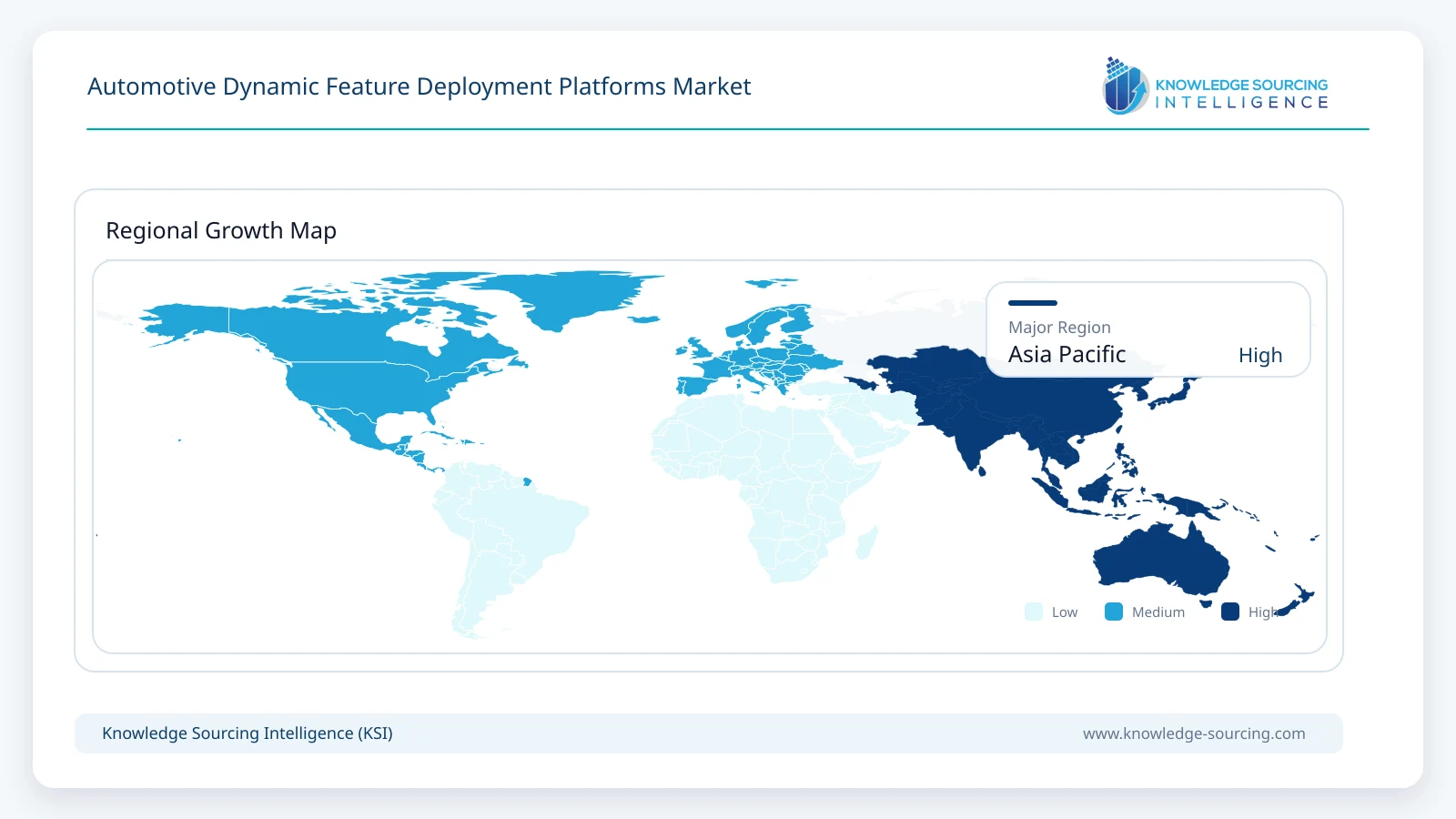
KSI expects Asia Pacific's share to reach approximately 44% by 2031, supported by additional software-defined vehicle programs and expansion into mid-market cars. Japan's electronics and systems-engineering base, South Korea's global vehicle programs and China's intensive product-refresh cycles each contribute through different supplier relationships. Software localization, regional cloud requirements and differences in model equipment remain important commercial constraints.
Europe
European OEM programs increasingly require controlled software changes across premium and higher-volume vehicles. HARMAN, ETAS and Vector provide relevant embedded software, update and release-management technologies, while vehicle brands continue testing customer demand for post-sale digital functions. Supplier opportunities depend on how consistently those functions can be installed and maintained across different vehicle lines.
Europe accounts for an estimated 31% of the 2026 platform market and around 28% in 2031 as faster Asian volume expansion changes the regional balance. UNECE update management requirements contribute to the focus on documented software changes, staged releases and security controls. These requirements can increase program complexity but also create continuing demand for suppliers able to integrate deployment, software inventory and validation processes.
Competitive Landscape
Dynamic feature deployment brings together specialist update-platform providers and suppliers with broader embedded automotive software portfolios. Sonatus focuses on configurable vehicle routines and update management, Excelfore connects software packages with feature authorization, and Sibros provides OTA campaign and remote-vehicle operations. Their competitive position depends on integration flexibility, dependable releases and support for different automotive electronic architectures.
Larger suppliers such as HARMAN, Aptiv, ETAS, Vector and Elektrobit compete through related runtime software, system integration and long-term platform maintenance. HARMAN also offers customer-facing distribution through Ready Link Marketplace, while Aptiv LINC manages the lifecycle of embedded applications. Automakers retain ownership of many digital services and part of the software engineering, limiting the revenue available to external providers.
Vehicle makers select deployment suppliers based on compatibility checks, secure entitlements and verifiable installation results. Contract value may come from licenses, program engineering or lifecycle services, often within a broader software-defined vehicle agreement. Suppliers seldom disclose deployment-platform sales separately.
Recent Developments
September 2026: Sonatus and Hagiwara Electronics agreed to distribute and pre-integrate Sonatus technology across multiple markets, extending access to lifecycle vehicle software capabilities through Hagiwara's integration network.
June 2026: Schaeffler and Sonatus announced a partnership to integrate Collector AI and AI Director into control units, supporting future delivery and management of vehicle-edge functions. This is a partnership, not proof of mass deployment.
June 2026: ETAS presented its Vehicle Software Platform Suite enabled by Eclipse S-CORE, demonstrating a path toward more portable applications and software foundations. The announced milestone is a technology presentation.
January 2026: HARMAN introduced enhancements to its SDV execution stack, combining Ready CQuence tools, OTA/Smart Delta and Ready Link Marketplace for lifecycle deployment and upgradeable services.
January 2026: Sonatus outlined a CES demonstration with Bosch pairing its update and data tools with personalized features-on-demand; the announcement describes a demonstration rather than an awarded production feature program.
September 2025: Vector launched SDx Cloud, combining vehicle-cloud connectivity, update delivery and service management for software-defined systems.
Market Outlook
Software-defined vehicle programs are expected to bring post-sale feature changes to more models rather than reserve them for individual premium launches. Cabin settings and customer-facing applications are easier to upgrade initially, while deeper control functions will require stronger safety evidence and software modularity. Suppliers combining vehicle integration with dependable backend release management will be better placed to support this transition.
Centralized and zonal architectures will allow more applications to be updated as packages or configured through shared service interfaces. Deployment platforms will nevertheless need to accommodate existing ECU generations, offline vehicles and changing regulatory requirements. Platform growth will follow OEM adoption and software content per eligible vehicle.
Automotive Dynamic Feature Deployment Platforms Market Scope:
| Report Metric | Details |
|---|---|
| Total Market Size in 2026 | USD 0.47 billion |
| Total Market Size in 2031 | USD 1.28 billion |
| Forecast Unit | USD Billion |
| Growth Rate | 22.2% |
| Study Period | 2021 to 2031 |
| Historical Data | 2021 to 2024 |
| Base Year | 2025 |
| Forecast Period | 2026 – 2031 |
| Segmentation | Platform Capability, Revenue Component, Primary Delivery Method, Vehicle Type, Geography |
| Companies |
|
Market Segmentation
By Platform Capability
Vehicle Feature Policy and Remote Configuration
Entitlement and Feature Activation
Modular Feature and Package Deployment
Fleet Rollout and Recovery Management
By Revenue Component
Embedded Platform Licenses
Program Integration and Validation
Lifecycle Cloud Operations
By Primary Delivery Method
Configuration and Policy Changes
Installable Application and Feature Packages
Entitlement-Only Activation
By Vehicle Type
Passenger Vehicles
Light Commercial Vehicles
Medium and Heavy Commercial Vehicles
By Geography
North America
United States
Canada
Mexico
South America
Brazil
Argentina
Others
Europe
Germany
United Kingdom
France
Italy
Spain
Others
Middle East and Africa
Saudi Arabia
United Arab Emirates
Israel
South Africa
Others
Asia Pacific
China
Japan
South Korea
India
Indonesia
Thailand
Australia
Taiwan
Others
Table of Contents
1. EXECUTIVE SUMMARY
1.1. Market Opportunity and Key Findings
1.2. 2026–2031 Revenue Outlook
1.3. Platform Capability and Regional Highlights
2. MARKET SNAPSHOT
2.1. Market Overview
2.2. Market Definition
2.3. Scope of the Study
2.4. Market Segmentation
3. BUSINESS LANDSCAPE
3.1. Market Drivers
3.1.1. Manufacturers are shipping vehicles with upgradeable software architectures
3.1.2. Post-sale digital upgrades require dependable entitlement management
3.1.3. Smaller software changes improve vehicle lifecycle economics
3.1.4. Software update governance is becoming a regular vehicle requirement
3.1.5. Software-rich regional programs are broadening the production base
3.2. Market Restraints
3.2.1. Mixed vehicle electronics make features hard to reproduce consistently
3.2.2. Safety-relevant changes extend qualification and approval work
3.2.3. Consumer acceptance of paid upgrades remains uneven
3.2.4. Offline vehicles and incomplete rollout records can disrupt campaigns
3.2.5. OEM software ownership creates pressure on independent licensing
3.3. Market Opportunities
3.4. Porter’s Five Forces Analysis
3.5. Industry Value Chain Analysis
3.6. Policies and Regulations
3.7. Strategic Recommendations
4. TECHNOLOGICAL OUTLOOK
4.1. Vehicle Feature Configuration and Policy Distribution
4.2. VIN-Based Entitlement and Authorization
4.3. Targeted Application and Container Deployment
4.4. Feature Dependency, Compatibility and Version Management
4.5. Staged Rollout, Validation and Rollback
4.6. Vehicle-Cloud API and Release Governance
5. AUTOMOTIVE DYNAMIC FEATURE DEPLOYMENT PLATFORMS MARKET BY PLATFORM CAPABILITY
5.1. Introduction
5.2. Vehicle Feature Policy and Remote Configuration
5.3. Entitlement and Feature Activation
5.4. Modular Feature and Package Deployment
5.5. Fleet Rollout and Recovery Management
6. AUTOMOTIVE DYNAMIC FEATURE DEPLOYMENT PLATFORMS MARKET BY REVENUE COMPONENT
6.1. Introduction
6.2. Embedded Platform Licenses
6.3. Program Integration and Validation
6.4. Lifecycle Cloud Operations
7. AUTOMOTIVE DYNAMIC FEATURE DEPLOYMENT PLATFORMS MARKET BY PRIMARY DELIVERY METHOD
7.1. Introduction
7.2. Configuration and Policy Changes
7.3. Installable Application and Feature Packages
7.4. Entitlement-Only Activation
8. AUTOMOTIVE DYNAMIC FEATURE DEPLOYMENT PLATFORMS MARKET BY VEHICLE TYPE
8.1. Introduction
8.2. Passenger Vehicles
8.3. Light Commercial Vehicles
8.4. Medium and Heavy Commercial Vehicles
9. AUTOMOTIVE DYNAMIC FEATURE DEPLOYMENT PLATFORMS MARKET BY GEOGRAPHY
9.1. North America
9.1.1. United States
9.1.2. Canada
9.1.3. Mexico
9.2. South America
9.2.1. Brazil
9.2.2. Argentina
9.2.3. Others
9.3. Europe
9.3.1. Germany
9.3.2. United Kingdom
9.3.3. France
9.3.4. Italy
9.3.5. Spain
9.3.6. Others
9.4. Middle East and Africa
9.4.1. Saudi Arabia
9.4.2. United Arab Emirates
9.4.3. Israel
9.4.4. South Africa
9.4.5. Others
9.5. Asia Pacific
9.5.1. China
9.5.2. Japan
9.5.3. South Korea
9.5.4. India
9.5.5. Indonesia
9.5.6. Thailand
9.5.7. Australia
9.5.8. Taiwan
9.5.9. Others
10. COMPETITIVE ENVIRONMENT AND ANALYSIS
10.1. Major Players and Strategy Analysis
10.2. Market Share Analysis
10.3. Mergers, Acquisitions, Agreements and Collaborations
10.4. Competitive Dashboard
11. COMPANY PROFILES
11.1. Sonatus, Inc.
11.2. HARMAN International Industries, Incorporated
11.3. Aptiv PLC
11.4. Sibros Technologies, Inc.
11.5. Excelfore Corporation
11.6. Vector Informatik GmbH
11.7. ETAS GmbH
11.8. Elektrobit Automotive GmbH
11.9. Aurora Labs Ltd.
11.10. KPIT Technologies Limited
12. APPENDIX
12.1. Currency
12.2. Assumptions
12.3. Base and Forecast Years Timeline
12.4. Key Benefits to Stakeholders
12.5. Research Methodology
12.6. Abbreviations
Navigate
Trusted by the world's leading organizations











