
The Automotive Road Noise Cancellation Market is forecast to grow at a CAGR of 21.2%, reaching USD 2.75 billion in 2031 from USD 1.05 billion in 2026.
Highlights:
- 1Hybrid feedforward-feedback control accounts for approximately 64% of global market value in 2026 because production RNC systems typically combine vibration-reference sensing with cabin microphones for adaptive error correction.
- 2Low-frequency broadband road-noise cancellation below roughly 300 Hz represents approximately 82% of 2026 market value, while extended high-frequency RNC is gaining share as suppliers push active control toward 1 kHz.
- 3Cabin-wide cancellation represents approximately 78% of 2026 market value, but seat-specific and zone-based control is expected to grow substantially faster as cabins become more personalized.
- 4Battery-electric and fuel-cell vehicles account for approximately 31% of global market value in 2026 and are the fastest-growing propulsion group because road and tire noise is more exposed without continuous combustion-engine masking.
- 5Passenger vehicles represent approximately 97% of global market value in 2026, reflecting concentration of active road-noise technology in premium cars, SUVs and increasingly upper-mainstream electrified vehicles.
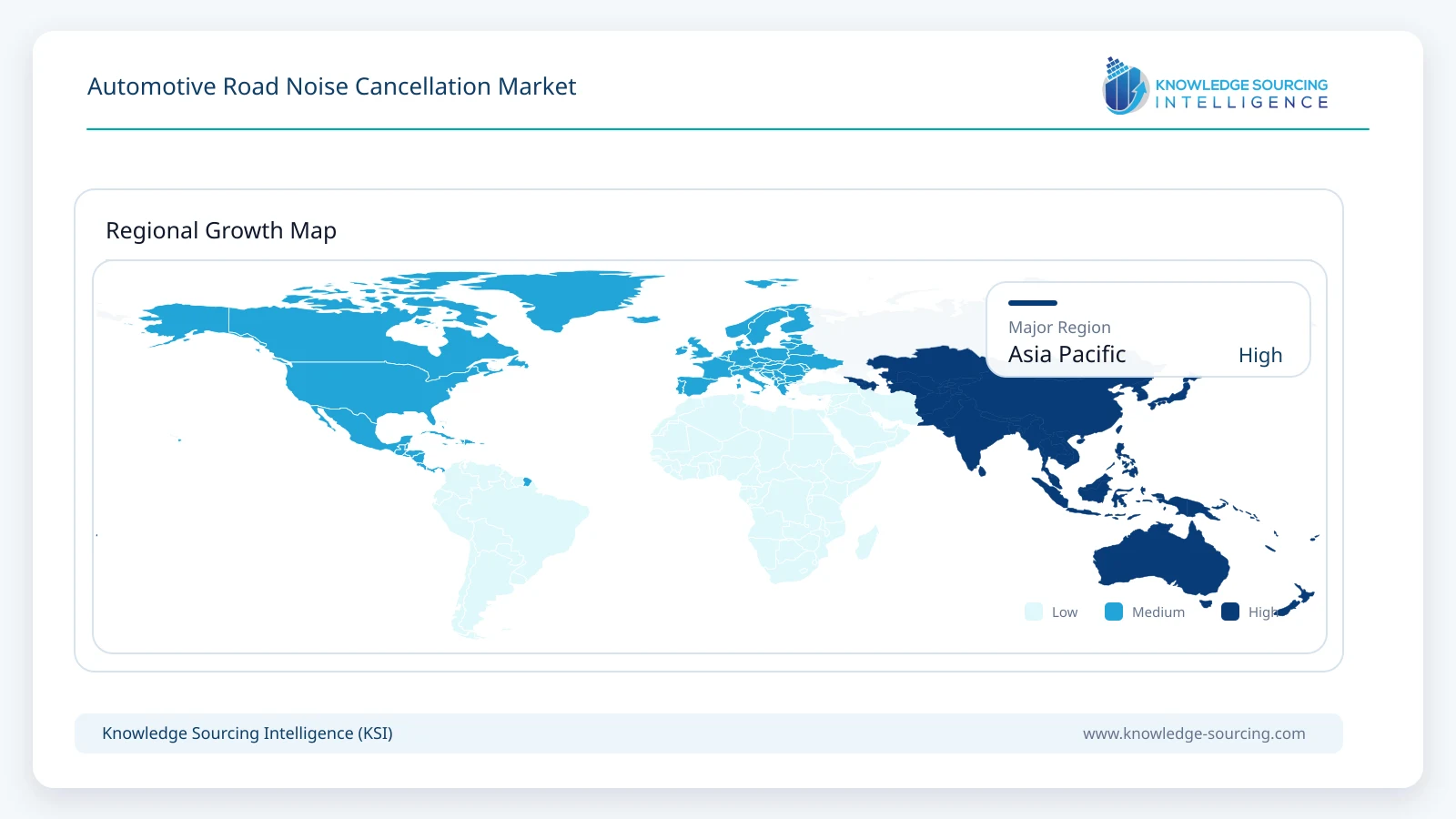
- 6Asia Pacific represents approximately 48% of global market value in 2026, supported by production deployments from Hyundai Motor Group, Genesis, Nissan and regional Tier 1 and audio-system suppliers.
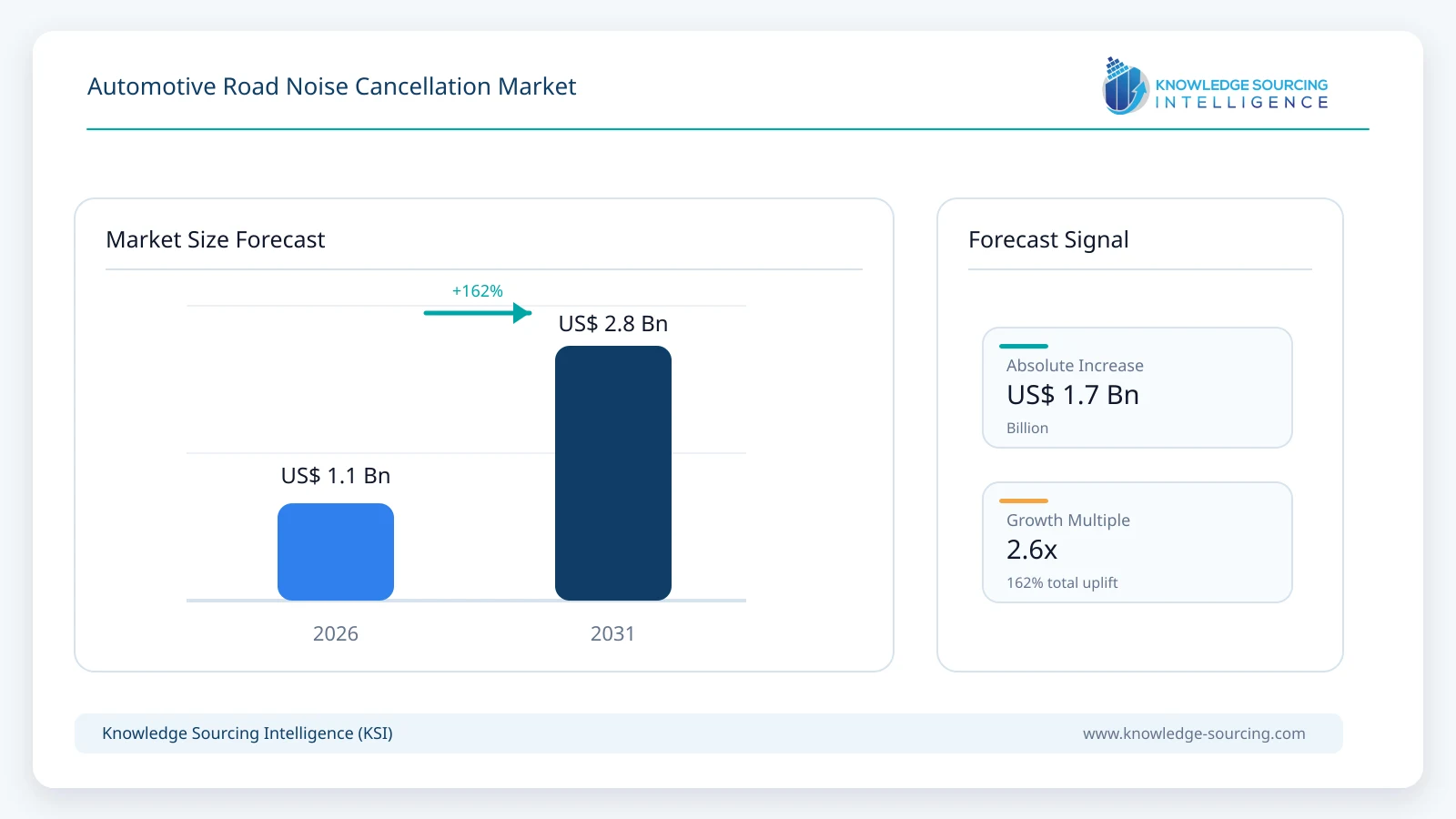
The market is moving from premium low-frequency road-noise suppression toward broader software-defined systems that can address multiple tire, suspension and body-transmission paths across a wider frequency range.
A typical road-noise cancellation architecture uses accelerometers or other vibration references near the suspension and body, cabin microphones for residual-noise feedback, a low-latency controller and the existing loudspeaker network to generate anti-phase sound. Newer systems add virtual microphones, headrest speakers, occupant-zone targeting and processing that can be hosted in audio amplifiers or centralized vehicle compute.
The market includes only the incremental hardware, software, calibration and integration value attributable to active road-noise cancellation. Passive acoustic trim, acoustic glazing, tire-foam products, engine-order cancellation, HVAC noise cancellation and general premium-audio content are excluded unless directly required for the road-noise cancellation function.
Market Overview
Road noise reaches occupants through both structure-borne and airborne paths. Tire forces excite suspension links, subframes and the body, while tire-cavity and wheelhouse noise also enters through air paths. The strongest low-frequency components are difficult to suppress efficiently with lightweight passive materials, making active cancellation particularly valuable in the rumble and boom ranges.
Feedforward RNC measures vibration before the resulting sound reaches the cabin. The controller predicts the noise transfer path and generates an opposing waveform through the speakers, while cabin microphones measure the remaining error and continuously refine the response. This allows the system to adapt to road surface, speed, tire condition, and vehicle aging.
Commercial development is shifting toward broader bandwidth and spatial control. High-frequency RNC, virtual sensing and zone-specific algorithms can improve cancellation around individual occupants, while software portability across DSPs and central audio platforms reduces the need for a dedicated controller. The result is a more scalable RNC function that can be reused across several vehicle programs.
Market Trends
High-Frequency Road Noise Cancellation Is Extending the Addressable Bandwidth
Conventional RNC performs best at low frequencies where road rumble and body boom are spatially coherent and passive treatment is relatively heavy. Suppliers are now extending control toward higher-frequency tire and road noise that has historically remained outside the effective cancellation range.
HARMAN positions High-Frequency RNC for operation up to 1 kHz using hybrid sensing, low-latency processing, and localized speaker-microphone arrangements. Wider bandwidth increases the value of processing performance, sensor placement, and robust vehicle-specific calibration.
Seat-Specific and Zone-Based Cancellation Is Emerging
Cabin-wide RNC targets a balanced reduction across multiple seating positions, but the optimum anti-noise field differs by occupant location. Nissan has introduced Zone Control that can concentrate noise reduction around occupied seats or prioritize a selected passenger area.
Zone control aligns with personalized audio and rear-seat comfort strategies. It also reduces the requirement to create the same cancellation depth everywhere, although accurate occupant location, near-field speakers, and virtual microphone techniques become more important.
RNC Is Moving onto Shared Audio and Software-Defined Compute Platforms
Road-noise cancellation requires deterministic low-latency processing, but it no longer necessarily requires a stand-alone ECU. Modern audio DSPs and software-defined vehicle platforms can host RNC alongside immersive audio, voice processing and sound synthesis when workload isolation and latency are controlled.
Analog Devices continues to position SHARC processors and A2B audio networking for RNC, while HARMAN describes HALOsonic as portable across multiple favored SoCs. This architecture supports platform reuse and lowers incremental electronics cost as RNC moves beyond flagship vehicles.
Virtual Microphones and Occupant-Aware Control Are Reducing Hardware Dependence
The strongest cancellation occurs near the point where residual noise is measured, but placing a physical microphone at every occupant ear position is impractical. Virtual microphone algorithms estimate acoustic conditions at the ear from microphones located elsewhere in the cabin.
The next step is combining virtual sensing with occupant-position information from seat systems or cabin cameras. This can help the RNC controller adapt to seating position and head location while controlling microphone count, wiring, and visible hardware.
Active and Passive NVH Are Being Co-Optimized Rather Than Treated Separately
RNC is not replacing passive NVH packages. It is being used selectively where low-frequency road noise would otherwise require heavy barriers, tuned mass dampers, softer bushings, or tire-resonator solutions that can affect weight, cost, or handling.
The commercial advantage comes from system-level optimization. OEMs can retain passive treatment for high-frequency isolation and leakage paths while shifting selected low-frequency targets into software, improving acoustic performance per kilogram of added mass.
Segment Analysis
By Control Architecture: Hybrid Feedforward-Feedback RNC
Hybrid feedforward-feedback systems lead the market because road noise is best predicted from vibration references before it reaches the cabin, while error microphones are needed to correct for changing transfer paths. Accelerometers provide the early reference signal and microphones close the adaptive loop.
The segment is estimated at approximately USD 0.67 billion in 2026 and could reach about USD 1.82 billion by 2031. Its share remains high because it provides the best balance of predictive response, adaptation, and stability across different surfaces, tires, and vehicle conditions.
By Frequency Range: Low-Frequency Broadband RNC
Low-frequency broadband RNC is the largest frequency segment because road rumble, suspension excitation, and cabin boom are difficult to reduce with lightweight passive treatments. These components also remain sufficiently coherent across the cabin for practical active control using the vehicle speaker system.
Low-frequency RNC represents approximately USD 0.86 billion in 2026 and is projected to approach USD 1.93 billion by 2031. Its share is expected to decline as high-frequency systems expand, but it remains the core commercial use case for active road-noise control.
By Cancellation Coverage: Cabin-Wide Cancellation
Cabin-wide cancellation holds the largest 2026 share because current production programs generally target a balanced reduction across the front and rear cabin rather than optimize a single listening point. This architecture is easier to package around the existing premium-audio speaker network.
Cabin-wide systems account for approximately USD 0.82 billion in 2026 and could reach around USD 1.82 billion by 2031. Seat- and zone-specific systems will grow faster as headrest speakers, occupant sensing and virtual microphones improve localized control.
By Propulsion: Internal-Combustion Engine Vehicles
Internal-combustion vehicles remain the largest propulsion segment in 2026 because premium SUVs and luxury sedans with sophisticated audio systems still represent a major installed base for RNC. Road-noise control can operate independently from engine-order cancellation even when both functions share sensors, microphones and speakers.
ICE vehicles account for approximately USD 0.47 billion in 2026. Their absolute value is expected to rise only gradually through 2031 as the strongest incremental adoption shifts toward BEVs, FCEVs and hybrids where road noise has greater perceptual prominence.
By Vehicle Type: Passenger Vehicles
Passenger vehicles dominate the market because road-noise cancellation is tied closely to cabin refinement, premium audio and high occupant sensitivity to tire and suspension noise. Luxury sedans, premium SUVs and high-specification EVs have provided the earliest production base.
Passenger vehicles represent approximately USD 1.02 billion in 2026 and are expected to exceed USD 2.6 billion by 2031. Commercial-vehicle applications will expand from a small base where long duty cycles create a case for fatigue reduction and improved voice communication.
Market Drivers
Electrification Is Making Road and Tire Noise More Perceptible
Electric propulsion removes much of the continuous engine masking present in conventional vehicles. Tire contact, suspension impacts and body-borne rumble therefore become more noticeable, particularly at highway speed and over coarse surfaces.
Hyundai uses ANC-R in vehicles including the IONIQ 9 and NEXO, while Genesis applies the technology across premium EV platforms. This makes RNC increasingly relevant as an EV refinement feature rather than only a luxury-audio option.
Larger Wheels and Low-Profile Tires Increase Road-Noise Excitation
Vehicle styling and handling trends favor larger wheels, wider tires and lower sidewalls. These configurations can transmit stronger impact and road-texture energy into the suspension and body, increasing the burden on cabin acoustic treatment.
RNC gives OEMs another tuning lever without requiring a return to softer bushings or heavier absorbers. The value is highest where chassis response and visual design are priorities but occupants still expect premium quietness.
Lightweighting and Efficiency Targets Favor Software-Based NVH Control
Traditional low-frequency countermeasures can require heavy barriers, damping materials and tuned mechanical devices. Added mass works against fuel economy and electric-vehicle range, while also consuming packaging space.
Active control can replace selected passive countermeasures rather than the complete acoustic package. Bose and HARMAN both position RNC as a tool for reducing engineering trade-offs between quietness, vehicle mass, efficiency and handling.
Low-Latency Audio Processing Is Becoming More Capable and Scalable
RNC depends on extremely fast signal acquisition, filtering and speaker output because the anti-noise must arrive before or with the disturbance. New automotive audio processors provide more deterministic compute, filter acceleration and multichannel connectivity for these workloads.
Analog Devices has continued to expand SHARC audio processing for ANC/RNC applications, while A2B and centralized audio networks simplify sensor and microphone connectivity. Higher compute density also supports high-frequency control and more cancellation zones.
Premium Cabin Experience Is Becoming a Stronger Vehicle Differentiator
As propulsion performance and digital features converge, cabin refinement has become a visible point of differentiation for premium and upper-mainstream vehicles. Lower background noise improves perceived quality, voice interaction, phone calls and audio clarity.
RNC therefore creates value beyond the measured decibel reduction. It supports the broader software-defined sound environment in which unwanted noise is reduced while music, alerts, conversation and intentional vehicle sound remain clear.
Market Restraints
Vehicle-Specific Calibration and Transfer-Path Complexity
Road-noise transfer paths vary with body stiffness, suspension geometry, wheel and tire combinations, seat position and cabin acoustics. A control model that performs well in one derivative may require significant recalibration in another.
OEM approval therefore requires extensive road testing and signal validation across surfaces, speeds, temperatures and payload conditions. This engineering burden can limit RNC adoption on low-volume or highly fragmented platforms.
Latency and Stability Requirements Are Difficult to Maintain
Feedforward cancellation loses effectiveness if sensing, processing, network transport or speaker response introduces too much delay. The challenge becomes more demanding as control bandwidth increases and as RNC shares compute with other audio functions.
Poor tuning can create audible artifacts or amplify noise instead of reducing it. Suppliers need deterministic processing, stable adaptive filters and clearly managed resource allocation inside centralized compute architectures.
Incremental Sensor, Microphone and Audio-System Cost
RNC can reuse the vehicle speaker system, but robust systems still require vibration references, error microphones, processing capacity and engineering calibration. Lower-cost vehicles may not already contain the speaker count or amplifier headroom needed for strong cancellation.
This keeps penetration concentrated in premium and higher-content platforms. Wider adoption depends on shared microphones, centralized DSP, and sensor reuse reducing the incremental bill of materials per vehicle.
Cancellation Performance Is Spatially and Frequency Limited
Active cancellation is strongest at lower frequencies and around controlled listening positions. As frequency rises, the sound field changes over shorter distances, and it becomes harder to create the correct anti-noise simultaneously at several occupant locations.
High-frequency and zone-based techniques improve this limitation but increase system complexity. Passive treatment remains necessary for many airborne and high-frequency noise paths, limiting the extent to which RNC can replace conventional NVH hardware.
Safety Sounds, Music and Speech Must Remain Intact
The RNC system operates through the same acoustic environment used for music, navigation, warning tones and conversation. Algorithms must remove road noise without suppressing sirens, alerts or desired audio content in overlapping frequency ranges.
This raises verification requirements as audio architectures become software-updatable. True-audio preservation, cybersecurity and regression testing are important when ANC algorithms share speakers and processors with safety-relevant sound functions.
Regional Outlook
Asia Pacific
Asia Pacific is the largest regional market, supported by vehicle-production scale and the strongest concentration of visible production RNC programs. Hyundai Motor Group and Genesis deploy ANC-R across premium and electrified models, while Nissan and Panasonic are expanding integrated active-noise control in Japan.
Growth through 2031 will be supported by EV adoption, premiumization in China and South Korea, and rapid smart-cabin development. Regional suppliers also benefit from close integration between audio electronics, semiconductors and vehicle engineering.
Europe
Europe is a high-value market because premium brands place strong emphasis on cabin refinement, lightweighting and EV efficiency. Jaguar Land Rover has previously adopted active road-noise technology, and European vehicle programs provide a large addressable base for premium audio and advanced NVH systems.
The strongest opportunity is expected in electric SUVs, luxury sedans and high-specification crossovers. European sourcing will favor systems that can demonstrate reliable cancellation while reducing passive mass and maintaining strict vehicle-level acoustic targets.
Competitive Landscape
The market combines automotive audio-system suppliers, specialist active-noise software companies, Tier 1 electronics providers and semiconductor companies. HARMAN and Bose have broad road-noise-control portfolios built around proprietary algorithms, audio integration and vehicle-specific tuning, while Panasonic Automotive Systems is expanding production ANC across Japanese OEM programs.
Silentium is differentiated through active road-noise software and prior production work with global OEM and Tier 1 partners. Hyundai Mobis and Hyundai Motor Group bring production-scale RANC integration, while Analog Devices supplies low-latency DSP and audio networking used in complex ANC/RNC architectures.
Competitive advantage increasingly depends on cancellation bandwidth, latency, tuning efficiency and portability across vehicle platforms. Suppliers that can reuse existing microphones, speakers and compute while supporting virtual sensing and zone control can lower incremental cost and improve the business case for mass-market adoption.
Recent Developments
18 September 2026: Panasonic Automotive Systems announced an integrated Advanced Active Noise Control system that simultaneously reduces road and engine noise in series-hybrid vehicles, with first production adoption on Nissan's all-new Elgrand in Japan.
15 September 2026: Cadence announced that its Tensilica IP was used with Analog Devices to develop the next-generation SHARC-FX automotive audio processor architecture, providing substantially higher processing performance for applications including intelligent noise cancellation.
July 2026: Nissan detailed its Advanced Active Noise Control technology with simultaneous road- and engine-noise reduction plus Zone Control that can concentrate cancellation around occupied or selected seating areas.
25 March 2026: Genesis detailed the GV60 Magma NVH package, combining reinforced passive acoustic treatment with Active Noise Control-Road using accelerometers, cabin microphones and the vehicle speaker system for low-frequency road-noise reduction.
11 November 2025: Hyundai Motor announced that the all-new NEXO, scheduled for global launch in early 2026, would use Active Noise Control-Road together with sound-absorbing tires to improve cabin refinement on uneven road surfaces.
Market Outlook
The automotive road noise cancellation market is driven by increasing demand for quieter vehicle cabins, enhanced passenger comfort, and improved acoustic performance. Hybrid feedforward-feedback systems remain the dominant architecture due to their ability to detect and counteract road-induced noise across varying driving conditions. High-frequency and zone-specific road noise cancellation technologies are gaining importance, offering more precise noise reduction and targeted acoustic control. Continued advancements in sensors, microphones, signal processing, and vehicle audio systems are supporting integration across passenger vehicles, particularly in premium and electric vehicle segments.
Electrified vehicles will provide the strongest growth because road and tire noise becomes more exposed as combustion masking disappears. At the same time, more powerful shared audio processors and software-defined vehicle platforms will reduce the need for dedicated RNC electronics and make the function easier to scale across model lines.
Asia Pacific is expected to remain the largest regional market, with Europe retaining a strong premium-vehicle opportunity. Supplier success will depend on low-latency execution, broader cancellation bandwidth, efficient calibration, hardware reuse and the ability to preserve music, speech and safety sounds while actively controlling road noise.
Automotive Road Noise Cancellation Market Scope:
| Report Metric | Details |
|---|---|
| Total Market Size in 2026 | USD 1.05 billion |
| Total Market Size in 2031 | USD 2.75 billion |
| Forecast Unit | USD Billion |
| Growth Rate | 21.2% |
| Study Period | 2021 to 2031 |
| Historical Data | 2021 to 2024 |
| Base Year | 2025 |
| Forecast Period | 2026 – 2031 |
| Segmentation | Control Architecture, Frequency Range, Cancellation Coverage, Propulsion |
| Companies |
|
Market Segmentation
By Control Architecture
Hybrid Feedforward-Feedback RNC
Feedforward-Dominant RNC
Feedback and Adaptive Acoustic-Reference RNC
By Frequency Range
Low-Frequency Broadband RNC
Extended and High-Frequency RNC
By Cancellation Coverage
Cabin-Wide Cancellation
Zone-Based and Seat-Specific Cancellation
By Propulsion
Internal-Combustion Engine Vehicles
Hybrid and Plug-In Hybrid Vehicles
Battery Electric and Fuel-Cell Electric Vehicles
By Vehicle Type
Passenger Vehicles
Light Commercial Vehicles
Medium and Heavy Commercial Vehicles and Buses
By Geography
North America
United States
Canada
Mexico
South America
Brazil
Argentina
Others
Europe
Germany
United Kingdom
France
Italy
Spain
Others
Middle East and Africa
Saudi Arabia
UAE
South Africa
Others
Asia Pacific
China
Japan
South Korea
India
Indonesia
Thailand
Others
Table of Contents
1. INTRODUCTION
1.1. Market Overview
1.2. Market Definition
1.3. Scope of the Study
1.4. Market Segmentation
1.5. Currency
1.6. Assumptions
1.7. Base and Forecast Years
1.8. Key Benefits to Stakeholders
2. RESEARCH METHODOLOGY
2.1. Research Design
2.2. Secondary Research
2.3. Primary Research
2.4. Market Estimation
2.5. Segment Modelling
2.6. Data Triangulation and Validation
3. EXECUTIVE SUMMARY
3.1. Key Findings
3.2. Automotive Road Noise Cancellation Market Size, 2026-2031
3.3. Control Architecture Outlook
3.4. Frequency Range Outlook
3.5. Cancellation Coverage Outlook
3.6. Propulsion Outlook
3.7. Vehicle Type Outlook
3.8. Regional Opportunity Summary
4. MARKET DYNAMICS
4.1. Market Drivers
4.1.1. Electrification Is Making Road and Tire Noise More Perceptible
4.1.2. Larger Wheels and Low-Profile Tires Increase Road-Noise Excitation
4.1.3. Lightweighting and Efficiency Targets Favor Software-Based NVH Control
4.1.4. Low-Latency Audio Processing Is Becoming More Capable and Scalable
4.1.5. Premium Cabin Experience Is Becoming a Stronger Vehicle Differentiator
4.2. Market Restraints
4.2.1. Vehicle-Specific Calibration and Transfer-Path Complexity
4.2.2. Latency and Stability Requirements Are Difficult to Maintain
4.2.3. Incremental Sensor, Microphone and Audio-System Cost
4.2.4. Cancellation Performance Is Spatially and Frequency Limited
4.2.5. Safety Sounds, Music and Speech Must Remain Intact
4.3. Market Opportunities
4.4. Porter's Five Forces Analysis
4.5. Industry Value Chain Analysis
4.6. RNC Hardware, Software and Calibration Economics
4.7. Cabin Acoustic Safety and Audio-System Integration Environment
5. TECHNOLOGY OUTLOOK
5.1. Accelerometer-Based Vibration Reference Sensing
5.2. Cabin Error Microphones and Acoustic Feedback
5.3. Low-Latency DSP and Audio Processing Platforms
5.4. A2B and Automotive Audio Networking
5.5. Hybrid Feedforward-Feedback RNC Algorithms
5.6. Virtual Microphone and Ear-Position Estimation
5.7. High-Frequency Road Noise Cancellation
5.8. Zone-Based and Seat-Specific Cancellation
5.9. Headrest and Near-Field Speaker Integration
5.10. Tire-Cavity, Suspension and Structure-Borne Noise Targeting
5.11. Adaptive Calibration and Lifecycle Tuning
5.12. Integration with Premium Audio and Software-Defined Sound Management
6. AUTOMOTIVE ROAD NOISE CANCELLATION MARKET BY CONTROL ARCHITECTURE
6.1. Introduction
6.2. Hybrid Feedforward-Feedback RNC
6.3. Feedforward-Dominant RNC
6.4. Feedback and Adaptive Acoustic-Reference RNC
7. AUTOMOTIVE ROAD NOISE CANCELLATION MARKET BY FREQUENCY RANGE
7.1. Introduction
7.2. Low-Frequency Broadband RNC
7.3. Extended and High-Frequency RNC
8. AUTOMOTIVE ROAD NOISE CANCELLATION MARKET BY CANCELLATION COVERAGE
8.1. Introduction
8.2. Cabin-Wide Cancellation
8.3. Zone-Based and Seat-Specific Cancellation
9. AUTOMOTIVE ROAD NOISE CANCELLATION MARKET BY PROPULSION
9.1. Introduction
9.2. Internal-Combustion Engine Vehicles
9.3. Hybrid and Plug-In Hybrid Vehicles
9.4. Battery Electric and Fuel-Cell Electric Vehicles
10. AUTOMOTIVE ROAD NOISE CANCELLATION MARKET BY VEHICLE TYPE
10.1. Introduction
10.2. Passenger Vehicles
10.3. Light Commercial Vehicles
10.4. Medium and Heavy Commercial Vehicles and Buses
11. AUTOMOTIVE ROAD NOISE CANCELLATION MARKET BY GEOGRAPHY
11.1. North America
11.1.1. United States
11.1.2. Canada
11.1.3. Mexico
11.2. South America
11.2.1. Brazil
11.2.2. Argentina
11.2.3. Others
11.3. Europe
11.3.1. Germany
11.3.2. United Kingdom
11.3.3. France
11.3.4. Italy
11.3.5. Spain
11.3.6. Others
11.4. Middle East and Africa
11.4.1. Saudi Arabia
11.4.2. UAE
11.4.3. South Africa
11.4.4. Others
11.5. Asia Pacific
11.5.1. China
11.5.2. Japan
11.5.3. South Korea
11.5.4. India
11.5.5. Indonesia
11.5.6. Thailand
11.5.7. Others
12. COMPETITIVE ENVIRONMENT AND ANALYSIS
12.1. Major Players and Strategy Analysis
12.2. Market Share Analysis
12.3. Low-Frequency versus High-Frequency RNC Benchmarking
12.4. Feedforward versus Hybrid Control Architecture Comparison
12.5. Cabin-Wide versus Zone-Based RNC Benchmarking
12.6. Sensor, Microphone and Audio-Compute Architecture Benchmarking
12.7. OEM Programs and Production Readiness
12.8. Competitive Dashboard
13. COMPANY PROFILES
13.1. HARMAN International
13.2. Bose Corporation
13.3. Panasonic Automotive Systems Co., Ltd.
13.4. Silentium Ltd.
13.5. Hyundai Mobis Co., Ltd.
13.6. Analog Devices, Inc.
13.7. Hyundai Motor Company
13.8. Genesis Motor
13.9. Nissan Motor Co., Ltd.
13.10. Jaguar Land Rover Automotive plc
14. APPENDIX
14.1. Currency
14.2. Assumptions
14.3. Base and Forecast Years Timeline
14.4. Key Benefits for Stakeholders
14.5. Research Methodology
14.6. Abbreviations
14.7. Data Sources
Navigate
Trusted by the world's leading organizations











