
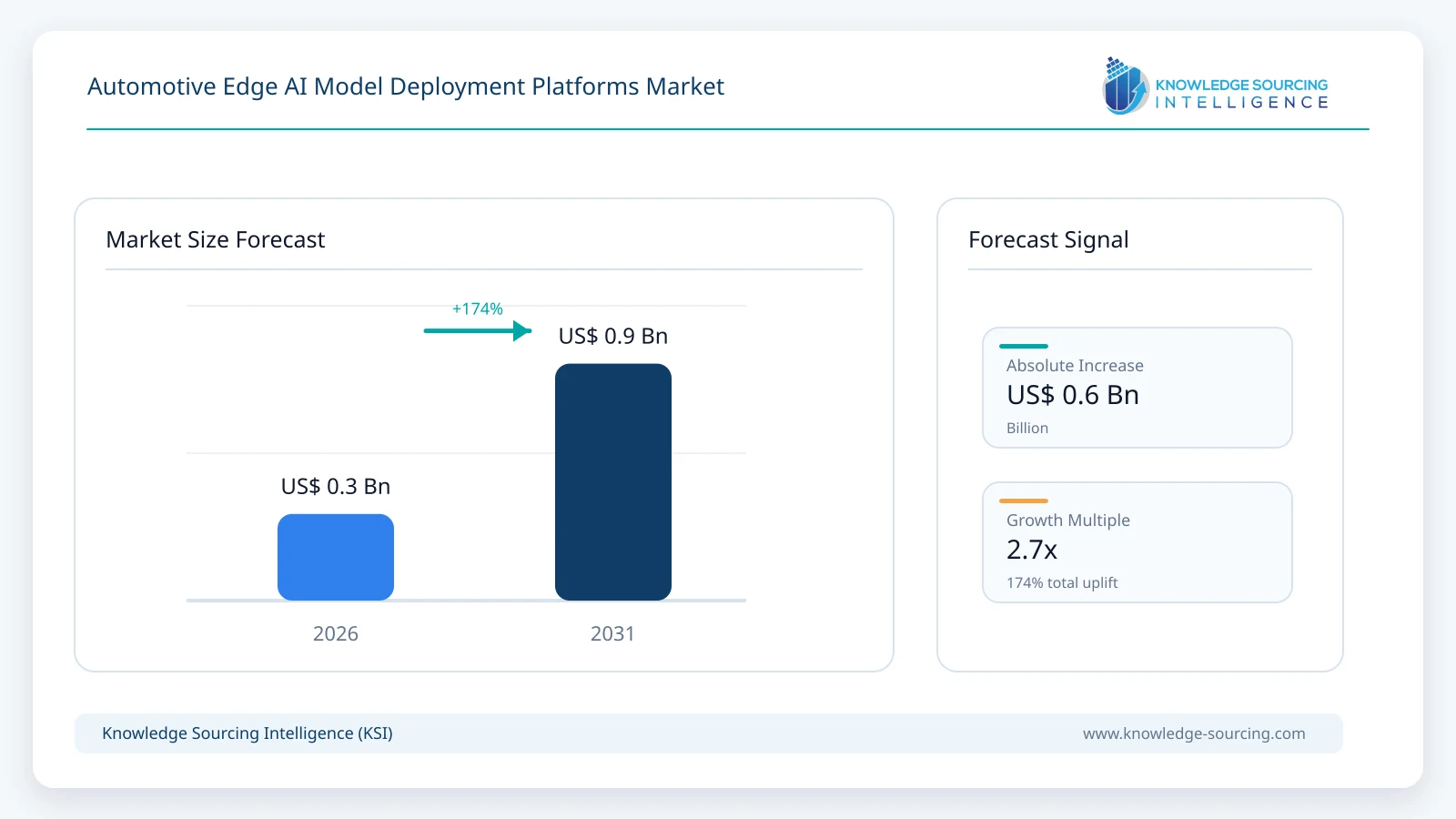
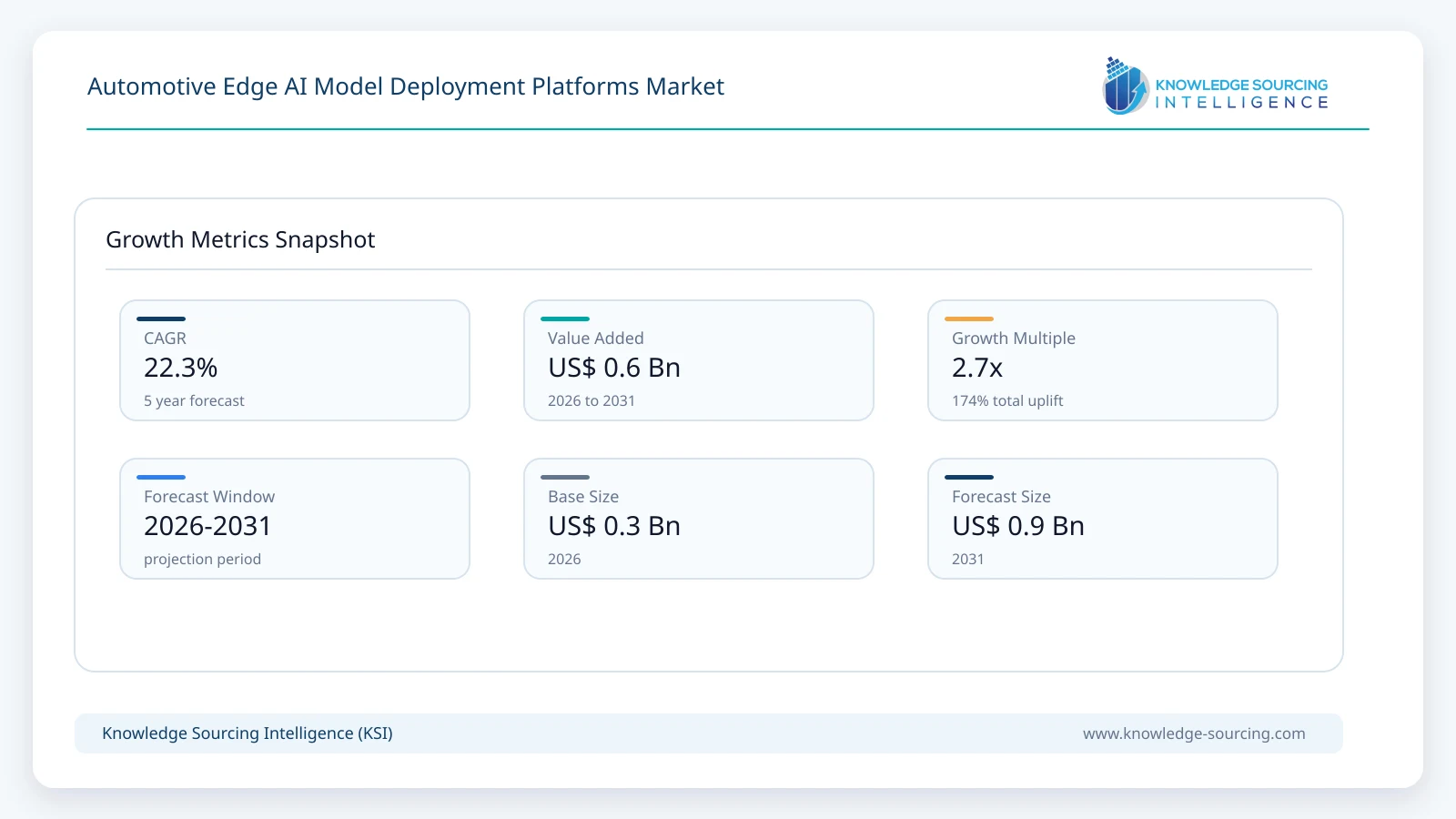
The automotive edge AI model deployment platforms market is projected to grow from USD 0.34 billion in 2026 to USD 0.93 billion by 2031, at a CAGR of 22.3% throughout the the forecast period.
Highlights:
- 1Global revenue is estimated at USD 340 million in 2026, rising to USD 930 million by 2031 at 22.3% CAGR.
- 2Model optimization and conversion account for approximately 33% of revenue in 2026.
- 3Driver assistance and automated driving represent an estimated 42% of 2026 revenue.
- 4Central and cross-domain computers account for around 48% of the deployment architecture category in 2026.
- 5Asia Pacific leads in 2026 with approximately 44% of global revenue.
- 6Hardware-aware optimization, release traceability and model safety validation are important purchasing requirements.
Edge AI model deployment connects the development of vehicle intelligence with the computing systems that run it in production. Engineers train or adapt models using driving data and simulation, reduce the model to a suitable size, test the resulting behavior on target processors and release a controlled software package. This work is particularly important for camera perception, cabin monitoring, battery-health estimation and other functions that must operate with limited onboard memory and processing time. Model deployment also extends into the vehicle lifecycle, because software teams need to know which model version is running on each approved hardware and software configuration.
Automotive suppliers are making these workflows more reusable across programs. Qualcomm combines Snapdragon Ride processors with an SDK and describes portability of AI models across vehicle tiers, while NVIDIA links model development and simulation to its DRIVE in-vehicle platform. NXP's eIQ environment supports optimized edge AI deployment, and MathWorks provides compression, verification and AUTOSAR-oriented code generation. These solutions address different parts of the route from a trained network to an automotive application, rather than a single interchangeable software product.
Vehicle manufacturers and Tier 1 suppliers remain responsible for selecting approved model configurations, establishing performance limits and controlling updates. Safety-relevant AI also requires evidence that the chosen model behaves acceptably under intended operating conditions, including cases poorly represented in training data. ISO/PAS 8800:2024 provides guidance for safety-related AI in road vehicles, and UN Regulation No. 156 establishes software-update management requirements where applicable. Platform providers compete on hardware compatibility, reproducible model builds, validation support and long-term release control.
Market Trends
Hardware-aware optimization is becoming a standard release step
Model compression, quantization and compilation increasingly determine whether an AI function can be used economically across several vehicle electronics configurations. A perception or diagnostic model that performs well in a development environment may exceed the memory or latency budget of its intended ECU. MathWorks documents an automotive workflow in which neural networks are optimized and checked before being converted into production C or C++ code. Such tooling gives suppliers a repeatable way to compare model quality and embedded execution performance.
Reusable optimization pipelines reduce the engineering work when a vehicle program changes processors, memory capacity or sensor interfaces. OEMs still need processor-specific verification, but common model preparation and testing tools can prevent each program team from rebuilding an entire delivery process.
Cloud-trained models are moving into controlled vehicle runtimes
Automakers increasingly develop advanced AI using cloud compute while keeping time-sensitive inference inside the vehicle. NVIDIA's DRIVE approach links training and high-fidelity simulation with the in-vehicle runtime, while Qualcomm emphasizes an end-to-end development ecosystem and AI model portability. Cloud development remains valuable for large-scale training, but production deployment must account for local execution, startup behavior, power consumption and failure response.
NVIDIA describes Alpamayo foundation models as cloud-side teachers that can be distilled into compact onboard models; the largest model is not assumed to run directly in each car. Model deployment vendors therefore need practical tools for reduction, compatibility testing and evidence retention.
Version control is expanding beyond ordinary software packages
AI model updates may change the outputs of a vehicle function even when the surrounding application code remains unchanged. Release teams must track model weights, training-data lineage, preprocessing, calibration, processor dependencies and validation results together. Without a dependable record of those relationships, an apparently small update can introduce inconsistent behavior between vehicle variants.
Automotive software pipelines are incorporating model-specific approvals. Reproducible compilation and signed packages need to sit alongside targeted road and simulation tests, staged rollout rules and rollback procedures. Platform differentiation increasingly rests on whether model information travels cleanly from engineering through manufacturing and in-service support.
More AI functions are sharing central and domain compute
Centralized and consolidated domain computers allow multiple AI-enabled functions to share high-performance processing resources. Qualcomm's 2026 collaboration with Leapmotor describes a computer that combines cockpit, driver assistance and vehicle-core functions, demonstrating the platform direction. Model deployment must account for resource allocation and timing interactions even when the actual orchestration and virtualization layers come from other suppliers.
Central computing can simplify model reuse across vehicle families, but does not remove the need to validate each deployment configuration. Camera counts, inference accelerators, thermal budgets and safety cases can vary substantially between vehicle trims. Engineering organizations seek model portability while retaining clear ownership of those hardware-specific constraints.
AI safety evidence is becoming part of model-release tooling
Safety-relevant automotive AI requires more than an accuracy score on a held-out dataset. Vehicle developers examine performance under environmental variation, uncertain inputs, degradation, rare scenarios and changes to sensors or model weights. ISO/PAS 8800 addresses safety-related behavior of AI-based vehicle systems and provides a common frame for technical assurance discussions.
Validation requirements create demand for traceable test evidence, approved model baselines and controlled release decisions. They can also slow introduction of new AI functions when data coverage or validation infrastructure is incomplete. Platforms that connect optimization results with engineering review and change management can reduce repeated manual work without weakening release accountability.
Automotive Edge AI Model Deployment Platforms Market Segment Analysis
By Platform Function
Model Optimization and Conversion
Model optimization and conversion account for an estimated 33% of market value in 2026, reflecting the engineering needed to move networks from training frameworks into automotive inference environments. Quantization, operator conversion, calibration and target-specific compilation help fit models within vehicle ECU limits. Qualcomm's hardware-aware development libraries and MathWorks code-generation tools illustrate how automotive AI teams handle these constraints.
Revenue in this category is supported by reusable tool licenses and paid integration work for specific processors. Its share is expected to moderate as version control and fleet monitoring gain importance, although demand for optimization rises with the number and complexity of models entering production.
By Deployment Architecture
Central and Cross-Domain Computers
Central and cross-domain computers account for approximately 48% of 2026 platform value. Their inference capacity supports more models sharing common resources. Deployment teams must qualify model binaries for the chosen acceleration hardware and preserve reliable interaction with the operating system, sensor stack and application interfaces.
This architecture is expected to gain share through 2031 as more manufacturers consolidate workloads onto common processing platforms. Domain-level ECUs will remain important for established ADAS and powertrain applications, and resource-constrained controllers will continue to require specialized deployment and optimization.
By Application
Driver Assistance and Automated Driving
Driver assistance and automated driving represent about 42% of 2026 model-deployment value, making them the largest application group. Camera perception, object classification, driver monitoring and increasingly complex driving policies require repeated model integration and validation on automotive-grade processors. NVIDIA DRIVE and Qualcomm Snapdragon Ride illustrate how development environments, optimized software stacks and target hardware are being linked for production programs.
The segment remains commercially important as AI functions become more capable, although cabin and vehicle-health applications are expected to broaden the overall customer base. Model-release tools must manage changes that can affect safety-relevant driving decisions.
By Revenue Component
Embedded Platform and Runtime Licensing
Embedded platform and runtime licensing represents approximately 44% of 2026 revenue. OEMs pay for inference deployment libraries, conversion tools and controlled runtime components, separately or within wider software agreements. Some customer programs still require a substantial engineering effort to move existing models into production.
Reusable production stacks are expected to lift licensing toward 65% of revenue in 2031. Independently billed validation and integration will remain necessary, but broader reuse across vehicle variants can reduce the service effort associated with each additional model or platform generation.
Market Drivers
Growing deployment of AI-enabled driver assistance
Automotive safety and driver-assistance programs rely increasingly on neural-network inference for perception and decision support. Camera-based functions must process images locally and maintain predictable performance during normal vehicle operation. The growing number of AI-enabled functions makes model preparation, conversion and testing repeatable tasks rather than one-off engineering projects. Qualcomm's Ride software environment and NVIDIA's automotive stack both illustrate investment in reusable development and deployment pathways. Suppliers that standardize these pathways can reduce repeated integration work when manufacturers expand a feature across models, regions and equipment levels.
Increasing model complexity and hardware diversity
Automotive engineers must deploy neural networks across processors that differ in accelerator capacity, numerical precision, memory and power limits. Hardware-aware compilation and quantization become important when a common model family has to operate on several vehicle tiers. MathWorks describes systematic model compression and code generation, while Qualcomm stresses AI portability across its automotive computing portfolio. These requirements support specialized platforms that manage conversions, test reproducibility and maintain compatibility matrices. Better tooling can lower per-program effort without eliminating the need for target-specific verification and final vehicle testing.
More connected vehicles receiving controlled software updates
Software-defined vehicle programs create opportunities to improve models after production, provided manufacturers retain control of the approved software configuration. A vehicle's AI package may need targeted updates when sensor behavior, operating conditions or system requirements change. Release systems therefore need model version identification, signed packages, staged deployment and recovery processes linked to the broader automotive software infrastructure. UN Regulation No. 156 reinforces organized software-update management in relevant markets. Deployment platform suppliers benefit when OEMs require a consistent record of which model build is installed and why it was approved.
Expansion of onboard AI beyond the driving stack
AI inference is moving into occupant interaction, vehicle diagnostics, energy management and other software-defined functions. These applications have different performance and safety requirements, but each may need model optimization and controlled embedded deployment. Qualcomm's automotive agent architecture and NXP's edge AI framework show how broader AI functionality is entering the vehicle software ecosystem. As automakers reuse data and computing platforms across functions, a common model-delivery process can prevent fragmented toolchains. Commercial demand increases when a deployment platform supports several engineering groups without forcing every application onto one runtime.
Greater emphasis on AI safety and deployment evidence
AI-enabled vehicle functions must demonstrate acceptable behavior beyond a narrow set of benchmark scenarios. ISO/PAS 8800:2024 addresses safety-related AI behavior in road vehicles, prompting stronger attention to traceability between models, test cases and intended applications. The requirement is commercially significant because a model update may alter a vehicle function even when other code is unchanged. Tools that record model lineage, validation results and release approvals help suppliers demonstrate engineering control across different hardware configurations. These capabilities support recurring platform and validation expenditure as AI applications move from pilot projects into production.
Market Restraints
Extensive validation requirements for safety-related functions
Model deployment for driver assistance cannot rely on a successful compilation or a single accuracy figure. Engineering teams must test the resulting function against the intended vehicle environment, sensor configuration and safety assumptions, including unusual or degraded conditions. An optimization that saves memory can also alter model output, requiring comparison with the approved baseline. These obligations increase release cost and can delay updates. Automotive customers may avoid frequent model changes when the effort needed to re-establish the safety case outweighs the operational benefit of the new version.
Fragmented processor and inference software ecosystems
Automotive processors use different acceleration architectures, supported operations, memory interfaces and development tools. A model exported from a standard machine-learning framework may behave differently after conversion to a target runtime. Software vendors therefore face continued engineering costs for toolchain maintenance and hardware qualification. OEMs also hesitate to commit to a single model-deployment supplier if the resulting applications cannot move between chip generations. Open interfaces can improve portability, but reliable execution still depends on extensive target-specific testing and integration work.
Cost of changing established automotive engineering toolchains
Vehicle development teams already use established tools for software builds, calibration, verification and ECU integration. Introducing a separate AI model-deployment environment can require new interfaces, staff training, processor qualification and changes to release procedures. OEMs may resist migration if a supplier cannot show savings across several vehicle programs. Engineering groups also need to retain compatibility with legacy applications and approved tool versions during long production cycles. These switching costs can favor internal pipelines or bundled solutions over independently licensed platforms, especially where the number of AI models being released remains modest.
Thermal, memory and compute limits in production vehicles
Vehicle electronics must operate within strict power and thermal envelopes, often for many years after the hardware design is frozen. Larger models can increase accelerator utilization, memory bandwidth and startup times, creating difficult trade-offs between performance and vehicle cost. Deploying a model originally trained with abundant cloud resources may require pruning, quantization or a smaller architecture. These adaptations can reduce accuracy and create additional validation cycles. Affordable vehicle platforms may therefore adopt sophisticated onboard AI more slowly than premium or high-performance architectures.
Cybersecurity and long-term update obligations
Production AI model packages introduce software supply-chain and lifecycle responsibilities that extend beyond installation. Manufacturers need to protect model artifacts, authenticate releases, track dependencies and preserve rollback options when a change fails in the field. A model may remain in service after the original training framework or processor tooling has changed, which complicates maintenance. Customer concerns over cybersecurity, data protection and continuing platform support can lengthen qualification and contracting decisions. Suppliers must demonstrate durable product maintenance rather than offering a short-lived conversion tool.
Regional Outlook
Asia Pacific
Asia Pacific holds an estimated 44% of global market value in 2026, supported by its concentration of vehicle production, electronics supply chains and expanding software-defined vehicle programs. China, Japan and South Korea combine large vehicle development organizations with substantial capability in semiconductor integration and embedded software engineering. Chinese EV and connected-vehicle programs are especially relevant to repeated deployment of cabin and driver-assistance AI across fast-changing model portfolios.
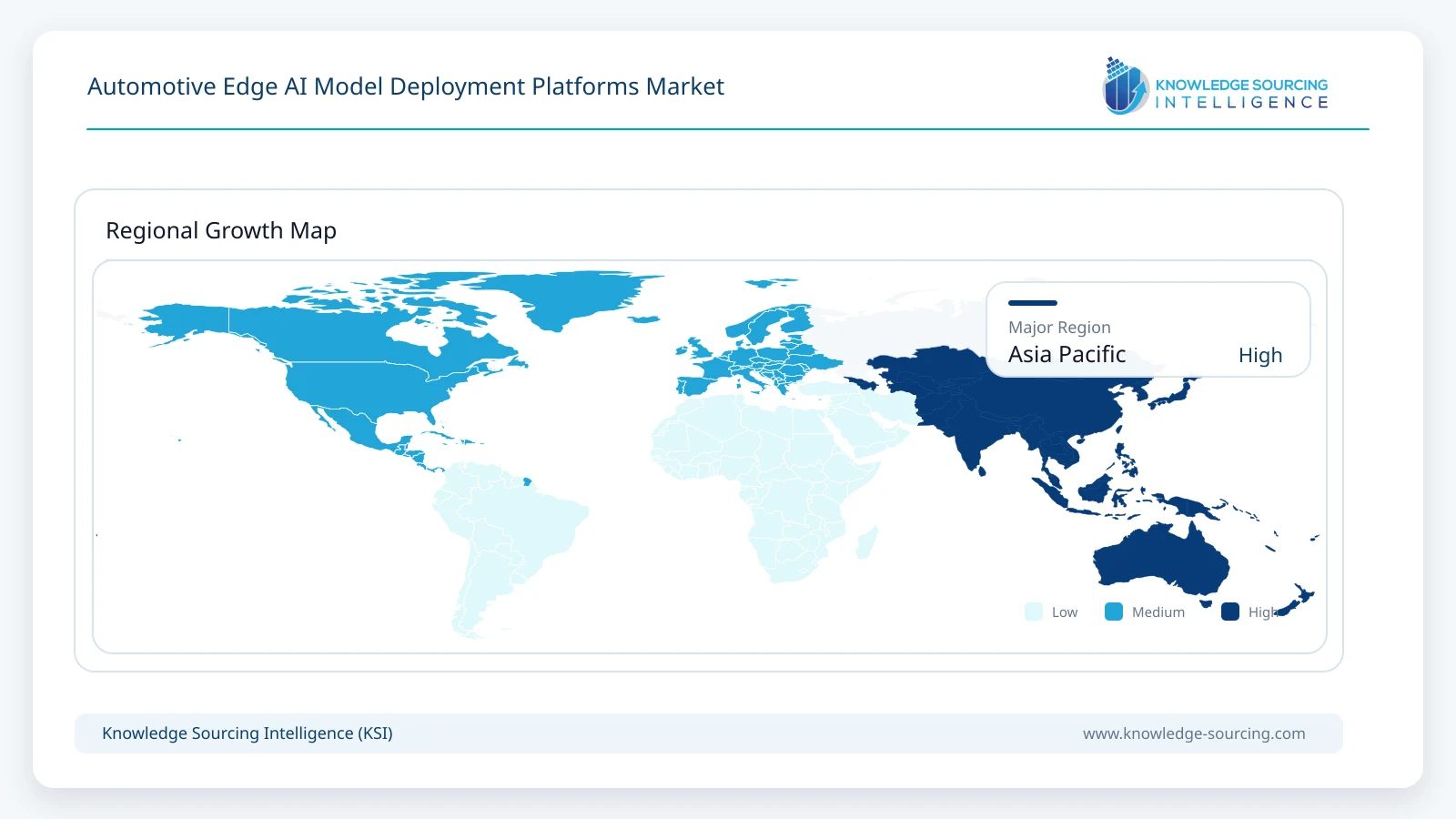
The region is expected to increase its share through 2031 as production architectures incorporate more local inference and AI model reuse. Automotive teams must still qualify software across processor and vehicle variants, and local regulatory and supply-chain requirements can influence deployment choices. Competitive differentiation is likely to depend on practical embedded performance and rapid program integration rather than model size alone.
Europe
European automotive manufacturers and suppliers have established processes for embedded engineering, functional safety and software validation. Germany remains an important center for vehicle computing, with software-development and verification ecosystems extending across France, the United Kingdom and other European countries. Automotive AI deployment platforms fit into this environment when they can connect existing model-based engineering tools, processor-specific compilers and documented release approvals.
Europe accounts for an estimated 27% of global value in 2026. Regulatory expectations, vehicle safety disciplines and long platform lifecycles are expected to favor products with traceability and support for controlled updates. Adoption may proceed more cautiously on safety-relevant functions because additional validation is required when a model is modified, but that same workload supports demand for mature engineering platforms.
Competitive Landscape
Automotive edge AI model deployment involves several types of suppliers. Semiconductor platform companies such as Qualcomm and NXP provide target-aware development and inference tools tied to their processors. NVIDIA combines its automotive software and hardware ecosystem with model development and simulation capabilities. Engineering software firms, including MathWorks, concentrate on model optimization, code generation and verification, while automotive middleware and vehicle software providers help integrate resulting models into production applications.
Vehicle manufacturers remain important buyers and often retain key tooling internally. Platform companies compete on supported model frameworks, accelerator compatibility, repeatable build processes, validation evidence and long-term maintenance. Supplier scale in chips or AI training does not automatically translate into an independently measurable share of model-deployment platform revenue. Contracts frequently bundle tools with hardware, engineering or wider software stacks, so competition is best assessed through product capability, customer programs and ownership of critical integration interfaces.
Recent Developments
November 2025: Mercedes-Benz Research & Development India and MathWorks presented a workflow for deploying AUTOSAR-based deep-learning models onto production ECUs, demonstrating neural-network optimization and code generation.
January 2026: NVIDIA introduced the Alpamayo family of open AI models, simulation tools and data resources for autonomous-vehicle development, with smaller runtime models expected to be derived for vehicles.
January 2026: Qualcomm and Google expanded their automotive collaboration around cloud-to-car AI, virtual SoCs and software-defined vehicle development platforms.
January 2026: NXP announced its eIQ Agentic AI Framework, extending tools for optimized autonomous AI deployment on edge devices.
March 2026: Qualcomm detailed its AI-defined vehicle development approach, emphasizing portable models and reusable software across processor and vehicle tiers.
August 2026: NVIDIA made Alpamayo 2 Super available under commercial licensing, enabling developers to adapt models and distill specialized versions for efficient in-vehicle inference.
Market Outlook
Edge AI model deployment is expected to become more routine within automotive engineering as manufacturers move from isolated neural-network features toward families of AI applications sharing vehicle computing resources. Better tools for conversion, target testing and version management should allow a successful model-development approach to be repeated across vehicle tiers. The value proposition will remain strongest where software teams face several processor configurations and long-term update commitments.
Safety assurance and platform portability will shape commercial outcomes through 2031. Reusable deployment libraries may increase software revenue relative to program-specific engineering, but vendors must maintain processor support, documentation and cybersecurity measures. The strongest opportunities will come from established production programs with recurring model releases, not from counting research models or every vehicle containing an AI-enabled chip.
Automotive Edge AI Model Deployment Platforms Market Scope:
| Report Metric | Details |
|---|---|
| Total Market Size in 2026 | USD 0.34 billion |
| Total Market Size in 2031 | USD 0.93 billion |
| Forecast Unit | USD Billion |
| Growth Rate | 22.3% |
| Study Period | 2021 to 2031 |
| Historical Data | 2021 to 2024 |
| Base Year | 2025 |
| Forecast Period | 2026 – 2031 |
| Segmentation | Platform Function, Revenue Component, Application, Deployment Architecture, Vehicle Type, Geography |
| Companies |
|
Market Segmentation
By Platform Function
Model Optimization and Conversion
Model Registry and Compatibility Management
Secure Rollout and Rollback
Inference Health and Fleet Monitoring
By Revenue Component
Embedded Deployment Runtime and Tools
Program Integration and Validation
Lifecycle Monitoring and Platform Operations
By Application
ADAS and Automated Driving
Cabin and Occupant AI
Diagnostics and Vehicle Health
Energy and Powertrain Optimization
By Deployment Architecture
Central and Cross-Domain Computers
Domain High-Performance ECUs
Zonal and Distributed Edge Controllers
By Vehicle Type
Passenger Vehicles
Light Commercial Vehicles
Medium and Heavy Commercial Vehicles
By Geography
North America
United States
Canada
Mexico
South America
Brazil
Argentina
Others
Europe
Germany
United Kingdom
France
Italy
Spain
Others
Middle East and Africa
Saudi Arabia
United Arab Emirates
South Africa
Others
Asia Pacific
China
Japan
South Korea
India
Indonesia
Thailand
Others
Table of Contents
1. EXECUTIVE SUMMARY
2. MARKET SNAPSHOT
2.1. Market Overview
2.2. Market Definition
2.3. Scope of the Study
2.4. Market Segmentation
3. BUSINESS LANDSCAPE
3.1. Market Drivers
3.1.1. Growing deployment of AI-enabled driver assistance
3.1.2. Increasing model complexity and hardware diversity
3.1.3. More connected vehicles receiving controlled software updates
3.1.4. Expansion of onboard AI beyond the driving stack
3.1.5. Greater emphasis on AI safety and deployment evidence
3.2. Market Restraints
3.2.1. Extensive validation requirements for safety-related functions
3.2.2. Fragmented processor and inference software ecosystems
3.2.3. Cost of changing established automotive engineering toolchains
3.2.4. Thermal, memory and compute limits in production vehicles
3.2.5. Cybersecurity and long-term update obligations
3.3. Market Opportunities
3.4. Porter’s Five Forces Analysis
3.5. Industry Value Chain Analysis
3.6. Policies and Regulations
3.7. Strategic Recommendations
4. TECHNOLOGICAL OUTLOOK
4.1. Model Optimization and Quantization
4.2. Automotive Inference Runtime and Accelerators
4.3. Model Registry and Compatibility Tracking
4.4. Deployment, Monitoring and Rollback
5. AUTOMOTIVE EDGE AI MODEL DEPLOYMENT PLATFORMS MARKET BY PLATFORM FUNCTION
5.1. Introduction
5.2. Model Optimization and Conversion
5.3. Model Registry and Compatibility Management
5.4. Secure Rollout and Rollback
5.5. Inference Health and Fleet Monitoring
6. AUTOMOTIVE EDGE AI MODEL DEPLOYMENT PLATFORMS MARKET BY REVENUE COMPONENT
6.1. Introduction
6.2. Embedded Deployment Runtime and Tools
6.3. Program Integration and Validation
6.4. Lifecycle Monitoring and Platform Operations
7. AUTOMOTIVE EDGE AI MODEL DEPLOYMENT PLATFORMS MARKET BY APPLICATION
7.1. Introduction
7.2. ADAS and Automated Driving
7.3. Cabin and Occupant AI
7.4. Diagnostics and Vehicle Health
7.5. Energy and Powertrain Optimization
8. AUTOMOTIVE EDGE AI MODEL DEPLOYMENT PLATFORMS MARKET BY DEPLOYMENT ARCHITECTURE
8.1. Introduction
8.2. Central and Cross-Domain Computers
8.3. Domain High-Performance ECUs
8.4. Zonal and Distributed Edge Controllers
9. AUTOMOTIVE EDGE AI MODEL DEPLOYMENT PLATFORMS MARKET BY VEHICLE TYPE
9.1. Introduction
9.2. Passenger Vehicles
9.3. Light Commercial Vehicles
9.4. Medium and Heavy Commercial Vehicles
10. AUTOMOTIVE EDGE AI MODEL DEPLOYMENT PLATFORMS MARKET BY GEOGRAPHY
10.1. Introduction
10.2. North America
10.2.1. United States
10.2.2. Canada
10.2.3. Mexico
10.3. South America
10.3.1. Brazil
10.3.2. Argentina
10.3.3. Others
10.4. Europe
10.4.1. Germany
10.4.2. United Kingdom
10.4.3. France
10.4.4. Italy
10.4.5. Spain
10.4.6. Others
10.5. Middle East and Africa
10.5.1. Saudi Arabia
10.5.2. United Arab Emirates
10.5.3. South Africa
10.5.4. Others
10.6. Asia Pacific
10.6.1. China
10.6.2. Japan
10.6.3. South Korea
10.6.4. India
10.6.5. Indonesia
10.6.6. Thailand
10.6.7. Others
11. COMPETITIVE ENVIRONMENT AND ANALYSIS
11.1. Major Players and Strategy Analysis
11.2. Market Share Analysis
11.3. Mergers, Acquisitions, Agreements, and Collaborations
11.4. Competitive Dashboard
12. COMPANY PROFILES
12.1. NVIDIA
12.2. Qualcomm Technologies
12.3. NXP Semiconductors
12.4. MathWorks
12.5. Arm
12.6. Applied Intuition
12.7. Elektrobit
12.8. BlackBerry QNX
12.9. Bosch/ETAS
12.10. Google
13. APPENDIX
13.1. Currency
13.2. Assumptions
13.3. Base and Forecast Years
13.4. Benefits for Stakeholders
13.5. Research Methodology
13.6. Abbreviations
Navigate
Trusted by the world's leading organizations











