
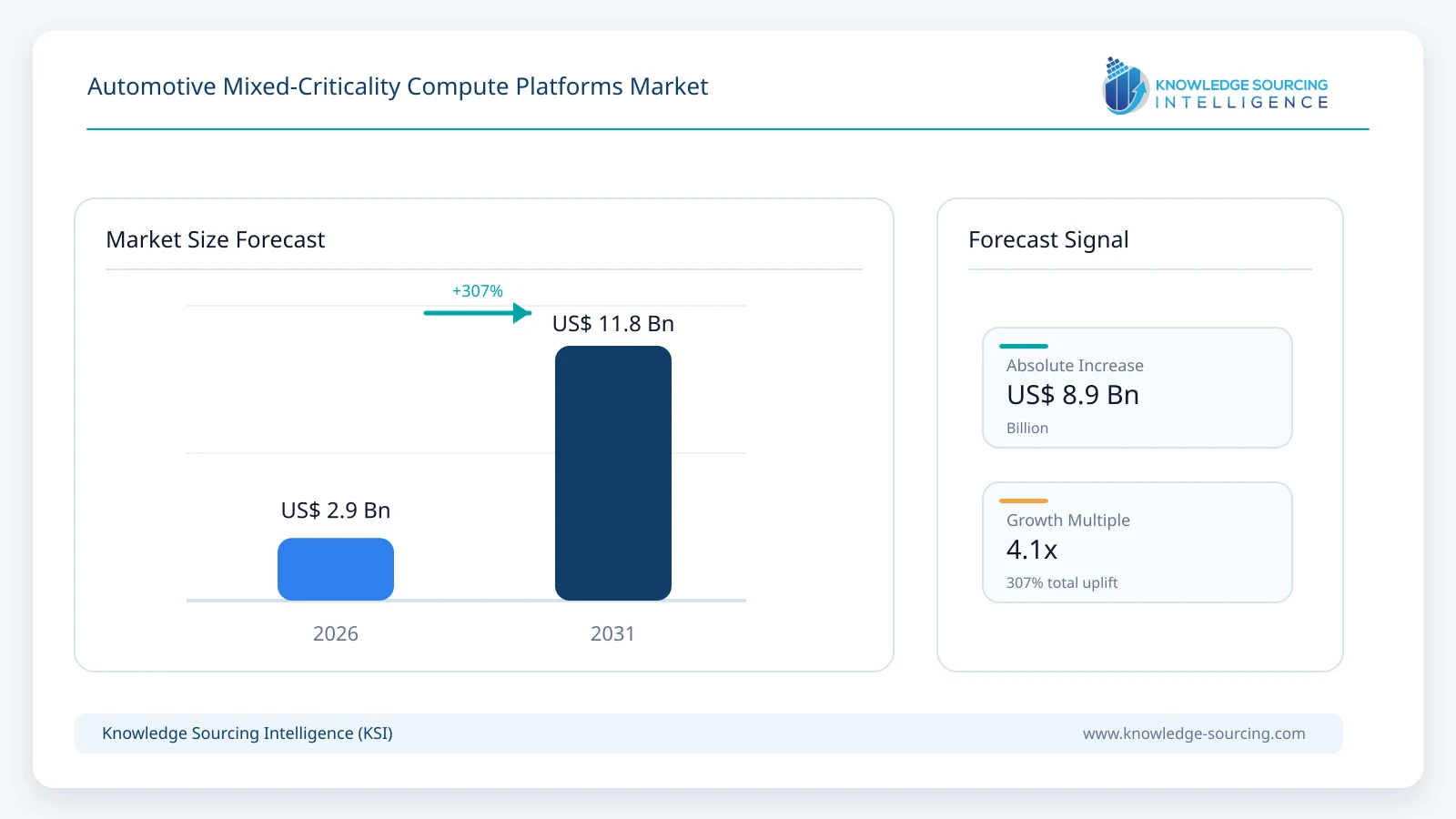
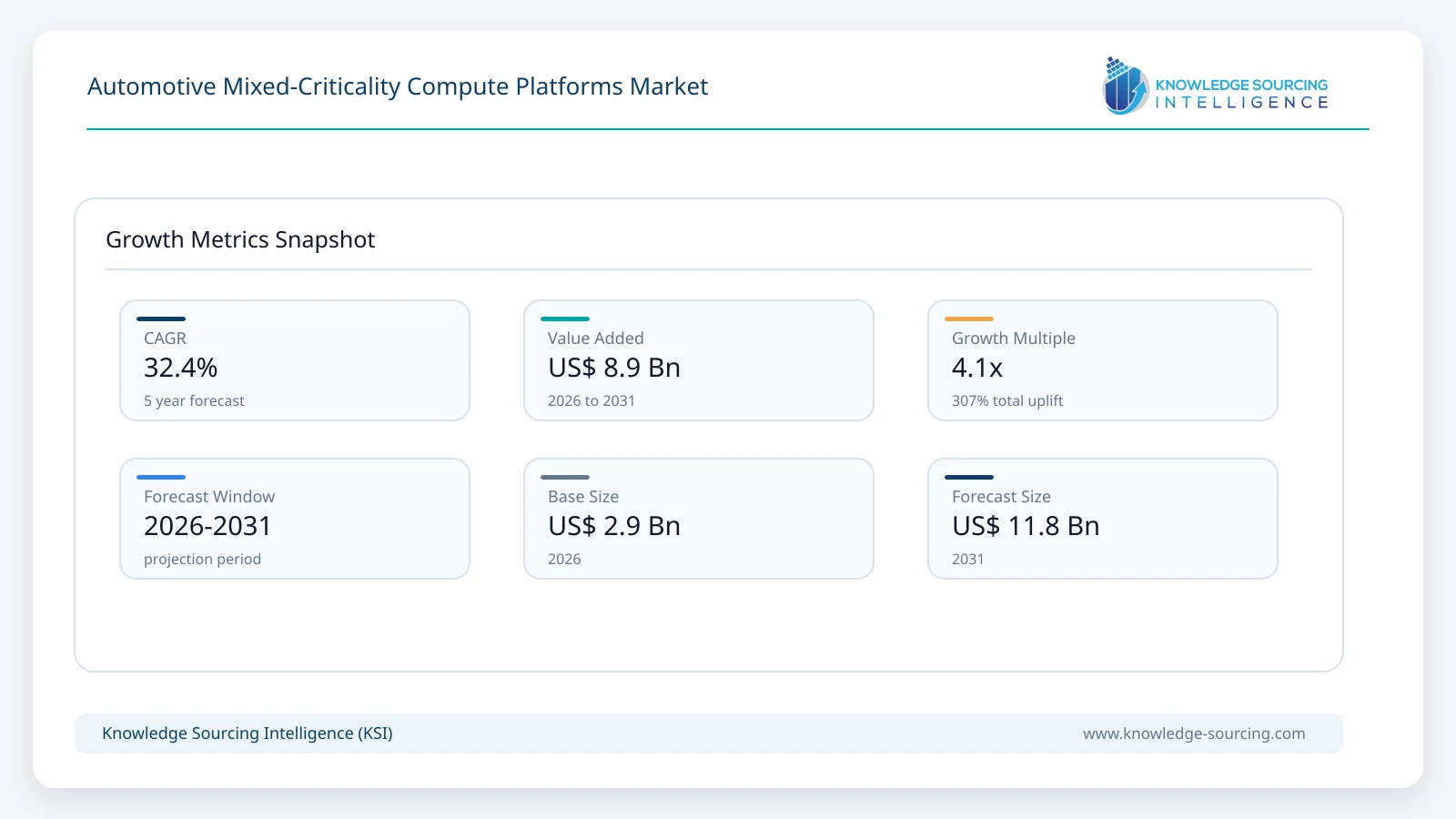
The Automotive Mixed-Criticality Compute Platforms Market is projected to expand at a CAGR of 32.4%, increasing from USD 2.90 billion in 2026 to USD 11.80 billion by 2031.
Highlights:
- 1The global mixed-criticality compute-platform market is modeled at USD 2.90 billion in 2026 and USD 11.80 billion in 2031, at an implied CAGR of 32.4%.
- 2Approximately 4.5 million qualified vehicle installations underpin the 2026 working case, increasing to 17.0 million by 2031; these are modeled installations, not supplier-reported volumes.
- 3Integrated processing hardware accounts for approximately 72% of 2026 market value; base safety software and hypervisor content gain share through 2031.
- 4Integrated safety-relevant instrumentation and infotainment is the largest principal workload combination in 2026, while cockpit and ADAS platforms gain share as centralization progresses.
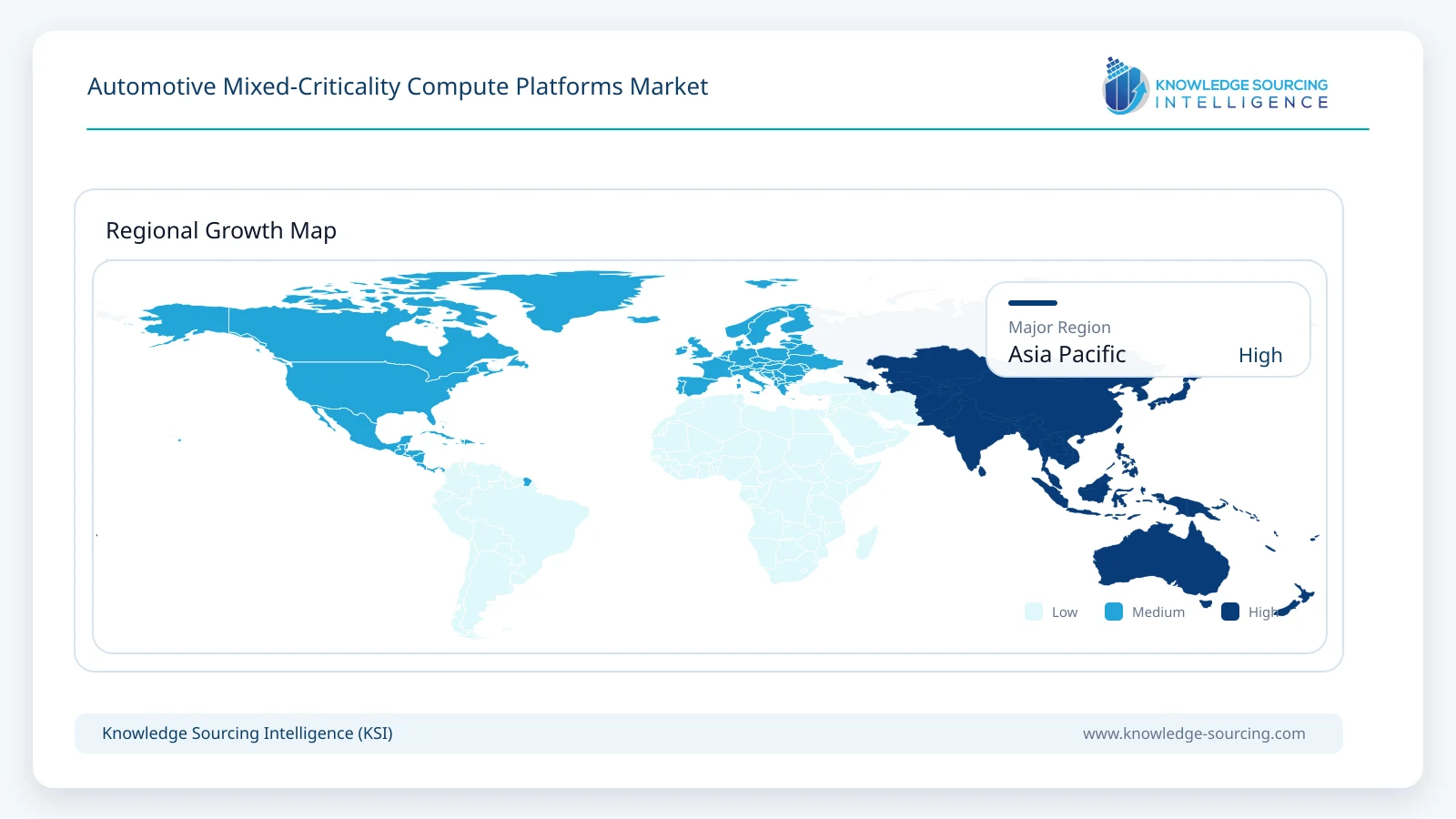
- 5Asia Pacific represents approximately 41% of modeled 2026 revenue, reflecting Chinese vehicle-platform activity and a broad East Asian electronic supply base.
- 6Software isolation, deterministic compute access and auditable safety evidence are becoming important selection criteria alongside cost and processor performance.
Mixed-criticality platforms run software functions with different safety requirements on a shared computing assembly while enforcing resource isolation, deterministic response, and independently managed fault behavior. The commercial system combines appropriate processing hardware, safety-focused platform software, and validated integration of concurrently operating workloads.
Qualcomm Snapdragon Ride Flex combines cockpit and ADAS applications with virtualization and hardware separation. NXP's S32N family addresses central-vehicle integration through real-time processing and safety supervision. Bosch, Hyundai Mobis and HARMAN provide related systems integration or development capabilities. Consolidation is commercially viable only where critical workloads remain demonstrably isolated.
Market Overview
Vehicle computers increasingly combine graphics, connected applications and safety-relevant functions with very different timing and failure requirements. A digital cluster may need dependable speed and warning displays while an infotainment application can tolerate a restart; ADAS processing requires sensor-to-decision timing controls that cannot be compromised by entertainment workloads. Mixed-criticality architectures use protected execution domains, memory and processor partitioning, real-time software and safety supervision to allow these functions to share components without sharing uncontrolled failure paths.
Qualcomm reported in January 2026 that Snapdragon Ride Flex had entered mass-produced vehicles across eight global programs, offering a tangible installed-program base for integrated cockpit and ADAS functions. Bosch and Qualcomm extended their collaboration in April 2026 around ADAS and combined cockpit/ADAS systems, while the NXP S32N7 family adds higher-level applications processing to the vehicle-core consolidation route. The announcements distinguish commercial deployments from architectures still approaching production.
Qualcomm and NXP supply processing architectures; Bosch, HARMAN, Hyundai Mobis and ZF contribute integrated systems or development programs. Green Hills Software and Wind River specialize in virtualization and safety software. AUTOSAR provides standardized execution and safety interfaces, while customer applications remain separate from foundational platform content.
Market Trends
Cockpit and ADAS workloads are converging on safety-partitioned processors
Qualcomm's January 2026 update identified eight global vehicle programs using Snapdragon Ride Flex, which combines digital cockpit and driver-assistance workloads on shared silicon. The platform's use of virtual machines, real-time execution and an ASIL-D-capable safety island shows why processor consolidation is accompanied by dedicated safety design rather than a simple transfer of applications to one operating system. Tier 1 integration still has to verify display priority, perception latency and startup order for the specific vehicle.
Bosch and Qualcomm expanded their ADAS collaboration in April 2026 to cover purpose-built mixed-criticality cockpit and ADAS solutions. This approach can reduce duplicate processor and memory content in higher-volume programs, although savings must offset stronger qualification, thermal controls and fault containment.
Vehicle-core processing is combining real-time control with application compute
NXP's S32N55 and announced S32N7 families illustrate the second route toward mixed-criticality integration: combining deterministic real-time vehicle control with higher-level applications and networking functions. Hardware-level partitioning and quality-of-service mechanisms limit the ability of one workload to monopolize shared resources. For powertrain, body and chassis integration, predictable response to sensor events remains a design requirement even when noncritical functions are updated frequently.
The S32N7 announcement in January 2026 named Bosch as the first customer to use the family in a vehicle integration platform, but the product family included preproduction devices. The sales contribution depends on later awarded vehicle launches rather than treating the processor announcement as immediate high-volume production.
Virtualization is becoming a product-level safety capability
Green Hills Software demonstrated a consolidated driver-monitoring environment with Smart Eye at CES 2026, showing how safety-relevant driver-monitoring functions can coexist with other applications under controlled software execution. Wind River's Helix platform separately illustrates the use of a safety-certifiable hypervisor with multiple operating systems. Both examples highlight why automotive virtualization is sold with integration evidence, interrupt control, protected memory and fault-management support rather than as a conventional desktop hypervisor.
Software suppliers and Tier 1 integrators must verify the impact of processor contention, shared caches, memory bandwidth and peripheral access on critical tasks. Certification artifacts and traceable partition configurations become part of long-term support obligations as OEMs modify their application mix after launch.
Common software foundations are lowering duplicated platform development
AUTOSAR's August 2026 CAPI 1.0 release made a common Adaptive Platform implementation available alongside established specifications. Standard functional clusters for communication, execution management and diagnostics give software developers a more consistent starting point across processor designs. Commercialization remains dependent on compatible hardware, partitioning policy, application qualification and the supplier's obligation to maintain a released vehicle configuration.
Open foundations can shift some supplier revenue from proprietary base components toward system integration, long-term validation and hardware-specific safety packages. Automotive engineering teams must also maintain interoperability with AUTOSAR Classic controllers and existing vehicle networks. The resulting market is less about licensing a single universal software stack than deploying qualified systems on particular production vehicle architectures.
Segment Analysis
By Revenue Component: Safety-Capable Processing Hardware
Safety-capable compute hardware represents approximately 72% of modeled market revenue in 2026. The qualified assembly includes the processor, memory, storage, networking, power management, safety supervisors, and thermal design required to host differentiated workloads on one platform. Snapdragon Ride Flex, NXP S32N processors and integrated Tier 1 computing modules provide the primary technical examples, although a processor shipment by itself is not treated as a second system sale.
Hardware remains the largest value pool in 2031 because mixed-criticality designs require processor isolation, failover provisions and communication bandwidth even as integration becomes more standardized. Higher production volumes support scaling to mainstream vehicle tiers, but procurement pressure encourages OEMs to reuse a smaller number of qualified compute configurations.
By Workload Combination: Safety Instrumentation and Infotainment
Safety instrumentation alongside infotainment accounts for about 46% of 2026 value under the modeled primary-workload classification. Instrument-cluster warnings, telltales, and selected safety-related display outputs must retain dependable operation despite faults or updates in navigation, media, or third-party applications. Production cockpit-domain experience makes this a commercially established starting point for mixed-criticality computing rather than requiring immediate integration of vehicle motion control.
The share decreases toward 2031 as combined cockpit and ADAS platforms expand faster. Dedicated safety partitions still matter inside cabin computers, especially when the same processor supports several display surfaces or occupant-monitoring functions. Integrators compete on boot behavior, latency assurance, and preserving deterministic displays across software releases.
By Workload Combination: Cockpit and Driver Assistance
Cockpit and driver-assistance integration captures approximately 34% of modeled revenue in 2026 and gains share by 2031. Qualcomm's Ride Flex platform and Bosch's combined cockpit/ADAS engineering work illustrate why processor hardware can host both graphics-intensive infotainment and safety-relevant sensor processing when execution and memory interference are controlled. The integrated system can reduce duplicate computing components, but the safety case must consider concurrent high-load operating conditions.
Tier 1 suppliers also need platform-specific thermal and power budgets because continuous camera and AI inference can compete with premium display workloads for finite silicon resources. OEM sourcing decisions therefore balance lower module count against increased system-testing complexity. Production evidence is strongest for identified programs, while future partnerships remain a pipeline indicator rather than existing volume.
By Compute Architecture: Single-SoC Partitioned Platforms
Single-SoC partitioned platforms represent approximately 43% of 2026 market value and are projected to reach 53% by 2031. Dedicated safety islands, split-lockstep cores, memory-protection features and suitable hypervisors allow applications with different assurance needs to execute inside a shared computing module. Consolidation can improve controller packaging and common-software reuse when the application mix fits the selected processor's safety and performance budgets.
Multi-processor systems will remain relevant for programs that require physical separation or higher processing headroom. Central-to-zonal combinations expand as vehicle-core responsibilities move toward central computers, although zonal I/O hardware alone does not constitute a mixed-criticality platform. Future market share depends on verified safety separation and system economics rather than architectural labels alone.
Market Drivers
Consolidation of safety and non-safety vehicle functions
Vehicle programs increasingly combine cluster, infotainment, driver-monitoring and selected ADAS tasks on shared processors, increasing the value of hardware that supports independent timing and fault behavior. Qualcomm's Ride Flex mass-production programs demonstrate that mixed-criticality functionality has advanced beyond laboratory prototypes. The purchase decision reflects not just elimination of duplicate ECUs but also fewer high-speed interfaces, lower packaging demand and common software maintenance.
OEM adoption should broaden where validated architectures can be reused across trim levels and regional configurations. Scale is more likely to follow proven supplier platforms than repeated one-off consolidation projects, because each new pairing of critical and noncritical applications requires analysis of workload interference and degraded operating modes.
Higher functional-safety requirements for consolidated computing
ISO 26262-oriented development raises the importance of demonstrable freedom from interference when critical functions share a processor with software that has lower safety obligations. Qualcomm describes hardware support for isolated virtual machines and an ASIL-D safety island, while NXP's S32N family includes core-to-pin protection and real-time safety mechanisms. Hardware vendors and software integrators can therefore sell a more complete qualified platform rather than commodity compute alone.
The revenue effect extends into validation tooling, traceable software configurations and long-term release support. Automotive customers need evidence that memory traffic, exception handling and peripheral access remain controlled during normal operation and fault recovery, not simply assurances that a hypervisor has been installed.
Vehicle-core centralization across body and control systems
NXP's S32N architecture addresses centralization of propulsion, vehicle dynamics, body and gateway functions that previously required multiple dedicated ECUs. Mixed safety and performance requirements create demand for real-time processing cores, hardware partitioning, networking accelerators and safety management in one platform family. Bosch's announced integration interest supports the relevance of this route beyond high-end cockpit computing.
The strongest opportunities are vehicle programs replacing established distributed controllers during platform redesigns. Integration engineering remains significant because customer-specific actuator interfaces and legacy networks cannot be removed through processor consolidation alone.
Reusable multi-OS software stacks and toolchains
Automotive-grade virtualization platforms can host a real-time operating system alongside Linux or Android while retaining explicit workload separation and restart behavior. Wind River's Helix product and the operating-software environment described for Snapdragon Ride Flex show the combination of base software, certified execution environments and system integration that customers source. AUTOSAR's CAPI release also increases the potential to share application infrastructure across programs.
Software reuse reduces repeated base-development expenditure while expanding the commercial role of integration, safety configuration, validation and lifecycle support. The opportunity is highest where a Tier 1 can qualify one reference platform and preserve its assurance evidence across several processor variants.
OEM demand for long-lived updatable vehicle platforms
Centralized vehicle architectures are designed to support periodic application changes after a vehicle enters service, which requires stable execution boundaries around functions that cannot tolerate arbitrary software modification. AUTOSAR Adaptive specifies execution and state mechanisms, while supplier safety architectures allow noncritical workloads to evolve without forcing identical release schedules for critical software.
Platform selection increasingly considers the cost of maintaining software for several vehicle years. Robust fault containment and configuration management can reduce regression scope, although each safety-relevant change still needs appropriate verification before deployment.
Market Restraints
Freedom-from-interference validation across shared resources
Sharing processor caches, memory controllers, interrupt paths and I/O resources can create timing interference even when applications operate inside different virtual machines. Automotive integrators have to demonstrate that a high-load graphics or AI application cannot delay a critical task beyond its allowed response. Freedom-from-interference analysis therefore extends from software partition definitions to physical processor behavior.
The validation matrix grows quickly as OEMs add operating systems, modify scheduling policy or change processor revisions. These costs can delay program awards and restrict the choice of workloads that suppliers are willing to consolidate on one controller.
Safety certification and program-specific integration costs
Processor data sheets and software-component certifications do not establish a complete vehicle-level safety case. Tier 1 suppliers must provide fault-injection results, traceability, safety manuals and integration evidence tied to the actual application mix. A component qualified for ASIL-relevant use still requires the automaker to confirm assumptions of use at the vehicle-system level.
Long automotive program cycles raise nonrecurring engineering expense and create additional contractual obligations after launch. Where hardware consolidation saves only a small number of inexpensive ECUs, qualification cost can outweigh the economic benefit and favor physically separate controllers.
Thermal constraints and shared-compute performance contention
High-resolution graphics, camera perception and AI inference generate sustained processing and memory demand that may conflict with real-time vehicle functions. Shared computing assemblies must reserve resources for safety-relevant work during peak thermal conditions, not merely meet average performance targets. Aggressive thermal throttling can undermine a safety architecture if worst-case execution budgets are not maintained.
Suppliers may need larger processors, more memory bandwidth or improved cooling, reducing the expected bill-of-materials savings from consolidation. Cost-sensitive vehicle variants can therefore retain separate compute paths or limited workload combinations.
Hardware fragmentation and long vehicle support lifecycles
Mixed-criticality isolation depends on processor-specific memory controllers, safety cores, interrupt routing and peripheral ownership, which differ across semiconductor families. A software configuration proven on one SoC may require substantial modification and renewed verification on another. Automotive program lifetimes further extend beyond the cadence of semiconductor updates.
OEMs are responding with portable middleware and common platform interfaces, but hardware abstraction cannot eliminate physical timing and fault-propagation characteristics. Multi-vendor sourcing may remain difficult for deeply integrated mixed-criticality platforms.
Unclear cost recovery for lower-volume vehicle programs
Developing a shared platform can reduce duplicated hardware, wiring and electronic packaging, but an OEM must fund additional systems engineering, safety analyses and software maintenance. In lower-volume commercial or entry-level passenger programs, the fixed engineering expense may be spread over relatively few vehicles. A proven dedicated controller can consequently remain economically preferable.
Mixed-criticality adoption is therefore sensitive to the number of vehicle lines using a common architecture and the extent to which safety artifacts can be reused. Delayed model launches or platform changes weaken the expected return from centralization and can defer supplier revenue.
Regional Outlook
Asia Pacific
Asia Pacific represents approximately 41% of the 2026 working market. Chinese automakers and Tier 1 suppliers have advanced integration of cockpit and assistance functions, while the region's semiconductor and electronic manufacturing ecosystems support controller deployment at scale. Qualcomm cited global series-production programs on Ride Flex, and partnerships with Asian suppliers offer a route for integrated compute designs to reach higher-volume vehicle segments.
China should remain the largest country allocation in the region, supported by rapid software-defined platform cycles and development of premium electric-vehicle architectures. Japan and South Korea retain significant vehicle electronics expertise, while Indian program development becomes more relevant through cost-adjusted ADAS platforms and supplier engineering partnerships. Adoption rates are modeled rather than taken from a disclosed country-level mixed-criticality installation series.
Europe
Europe accounts for approximately 29% of modeled 2026 revenue and remains a center for mixed-criticality systems engineering, functional-safety qualification and Tier 1 platform integration. Bosch's announced collaborations with Qualcomm and NXP illustrate the region's role in combining processor innovation with vehicle-program responsibility. European OEMs also have established supplier qualification processes that favor detailed safety cases and configuration control.
The region's 2031 market value increases as platforms with mixed safety and non-safety functions spread beyond premium vehicle launches. Cost and integration complexity may moderate uptake relative to faster-changing Chinese architectures, but reusable certified software and long program support should sustain high attributable engineering content per qualifying vehicle.
Competitive Landscape
Competition combines semiconductor platform companies, vehicle-computer integrators and safety-software suppliers rather than one homogeneous set of finished-product manufacturers. Qualcomm and NXP compete through processing architectures and hardware safety features. Bosch, HARMAN and Hyundai Mobis are relevant through systems integration or announced development programs, while ZF is engaged in mixed-domain development with Qualcomm. These companies operate at different layers of the value chain and should not be assigned interchangeable market shares.
Green Hills Software and Wind River compete in safety-focused operating software and virtualization; their products create attributable value where actually licensed or integrated with qualified hardware. AUTOSAR-based software suppliers and development partners provide compatible runtime, application integration and lifecycle tooling. Customer selection depends on processor timing guarantees, safety documentation, hardware-software co-design and the ability to scale a validated reference system across model lines. Public company reporting rarely isolates mixed-criticality compute revenue.
Recent Developments
20 August 2026: AUTOSAR released CAPI 1.0, a shared implementation of the Adaptive Platform with code and generators. The release improves the development foundation for execution and communication functions; it does not independently establish a vehicle platform safety case.
April 2026: Bosch and Qualcomm announced expanded collaboration on production-oriented ADAS and combined cockpit/ADAS systems using Snapdragon technology, including mixed-criticality applications on shared hardware.
7 January 2026: Hyundai Mobis and Qualcomm signed an agreement to co-develop next-generation SDV and ADAS technology based initially on Snapdragon Ride Flex. The agreement is a development commitment rather than confirmed vehicle shipments.
5 January 2026: Qualcomm reported that Snapdragon Ride Flex had been deployed across eight mass-produced vehicle programs, providing a commercial reference for combined cockpit and ADAS workloads.
5 January 2026: NXP introduced the S32N7 family for central vehicle functions and identified Bosch as the first integration-platform customer; announced silicon availability must be distinguished from vehicle production.
5 January 2026: Green Hills Software and Smart Eye announced a CES demonstration integrating driver monitoring in a consolidated mixed-criticality environment; the event was a technical demonstration, not a confirmed series-production award.
Market Outlook
Mixed-criticality compute adoption should expand as OEMs combine previously separated functions. Shared cockpit/ADAS and central vehicle-core computers will lead growth where safety partitioning is validated. Hardware remains the largest revenue component, while virtualization, safety configuration and lifecycle engineering gain importance in repeatable platforms.
Qualification costs and timing constraints will prevent universal consolidation. Platforms with documented fault handling and long-term support should outperform compute-only offerings. Asia Pacific should remain the largest regional market, while European suppliers contribute substantial safety-engineering expertise.
Automotive Mixed-Criticality Compute Platforms Market Scope:
| Report Metric | Details |
|---|---|
| Total Market Size in 2026 | USD 2.90 billion |
| Total Market Size in 2031 | USD 11.80 billion |
| Forecast Unit | USD Billion |
| Growth Rate | 32.4% |
| Study Period | 2021 to 2031 |
| Historical Data | 2021 to 2024 |
| Base Year | 2025 |
| Forecast Period | 2026 – 2031 |
| Segmentation | Revenue Component, Primary Workload Combination, Compute Architecture, Vehicle Type |
| Companies |
|
Market Segmentation
By Revenue Component
Safety-Capable Compute Hardware and Controllers
Base Safety Software, Virtualization and Runtime
System Integration, Verification and Lifecycle Engineering
By Primary Workload Combination
Safety-Relevant Instrumentation and Infotainment
Cockpit and Driver-Assistance Processing
Vehicle-Core Control and Noncritical Services
By Compute Architecture
Single-SoC Hardware-Partitioned Platforms
Multi-SoC and Heterogeneous Partitioned Systems
Central-to-Zonal Safety-Partitioned Platforms
By Vehicle Type
Passenger Vehicles
Light Commercial Vehicles
Medium and Heavy Commercial Vehicles
By Geography
North America
United States
Canada
Mexico
South America
Brazil
Argentina
Others
Europe
Germany
United Kingdom
France
Italy
Spain
Others
Middle East and Africa
Saudi Arabia
United Arab Emirates
South Africa
Israel
Others
Asia Pacific
China
Japan
India
South Korea
Indonesia
Thailand
Australia
Taiwan
Others
Table of Contents
1. EXECUTIVE SUMMARY
1.1. Market Opportunity and Key Findings
1.2. Market Size and Growth Outlook
1.3. Component and Architecture Outlook
1.4. Regional Opportunity Summary
2. MARKET SNAPSHOT
2.1. Market Overview
2.2. Market Definition
2.3. Scope of the Study
2.4. Market Segmentation
3. BUSINESS LANDSCAPE
3.1. Market Drivers
3.1.1. Consolidation of safety and non-safety vehicle functions
3.1.2. Higher functional-safety requirements for consolidated computing
3.1.3. Vehicle-core centralization across body and control systems
3.1.4. Reusable multi-OS software stacks and toolchains
3.1.5. OEM demand for long-lived updatable vehicle platforms
3.2. Market Restraints
3.2.1. Freedom-from-interference validation across shared resources
3.2.2. Safety certification and program-specific integration costs
3.2.3. Thermal constraints and shared-compute performance contention
3.2.4. Hardware fragmentation and long vehicle support lifecycles
3.2.5. Unclear cost recovery for lower-volume vehicle programs
3.3. Market Opportunities
3.4. Porter's Five Forces Analysis
3.5. Industry Value Chain Analysis
3.6. Policies, Standards and Regulations
3.7. Strategic Recommendations
4. TECHNOLOGICAL OUTLOOK
4.1. Mixed-Criticality Hardware Partitioning and Isolation
4.2. Safety Islands, Split-Lockstep Cores and Deterministic Compute
4.3. Type-1 Hypervisors and Multiple Operating Systems
4.4. Freedom from Interference and Shared-Resource Quality of Service
4.5. AUTOSAR Adaptive, Classic and Safety Runtime Interworking
4.6. Health Monitoring, Recovery and Fail-Operational Architecture
4.7. Software Updates and Safety Case Maintenance
5. AUTOMOTIVE MIXED-CRITICALITY COMPUTE PLATFORMS MARKET BY REVENUE COMPONENT
5.1. Introduction
5.2. Safety-Capable Compute Hardware and Controllers
5.3. Base Safety Software, Virtualization and Runtime
5.4. System Integration, Verification and Lifecycle Engineering
6. AUTOMOTIVE MIXED-CRITICALITY COMPUTE PLATFORMS MARKET BY PRIMARY WORKLOAD COMBINATION
6.1. Introduction
6.2. Safety-Relevant Instrumentation and Infotainment
6.3. Cockpit and Driver-Assistance Processing
6.4. Vehicle-Core Control and Noncritical Services
7. AUTOMOTIVE MIXED-CRITICALITY COMPUTE PLATFORMS MARKET BY COMPUTE ARCHITECTURE
7.1. Introduction
7.2. Single-SoC Hardware-Partitioned Platforms
7.3. Multi-SoC and Heterogeneous Partitioned Systems
7.4. Central-to-Zonal Safety-Partitioned Platforms
8. AUTOMOTIVE MIXED-CRITICALITY COMPUTE PLATFORMS MARKET BY VEHICLE TYPE
8.1. Introduction
8.2. Passenger Vehicles
8.3. Light Commercial Vehicles
8.4. Medium and Heavy Commercial Vehicles
9. AUTOMOTIVE MIXED-CRITICALITY COMPUTE PLATFORMS MARKET BY GEOGRAPHY
9.1. North America
9.1.1. United States
9.1.2. Canada
9.1.3. Mexico
9.2. South America
9.2.1. Brazil
9.2.2. Argentina
9.2.3. Others
9.3. Europe
9.3.1. Germany
9.3.2. United Kingdom
9.3.3. France
9.3.4. Italy
9.3.5. Spain
9.3.6. Others
9.4. Middle East and Africa
9.4.1. Saudi Arabia
9.4.2. United Arab Emirates
9.4.3. South Africa
9.4.4. Israel
9.4.5. Others
9.5. Asia Pacific
9.5.1. China
9.5.2. Japan
9.5.3. India
9.5.4. South Korea
9.5.5. Indonesia
9.5.6. Thailand
9.5.7. Australia
9.5.8. Taiwan
9.5.9. Others
10. COMPETITIVE ENVIRONMENT AND ANALYSIS
10.1. Major Players and Strategy Analysis
10.2. Market Share Analysis
10.3. Mergers, Acquisitions, Agreements and Collaborations
10.4. Competitive Dashboard
11. COMPANY PROFILES
11.1. Qualcomm Technologies, Inc.
11.2. NXP Semiconductors N.V.
11.3. Robert Bosch GmbH
11.4. HARMAN International Industries, Incorporated
11.5. Hyundai Mobis Co., Ltd.
11.6. ZF Friedrichshafen AG
11.7. Green Hills Software LLC
11.8. Wind River Systems, Inc.
11.9. Elektrobit Automotive GmbH
11.10. BlackBerry QNX
11.11. AUMOVIO SE
11.12. Vector Informatik GmbH
12. APPENDIX
12.1. Currency
12.2. Assumptions
12.3. Base and Forecast Years Timeline
12.4. Key Benefits to Stakeholders
12.5. Research Methodology
12.6. Abbreviations
Navigate
Trusted by the world's leading organizations











