
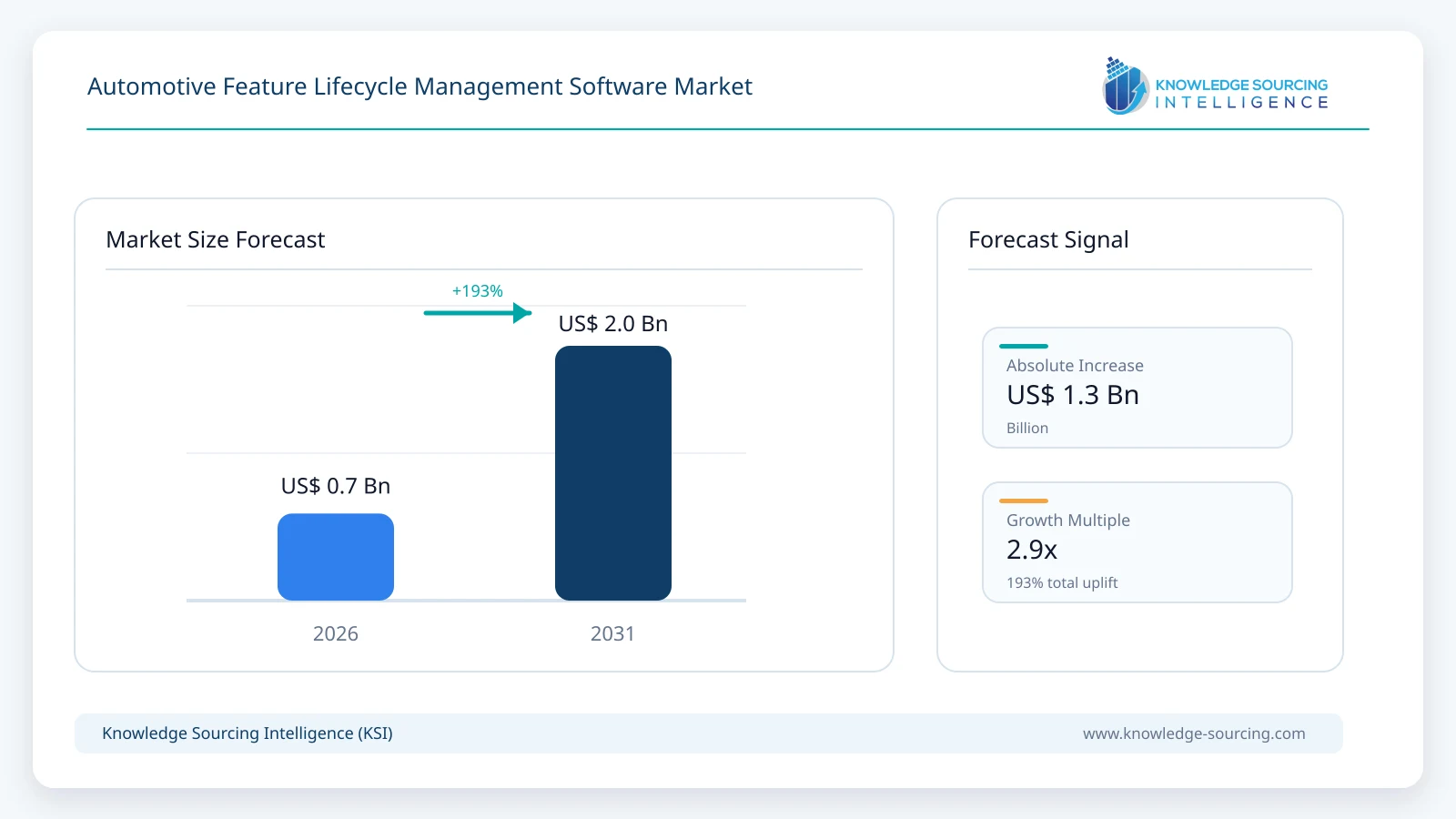
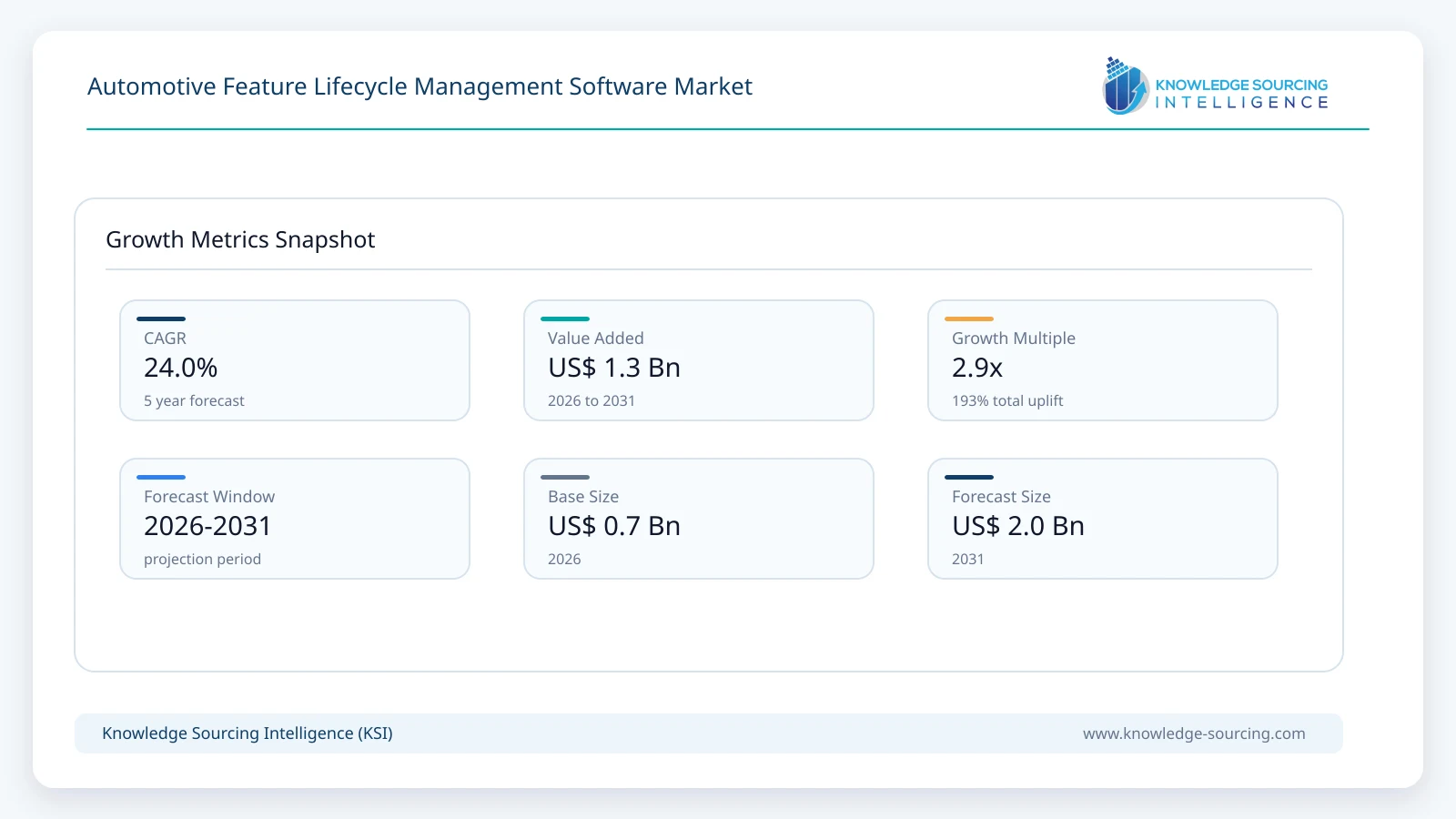
The automotive feature lifecycle management software market is expected to grow from USD 0.69 billion in 2026 to USD 2.02 billion by 2031, expanding at a CAGR of approximately 24.0% across the forecast period.
Highlights:
- 1Feature-catalogue and configuration governance is the largest lifecycle capability in 2026, while in-field monitoring and support increase their share by 2031.
- 2Embedded platform software accounts for most modeled revenue, with ongoing fleet support becoming more important as connected-vehicle populations grow.
- 3Passenger vehicles represent the largest customer base, while commercial fleets need durable support for diagnostics, utilization and feature eligibility.
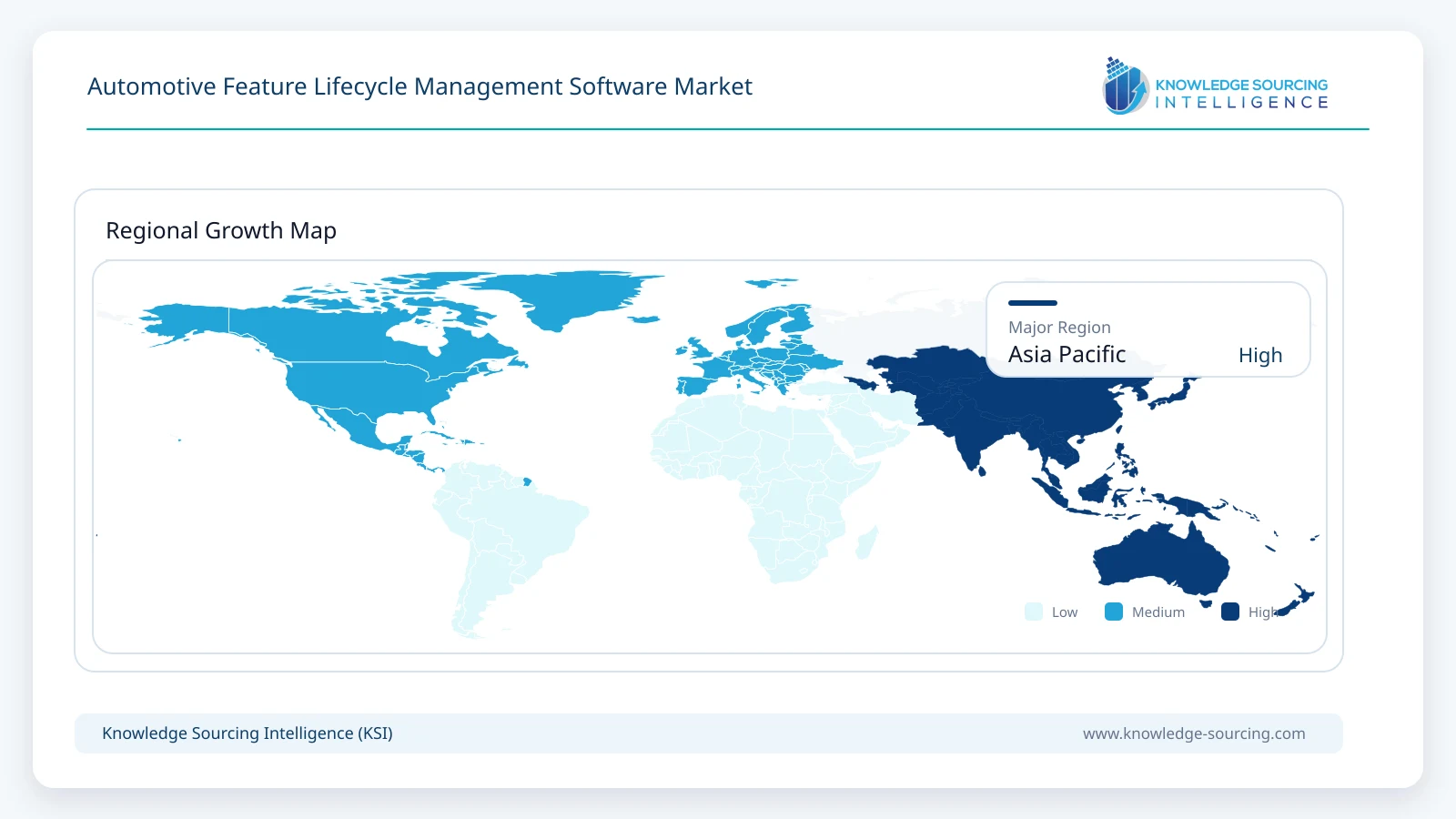
- 4Asia Pacific leads the regional revenue mix, supported by new connected and software-defined vehicle programs in China, Japan, South Korea and India.
- 5Automakers are increasingly linking software release decisions with version records, authorization, operational evidence and regulatory documentation.
Vehicle features now move through several software states after a model enters production. An automaker may release a comfort function on one vehicle grade, revise its operating rules after customer feedback, introduce the feature on another platform and later withdraw an unsupported version. Managing these changes requires a reliable view of the feature definition, approved software combination, available hardware, customer eligibility and deployment history. Lifecycle platforms provide that common record and help engineering, manufacturing, sales and aftersales teams work from consistent information.
Sonatus supplies vehicle software tools that support configuration changes and traceable software updates, while Sibros provides software-update and lifecycle-management capabilities across different vehicle architectures. Aptiv LINC combines application lifecycle management with container and OTA capabilities, and HARMAN links software validation, OTA delivery and its Ready Link Marketplace for customer-facing digital features. These examples show different supplier approaches to the same operational need: keeping the active vehicle configuration consistent with the version approved by engineering and authorized for the owner.
Automakers generally retain responsibility for feature policy, model-specific eligibility and safety approval even when platform software comes from a supplier. UNECE Regulation No. 156 provides software-update management requirements for vehicles to which the regulation applies, reinforcing the need for release records and change control. Suppliers compete on traceability across vehicle variants, integration with existing engineering systems and dependable support after production rather than on package delivery speed alone.
Market Trends
Feature records are becoming part of the vehicle’s production configuration
Automakers increasingly need a consistent link between the software promised in the product specification and the software installed in each finished vehicle. Feature catalogues record configuration options, prerequisites and applicable hardware, then connect those records with the release configuration used by factories and dealers.
Vector’s PREEvision connects requirements, architecture, implementation and test information, while its software-update tools address the later fleet workflow. A common record reduces the risk that feature definitions maintained by engineering differ from those used in aftersales support.
Release eligibility is becoming more important than the update package alone
Software packages cannot be treated as interchangeable across all vehicles that share a model badge. Controller generations, optional sensors, battery variants and regional approvals determine whether a feature can be installed or enabled safely. Lifecycle tools increasingly check this information before a release enters a deployment campaign.
Sonatus Updater supports software dependencies, configuration changes, dry runs and traceability, while Excelfore’s production-oriented eSync work addresses update control and remote diagnostics.
Feature entitlements are being connected to operating status
A software function sold or included at delivery still needs a dependable record of authorization, activation and continued support. Vehicle owners may change subscriptions, ownership or regional registration, while an OEM may change a feature’s technical eligibility following a software update.
HARMAN’s Ready Link Marketplace provides a route for in-vehicle applications and services, while suppliers such as Sonatus support the underlying configuration and automation functions. Suppliers earn platform consideration for feature-state control, approved interfaces and lifecycle support rather than the full value of subscriptions purchased by drivers.
In-field evidence is influencing the next release decision
Automotive feature teams increasingly use connected diagnostics and software-state information to decide whether an update should be expanded, adjusted or rolled back. Vehicle configuration, installation success and fault behavior allow engineers to identify whether a problem affects one software version, one hardware combination or a larger program. This feedback reduces the cost of investigating field issues.
Sibros combines updating with remote commands and vehicle data capabilities, and Sonatus supports targeted data collection and diagnostic workflows. Feature lifecycle software uses the relevant evidence to inform release and support decisions.
Open software foundations are changing integration requirements
Software-defined vehicle programs increasingly seek common middleware and application interfaces that can be carried between processor families and vehicle generations. ETAS presented a Vehicle Software Platform Suite based on Eclipse S-CORE in June 2026, emphasizing portability and a more reusable software foundation. Common interfaces can reduce duplicated work across vehicle programs.
Open foundations do not remove the need to identify the exact hardware, software and validation state of a released feature. Instead, automakers still need tools for lifecycle evidence, approval and controlled change across supplier products.
Automotive Feature Lifecycle Management Software Market Segment Analysis
By Lifecycle Capability
Feature Catalogue and Configuration Governance
Feature catalogue and configuration governance represents approximately 30% of modeled market value in 2026. This activity covers feature definitions, configuration baselines, hardware prerequisites and links between engineering data and production variants. The segment holds a leading position because a reliable feature record is needed before release eligibility or ongoing entitlement can be managed.
Vector’s systems-engineering tools show the wider market demand for controlled technical definitions, while vehicle software suppliers implement the production-facing record and configuration interfaces. By 2031 the segment remains important but represents a smaller share as monitoring and fleet support gain weight.
By Lifecycle Capability
In-Field Monitoring, Support and Retirement
In-field monitoring, support and retirement accounts for approximately 23% of market value in 2026 and rises to 30% in the 2031 model. Once several software revisions are operating across a large installed fleet, suppliers must help automakers identify unsupported versions, confirm update outcomes and plan the withdrawal of obsolete features. Lifecycle work also includes preserving records needed for service and warranty decisions.
Sonatus, Sibros and Excelfore provide different combinations of vehicle-state visibility, updating and remote diagnostics that support this workflow. Growth reflects the rising number of vehicles requiring service after their first software release, not only the number of new models launched each year.
By Revenue Component
Embedded Lifecycle Platform Software
Embedded lifecycle platform licensing represents about 70% of modeled revenue in 2026. Software supplied at the vehicle-program level links the in-vehicle runtime with configuration, authorization and release records that persist through production and aftersales. The attributable platform value is smaller than the whole OTA or operating-system contract because the lifecycle function is only one part of those larger software stacks.
The market share of embedded licensing rises as the number of qualified vehicles increases and common software is reused across platforms. Engineering and validation remain necessary, but growth in volumes spreads program-level integration expense over more installations.
By Vehicle Function
ADAS, Safety and Driving Functions
ADAS, safety and driving functions account for approximately 21% of modeled market value in 2026, with a larger share expected by 2031. Changes to assistance or driving-related functions generally face stronger validation, version-control and eligibility requirements than a graphical interface update. Software approval must therefore be connected to the supported sensor set, control hardware and applicable operating conditions.
Vehicle manufacturers may update perception or assistance features over time, but the lifecycle platform does not include the commercial value of those algorithms themselves. Its revenue comes from the controls and records needed to manage qualified releases.
Market Drivers
Growing software variation across vehicle models
One vehicle architecture now supports many combinations of powertrain, assistance systems, displays and regional software. Engineering teams must keep the feature definition consistent while still allowing vehicle-grade differences and country-specific rules. A lifecycle platform reduces manual comparisons between configuration databases, production software and aftersales records.
Vector’s PREEvision tools demonstrate the demand for linked engineering information from specification to implementation, while embedded suppliers translate those configurations into deployable software states. Each additional software variant increases the value of automated eligibility checking and a maintained version history. This demand extends beyond premium models as common electronics platforms reach higher-volume vehicles.
Longer in-field software support commitments
Automakers are expected to manage software changes for years after a vehicle is sold. A vehicle may need a defect correction, a security update or a compatibility change long after a replacement model enters production. Manufacturers must identify the exact feature version present in the vehicle before a release can be authorized or a support case closed.
Sibros and Sonatus provide tools for updates, remote diagnostics and software-state visibility across connected vehicles. These capabilities turn lifecycle support into an ongoing operating expense for automakers and a continuing software-service opportunity for suppliers. A growing installed fleet also creates demand for reliable maintenance records even when the annual number of new vehicle programs changes only modestly.
Expansion of post-sale feature activation
Functions available through a vehicle digital store require a connection between the customer’s purchase, the vehicle’s technical eligibility and the actual feature state. A single customer may enable a function, suspend it, transfer the vehicle or request support after a software revision. Without a dependable lifecycle record, customer-service teams cannot easily distinguish an entitlement problem from an installation or compatibility issue.
HARMAN Ready Link Marketplace and related OTA tools show how automotive suppliers combine customer-facing feature access with software delivery and validation. The wider economic value of a paid function belongs to the feature provider or automaker, but the transaction creates demand for lifecycle controls. Platform suppliers benefit when features must remain reliable across successive vehicle software releases.
Release documentation and software-update governance
UN Regulation No. 156 and the software-update management practices associated with it increase attention to the records behind software changes in covered vehicle programs. Automakers need to know which version was approved, what was changed, which vehicles received the release and whether the outcome was verified. These requirements cannot be met reliably with isolated spreadsheets once software variation becomes extensive.
Suppliers that connect feature records to release evidence and vehicle configuration can reduce approval and audit preparation work. The same information helps engineering teams investigate field behavior after a release. Regulatory requirements support the market mainly through stronger process discipline, not through an assumption that every country or vehicle is governed by the same implementation date.
Reusable software platforms across vehicle generations
Common software components allow manufacturers to spread development effort across several vehicles and maintain a consistent approach to future changes. Yet reuse creates a new problem: the same function may operate on different chips, controller versions and network configurations. Lifecycle tools are needed to identify where common software remains compatible and where further testing is required.
ETAS and Aptiv promote software foundations designed for reuse and integration across vehicle architectures. Their work reflects the commercial importance of reducing duplicated engineering without weakening production control. As more OEM programs adopt shared software stacks, demand rises for versioning, feature baselines and targeted release management alongside the underlying runtime software.
Market Restraints
Difficult integration with legacy configuration systems
Vehicle manufacturers commonly maintain product specifications, software bills of material, service histories and customer entitlements in separate enterprise systems. Connecting these records requires mapping product identifiers, software versions and vehicle-level eligibility rules. A lifecycle platform cannot provide reliable release control when these data disagree or are updated at different times.
Integration work becomes especially demanding for automakers with older distributed ECU architectures and long-running platforms. Supplier software may be technically ready while production and aftersales teams still need months to align data ownership and interfaces. These costs can slow broader rollouts and encourage manufacturers to retain established internal tools.
Safety validation limits the speed of feature changes
Changes to braking, steering, energy management or driver-assistance functions can affect the vehicle’s safety case and approved operating behavior. Even where a change is software-only, it may need extensive testing against multiple sensor and hardware combinations. Lifecycle tools can automate records and eligibility checks but cannot replace required engineering judgment or functional validation.
Automakers therefore tend to introduce stronger change-control processes for higher-criticality features than for comfort or entertainment applications. The resulting program work reduces the pace at which some feature classes become available for post-sale revision. Supplier claims about rapid deployment must be assessed against the actual maturity and qualification status of each vehicle function.
Unclear commercial ownership of bundled software
Feature lifecycle functions are often included in larger OTA, cloud, engineering or software-platform contracts. Automakers may purchase a package covering data management, delivery, authentication and support without an independently priced lifecycle component. The bundled structure makes it difficult for specialist suppliers to demonstrate a separate budget line for their software.
Large Tier 1 suppliers can absorb lifecycle functions into broader platform programs, while independent vendors must prove measurable savings in release engineering and aftersales operations. Negotiations increasingly concern interface ownership, support duration and responsibility for failures. This commercial structure can limit standalone pricing even as technical use of lifecycle controls increases.
Cybersecurity and permission-management burdens
Feature activation creates additional paths through which software settings and operating permissions can be changed after sale. Automakers have to protect release credentials, customer entitlements and interfaces that could otherwise permit unauthorized configuration changes. A lifecycle system must establish who approved an action and which vehicle or fleet received it.
Security requirements increase integration effort, especially where software runs across vehicle domains with different safety levels. OEM teams need to manage credential renewal, role-based access and evidence retention over long periods. Platform vendors that cannot align with the customer’s security architecture may face extended qualification or lose access to higher-value functions.
Installed-fleet fragmentation raises long-term support costs
Connected fleets accumulate vehicles with different hardware generations, incomplete updates and software combinations that are no longer sold. Maintaining compatibility rules for these older vehicles can be more expensive than supporting a single new platform. A feature that operates well on one model year may need altered instructions or a replacement package on another.
Suppliers must preserve historical configuration information and investigate issues without assuming that all vehicles can accept the newest release. As the installed base expands, support obligations can grow faster than the number of new program awards. Automakers may defer less-essential feature additions when the cost of maintaining several supported versions becomes too high.
Regional Outlook
Asia Pacific
China, Japan, South Korea and India provide a large base of new connected-vehicle programs and manufacturing activity. The region holds an estimated 43% of this software market in 2026, supported by manufacturers introducing common electronic architectures and varied feature packages across multiple brands.
Excelfore announced in April 2026 that its OTA and remote diagnostics platform was deployed for Tata Motors Passenger Vehicles with the new Tata Sierra, providing an example of lifecycle capabilities entering production-focused programs in India. Japanese technology partnerships and Chinese digital-vehicle platforms contribute further demand, although software supplier attribution can vary considerably between OEM-led and externally sourced platforms.
Europe
European vehicle manufacturers operate broad model ranges with extensive equipment variation and long aftersales support obligations. The region accounts for approximately 28% of modeled market value in 2026. Feature lifecycle tools are relevant to keeping software configurations, approved releases and vehicle service records aligned across several countries and vehicle generations.
UNECE software-update management rules affect relevant European vehicle programs and encourage more disciplined records and release procedures. ETAS and Vector provide a local base of engineering and platform expertise, while international vendors support the operational side of connected releases.
Competitive Landscape
Feature lifecycle management is supplied through specialist connected-vehicle platforms, embedded software toolchains and larger Tier 1 software portfolios. Sonatus, Sibros and Excelfore focus on aspects of vehicle software status, update management and connected operations. Aptiv, HARMAN and ETAS provide broader platforms in which lifecycle functions support application management, software validation and sustained field operation. Vector and KPIT contribute engineering, diagnostic and update-management capabilities that connect development decisions with production and aftersales work.
Suppliers compete on the ability to connect vehicle eligibility, release approval, update outcome and field evidence without requiring automakers to replace every existing engineering system. OEM-controlled software teams remain significant competitors for account ownership, so third-party vendors increasingly sell interoperable components and integration support rather than demanding ownership of an entire vehicle software stack.
Recent Developments
January 2026: Sibros introduced an SDV App Marketplace for ready-to-deploy applications across diagnostics, compliance, battery intelligence and other connected-vehicle activities. This is a marketplace launch, not evidence that every listed application is in fleet production.
January 2026: HARMAN announced additions to its Ready CQuence software toolchain, linking development and validation tools with OTA technologies and Ready Link Marketplace support for vehicle software evolution.
April 2026: Excelfore announced deployment of a production-grade OTA software update and remote diagnostics platform for Tata Motors Passenger Vehicles, debuting with the new Tata Sierra.
May 2026: Aptiv joined SDVerse and said it would offer its LINC software platform and related products through the business-to-business automotive software marketplace.
June 2026: ETAS presented its Vehicle Software Platform Suite enabled by Eclipse S-CORE at Bosch Connected World, emphasizing reusable foundations for software development and deployment.
September 2026: Sonatus and Hagiwara Electronics announced collaboration on distribution and pre-integrated software-defined vehicle solutions across multiple markets, including Japan and other automotive regions.
Market Outlook
Vehicle software teams will manage a larger number of active feature versions as connected fleets grow and a greater share of vehicles remains eligible for changes after sale. The market is forecast to reach USD 2.02 billion by 2031, with spending moving toward reusable feature records, controlled eligibility, maintenance and in-field evidence.
Feature lifecycle software will remain closely linked to OTA delivery, service-oriented middleware and cloud operations, but its distinct value is the continuity of the feature record from design through field support. The most durable opportunities are likely to come from reducing release errors and supporting already-deployed vehicles, rather than from assuming that every possible vehicle feature will become a paid subscription.
Automotive Feature Lifecycle Management Software Market Scope:
| Report Metric | Details |
|---|---|
| Total Market Size in 2026 | USD 0.69 billion |
| Total Market Size in 2031 | USD 2.02 billion |
| Forecast Unit | USD Billion |
| Growth Rate | 24.0% |
| Study Period | 2021 to 2031 |
| Historical Data | 2021 to 2024 |
| Base Year | 2025 |
| Forecast Period | 2026 – 2031 |
| Segmentation | Lifecycle Capability, Revenue Component, Vehicle Function, Vehicle Type, Geography |
| Companies |
|
Market Segmentation
By Lifecycle Capability
Feature Catalogue and Configuration Governance
Release Readiness and Validation
Entitlement and Feature State Management
In-Field Monitoring, Support and Retirement
By Revenue Component
Embedded Platform Software Licensing
Program Integration and Validation
Fleet Lifecycle Cloud Operations
By Vehicle Function
Infotainment and Digital Services
Comfort and Convenience
ADAS and Safety Functions
Energy, Powertrain and Diagnostics
By Vehicle Type
Passenger Cars
Light Commercial Vehicles
Medium and Heavy Commercial Vehicles
By Geography
North America
United States
Canada
Mexico
South America
Brazil
Argentina
Others
Europe
Germany
United Kingdom
France
Italy
Spain
Others
Middle East and Africa
Saudi Arabia
United Arab Emirates
South Africa
Others
Asia Pacific
China
Japan
India
South Korea
Indonesia
Thailand
Australia
Taiwan
Others
Table of Contents
1. EXECUTIVE SUMMARY
2. MARKET SNAPSHOT
2.1. Market Overview
2.2. Market Definition
2.3. Scope of the Study
2.4. Market Segmentation
3. BUSINESS LANDSCAPE
3.1. Market Drivers
3.1.1. Growing software variation across vehicle models
3.1.2. Longer in-field software support commitments
3.1.3. Expansion of post-sale feature activation
3.1.4. Release documentation and software-update governance
3.1.5. Reusable software platforms across vehicle generations
3.2. Market Restraints
3.2.1. Difficult integration with legacy configuration systems
3.2.2. Safety validation limits the speed of feature changes
3.2.3. Unclear commercial ownership of bundled software
3.2.4. Cybersecurity and permission-management burdens
3.2.5. Installed-fleet fragmentation raises long-term support costs
3.3. Market Opportunities
3.4. Porter’s Five Forces Analysis
3.5. Industry Value Chain Analysis
3.6. Policies and Regulations
3.7. Strategic Recommendations
4. TECHNOLOGICAL OUTLOOK
4.1. Vehicle Feature Catalogue and Configuration Records
4.2. Software Release Eligibility and Dependency Mapping
4.3. Entitlement and Activation State Management
4.4. Fleet Status Monitoring and Lifecycle Evidence
4.5. Software Retirement and Version Sunset Management
5. FEATURE LIFECYCLE MANAGEMENT SOFTWARE MARKET BY LIFECYCLE CAPABILITY
5.1. Introduction
5.2. Feature Catalogue and Configuration Governance
5.3. Release Readiness and Validation
5.4. Entitlement and Feature State Management
5.5. In-Field Monitoring, Support and Retirement
6. FEATURE LIFECYCLE MANAGEMENT SOFTWARE MARKET BY REVENUE COMPONENT
6.1. Introduction
6.2. Embedded Platform Software Licensing
6.3. Program Integration and Validation
6.4. Fleet Lifecycle Cloud Operations
7. FEATURE LIFECYCLE MANAGEMENT SOFTWARE MARKET BY VEHICLE FUNCTION
7.1. Introduction
7.2. Infotainment and Digital Services
7.3. Comfort and Convenience
7.4. ADAS and Safety Functions
7.5. Energy, Powertrain and Diagnostics
8. FEATURE LIFECYCLE MANAGEMENT SOFTWARE MARKET BY VEHICLE TYPE
8.1. Introduction
8.2. Passenger Cars
8.3. Light Commercial Vehicles
8.4. Medium and Heavy Commercial Vehicles
9. FEATURE LIFECYCLE MANAGEMENT SOFTWARE MARKET BY GEOGRAPHY
9.1. Introduction
9.2. North America
9.2.1. United States
9.2.2. Canada
9.2.3. Mexico
9.3. South America
9.3.1. Brazil
9.3.2. Argentina
9.3.3. Others
9.4. Europe
9.4.1. Germany
9.4.2. United Kingdom
9.4.3. France
9.4.4. Italy
9.4.5. Spain
9.4.6. Others
9.5. Middle East and Africa
9.5.1. Saudi Arabia
9.5.2. United Arab Emirates
9.5.3. South Africa
9.5.4. Others
9.6. Asia Pacific
9.6.1. China
9.6.2. Japan
9.6.3. India
9.6.4. South Korea
9.6.5. Indonesia
9.6.6. Thailand
9.6.7. Australia
9.6.8. Taiwan
9.6.9. Others
10. COMPETITIVE ENVIRONMENT AND ANALYSIS
10.1. Major Players and Strategy Analysis
10.2. Market Share Analysis
10.3. Mergers, Acquisitions, Agreements and Collaborations
10.4. Competitive Dashboard
11. COMPANY PROFILES
11.1. Sonatus, Inc.
11.2. Sibros Technologies, Inc.
11.3. Excelfore Corporation
11.4. Aptiv PLC
11.5. HARMAN International Industries, Incorporated
11.6. ETAS GmbH
11.7. Vector Informatik GmbH
11.8. KPIT Technologies Limited
11.9. Aurora Labs Ltd.
11.10. Elektrobit Automotive GmbH
12. APPENDIX
12.1. Currency
12.2. Assumptions
12.3. Base and Forecast Years Timeline
12.4. Key Benefits to Stakeholders
12.5. Research Methodology
12.6. Abbreviations
Navigate
Trusted by the world's leading organizations











