
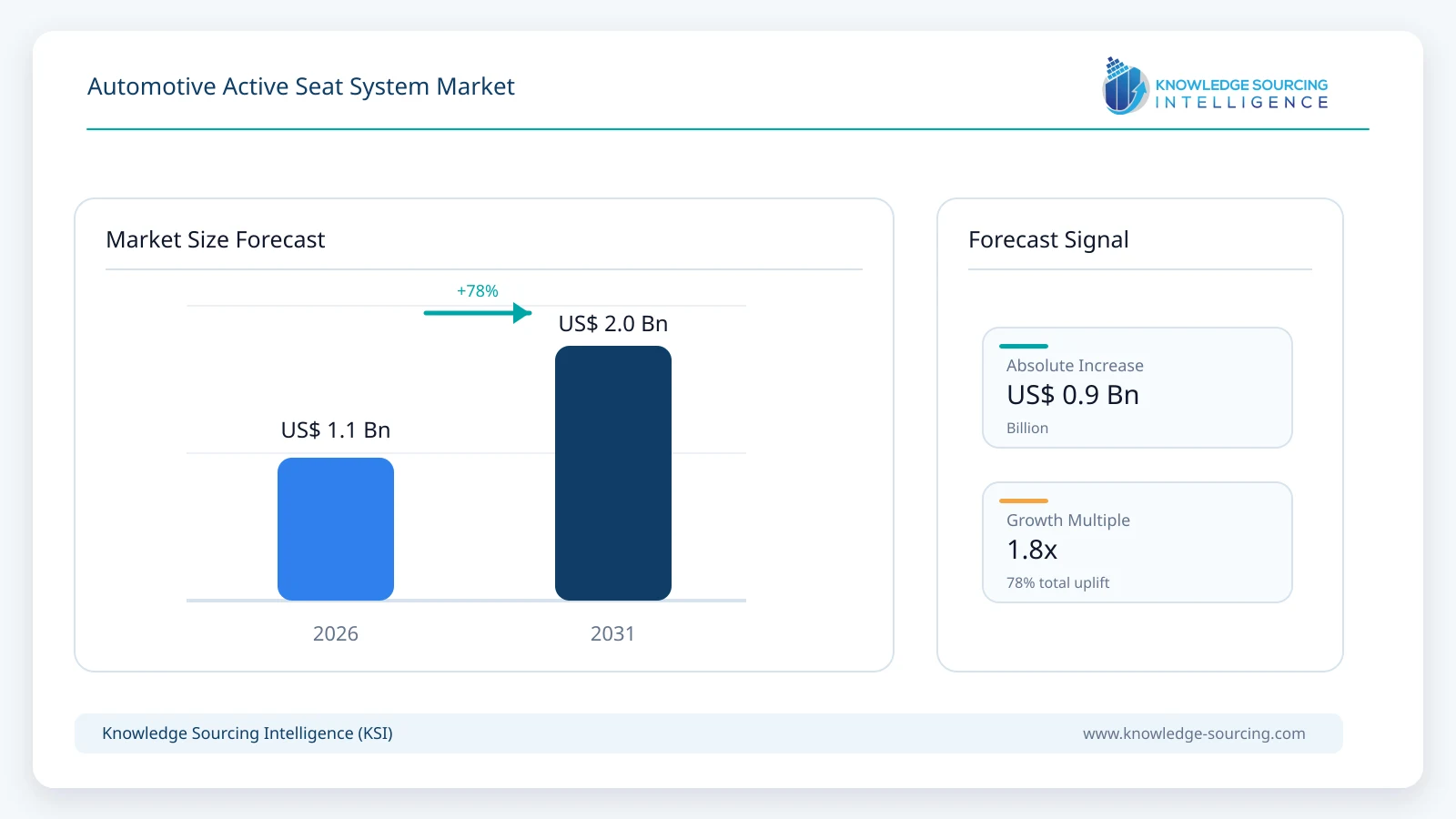
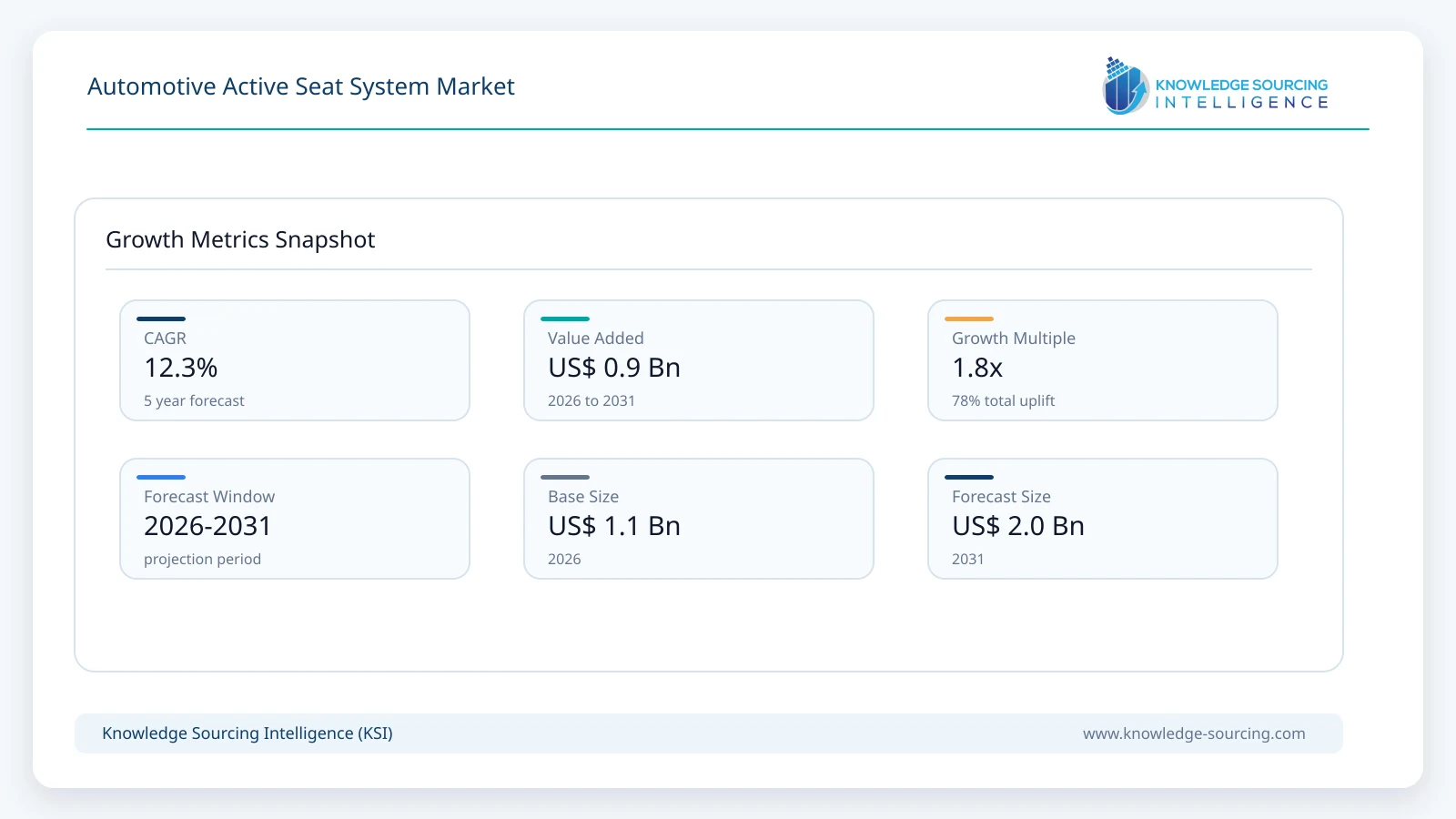
The automotive active seat system market is forecast to grow at a CAGR of 12.3%, reaching approximately USD 2.05 billion in 2031 from USD 1.15 billion in 2026.
Highlights:
- 1Electronically controlled damping systems account for approximately 56% of global market value in 2026, supported by comparatively lower power demand and strong suitability for heavy-duty seat-suspension applications.
- 2Magnetorheological systems represent approximately 41% of market value in 2026, reflecting growing use of rapidly adjustable damping in premium agricultural, construction and on-highway seats.
- 3Off-highway and utility vehicles account for approximately 47% of global market value in 2026 because severe terrain and long operator duty cycles create the strongest requirement for advanced vibration isolation.
- 4OEM installations represent approximately 82% of market value in 2026, supported by vehicle-level integration, electronic calibration and safety validation requirements.
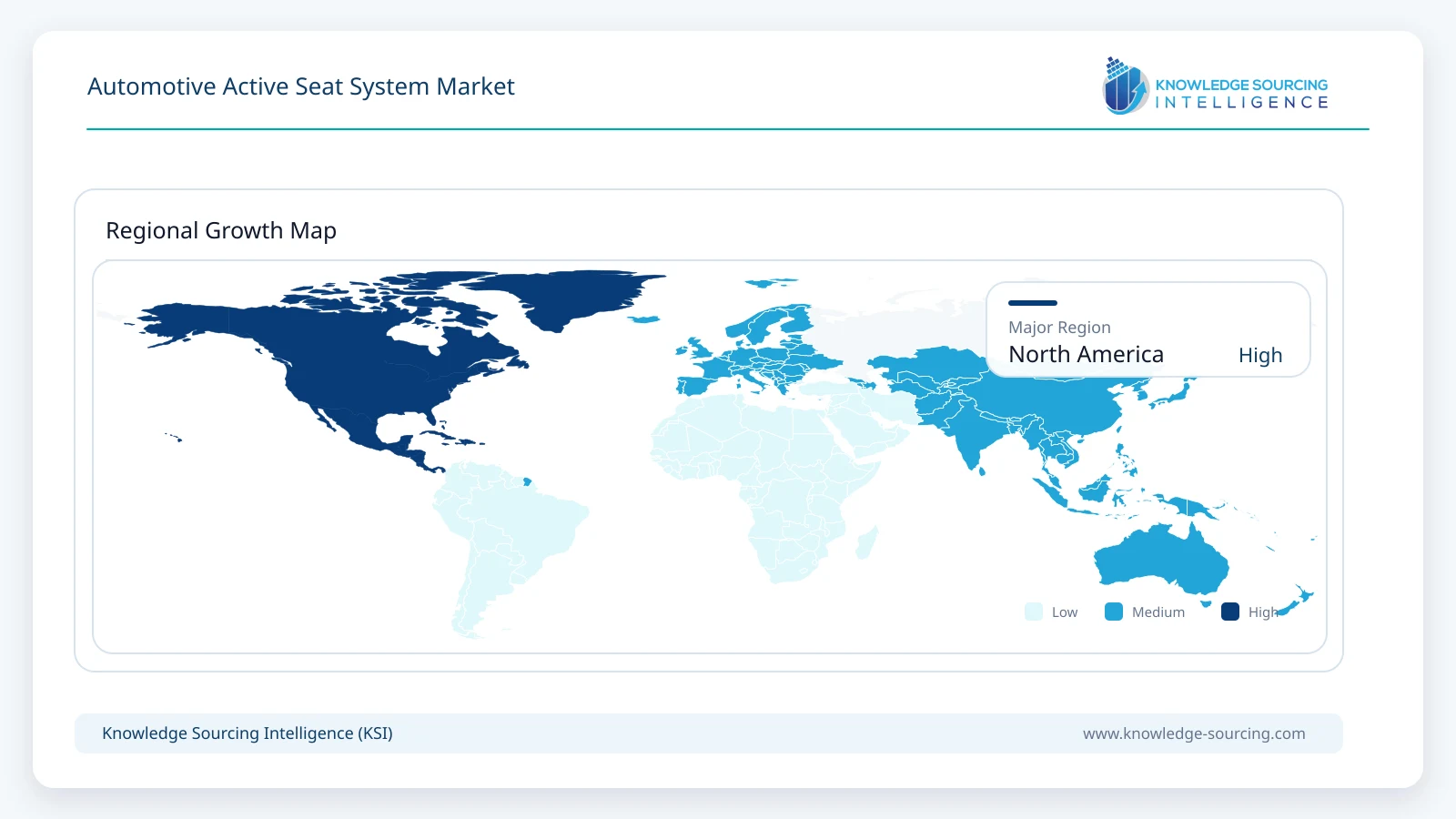
- 5North America represents approximately 35% of global market value in 2026, supported by strong adoption across heavy trucks, agricultural machinery and large construction equipment.
Demand is being supported by stricter operator-comfort requirements, longer duty cycles, greater awareness of whole-body vibration exposure and continued development of electronically controlled seat suspensions.
Current systems range from electronically controlled active suspensions that generate counteracting force to adaptive damping architectures that continuously alter damping response according to seat motion and road or terrain inputs. Magnetorheological dampers, pneumatic actuation and electromechanical mechanisms are the principal technology routes.
Commercial products demonstrate increasing system maturity. Sears Seating offers ActiveVRS magnetic ride suspensions for on-highway and off-highway vehicles. GRAMMER's active seating portfolio includes electronically controlled suspension systems for large agricultural machines. John Deere's ActiveSeat II uses an electric motor to isolate operators from vertical motion, while Uno Minda and ISRINGHAUSEN continue to expand electronically controlled suspended-seat technologies for commercial-vehicle applications.
Market Overview
Vehicle occupants are exposed to low-frequency vibration transmitted through the floor, cab and seat. Active seat systems reduce this transmission by measuring seat or base motion and adjusting damping or applying a counteracting force. The objective is to reduce seat acceleration and whole-body vibration while maintaining adequate suspension travel and occupant stability.
Sears Seating's ActiveVRS platform uses magnetorheological damping, onboard sensing and electronic control to continuously alter suspension response. The company offers the technology across on-highway, agricultural and severe-duty construction seats, including the Atlas II ActiveVRS and D 8599 ActiveVRS.
GRAMMER applies active suspension in high-end agricultural seating. Its Maximo XT Evolution Active uses electronically controlled suspension to reduce vibration and peak acceleration, while the newer Maximo XT2 platform introduced an actively controlled suspension architecture with broader electronic and comfort integration.
John Deere's ActiveSeat II represents a vertically integrated vehicle application. The system uses an electric motor for rapid response and is designed to isolate the operator from a substantial portion of vertical vehicle movement during field operation. Electronic controls, seat adjustment and comfort functions are integrated within the broader tractor cab system.
Market Trends
Magnetorheological Damping Is Expanding
Magnetorheological technology is becoming increasingly important because damping force can be altered quickly without the energy demand of continuously force-generating actuators. Sears Seating uses MR damping across its ActiveVRS range for agricultural, construction, mining and on-highway applications.
Recent technical research has also focused on fail-safe MR architectures that can maintain damping performance if an active-control function fails. This improves the suitability of electronically controlled suspension for safety-critical vehicle seating.
Active Seat Systems Are Moving Toward Software-Defined Control
Seat-suspension performance is increasingly influenced by software rather than only mechanical spring and damper tuning. Controllers can use position, acceleration and vehicle-state signals to alter damping or actuation in real time, allowing the seat to respond differently to large impacts, repetitive low-frequency motion and end-of-stroke conditions.
GRAMMER reported continued development of software-based suspension functions during 2025, while academic research published in 2026 examined AI-based and advanced feedback-control strategies for active vibration suppression.
Commercial-Vehicle Driver Health Is Supporting Adoption
Long-haul truck, construction and agricultural operators can remain seated for extended periods and are repeatedly exposed to road or terrain inputs. Active seat systems address this requirement by reducing vibration at the operator interface rather than relying exclusively on vehicle or cab suspension.
The use case is particularly strong in vehicles where a large proportion of residual vibration reaches the driver through the seat, including heavy trucks, tractors, dump trucks, loaders and other high-duty-cycle equipment.
Passenger-Car Applications Are Emerging
Active seat suspension is beginning to move beyond traditional heavy-duty applications. Research published in 2026 demonstrated a compact active seat-suspension system designed around the installation height available in a medium-sized passenger vehicle, with particular relevance to future autonomous-vehicle comfort.
GRAMMER has also disclosed investigation of suspension technologies for passenger cars, including applications linked to anti-kinetosis. Passenger-vehicle commercialization is expected to depend on low installation height, quiet operation, low mass and integration with existing seat structures.
Standards Are Reinforcing Objective Vibration Evaluation
Vehicle-seat vibration performance is increasingly measured using standardized laboratory methods. ISO 10326-1 specifies basic requirements for laboratory evaluation of vibration transmission through vehicle seats, while ISO 7096 defines seat-vibration evaluation for earth-moving machinery over the principal low-frequency range affecting operators.
These frameworks support more consistent comparison of seat-suspension performance and encourage suppliers to demonstrate measurable vibration reduction rather than relying only on subjective comfort claims.
Segment Analysis
By Control Architecture: Electronically Controlled Damping Systems
Electronically controlled damping systems are projected to reach approximately USD 1.05 billion by 2031. Their growth is supported by rapid response, relatively modest electrical demand and compatibility with air-suspension seat architectures. Magnetorheological dampers are particularly well suited to severe-duty applications because damping can be adjusted continuously without requiring large active-force actuators.
By Actuation Technology: Magnetorheological
Magnetorheological active seat technologies are projected to reach approximately USD 0.80 billion by 2031. The technology is gaining traction in heavy-duty seats because an electronic controller can vary fluid resistance rapidly according to vibration input. Current commercial systems combine MR dampers with air suspension, position sensing and adaptive control logic.
By Vehicle Application: Off-Highway and Utility Vehicles
Off-highway and utility vehicle applications are projected to generate approximately USD 0.88 billion of active-seat-system market value by 2031. Agricultural tractors, mining vehicles, dump trucks, wheel loaders and other machines operate on irregular terrain and frequently expose operators to sustained vibration, supporting higher adoption of advanced suspension seats.
By Sales Channel: OEM
OEM installations are projected to generate approximately USD 1.70 billion by 2031. Factory integration remains dominant because active seat systems require calibration to vehicle electrical architecture, suspension characteristics, operator controls and safety requirements. Aftermarket demand remains relevant in commercial and off-highway fleets where operators replace conventional air-suspension seats with higher-performance systems.
By Geography: North America
North America is projected to reach approximately USD 0.66 billion by 2031. The region benefits from a large heavy-truck fleet, extensive agricultural and construction activity, established premium suspension-seat suppliers and continued use of active seat systems in high-duty-cycle machinery.
Market Drivers
Need to Reduce Whole-Body Vibration
Persistent low-frequency vibration contributes to fatigue and discomfort during extended vehicle operation. Active seat suspensions reduce motion at the occupant interface and can complement cab and chassis suspension systems.
Long Operator Duty Cycles
Commercial drivers and heavy-equipment operators frequently spend many hours seated. Improved vibration isolation can support endurance and perceived comfort, making active seats more attractive to fleet operators and equipment manufacturers.
Growth of Premium Heavy-Duty Equipment
High-value tractors, construction machines and long-haul trucks increasingly incorporate advanced operator environments. Active seat suspension is becoming part of premium comfort packages alongside climate control, massage, electronic adjustment and integrated control systems.
Advances in Sensors, Controllers and Smart Dampers
Lower-cost acceleration sensors, faster embedded processors, CAN connectivity and controllable dampers are improving system performance and enabling more precise real-time vibration management.
Expansion Toward Passenger and Autonomous Vehicles
Future passenger and autonomous vehicles are increasing interest in seat-level motion control because occupants may use more relaxed postures, work, read or interact with displays while travelling. These use cases can increase sensitivity to vertical motion and motion sickness.
Market Restraints
Higher Cost Than Passive Seat Suspension
Active systems require sensors, electronic controllers, controllable dampers or actuators and additional validation. This increases cost relative to conventional mechanical or passive air-suspension seats.
Energy Consumption
Fully active force-generating systems require continuous electrical or hydraulic energy. Power consumption becomes an important design constraint in vehicles where electrical capacity is limited or efficiency is a priority.
Installation Height and Packaging
Many active mechanisms require greater under-seat space than conventional structures. Packaging is particularly challenging in passenger vehicles where seat height, floor clearance and crash structures limit available volume.
Control and Reliability Complexity
Active seat systems must respond quickly without creating instability, excessive seat travel or uncomfortable counter-motion. Sensors, controllers and actuators also need to maintain reliable performance over long service lives and severe vibration environments.
Safety and Fail-Safe Requirements
A loss of active control must not create uncontrolled seat movement. Suppliers therefore need mechanical limits, fallback damping and robust fault management, increasing development and validation requirements.
Regional Outlook
North America
North America is the largest regional market, supported by extensive use of heavy trucks, agricultural equipment and construction machinery. Sears Seating has a broad ActiveVRS product range across on-highway and severe-duty applications, while John Deere integrates ActiveSeat II into high-end tractor platforms.
The region also benefits from fleet attention to driver comfort and whole-body vibration, particularly in long-haul transport and high-duty-cycle equipment. Premium equipment packages and aftermarket replacement demand provide additional opportunities for active and electronically controlled seat suspensions.
Asia Pacific
Asia Pacific is expected to be the fastest-expanding major region through 2031 as commercial-vehicle production, infrastructure investment and agricultural mechanization increase the installed base for suspended seats. India is an important emerging supplier base, with Uno Minda reporting growth in suspended-seat demand and ongoing engineering work on active seat-suspension components.
China, Japan and South Korea also provide a strong foundation in vehicle electronics, smart materials and motion-control technologies. Continued research into compact active suspensions and passenger-car applications is expected to broaden the regional addressable market.
Competitive Landscape
Competition is concentrated among specialist commercial-vehicle seat manufacturers, agricultural-equipment OEMs and seating-system suppliers with capabilities in suspension mechanisms, damping, electronics and controls. GRAMMER, Sears Seating, Deere & Company, Uno Minda and ISRINGHAUSEN are directly involved in electronically controlled or actively managed suspended-seat technologies.
Sears Seating differentiates through ActiveVRS magnetorheological damping across on-highway, agricultural and construction applications. GRAMMER combines active suspension with premium operator-seat functions and is extending research toward passenger-vehicle motion control. Deere integrates ActiveSeat II directly within tractor platforms, creating close coordination between seat and vehicle control.
Uno Minda is expanding its suspended-seat business and has published engineering work relating to automotive active seat-suspension structures. ISRINGHAUSEN combines pneumatic suspension, electronic adjustment and progressive damping in commercial-vehicle seating and provides CAN-integrated seat architectures for OEM customers.
Recent Developments
March 2026: GRAMMER's 2025 annual report disclosed the introduction of the Maximo XT2 seat, development of a semi-active suspension with controlled dampers, further software-based suspension work and investigation of suspension technologies for passenger-car anti-kinetosis applications.
March 2026: Researchers from the University of Zagreb published the design and experimental identification of an active seat-suspension mechatronic system sized for a medium passenger vehicle, including compact electromechanical actuation and closed-loop control.
January 2026: SAE International published an Uno Minda engineering paper examining failure of an air-spring bracket within an automotive active seat-suspension system and proposing design improvements for durability.
December 2025: Mechanical Systems and Signal Processing published a fail-safe active seat-suspension concept using magnetorheological technology to combine active vibration control with a fallback damping mode.
November 2025: GRAMMER presented the Maximo XT2 at Agritechnica 2025, featuring a newly developed actively controlled suspension system together with climate and massage functions.
June 2025: Applied Sciences published a performance-guaranteed active seat-suspension control approach for heavy-duty vehicles, addressing changing driver mass, friction, stiffness and damping conditions.
Market Outlook
The automotive active seat system market is expected to expand steadily through 2031 as electronically controlled suspension becomes more capable, compact and software-driven. Heavy-duty and off-highway vehicles will remain the principal commercial base because vibration exposure and long duty cycles create clear value for improved seat isolation.
Magnetorheological and adaptive damping systems are expected to remain important because they combine fast response with lower energy consumption than fully active force-generation. At the same time, compact electromechanical architectures are likely to gain relevance as suppliers pursue passenger-vehicle and autonomous-mobility applications.
North America is expected to remain the largest regional market, while Asia Pacific offers the strongest expansion potential. Competitive advantage will depend on measurable vibration reduction, low installation height, fail-safe operation, software quality, power efficiency and the ability to integrate seat controls with wider vehicle electronics.
Automotive Active Seat System Market Scope
| Report Metric | Details |
|---|---|
| Total Market Size in 2026 | USD 1.15 billion |
| Total Market Size in 2031 | USD 2.05 billion |
| Forecast Unit | Billion |
| Growth Rate | 12.3% |
| Study Period | 2021 to 2031 |
| Historical Data | 2021 to 2024 |
| Base Year | 2025 |
| Forecast Period | 2026 – 2031 |
| Segmentation | Control Architecture, Actuation Technology, Vehicle Application, Sales Channel, Geography |
| Companies |
|
Market Segmentation
By Control Architecture
Electronically Controlled Damping Systems
Fully Active Force-Generating Systems
By Actuation Technology
Magnetorheological
Pneumatic and Hydraulic
Electromechanical
By Vehicle Application
Off-Highway and Utility Vehicles
Medium and Heavy Commercial Vehicles
Passenger Cars and Light Vehicles
By Sales Channel
OEM
Aftermarket
By Geography
North America
United States
Canada
Mexico
South America
Brazil
Argentina
Others
Europe
Germany
United Kingdom
France
Italy
Spain
Others
Middle East and Africa
Saudi Arabia
UAE
South Africa
Others
Asia Pacific
China
Japan
South Korea
India
Australia
Others
Table of Contents
1. INTRODUCTION
1.1. Market Overview
1.2. Market Definition
1.3. Scope of the Study
1.4. Market Segmentation
1.5. Currency
1.6. Assumptions
1.7. Base and Forecast Years
1.8. Key Benefits to Stakeholders
2. RESEARCH METHODOLOGY
2.1. Research Design
2.2. Secondary Research
2.3. Primary Research
2.4. Market Estimation
2.5. Segment Modelling
2.6. Data Triangulation and Validation
3. EXECUTIVE SUMMARY
3.1. Key Findings
3.2. Automotive Active Seat System Market Size, 2026-2031
3.3. Control Architecture Outlook
3.4. Actuation Technology Outlook
3.5. Vehicle Application Outlook
3.6. Sales Channel Outlook
3.7. Regional Opportunity Summary
4. MARKET DYNAMICS
4.1. Market Drivers
4.1.1. Need to Reduce Whole-Body Vibration
4.1.2. Long Operator Duty Cycles
4.1.3. Growth of Premium Heavy-Duty Equipment
4.1.4. Advances in Sensors, Controllers and Smart Dampers
4.1.5. Expansion Toward Passenger and Autonomous Vehicles
4.2. Market Restraints
4.2.1. Higher Cost Than Passive Seat Suspension
4.2.2. Energy Consumption
4.2.3. Installation Height and Packaging
4.2.4. Control and Reliability Complexity
4.2.5. Safety and Fail-Safe Requirements
4.3. Market Opportunities
4.4. Porter's Five Forces Analysis
4.5. Industry Value Chain Analysis
4.6. Active Seat System Economics
4.7. Standards and Test Requirements
5. TECHNOLOGY OUTLOOK
5.1. Active Force-Generating Seat Suspension
5.2. Electronically Controlled Damping
5.3. Magnetorheological Dampers
5.4. Pneumatic Active Suspension
5.5. Electromechanical Actuation
5.6. Acceleration and Position Sensing
5.7. Feedback and Feedforward Control
5.8. CAN and Vehicle-Network Integration
5.9. Fail-Safe and End-Stop Control
5.10. Passenger-Car Anti-Kinetosis Applications
6. AUTOMOTIVE ACTIVE SEAT SYSTEM MARKET BY CONTROL ARCHITECTURE
6.1. Introduction
6.2. Electronically Controlled Damping Systems
6.3. Fully Active Force-Generating Systems
7. AUTOMOTIVE ACTIVE SEAT SYSTEM MARKET BY ACTUATION TECHNOLOGY
7.1. Introduction
7.2. Magnetorheological
7.3. Pneumatic and Hydraulic
7.4. Electromechanical
8. AUTOMOTIVE ACTIVE SEAT SYSTEM MARKET BY VEHICLE APPLICATION
8.1. Introduction
8.2. Off-Highway and Utility Vehicles
8.3. Medium and Heavy Commercial Vehicles
8.4. Passenger Cars and Light Vehicles
9. AUTOMOTIVE ACTIVE SEAT SYSTEM MARKET BY SALES CHANNEL
9.1. Introduction
9.2. OEM
9.3. Aftermarket
10. AUTOMOTIVE ACTIVE SEAT SYSTEM MARKET BY GEOGRAPHY
10.1. North America
10.1.1. United States
10.1.2. Canada
10.1.3. Mexico
10.2. South America
10.2.1. Brazil
10.2.2. Argentina
10.2.3. Others
10.3. Europe
10.3.1. Germany
10.3.2. United Kingdom
10.3.3. France
10.3.4. Italy
10.3.5. Spain
10.3.6. Others
10.4. Middle East and Africa
10.4.1. Saudi Arabia
10.4.2. UAE
10.4.3. South Africa
10.4.4. Others
10.5. Asia Pacific
10.5.1. China
10.5.2. Japan
10.5.3. South Korea
10.5.4. India
10.5.5. Australia
10.5.6. Others
11. COMPETITIVE ENVIRONMENT AND ANALYSIS
11.1. Major Players and Strategy Analysis
11.2. Market Share Analysis
11.3. Product and Technology Benchmarking
11.4. Partnerships, Product Launches and Technology Development
11.5. Competitive Dashboard
12. COMPANY PROFILES
12.1. GRAMMER AG
12.2. Sears Seating
12.3. Deere & Company
12.4. Uno Minda Limited
12.5. ISRINGHAUSEN GmbH & Co. KG
13. APPENDIX
13.1. Currency
13.2. Assumptions
13.3. Base and Forecast Years Timeline
13.4. Key Benefits for Stakeholders
13.5. Research Methodology
13.6. Abbreviations
13.7. Data Sources
Navigate
Trusted by the world's leading organizations











