
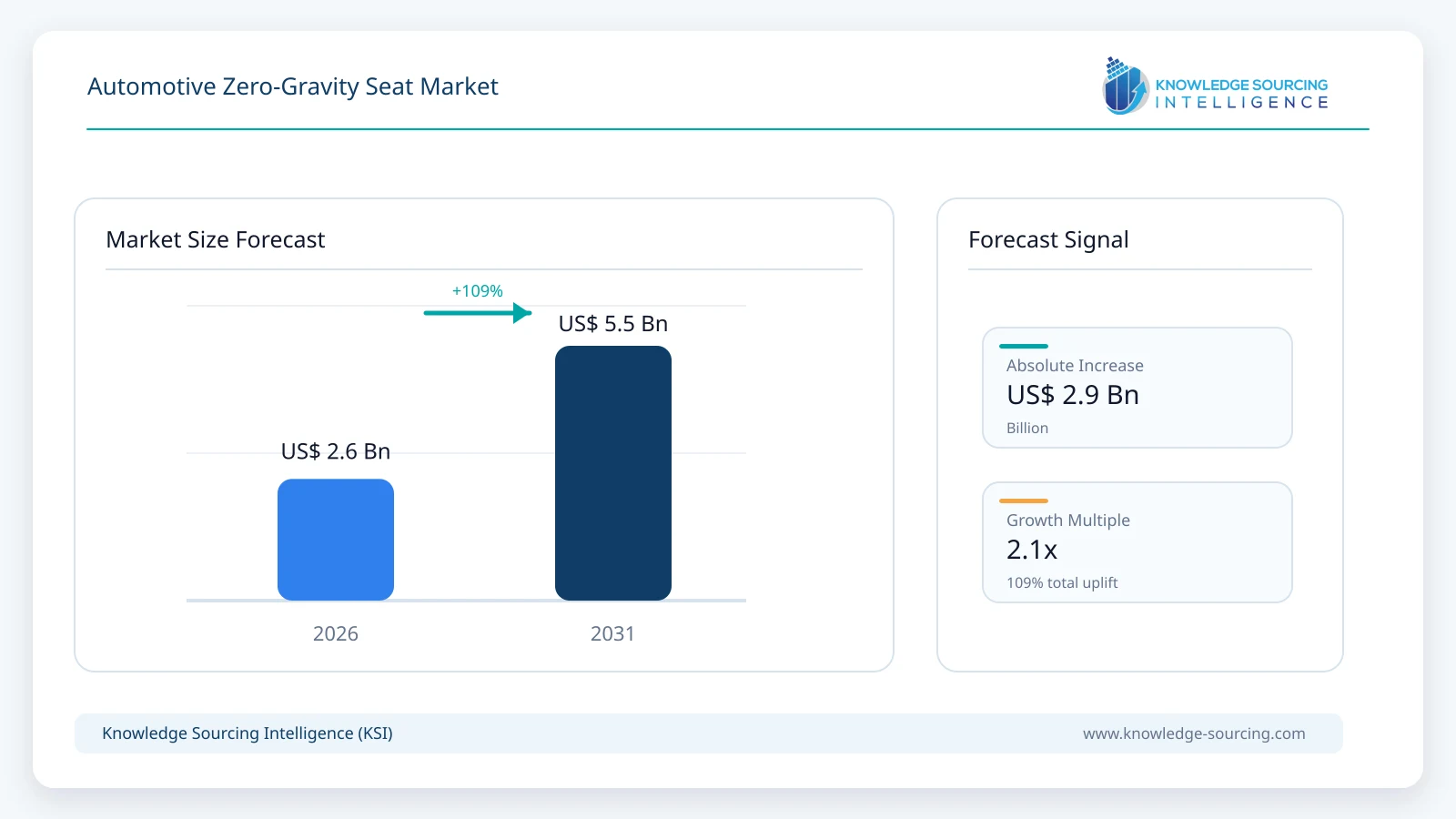
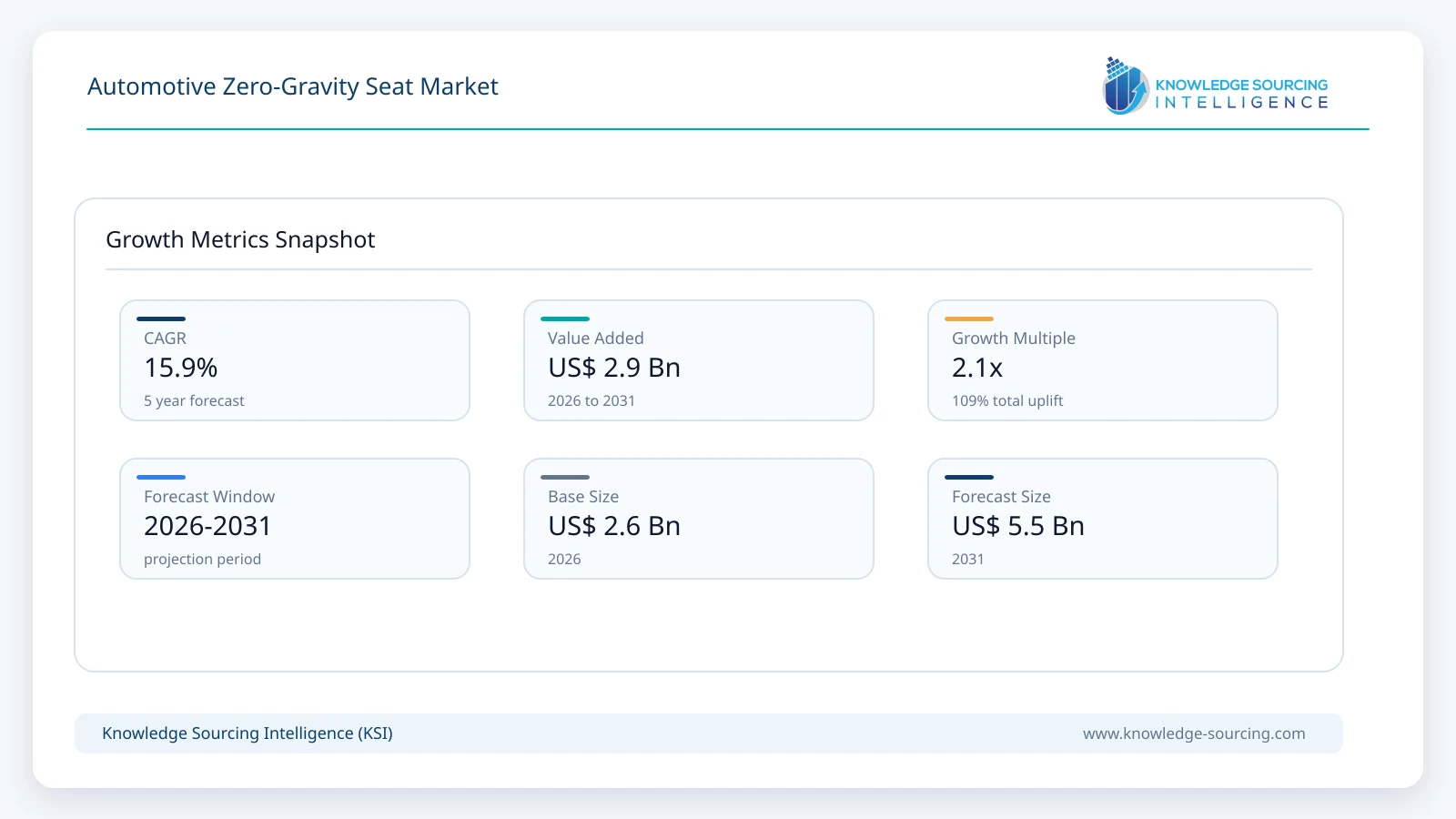
The automotive zero-gravity seat market is forecast to grow at a CAGR of 15.9%, reaching approximately USD 5.55 billion in 2031 from USD 2.65 billion in 2026.
Highlights:
- 1Second-row and rear passenger applications account for approximately 68% of global market value in 2026, reflecting strong adoption in executive seating, premium SUVs and electric MPVs.
- 2Passenger cars represent approximately 96% of global market value in 2026, with zero-gravity seating concentrated in premium sedans, SUVs, crossovers and MPVs.
- 3Premium and luxury vehicles account for approximately 62% of market value in 2026 because advanced recline, leg support and integrated comfort remain concentrated in higher-content models.
- 4Battery electric vehicles represent approximately 38% of market value in 2026 as flat-floor layouts and premium cabin differentiation support deeper recline and more flexible seat packaging.
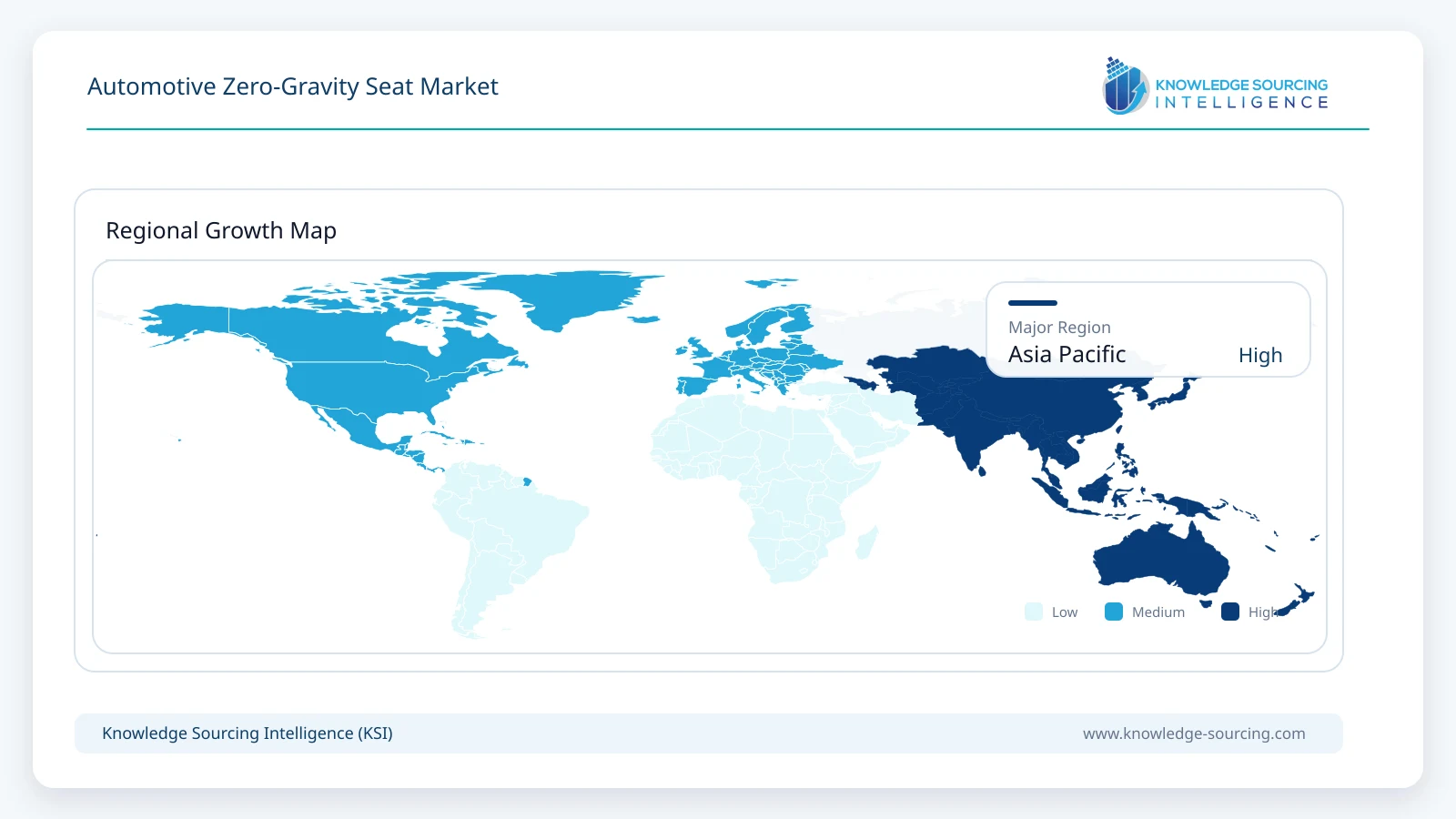
- 5Asia Pacific represents approximately 55% of global market value in 2026, supported by strong commercialization in China and established seating capabilities in Japan and South Korea.
Adoption is being led by seating systems that combine deep recline, cushion-angle control, calf or leg support and powered multi-axis adjustment to reduce pressure concentration and provide a more relaxed occupant posture.
Commercialization is strongest in premium second-row applications. Lear has developed and launched a zero-gravity second-row seat with deep recline, calf support and integrated comfort functions. FORVIA is supplying zero-gravity chairs to Luxeed as part of a multi-year seat program in China. Yanfeng has moved zero-gravity seating from production-ready development into mass-production applications with integrated safety protection.
The supplier base is also expanding through scalable zero-gravity mechanisms and safety technologies. Magna's ZG Lounger uses a scalable architecture with coordinated seat and leg-rest movement, while Adient and Autoliv have developed Z-Guard for occupant protection in deeply reclined positions. Hyundai Transys markets a Relaxation Comfort Seat specifically designed around the zero-gravity posture.
Market Overview
Zero-gravity seating is designed to reduce concentrated pressure on the spine, hips and lower body by placing the occupant in a highly reclined posture with coordinated support under the legs and calves. Automotive systems typically combine powered backrest recline, cushion tilt, seat travel and extendable leg support rather than relying on a single reclining mechanism.
Lear's second-row zero-gravity seat provides a direct production example. The system includes a 65-degree recline, raising calf rest, adaptive armrest and body-pressure distribution together with pneumatic neck support and heated back massage. Lear states that the technology has become increasingly important in the Chinese market and is deployed across multiple platforms.
FORVIA is also moving zero-gravity seating into volume programs. Its February 2026 Luxeed award includes zero-gravity chairs that recline close to horizontal and are intended to distribute occupant weight more evenly. The company has separately reported multiple innovation awards in China covering zero-gravity seating, massage and advanced kinematics.
Magna, Yanfeng, Adient and Hyundai Transys broaden the competitive technology base. Magna offers a scalable ZG Lounger mechanism with adjustable leg support, Yanfeng combines zero-gravity posture with integrated massage and safety technologies, Adient is developing predictive protection for deeply reclined occupants, and Hyundai Transys incorporates zero-gravity principles into its Relaxation Comfort Seat.
Market Trends
Second-Row Zero-Gravity Seating Is Becoming the Primary Commercial Application
The strongest commercialization is occurring in the second row, where passengers can use deeper recline without affecting vehicle control. Chinese premium EVs, SUVs and MPVs are increasingly using lounge-style rear seating with calf support, massage and individualized comfort functions.
Lear has identified second-row zero-gravity seating as an increasingly important feature in China and has launched the technology across multiple platforms. FORVIA's Luxeed program and Yanfeng's zero-gravity seat portfolio further reinforce second-row seating as the largest near-term application.
Zero-Gravity Seats Are Becoming More Integrated with Wellness Functions
Zero-gravity positioning is increasingly combined with massage, heating, ventilation, neck support and adaptive comfort. Yanfeng's Zero Gravity Seat can integrate massage, heating and ventilation, while its Hover Seat adds posture sensing and automatic fatigue-relief functions. Lear's production system combines the zero-gravity posture with pneumatic neck support and heated back massage.
This integration increases seat-system value because the zero-gravity mode becomes part of a broader wellness package rather than a stand-alone reclining function.
Safety in Deeply Reclined Positions Is Becoming a Core Development Area
Deep recline changes occupant geometry relative to the seat belt, airbags and seat structure. Suppliers are therefore developing integrated restraint, cushion and pre-crash repositioning technologies specifically for zero-gravity seating.
Adient and Autoliv's Z-Guard system combines high-speed predictive seat repositioning with pretensioners, cushion buffering and additional restraint technologies. Yanfeng has also developed system-level protection for zero-gravity occupants and is participating in industry discussions on evaluation and safety standards.
Electric Vehicles Are Accelerating Flexible Zero-Gravity Cabin Design
Electric-vehicle platforms are well suited to zero-gravity seating because flatter floors, centralized electronics and larger cabin packages can support longer rails, leg rests and more extreme recline. Premium EV brands are also using interior comfort as a key differentiator as powertrain performance becomes more standardized.
The International Energy Agency reported that electric cars represented one-quarter of global new-car sales in 2025 and expects their share to continue rising in 2026, expanding the addressable platform base for advanced seating systems.
Scalable Mechanisms Are Broadening the Addressable Vehicle Range
Suppliers are developing modular or scalable mechanisms to reduce the cost of offering zero-gravity functions across several vehicle programs. Magna's ZG Lounger is designed around scalable architecture, while Yanfeng offers configurable functions including rotation, long rails and electronic control according to automaker requirements.
Scalability is important for expanding the technology beyond flagship vehicles into upper-mid and mid-range segments without requiring a completely unique seat structure for every model.
Segment Analysis
By Seat Position: Second Row and Rear Passenger
Second-row and rear passenger zero-gravity seating is projected to reach approximately USD 3.55 billion by 2031. Growth is being supported by executive lounge seating, premium SUVs, electric MPVs and chauffeur-oriented vehicles where passengers can use deep recline, calf support and massage without interfering with vehicle control.
By Vehicle Type: Passenger Cars
Passenger cars are projected to generate approximately USD 5.33 billion of zero-gravity seat market value by 2031. Premium sedans, SUVs, crossovers and MPVs provide the largest commercialization base because these vehicles combine sufficient cabin space with higher consumer willingness to pay for advanced comfort.
By Vehicle Class: Premium and Luxury Vehicles
Premium and luxury vehicles are projected to generate approximately USD 3.16 billion of market value by 2031. These vehicles remain the principal platform for deep-recline mechanisms, powered leg support, massage and integrated safety systems, although adoption is gradually expanding toward upper-mid vehicle segments.
By Propulsion: Battery Electric Vehicles
Battery electric vehicles are projected to generate approximately USD 2.78 billion of zero-gravity seat market value by 2031. EV platforms support flatter floors, longer seat travel and greater freedom for lounge-style cabin layouts, while premium EV makers are placing greater emphasis on second-row passenger experience.
By Geography: Asia Pacific
Asia Pacific is projected to reach approximately USD 3.33 billion by 2031. China is the principal growth engine, supported by rapid premium EV development and strong adoption of second-row lounge seating. Japan and South Korea contribute additional engineering depth through established automotive seat manufacturers and high-content vehicle programs.
Market Drivers
Premiumization of Passenger Comfort
Automakers are increasing interior comfort content to differentiate higher-value vehicles. Zero-gravity seating provides a visible and easily experienced feature that can support premium positioning, particularly in executive rear seats and flagship electric models.
Growth of Premium Electric SUVs and MPVs
Large electric SUVs and MPVs provide the physical space required for deep recline, extendable calf support and long seat travel. These vehicles are becoming important launch platforms for zero-gravity seating in China and other premium markets.
Increasing Focus on Occupant Wellness
Zero-gravity posture is marketed around reduced spinal pressure, improved pressure distribution and greater relaxation during long journeys. Integration with massage, thermal comfort and neck support is strengthening the wellness proposition.
Advances in Seat Kinematics and Electronics
Compact actuators, multi-axis control, long rails, cushion-tilt mechanisms and integrated seat controllers are making it easier to coordinate the complex movement required for zero-gravity positions.
Expansion of Software-Defined Vehicle Architectures
Software-defined vehicle platforms allow seat position, safety, climate and user preferences to be coordinated through common control systems. This supports one-touch relaxation modes and automatic repositioning linked to vehicle-state or safety signals.
Market Restraints
High System Cost
Zero-gravity seats require multiple powered mechanisms, leg support, reinforced structures, control electronics and often premium comfort functions. The cost premium limits adoption in entry-level vehicles.
Packaging and Cabin-Space Requirements
Deep recline and extended leg support require substantial longitudinal and vertical space. This can reduce cargo volume, affect third-row access and complicate packaging in smaller vehicles.
Safety Validation Complexity
Reclined occupants interact differently with seat belts, airbags and seat cushions during a crash. Suppliers must therefore validate restraint performance across a wider range of postures and often integrate additional safety technologies.
Added Weight and Electrical Load
Additional motors, tracks, leg-rest mechanisms and integrated comfort systems increase seat mass and electrical demand. These effects can conflict with lightweighting and efficiency targets, particularly in electric vehicles.
Concentration in Premium Vehicle Programs
Adoption remains concentrated in mid- to high-end vehicle programs, limiting near-term volume in cost-sensitive segments. Wider penetration depends on scalable mechanisms, simplified structures and lower-cost integration.
Regional Outlook
Asia Pacific
Asia Pacific is the largest regional market and is expected to remain the strongest growth centre through 2031. China is leading commercialization through premium EV, SUV and MPV programs that increasingly use second-row lounge seating, calf support, massage and advanced safety. FORVIA's Luxeed program, Lear's multi-platform production, Yanfeng's mass-production experience and Hyundai Transys's relaxation seating demonstrate the depth of regional supplier activity.
Japan and South Korea add established automotive seating capabilities and premium vehicle production, while the wider Asia Pacific region is benefiting from rapid electrification and increasing consumer demand for higher-content cabins.
Europe
Europe is the second major regional market, supported by premium OEMs, strong seat-system engineering and increasing electrification. Zero-gravity seating aligns with the region's long-standing focus on multi-contour comfort, advanced restraint systems and premium rear passenger experience.
European growth is also being supported by global suppliers such as FORVIA, Magna, Adient and Yanfeng, which are developing scalable zero-gravity mechanisms, safety integration and flexible seating technologies for multiple global OEM programs.
Competitive Landscape
The automotive zero-gravity seat market is led by complete-seat manufacturers with capabilities in structures, recliners, tracks, leg-rest mechanisms, comfort systems and safety integration. FORVIA, Magna, Lear, Yanfeng, Adient and Hyundai Transys are directly involved in zero-gravity seat manufacturing, production programs or dedicated zero-gravity seat platforms.
Lear has one of the clearest production positions through second-row zero-gravity seats already launched in China across multiple platforms. FORVIA is expanding through its Luxeed award and additional China technology wins. Magna differentiates through the scalable ZG Lounger mechanism, while Yanfeng combines zero-gravity seating with electronics, massage and integrated safety.
Adient is strengthening the safety side of zero-gravity seating through its Z-Guard concept with Autoliv, including predictive seat repositioning for deeply reclined occupants. Hyundai Transys contributes a complete-seat approach through its Relaxation Comfort Seat and broader future-mobility seating technologies.
Recent Developments
May 2026: Magna showcased its ZG Lounger at the Automotive Engineering Exposition 2026 YOKOHAMA, highlighting a scalable zero-gravity mechanism with coordinated seat and leg-rest movement.
February 2026: FORVIA announced a multi-year project to supply complete seat sets to Luxeed, including zero-gravity chairs that recline close to a horizontal position.
February 2026: Lear's 2025 Form 10-K confirmed that the company had developed and launched a second-row zero-gravity seat with 65-degree recline, calf support, adaptive armrests and integrated comfort functions.
October 2025: Yanfeng reported its work on zero-gravity occupant protection at the 2025 NCAP World Congress and stated that its zero-gravity seating with complete safety protection had progressed from concept to mass production.
October 2025: Adient and Autoliv unveiled the mass-production-ready Z-Guard safety solution for deeply reclined and zero-gravity seating positions, including predictive high-speed seat repositioning.
August 2025: Adient detailed an updated zero-gravity seating concept integrating Autoliv Omni Safety technologies, including belt pretensioners, airbags and protective systems for relaxed seating positions.
July 2025: FORVIA reported more than ten innovation awards in China covering technologies including zero-gravity seats, Zen massage and advanced seating kinematics.
Market Outlook
The automotive zero-gravity seat market is expected to expand strongly through 2031 as lounge-style seating becomes more common in premium electric vehicles and high-content SUVs and MPVs. Second-row applications will remain the largest value pool, but front-passenger zero-gravity functions are also expected to expand as vehicle cabins become more flexible.
Future development will focus increasingly on safety integration, compact kinematics and scalable mechanisms. Suppliers that can combine deep recline with leg support, massage, thermal comfort and reliable restraint performance will be better positioned to move the technology from flagship vehicles into broader premium and upper-mid segments.
Asia Pacific is expected to remain the leading commercialization region, while Europe will continue to provide strong premium demand and safety engineering. Competition will center on occupant comfort, packaging efficiency, crash protection, software-controlled positioning and the ability to deploy common zero-gravity architectures across multiple vehicle programs.
Automotive Zero-Gravity Seat Market Scope
| Report Metric | Details |
|---|---|
| Total Market Size in 2026 | USD 2.65 billion |
| Total Market Size in 2031 | USD 5.55 billion |
| Forecast Unit | Billion |
| Growth Rate | 15.9% |
| Study Period | 2021 to 2031 |
| Historical Data | 2021 to 2024 |
| Base Year | 2025 |
| Forecast Period | 2026 – 2031 |
| Segmentation | Seat Position, Vehicle Type, Vehicle Class, Propulsion, Geography |
| Companies |
|
Market Segmentation
By Seat Position
Second Row and Rear Passenger
Front Passenger
Driver
By Vehicle Type
Passenger Cars
Light Commercial Vehicles
Medium and Heavy Commercial Vehicles
By Vehicle Class
Premium and Luxury Vehicles
Mid-Range Vehicles
Entry-Level Vehicles
By Propulsion
Internal Combustion Engine Vehicles
Hybrid Electric Vehicles
Battery Electric Vehicles
By Geography
North America
United States
Canada
Mexico
South America
Brazil
Argentina
Others
Europe
Germany
United Kingdom
France
Italy
Spain
Others
Middle East and Africa
Saudi Arabia
UAE
South Africa
Others
Asia Pacific
China
Japan
South Korea
India
Indonesia
Thailand
Others
Table of Contents
1. INTRODUCTION
1.1. Market Overview
1.2. Market Definition
1.3. Scope of the Study
1.4. Market Segmentation
1.5. Currency
1.6. Assumptions
1.7. Base and Forecast Years
1.8. Key Benefits to Stakeholders
2. RESEARCH METHODOLOGY
2.1. Research Design
2.2. Secondary Research
2.3. Primary Research
2.4. Market Estimation
2.5. Segment Modelling
2.6. Data Triangulation and Validation
3. EXECUTIVE SUMMARY
3.1. Key Findings
3.2. Automotive Zero-Gravity Seat Market Size, 2026-2031
3.3. Seat Position Outlook
3.4. Vehicle Type Outlook
3.5. Vehicle Class Outlook
3.6. Propulsion Outlook
3.7. Regional Opportunity Summary
4. MARKET DYNAMICS
4.1. Market Drivers
4.1.1. Premiumization of Passenger Comfort
4.1.2. Growth of Premium Electric SUVs and MPVs
4.1.3. Increasing Focus on Occupant Wellness
4.1.4. Advances in Seat Kinematics and Electronics
4.1.5. Expansion of Software-Defined Vehicle Architectures
4.2. Market Restraints
4.2.1. High System Cost
4.2.2. Packaging and Cabin-Space Requirements
4.2.3. Safety Validation Complexity
4.2.4. Added Weight and Electrical Load
4.2.5. Concentration in Premium Vehicle Programs
4.3. Market Opportunities
4.4. Porter's Five Forces Analysis
4.5. Industry Value Chain Analysis
4.6. Zero-Gravity Seat System Economics
4.7. Safety and Regulatory Environment
5. TECHNOLOGY OUTLOOK
5.1. Deep-Recline Kinematics
5.2. Cushion Tilt Mechanisms
5.3. Leg and Calf Support Systems
5.4. Long-Slide and Reconfigurable Rails
5.5. Swivel and Rotating Seat Mechanisms
5.6. Massage and Thermal Comfort Integration
5.7. Pressure Distribution and Occupant Sensing
5.8. Integrated Restraint and Belt-in-Seat Systems
5.9. Predictive Seat Repositioning
6. AUTOMOTIVE ZERO-GRAVITY SEAT MARKET BY SEAT POSITION
6.1. Introduction
6.2. Second Row and Rear Passenger
6.3. Front Passenger
6.4. Driver
7. AUTOMOTIVE ZERO-GRAVITY SEAT MARKET BY VEHICLE TYPE
7.1. Introduction
7.2. Passenger Cars
7.3. Light Commercial Vehicles
7.4. Medium and Heavy Commercial Vehicles
8. AUTOMOTIVE ZERO-GRAVITY SEAT MARKET BY VEHICLE CLASS
8.1. Introduction
8.2. Premium and Luxury Vehicles
8.3. Mid-Range Vehicles
8.4. Entry-Level Vehicles
9. AUTOMOTIVE ZERO-GRAVITY SEAT MARKET BY PROPULSION
9.1. Introduction
9.2. Internal Combustion Engine Vehicles
9.3. Hybrid Electric Vehicles
9.4. Battery Electric Vehicles
10. AUTOMOTIVE ZERO-GRAVITY SEAT MARKET BY GEOGRAPHY
10.1. North America
10.1.1. United States
10.1.2. Canada
10.1.3. Mexico
10.2. South America
10.2.1. Brazil
10.2.2. Argentina
10.2.3. Others
10.3. Europe
10.3.1. Germany
10.3.2. United Kingdom
10.3.3. France
10.3.4. Italy
10.3.5. Spain
10.3.6. Others
10.4. Middle East and Africa
10.4.1. Saudi Arabia
10.4.2. UAE
10.4.3. South Africa
10.4.4. Others
10.5. Asia Pacific
10.5.1. China
10.5.2. Japan
10.5.3. South Korea
10.5.4. India
10.5.5. Indonesia
10.5.6. Thailand
10.5.7. Others
11. COMPETITIVE ENVIRONMENT AND ANALYSIS
11.1. Major Players and Strategy Analysis
11.2. Market Share Analysis
11.3. Product and Technology Benchmarking
11.4. Mergers, Acquisitions, Agreements, and Collaborations
11.5. Competitive Dashboard
12. COMPANY PROFILES
12.1. FORVIA
12.2. Magna International Inc.
12.3. Lear Corporation
12.4. Yanfeng
12.5. Adient plc
12.6. Hyundai Transys Inc.
13. APPENDIX
13.1. Currency
13.2. Assumptions
13.3. Base and Forecast Years Timeline
13.4. Key Benefits for Stakeholders
13.5. Research Methodology
13.6. Abbreviations
13.7. Data Sources
Navigate
Trusted by the world's leading organizations











