
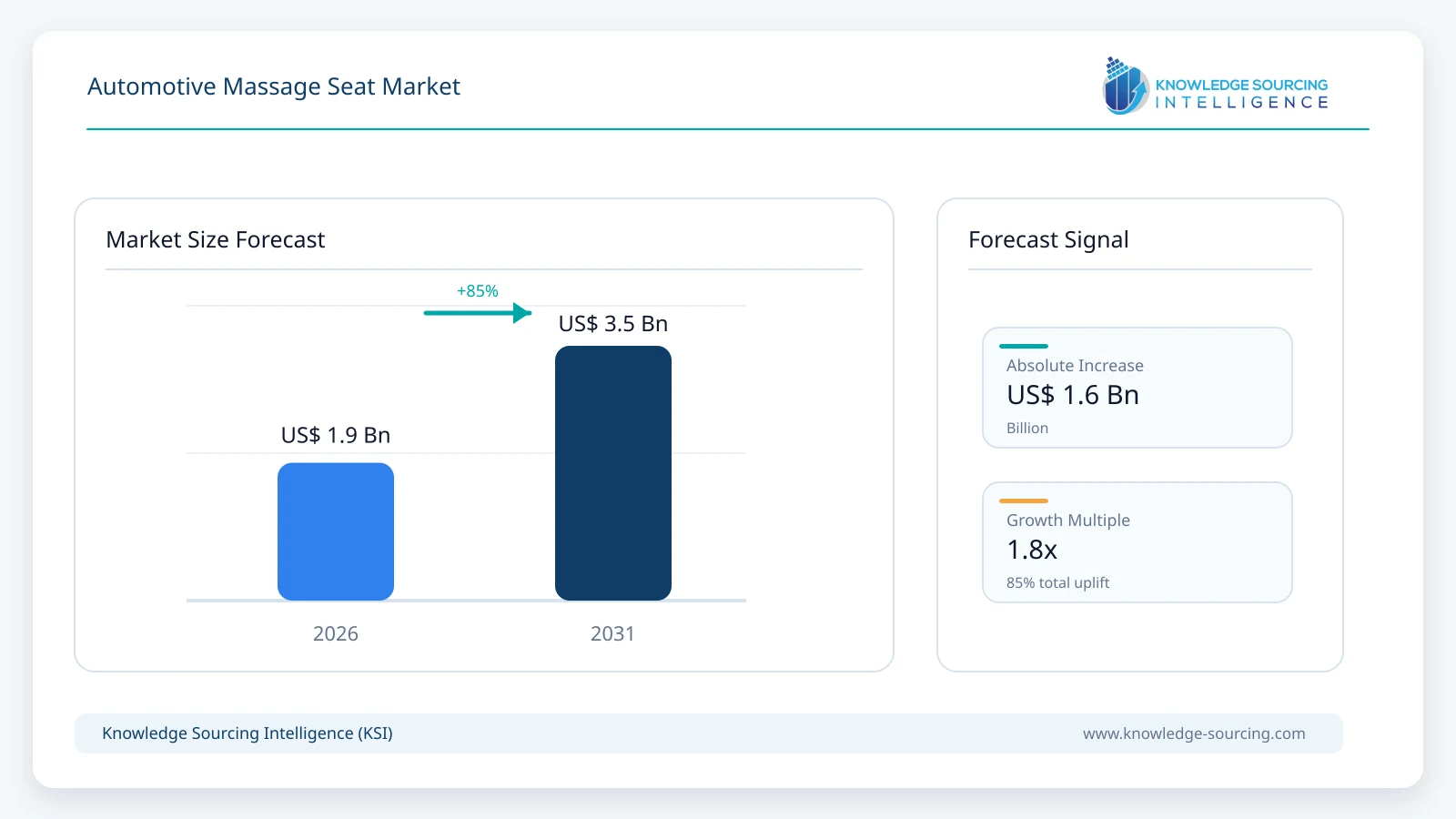
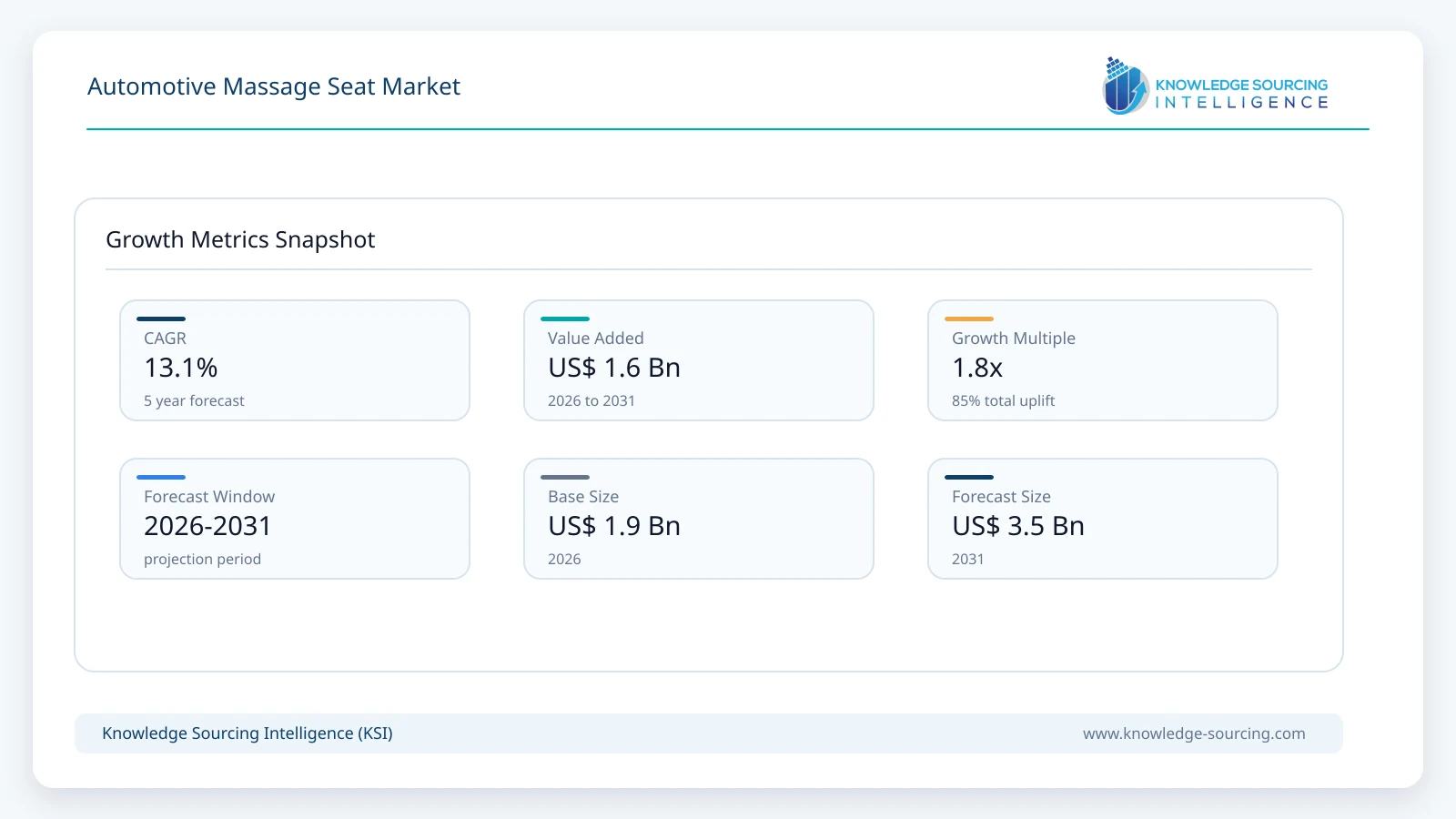
The automotive massage seat market is forecast to grow at a CAGR of 13.1%, reaching approximately USD 3.55 billion in 2031 from USD 1.92 billion in 2026.
Highlights:
- 1Pneumatic massage systems account for approximately 58% of global market value in 2026, supported by their established use in lumbar, backrest and multi-zone comfort systems.
- 2Front-seat applications represent approximately 70% of market value in 2026, reflecting earlier adoption in driver and front-passenger premium comfort packages.
- 3Passenger cars account for approximately 94% of global market value in 2026, with premium sedans, SUVs, MPVs and higher-content electric vehicles providing the principal demand base.
- 4Internal-combustion vehicles represent approximately 55% of market value in 2026, although battery electric vehicles are gaining share as automakers emphasize differentiated cabin experience.
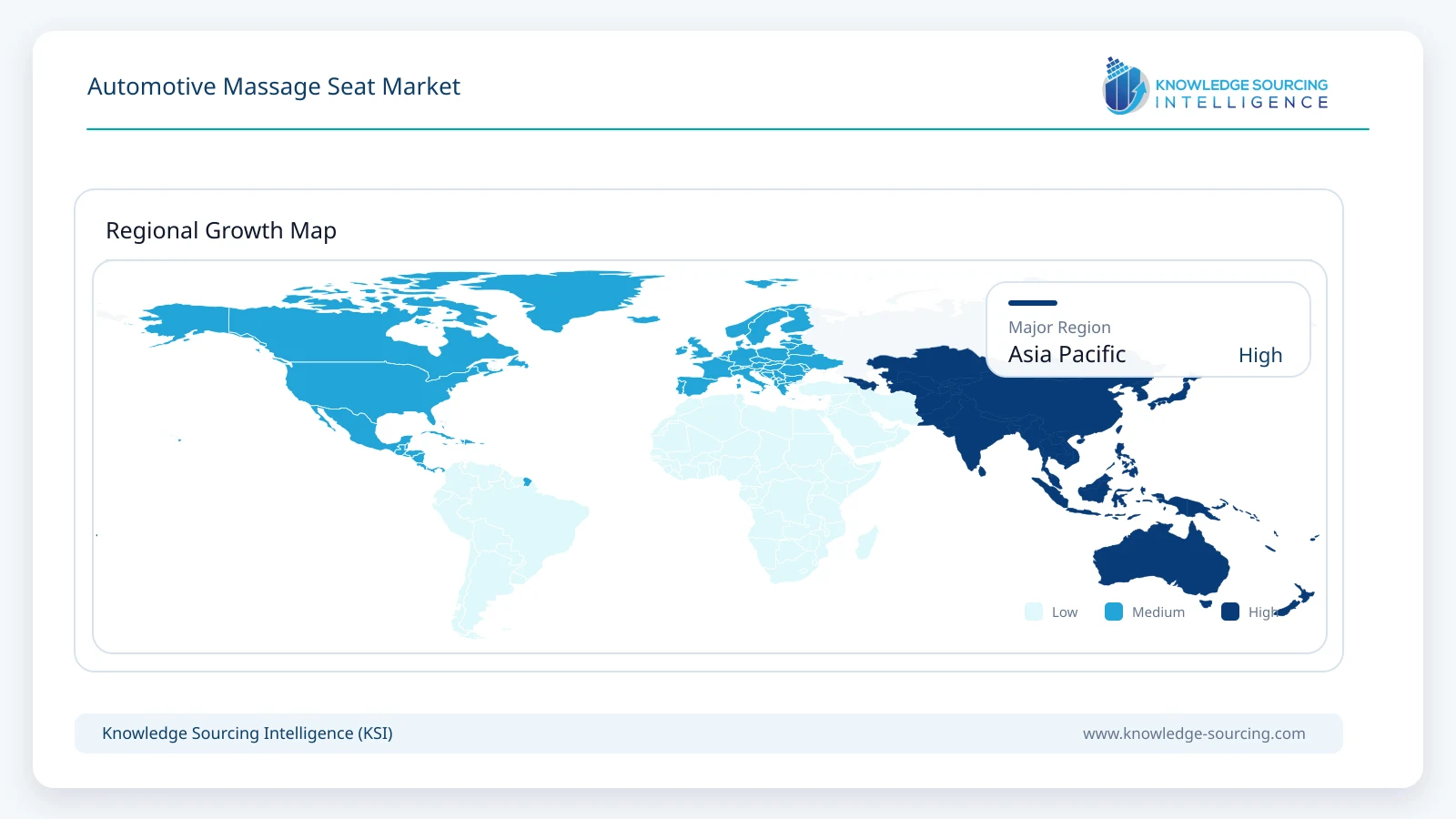
- 5Asia Pacific represents approximately 43% of global market value in 2026, supported by premium-vehicle demand, strong electric-vehicle production and rapid commercialization of advanced seating features in China, South Korea and Japan.
The market covers factory-installed automotive seating and directly integrated massage modules that provide active massage through pneumatic air cells, motor-driven mechanical mechanisms, percussion, vibration, rolling, kneading or hybrid actuation.
Massage functionality is increasingly being designed as part of a broader seat-comfort architecture rather than as a stand-alone luxury option. Lear combines pneumatic lumbar and massage with modular thermal comfort systems, Gentherm supplies dedicated lumbar and massage comfort solutions, Adient is commercializing mechanical massage platforms, and FORVIA has moved its 3D Zen mechanical massage technology into a production program with IM Motors.
The market is also expanding beyond the driver's seat. Rear-row massage is becoming more visible in premium SUVs, electric MPVs and executive vehicles, while foot-massage modules are beginning to enter production. Hyundai Transys has deployed its Dynamic Body Care massage technology across large SUVs, and Adient introduced an automotive-grade foot massage system on NIO's ES9 in 2026.
Market Overview
Automotive massage seats use integrated actuators within the seat cushion, backrest, lumbar zone or footrest to deliver controlled pressure, movement, vibration or percussion. Pneumatic systems typically use multiple air bladders and valves to create cyclical pressure patterns, while mechanical systems use motor-driven heads, rollers, cams or moving modules to produce stronger and more localized massage effects.
Pneumatic technology remains widely used because it can share components with lumbar-support systems and can be packaged within relatively thin seat structures. Gentherm's automotive portfolio includes pneumatic lumbar and massage solutions and its Puls.A technology uses precision micro-air-pressure bursts to create a deeper pulsating effect. Lear similarly supplies pneumatic lumbar and massage systems as part of its vertically integrated Seating business.
Mechanical massage is gaining momentum where automakers want a stronger experience comparable with premium home massage chairs. Adient's ProForce platform uses mechanical massage modules and FORVIA's 3D Zen Massage Seat provides kneading, rubbing, tapping and grasping functions. Both companies have moved these technologies from demonstration into production-oriented automotive programs.
Massage is also being integrated with wider wellness features. Heating, ventilation, posture support and intelligent controls can operate alongside the massage function, allowing automakers to offer multi-mode comfort packages. This integration increases the value of the seat as a differentiated cabin system, particularly during long-distance travel, EV charging stops and rear-seat relaxation.
Market Trends
Mechanical Massage Is Moving into Production Programs
Mechanical massage is becoming a more important technology path because it can deliver greater force and a wider range of techniques than conventional air-bladder systems. On 24 April 2026, Adient introduced ProForce Massage Flow, a moving-module solution capable of kneading, tapping and rolling, with production planned on two Chinese OEM models. The design supports front and rear seats and integrates with lumbar support, ventilation and heating.
FORVIA has taken a similar direction with its 3D Zen Massage Seat. The system uses motorized mechanical massage to deliver kneading, rubbing, tapping and grasping functions. A five-year supply agreement with IM Motors places the technology into the IM LS9, demonstrating that mechanical massage is becoming commercially viable in premium vehicle programs rather than remaining limited to concept displays.
Massage Is Expanding Beyond the Front Seat
Rear-seat comfort is becoming an important source of content growth, especially in large SUVs, executive sedans, electric MPVs and chauffeur-oriented vehicles. Hyundai Transys's Dynamic Body Care technology combines percussion and vibration in second-row seating and has expanded across vehicles including the Kia EV9, Hyundai IONIQ 9, Palisade and Carnival.
Adient's StepJoy development extends massage beyond the back and lumbar region. Introduced on the NIO ES9, the system uses synchronized cam modules to massage the forefoot and arch and can stow within the seatback when not in use. The development illustrates how premium rear-seat packages are broadening into multi-zone body-care systems.
Pneumatic Massage Is Becoming More Sophisticated
Pneumatic systems continue to evolve through better valve control, pressure modulation and software programming. Gentherm's Puls.A technology uses precision micro-pressure bursts to create a deeper pulsating massage while retaining the packaging benefits of an air-based system. The company secured a Mercedes-Benz lumbar and massage award including Puls.A in 2025, following earlier production awards with Genesis and Range Rover programs.
Lear is also expanding modular pneumatic comfort. During the first quarter of 2026, the company reported new BMW and Audi module awards combining lumbar and massage functions, supporting wider use of massage modules across premium platforms in Asia and Europe.
Massage Is Becoming Part of Integrated Wellness Packages
Automakers increasingly package massage with heating, ventilation, lumbar support and posture-management functions. This allows a common seat platform to provide multiple comfort modes while reducing the number of separate modules. Lear's ComfortFlex architecture, Adient's ProForce platform and Hyundai Transys's Ergo Motion Seat all demonstrate the move toward integrated comfort rather than isolated massage functions.
The wellness positioning is particularly important for long journeys and high-value vehicle interiors. Massage is increasingly marketed as a means of reducing fatigue, relieving back discomfort and supporting relaxation during travel or charging stops.
China Is Accelerating Commercialization
China is emerging as a key launch market for new massage-seat technologies because local OEMs are competing intensely on intelligent-cabin and comfort features. Adient's recent mechanical massage programs, FORVIA's IM Motors contract and Lear's expanding modular comfort awards all show increasing supplier activity in the region.
Premium electric SUVs and MPVs are particularly important because larger cabins provide more packaging freedom for second-row recliners, footrests and multi-zone massage functions. The wider shift of global automotive production and electric-vehicle manufacturing toward Asia further supports regional commercialization.
Segment Analysis
By Massage Technology: Pneumatic Massage
Pneumatic massage is projected to reach approximately USD 1.78 billion by 2031. Air-cell architectures remain attractive because they can combine massage and lumbar support within a common pneumatic system, offer relatively low seat-packaging depth and provide multiple programmable zones. Continued development of pulsating air-pressure technologies is improving the strength and differentiation of pneumatic massage while maintaining compatibility with existing seat platforms.
By Seat Position: Front Seat
Front-seat massage applications are projected to reach approximately USD 2.27 billion by 2031. Driver and front-passenger seats have historically received advanced powered adjustment, lumbar support, heating and ventilation earlier than rear seats, creating an established platform for massage integration. Demand is supported by long-distance comfort, fatigue management and premium trim differentiation.
By Vehicle Type: Passenger Cars
Passenger cars are projected to generate approximately USD 3.27 billion of automotive massage seat market value by 2031. Premium sedans, SUVs, MPVs and high-content electric vehicles account for the majority of adoption because massage is primarily sold as a comfort and wellness feature. Commercial-vehicle opportunities exist for driver fatigue reduction, but passenger vehicles provide the largest installed base and the strongest willingness to pay for multi-function seating.
By Propulsion: Battery Electric Vehicles
Battery electric vehicles are projected to generate approximately USD 1.35 billion of automotive massage seat market value by 2031. EV makers are using interior technology to differentiate vehicles beyond powertrain performance, and larger electric SUVs and MPVs increasingly combine reclining, zero-gravity, massage and thermal-comfort functions. The IEA reported that electric cars accounted for one-quarter of global new-car sales in 2025, reinforcing the growing vehicle base for advanced cabin features.
By Geography: Asia Pacific
Asia Pacific is projected to reach approximately USD 1.70 billion by 2031. China is the main growth engine because domestic automakers are rapidly adopting mechanical massage, premium second-row seating and software-controlled comfort features. South Korea contributes advanced production applications through suppliers such as Hyundai Transys, while Japan remains an important automotive seating and premium-vehicle market.
Market Drivers
Premiumization of Vehicle Interiors
Automakers are using seat comfort as a visible differentiator as powertrain and digital features become increasingly competitive. Massage provides a feature that occupants can experience directly and can support premium pricing in upper trims, luxury vehicles and high-content electric models.
Increasing Focus on Occupant Wellness
Long commuting times and extended road journeys are increasing interest in functions that can reduce discomfort and fatigue. Massage systems are increasingly positioned around lumbar relief, muscle stimulation, relaxation and posture support rather than only luxury.
Expansion of Electric and Premium SUVs
Large electric SUVs and MPVs provide greater packaging flexibility for reclining seats, extended leg support, second-row comfort modules and foot-massage functions. These vehicle formats are therefore important commercialization platforms for multi-zone massage seating.
Advances in Pneumatic and Mechanical Actuation
Improved valves, compact motors, moving modules, cams and software controls are broadening the achievable massage experience. Mechanical systems are delivering stronger kneading and rolling effects, while pneumatic systems are using more precise pressure control to improve depth and personalization.
Modular Seat-Comfort Architectures
Seat suppliers are increasingly combining massage with lumbar support, heating, ventilation and electronics within common modules. This can simplify integration for OEMs and makes it easier to offer multiple feature grades across the same vehicle platform.
Market Restraints
Higher Seat-System Cost
Massage systems add actuators, valves, air bladders, mechanical modules, electronics and software to the seat. The incremental cost remains easier to justify in premium vehicles than in entry-level models, limiting penetration in price-sensitive segments.
Packaging and Weight Constraints
Mechanical heads, pneumatic cells and foot-massage modules must fit within seat structures that are already required to accommodate heating, ventilation, airbags, restraint hardware and powered mechanisms. Maintaining thin seat profiles and low mass can therefore be difficult as feature content increases.
Durability and Noise Requirements
Automotive massage modules must operate reliably over many years while remaining quiet enough for a premium cabin. Mechanical systems in particular need durable moving parts and effective noise isolation, while pneumatic systems must maintain valve and bladder integrity under repeated cycling.
Safety Integration
Massage hardware must not interfere with crash performance, occupant sensing or restraint systems. Collapsible or resettable massage mechanisms, airbag compatibility and validation across different seat positions increase engineering requirements and development time.
Concentration in Higher-Value Vehicle Segments
Mass-market adoption remains uneven because massage is still frequently bundled with premium trim packages. Wider penetration depends on lower-cost modular designs and stronger consumer willingness to pay outside luxury and upper-mid vehicle categories.
Regional Outlook
Asia Pacific
Asia Pacific is the largest regional market and is expected to remain the strongest growth centre through 2031. China is the principal driver because domestic and international automakers are using advanced seating to differentiate premium EVs, SUVs and MPVs. FORVIA's Zen Massage production program with IM Motors, Adient's mechanical massage launches and Lear's expanding modular comfort awards demonstrate the region's role as a rapid commercialization market.
South Korea adds an established production base for advanced massage seating through Hyundai Transys, whose Ergo Motion and Dynamic Body Care systems are used across Genesis, Kia and Hyundai vehicles. Japan remains relevant through its premium vehicle industry and automotive seating supply base, while India and Southeast Asia provide longer-term demand as higher-content vehicle sales increase.
Europe
Europe is the second major regional market, supported by strong premium-vehicle production and long-standing adoption of advanced comfort seating. German luxury brands remain important customers for pneumatic lumbar and massage modules, with Lear reporting BMW and Audi awards in 2026 and Gentherm securing a Mercedes-Benz award that includes its Puls.A technology.
European growth is also supported by high consumer familiarity with multi-contour seats, wellness packages and rear-seat comfort in executive vehicles. The region's relatively mature vehicle volumes are offset by high feature content per vehicle and continued investment in premium electric platforms.
Competitive Landscape
Competition combines complete-seat manufacturers with specialist comfort-system suppliers. Adient, FORVIA, Lear, Hyundai Transys and Yanfeng integrate massage functions into complete automotive seats, while Gentherm and Leggett & Platt manufacture dedicated pneumatic, massage, actuation and seating-comfort systems supplied to OEMs and Tier-1 seat manufacturers.
Adient is strengthening its position through mechanical massage, including ProForce Massage Focus and Flow as well as the StepJoy foot-massage module. FORVIA competes through pneumatic comfort and its new 3D Zen mechanical massage technology, which entered production through IM Motors. Lear combines complete-seat integration with pneumatic lumbar and massage products and modular ComfortFlex systems.
Gentherm remains an important specialist in pneumatic lumbar and massage solutions and has expanded its Puls.A pulsating massage technology through production awards with premium OEMs. Hyundai Transys differentiates through its Ergo Motion and Dynamic Body Care systems, while Yanfeng integrates massage within zero-gravity and intelligent-seat concepts. Leggett & Platt participates directly through automotive massage systems, motors, actuators and lumbar-support products.
Recent Developments
May 2026: Lear reported new ComfortFlex module awards with BMW in Asia and Audi in Europe that include lumbar and massage functionality, extending adoption of its modular seat-comfort systems.
April 2026: Adient introduced ProForce Massage Flow, a mechanical massage solution with moving modules capable of kneading, tapping and rolling; production is planned on two Chinese OEM models.
April 2026: Adient launched StepJoy on NIO's ES9, bringing an automotive-grade foot massage system into mass production using compact cam-based modules integrated into the seatback.
February 2026: FORVIA highlighted 3D Zen mechanical massage as a key seating growth technology at its Capital Markets Day, following a rapid transition from innovation to production.
October 2025: Gentherm announced a Mercedes-Benz conquest award for lumbar and massage comfort solutions that includes its Puls.A pulsating pneumatic massage technology.
October 2025: FORVIA signed a five-year agreement to supply its 3D Zen Massage system to IM Motors for the IM LS9, marking the first production application of FORVIA's mechanical massage technology.
July 2025: Adient launched its mechanical massage seat solution on GAC-Trumpchi's M8 PHEV, using a 3D massage module designed to simulate kneading techniques and provide stronger localized massage.
May 2025: Hyundai Transys detailed the expansion of its Dynamic Body Care second-row massage seat from the Kia EV9 to additional large SUV and MPV programs including the Hyundai IONIQ 9, Palisade and Carnival.
Market Outlook
The automotive massage seat market is expected to maintain strong expansion through 2031 as massage moves from a specialized luxury feature toward a broader wellness and premium-comfort function. Pneumatic systems will remain an important base technology, but mechanical massage is expected to gain relevance as suppliers improve packaging, noise control and crash-safe designs.
Rear-seat and multi-zone applications will become more important as premium electric SUVs, MPVs and executive vehicles offer deeper recline, footrests and lounge-style cabin modes. Foot massage and stronger mechanical massage functions will broaden the addressable content beyond conventional lumbar-focused systems.
Asia Pacific is expected to lead commercialization, while Europe remains an important premium-vehicle market. Supplier competition will increasingly focus on massage strength, coverage area, quiet operation, compact packaging, integration with thermal comfort and lumbar functions, safety validation and the ability to scale common modules across multiple vehicle platforms.
Automotive Massage Seat Market Scope
| Report Metric | Details |
|---|---|
| Total Market Size in 2026 | USD 1.92 billion |
| Total Market Size in 2031 | USD 3.55 billion |
| Forecast Unit | Billion |
| Growth Rate | 13.1% |
| Study Period | 2021 to 2031 |
| Historical Data | 2021 to 2024 |
| Base Year | 2025 |
| Forecast Period | 2026 – 2031 |
| Segmentation | Massage Technology, Seat Position, Vehicle Type, Propulsion, Geography |
| Companies |
|
Market Segmentation
By Massage Technology
Pneumatic Massage
Mechanical Massage
Hybrid and Other Massage Technologies
By Seat Position
Front Seat
Rear Seat
By Vehicle Type
Passenger Cars
Light Commercial Vehicles
Medium and Heavy Commercial Vehicles
By Propulsion
Internal Combustion Engine Vehicles
Hybrid Electric Vehicles
Battery Electric Vehicles
By Geography
North America
United States
Canada
Mexico
South America
Brazil
Argentina
Others
Europe
Germany
United Kingdom
France
Italy
Spain
Others
Middle East and Africa
Saudi Arabia
UAE
South Africa
Others
Asia Pacific
China
Japan
South Korea
India
Indonesia
Thailand
Others
Table of Contents
1. INTRODUCTION
1.1. Market Overview
1.2. Market Definition
1.3. Scope of the Study
1.4. Market Segmentation
1.5. Currency
1.6. Assumptions
1.7. Base and Forecast Years
1.8. Key Benefits to Stakeholders
2. RESEARCH METHODOLOGY
2.1. Research Design
2.2. Secondary Research
2.3. Primary Research
2.4. Market Estimation
2.5. Segment Modelling
2.6. Data Triangulation and Validation
3. EXECUTIVE SUMMARY
3.1. Key Findings
3.2. Automotive Massage Seat Market Size, 2026-2031
3.3. Massage Technology Outlook
3.4. Seat Position Outlook
3.5. Vehicle Type Outlook
3.6. Propulsion Outlook
3.7. Regional Opportunity Summary
4. MARKET DYNAMICS
4.1. Market Drivers
4.1.1. Premiumization of Vehicle Interiors
4.1.2. Increasing Focus on Occupant Wellness
4.1.3. Expansion of Electric and Premium SUVs
4.1.4. Advances in Pneumatic and Mechanical Actuation
4.1.5. Modular Seat-Comfort Architectures
4.2. Market Restraints
4.2.1. Higher Seat-System Cost
4.2.2. Packaging and Weight Constraints
4.2.3. Durability and Noise Requirements
4.2.4. Safety Integration
4.2.5. Concentration in Higher-Value Vehicle Segments
4.3. Market Opportunities
4.4. Porter's Five Forces Analysis
4.5. Industry Value Chain Analysis
4.6. Automotive Seat Comfort Economics
4.7. Safety and Regulatory Environment
5. TECHNOLOGY OUTLOOK
5.1. Pneumatic Air-Bladder Massage
5.2. Mechanical Roller and Moving-Head Massage
5.3. Percussion and Vibration Systems
5.4. Pulsating Pressure Technologies
5.5. Multi-Zone Massage Control
5.6. Foot and Leg Massage Integration
5.7. Massage, Lumbar and Thermal Comfort Integration
5.8. Software-Controlled Massage Programs
5.9. Crash-Safe and Resettable Massage Mechanisms
6. AUTOMOTIVE MASSAGE SEAT MARKET BY MASSAGE TECHNOLOGY
6.1. Introduction
6.2. Pneumatic Massage
6.3. Mechanical Massage
6.4. Hybrid and Other Massage Technologies
7. AUTOMOTIVE MASSAGE SEAT MARKET BY SEAT POSITION
7.1. Introduction
7.2. Front Seat
7.3. Rear Seat
8. AUTOMOTIVE MASSAGE SEAT MARKET BY VEHICLE TYPE
8.1. Introduction
8.2. Passenger Cars
8.3. Light Commercial Vehicles
8.4. Medium and Heavy Commercial Vehicles
9. AUTOMOTIVE MASSAGE SEAT MARKET BY PROPULSION
9.1. Introduction
9.2. Internal Combustion Engine Vehicles
9.3. Hybrid Electric Vehicles
9.4. Battery Electric Vehicles
10. AUTOMOTIVE MASSAGE SEAT MARKET BY GEOGRAPHY
10.1. North America
10.1.1. United States
10.1.2. Canada
10.1.3. Mexico
10.2. South America
10.2.1. Brazil
10.2.2. Argentina
10.2.3. Others
10.3. Europe
10.3.1. Germany
10.3.2. United Kingdom
10.3.3. France
10.3.4. Italy
10.3.5. Spain
10.3.6. Others
10.4. Middle East and Africa
10.4.1. Saudi Arabia
10.4.2. UAE
10.4.3. South Africa
10.4.4. Others
10.5. Asia Pacific
10.5.1. China
10.5.2. Japan
10.5.3. South Korea
10.5.4. India
10.5.5. Indonesia
10.5.6. Thailand
10.5.7. Others
11. COMPETITIVE ENVIRONMENT AND ANALYSIS
11.1. Major Players and Strategy Analysis
11.2. Market Share Analysis
11.3. Product and Technology Benchmarking
11.4. Mergers, Acquisitions, Agreements, and Collaborations
11.5. Competitive Dashboard
12. COMPANY PROFILES
12.1. Adient plc
12.2. Lear Corporation
12.3. FORVIA
12.4. Gentherm Incorporated
12.5. Hyundai Transys Inc.
12.6. Yanfeng
12.7. Leggett & Platt Incorporated
13. APPENDIX
13.1. Currency
13.2. Assumptions
13.3. Base and Forecast Years Timeline
13.4. Key Benefits for Stakeholders
13.5. Research Methodology
13.6. Abbreviations
13.7. Data Sources
Navigate
Trusted by the world's leading organizations











