
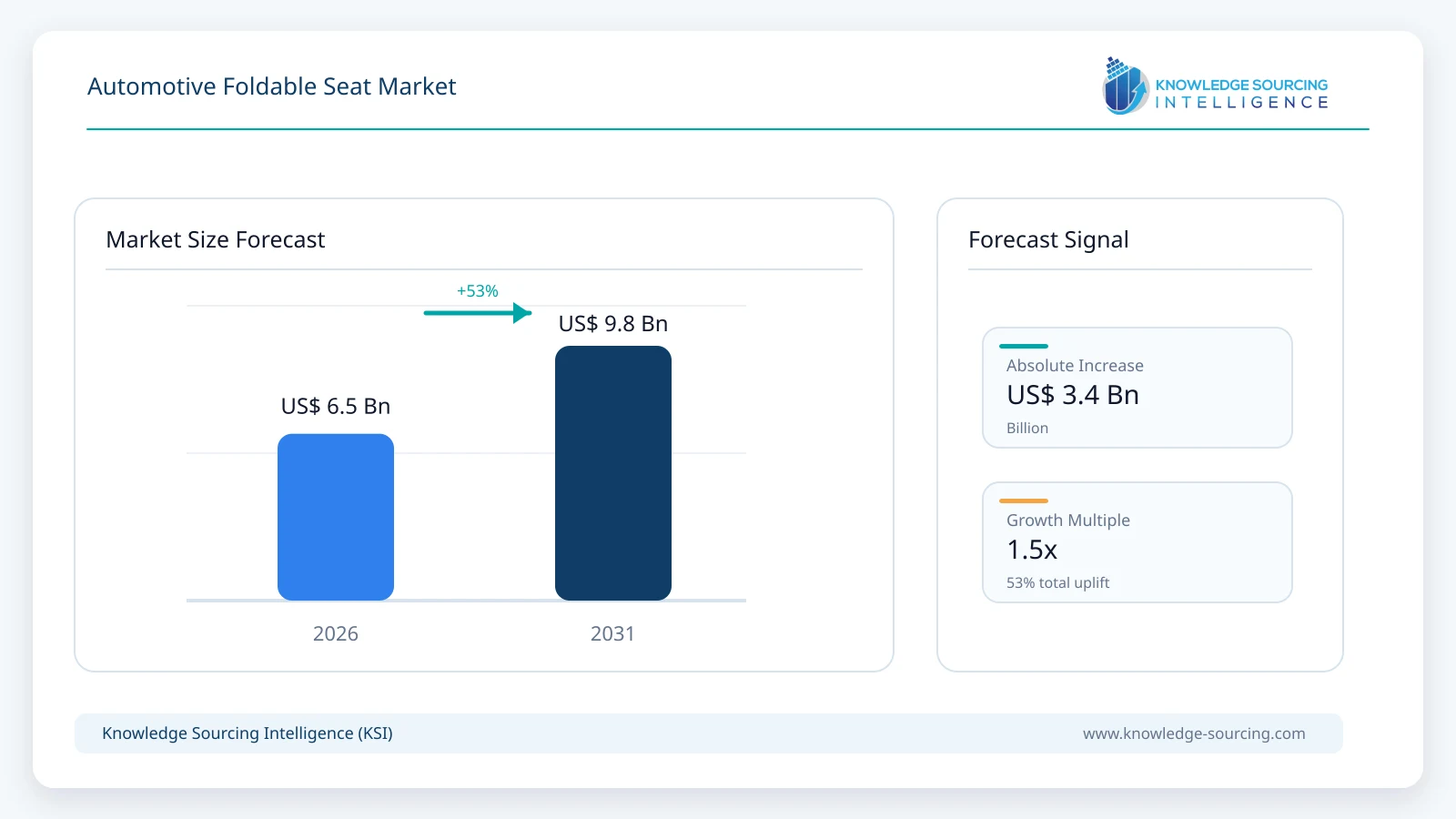
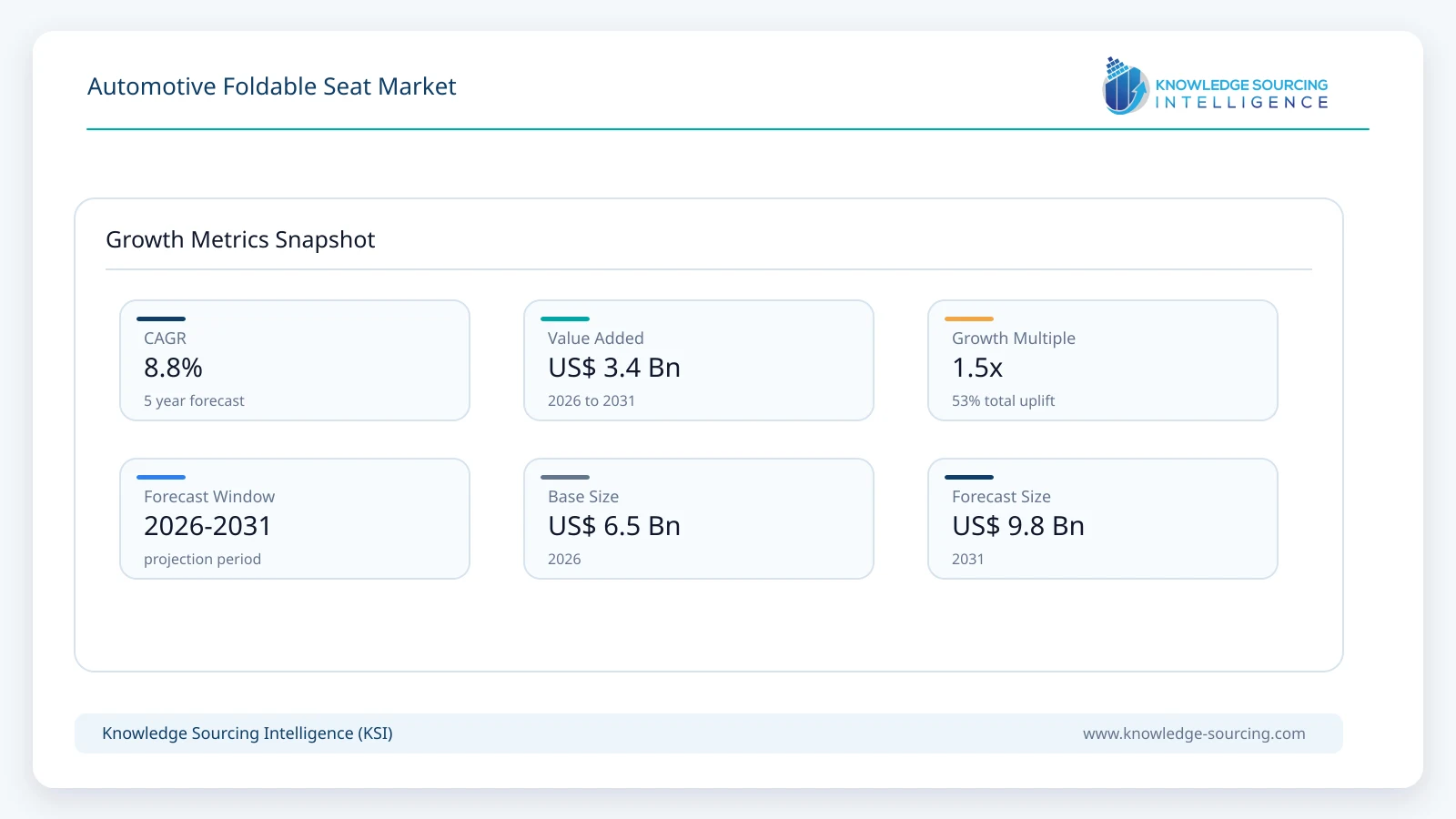
The automotive foldable seat market is forecast to grow at a CAGR of 8.8%, reaching approximately USD 9.85 billion in 2031 from USD 6.45 billion in 2026.
Highlights:
- 1Fold-flat and split-folding systems account for approximately 53% of global market value in 2026, reflecting their broad use across hatchbacks, SUVs, crossovers, MPVs and vans.
- 2Manual folding systems represent approximately 72% of market value in 2026, supported by their lower cost, simplicity and broad adoption in high-volume vehicle segments.
- 3Second-row applications account for approximately 61% of global market value in 2026 because foldable backrests, tumble mechanisms and easy-entry functions are widely integrated into two- and three-row vehicles.
- 4Passenger cars represent approximately 89% of market value in 2026, with SUVs, crossovers, hatchbacks and MPVs providing the largest installation base.
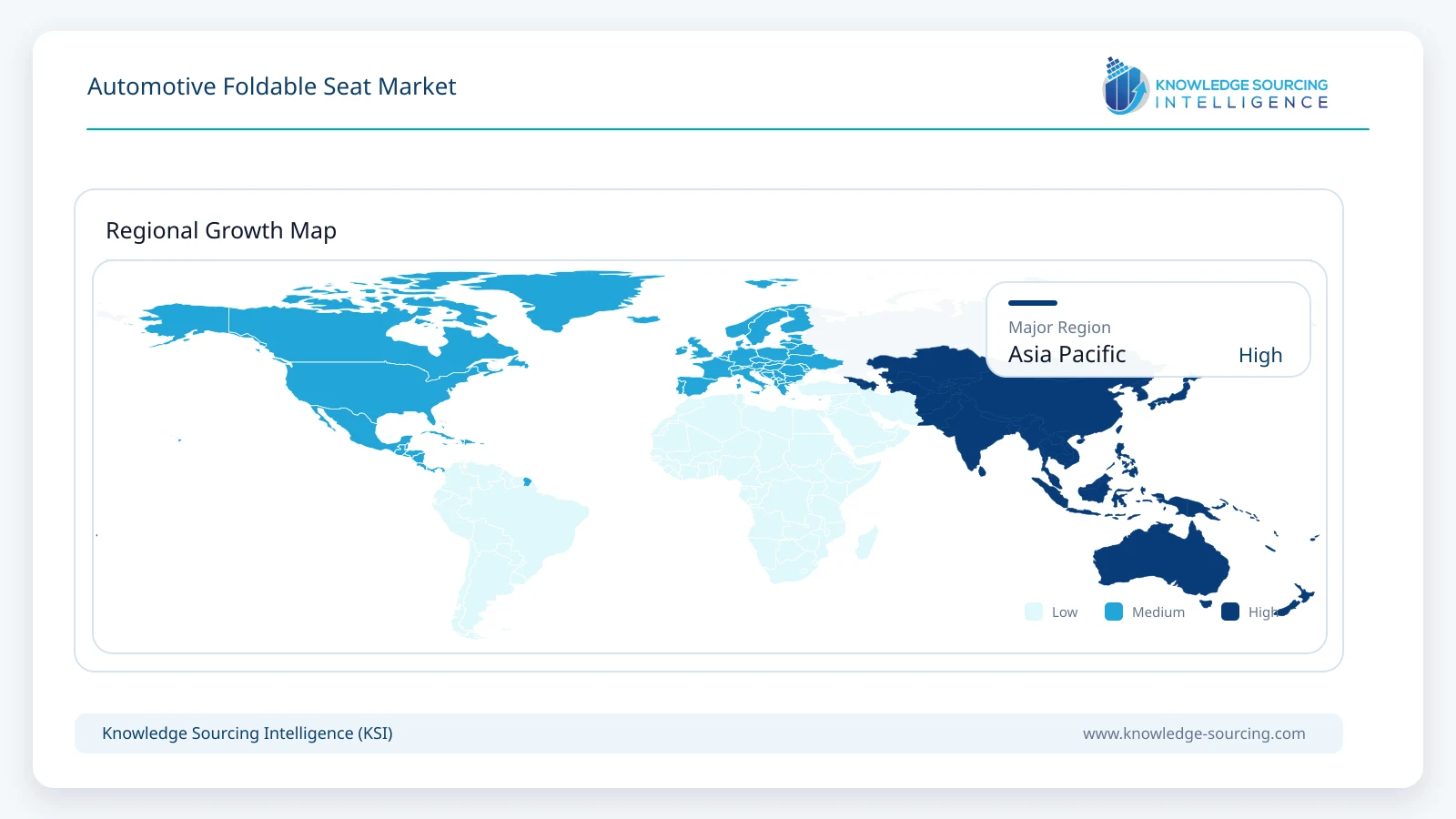
- 5Asia Pacific represents approximately 46% of global market value in 2026, supported by large passenger-vehicle production volumes and growing demand for flexible multi-row EV, SUV and MPV interiors.
Demand is being driven by greater emphasis on cargo flexibility, easier third-row access, compact seat stowage and multi-purpose cabin layouts across passenger vehicles and light commercial vehicles.
Foldable seat systems are increasingly engineered as complete rear-seat architectures rather than simple hinged backrests. FORVIA offers a light and foldable rear-seat structure supporting single-fold, dive-down and easy-entry functions in both manual and powered configurations. Hyundai Transys uses multifunctional second- and third-row frames for fold-and-dive, double-fold easy entry and reclining functions.
Newer systems are adding longer travel, power actuation and compact nesting. Magna combines stadium-flip cushions, long rails and reconfigurable seat structures to improve cargo management. Yanfeng's XiM27 demonstrates how second-row seats can transform into a flat bed while the third row switches between cargo and lounge configurations. These developments are increasing the value of foldable seating beyond conventional rear-seat utility.
Market Overview
Automotive foldable seats use seatback hinges, latches, recliners, cushion linkages, tracks, motors and structural frames to move one or more seat sections from an occupied position into a compact cargo or access configuration. Depending on the vehicle, the seat may fold flat, tumble forward, dive toward the floor, flip upward, nest against another interior structure or stow below the load floor.
Fold-flat and split-folding architectures remain the highest-volume format because they can be applied across two-row and three-row passenger vehicles. Typical designs use 60/40, 40/20/40 or 50/50 split rear seatbacks, allowing the vehicle to carry long or bulky cargo while retaining one or more passenger seats.
Three-row vehicles require more complex kinematics. Hyundai Transys combines fold-and-dive and easy-entry mechanisms in multifunctional rear-seat frames, while FORVIA's foldable structure links seatback movement with cushion motion to create more cargo space and improve access to the third row.
Power folding is becoming more important in premium SUVs, MPVs and larger EVs. One-touch mechanisms reduce the effort required to reconfigure second- and third-row seats, especially where seat weight, long slide travel or under-floor stowage make manual operation less convenient.
Market Trends
Foldable Seats Are Moving Toward System-Level Reconfiguration
The market is progressing from isolated seatback folding toward coordinated movement of the cushion, backrest, rails and adjacent interior systems. Magna's Flexible Seating System uses reusable structural building blocks to support compact stowage and extended flat configurations without requiring a separate mechanism for every cabin mode.
This approach allows automakers to create passenger, cargo, rest and access configurations from a common architecture, increasing the value of the folding mechanism as part of the wider cabin system.
Power Folding and One-Touch Operation Are Expanding
Powered rear-seat movement is increasing in larger SUVs and premium multi-row vehicles. Electric release, motorized folding and one-touch slide-and-fold functions improve accessibility and reduce the effort required to reconfigure heavier second- and third-row seats.
Current vehicle applications include one-touch second-row fold-and-slide systems and power-folding third rows. As electronics and actuator costs decline, power folding is expected to move into a wider range of upper-mid vehicle segments.
Fold-and-Dive and Tumble Systems Are Supporting Three-Row Growth
Three-row SUVs and MPVs require mechanisms that provide both cargo flexibility and a usable path to the rear seats. Fold-and-dive and tumble architectures move the seatback and cushion together, reducing the space occupied by the folded seat and creating a larger access opening.
Hyundai Transys's multifunctional rear frame and FORVIA's light and foldable rear-seat platform demonstrate the continued importance of linked kinematics for second-row easy entry and third-row cargo conversion.
Stadium and Nesting Concepts Are Broadening Cargo Flexibility
Stadium-flip seating raises the cushion vertically or nests it against another structure to create a larger floor area without requiring complete seat removal. Magna's Stadium Cushion is designed specifically around this use case and is being combined with long rails in broader reconfigurable interior platforms.
These architectures are particularly relevant to EVs and multi-purpose vehicles because flat floors can support longer seat travel and more dramatic changes between passenger and cargo layouts.
Foldable Seating Is Becoming More Important in EV Cabin Design
Electric vehicles are increasing interest in flexible interiors because battery platforms can create flatter floors and free up packaging options that are more difficult to achieve around conventional drivetrains. Foldable seats allow automakers to translate this packaging freedom into practical cargo and rest modes.
Yanfeng's XiM27 illustrates the direction of travel, using long rails and highly modular seating to create a second-row flat-bed configuration and a third row that transitions between cargo and lounge use.
Segment Analysis
By Folding Configuration: Fold-Flat and Split-Folding
Fold-flat and split-folding systems are projected to reach approximately USD 4.83 billion by 2031. Their large installed base is supported by widespread use across hatchbacks, SUVs, crossovers and MPVs, where folding rear backrests provide a low-cost method of increasing cargo capacity while maintaining seating flexibility.
By Operation: Manual
Manual foldable seat systems are projected to reach approximately USD 5.91 billion by 2031. Mechanical release handles, cable-operated latches and spring-assisted mechanisms remain attractive for high-volume vehicles because they are durable, lightweight and cost-efficient. Powered systems are growing faster, but manual operation will remain important across mainstream vehicle segments.
By Seat Row: Second Row
Second-row foldable seating is projected to reach approximately USD 5.61 billion by 2031. Second-row systems serve both cargo conversion and third-row access, supporting a wide range of split-fold, tumble, fold-and-dive and easy-entry mechanisms in SUVs, MPVs, crossovers and vans.
By Vehicle Type: Passenger Cars
Passenger cars are projected to generate approximately USD 8.57 billion of foldable-seat market value by 2031. SUVs, crossovers, hatchbacks and MPVs provide the largest demand base because rear-seat flexibility is a standard or high-volume feature across these body styles.
By Propulsion: Battery Electric Vehicles
Battery electric vehicles are projected to generate approximately USD 3.74 billion of foldable-seat market value by 2031. Flat-floor packaging and the stronger focus on multi-purpose cabin use are increasing demand for compact stowage, long-travel seating and powered reconfiguration in electric SUVs and MPVs.
By Geography: Asia Pacific
Asia Pacific is projected to reach approximately USD 4.83 billion by 2031. The region combines large vehicle-production volumes with strong growth in SUVs, MPVs and EVs. China is a major development centre for flexible cabin concepts, while Japan and South Korea contribute established rear-seat engineering and production capabilities.
Market Drivers
Growth of SUVs, Crossovers and MPVs
SUVs, crossovers and MPVs rely heavily on flexible second- and third-row seating to balance passenger capacity with cargo utility. Continued expansion of these body styles supports a large installation base for folding rear seats.
Demand for Greater Cargo Flexibility
Consumers increasingly use passenger vehicles for mixed passenger, leisure and cargo requirements. Fold-flat and stowable seats allow the load floor to be expanded without permanently removing seating capacity.
Expansion of Three-Row Vehicles
Three-row SUVs and MPVs require easy-entry and compact folding mechanisms to improve access to rear passengers. This increases seat-system content through tumble, fold-and-dive, power release and long-slide functions.
Electrification and Flexible Interior Packaging
Battery-electric platforms provide greater freedom for interior packaging and support longer seat rails, flat floors and more configurable cabins. Foldable seating is therefore becoming an important enabler of multi-use EV interiors.
Increasing Adoption of Powered Convenience Features
Power releases, remote seat folding and one-touch reconfiguration improve convenience in large multi-row vehicles. These functions are increasing content per vehicle and supporting market growth beyond basic manual folding mechanisms.
Market Restraints
Cost and Mechanism Complexity
Fold-and-dive, powered tumble and under-floor stowage systems require additional linkages, motors, sensors and control logic compared with a conventional fixed rear seat. This increases component and validation cost.
Weight and Packaging Trade-Offs
Additional tracks, hinges and powered mechanisms increase seat mass and can occupy valuable under-floor or cargo space. Suppliers must balance flexibility with lightweighting and packaging targets.
Crash and Latch Performance Requirements
A foldable seat must lock securely in the occupied position and maintain structural integrity during a crash. Latches, recliners and floor interfaces therefore require robust validation across repeated folding cycles and impact conditions.
Noise, Vibration and Durability
Multiple moving joints can create rattle, looseness or higher operating effort over time. Premium applications place particular emphasis on quiet powered movement and consistent latch feel throughout the vehicle life cycle.
Reduced Need in Fixed-Layout Vehicle Segments
Sedans, two-seat commercial vehicles and some premium chauffeur-oriented vehicles can rely on fixed rear layouts, reducing the addressable opportunity relative to SUVs, hatchbacks and multi-row vehicles.
Regional Outlook
Asia Pacific
Asia Pacific is the largest regional market and is expected to remain the strongest growth centre through 2031. China combines high SUV and EV volumes with rapid development of software-controlled flexible interiors. Yanfeng's XiM27 demonstrates second-row flat-bed conversion and third-row cargo transformation, while Hyundai Transys supplies fold-and-dive and easy-entry structures across multi-row seating applications.
Japan and South Korea contribute deep engineering expertise in rear-seat frames, compact kinematics and multi-purpose vehicle seating. Toyota Boshoku continues to develop standardized rear-seat structures, while regional OEMs increasingly offer one-touch and power-fold functions in three-row SUVs and MPVs.
North America
North America is a major foldable-seat market because SUVs, pickups and minivans account for a large share of light-vehicle demand. Three-row vehicles frequently use split-folding second rows, power-fold third rows and tip-and-slide mechanisms to support family and cargo use.
The region also has a long history of advanced stowable seating. Chrysler's Stow 'n Go system remains a benchmark for under-floor second- and third-row storage, while Magna supplies reconfigurable seating technologies and has major seating programs across North American SUVs and MPVs.
Competitive Landscape
Competition is led by automotive seating suppliers with capabilities in rear-seat frames, recliners, tracks, latches, fold linkages and complete seat integration. FORVIA, Magna, Hyundai Transys, Yanfeng, Toyota Boshoku and Lear are directly active in foldable or reconfigurable seating technologies.
FORVIA differentiates through a dedicated light and foldable rear-seat structure supporting single-fold, dive-down and easy-entry functions in manual and powered configurations. Magna combines foldable mechanisms with long rails, stadium cushions and nested seat layouts to create wider reconfiguration capability.
Hyundai Transys provides multifunctional second- and third-row frames supporting fold-and-dive and double-fold easy entry. Yanfeng integrates flat-bed and cargo conversion into smart-cabin platforms, Toyota Boshoku develops standardized rear-seat frames for multiple body styles, and Lear contributes powered reconfigurable seating through its Configure+ architecture.
Recent Developments
June 2026: Yanfeng unveiled XiM27, a production-ready smart-cabin platform with a second row that transforms into a flat bed and a flexible third row that transitions between cargo and lounge modes.
June 2026: Magna detailed its Flexible Seating System, including compact seat stowage and extended flat configurations built around reusable rails, cushions and rotating support structures.
May 2026: Toyota unveiled a prototype multi-row SUV interior in which second- and third-row seats fold to create flexible cabin layouts, with one-touch third-row folding controlled by buttons near the rear door and tailgate.
January 2026: Jeep India introduced the 2026 Meridian with a revised 40/60 second row offering extended slide travel and forward tilt to improve third-row ingress and egress.
June 2025: Chrysler marked its centenary while highlighting the 20th anniversary of its Stow 'n Go seating and storage system, which remains a defining under-floor fold-and-stow architecture for minivans.
April 2025: Toyota Boshoku announced its Auto Shanghai 2025 future-mobility interior program, including next-generation configurable seats and rear seating concepts designed for more flexible cabin use.
Market Outlook
The automotive foldable seat market is expected to continue expanding through 2031 as vehicle interiors become more flexible and multi-purpose. Fold-flat and split-folding systems will remain the largest value pool because of their broad vehicle coverage, while power-fold, fold-and-dive and compact stowage systems are expected to grow faster.
The strongest product development will occur in multi-row SUVs, MPVs and electric vehicles, where automakers need to balance passenger comfort, third-row access and cargo utility. Greater use of long rails, powered releases, software-coordinated movement and nested seat structures will increase the functional value of rear seating.
Asia Pacific is expected to lead global expansion, while North America will remain a major demand centre because of its high concentration of SUVs, pickups and minivans. Competitive advantage will depend on low mass, compact packaging, quiet operation, durable latching, crash performance and the ability to deliver multiple seating configurations from a common rear-seat architecture.
Automotive Foldable Seat Market Scope:
| Report Metric | Details |
|---|---|
| Total Market Size in 2026 | USD 6.45 billion |
| Total Market Size in 2031 | USD 9.85 billion |
| Forecast Unit | Billion |
| Growth Rate | 8.8% |
| Study Period | 2021 to 2031 |
| Historical Data | 2021 to 2024 |
| Base Year | 2025 |
| Forecast Period | 2026 – 2031 |
| Segmentation | Folding Configuration, Operation, Seat Row, Vehicle Type, Propulsion, Geography |
| Companies |
|
Market Segmentation
By Folding Configuration
Fold-Flat and Split-Folding
Fold-and-Dive and Tumble
Stadium, Flip and Stowable
Other Reconfigurable Folding Systems
By Operation
Manual
Powered
By Seat Row
Second Row
Third Row
By Vehicle Type
Passenger Cars
Light Commercial Vehicles
Medium and Heavy Commercial Vehicles
By Propulsion
Internal Combustion Engine Vehicles
Hybrid Electric Vehicles
Battery Electric Vehicles
By Geography
North America
United States
Canada
Mexico
South America
Brazil
Argentina
Others
Europe
Germany
United Kingdom
France
Italy
Spain
Others
Middle East and Africa
Saudi Arabia
UAE
South Africa
Others
Asia Pacific
China
Japan
South Korea
India
Indonesia
Thailand
Others
Table of Contents
1. INTRODUCTION
1.1. Market Overview
1.2. Market Definition
1.3. Scope of the Study
1.4. Market Segmentation
1.5. Currency
1.6. Assumptions
1.7. Base and Forecast Years
1.8. Key Benefits to Stakeholders
2. RESEARCH METHODOLOGY
2.1. Research Design
2.2. Secondary Research
2.3. Primary Research
2.4. Market Estimation
2.5. Segment Modelling
2.6. Data Triangulation and Validation
3. EXECUTIVE SUMMARY
3.1. Key Findings
3.2. Automotive Foldable Seat Market Size, 2026-2031
3.3. Folding Configuration Outlook
3.4. Operation Outlook
3.5. Seat Row Outlook
3.6. Vehicle Type Outlook
3.7. Propulsion Outlook
3.8. Regional Opportunity Summary
4. MARKET DYNAMICS
4.1. Market Drivers
4.1.1. Growth of SUVs, Crossovers and MPVs
4.1.2. Demand for Greater Cargo Flexibility
4.1.3. Expansion of Three-Row Vehicles
4.1.4. Electrification and Flexible Interior Packaging
4.1.5. Increasing Adoption of Powered Convenience Features
4.2. Market Restraints
4.2.1. Cost and Mechanism Complexity
4.2.2. Weight and Packaging Trade-Offs
4.2.3. Crash and Latch Performance Requirements
4.2.4. Noise, Vibration and Durability
4.2.5. Reduced Need in Fixed-Layout Vehicle Segments
4.3. Market Opportunities
4.4. Porter's Five Forces Analysis
4.5. Industry Value Chain Analysis
4.6. Foldable Seat System Economics
4.7. Safety and Regulatory Environment
5. TECHNOLOGY OUTLOOK
5.1. Split-Folding Backrests
5.2. Fold-Flat Mechanisms
5.3. Fold-and-Dive Systems
5.4. Tumble and Tip-and-Slide Systems
5.5. Stadium-Flip Cushions
5.6. Under-Floor Stowable Seats
5.7. Powered Folding and Remote Release
5.8. Long-Rail Reconfigurable Seating
5.9. Latches, Recliners and Linkages
5.10. Lightweight Foldable Seat Frames
6. AUTOMOTIVE FOLDABLE SEAT MARKET BY FOLDING CONFIGURATION
6.1. Introduction
6.2. Fold-Flat and Split-Folding
6.3. Fold-and-Dive and Tumble
6.4. Stadium, Flip and Stowable
6.5. Other Reconfigurable Folding Systems
7. AUTOMOTIVE FOLDABLE SEAT MARKET BY OPERATION
7.1. Introduction
7.2. Manual
7.3. Powered
8. AUTOMOTIVE FOLDABLE SEAT MARKET BY SEAT ROW
8.1. Introduction
8.2. Second Row
8.3. Third Row
9. AUTOMOTIVE FOLDABLE SEAT MARKET BY VEHICLE TYPE
9.1. Introduction
9.2. Passenger Cars
9.3. Light Commercial Vehicles
9.4. Medium and Heavy Commercial Vehicles
10. AUTOMOTIVE FOLDABLE SEAT MARKET BY PROPULSION
10.1. Introduction
10.2. Internal Combustion Engine Vehicles
10.3. Hybrid Electric Vehicles
10.4. Battery Electric Vehicles
11. AUTOMOTIVE FOLDABLE SEAT MARKET BY GEOGRAPHY
11.1. North America
11.1.1. United States
11.1.2. Canada
11.1.3. Mexico
11.2. South America
11.2.1. Brazil
11.2.2. Argentina
11.2.3. Others
11.3. Europe
11.3.1. Germany
11.3.2. United Kingdom
11.3.3. France
11.3.4. Italy
11.3.5. Spain
11.3.6. Others
11.4. Middle East and Africa
11.4.1. Saudi Arabia
11.4.2. UAE
11.4.3. South Africa
11.4.4. Others
11.5. Asia Pacific
11.5.1. China
11.5.2. Japan
11.5.3. South Korea
11.5.4. India
11.5.5. Indonesia
11.5.6. Thailand
11.5.7. Others
12. COMPETITIVE ENVIRONMENT AND ANALYSIS
12.1. Major Players and Strategy Analysis
12.2. Market Share Analysis
12.3. Product and Technology Benchmarking
12.4. Product Launches and Development Activity
12.5. Competitive Dashboard
13. COMPANY PROFILES
13.1. FORVIA
13.2. Magna International Inc.
13.3. Hyundai Transys Inc.
13.4. Yanfeng
13.5. Toyota Boshoku Corporation
13.6. Lear Corporation
14. APPENDIX
14.1. Currency
14.2. Assumptions
14.3. Base and Forecast Years Timeline
14.4. Key Benefits for Stakeholders
14.5. Research Methodology
14.6. Abbreviations
14.7. Data Sources
Navigate
Trusted by the world's leading organizations











