
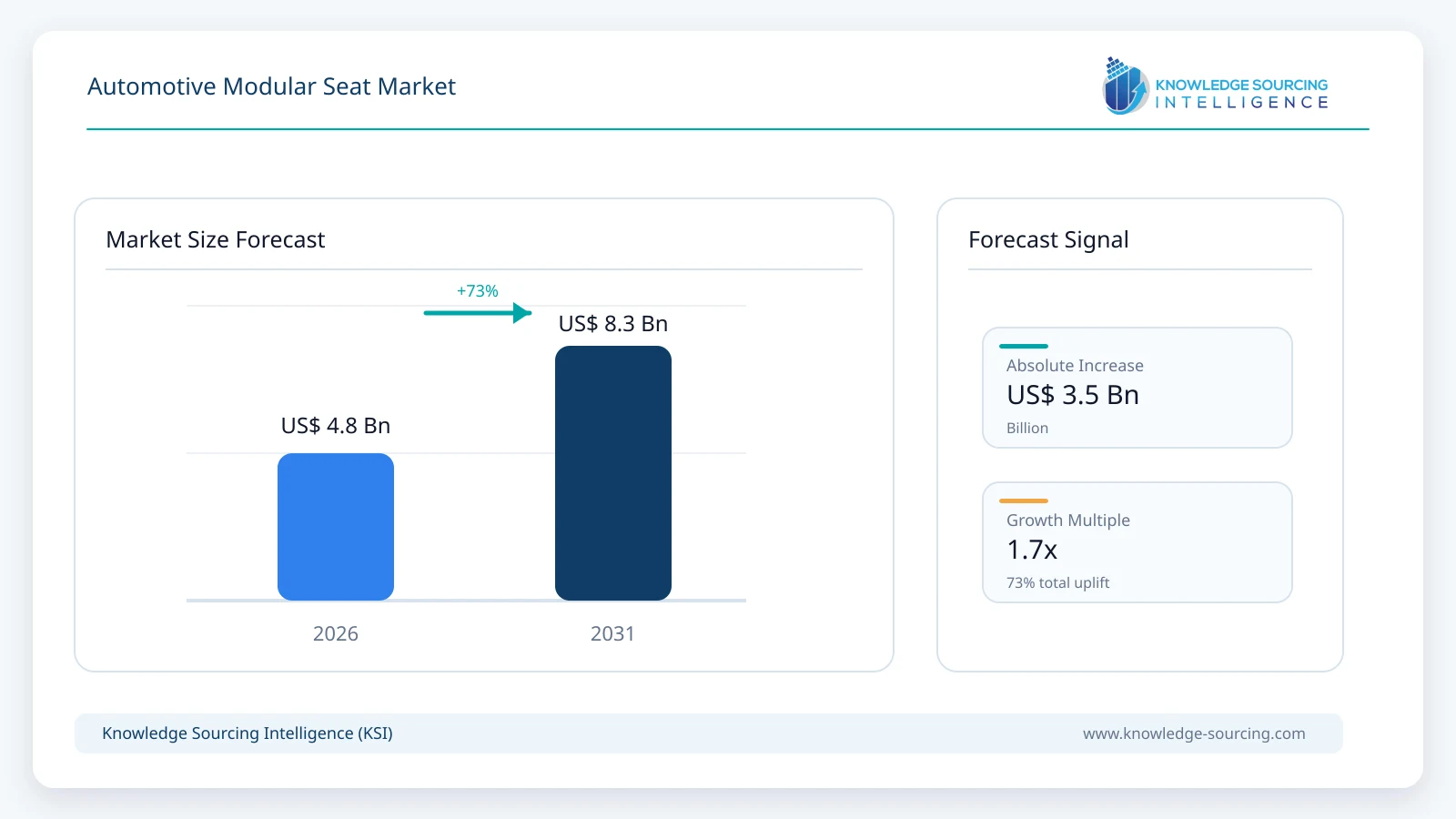
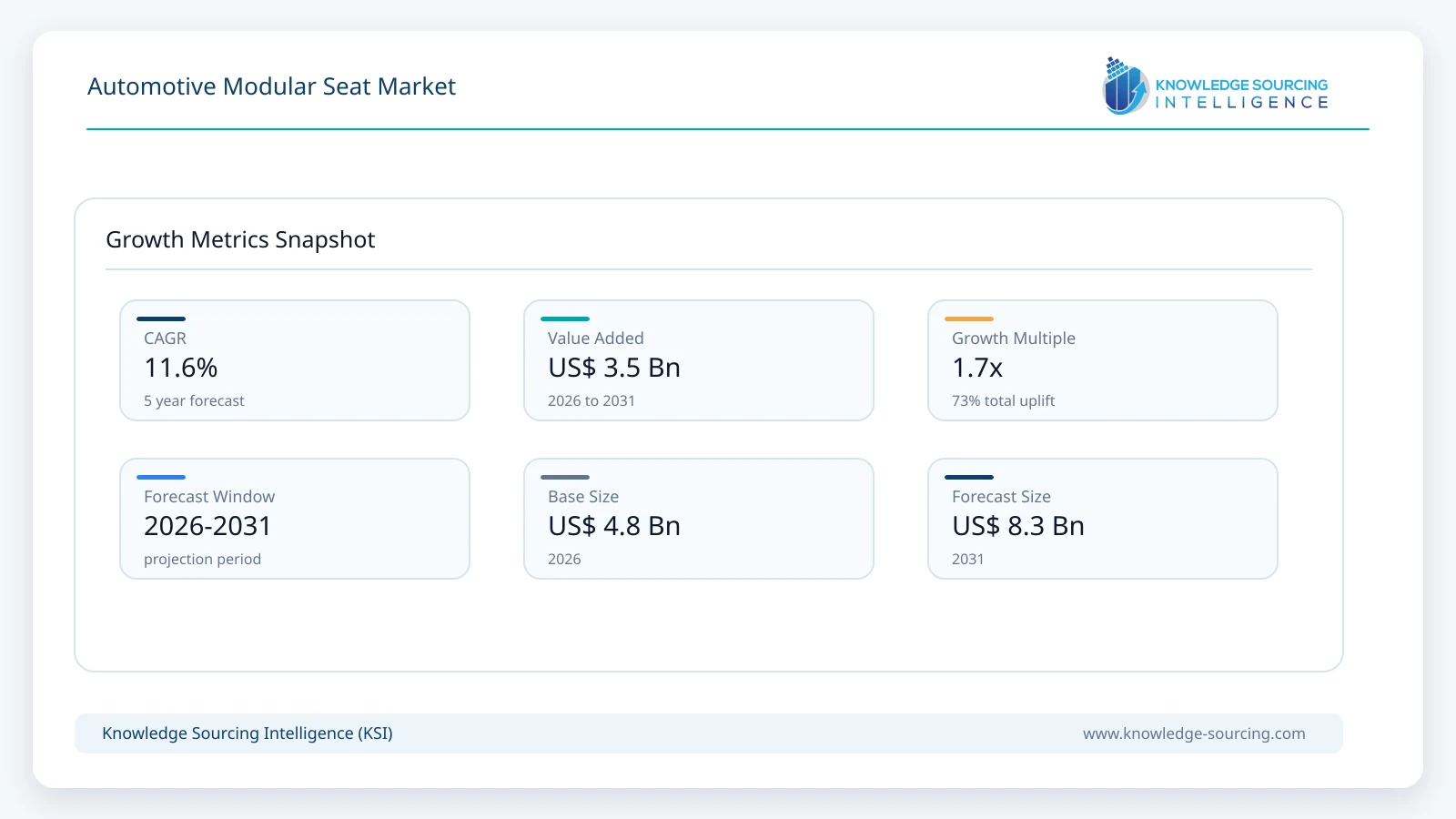
The automotive modular seat market is forecast to grow at a CAGR of 11.6%, reaching approximately USD 8.30 billion in 2031 from USD 4.80 billion in 2026.
Highlights:
- 1Structural and frame modules account for approximately 38% of global market value in 2026, reflecting the importance of standardized seat frames, tracks, recliners and scalable mechanisms across multiple vehicle platforms.
- 2Front-row applications represent approximately 62% of market value in 2026 because modular structures and comfort subassemblies are adopted earlier in driver and front-passenger seats.
- 3Passenger cars account for approximately 88% of global market value in 2026, supported by high production volumes and increasing use of modular seating across sedans, SUVs, crossovers, MPVs and electric vehicles.
- 4Mid-range vehicles represent approximately 46% of market value in 2026 as modularity allows automakers to share seat architectures while varying comfort content and trim specifications across larger-volume programs.
- 5Internal-combustion vehicles represent approximately 54% of market value in 2026, although battery electric vehicles are gaining share as flat-floor architectures and flexible cabins increase demand for reconfigurable seating.
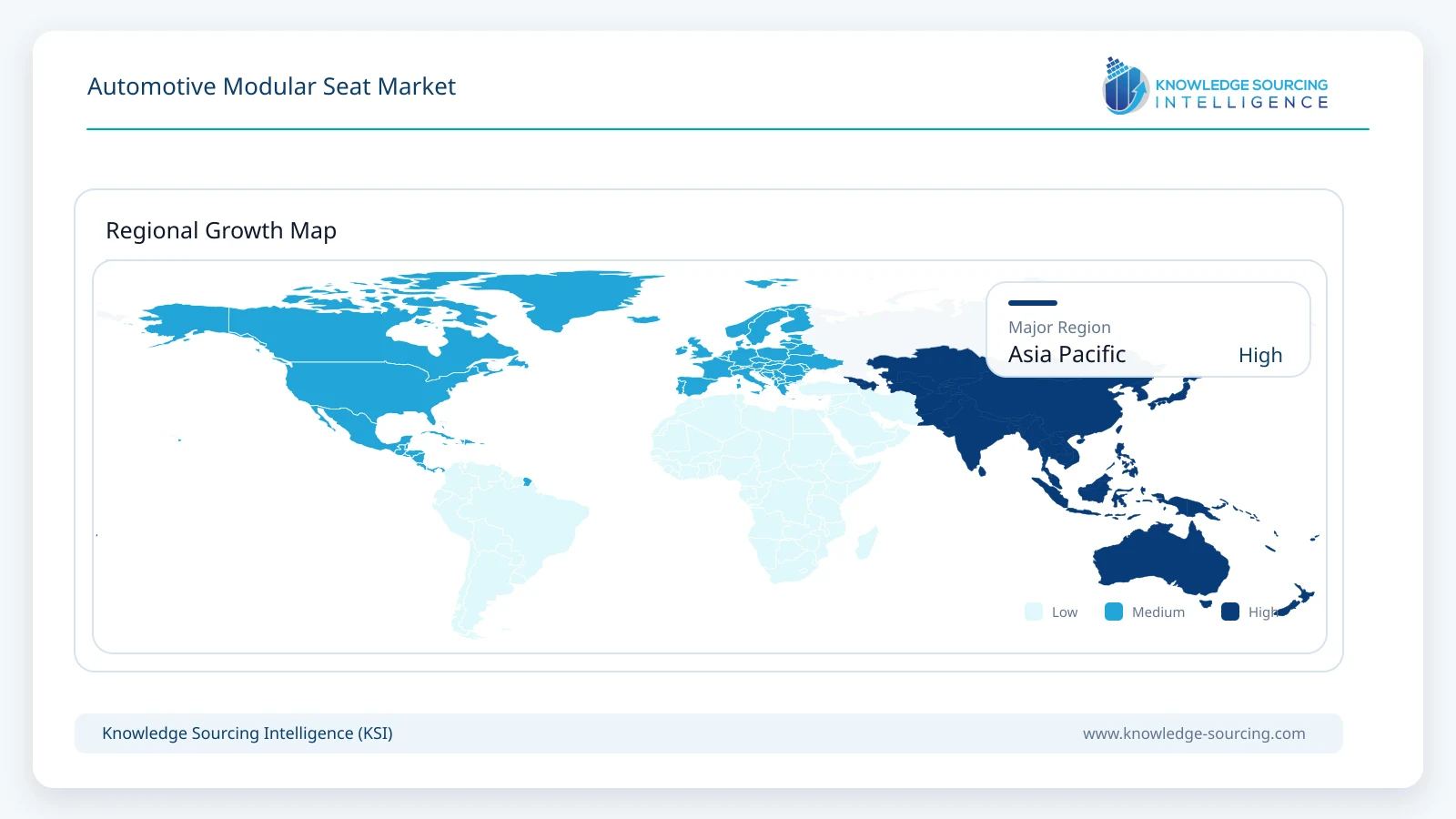
- 6Asia Pacific represents approximately 47% of global market value in 2026, supported by large vehicle-production volumes, rapid EV adoption and strong commercialization of modular and flexible seat architectures in China, Japan and South Korea.
The market covers automotive seat systems and directly integrated seat modules designed around standardized, scalable or interchangeable architectures that enable component sharing, configurable features, simplified assembly or flexible seat layouts across multiple vehicle programs.
Modularity is being applied across several layers of the seat. Structural platforms increasingly use scalable frames, tracks and mechanisms that can support multiple actuation levels. Comfort functions such as heating, ventilation, lumbar support and massage are moving toward plug-and-play modules. Reconfigurable systems use long rails, swivels, foldable structures and removable components to support different passenger, cargo and mobility scenarios.
Commercial activity is accelerating. Adient has introduced both ModuGo, a modular customizable seat architecture, and ModuTec, a modular manufacturing approach intended to simplify seat assembly and improve automation. Magna is advancing flexible seating around reusable building blocks including long rails, rotating bases and adaptive support mechanisms. Toyota Boshoku, Hyundai Transys, Lear, FORVIA and Yanfeng are also developing modular seat structures, subassemblies or configurable seating platforms.
Market Overview
Automotive modular seating uses common seat platforms and standardized interfaces to reduce engineering duplication while maintaining flexibility for different vehicle configurations. A modular architecture can allow automakers to change comfort content, trim, actuation, structural features or seat layout without redesigning the entire seat system.
Adient's ModuGo illustrates product-level modularity. Built around a lightweight base and frame, the architecture can be customized through structural zoning, material choices and smart features such as heating, ventilation and massage. Adient's ModuTec extends modularity into manufacturing by assembling seat modules offline and sequencing them into the main just-in-time line, supporting faster assembly and greater automation.
Magna is applying modularity to flexible vehicle interiors. Its Flexible Seating System uses common building blocks including long-travel rails, rotating bases and adaptive support mechanisms that can be configured differently across use cases and vehicle architectures. The company also has a production award for a reconfigurable seating system in China using rotating front seats and long rails.
Other major seating suppliers are developing similar strategies. FORVIA offers a Global and Modular front-seat frame designed for multiple vehicle segments and actuation levels, along with scalable rear-seat structures. Lear markets complete seats with patented modular subassemblies. Yanfeng offers modular seat frames across vehicle types and platforms, while Hyundai Transys and Toyota Boshoku have developed modular seat concepts for purpose-built and next-generation mobility.
Market Trends
Modular Manufacturing Is Reducing Seat Assembly Complexity
Seat manufacturing is becoming an important area for modularization because complete seats contain numerous structures, mechanisms, comfort systems, electronics and trim variants. Adient's ModuTec approach separates module build from final just-in-time sequencing, reducing the time required on the main assembly line and creating greater scope for automation.
This approach is particularly relevant as OEMs increase the number of seat variants offered within a single vehicle program. Modular manufacturing can simplify subassembly handling, improve serviceability and allow selected features to be added without disrupting the entire seat-production flow.
Cross-Platform Seat Structures Are Expanding
Seat suppliers are increasingly designing common structures that can serve multiple vehicle classes, regions and actuation levels. FORVIA's Global and Modular G&M2 front-seat structure is designed for global platforms and can support different kinematics as well as manual or powered adjustment with a reduced parts count.
Yanfeng also offers a modular frame designed for cross-vehicle types and platforms, while Hyundai Transys has developed standardized modular seat frames by vehicle class. Cross-platform structures can reduce tooling duplication and improve scale economics while preserving the ability to customize comfort and surface features.
Flexible Interiors Are Increasing Reconfigurable Seat Demand
Electric vehicles, autonomous-driving concepts and purpose-built vehicles are increasing interest in seats that can move, rotate, fold or be removed to support changing passenger and cargo requirements. Magna's reconfigurable seating uses long rails and rotating seats, while Hyundai Transys's PBV modular seat allows components to be detached or replaced for different mobility scenarios.
Yanfeng's XiM27 extends this trend into a production-ready smart-cabin platform with highly modular layouts, full-length floor rails and seating configurations that can shift between driving, lounge, sleep and cargo scenarios.
Interchangeable Comfort Modules Are Increasing Customization
Modular seating is also expanding at the comfort-system level. Heating, ventilation, lumbar support, massage and thermal technologies can increasingly be added as discrete subassemblies rather than requiring a unique complete-seat design. Lear has highlighted patented modular subassemblies in its complete-seat portfolio and has expanded modular thermal comfort systems across premium OEM programs.
This enables automakers to create multiple trim grades from a common structural platform while reducing development time and improving feature scalability across global vehicle programs.
Purpose-Built Vehicles Are Creating New Modular Use Cases
Purpose-built vehicles require interiors that can change between passenger transport, delivery, accessibility and other commercial functions. Hyundai Transys's modular PBV seat is designed so components including the headrest, armrest and cushion can be detached or replaced, allowing the cabin to be reconfigured around different users and cargo requirements.
This application broadens modular seating beyond premium passenger cars. Shared mobility, commercial vans, autonomous shuttles and multi-purpose EV platforms can benefit from easier seat removal, replacement, maintenance and configuration.
Segment Analysis
By Modular System Type: Structural and Frame Modules
Structural and frame modules are projected to reach approximately USD 2.82 billion by 2031. Standardized frames, tracks, recliners, latches and mounting interfaces form the foundation of modular seating because they allow multiple seat variants to be developed around common mechanical architecture. Growth is supported by cross-platform standardization, reduced part counts and increased use of scalable structures that can support both manual and powered functions.
By Seat Position: Front Row
Front-row modular seating is projected to reach approximately USD 4.81 billion by 2031. Driver and front-passenger seats carry the highest concentration of powered adjustment, electronics and comfort modules, making them the primary location for modular subassemblies. Modular front-seat structures also allow OEMs to vary specifications across trim levels without changing the underlying platform.
By Vehicle Type: Passenger Cars
Passenger cars are projected to generate approximately USD 7.14 billion of modular-seat market value by 2031. Large global production volumes, platform sharing and increasing differentiation by trim make passenger vehicles well suited to modular seat architectures. SUVs, crossovers, MPVs and electric vehicles provide additional demand for flexible seat layouts and reconfigurable second- and third-row systems.
By Vehicle Class: Mid-Range Vehicles
Mid-range vehicles are projected to account for approximately USD 3.65 billion of modular-seat market value by 2031. This segment benefits strongly from common seat platforms because manufacturers need to balance cost with increasing consumer expectations for powered adjustment, heating, ventilation and flexible cabin features. Modular architectures allow feature differentiation without creating a completely separate seat system for each trim.
By Propulsion: Battery Electric Vehicles
Battery electric vehicles are projected to generate approximately USD 3.32 billion of modular-seat market value by 2031. Flat-floor packaging, centralized electronics and flexible cabin layouts make EV platforms particularly suitable for long rails, swivels, removable modules and scalable comfort systems. The IEA expects electric vehicles to represent an increasing share of global car sales through the forecast period, supporting broader deployment of modular seating.
By Geography: Asia Pacific
Asia Pacific is projected to reach approximately USD 4.23 billion by 2031. The region combines the world's largest vehicle-production base with rapid EV adoption and strong activity in modular and reconfigurable seating. China is the principal growth engine, while Japan and South Korea contribute established seat manufacturers and engineering capabilities.
Market Drivers
Need for Faster Vehicle-Program Development
Automakers are seeking to shorten development cycles while offering more vehicle variants. Common modular seat platforms allow structures and subassemblies to be reused across programs, reducing the need to engineer each seating system from the ground up.
Increasing Vehicle Customization
Consumers increasingly expect different comfort, trim and technology levels within the same model range. Modular seats allow automakers to vary materials, support systems, thermal functions and other features while retaining common structural architecture.
Growth of Electric and Flexible Cabin Architectures
Electric platforms provide greater freedom in floor design and cabin packaging, supporting long rails, swivels and flexible seat layouts. These architectures increase the value of modular seating systems that can be adapted to different passenger, cargo and relaxation scenarios.
Manufacturing Automation and Cost Efficiency
Modular subassemblies can simplify production sequencing and enable greater automation. Building selected modules offline and integrating them later in the assembly process can reduce line complexity and improve consistency across high-variant seat programs.
Expansion of Purpose-Built and Multi-Use Vehicles
PBVs, autonomous shuttles and commercial EVs require interiors that can be adapted to different operating modes. Modular seats support easier removal, replacement, reconfiguration and service, increasing their relevance in mobility platforms where cabin function may change frequently.
Market Restraints
Interface and Standardization Challenges
Seat modules must maintain consistent mechanical, electrical and safety interfaces across multiple vehicle platforms. Differences in floor structures, electrical architectures and restraint requirements can limit the degree of standardization that is practical.
Safety Validation Complexity
Modular frames, removable components and reconfigurable mechanisms must meet crash, seat-belt anchorage and structural requirements across every approved configuration. Validation becomes more complex as seats gain greater movement and interchangeability.
Packaging and Weight Trade-Offs
Additional rails, interfaces, swivels and modular connection points can increase packaging requirements or system mass. Suppliers must balance flexibility with lightweighting targets and available cabin space.
Upfront Engineering and Tooling Investment
Developing a modular platform can require significant initial engineering effort because the architecture must support multiple future variants. The economic benefit is strongest when common modules can be deployed across sufficiently large vehicle volumes.
Complex Supplier Coordination
Seat modularity often requires closer coordination between structures, comfort systems, electronics, trim and final assembly. Poorly defined module interfaces can shift complexity upstream rather than eliminating it, increasing integration risk for OEMs and Tier-1 suppliers.
Regional Outlook
Asia Pacific
Asia Pacific is the largest regional market and is expected to remain the strongest growth centre through 2031. China is driving commercialization through rapid EV development, flexible-cabin concepts and strong competition around interior features. Magna's reconfigurable seating production award, Yanfeng's modular smart-cabin layouts, Adient's ModuGo activity and Toyota Boshoku's Future Creation Modular Seat illustrate the region's broad supplier investment.
Japan and South Korea add established seating engineering capabilities through companies including Toyota Boshoku and Hyundai Transys. The region also benefits from high vehicle-production scale, growing PBV activity and increasing adoption of standardized platforms that support multiple body styles and trim levels.
Europe
Europe is a major modular-seat market because premium OEMs and global platform strategies create strong demand for scalable seat structures, configurable comfort modules and lightweight architectures. FORVIA's Global and Modular G&M2 frame and Lear's modular subassemblies reflect the region's emphasis on sharing core seat systems while preserving brand-specific comfort and design.
Electrification and stricter efficiency requirements are also encouraging lighter and more flexible interiors. European vehicle programs increasingly require seat platforms that can support different powertrains, actuation levels and safety specifications without multiplying tooling and engineering cost.
Competitive Landscape
The automotive modular seat market is led by seat manufacturers with capabilities across complete seats, structures, mechanisms, comfort systems and final assembly. Adient, Magna, Lear, FORVIA, Toyota Boshoku, Hyundai Transys and Yanfeng are directly involved in modular seat platforms, scalable frames, modular subassemblies or flexible reconfigurable seating systems.
Adient is building a broad modular strategy through ModuGo and ModuTec, covering both product customization and manufacturing efficiency. Magna combines reusable seating building blocks with reconfigurable long-rail and swivel technologies. Lear develops modular structures and patented subassemblies within complete-seat programs, while FORVIA offers global modular front-seat frames and scalable rear-seat structures.
Toyota Boshoku and Hyundai Transys are developing modular seats for future mobility and PBV applications, where interchangeable components and flexible layouts provide greater value. Yanfeng combines modular frame technology with smart-cabin integration, using long floor rails and adaptable seating configurations to support multiple interior scenarios.
Recent Developments
July 2026: Lear reported new and conquest seating awards with Audi covering complete seats and modular comfort systems in Europe and North America, reinforcing the company's use of modular seat subassemblies across premium programs.
June 2026: Yanfeng unveiled XiM27, a production-ready smart-cabin platform with highly modular seat layouts, full-length floor rails and configurations that can shift between lounge, sleep, passenger and cargo modes.
June 2026: Magna detailed its Flexible Seating System as a modular foundation using reusable building blocks including long-travel rails, rotating bases and adaptive support mechanisms that can be configured across vehicle architectures.
January 2026: Adient announced ModuTec, a modular seat design and manufacturing solution that builds seat modules offline before sequencing them into the main just-in-time assembly line.
November 2025: Hyundai Transys detailed its award-winning modular PBV seat, which allows components including the headrest, armrest and cushion to be detached or replaced for different passenger and cargo configurations.
August 2025: Adient introduced the ModuGo seat, using a modular architecture to support structural customization, material choices and smart features including heating, ventilation and massage.
April 2025: Toyota Boshoku announced its Future Creation Modular Seat for Auto Shanghai 2025, featuring a modular structure that can switch between advanced, relaxed and sporty configurations.
Market Outlook
The automotive modular seat market is expected to expand steadily through 2031 as seat suppliers shift from one-off vehicle architectures toward standardized platforms, interchangeable subassemblies and flexible interior systems. Structural and frame modules will remain an important revenue base, while reconfigurable seating and modular comfort systems are expected to gain importance as EV and PBV platforms expand.
The strongest commercial value will come from architectures that reduce program complexity without limiting brand differentiation. Seat suppliers able to combine common frames, configurable comfort features, scalable electronics and flexible movement systems will be better positioned to serve global OEM platforms with fewer unique components.
Asia Pacific is expected to lead market growth, while Europe remains an important centre for global platform engineering and premium seat content. Competition will increasingly focus on platform scalability, assembly efficiency, part-count reduction, lightweighting, safety validation and the ability to deploy common modules across multiple vehicle classes.
Automotive Modular Seat Market Scope
| Report Metric | Details |
|---|---|
| Total Market Size in 2026 | USD 4.80 billion |
| Total Market Size in 2031 | USD 8.30 billion |
| Forecast Unit | Billion |
| Growth Rate | 11.6% |
| Study Period | 2021 to 2031 |
| Historical Data | 2021 to 2024 |
| Base Year | 2025 |
| Forecast Period | 2026 – 2031 |
| Segmentation | Modular System Type, Seat Position, Vehicle Type, Vehicle Class, Propulsion, Geography |
| Companies |
|
Market Segmentation
By Modular System Type
Structural and Frame Modules
Comfort and Functional Modules
Reconfigurable Seating Modules
Electronics and Interface Modules
By Seat Position
Front Row
Rear and Second Row
By Vehicle Type
Passenger Cars
Light Commercial Vehicles
Medium and Heavy Commercial Vehicles
By Vehicle Class
Entry-Level Vehicles
Mid-Range Vehicles
Premium and Luxury Vehicles
By Propulsion
Internal Combustion Engine Vehicles
Hybrid Electric Vehicles
Battery Electric Vehicles
By Geography
North America
United States
Canada
Mexico
South America
Brazil
Argentina
Others
Europe
Germany
United Kingdom
France
Italy
Spain
Others
Middle East and Africa
Saudi Arabia
UAE
South Africa
Others
Asia Pacific
China
Japan
South Korea
India
Indonesia
Thailand
Others
Table of Contents
1. INTRODUCTION
1.1. Market Overview
1.2. Market Definition
1.3. Scope of the Study
1.4. Market Segmentation
1.5. Currency
1.6. Assumptions
1.7. Base and Forecast Years
1.8. Key Benefits to Stakeholders
2. RESEARCH METHODOLOGY
2.1. Research Design
2.2. Secondary Research
2.3. Primary Research
2.4. Market Estimation
2.5. Segment Modelling
2.6. Data Triangulation and Validation
3. EXECUTIVE SUMMARY
3.1. Key Findings
3.2. Automotive Modular Seat Market Size, 2026-2031
3.3. Modular System Type Outlook
3.4. Seat Position Outlook
3.5. Vehicle Type Outlook
3.6. Vehicle Class Outlook
3.7. Propulsion Outlook
3.8. Regional Opportunity Summary
4. MARKET DYNAMICS
4.1. Market Drivers
4.1.1. Need for Faster Vehicle-Program Development
4.1.2. Increasing Vehicle Customization
4.1.3. Growth of Electric and Flexible Cabin Architectures
4.1.4. Manufacturing Automation and Cost Efficiency
4.1.5. Expansion of Purpose-Built and Multi-Use Vehicles
4.2. Market Restraints
4.2.1. Interface and Standardization Challenges
4.2.2. Safety Validation Complexity
4.2.3. Packaging and Weight Trade-Offs
4.2.4. Upfront Engineering and Tooling Investment
4.2.5. Complex Supplier Coordination
4.3. Market Opportunities
4.4. Porter's Five Forces Analysis
4.5. Industry Value Chain Analysis
4.6. Modular Seat Platform Economics
4.7. Safety and Regulatory Environment
5. TECHNOLOGY OUTLOOK
5.1. Modular Seat Frames
5.2. Standardized Tracks and Recliners
5.3. Plug-and-Play Comfort Modules
5.4. Modular Electronic Interfaces
5.5. Long-Rail and Swivel Systems
5.6. Removable and Replaceable Seat Modules
5.7. Modular Rear-Seat Structures
5.8. Reconfigurable PBV Seating
5.9. Lightweight and Recyclable Modular Architectures
6. AUTOMOTIVE MODULAR SEAT MARKET BY MODULAR SYSTEM TYPE
6.1. Introduction
6.2. Structural and Frame Modules
6.3. Comfort and Functional Modules
6.4. Reconfigurable Seating Modules
6.5. Electronics and Interface Modules
7. AUTOMOTIVE MODULAR SEAT MARKET BY SEAT POSITION
7.1. Introduction
7.2. Front Row
7.3. Rear and Second Row
8. AUTOMOTIVE MODULAR SEAT MARKET BY VEHICLE TYPE
8.1. Introduction
8.2. Passenger Cars
8.3. Light Commercial Vehicles
8.4. Medium and Heavy Commercial Vehicles
9. AUTOMOTIVE MODULAR SEAT MARKET BY VEHICLE CLASS
9.1. Introduction
9.2. Entry-Level Vehicles
9.3. Mid-Range Vehicles
9.4. Premium and Luxury Vehicles
10. AUTOMOTIVE MODULAR SEAT MARKET BY PROPULSION
10.1. Introduction
10.2. Internal Combustion Engine Vehicles
10.3. Hybrid Electric Vehicles
10.4. Battery Electric Vehicles
11. AUTOMOTIVE MODULAR SEAT MARKET BY GEOGRAPHY
11.1. North America
11.1.1. United States
11.1.2. Canada
11.1.3. Mexico
11.2. South America
11.2.1. Brazil
11.2.2. Argentina
11.2.3. Others
11.3. Europe
11.3.1. Germany
11.3.2. United Kingdom
11.3.3. France
11.3.4. Italy
11.3.5. Spain
11.3.6. Others
11.4. Middle East and Africa
11.4.1. Saudi Arabia
11.4.2. UAE
11.4.3. South Africa
11.4.4. Others
11.5. Asia Pacific
11.5.1. China
11.5.2. Japan
11.5.3. South Korea
11.5.4. India
11.5.5. Indonesia
11.5.6. Thailand
11.5.7. Others
12. COMPETITIVE ENVIRONMENT AND ANALYSIS
12.1. Major Players and Strategy Analysis
12.2. Market Share Analysis
12.3. Product and Technology Benchmarking
12.4. Mergers, Acquisitions, Agreements, and Collaborations
12.5. Competitive Dashboard
13. COMPANY PROFILES
13.1. Adient plc
13.2. Magna International Inc.
13.3. Lear Corporation
13.4. FORVIA
13.5. Toyota Boshoku Corporation
13.6. Hyundai Transys Inc.
13.7. Yanfeng
14. APPENDIX
14.1. Currency
14.2. Assumptions
14.3. Base and Forecast Years Timeline
14.4. Key Benefits for Stakeholders
14.5. Research Methodology
14.6. Abbreviations
14.7. Data Sources
Navigate
Trusted by the world's leading organizations











