
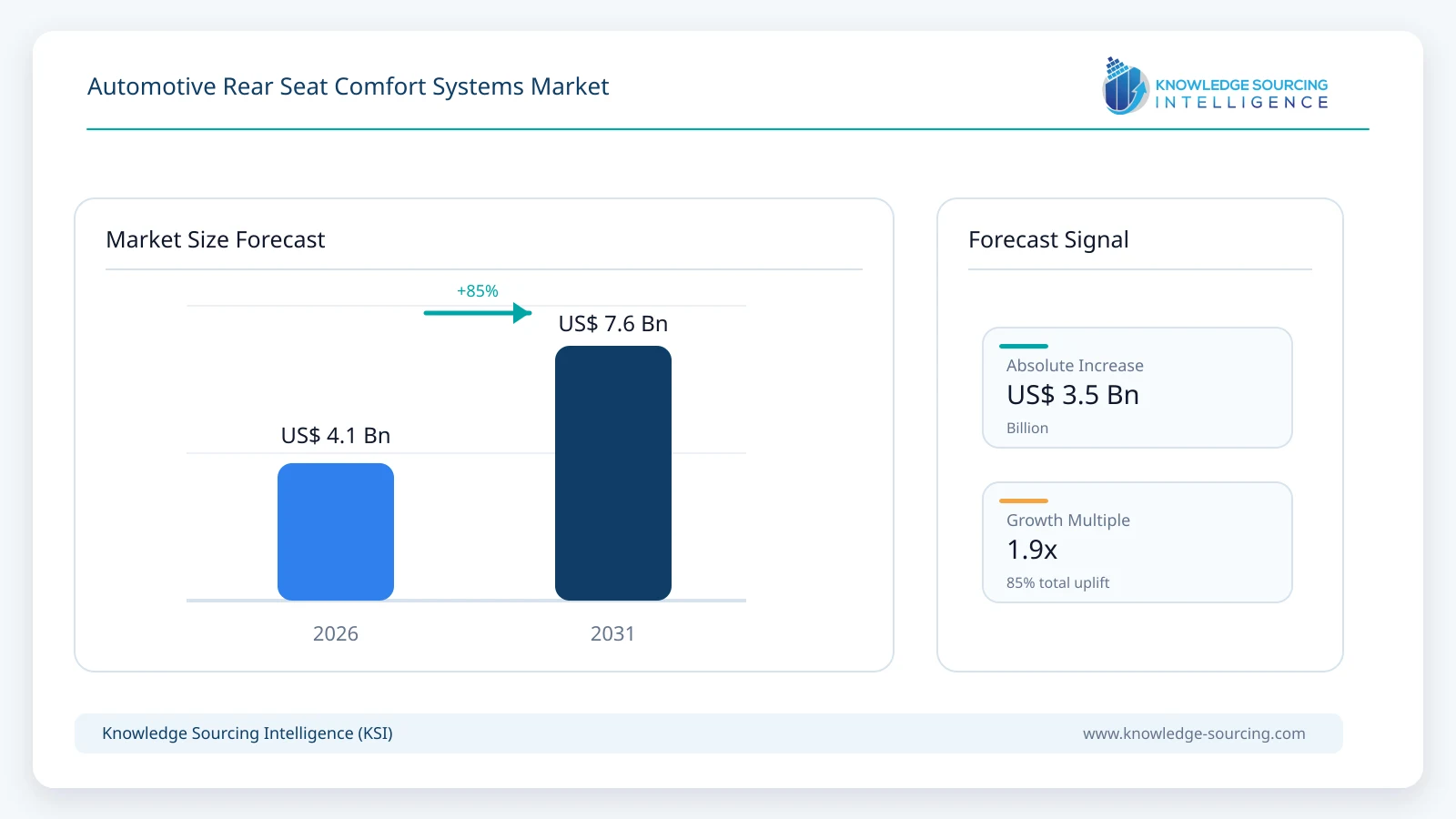
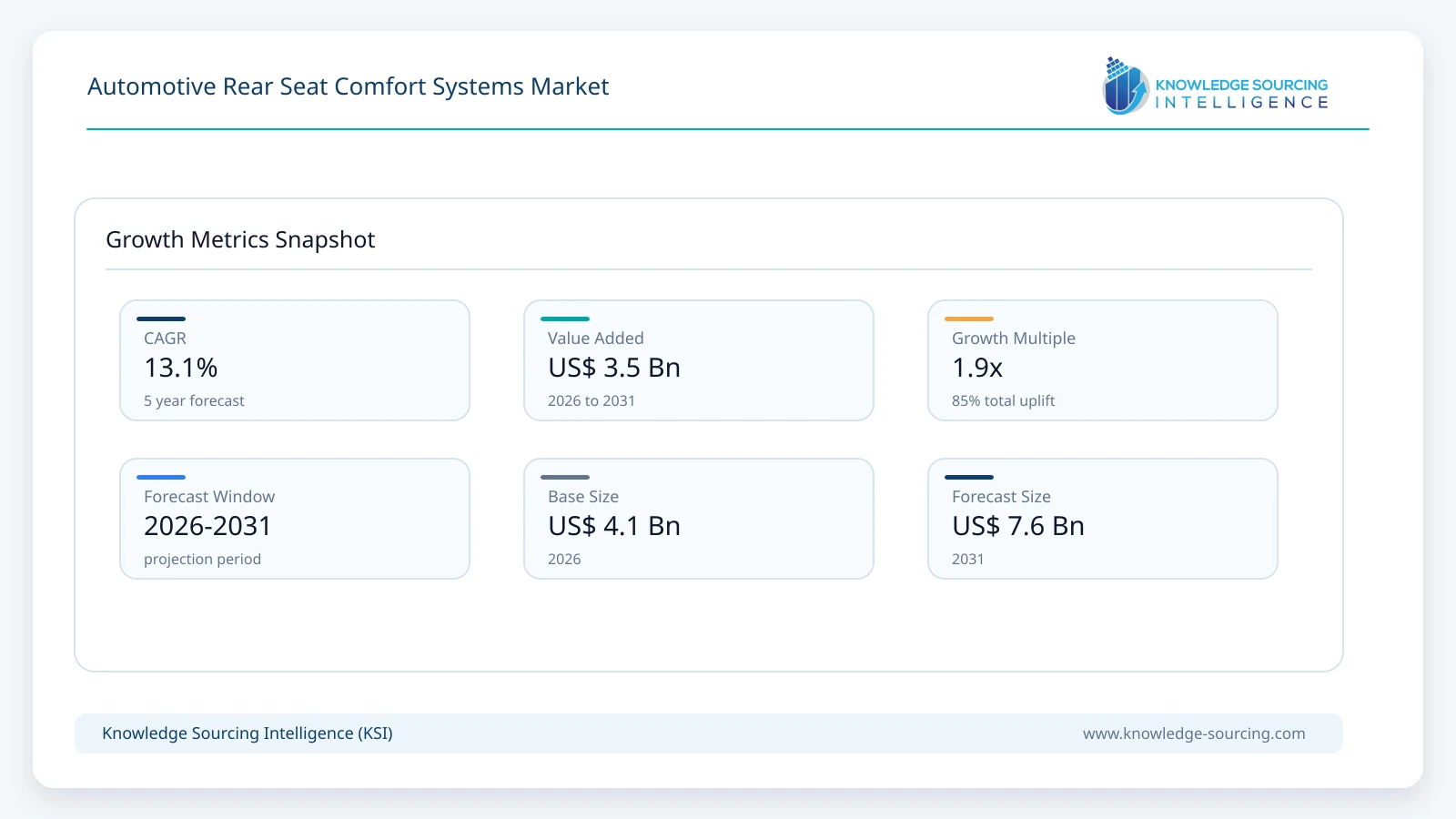
The automotive rear seat comfort systems market is forecast to grow at a CAGR of 13.1%, reaching approximately USD 7.60 billion in 2031 from USD 4.10 billion in 2026.
Highlights:
- 1Powered recline, leg support and positioning systems account for approximately 31% of global market value in 2026, reflecting strong demand for executive-style rear seating, ottomans and multi-position adjustment.
- 2Second-row applications represent approximately 86% of market value in 2026 because advanced comfort functions are concentrated primarily in captain chairs, executive lounge seats and premium rear benches.
- 3Passenger cars account for approximately 97% of global market value in 2026, led by premium sedans, SUVs, crossovers and MPVs with factory-integrated rear comfort packages.
- 4Internal-combustion vehicles represent approximately 50% of market value in 2026, while battery electric vehicles are increasing their contribution as flat-floor layouts and premium cabin features expand.
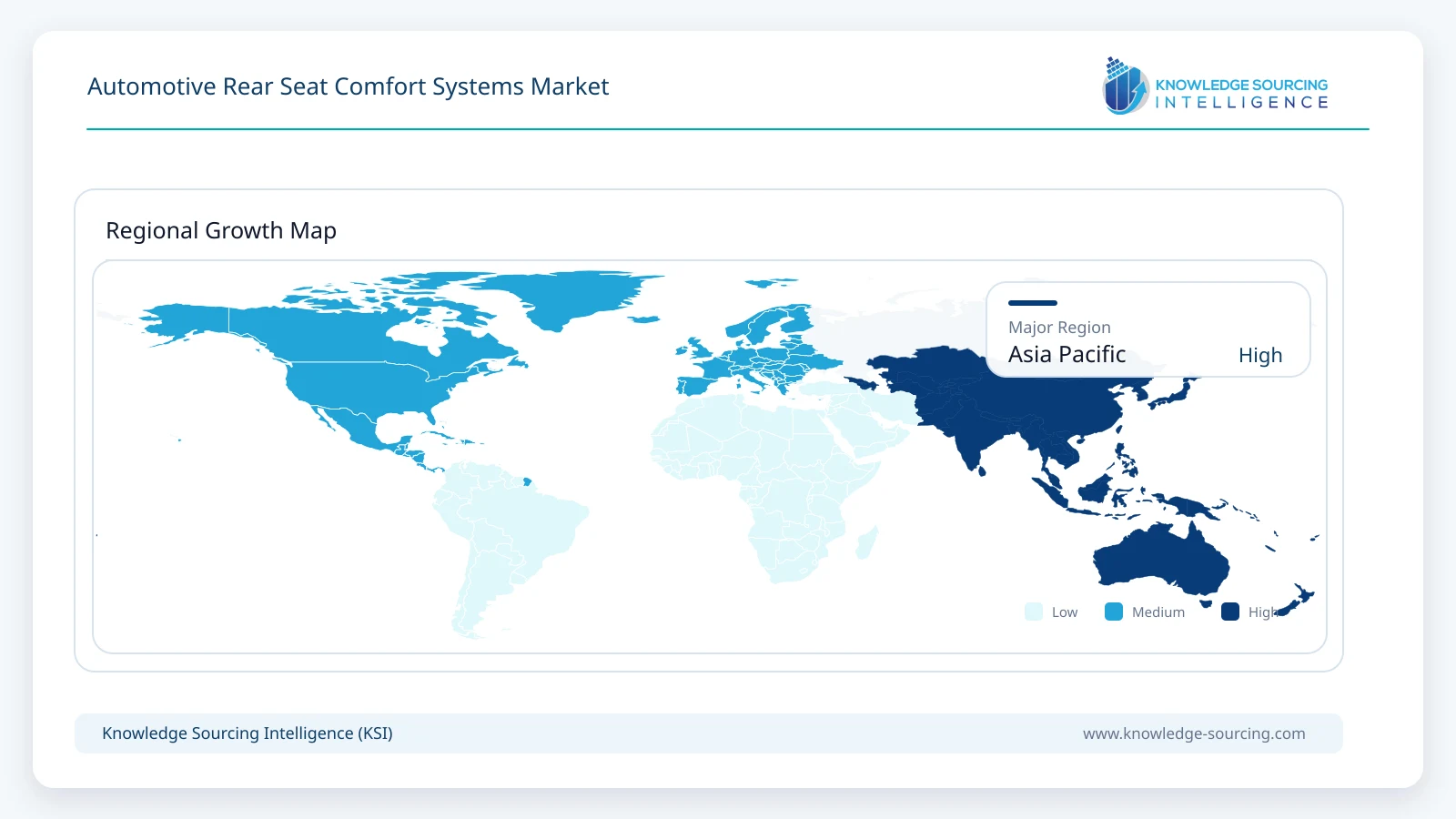
- 5Asia Pacific represents approximately 47% of global market value in 2026, supported by rapid commercialization of second-row lounge, massage, zero-gravity and reconfigurable seating in China, Japan and South Korea.
Demand is being driven by increasing use of powered recline, ottomans and leg rests, localized heating and ventilation, massage, adaptive support and lounge-oriented rear seating across premium sedans, SUVs, MPVs and higher-content electric vehicles.
Second-row seating is becoming a major area of cabin differentiation. Toyota Boshoku supplies executive lounge seats with automatic slide, recline, footrest, heating and ventilation functions; Hyundai Transys combines one-touch relax modes, leg rests, massage and personalized rear-seat comfort; FORVIA has developed second-row zero-gravity Captain Chairs and production massage applications; and Adient is extending rear comfort into mechanical massage and foot-relaxation systems.
Third-row comfort is also improving as suppliers develop deeper recline, better support, linked ottomans and more flexible seat movement within limited cabin space. Reconfigurable and software-controlled seating platforms are expanding the range of comfort functions that can be offered beyond traditional luxury sedans and into SUVs, electric MPVs and multi-purpose vehicles.
Market Overview
Rear seat comfort systems encompass the integrated hardware and control functions used to improve passenger support, posture, temperature management and relaxation in the second and third rows. Core functions include powered recline, long-slide adjustment, ottomans and leg rests, seat heating and ventilation, lumbar support, massage, headrest adjustment and increasingly software-coordinated comfort modes.
Executive lounge seating remains an important reference architecture. Toyota Boshoku's executive lounge seats combine automatic sliding, reclining and footrest functionality with thermal comfort and ventilation. FORVIA has developed second-row zero-gravity Captain Chairs for premium customers, while Magna's ZG Lounger and long-rail technologies support deep relaxation and flexible cabin configurations.
Massage is adding a stronger wellness component to rear seating. Hyundai Transys's Dynamic Body Care system combines tapping and vibration for second-row passengers, Adient's ProForce Massage Flow supports rear-seat integration, and FORVIA's Zen Massage program for IM Motors can be installed in the second-row right-hand position. Adient has also moved foot massage into production on NIO's ES9 through its StepJoy system.
The technology mix is becoming increasingly integrated. Thermal comfort can operate alongside massage and powered positioning, while electronic controllers coordinate recline, ottomans, headrests and personalized comfort modes. Electric platforms are accelerating this development by creating flatter cabin floors and greater flexibility for long rails, lounge positions and multi-purpose rear seating.
Market Trends
Second-Row Lounge Seating Is Becoming a Key Premium Differentiator
The rear cabin is increasingly being designed around individual captain chairs and executive lounge seats rather than conventional fixed benches. Powered slide, deep recline, ottomans, winged headrests and one-touch relaxation modes allow second-row passengers to adopt more supportive positions during long journeys.
Toyota Boshoku's executive lounge seats and Hyundai Transys's second-row relaxation systems illustrate this direction. The trend is particularly visible in large SUVs and MPVs where packaging space allows automakers to offer airline-style comfort without materially reducing passenger capacity.
Zero-Gravity and Deep-Recline Functions Are Expanding
Zero-gravity seating is moving from concept displays toward production-oriented programs. FORVIA's Luxeed seating project includes zero-gravity chairs that recline close to horizontal, while Magna offers scalable zero-gravity and long-rail mechanisms designed to support relaxation and reconfiguration.
These systems increase the value of rear-seat actuation because they require coordinated movement of the backrest, cushion, leg rest and often the entire seat base. Safety integration also becomes more important as occupants use deeper recline angles.
Massage and Foot-Comfort Functions Are Broadening Rear Wellness
Rear-seat massage is becoming more sophisticated as pneumatic systems are supplemented by mechanical, tapping and vibration technologies. Hyundai Transys's Dynamic Body Care system was developed specifically for second-row passengers, while FORVIA and Adient are commercializing stronger mechanical massage solutions for premium seating.
Foot comfort is also becoming a dedicated feature. Adient's StepJoy combines cam-based foot massage with a stowable footrest and optional heating, extending comfort beyond the traditional lumbar and backrest zones.
Thermal Comfort Is Expanding into Rear Seating
Heated rear seats are increasingly complemented by ventilation and more localized temperature control. Toyota Boshoku has integrated heating and ventilation into executive lounge seats, and rear ventilation has expanded into premium SUV applications. The combination of thermal comfort with massage and reclining functions is creating more complete rear passenger packages.
Localized rear-seat conditioning is particularly relevant to electric vehicles because direct occupant heating and cooling can improve perceived comfort without relying entirely on whole-cabin HVAC output.
Flexible Second- and Third-Row Architectures Are Increasing
Rear seating is becoming more configurable as suppliers combine long rails, swivels, flat-bed modes and foldable structures. Yanfeng's XiM27 can transform its second row into a flat bed and convert the third row between cargo and lounge modes. Magna's flexible seating platform similarly uses common long-rail, rotating and support mechanisms to support different passenger scenarios.
This shift increases the importance of rear comfort systems that can function across multiple positions rather than only in a single fixed seating posture.
Segment Analysis
By Comfort Function: Powered Recline, Leg Support and Positioning
Powered recline, leg support and positioning systems are projected to reach approximately USD 2.17 billion by 2031. Growth is supported by increasing use of executive lounge seats, ottomans, long-slide mechanisms and one-touch relaxation modes in premium sedans, SUVs and MPVs. The function is becoming particularly important in second-row captain-chair layouts where seating position forms the foundation for massage, thermal comfort and entertainment use.
By Seat Row: Second Row
Second-row comfort systems are projected to reach approximately USD 6.23 billion by 2031. This row receives the highest concentration of powered recline, ottoman, massage, heating, ventilation and personalized control functions, particularly in premium SUVs, executive sedans and large MPVs. Increasing use of individual captain chairs is further increasing rear-seat system value and feature integration.
By Vehicle Type: Passenger Cars
Passenger cars are projected to generate approximately USD 7.30 billion of rear-seat comfort system market value by 2031. Premium sedans, SUVs, crossovers and MPVs provide the largest addressable base because automakers use rear comfort as a visible differentiator for family, chauffeur and long-distance travel applications.
By Propulsion: Battery Electric Vehicles
Battery electric vehicles are projected to generate approximately USD 3.12 billion of rear-seat comfort system market value by 2031. Electric platforms support flatter floors, longer seat travel and greater freedom for lounge-style configurations, while premium EV makers increasingly emphasize second-row experience, thermal comfort and zero-gravity seating.
By Geography: Asia Pacific
Asia Pacific is projected to reach approximately USD 3.95 billion by 2031. China is the principal growth engine because domestic automakers are rapidly adding zero-gravity seating, rear massage, executive second-row layouts and software-controlled comfort to premium EVs and MPVs. Japan and South Korea add established expertise through major automotive seat manufacturers.
Market Drivers
Premiumization of Rear Passenger Experience
Automakers are increasingly using rear-seat comfort to distinguish flagship sedans, SUVs and MPVs. Powered recline, ottomans, massage and individualized thermal functions create a visible and easily experienced upgrade for passengers, supporting higher trim values and premium positioning.
Growth of Large SUVs and MPVs
Larger vehicle bodies provide the packaging space required for captain chairs, longer slide travel, leg rests and deeper recline. This creates a strong platform for advanced rear comfort systems in family, executive and chauffeur-oriented vehicles.
Electric-Vehicle Cabin Flexibility
Electric platforms can offer flatter floors and more flexible seat placement, enabling long rails, lounge modes and second-row reconfiguration. EV manufacturers are also competing strongly on cabin technology, accelerating adoption of premium rear comfort.
Increasing Focus on Wellness and Fatigue Reduction
Rear-seat passengers are spending more time using vehicles for work, rest and entertainment. Massage, posture support, thermal comfort and deeper recline can reduce discomfort during longer journeys and strengthen the wellness positioning of premium interiors.
Advances in Seat Actuation and Electronics
Compact motors, pneumatic systems, electronic controllers and software-defined comfort modes are making it easier to coordinate multiple rear-seat functions. Integrated systems can control recline, leg rests, lumbar support, massage and thermal features through a common interface.
Market Restraints
Higher System Cost
Rear comfort packages can add multiple motors, rails, pneumatic modules, thermal systems, massage hardware and electronic controls. The resulting cost premium remains easier to justify in luxury and upper-mid vehicles than in high-volume entry models.
Packaging and Cabin-Space Constraints
Deep recline, long-slide travel, footrests and ottomans require physical space that can conflict with third-row access, cargo volume and battery packaging. Suppliers must deliver greater comfort without reducing overall cabin utility.
Safety Validation for Reclined Seating
More extreme rear-seat positions change occupant geometry relative to seat belts, airbags and vehicle structures. Zero-gravity and deep-recline systems therefore require extensive structural and restraint validation across approved seating positions.
Added Weight and Power Consumption
Powered rails, actuators, massage systems and thermal hardware increase seat mass and electrical load. These effects are particularly important in electric vehicles where weight and energy consumption influence driving range.
Uneven Adoption Outside Premium Segments
Advanced rear comfort remains concentrated in higher-value vehicles. Wider market penetration depends on lower-cost mechanisms, modular comfort systems and greater consumer willingness to pay for rear-seat features in mid-range vehicles.
Regional Outlook
Asia Pacific
Asia Pacific is the largest regional market and is expected to remain the strongest growth centre through 2031. China is driving commercialization through intense competition around premium EV, SUV and MPV interiors. FORVIA's second-row zero-gravity and massage programs, Yanfeng's flat-bed and lounge configurations, Adient's StepJoy launch and Hyundai Transys's second-row Dynamic Body Care technology illustrate the region's rapid adoption of rear comfort features.
Japan and South Korea contribute strong seating engineering capabilities through Toyota Boshoku, Hyundai Transys and TACHI-S. Rear comfort is also supported by established demand for executive MPVs and chauffeur-oriented vehicles, where second-row seating plays a central role in the purchase proposition.
Europe
Europe is a major rear-seat comfort market because premium sedans and SUVs have long used powered rear adjustment, heating, ventilation and executive seating packages. German premium brands in particular have established high expectations for multi-contour seating, thermal comfort and rear passenger controls.
The region is also benefiting from growing electric-vehicle penetration and the introduction of more lounge-oriented cabin concepts. Supplier activity from Lear, FORVIA, Magna and other European-facing seating manufacturers is supporting continued integration of modular thermal, actuation and wellness functions into premium rear seats.
Competitive Landscape
The automotive rear seat comfort systems market is led by complete-seat manufacturers and integrated comfort-system suppliers with capabilities in structures, powered mechanisms, thermal comfort, massage and electronic control. Adient, Lear, FORVIA, Magna, Toyota Boshoku, Hyundai Transys, Yanfeng and TACHI-S are directly involved in advanced rear-seat or multi-row comfort systems.
Toyota Boshoku has a strong position in executive lounge seating through integrated recline, footrest and thermal functions. Hyundai Transys differentiates through second-row relaxation seating and Dynamic Body Care massage. FORVIA combines zero-gravity seating, pneumatic comfort and mechanical massage, while Adient is extending rear comfort through ProForce Massage Flow and StepJoy.
Magna competes through scalable zero-gravity, long-rail and reconfigurable seating technologies. Yanfeng combines smart-cabin control with adaptive second- and third-row configurations. Lear brings complete-seat integration and modular thermal comfort, while TACHI-S is developing deeper recline and linked ottoman solutions intended to bring premium rear-seat comfort into broader vehicle categories.
Recent Developments
June 2026: Yanfeng unveiled XiM27, a production-ready smart-cabin platform featuring AI-adaptive seating, a second row that transforms into a flat bed, and a third row that transitions between cargo and lounge modes.
June 2026: Magna detailed its Flexible Seating System, using long-travel rails, rotating bases and coordinated support mechanisms to provide multiple interior configurations from a common seating architecture.
May 2026: TACHI-S announced its Automotive Engineering Exposition 2026 program, including an updated Smart Shell seat designed to provide a more comfortable relaxed posture and premium in-cabin experience.
April 2026: Adient introduced ProForce Massage Flow, a mechanical massage platform designed for both front and rear seats and scheduled for production on two Chinese OEM models.
April 2026: Toyota Boshoku announced T-CORE seating concepts with Comfort, Relax and Sport configurations designed around different usage scenes and body-support requirements.
April 2026: Adient launched StepJoy on NIO's ES9, bringing a compact automotive-grade foot massage and footrest system into mass production.
February 2026: FORVIA announced a multi-year Luxeed seating program that includes zero-gravity chairs capable of reclining close to a horizontal position for improved occupant relaxation.
October 2025: FORVIA signed a five-year agreement to supply its mechanical Zen Massage system to IM Motors for the IM LS9, with the system available in the second-row right-hand seat.
May 2025: Hyundai Transys detailed the expansion of its Dynamic Body Care second-row massage system across large SUV and MPV programs including the Kia EV9, Hyundai IONIQ 9 and Palisade.
Market Outlook
The automotive rear seat comfort systems market is expected to expand strongly through 2031 as rear seating becomes a more important part of vehicle differentiation. Powered positioning and leg-support systems will remain a major value pool, while massage, thermal comfort and software-controlled relaxation modes are expected to become more widely integrated into complete comfort packages.
Second-row captain chairs and executive lounge seats will remain the primary commercialization platform, but third-row comfort is also expected to improve through deeper recline, better support and more flexible seat mechanisms. Electric SUVs and MPVs are likely to accelerate this transition because their interior packaging supports larger comfort zones and more reconfigurable rear cabins.
Asia Pacific is expected to lead market expansion, while Europe remains a major premium demand centre. Competition will increasingly focus on comfort integration, quiet actuation, packaging efficiency, safety in reclined positions, thermal efficiency and the ability to scale advanced rear-seat functions across multiple vehicle platforms.
Automotive Rear Seat Comfort Systems Market Scope
| Report Metric | Details |
|---|---|
| Total Market Size in 2026 | USD 4.10 billion |
| Total Market Size in 2031 | USD 7.60 billion |
| Forecast Unit | Billion |
| Growth Rate | 13.1% |
| Study Period | 2021 to 2031 |
| Historical Data | 2021 to 2024 |
| Base Year | 2025 |
| Forecast Period | 2026 – 2031 |
| Segmentation | Comfort Function, Seat Row, Vehicle Type, Propulsion, Geography |
| Companies |
|
Market Segmentation
By Comfort Function
Powered Recline, Leg Support and Positioning
Thermal Comfort
Massage and Wellness
Lumbar, Support and Pressure Management
By Seat Row
Second Row
Third Row
By Vehicle Type
Passenger Cars
Light Commercial Vehicles
Medium and Heavy Commercial Vehicles
By Propulsion
Internal Combustion Engine Vehicles
Hybrid Electric Vehicles
Battery Electric Vehicles
By Geography
North America
United States
Canada
Mexico
South America
Brazil
Argentina
Others
Europe
Germany
United Kingdom
France
Italy
Spain
Others
Middle East and Africa
Saudi Arabia
UAE
South Africa
Others
Asia Pacific
China
Japan
South Korea
India
Indonesia
Thailand
Others
Table of Contents
1. INTRODUCTION
1.1. Market Overview
1.2. Market Definition
1.3. Scope of the Study
1.4. Market Segmentation
1.5. Currency
1.6. Assumptions
1.7. Base and Forecast Years
1.8. Key Benefits to Stakeholders
2. RESEARCH METHODOLOGY
2.1. Research Design
2.2. Secondary Research
2.3. Primary Research
2.4. Market Estimation
2.5. Segment Modelling
2.6. Data Triangulation and Validation
3. EXECUTIVE SUMMARY
3.1. Key Findings
3.2. Automotive Rear Seat Comfort Systems Market Size, 2026-2031
3.3. Comfort Function Outlook
3.4. Seat Row Outlook
3.5. Vehicle Type Outlook
3.6. Propulsion Outlook
3.7. Regional Opportunity Summary
4. MARKET DYNAMICS
4.1. Market Drivers
4.1.1. Premiumization of Rear Passenger Experience
4.1.2. Growth of Large SUVs and MPVs
4.1.3. Electric-Vehicle Cabin Flexibility
4.1.4. Increasing Focus on Wellness and Fatigue Reduction
4.1.5. Advances in Seat Actuation and Electronics
4.2. Market Restraints
4.2.1. Higher System Cost
4.2.2. Packaging and Cabin-Space Constraints
4.2.3. Safety Validation for Reclined Seating
4.2.4. Added Weight and Power Consumption
4.2.5. Uneven Adoption Outside Premium Segments
4.3. Market Opportunities
4.4. Porter's Five Forces Analysis
4.5. Industry Value Chain Analysis
4.6. Rear Seat Comfort System Economics
4.7. Safety and Regulatory Environment
5. TECHNOLOGY OUTLOOK
5.1. Powered Recline and Long-Slide Mechanisms
5.2. Ottomans, Leg Rests and Footrests
5.3. Rear Seat Heating
5.4. Rear Seat Ventilation and Localized Thermal Comfort
5.5. Pneumatic and Mechanical Massage
5.6. Lumbar and Pressure Support
5.7. Zero-Gravity Seating
5.8. Smart Headrests and Wing Supports
5.9. Electronic Comfort Controllers
5.10. Flexible and Reconfigurable Rear Seating
6. AUTOMOTIVE REAR SEAT COMFORT SYSTEMS MARKET BY COMFORT FUNCTION
6.1. Introduction
6.2. Powered Recline, Leg Support and Positioning
6.3. Thermal Comfort
6.4. Massage and Wellness
6.5. Lumbar, Support and Pressure Management
7. AUTOMOTIVE REAR SEAT COMFORT SYSTEMS MARKET BY SEAT ROW
7.1. Introduction
7.2. Second Row
7.3. Third Row
8. AUTOMOTIVE REAR SEAT COMFORT SYSTEMS MARKET BY VEHICLE TYPE
8.1. Introduction
8.2. Passenger Cars
8.3. Light Commercial Vehicles
8.4. Medium and Heavy Commercial Vehicles
9. AUTOMOTIVE REAR SEAT COMFORT SYSTEMS MARKET BY PROPULSION
9.1. Introduction
9.2. Internal Combustion Engine Vehicles
9.3. Hybrid Electric Vehicles
9.4. Battery Electric Vehicles
10. AUTOMOTIVE REAR SEAT COMFORT SYSTEMS MARKET BY GEOGRAPHY
10.1. North America
10.1.1. United States
10.1.2. Canada
10.1.3. Mexico
10.2. South America
10.2.1. Brazil
10.2.2. Argentina
10.2.3. Others
10.3. Europe
10.3.1. Germany
10.3.2. United Kingdom
10.3.3. France
10.3.4. Italy
10.3.5. Spain
10.3.6. Others
10.4. Middle East and Africa
10.4.1. Saudi Arabia
10.4.2. UAE
10.4.3. South Africa
10.4.4. Others
10.5. Asia Pacific
10.5.1. China
10.5.2. Japan
10.5.3. South Korea
10.5.4. India
10.5.5. Indonesia
10.5.6. Thailand
10.5.7. Others
11. COMPETITIVE ENVIRONMENT AND ANALYSIS
11.1. Major Players and Strategy Analysis
11.2. Market Share Analysis
11.3. Product and Technology Benchmarking
11.4. Mergers, Acquisitions, Agreements, and Collaborations
11.5. Competitive Dashboard
12. COMPANY PROFILES
12.1. Adient plc
12.2. Lear Corporation
12.3. FORVIA
12.4. Magna International Inc.
12.5. Toyota Boshoku Corporation
12.6. Hyundai Transys Inc.
12.7. Yanfeng
12.8. TACHI-S Co., Ltd.
13. APPENDIX
13.1. Currency
13.2. Assumptions
13.3. Base and Forecast Years Timeline
13.4. Key Benefits for Stakeholders
13.5. Research Methodology
13.6. Abbreviations
13.7. Data Sources
Navigate
Trusted by the world's leading organizations











