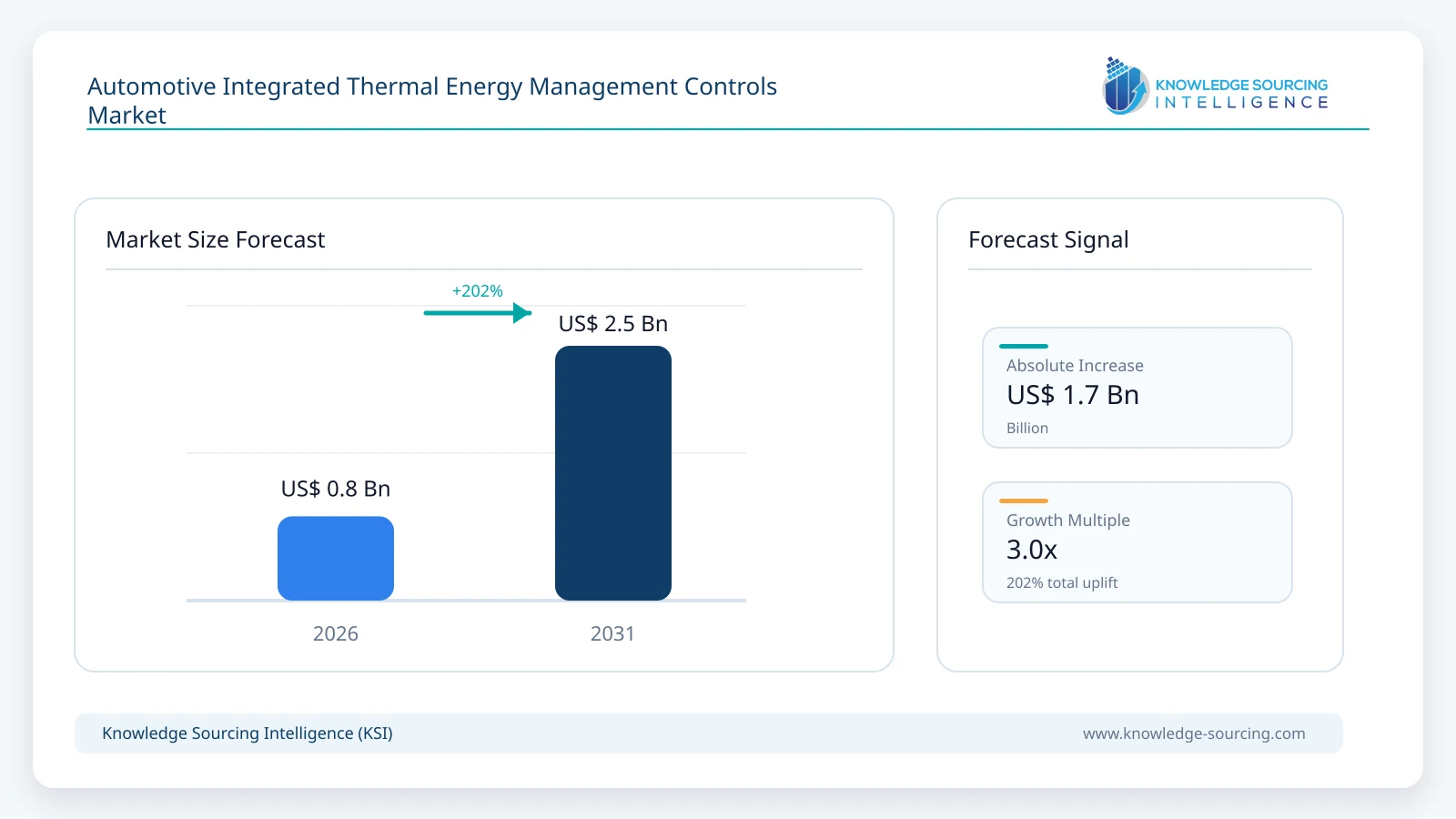
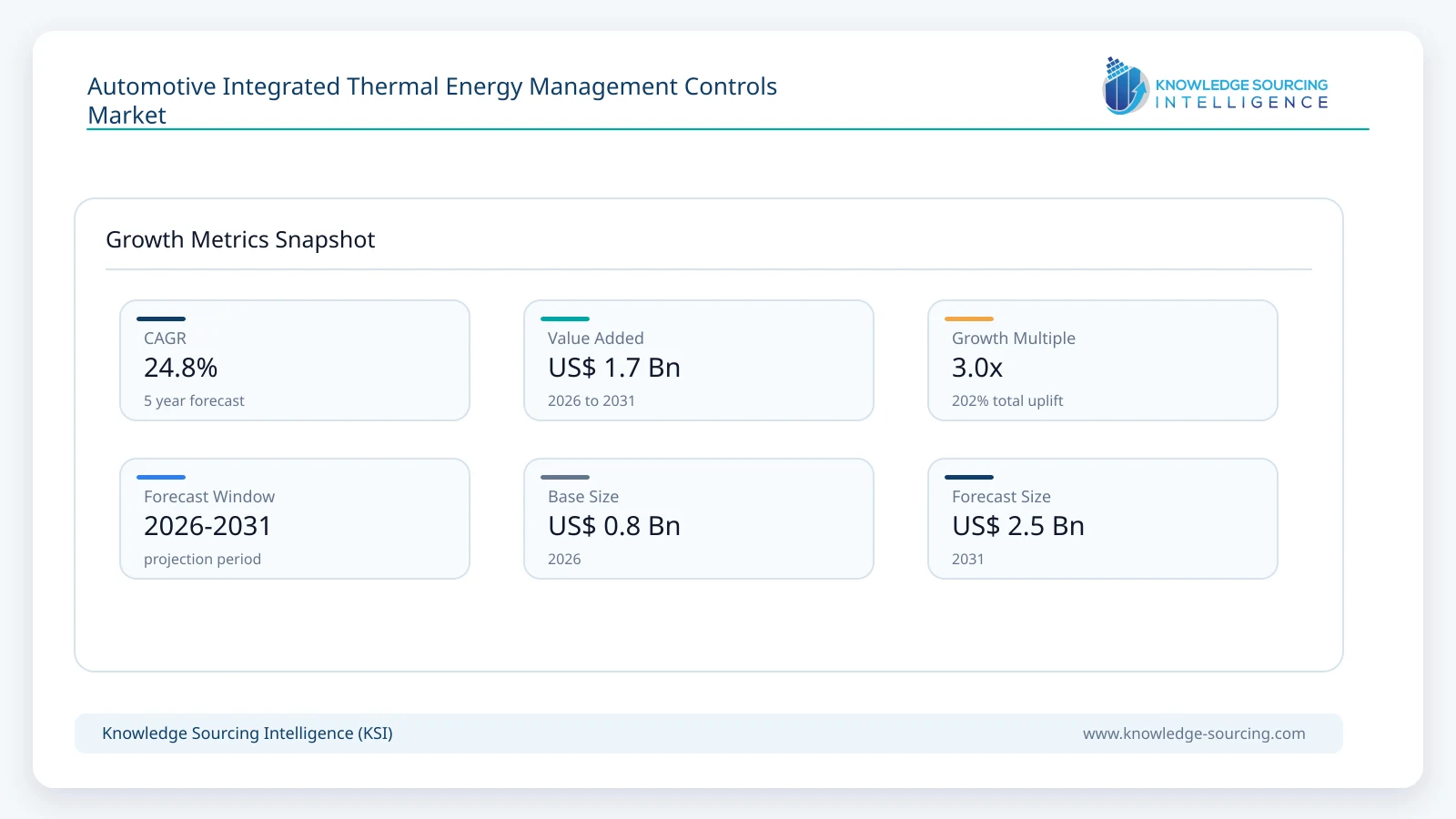
The automotive integrated thermal energy management controls market is projected to grow from USD 0.82 billion in 2026 to USD 2.48 billion by 2031, at a CAGR of 24.8% during the forecast period.
Highlights:
- 1Integrated heat-flow and thermal-source allocation is estimated to account for 33% of 2026 market value, reflecting coordinated cabin, battery and electric-drive requirements.
- 2Dedicated thermal controller and drive electronics represent 37% of 2026 revenue, while embedded supervisory software is projected to gain share by 2031.
- 3Battery electric vehicles account for an estimated 55% of 2026 value because charging preconditioning and range-sensitive cabin cooling require linked thermal control.
- 4Asia Pacific leads the market in 2026, supported by EV production in China and control-system engineering activity in Japan, South Korea and India.
- 5Module-integrated thermal control architectures gain share as vehicle manufacturers consolidate pumps, valves, coolant flow and electronic supervision.
- 6Validation across extreme weather, battery aging and charge events remains a major determinant of program award timing and software calibration expenditure.
Electric vehicles redistribute thermal energy among systems that do not always need heating or cooling at the same time. A battery can require preheating before a high-power charge while the cabin is already warm, and the inverter or electric motor can supply recoverable heat during operation. An integrated thermal controller responds to competing requirements by selecting the operating mode, commanding refrigerant and coolant valves, regulating pump speed and protecting the temperature limits of each component. The result is a coordinated control problem involving energy consumption, temperature stability, charging availability and occupant comfort.
Bosch offers predictive thermal-control software with modules for heat-pump operation, waste-heat recovery and battery preconditioning, while Hanon Systems combines a dedicated thermal-management driver with configurable software functions for compressors, valves, blowers and pumps. MAHLE’s production system for Mahindra and Valeo’s Smart Thermal Management architecture demonstrate alternative ways to combine supervisory control with thermal hardware. OEM purchasing consequently ranges from a supplier-integrated controller and calibrated module to licensed software operating on a vehicle-domain computer; the controller value must be distinguished from the much larger physical heating and cooling assembly.
The increased use of mixed coolant and refrigerant circuits raises the value of software that can arbitrate several temperature and energy constraints. Integrated programs require coordinated fault handling, compressor protection, fast-charge conditioning, heat recovery and demisting performance under changing conditions. Manufacturers that control the main thermal system internally may purchase only algorithms, application engineering or semiconductor interfaces, whereas other OEMs outsource a fuller thermal-control package to a system supplier. That variation in sourcing structure is central to understanding the competitive landscape.
Market Trends
Thermal Control Software Is Moving into Shared Domain Architectures
Bosch’s predictive control package is designed for modular AUTOSAR integration, enabling heat-pump, preconditioning and waste-heat recovery functions to operate without requiring a wholly proprietary standalone ECU. Hanon Systems takes a similar modular approach, with applications that can run on individual components, integrated modules or its thermal-management driver. Such flexibility matters as manufacturers consolidate vehicle computing yet retain local protection and actuator loops. The larger integration task shifts toward coordinating functions across multiple software domains while preserving deterministic responses for valves and pumps.
Marelli presented its Intelligent Energy Management technology in December 2025 as proprietary software capable of linking thermal, propulsion and electronic domains. The announcement describes a modular approach and digital-twin development tools rather than verified mass production across a stated vehicle volume. Nevertheless, it illustrates the direction of competition toward software portability, system simulation and reusable calibration rather than dedicated control hardware alone.
Heat Recovery and Battery Preconditioning Are Being Optimized Together
A battery approaching a fast charger may require heating in winter and substantial cooling during or after charging, while the cabin imposes a separate comfort demand. Bosch’s predictive package includes battery preconditioning and waste-heat recovery modules, and Valeo’s Smart Heat Pump is designed to direct heat exchange between the cabin, battery and electric powertrain. Joint optimization allows the vehicle to use available thermal capacity before demanding additional compressor power, subject to battery temperature and safety limits.
Vehicle manufacturers must calibrate these decisions for cold starts, hot-weather charging, steep gradients and rapid changes in driver demand. The value of a predictive function depends on accurate temperature sensing, knowledge of circuit states and fallback logic if navigation or forecast inputs are unavailable. These requirements favor suppliers with validated thermal models, system integration experience and access to vehicle-level operating data.
Compact Thermal Modules Are Absorbing Control Functions
Hanon Systems reported in March 2026 that its highly integrated cooling entity, first deployed in BMW’s electric iX3, combines the electronic expansion valve block, compressor, condenser, chiller and sensors into a compact thermal assembly. Schaeffler similarly describes combined coolant and refrigerant management with coordinated pumps and valves. The electronic control function remains necessary even when it is housed within the module, but OEM procurement may value it as part of the integrated assembly rather than as an independent ECU.
Infineon’s integrated thermal-management architecture uses a shared ECU to supervise several motorized actuators, contrasting with separate pump- and valve-mounted controllers. This integration can reduce the number of wiring connections and local control boards, although additional circuit flexibility increases software and functional-validation work. Procurement will therefore favor the physical topology that delivers the required performance at the lowest validated vehicle-level cost.
Automotive Integrated Thermal Energy Management Controls Market Segment Analysis
By Control Capability
Integrated Heat-Flow and Thermal-Source Allocation
Integrated heat-flow and thermal-source allocation is estimated to account for 33% of global revenue in 2026 because it provides the supervisory logic needed to route useful heat among the cabin, battery and drive components. Heat pumps, coolant valves and pumps can be controlled individually, but coordinated operation is necessary when heating one circuit changes the thermal capacity available to another. Valeo’s smart thermal architecture and Bosch’s predictive controls illustrate two supplier approaches to this problem.
The capability is projected to reach approximately USD 719 million by 2031 as integrated thermal modules spread beyond high-content EV platforms. Its share moderates as battery-specific charging control and predictive optimization gain incremental value, while whole-system energy arbitration remains the foundation for more advanced strategies.
By Revenue Component
Embedded Supervisory Software and Licenses
Embedded supervisory software and related licenses represent an estimated 25% of 2026 market value. Software coordinates thermal-source selection, efficiency optimization, actuator commands and operating-state transitions, frequently drawing on proprietary calibrations derived from vehicle-level testing. Bosch offers modules that can be integrated into third-party AUTOSAR systems, while Hanon Systems provides a configurable library covering the components it supplies throughout the thermal circuit.
The software component is projected to reach approximately USD 868 million in 2031 and increase to 35% of market value. The increase assumes that more automakers purchase software functions with continuing maintenance and configuration value rather than treating all thermal intelligence as a fixed attribute of a bundled heat-pump assembly.
By Integration Architecture
Thermal Module-Integrated Controllers
Thermal-module-integrated control accounts for an estimated 34% of 2026 revenue because packaging the controller with a coolant or refrigerant module reduces vehicle assembly and interface complexity. Hanon Systems’ integrated cooling entity and Schaeffler’s thermal-management module exemplify the move toward fewer hydraulic connections and coordinated electronic control. These architectures remain different from an entire vehicle-domain computer and require specific attribution of the module’s electronic and software content.
Thermal-module-integrated controllers are projected to reach about USD 1.09 billion and 44% share in 2031. The shift reflects expanded use of multifunction valves, centralized actuation and electronic interfaces designed around a smaller number of vehicle connectors.
By Control Strategy
Model-Based Predictive Control
Model-based predictive control is estimated to represent 31% of the 2026 market. Instead of responding only to instantaneous sensor thresholds, predictive strategies can evaluate expected battery heat loads, route information and anticipated cabin demand before selecting a thermal operating mode. Bosch’s software modules provide a commercial example of this approach, although practical performance depends on high-quality models and conservative fallback behavior.
Model-based predictive control is forecast to represent 42% of market value in 2031 as more EV platforms adopt charge-aware conditioning and shared energy optimization. Calibration effort will remain substantial because model performance depends on battery chemistry, coolant topology, compressor characteristics and ambient conditions.
By Propulsion
Battery Electric Vehicles
Battery electric vehicles account for an estimated 55% of the 2026 integrated-control market because thermal energy directly competes with traction energy for stored electricity. Unlike a conventional engine vehicle, a BEV must manage battery charging temperatures, cabin heating, motor and inverter cooling, and potentially low-grade recovered heat without relying on substantial continuous engine waste heat. MAHLE’s implementation on Mahindra BEV models demonstrates production demand for integrated cabin-battery control.
Battery electric vehicles are forecast to represent 64% of market value by 2031, with plug-in hybrids and full hybrids contributing additional demand from multi-loop control. This allocation captures the higher attributable control content per qualifying BEV rather than assuming that every electric vehicle carries an identical thermal architecture.
Market Drivers
Growth in Electric Vehicle Thermal-Circuit Complexity
Battery electric vehicles use distinct operating temperature targets for the cabin, traction battery, electric motor and power electronics. As heat pumps, chillers and multiple coolant valves link these circuits, a larger share of vehicle efficiency depends on the controller selecting correct operating modes. Hanon Systems and Valeo both offer multi-circuit thermal architectures, while Infineon supports a single-ECU approach for integrated control. The spread of these architectures increases demand for supervisory software, diagnostics and calibrated actuator command functions.
Demand for Shorter Charging Times and Reliable Preconditioning
Fast charging introduces rapidly changing thermal loads that require battery preconditioning before arrival and heat rejection once charging starts. A control package must balance battery temperature targets with cabin demand and available compressor capacity, particularly in extreme ambient conditions. Bosch explicitly provides preconditioning modules within its predictive thermal-control offering. Greater emphasis on charging reliability supports higher-value model-based control and vehicle-specific validation programs.
Pressure to Reduce Cabin Heating and Cooling Energy Consumption
Cabin heating can significantly affect winter EV range because heat-pump output, fan power and supplemental electric heating all draw from the battery. MAHLE reported lower electric-compressor consumption against reference vehicles for its Mahindra ITMS implementation, attributing the result to coordinated software and hardware control. The supplier-reported performance is program-specific, but it shows why automakers value software optimization beyond the purchase of efficient individual components.
Consolidation of Coolant and Refrigerant Module Electronics
Thermal suppliers are combining valves, pumps, sensors and refrigerant functions within preintegrated assemblies to reduce piping, connectors and assembly steps. Schaeffler’s thermal modules and Hanon Systems’ production cooling entity illustrate the engineering direction. An integrated electronic controller can replace several local boards, but it also requires more extensive actuator scheduling and fault monitoring. Such consolidation creates demand for qualified controller designs and thermal application software.
Software-Defined Vehicle Platforms and Reusable Calibration
Vehicle manufacturers are moving selected thermal functions toward shared computing and software architectures while keeping safety-critical actuator control deterministic. Bosch’s AUTOSAR-oriented modules, Marelli’s software-led energy-management approach and Hanon Systems’ configurable library give OEMs alternatives to one-off application development. Reusable software can reduce duplication across derivatives, although the savings depend on common hardware topologies and carefully managed calibration variants.
Market Restraints
Thermal Coupling and Extreme-Condition Validation
A shared compressor or coolant loop can face conflicting cooling requirements during rapid charging, a hot-weather climb or a defogging event. A controller that improves nominal efficiency may still need to sacrifice energy savings to protect the battery or maintain windshield visibility. Extensive climatic tests, fault injection and hardware-in-the-loop validation are necessary to prove these operating priorities across vehicle variants. Validation complexity can slow launches and raise integration expenditure.
High Platform-Specific Calibration and Software Integration Costs
Coolant routing, refrigerant choice, heat-exchanger sizing, sensor placement and electric compressor characteristics differ substantially among automakers. A predictive algorithm developed for one hardware topology often requires additional identification, software adaptation and validation before reuse. Thermal-domain suppliers can amortize development across shared modules, but OEM-specific programs still generate engineering cost and can restrict commercial software margins.
Bundled Sourcing and Limited Standalone Software Monetization
Many vehicle manufacturers buy thermal modules with embedded control electronics and receive application calibration as part of a larger supplier contract. Other OEMs develop supervisory algorithms internally and purchase only microcontrollers or actuator components. This sourcing mix can limit independent licensing revenue even as technical control complexity increases. Suppliers must demonstrate distinct performance, integration speed or after-delivery maintenance value to secure separate software compensation.
Reliability, Safety and Cybersecurity Requirements
Thermal failures can reduce charging capability, damage components or degrade cabin visibility, making diagnostics and fallback modes essential. Shared ECUs also introduce software lifecycle and access-control requirements when thermal calibration can be updated remotely. Functional-safety engineering must establish clear responsibility for protective limits between the BMS, thermal controller and vehicle computer. Additional verification raises cost and complicates integration across supplier boundaries.
Cost Pressure and Alternative Distributed Architectures
Entry-level electrified vehicles do not always support the bill of materials for sophisticated shared thermal control. Some manufacturers retain distributed pump and valve controls with established rule-based coordination, particularly when energy benefits from centralization are modest. Centralized designs can reduce certain wiring and assembly costs while increasing controller and software qualification requirements. OEM program awards therefore depend on demonstrated whole-vehicle economics rather than control sophistication alone.
Regional Outlook
Asia Pacific
China provides the largest concentration of electric-vehicle production and locally developed thermal architectures in the region, while Japan and South Korea host established thermal and control-electronics suppliers. Regional demand is supported by the scale of EV platform launches, widespread heat-pump integration and intense attention to winter range and rapid charging. MAHLE’s production ITMS for Mahindra in India adds evidence that integrated thermal-control functionality is being commercialized beyond premium vehicles and established Northeast Asian OEM programs.
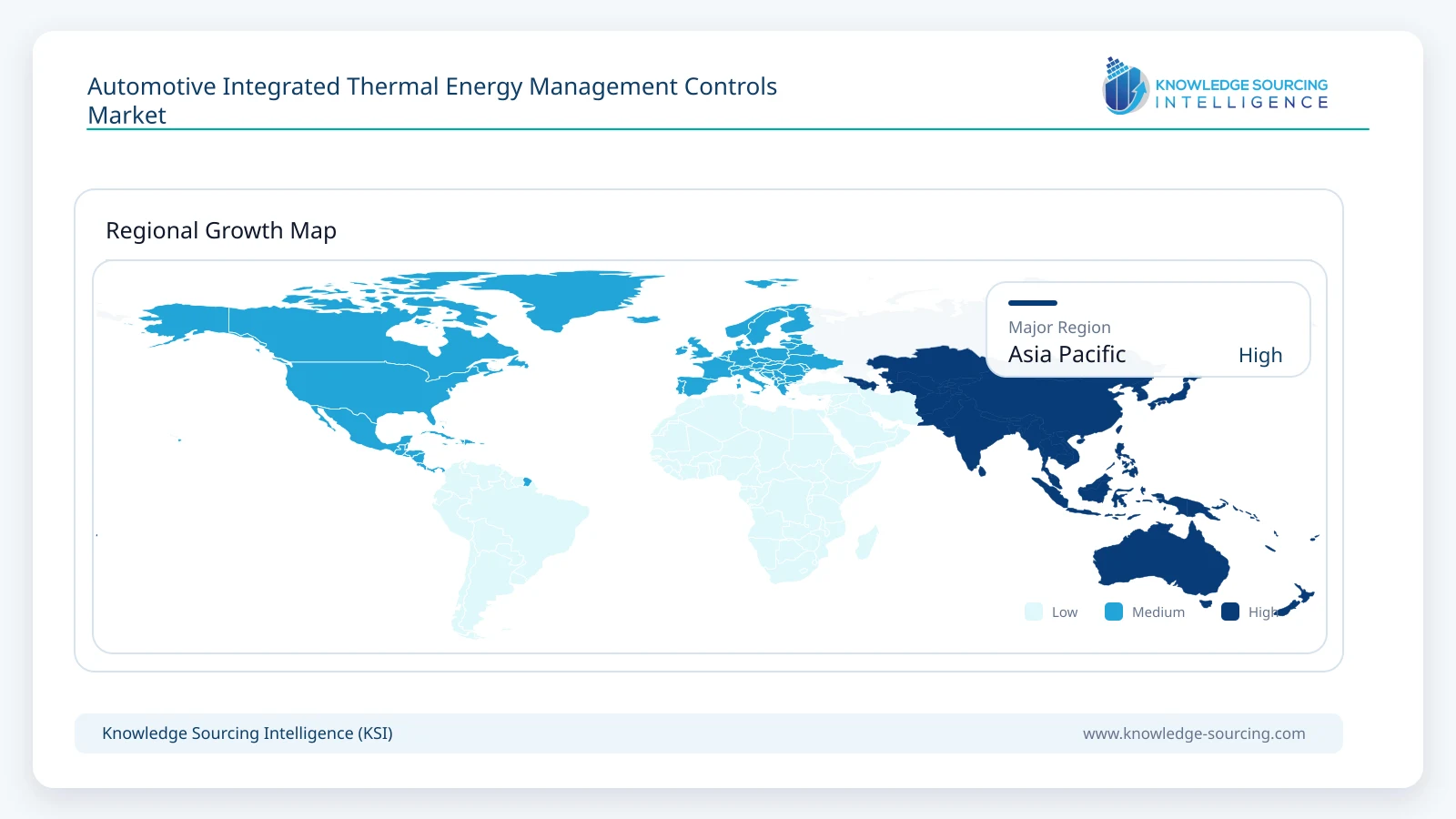
Asia Pacific is estimated to account for 44% of the 2026 market and reach approximately USD 1.19 billion in 2031. China remains the principal revenue contributor, with Japan and South Korea supplying important control technology and system engineering. Growth in India and Southeast Asia is expected to broaden the customer base, although adoption of advanced predictive functions will remain uneven by price segment and vehicle platform.
Europe
Europe combines demanding EV efficiency requirements with established thermal-management development at MAHLE, Valeo, Schaeffler and Bosch. Suppliers are commercializing software that coordinates cabin conditioning, battery preconditioning and electric-drive cooling through common thermal architectures. Bosch’s predictive software and Schaeffler’s integrated energy-management ecosystem demonstrate the importance of platform-level controls, while OEM adoption depends on measurable performance under European winter conditions and cross-market vehicle validation.
Europe represents an estimated 28% of global market value in 2026 and is projected to approach USD 645 million by 2031. German, French and British engineering programs remain relevant to high-value software and thermal-system integration, although production supply chains span several regions. The fastest gains are expected where OEMs use standardized thermal modules and control software across multiple electric and plug-in hybrid vehicle lines.
Competitive Landscape
Automotive integrated thermal-energy control is supplied through different commercial models. Hanon Systems, MAHLE, Valeo, Schaeffler, Bosch and DENSO combine thermal hardware and engineering capability, whereas Marelli is developing an explicitly software-led energy-management proposition. Control-semiconductor suppliers including Infineon, Texas Instruments and NXP provide microcontrollers, motor-control interfaces and integrated-system development platforms. These categories should not be interpreted as ten interchangeable sellers of standalone thermal software.
Hanon Systems differentiates through its thermal-management driver and reusable application library; MAHLE has a documented production implementation on Mahindra’s EV platform; and Bosch offers independently described predictive thermal-control software modules. Valeo and Schaeffler integrate control functions with coolant and refrigerant hardware, creating different supply arrangements for automakers. Supplier selection depends on proven whole-vehicle energy performance, calibration capability, functional robustness and the cost of adapting an architecture to a new platform.
Recent Developments
June 2026: Schaeffler highlighted an integrated vehicle energy-management portfolio that combines thermal systems, electrified powertrains and energy coordination at its Automotive Symposium. The announcement establishes strategic direction, not a disclosed shipment volume for thermal controllers.
March 2026: Hanon Systems reported supply of a highly integrated cooling entity, first deployed in the electric BMW iX3. Combined electronic valves, compressor, chiller and sensors strengthen the commercial case for tightly coordinated module controls.
December 2025: Marelli unveiled modular Intelligent Energy Management software intended to coordinate thermal, propulsion and electronic domains. The announcement represents a technology introduction, not independently verified series production.
November 2025: Valeo announced a compact five-way refrigerant valve for smart heat-pump modules. Consolidated refrigerant routing increases the importance of reliable electronic mode selection and component-level controls.
September 2025: Valeo presented Smart Thermal Management at IAA Mobility, connecting a smart heat pump with coolant modules for coordinated heat exchange among cabin, battery and powertrain circuits.
May 2025: MAHLE described the Intelligent Thermal Management System used on Mahindra BE 6 and XEV 9e models, including software for cabin and battery temperature and cooling-module airflow; the supplier reported a program-specific compressor-power reduction versus reference vehicles.
Market Outlook
The integrated thermal energy management controls market is projected to reach USD 2.48 billion by 2031 as more electrified vehicles coordinate battery, cabin, powertrain and charging heat flows. Controller and embedded-software content will gain value from increasingly coupled circuits, while wider thermal-module integration changes where that value is physically located. Supplier programs are expected to emphasize energy efficiency, predictable charging performance and verifiable operation across climatic extremes.
Greater software modularity should allow control suppliers to support several vehicle platforms with reusable application components. Bosch, Hanon Systems and Marelli offer different models for software licensing or delivery alongside thermal hardware, while Infineon and Texas Instruments enable integration of actuators into compact shared controllers. OEM internal development and bundled purchasing will continue to constrain how much supervisory logic is commercially sold as a distinct product.
Asia Pacific is expected to retain regional leadership, with Europe remaining a significant software-engineering and thermal-integration center. Investment will concentrate on reliable predictive control, charge-aware preconditioning, heat recovery and low-complexity electronic architectures rather than additional thermal hardware for its own sake. Suppliers able to document efficiency gains without weakening battery protection, demisting or service reliability should be better positioned for repeat vehicle-program awards.
Automotive Integrated Thermal Energy Management Controls Market Scope:
| Report Metric | Details |
|---|---|
| Total Market Size in 2026 | USD 0.82 billion |
| Total Market Size in 2031 | USD 2.48 billion |
| Forecast Unit | USD Billion |
| Growth Rate | 24.8% |
| Study Period | 2021 to 2031 |
| Historical Data | 2021 to 2024 |
| Base Year | 2025 |
| Forecast Period | 2026 – 2031 |
| Segmentation | Control Capability, Revenue Component, Integration Architecture, Control Strategy,, Thermal-Circuit Coupling, Vehicle Type, Propulsion, Geography. |
| Companies |
|
Market Segmentation
By Control Capability
Integrated Heat-Flow and Thermal-Source Allocation
Battery Preconditioning and Charging Thermal Control
Heat-Pump and Heat-Recovery Optimization
Drivetrain and Power-Electronics Thermal Coordination
Predictive Thermal Energy Optimization
By Revenue Component
Dedicated Thermal Controller and Drive Electronics
Embedded Supervisory Software and Licenses
Attributable Sensors and Control Interfaces
Integration, Calibration and Lifecycle Services
By Integration Architecture
Dedicated Thermal-Domain Controller
Integrated Controller Within Thermal Module
Distributed ECU and Central Supervisory Coordination
By Control Strategy
Calibrated Rule-Based and Feedback Control
Model-Based Predictive Control
Adaptive and AI-Assisted Optimization
By Thermal-Circuit Coupling
Cabin, Battery and Drive Multi-Circuit Coordination
Cabin and Battery Coupled Control
Battery and Electric-Drive Coupled Control
Other Multi-Domain Thermal Coordination
By Vehicle Type
Passenger Vehicles
Light Commercial Vehicles
Medium and Heavy Commercial Vehicles
Buses and Specialized Vehicles
By Propulsion
Battery Electric Vehicles
Plug-In Hybrid Electric Vehicles
Full Hybrid Electric Vehicles
Internal Combustion and Mild-Hybrid Vehicles
By Geography
North America
United States
Canada
Mexico
South America
Brazil
Argentina
Others
Europe
Germany
United Kingdom
France
Italy
Spain
Others
Middle East and Africa
Saudi Arabia
United Arab Emirates
South Africa
Others
Asia Pacific
China
Japan
South Korea
India
Thailand
Indonesia
Taiwan
Others
Table of Contents
1. EXECUTIVE SUMMARY
2. MARKET SNAPSHOT
2.1. Market Overview
2.2. Market Definition
2.3. Scope of the Study
2.4. Market Segmentation
3. BUSINESS LANDSCAPE
3.1. Market Drivers
3.1.1. Electrified Vehicle Thermal-Circuit Complexity
3.1.2. Fast-Charging and Battery Preconditioning
3.1.3. Cabin Heating and Cooling Energy Efficiency
3.1.4. Integrated Coolant and Refrigerant Electronics
3.1.5. Reusable Thermal-Control Software
3.2. Market Restraints
3.2.1. Extreme-Condition Thermal-Coupling Validation
3.2.2. Platform-Specific Software Calibration
3.2.3. Bundled Procurement and Limited Separate Monetization
3.2.4. Reliability and Safety Requirements
3.2.5. Cost and Distributed Control Alternatives
3.3. Market Opportunities
3.4. Porter’s Five Forces Analysis
3.5. Industry Value Chain Analysis
3.6. Policies and Regulations
3.7. Strategic Recommendations
4. TECHNOLOGICAL OUTLOOK
4.1. Supervisory Thermal Energy Allocation
4.2. Predictive Battery and Cabin Preconditioning
4.3. Thermal Control ECUs and Software Platforms
4.4. Multicircuit Heat Pump and Coolant Coordination
4.5. Software Integration and Functional Validation
5. MARKET BY CONTROL CAPABILITY
5.1. Integrated Heat-Flow and Thermal-Source Allocation
5.2. Battery Preconditioning and Charging Thermal Control
5.3. Heat-Pump and Heat-Recovery Optimization
5.4. Drivetrain and Power-Electronics Thermal Coordination
5.5. Predictive Thermal Energy Optimization
6. MARKET BY REVENUE COMPONENT
6.1. Dedicated Thermal Controller and Drive Electronics
6.2. Embedded Supervisory Software and Licenses
6.3. Attributable Sensors and Control Interfaces
6.4. Integration, Calibration and Lifecycle Services
7. MARKET BY INTEGRATION ARCHITECTURE
7.1. Dedicated Thermal-Domain Controller
7.2. Integrated Controller Within Thermal Module
7.3. Distributed ECU and Central Supervisory Coordination
8. MARKET BY CONTROL STRATEGY
8.1. Calibrated Rule-Based and Feedback Control
8.2. Model-Based Predictive Control
8.3. Adaptive and AI-Assisted Optimization
9. MARKET BY THERMAL-CIRCUIT COUPLING
9.1. Cabin, Battery and Drive Multi-Circuit Coordination
9.2. Cabin and Battery Coupled Control
9.3. Battery and Electric-Drive Coupled Control
9.4. Other Multi-Domain Thermal Coordination
10. MARKET BY VEHICLE TYPE
10.1. Passenger Vehicles
10.2. Light Commercial Vehicles
10.3. Medium and Heavy Commercial Vehicles
10.4. Buses and Specialized Vehicles
11. MARKET BY PROPULSION
11.1. Battery Electric Vehicles
11.2. Plug-In Hybrid Electric Vehicles
11.3. Full Hybrid Electric Vehicles
11.4. Internal Combustion and Mild-Hybrid Vehicles
12. GEOGRAPHICAL SEGMENTATION
12.1. North America
12.1.1. United States
12.1.2. Canada
12.1.3. Mexico
12.2. South America
12.2.1. Brazil
12.2.2. Argentina
12.2.3. Others
12.3. Europe
12.3.1. Germany
12.3.2. United Kingdom
12.3.3. France
12.3.4. Italy
12.3.5. Spain
12.3.6. Others
12.4. Middle East and Africa
12.4.1. Saudi Arabia
12.4.2. United Arab Emirates
12.4.3. South Africa
12.4.4. Others
12.5. Asia Pacific
12.5.1. China
12.5.2. Japan
12.5.3. South Korea
12.5.4. India
12.5.5. Thailand
12.5.6. Indonesia
12.5.7. Taiwan
12.5.8. Others
13. COMPETITIVE ENVIRONMENT AND ANALYSIS
13.1. Major Players and Strategy Analysis
13.2. Market Share Analysis
13.3. Mergers, Acquisitions, Agreements and Collaborations
13.4. Competitive Dashboard
14. COMPANY PROFILES
14.1. Hanon Systems
14.2. MAHLE GmbH
14.3. Valeo
14.4. Robert Bosch GmbH
14.5. Schaeffler AG
14.6. DENSO Corporation
14.7. Marelli
14.8. Infineon Technologies AG
14.9. Texas Instruments Incorporated
14.10. NXP Semiconductors N.V.
15. APPENDIX
15.1. Currency
15.2. Assumptions
15.3. Base and Forecast Years Timeline
15.4. Key Benefits for Stakeholders
15.5. Research Methodology
15.6. Abbreviations
Navigate
Trusted by the world's leading organizations