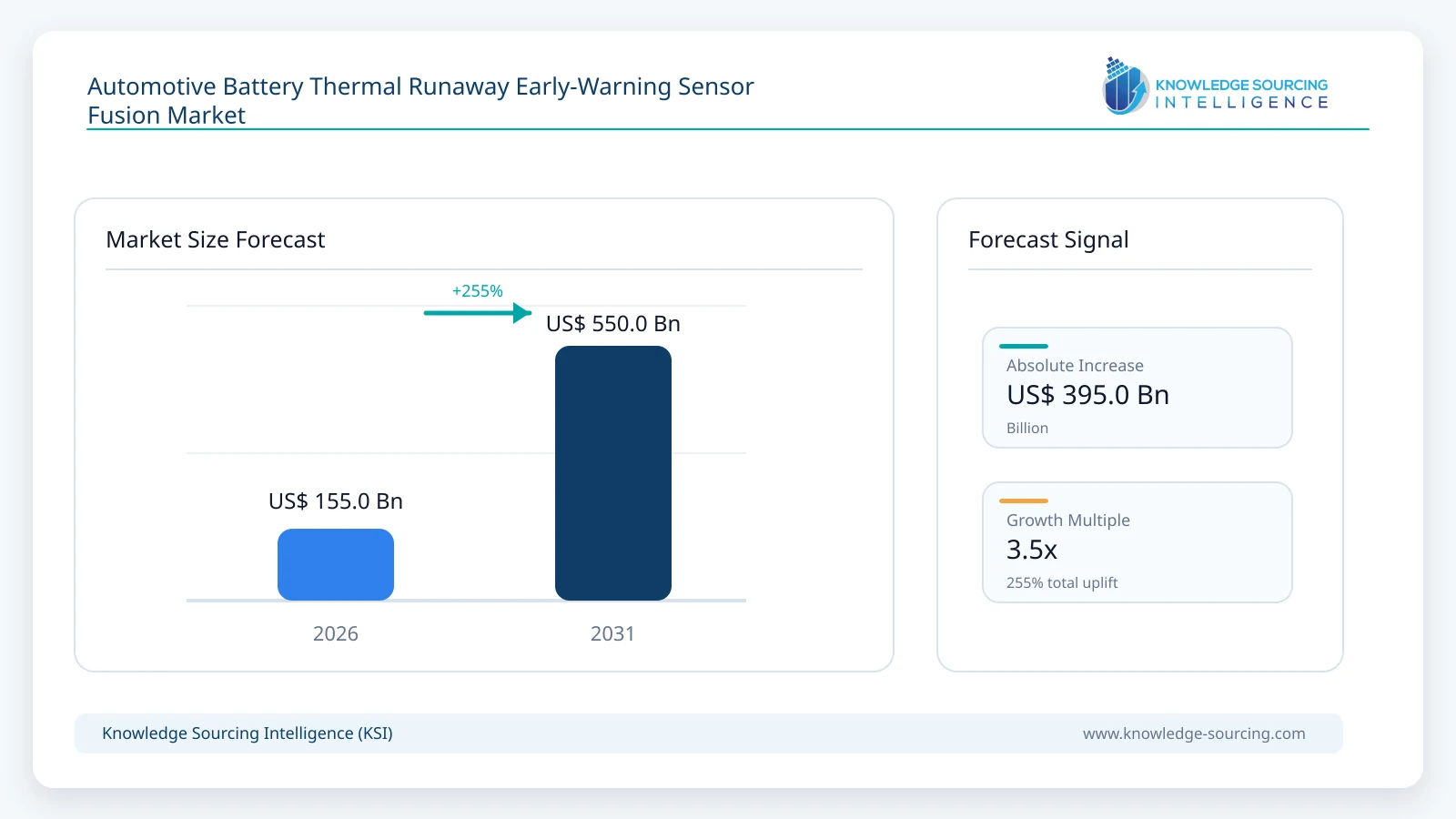
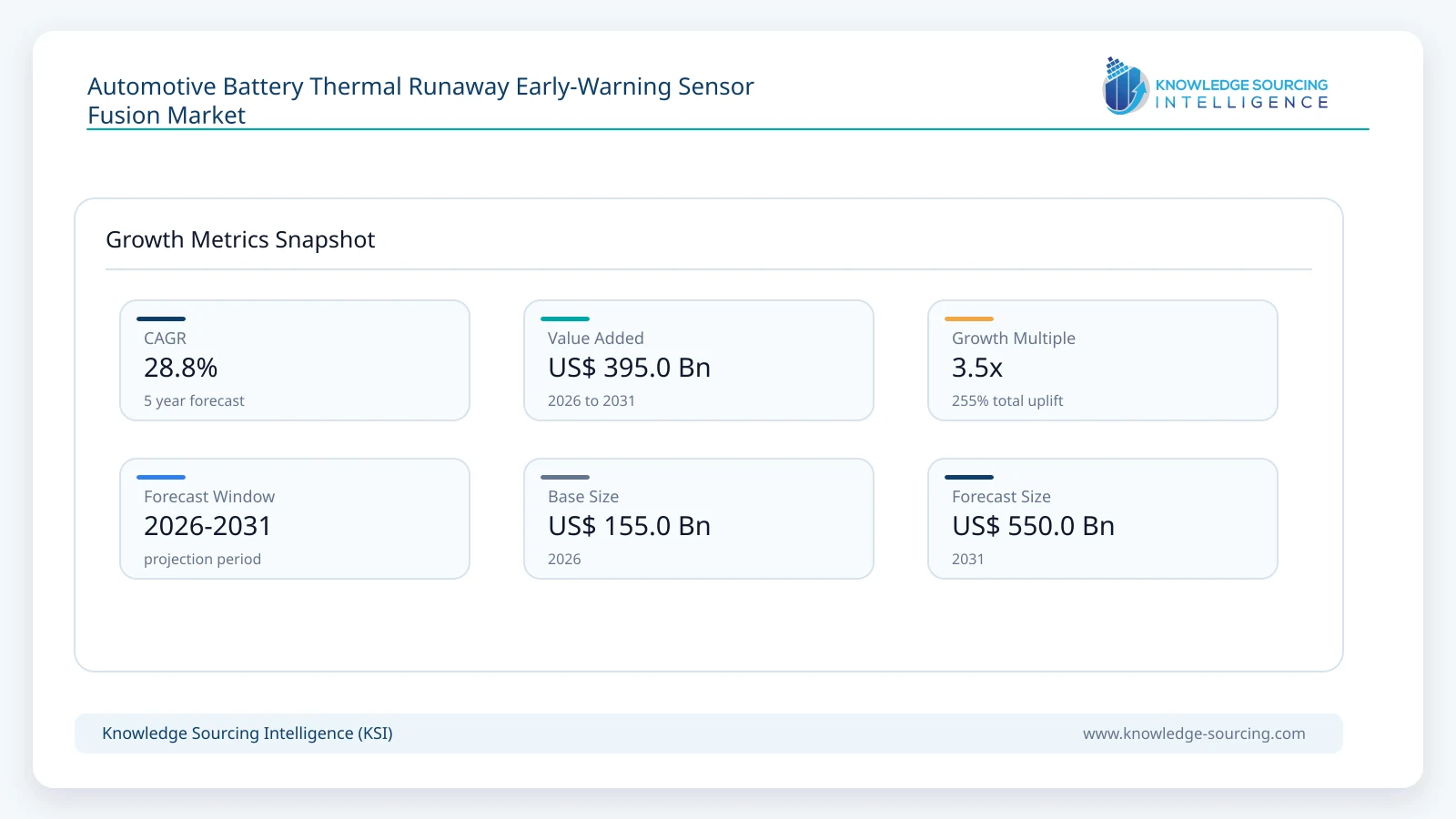
The automotive battery thermal runaway early-warning sensor fusion market is growing at a CAGR of 28.8%, from USD 155 million in 2026 to USD 550 million by 2031.
Highlights:
- 1Integrated gas, pressure and environmental sensor modules represent an estimated 39% of 2026 market value, with BMS-hosted fusion gaining share through 2031.
- 2Dedicated detection sensor hardware accounts for 53% of revenue in 2026, while embedded algorithms and integration services increase their combined contribution over the forecast period.
- 3Electrolyte-vapour and VOC-led detection represents approximately 37% of 2026 revenue as suppliers target venting precursors rather than temperature rise alone.
- 4Battery electric passenger vehicles account for an estimated 70% of 2026 demand; commercial EV applications become more important as vehicle packs increase in energy capacity.
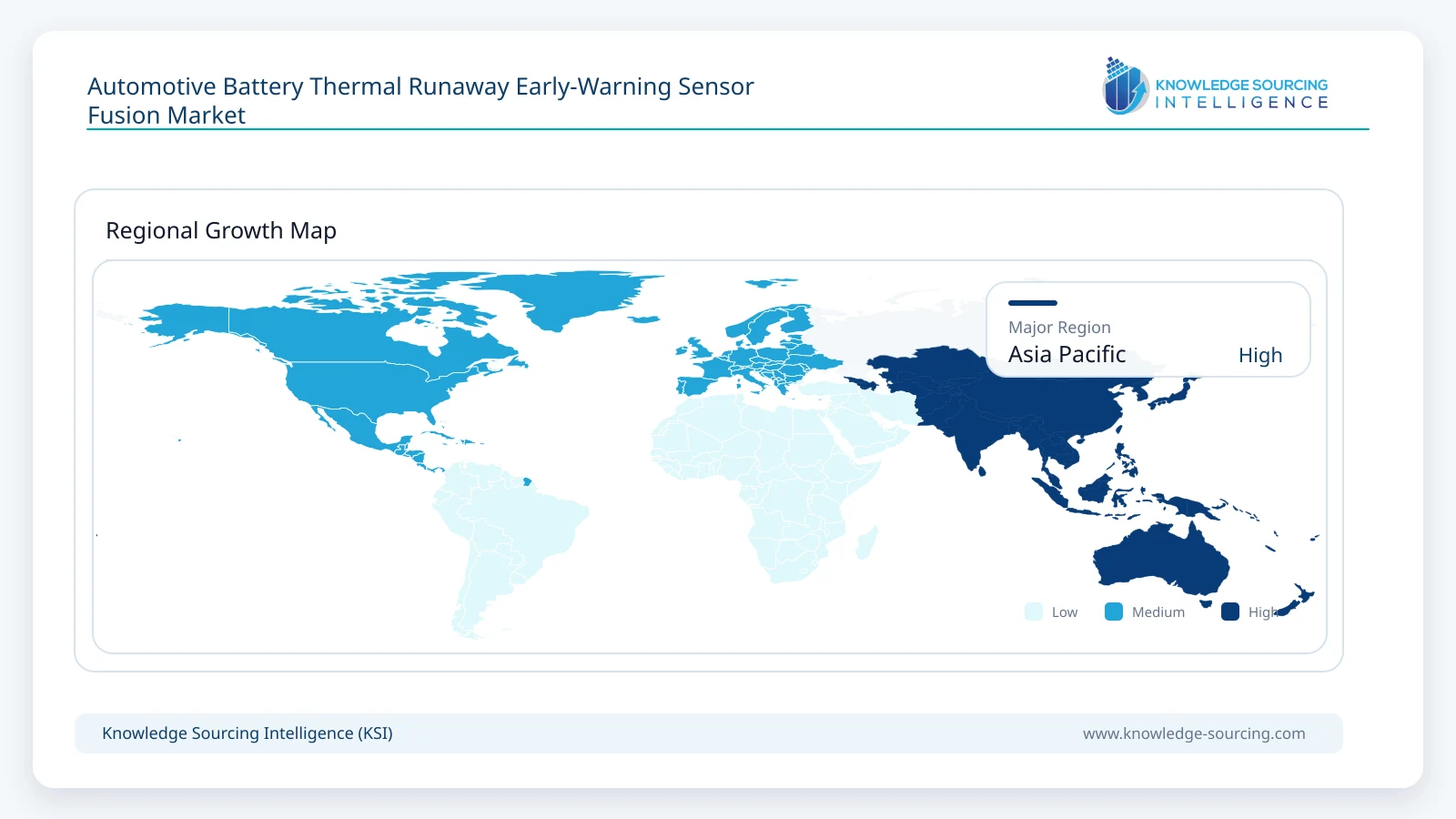
- 5Asia Pacific accounts for approximately 53% of the modeled global market in 2026, supported by China’s scale in electric-vehicle and battery production.
- 6China’s GB 38031-2025 entered into force in July 2026, strengthening battery-safety testing obligations without prescribing a universal sensor-fusion architecture.
It comprises pack-installed vent-gas, electrolyte-vapour, pressure and complementary sensors when used in a dedicated multisignal warning function; the attributable interface electronics, fusion algorithms, diagnostic software and separately billed program integration are also included. The market excludes complete battery management systems, ordinary voltage or temperature sensing with no qualified early-warning function, battery enclosures, contactors, fire suppression systems and stationary energy-storage monitoring.
Honeywell provides an automotive Battery Safety Electrolyte Sensor that detects the first vent and supports CAN communications, together with a separate pack-pressure sensing product. Amphenol Advanced Sensors combines gas, pressure, temperature and humidity measurements in its REDTR technology, while Metis Engineering offers Cell Guard for electrolyte-related VOCs and other battery-enclosure parameters. These products establish several commercial approaches to detecting abnormal pack conditions; only the attributable automotive early-warning content is included in the forecast.
Market Overview
Lithium-ion cells can release electrolyte vapours and gases as internal damage progresses, sometimes before a small number of embedded temperature probes shows a clear anomaly. Pack pressure, gas composition and electrical behaviour therefore provide complementary indications, but none is uniformly earliest or most reliable across every chemistry and enclosure design. A dedicated sensor-fusion system compares these inputs and communicates an actionable warning to the battery management system or vehicle controller, including when the vehicle is parked. Placement near vents, exposure to coolant and humidity, and variations in air movement all influence detection performance.
Amphenol’s REDTR technology monitors vent-gas conditions with pressure, temperature and humidity, whereas Metis Engineering’s Cell Guard combines VOC measurement with pressure, humidity, dew point and optional shock information. Honeywell’s BES and BPS offerings address different first-vent indicators that may be interpreted together by a vehicle controller. STMicroelectronics supports battery-pressure monitoring through its NBP8 family, and ScioSense provides an automotive battery-condition monitor with optional humidity and pressure functions. These architectures create distinct opportunities for multi-parameter modules, separately sourced sensors and the software that reconciles their alarms.
OEM battery-pack engineering teams decide whether fusion logic remains in a dedicated local hub or resides in the existing BMS. The purchasing choice affects wiring, redundancy, diagnostic communication, cybersecurity, power draw during parking and the amount of software validation that suppliers must perform. Conventional BMS temperature and voltage measurements remain valuable as corroborating signals, but their complete hardware value is not newly counted in this market. Supplier revenue is concentrated on additional safety sensing, qualified decision logic and integration work rather than on the entire battery pack electronics bill.
Market Trends
First-Vent Detection Is Being Combined with Electrical Diagnostics
Honeywell’s BES sensor is designed to identify electrolyte vapours released during an initial battery-cell vent, while its BPS product tracks absolute pressure and rate-of-change thresholds. Combining these measurements with existing cell-voltage and temperature information can help distinguish a developing cell fault from a short-lived environmental disturbance. It also allows vehicle designers to establish different warnings for an isolated vent, a rapid pack-pressure rise or a confirmed propagation event, although validation must be performed under each manufacturer’s pack conditions.
Metis Engineering’s Cell Guard follows a similar multi-parameter approach by measuring VOCs, pressure, temperature, humidity and dew point. Laboratory comparisons cited by the supplier indicate that the timing of gas release can provide earlier warning than hydrogen-only detection in some tests. Such findings are useful for choosing sensor combinations but cannot be generalized into a universal warning interval. Supplier qualification must still account for battery chemistry, vent paths, pack layout and the possibility of a fault occurring far from a sensing point.
Battery Safety Sensors Are Becoming More Autonomous at the Pack Edge
STMicroelectronics’ NBP8 battery-pressure monitoring family incorporates local processing, configurable pressure-change detection, self-test and host wake-up. Its February 2026 firmware examples also demonstrate how external gas-sensor inputs can be connected to the embedded processing environment. Edge-based decisions allow a low-power sensor to identify a threshold event before the main battery controller exits a reduced-power state, an important characteristic for vehicles that remain parked for long periods.
Sensirion made its automotive STC42A hydrogen sensor generally available in June 2026, with digital measurement and the option to communicate with humidity and temperature sensing. Hydrogen is useful as one signal in a broader warning strategy, but its appearance may differ from electrolyte-vapour release across failure mechanisms. Future systems will therefore compete increasingly on sensor diversity, diagnostics, wake-up latency and validated alarm classification rather than on one sensing parameter alone.
Regulatory Testing Is Increasing Demand for Documented Detection Performance
China’s updated GB 38031-2025 became effective in July 2026 and revised thermal-propagation, bottom-impact and post-fast-charging battery tests. Compliance applies to specified battery safety outcomes rather than requiring any named gas sensor or sensor-fusion product. Nevertheless, manufacturers seeking to verify occupant warnings and characterize pack events have a stronger reason to evaluate pressure, gas and thermal evidence together, particularly when multiple battery chemistries and pack formats share a vehicle platform.
Early-warning validation depends on detecting genuine events without creating unacceptable false alarms during normal use, charging, car washing, high-altitude driving or seasonal temperature changes. Testing therefore extends beyond the sensor data sheet to environmental durability, sensor placement, communication faults, BMS fallback responses and the timing of occupant alerts. Qualification expenditure can delay adoption, but it also raises the value of proven sensing architectures and documented integration support.
Segment Analysis
By Detection Architecture: Integrated Multisignal Modules
Integrated gas, pressure and environmental sensor modules represent an estimated 39% of market value in 2026. Pack-mounted devices such as Amphenol REDTR and Metis Cell Guard combine several physical measurements within one unit, reducing the need for multiple independently housed sensors. These modules are particularly relevant when pack integration space is limited or an OEM wants a defined local warning interface. The segment retains a substantial position through 2031, while systems fusing individual off-gas sensors with existing BMS signals gain share.
The value of a combined module depends on its coverage rather than simply the number of measured parameters. A sensor that identifies electrolyte vapours near a pack vent may provide a stronger early signal for one failure path, whereas pressure-rate sensing can be more dependable in another enclosure configuration. Higher-value configurations must justify their additional validation, environmental protection and electrical interface costs against the simpler option of a single qualified sensing device.
By Primary Warning Signal: Electrolyte Vapour and VOC
Electrolyte-vapour and VOC-led warning accounts for approximately 37% of modeled 2026 revenue, rising toward 42% by 2031 as pack suppliers add sensing methods that can respond to initial venting. Honeywell’s BES targets this phase, and Metis Engineering identifies VOC detection as a key Cell Guard function. These measurements can improve warning timing when vapours reach the sensor before a significant temperature or pack-pressure excursion.
Sensor location and chemical selectivity determine whether vapour detection can reliably support a production warning. Adhesives, cleaning fluids and other materials may introduce background vapours, while venting in a remote module may reach a sensor slowly. Fused systems can use pressure, temperature and electrical confirmation to reduce erroneous escalations without delaying an urgent occupant warning, making the diagnostic algorithm as important as the gas-sensing element.
By Revenue Component: Dedicated Detection Hardware
Dedicated sensing hardware represents an estimated 53% of 2026 market value, reflecting the cost of automotive-qualified gas, pressure and multi-parameter sensing assemblies. This category includes only specialized early-warning devices, not the BMS temperature probes or cell-voltage acquisition chips that would ordinarily be installed regardless of the warning feature. Hardware remains the largest revenue component in 2031, although its modeled share declines as software and calibration become more important to final system performance.
Embedded classification software, sensor-interface electronics and supplier integration services become more valuable when automakers request reusable warning functions across LFP and nickel-rich batteries. A supplier may license an alarm algorithm separately, while another includes the same functionality in a pack module contract. The model counts each function once at the final attributable transaction level, with a separate allocation for engineering performed outside the supplied product price.
By Fusion Method: Model-Based and Adaptive Classification
Calibrated thresholds and voting rules dominate early implementations because their responses are straightforward to test and document. Model-based estimation can account for expected temperature, pressure and gas behaviour under different operating states, reducing the risk of treating every environmental excursion as a fault. As battery data sets expand, adaptive classifiers may help recognize more complex patterns, provided the system retains defined alarm limits and safety fallbacks.
Data-driven algorithms face particular validation demands because genuine thermal runaway events are rare and intentional abuse tests cover a limited set of operating conditions. Training data drawn from one chemistry or pack layout may not reproduce the signatures seen in another. Manufacturers consequently need independent test cases, failure injection, explainable alarm logic and a deterministic path for issuing a warning when model confidence is insufficient.
By Vehicle Application: Battery Electric Passenger Vehicles
Battery electric passenger vehicles represent around 70% of the modeled 2026 market because they contain the largest number of qualifying high-energy packs in mainstream road-vehicle production. China’s high EV manufacturing output provides important potential scale, although no published industry figure establishes the number of EVs fitted with multisignal warning hardware. Plug-in hybrids form a smaller opportunity because battery size, enclosure design and safety architecture differ, and not every model requires identical additional sensing.
Electric buses and trucks gain market relevance as operators seek robust fault warnings on larger packs and vehicles with long daily duty cycles. Additional cell groups and enclosure compartments can increase the need for distributed detection, especially where a single sensor cannot sample every relevant location. The economics depend on actual sensor placements and architecture rather than a mechanical multiplication of passenger-car content by battery capacity.
Market Drivers
Expansion of High-Voltage Battery Production
The IEA reported global electric-car sales above 20 million in 2025 and estimated a market of about 23 million in 2026. Each additional EV platform creates a new opportunity for battery-pack electronics, but dedicated multisignal warnings are not fitted universally. Demand is concentrated where OEM safety specifications add gas, pressure or fused warning functions to the standard BMS sensor set.
Large-scale battery manufacturing in China, alongside production in Europe, North America and other Asian countries, increases the number of battery platforms that require reproducible validation procedures. Suppliers able to adapt warning modules across pack chemistries and enclosures can reduce program engineering for vehicle manufacturers without assuming identical signal behaviour across every design.
Stricter Battery Safety and Propagation Testing
China introduced the updated GB 38031-2025 requirements effective July 2026, strengthening tests relating to thermal propagation and other battery failure scenarios. The regulation requires documented battery safety performance but does not require one particular early-warning sensor. Advanced detection systems are nevertheless commercially relevant where automakers use them to support timely warnings and demonstrate system behaviour in abuse testing.
Battery safety qualification increasingly involves vehicle-level action after a warning, including shutdown decisions, driver information and safe-stop strategies. This expands the engineering task from individual sensor accuracy to diagnostic communication, alarm logic and fault-response timing.
Increasing Value of Early Venting Information
Amphenol, Honeywell and Metis Engineering each offer battery-condition sensing intended to detect venting-related changes before traditional temperature or voltage signals necessarily become decisive. Earlier awareness can provide time for the BMS to protect electrical circuits and initiate a vehicle warning, although the available interval varies substantially with the failure event.
The value of a dedicated warning system is highest when the detection result is actionable and validated against real pack geometry. Supplier effort therefore includes selecting sensor placement, establishing acceptable background conditions and linking alarms to defined safety actions rather than supplying an isolated gas reading.
Sensor Miniaturization and Edge Processing
Automotive pressure and gas devices are incorporating local processing, communication interfaces and self-test. STMicroelectronics’ NBP8 family combines a pressure sensing element with embedded control and host notification, while Honeywell offers CAN-compatible battery safety sensors. Such capabilities reduce the need for continuous high-power polling and support monitoring during parked conditions.
Integrated local diagnostics also allow faults such as disconnected sensors or abnormal communication to be distinguished from actual venting events. The resulting electronics and software content supports higher-value sensor assemblies where OEMs require qualified warning coverage over the vehicle life.
Broader Need for Battery Health Evidence
Metis Engineering’s Cell Guard supplements vent-gas detection with humidity, dew-point and optional shock information, allowing pack operators to identify conditions related to water ingress or damage. These measurements can support service evaluation and accident inspection in addition to their immediate safety role.
Automakers and fleet operators may therefore favor multisignal devices that provide useful diagnostic records without requiring full new sensing networks. Non-safety battery analytics and resale applications, however, are excluded from the narrowly defined early-warning market unless they are integral to the qualifying warning system.
Market Restraints
False Positives and Difficult Signal Discrimination
Battery-enclosure pressure can vary with altitude, temperature and vent-valve behaviour, while chemical sensors may respond to background vapours unrelated to a failing cell. Incorrect warnings can immobilize vehicles or lead to unnecessary battery-pack replacement. Fusion logic must be calibrated to recognize relevant combinations of signals without obscuring a fast-developing hazard.
Validation across battery chemistries, climates and aging conditions is therefore more expensive than testing an isolated sensor on a laboratory bench. Suppliers with insufficient field and abuse-test evidence face long OEM qualification cycles.
Sensor Placement and Pack Integration Constraints
Large battery enclosures do not necessarily transport gases evenly, and an initial vent may be trapped within a module or travel along a path away from the monitoring location. A system with a fast sensor response on a test bench can still deliver a late pack-level warning if the gas plume does not reach its sampling position.
Engineers may need several distributed sensors or pack-specific duct and vent designs, increasing wiring, ingress-protection and assembly complexity. These costs are particularly difficult to justify for entry-level vehicles designed around tightly controlled battery-system bills of materials.
Uncertain Incremental Revenue in Integrated BMS Designs
Vehicle manufacturers can place warning classification in existing BMS electronics and use previously installed cell-voltage and thermal measurements as corroborating inputs. When only one extra pressure or gas device is purchased, there is no defensible basis to count the full battery controller as dedicated early-warning revenue.
Sourcing strategies vary among OEMs, battery manufacturers and Tier 1 suppliers, leaving some algorithms internally developed and others embedded in complete module prices. This reduces the amount of independently identifiable supplier revenue even when the safety function becomes more common.
Durability and Low-Power Monitoring Requirements
Pack sensors are exposed to humidity, vibration, temperature cycling and potentially corrosive venting products over a vehicle life measured in years. Calibration drift and contamination can impair detection long before the vehicle encounters an actual thermal event. Automotive qualification must therefore evaluate endurance, diagnostic self-checks and failure reporting.
Parked EVs add a separate constraint because sensors must detect a problem without imposing unacceptable 12 V battery consumption. Low-power wake-up circuits and autonomous alarms address this need but add design and testing requirements.
Limited Comparable Production and Cost Disclosure
Dedicated multisignal safety sensors are commercially available, yet OEM-level installed volumes and attributable contract prices are rarely disclosed. Several products are sold as components or engineering solutions, while other technology remains at an upcoming or demonstration stage. These differences slow reliable scale comparisons and complicate procurement decisions for vehicle manufacturers.
The market must not be inferred directly from aggregate EV sales or battery sensor revenue. The limited public contract detail increases the need for conservative content assumptions, well-defined system boundaries and continued checks against actual automotive programs.
Regional Outlook
Asia Pacific
Asia Pacific accounts for an estimated 53% of the 2026 market, supported by China’s concentration of electric-car manufacturing and battery-cell production. China’s GB 38031-2025 also reinforces the importance of documented propagation and safety performance for new vehicle programs. Domestic battery producers and global sensing suppliers must adapt systems to LFP and nickel-rich chemistries, packaging constraints and vehicle cost targets rather than assuming one detection method can serve all platforms.
Japan, South Korea and India provide additional engineering and vehicle-production demand, while Southeast Asian markets contribute through the expansion of electric-car manufacturing and imports. The region is projected to retain the largest share in 2031, but adoption of dedicated multisignal sensors is modeled separately from overall EV penetration because warning architectures differ markedly across OEMs and pack designs.
Europe
Europe represents about 24% of modeled 2026 market value, reflecting established automotive electronic-sensing engineering, vehicle electrification and demand for validated high-voltage battery safety. Germany, France and the United Kingdom support engineering programs and supplier integration, while regional OEMs typically require detailed durability, failure-response and documentation procedures for new battery modules.
European suppliers and vehicle programs emphasize reusable electronics and functional safety validation, supporting market opportunities for configurable warning logic as well as individual sensing devices. Growth through 2031 is expected to reflect broader battery safety specifications and commercialization of multisignal technology rather than wholesale replacement of the existing BMS sensor architecture.
Competitive Landscape
The competitive environment includes automotive-qualified sensor suppliers, specialist battery-pack monitoring companies and semiconductor manufacturers that provide local processing and pressure sensing. Honeywell markets electrolyte-vapour and pressure monitoring products for EV packs, while Amphenol Advanced Sensors offers REDTR multi-parameter venting detection. Metis Engineering competes with its Cell Guard environmental sensing module and ScioSense provides a battery-condition monitor with gas sensing and optional environmental parameters.
Sensirion supplies automotive hydrogen sensing and lists its SABM battery-state monitoring module as upcoming, so the latter should not be treated as proven mass-production revenue. STMicroelectronics provides integrated battery-pressure monitors that can participate in fused warning designs, while some logic may reside in OEM-owned BMS software. Suppliers compete through detection reliability, sensor placement support, power consumption, environmental durability, warning diagnostics and program-level engineering rather than through product count alone.
Recent Developments
June 2026: Sensirion announced global availability of its STC42A automotive hydrogen sensor, providing a new component option for battery-warning designs that use hydrogen measurement alongside complementary signals.
February 2026: STMicroelectronics published battery-pressure-monitoring firmware examples supporting host microcontroller communication and external gas-sensor integration, demonstrating an engineering route for local multisignal warning logic.
February 2026: Honeywell published updated BES battery electrolyte sensor documentation and installation information describing first-vent sensing, CAN output and diagnostic support for automotive battery packs.
July 2026: China’s GB 38031-2025 became effective, changing the battery-safety compliance environment and reinforcing the importance of verified warning and propagation performance for vehicle programs.
October 2025: Metis Engineering’s Cell Guard battery monitoring module was released with VOC, pressure, humidity and temperature parameters and optional hydrogen and shock sensing, supporting multi-parameter pack monitoring.
July 2025: Honeywell detailed its BES LITE selective electrolyte-vapour sensor following a Best of Sensors award. The low-power device illustrates another early vent-detection route, primarily for compact battery applications rather than verified mass-market passenger-car fitment.
Market Outlook
The automotive thermal runaway early-warning sensor fusion market is forecast to reach approximately USD 550 million by 2031, with growth driven by increasing deployment of dedicated venting and pack-condition monitoring in high-voltage vehicle batteries. Adoption is expected to spread from sensor modules with calibrated rules toward solutions that reconcile multiple precursor signals with BMS operating data. China’s regulatory changes and the growing variety of EV pack designs support additional engineering activity, although they do not independently establish purchased units.
Electrolyte-vapour sensing, pressure diagnostics and local warning processors are likely to remain complementary technologies rather than converge around a universal component. Competitive advantage will depend on repeatable timing across failure scenarios, low false-alarm rates and operation during parked conditions. Multisignal systems that can be qualified across several battery designs should capture more software and integration value as automakers consolidate electronic architectures.
The revenue outlook remains sensitive to how much sensing functionality OEMs integrate within existing BMS equipment and how many additional devices are needed to cover a battery enclosure. Where a single dedicated sensor and internally developed algorithm meet a manufacturer’s requirements, purchased content will be materially lower than for distributed multisignal systems. The forecast therefore reflects a gradual expansion of qualified additional sensing content, not the total value of battery management or thermal control.
Automotive Battery Thermal Runaway Early-Warning Sensor Fusion Market Scope
| Report Metric | Details |
|---|---|
| Total Market Size in 2026 | USD 155 million |
| Total Market Size in 2031 | USD 550 million |
| Forecast Unit | Billion |
| Growth Rate | 28.8% |
| Study Period | 2021 to 2031 |
| Historical Data | 2021 to 2024 |
| Base Year | 2025 |
| Forecast Period | 2026 – 2031 |
| Segmentation | Detection Architecture, Primary Warning Signal, Revenue Component, Fusion Method, Integration Configuration, Battery Chemistry, Vehicle Application, Geography |
| Companies |
|
Market Segmentation
By Detection Architecture
Integrated Gas, Pressure and Environment Sensor Modules
Gas-Sensor Outputs Fused with BMS Signals
Pressure-Led Multisignal Warning Systems
Other Dedicated Multisignal Detection Configurations
By Primary Warning Signal
Electrolyte Vapour and VOC
Hydrogen and Other Vent Gases
Pressure and Venting Rate
Thermal and Electrical Anomaly Corroboration
By Revenue Component
Dedicated Detection Sensor Hardware
Fusion and Interface Electronics
Embedded Diagnostic and Warning Software
Integration, Validation and Lifecycle Services
By Fusion Method
Calibrated Rules and Voting Logic
Model-Based State Estimation
Adaptive and Data-Driven Classification
By Integration Configuration
Pack-Local Standalone Sensor Hub
BMS-Hosted Fusion with Dedicated Sensors
Module-Distributed Sensor Network
By Battery Chemistry
Lithium Iron Phosphate (LFP)
Nickel-Rich and Other Ternary Lithium-Ion
Other Lithium-Ion Chemistries
By Vehicle Application
Battery Electric Passenger Vehicles
Plug-In Hybrid Passenger Vehicles
Electric Buses, Trucks and Other Road Vehicles
By Geography
Asia Pacific
China
Japan
South Korea
India
Thailand
Indonesia
Others
Europe
Germany
France
United Kingdom
Italy
Spain
Others
North America
United States
Canada
Mexico
South America
Brazil
Argentina
Others
Middle East and Africa
Saudi Arabia
United Arab Emirates
Israel
South Africa
Others
Table of Contents
1. EXECUTIVE SUMMARY
2. MARKET SNAPSHOT
2.1. Market Overview
2.2. Market Definition
2.3. Scope of the Study
2.4. Market Segmentation
3. BUSINESS LANDSCAPE
3.1. Market Drivers
3.1.1. Expansion of High-Voltage Battery Production
3.1.2. Stricter Battery Safety and Propagation Testing
3.1.3. Increasing Value of Early Venting Information
3.1.4. Sensor Miniaturization and Edge Processing
3.1.5. Broader Need for Battery Health Evidence
3.2. Market Restraints
3.2.1. False Positives and Signal Discrimination
3.2.2. Sensor Placement and Pack Integration
3.2.3. Integrated BMS Sourcing and Revenue
3.2.4. Durability and Low-Power Requirements
3.2.5. Production Qualification and Cost Disclosure
3.3. Market Opportunities
3.4. Porter’s Five Forces Analysis
3.5. Industry Value Chain Analysis
3.6. Policies and Regulations
3.7. Strategic Recommendations
4. TECHNOLOGICAL OUTLOOK
4.1. Electrolyte-Vapour and Gas Detection
4.2. Pack-Pressure and Thermal Anomaly Sensing
4.3. Multisignal Fusion and Embedded Algorithms
4.4. Warning Diagnostics and Functional Safety
4.5. Integration with Battery Management Systems
5. MARKET BY DETECTION ARCHITECTURE
5.1. Integrated Gas, Pressure and Environment Sensor Modules
5.2. Gas-Sensor Outputs Fused with BMS Signals
5.3. Pressure-Led Multisignal Warning Systems
5.4. Other Dedicated Multisignal Detection Configurations
6. MARKET BY PRIMARY WARNING SIGNAL
6.1. Electrolyte Vapour and VOC
6.2. Hydrogen and Other Vent Gases
6.3. Pressure and Venting Rate
6.4. Thermal and Electrical Anomaly Corroboration
7. MARKET BY REVENUE COMPONENT
7.1. Dedicated Detection Sensor Hardware
7.2. Fusion and Interface Electronics
7.3. Embedded Diagnostic and Warning Software
7.4. Integration, Validation and Lifecycle Services
8. MARKET BY FUSION METHOD
8.1. Calibrated Rules and Voting Logic
8.2. Model-Based State Estimation
8.3. Adaptive and Data-Driven Classification
9. MARKET BY INTEGRATION CONFIGURATION
9.1. Pack-Local Standalone Sensor Hub
9.2. BMS-Hosted Fusion with Dedicated Sensors
9.3. Module-Distributed Sensor Network
10. MARKET BY BATTERY CHEMISTRY
10.1. Lithium Iron Phosphate (LFP)
10.2. Nickel-Rich and Other Ternary Lithium-Ion
10.3. Other Lithium-Ion Chemistries
11. MARKET BY VEHICLE APPLICATION
11.1. Battery Electric Passenger Vehicles
11.2. Plug-In Hybrid Passenger Vehicles
11.3. Electric Buses, Trucks and Other Road Vehicles
12. MARKET BY GEOGRAPHY
12.1. Asia Pacific
12.1.1. China
12.1.2. Japan
12.1.3. South Korea
12.1.4. India
12.1.5. Thailand
12.1.6. Indonesia
12.1.7. Others
12.2. Europe
12.2.1. Germany
12.2.2. France
12.2.3. United Kingdom
12.2.4. Italy
12.2.5. Spain
12.2.6. Others
12.3. North America
12.3.1. United States
12.3.2. Canada
12.3.3. Mexico
12.4. South America
12.4.1. Brazil
12.4.2. Argentina
12.4.3. Others
12.5. Middle East and Africa
12.5.1. Saudi Arabia
12.5.2. United Arab Emirates
12.5.3. Israel
12.5.4. South Africa
12.5.5. Others
13. COMPETITIVE ENVIRONMENT AND ANALYSIS
13.1. Major Players and Strategy Analysis
13.2. Market Share Analysis
13.3. Mergers, Acquisitions, Agreements and Collaborations
13.4. Competitive Dashboard
14. COMPANY PROFILES
14.1. Amphenol Corporation
14.2. Honeywell International Inc.
14.3. Metis Engineering Ltd.
14.4. ScioSense B.V.
14.5. Sensirion Holding AG
14.6. STMicroelectronics N.V.
15. APPENDIX
15.1. Currency
15.2. Assumptions
15.3. Base and Forecast Years Timeline
15.4. Key Benefits for Stakeholders
15.5. Research Methodology
15.6. Abbreviations
Navigate
Trusted by the world's leading organizations