
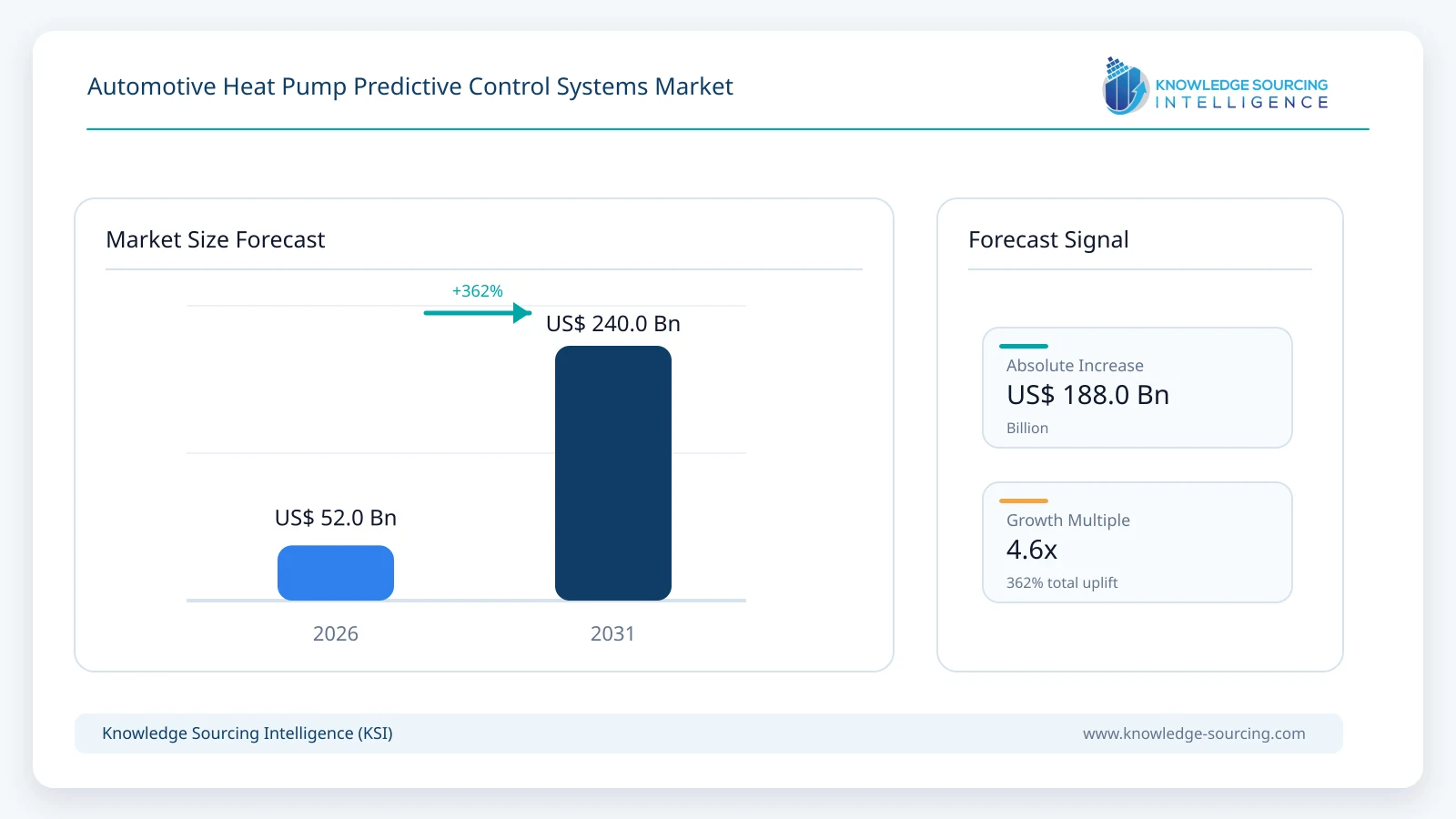
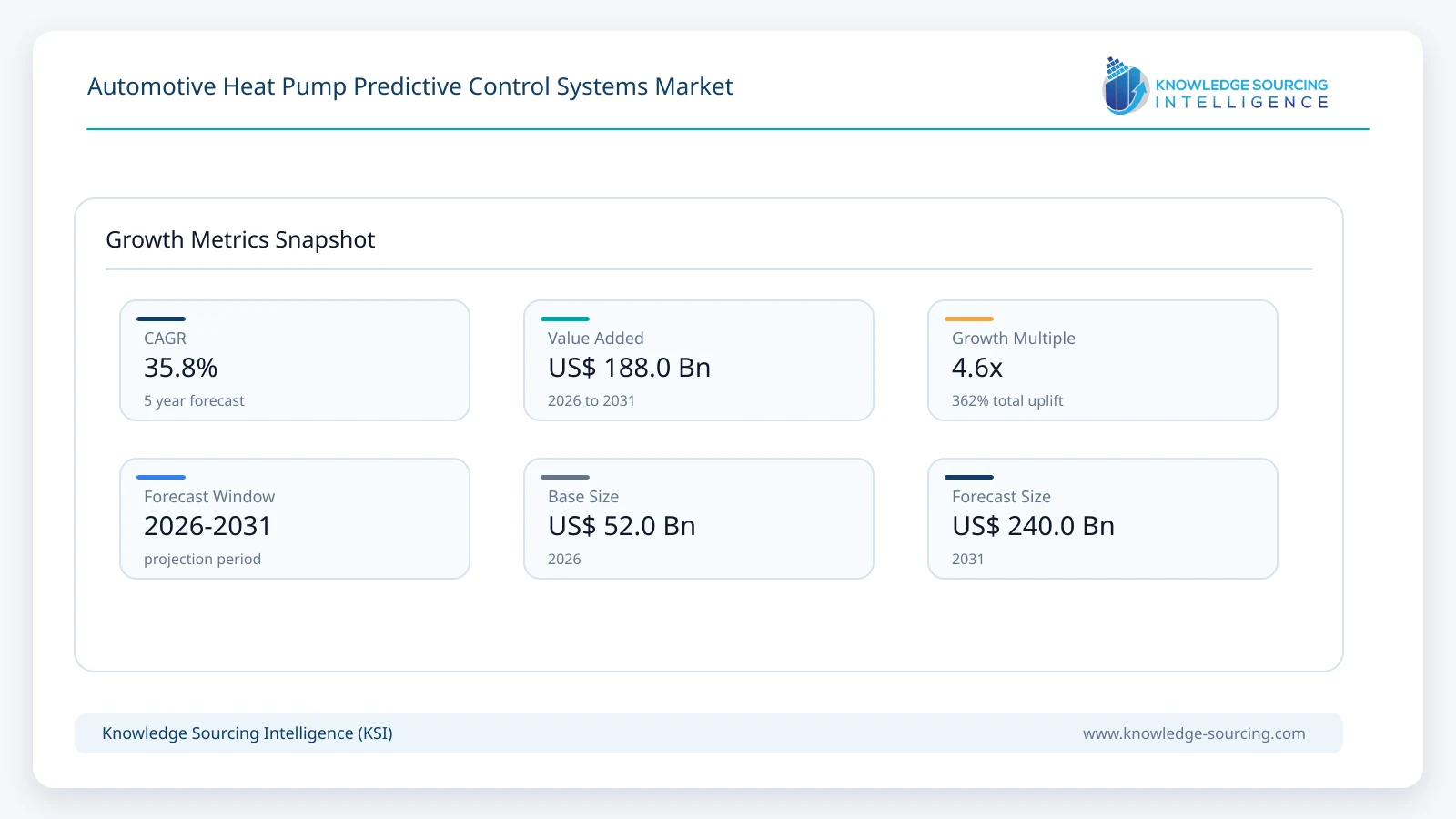
The automotive heat pump predictive control systems market is projected to expand at a CAGR of 35.8%, increasing from USD 52.0 million in 2026 to USD 240.0 million by 2031.
Highlights:
- 1Global value is modeled at USD 52 million in 2026 and USD 240 million in 2031, implying 35.8% annual growth.
- 2Route- and weather-aware heat-pump scheduling represents an estimated 32% of 2026 value, followed by cabin/battery preconditioning at 27%.
- 3Embedded predictive software accounts for an estimated 55% of 2026 revenue, increasing to 65% by 2031.
- 4Battery electric vehicles represent around 81% of 2026 demand, reflecting the energy cost of heating and thermal readiness for charging.
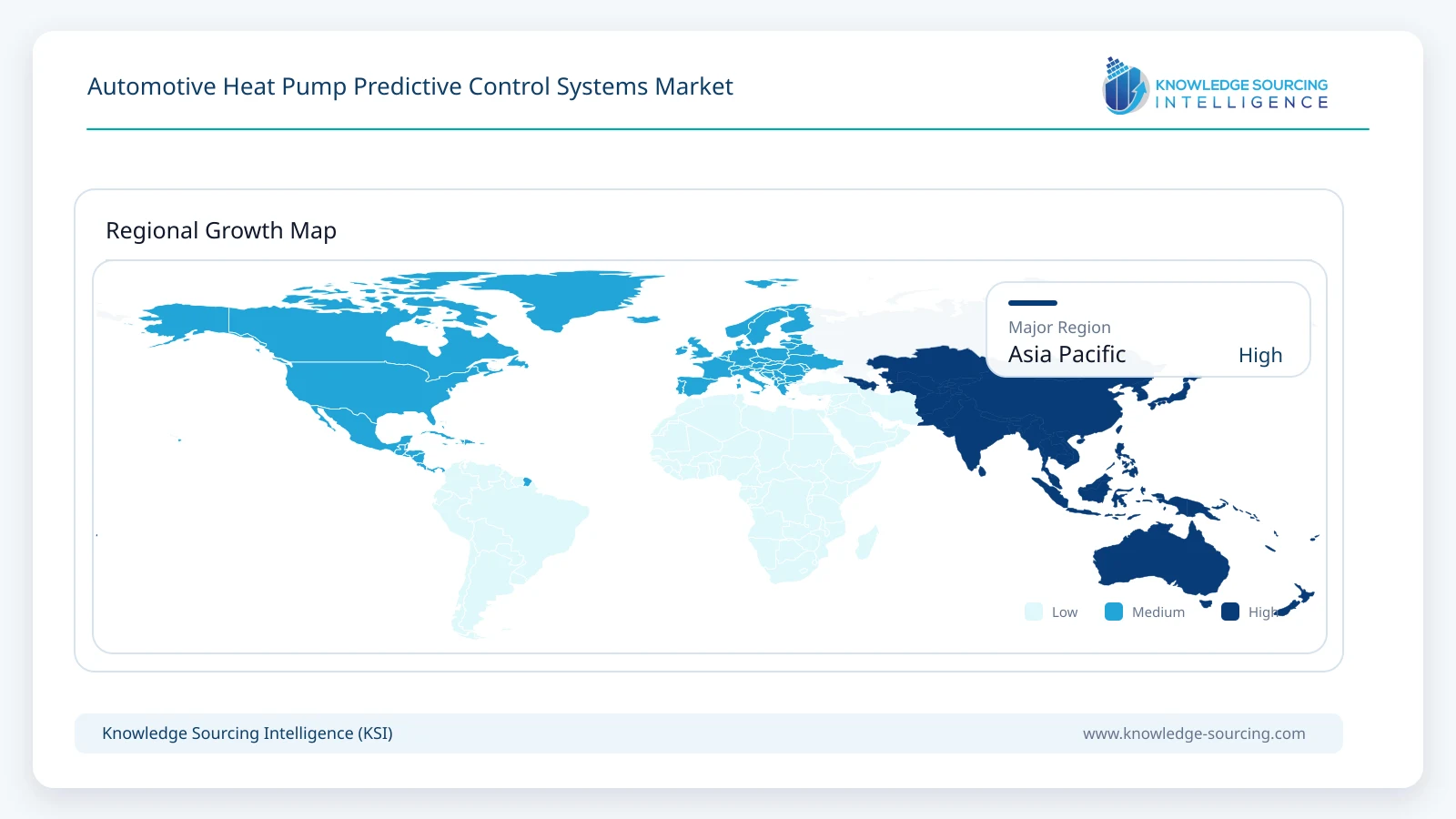
- 5Asia Pacific contributes an estimated 49% of 2026 value; Europe accounts for 28% and remains a major supplier-engineering center.
- 6The primary commercialization constraint is separating actual predictive-control supplier revenue from bundled heat-pump and OEM-developed software.
Qualifying functionality uses expected driving conditions, charging events, cabin demand or thermal-state forecasts to schedule heat-pump operation ahead of immediate feedback-control requirements. Conventional HVAC electronics, complete heat-pump assemblies and general vehicle-energy management remain outside the defined scope.
Bosch offers modular Predictive Control of Thermal System software, including heat-pump operation, waste-heat recovery and charging preconditioning functions that can be integrated into AUTOSAR-based systems. Valeo's Predict4Range combines weather and route information with battery and cabin thermal strategies; its Smart Thermal Management architecture also links the heat pump to coolant-distribution hardware. These offerings establish a distinct software opportunity, although OEM purchasing varies between discrete predictive functions and complete thermal systems with embedded, internally developed control logic.
Market Overview
An automotive heat pump uses compressor work and available environmental or vehicle waste heat to deliver cabin heating with less direct electrical energy than resistive heating under suitable conditions. The operational challenge changes as the vehicle drives: an approaching charging stop may require battery warming, a steep route section can increase drivetrain heat generation, and a sudden change in weather alters cabin demand. Predictive control can begin a heating or cooling action before the measured temperature moves beyond its target, provided system constraints and available energy are known with sufficient reliability.
Bosch markets predictive software modules that coordinate heat-pump operation, waste-heat recovery and battery preconditioning rather than requiring one proprietary hardware package. Valeo's Predict4Range incorporates ambient conditions, elevation and charger-location information to estimate a more efficient thermal strategy, while Hanon Systems supplies a thermal-management driver and configurable software library for refrigerant and coolant components. Different architectures can therefore place the supervisory algorithm inside a dedicated thermal ECU, an integrated heat-pump controller or a centralized vehicle computer, with local actuator protection remaining near the controlled devices.
Manufacturer procurement depends on the ownership of the thermal system and access to vehicle operating data. A supplier delivering a complete heat-pump module may include predictive functions in a broader integration contract, whereas an OEM with in-house energy-management software may license only calibration tools, software building blocks or controller interfaces. Charging forecasts, battery-aging behaviour, compressor maps and defrost performance require platform-specific validation; these activities contribute commercial value without implying that each heat-pump-equipped vehicle generates a separate third-party software license.
Market Trends
Route and Charging Information Are Becoming Control Inputs
Valeo's Predict4Range links real-time ambient data, road elevation, charging-station information and vehicle parameters to thermal decisions that would otherwise respond mainly to measured temperatures. A route with repeated elevation changes or an imminent fast-charging stop can justify earlier battery conditioning, while mild ambient conditions can permit the controller to defer unnecessary compressor operation. The benefit depends on correctly estimating arrival times and the thermal mass of the battery rather than only adding navigation data to an HVAC display.
Tesla's owner documentation confirms navigation-triggered battery preconditioning before designated fast chargers, establishing a production example of anticipatory thermal planning. That feature does not by itself prove a separately licensed heat-pump predictive system or that every charging-preconditioning action uses heat-pump hardware. For suppliers, the commercial opportunity lies in functions that coordinate charging preparation with heat-pump operating modes and cabin comfort across multiple vehicle platforms.
Heat-Pump Software Is Becoming a Modular Purchasing Category
Bosch packages predictive thermal control as individual modules compatible with vehicle software architectures, including functions for the heat pump, preconditioning and waste-heat recovery. Hanon Systems' modular software library separately supports compressors, electronic valves, pumps and sensors, providing OEMs with a choice between integrated supervision and selective software procurement. This flexibility is important where one platform uses several thermal hardware suppliers, and the automaker retains vehicle-level energy arbitration.
Marelli's December 2025 Intelligent Energy Management introduction describes software operating across thermal, propulsion, and electronic domains. The announcement illustrates the direction of software integration but does not establish the number of vehicles using that specific solution. Predictive heat-pump functions should be considered commercial content only when their engineering or license value can be identified within such broader control platforms.
Prediction Methods Are Moving Beyond Fixed Look-Ahead Rules
Researchers and suppliers increasingly evaluate model-predictive and adaptive control because heat pumps operate with nonlinear compressor efficiency, changing refrigerant states, and competing battery-cabin thermal demands. A study published in Energy Conversion and Management in October 2026 compared nonlinear predictive control with hierarchical control allocation for a vehicle cabin heat-pump system. The predictive approach reduced energy consumption by up to 9% under the tested conditions, while requiring greater computation.
Moving experimental optimization into series software requires more than reproducing a simulation result. Hardware-in-the-loop testing, fallback control, bounded execution time, and reliable thermal-state estimation determine whether advanced methods can operate on automotive controllers during fast transients. Suppliers able to reuse validated models and calibration infrastructure across vehicle variants may improve development economics even when the per-vehicle software price remains modest.
Cold-Weather Performance Is Shifting Toward System Coordination
ZF's TherMaS design combines heat-pump operation and fluid-flow management, illustrating how compressor strategy depends on several thermal circuits rather than cabin heating alone. MAHLE's thermal system for Mahindra's BE 6 and XEV 9e similarly links battery temperature, cabin conditions, and cooling-module airflow. Both examples support the engineering need for coordinated controls, although neither announcement discloses a separate sale of predictive heat-pump software.
Extreme-temperature operation imposes different priorities from routine energy optimization. Defrost and visibility requirements, battery temperature limits, compressor lubrication and pressure constraints must override an energy-saving forecast when conditions deteriorate. As heat pumps spread to additional climate zones and vehicle classes, validated prediction with dependable fallback behaviour is likely to determine which algorithms are adopted in high-volume programs.
Segment Analysis
By Control Function: Route- and Weather-Aware Heat-Pump Scheduling
Route- and weather-aware scheduling represents an estimated 32% of 2026 market value, reflecting software that modifies heat-pump operation before road gradient, outside temperature or driving load affects vehicle temperatures. The revenue pool is limited to attributable algorithms, controller content and calibration, rather than the value of navigation systems or weather-data subscriptions. Valeo's predictive thermal strategy provides a direct example of combining route and environmental information with energy-management commands.
The function is projected to reach approximately USD 64.8 million by 2031 while its market share moderates to 27%. Cabin-battery preconditioning and charging-aware planning gain proportionally as fast-charging coordination becomes more common on mass-market EV platforms. Vehicle manufacturers will continue to demand operation when navigation information is unavailable, limiting reliance on connected forecasts alone.
By Revenue Component: Embedded Predictive Software and Licensing
Embedded predictive software and directly attributable licensing account for approximately 55% of estimated 2026 market value. Heat-pump system suppliers increasingly deliver reusable control libraries, optimization logic and calibration packages that can operate within dedicated thermal electronics or a shared vehicle computer. Software value is identified only once, whether separately contracted or included in a qualifying thermal-controller assembly.
Software's modeled share increases to 65% by 2031 as OEMs adapt functions across multiple hardware platforms and add increasingly complex charging and route-planning inputs. Dedicated electronics remain commercially relevant for actuator command, diagnostics and local control, but the changing controller architecture encourages reuse of algorithm libraries rather than a matching increase in standalone thermal ECU content.
By Control Architecture: Dedicated Thermal-Domain ECU
Dedicated thermal-domain ECUs account for approximately 46% of market value in 2026 because many heat-pump programs retain separate electronics for compressor, valve, and pump supervision. A dedicated controller simplifies local timing and interfaces with the thermal system even when navigation and energy-demand signals originate elsewhere in the vehicle. Bosch and Hanon Systems illustrate software offerings that can be deployed across different electronics architectures.
The dedicated-ECU segment is forecast to reach USD 69.6 million by 2031 but loses share as heat-pump controllers are consolidated into modules or centralized computers. The transition does not eliminate local actuation or thermal protection requirements: safety limits and control fallback continue to require deterministic responses even when higher-level optimization is hosted centrally.
By Predictive Input: Navigation and Charging-Route Information
Navigation and charging-route information accounts for an estimated 30% of 2026 value and is projected to reach 39% by 2031. A known charger destination gives the thermal controller time to prepare battery temperature, while route gradient and expected speed improve estimates of usable waste heat and future energy demand. These functions are distinguishable from conventional set-point heating because they change the timing of thermal action before the associated load occurs.
Wider use depends on consistent interfaces between the navigation service, charging planner, and thermal controller. Charger location, expected arrival, external conditions and battery state may be unavailable or inaccurate; control software must then revert to measured-state operation without compromising passenger comfort, defogging or pack protection.
By Algorithm Strategy: Physics-Based Model Predictive Control
Physics-based model predictive control represents approximately 37% of 2026 market value and is expected to become the leading strategy by 2031. It forecasts compressor and refrigerant response over a defined time horizon while respecting temperature, pressure and energy constraints. The method is particularly suited to systems in which battery and cabin thermal demands share heat-pump capacity but respond at different speeds.
The model assigns a 47% share to this strategy in 2031, reflecting growing engineering maturity and more capable embedded controllers rather than universal adoption. Calibration quality, computational burden, and extreme-weather robustness remain substantial costs, while simpler heuristic look-ahead functions can still be more economical on tightly cost-constrained platforms.
By Propulsion: Battery Electric Vehicles
Battery electric vehicles generate an estimated 81% of the 2026 market because cabin heating directly draws on traction energy and battery temperature influences charging acceptance, regeneration, and available performance. Predictive heat-pump logic can coordinate several of these requirements before a charging stop or cold-weather drive. Plug-in hybrids also benefit, but their engine heat and different operating patterns reduce the number of heat-pump-specific programs requiring the same level of prediction.
BEV revenue is projected to reach approximately USD 199.2 million by 2031, representing 83% of the market. Growth is expected to follow electrified vehicle platforms that combine compact heat-pump modules with charging-route services and sophisticated thermal energy control, subject to lower software value on vehicles whose prediction functions are developed in-house.
Market Drivers
Growing Demand for Energy-Efficient EV Heating
Battery electric vehicles must supply cabin heat without the extensive waste heat available from combustion engines, making heat-pump operating efficiency a direct contributor to usable winter range. The IEA reported more than 20 million electric-car sales in 2025 and expected 23 million in 2026, providing a larger potential installation base for heat-pump systems. Predictive strategies can improve timing and heat recovery, but market revenue depends on separately attributable controls, not the number of EVs sold. Manufacturers are most likely to purchase advanced prediction where temperature-sensitive driving range is a measurable customer issue.
Charging-Route Preconditioning and Thermal Readiness
Battery temperature affects high-power charging acceptance, while preconditioning consumes energy and must begin sufficiently early to achieve a useful result. Navigation-linked thermal planning can choose when to heat the battery and how to allocate compressor, cabin and drivetrain heat flows as arrival approaches. Tesla's vehicle documentation establishes user-facing preconditioning around fast-charger navigation, while Bosch markets preconditioning functions within its predictive thermal software. The purchasing case strengthens where predictive heat-pump scheduling reduces charging delays without excessive cabin-heating consumption.
Higher Software Content in Integrated Heat-Pump Modules
Multiple electronic valves, variable-speed compressors and coupled coolant circuits allow the thermal system to operate in several heating, cooling and heat-recovery modes. Predictive software has more potential in these architectures because anticipating one load can affect the efficient operating point of several components. Valeo's Smart Thermal Management and Hanon Systems' modular control architecture show how heat-pump hardware is becoming tightly coupled with supervisory software. Supplier differentiation increasingly depends on repeatable algorithms and validation effort, not only compressor efficiency.
Reusable Thermal Software Across Vehicle Platforms
Automakers developing several BEV models on common architectures need control functions that can be retuned without rebuilding an entirely new software stack for each model. Bosch's modular software approach and Hanon Systems' configurable library make predictive heat-pump capabilities more adaptable across ECU and module environments. Reusable models and automated calibration can lower program engineering effort, while the supplier retains opportunities for licensing and platform-specific integration. The commercial benefit is strongest when the OEM has a clear interface specification and consistent access to thermal plant data.
Demand for Cold-Weather Comfort and Battery Durability
Cold climates expose competing requirements for rapid demisting, cabin comfort and battery conditioning, while repeated thermal excursions influence battery and electronics durability. Heat-pump controls must balance these constraints without exhausting available energy or violating compressor limits. ZF's integrated thermal architecture and MAHLE's coupled cabin-battery controls demonstrate the move toward coordinated thermal design. Predictive functionality gains value when it anticipates thermal demand and maintains safe operation over changing weather and duty cycles rather than optimizing a single steady-state condition.
Market Restraints
High Calibration and Validation Burden
Predictive heat-pump software depends on thermal models of compressors, exchangers, coolant circuits, cabin loads, and battery heat capacity. Vehicle variants with different refrigerants, pack sizes, or valve layouts can require extensive retuning and testing across temperatures, humidity, and drive cycles. Control gains demonstrated in laboratories cannot be assumed to transfer unchanged into every production vehicle. OEMs may retain simpler validated algorithms when the incremental efficiency benefit does not justify new calibration and durability programs.
Difficulties with Forecast and Navigation Data
Route-aware thermal control relies on dependable destination and arrival information, road conditions, ambient forecasts, and battery state estimates. An unexpected charger diversion, traffic delay, or inaccurate forecast can turn an early thermal action into unnecessary energy consumption. Designers must therefore constrain prediction and fall back to sensor-based feedback when the expected operating event changes. The need for robust fallback reduces the feasible benefit of aggressive heat-pump optimization and raises engineering expenditure.
Limited Separately Priced Software Revenue
Large thermal suppliers often package predictive logic inside a complete heat-pump system or broader thermal-controller contract, while vertically integrated automakers may develop the algorithm internally. Even where advanced features are present, there may be no discrete third-party license or supplier-recognized revenue for prediction. The available market is therefore substantially narrower than heat-pump unit shipments or vehicle-wide thermal-management spending. Licensing models must reflect real contract boundaries rather than applying a generic software price to every installed unit.
Real-Time Computing and Safety Constraints
Detailed predictive optimization can demand more processor time and memory than conventional feedback loops, particularly when cabin and battery constraints change rapidly. Compressor protection, pressure limits, electrical isolation and visibility-related defogging cannot depend on the success of a remote forecast or computationally intensive solver. The 2026 academic comparison of predictive and hierarchical heat-pump control reported efficiency advantages under tested conditions but also additional computational cost. Production software therefore requires bounded execution, deterministic override logic and extensive hardware-in-the-loop validation.
Heat-Pump Economics and Climate-Specific Fitment
Predictive software can only be deployed where vehicle thermal architecture includes a suitable heat pump and controllable flow paths. Lower-cost models, vehicles operating mainly in mild climates or platforms with limited thermal integration may lack the hardware flexibility needed to recover the expected software benefit. Manufacturers also weigh incremental controller cost, licensing fees and calibration effort against competing range improvements from batteries, aerodynamics and drivetrain efficiency. This limits near-term fitment below the total electric-vehicle market even as heat-pump adoption increases.
Regional Outlook
Asia Pacific
Asia Pacific is estimated to account for 49% of global value in 2026, supported by the concentration of electric-vehicle manufacturing in China and the regional presence of thermal systems suppliers in Japan and South Korea. China provides the largest addressable vehicle production base, but qualifying revenue remains limited to vehicles and contracts with attributable predictive heat-pump functions. Japanese and Korean suppliers contribute both hardware engineering and software development for heat recovery and battery-cabin integration.
Regional market value is projected to reach approximately USD 127.2 million by 2031, increasing to 53% of the global total. Rising EV model diversity, local engineering programs and faster vehicle-platform iterations can support adoption of reusable predictive algorithms, although strong automaker internal software teams may reduce the share purchased from independent providers. China's high EV penetration makes scale attractive while placing continued pressure on controller and software pricing.
Europe
European manufacturers and suppliers place substantial emphasis on heat-pump efficiency, battery conditioning and cold-weather range performance. Bosch, Valeo, ZF and MAHLE are active in different layers of predictive and integrated thermal management, creating a regional supplier base for development, calibration and cross-platform software licensing. Electric-car adoption, winter performance expectations and complex vehicle approval processes increase the technical value of reliable heat-pump control.
Europe is forecast to represent approximately USD 62.4 million by 2031, compared with USD 14.56 million in 2026. Its percentage share moderates from 28% to 26% as Asia Pacific expands more quickly, but European suppliers remain important technology contributors. Supplier selection is likely to depend on demonstrated vehicle-level energy savings, repeatable calibration methods and the ability to integrate algorithms into both dedicated thermal controllers and centralized software platforms.
Competitive Landscape
Bosch and Valeo offer some of the clearest supplier evidence for predictive thermal algorithms. Bosch's PCTS is structured as modules that can be integrated into external automotive software platforms, while Valeo's Predict4Range combines road, weather, battery and charging information to improve vehicle energy strategy. Hanon Systems and MAHLE compete from a thermal-system integration position, where heat-pump, valve and pump controls may be embedded in broader hardware programs. Marelli's multi-domain energy software and ZF's TherMaS illustrate adjacent integrated offerings, but those company claims should not be interpreted as proof of standalone predictive heat-pump license revenue.
DENSO, FEV and AVL contribute thermal hardware integration, controls engineering, modeling and calibration capabilities, although not all offerings are independently marketed as a predictive heat-pump package. Competitive advantage rests on measured energy-efficiency improvement across climates, execution reliability, reusable vehicle models and contractual access to vehicle data. The largest OEMs may internalize route prediction while sourcing thermal plant models, specialist modules or validation services; other manufacturers may adopt an integrated supplier package with fewer custom software interfaces.
Recent Developments
15 October 2026: Researchers published an experimental comparison of nonlinear model-predictive heat-pump control and hierarchical control allocation. The predictive approach achieved up to 9% energy reduction in the evaluated scenarios but imposed greater computing demand, emphasizing the trade-off between efficiency and production deployment.
April 2026: Valeo highlighted Predict4Range at Auto China 2026 alongside its integrated thermal and refrigerant-control portfolio. The company stated that the software can optimize vehicle energy strategy and support range improvement; the figure is supplier-reported and does not establish vehicle-fleet adoption.
3 December 2025: Marelli unveiled Intelligent Energy Management software designed to coordinate thermal, propulsion and electronics functions through vehicle and zonal controls. The launch broadens the software-integration options adjacent to heat-pump predictive control; a series-production heat-pump contract was not disclosed.
30 October 2025: A Bosch Global Software Technologies technical paper published by SAE discussed location-based predictive thermal control with reduced dependence on high-performance navigation or cloud connectivity. The work informs possible embedded implementations but should not be treated as an announced production shipment.
September 2025: Valeo presented Smart Thermal Management at IAA Mobility 2025, combining a smart heat pump, fluid distribution and control. The architecture provides a route to coordinated heat-flow management but includes hardware value outside the predictive-control market.
15 May 2025: MAHLE reported that its Intelligent Thermal Management System was used on Mahindra’s BE 6 and XEV 9e platform. The system integrates cabin and battery temperature management with intelligent control, providing production evidence for software-led thermal integration rather than a separately disclosed predictive heat-pump license.
Market Outlook
Automotive heat-pump predictive control is gaining importance as electric-vehicle platforms integrate heat-pump hardware with navigation services, charging planners and vehicle-level energy software. Adoption depends on the proportion of heat-pump-equipped vehicles requiring dedicated predictive logic and associated integration capabilities. Automakers are increasingly focused on improving cabin comfort, battery efficiency and driving range through coordinated thermal management. Predictive control can use route information, ambient conditions, battery status and charging plans to optimise heating and cooling operations. However, broader heat-pump installation growth does not necessarily translate into equivalent growth in independent control-platform revenue, as predictive functions may be developed internally by automakers or integrated into wider vehicle software systems.
Physics-based model predictive control and charging-route information are projected to gain share because they can coordinate future heating and cooling demand with compressor operating constraints. Reusable software packages should reduce the cost of adapting algorithms across vehicle models, but validation under extreme weather, charging transients and degraded sensor inputs remains a substantial hurdle. The value of prediction will be judged against vehicle-level efficiency, battery readiness and controllable thermal stress rather than theoretical algorithm performance alone.
Asia Pacific is expected to remain the largest regional market through 2031, while Europe continues to support specialist heat-pump software engineering and integration. The competitive market is likely to combine licensed functions from major thermal and software suppliers with OEM-developed strategies and contract calibration services. Suppliers that can show dependable results across different heat-pump layouts and retain a clear commercial boundary for their software will be best positioned to capture forecast growth.
Automotive Heat Pump Predictive Control Systems Market Scope:
| Report Metric | Details |
|---|---|
| Total Market Size in 2026 | USD 52.0 million |
| Total Market Size in 2031 | USD 240.0 million |
| Forecast Unit | USD Billion |
| Growth Rate | 35.8% |
| Study Period | 2021 to 2031 |
| Historical Data | 2021 to 2024 |
| Base Year | 2025 |
| Forecast Period | 2026 – 2031 |
| Segmentation | Predictive Control Function, Revenue Component, Control Architecture, Predictive Information Input |
| Companies |
|
Market Segmentation
By Predictive Control Function
Route- and Weather-Aware Heat-Pump Scheduling
Cabin and Battery Preconditioning Optimization
Heat Recovery and Compressor Efficiency Control
Charging-Aware Heat-Pump Thermal Planning
Predictive Defrost and Extreme-Temperature Management
By Revenue Component
Attributable Controller and Interface Electronics
Embedded Predictive Software and Licensing
Calibration and Vehicle Integration Engineering
Post-Launch Support and Updates
By Control Architecture
Dedicated Thermal-Domain ECU
Integrated Heat-Pump Module Controller
Central Vehicle / Domain Computer Application
By Predictive Information Input
Onboard Thermal-State and Driver-Demand Estimation
Navigation and Charging-Route Information
Weather, Connected Forecast and Fleet Inputs
By Algorithm Strategy
Calibrated Forecast and Look-Ahead Heuristics
Physics-Based Model Predictive Control
Adaptive and Learning-Assisted Predictive Control
By Vehicle Propulsion
Battery Electric Vehicles
Plug-in Hybrid Electric Vehicles
Other Heat-Pump-Equipped Electrified Vehicles
By Vehicle Type
Passenger Cars and SUVs
Light Commercial Vehicles
Buses and Medium/Heavy Commercial Vehicles
By Geography
Asia Pacific
China
Japan
South Korea
India
Indonesia
Thailand
Others
Europe
Germany
France
United Kingdom
Italy
Spain
Others
North America
United States
Canada
Mexico
South America
Brazil
Argentina
Others
Middle East and Africa
Saudi Arabia
United Arab Emirates
South Africa
Israel
Others
Table of Contents
1. EXECUTIVE SUMMARY
2. MARKET SNAPSHOT
2.1. Market Overview
2.2. Market Definition
2.3. Scope of the Study
2.4. Market Segmentation
3. BUSINESS LANDSCAPE
3.1. Market Drivers
3.1.1. Growing Demand for Energy-Efficient EV Heating
3.1.2. Charging-Route Preconditioning and Thermal Readiness
3.1.3. Higher Software Content in Integrated Heat-Pump Modules
3.1.4. Reusable Thermal Software Across Vehicle Platforms
3.1.5. Demand for Cold-Weather Comfort and Battery Durability
3.2. Market Restraints
3.2.1. High Calibration and Validation Burden
3.2.2. Difficulties with Forecast and Navigation Data
3.2.3. Limited Separately Priced Software Revenue
3.2.4. Real-Time Computing and Safety Constraints
3.2.5. Heat-Pump Economics and Climate-Specific Fitment
3.3. Market Opportunities
3.4. Porter’s Five Forces Analysis
3.5. Industry Value Chain Analysis
3.6. Policies and Regulations
3.7. Strategic Recommendations
4. TECHNOLOGICAL OUTLOOK
4.1. Automotive Heat-Pump Operating Modes
4.2. Route-Aware Thermal Forecasting
4.3. Navigation-Triggered Battery Preconditioning
4.4. Heat Recovery and Compressor Optimization
4.5. Model Predictive Control
4.6. Adaptive and Learning-Assisted Control
4.7. Electronic Control Architecture and AUTOSAR Integration
4.8. Calibration, Fault Handling and Extreme-Weather Validation
5. AUTOMOTIVE HEAT PUMP PREDICTIVE CONTROL SYSTEMS MARKET BY PREDICTIVE CONTROL FUNCTION
5.1. Introduction
5.2. Route- and Weather-Aware Heat-Pump Scheduling
5.3. Cabin and Battery Preconditioning Optimization
5.4. Heat Recovery and Compressor Efficiency Control
5.5. Charging-Aware Heat-Pump Thermal Planning
5.6. Predictive Defrost and Extreme-Temperature Management
6. AUTOMOTIVE HEAT PUMP PREDICTIVE CONTROL SYSTEMS MARKET BY REVENUE COMPONENT
6.1. Introduction
6.2. Attributable Controller and Interface Electronics
6.3. Embedded Predictive Software and Licensing
6.4. Calibration and Vehicle Integration Engineering
6.5. Post-Launch Support and Updates
7. AUTOMOTIVE HEAT PUMP PREDICTIVE CONTROL SYSTEMS MARKET BY CONTROL ARCHITECTURE
7.1. Introduction
7.2. Dedicated Thermal-Domain ECU
7.3. Integrated Heat-Pump Module Controller
7.4. Central Vehicle / Domain Computer Application
8. AUTOMOTIVE HEAT PUMP PREDICTIVE CONTROL SYSTEMS MARKET BY PREDICTIVE INFORMATION INPUT
8.1. Introduction
8.2. Onboard Thermal-State and Driver-Demand Estimation
8.3. Navigation and Charging-Route Information
8.4. Weather, Connected Forecast and Fleet Inputs
9. AUTOMOTIVE HEAT PUMP PREDICTIVE CONTROL SYSTEMS MARKET BY ALGORITHM STRATEGY
9.1. Introduction
9.2. Calibrated Forecast and Look-Ahead Heuristics
9.3. Physics-Based Model Predictive Control
9.4. Adaptive and Learning-Assisted Predictive Control
10. AUTOMOTIVE HEAT PUMP PREDICTIVE CONTROL SYSTEMS MARKET BY VEHICLE PROPULSION
10.1. Introduction
10.2. Battery Electric Vehicles
10.3. Plug-in Hybrid Electric Vehicles
10.4. Other Heat-Pump-Equipped Electrified Vehicles
11. AUTOMOTIVE HEAT PUMP PREDICTIVE CONTROL SYSTEMS MARKET BY VEHICLE TYPE
11.1. Introduction
11.2. Passenger Cars and SUVs
11.3. Light Commercial Vehicles
11.4. Buses and Medium/Heavy Commercial Vehicles
12. AUTOMOTIVE HEAT PUMP PREDICTIVE CONTROL SYSTEMS MARKET BY GEOGRAPHY
12.1. Introduction
12.2. Asia Pacific
12.2.1. China
12.2.2. Japan
12.2.3. South Korea
12.2.4. India
12.2.5. Indonesia
12.2.6. Thailand
12.2.7. Others
12.3. Europe
12.3.1. Germany
12.3.2. France
12.3.3. United Kingdom
12.3.4. Italy
12.3.5. Spain
12.3.6. Others
12.4. North America
12.4.1. United States
12.4.2. Canada
12.4.3. Mexico
12.5. South America
12.5.1. Brazil
12.5.2. Argentina
12.5.3. Others
12.6. Middle East and Africa
12.6.1. Saudi Arabia
12.6.2. United Arab Emirates
12.6.3. South Africa
12.6.4. Israel
12.6.5. Others
13. COMPETITIVE ENVIRONMENT AND ANALYSIS
13.1. Major Players and Strategy Analysis
13.2. Market Share Analysis
13.3. Mergers, Acquisitions, Agreements and Collaborations
13.4. Competitive Dashboard
14. COMPANY PROFILES
14.1. Robert Bosch GmbH
14.2. Valeo SE
14.3. Hanon Systems
14.4. MAHLE GmbH
14.5. Marelli Holdings Co., Ltd.
14.6. ZF Friedrichshafen AG
14.7. DENSO Corporation
14.8. AVL List GmbH
14.9. FEV Group
15. APPENDIX
15.1. Currency
15.2. Assumptions
15.3. Base and Forecast Years Timeline
15.4. Key Benefits for Stakeholders
15.5. Research Methodology
15.6. Abbreviations
Navigate
Trusted by the world's leading organizations











