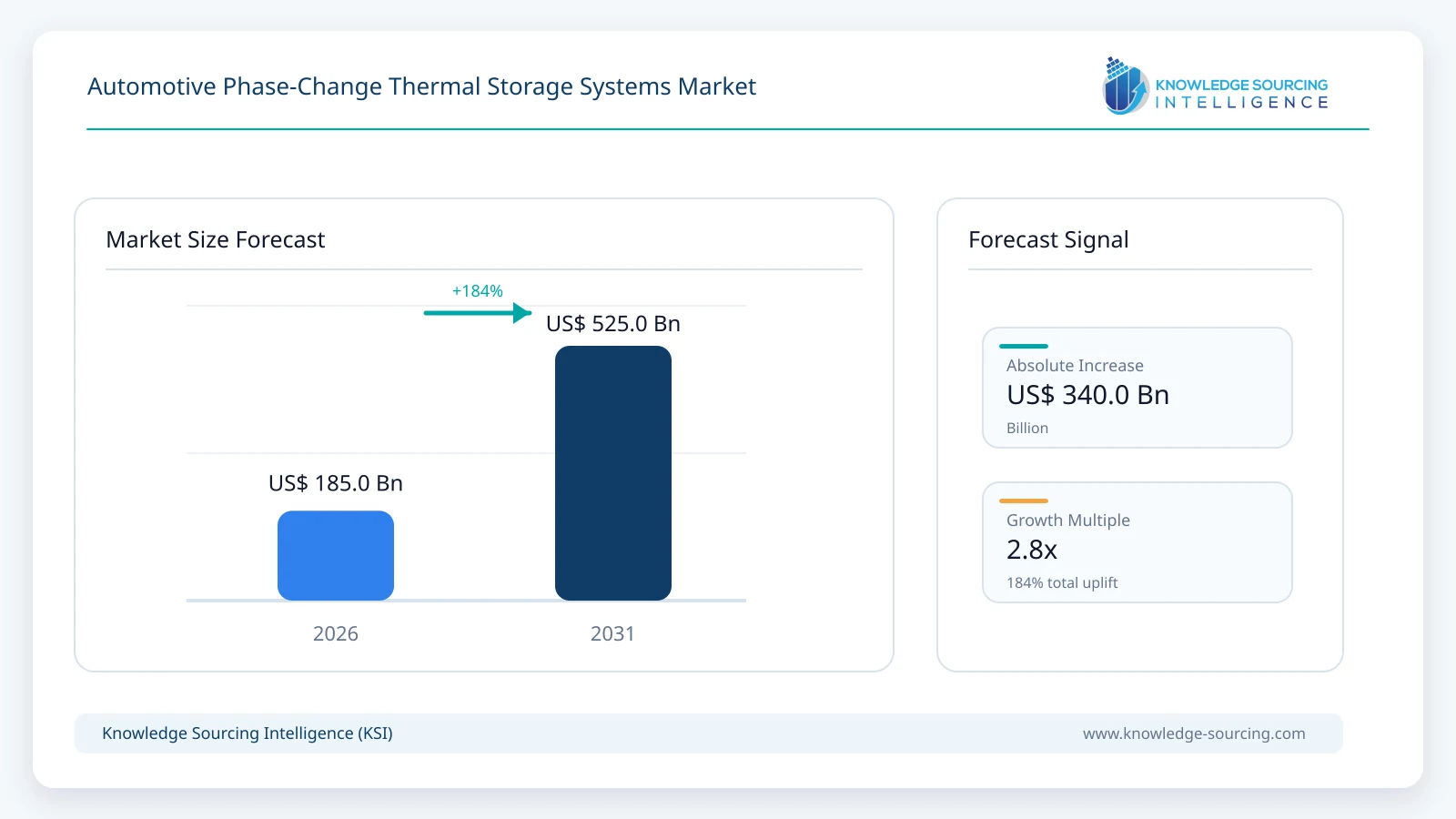
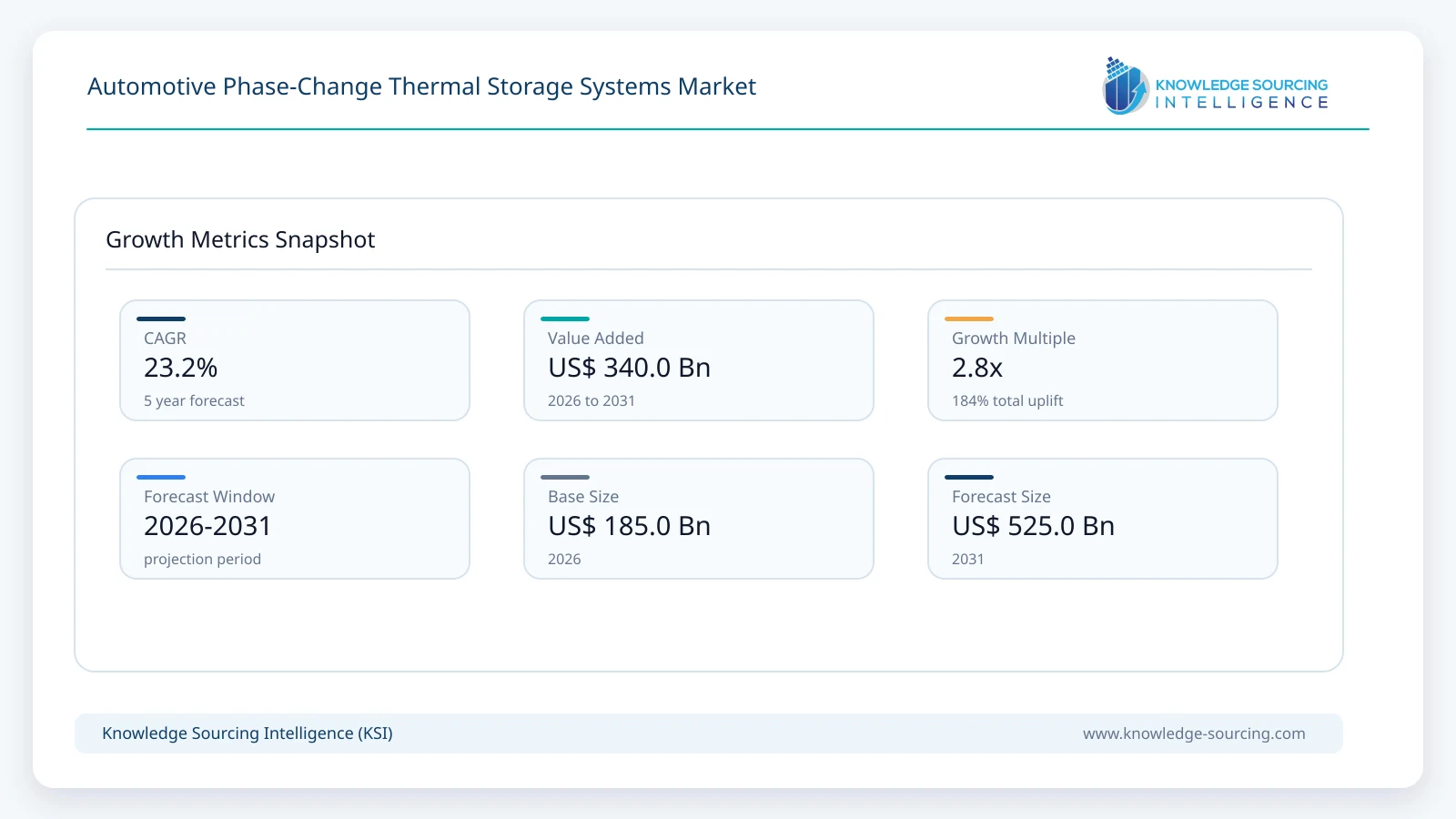
The automotive phase-change thermal storage systems market is projected to grow at a CAGR of 23.2%, increasing from USD 185 million in 2026 to USD 525 million by 2031 during the forecast period.
Highlights:
- 1Refrigerated transport represents an estimated 60% of 2026 system value, reflecting established eutectic cold-plate and thermal-battery applications in multi-stop delivery.
- 2Passenger-cabin cooling and heating storage accounts for approximately 23% of 2026 revenue, with growth tied to thermal preconditioning and compressor-off comfort rather than universal EV fitment.
- 3Battery and power-electronics thermal buffering represents approximately 13% of 2026 value and rises toward 19% by 2031, although serial-production penetration remains uncertain.
- 4Eutectic plates and cold beams account for around 53% of 2026 system revenue; the share declines as modular cabin and hybrid heat-exchanger designs expand.
- 5Asia Pacific represents an estimated 42% of 2026 value, supported by transport cold-chain infrastructure and vehicle manufacturing, and gains share by 2031.
- 6The most demanding commercial design requirements are repeatable recharge time, PCM cycling stability, packaging weight, heat-transfer rate and reliable temperature holdover.
A phase-change accumulator absorbs or releases latent heat within a defined transition range. In refrigerated road transport, a depot-supplied refrigeration circuit can freeze eutectic media before a delivery route; the media subsequently melts while absorbing heat entering the insulated load compartment. Carrier’s Vatna specifications describe storage in eutectic plates, with a dedicated refrigeration assembly used to charge them. The phase-change stage is therefore an energy buffer, not a substitute for the electrical input needed to recharge it.
Rubitherm supplies organic and inorganic PCM formulations selected for different melting ranges, including low-temperature eutectic storage and temperatures suited to vehicle air conditioning. Its automotive application guidance describes storing cabin cooling during compressor operation and releasing it during engine-off stops. Pluss packages PCM in ThermoTab thermal-battery plates, while Tessol integrates latent-heat media with heat exchangers and chargers for transport refrigeration. These offerings span materials, plate assemblies and complete cold-chain installations, with markedly different selling prices and procurement channels.
Vehicle passenger and battery applications require a different engineering balance from refrigerated cargo systems. Cabin accumulators must fit constrained air-handling packages without raising weight or restricting air flow; battery buffers need high conductive contact area and sufficient time to discharge the stored heat before the next thermal event. Active coolant loops remain responsible for continuous heat removal in demanding EV battery duty cycles. The addressable systems market consequently depends on charging opportunity, thermal duty cycle and the value of deferring active cooling rather than on PCM availability alone.
Market Trends
Depot Charging Supports Compressor-Off Distribution Routes
Carrier’s Vatna architecture and Thermo King’s FR-Series allow fleet operators to transfer refrigeration duty away from repeated urban delivery stops. Charging the cold plates during planned dwell periods can avoid running a vehicle-powered refrigeration engine on parts of the route, provided the storage capacity covers the expected number of door openings and ambient heat gain. The operating case is strongest for repetitive delivery patterns with predictable departure and return times.
Tessol describes PLUGnCHILL systems that precharge PCM thermal batteries and retain useful temperatures during subsequent transport. Pluss similarly positions its thermal-battery plates for temperature-sensitive logistics. Successful rollouts depend on depot charging infrastructure, insulation quality, vehicle payload constraints and management of routes that exceed the stored thermal reserve.
Encapsulation and Heat Exchange Determine System Performance
Rubitherm’s SP salt-water PCM formulations provide a range of temperature set points, while its encapsulation formats address how a stable thermal medium can be incorporated into heat-exchange hardware. Melting temperature alone is insufficient for system selection: the supplier must also achieve acceptable cycle stability, limited subcooling, low leakage risk and repeatable heat flux during charging and discharge.
Eutectic transport plates prioritize high latent-energy content and mechanical strength, whereas passenger-cabin modules require compact geometry and manageable air-side pressure drop. Adding fins or conductive composites increases heat exchange but also consumes space and adds assembly cost. The system designer therefore trades off effective capacity, mass, temperature uniformity and charging time rather than maximizing a single laboratory material property.
Passenger-Cabin Storage Competes With Efficient Heat Pumps
Climate-system engineers can use PCM reservoirs to maintain cabin comfort over short engine-off or compressor-off periods, but heat pumps and controlled ventilation may deliver similar operating advantages without a dedicated thermal store. Rubitherm documents the established stop-start use case, where cold charged during driving is released when the vehicle stops. Scaling that principle to EVs requires validating whether the saved compressor energy outweighs the penalty from PCM mass and added heat-exchanger surfaces.
Battery Buffers Are Moving Toward Hybrid Designs
Research published through SAE in 2025 evaluated PCM combined with liquid cold plates, as well as PCM storage-device geometry and bio-based formulations with copper fins. These investigations address the poor conductivity of unmodified PCM by creating better heat paths between cells, PCM and circulating coolant. Their results support engineering exploration, but a numerical or test-bench result must not be treated as evidence of broad serial production.
The April 2026 Next Energy review evaluated hybrid PCM battery designs and performance trade-offs under different charging conditions. A commercial battery module must eventually reject the energy absorbed by PCM during a fast-charge or high-discharge interval. Materials and system integrators will need to show that the stored heat can be removed quickly enough during realistic consecutive duty cycles before claiming a system-level efficiency advantage.
Automotive Phase-Change Thermal Storage Systems Market Segment Analysis
By Application
Refrigerated Transport Thermal Storage
Multi-stop delivery vehicles account for approximately USD 111 million, or 60% of market value in 2026. Thermal batteries and cold plates are particularly well suited to routes carrying frozen foods and other temperature-sensitive goods, because the refrigeration requirement continues while doors open and close but the opportunity for depot charging is predictable. Carrier, Thermo King, Tessol and Pluss serve different portions of the supply chain, ranging from plate-compatible refrigeration units to complete PCM transport installations.
Refrigerated transport is projected to reach about USD 273 million in 2031. Fleet investment is conditioned by vehicle-body insulation, the availability of overnight electrical supply, cold-plate mass and the operating cost of alternative battery-electric refrigeration equipment. The segment remains the largest, although its share moderates as smaller vehicle-integrated thermal-storage modules expand from a limited base.
By Application
Passenger Cabin Thermal Storage
Cabin cooling and heating storage is estimated at approximately USD 42.6 million in 2026 and USD 136.5 million by 2031. Compact latent-heat accumulators are incorporated into HVAC airflow or coolant paths to release previously stored thermal energy during stops or peak demand. Rubitherm’s automotive materials guidance identifies compressor-off cabin cooling as a working use case, but adoption depends on whether the available system volume and recharge strategy support an attractive performance benefit relative to optimized electric compressors and heat pumps.
By Architecture
Eutectic Plates and Cold Beams
Eutectic plates and beams account for approximately 53% of 2026 revenue because commercial cold-chain systems use comparatively large thermal reservoirs inside insulated truck bodies. Carrier specifies multi-plate Vatna configurations with defined accumulated cooling capacity, and Thermo King’s FR-Series is designed to operate with different cold-plate assemblies. The segment’s share declines toward 45% by 2031 as encapsulated PCM modules and heat-exchanger-integrated systems achieve stronger growth outside transport refrigeration.
By Vehicle Type
Light Commercial Vehicles
Light commercial vehicles represent about 47% of 2026 value, driven by last-mile refrigerated delivery vans and rigid distribution vehicles. Their route profiles produce a clear economic case for charging cold-storage media when parked and releasing it through delivery rounds. Fleet buyers nevertheless require validation of payload loss, temperature holdover during repeated loading cycles and maintenance downtime before specifying storage instead of a conventional refrigeration unit.
Market Drivers
Higher Refrigeration Energy Costs on Multi-Stop Routes
Road distribution vehicles experience large refrigeration loads during repeated stops and door openings. PCM cold plates shift much of the refrigeration work to planned charging periods, enabling quieter and potentially less fuel-intensive deliveries when route length and insulation are suitable. The commercial benefit is assessed against depot electricity use, installation cost and expected daily thermal throughput.
Electric Commercial-Vehicle Range Preservation
An electric delivery vehicle supplies propulsion and auxiliary refrigeration from finite stored electrical energy. Thermal energy charged before departure can reduce demand for compressor operation during selected delivery windows, provided the plate weight does not offset the saved load. The value of PCM storage therefore increases where fleets run regular delivery cycles with reliable depot access.
Passenger Thermal Comfort During Stops
Engine stop-start systems and electrified climate circuits can use charged thermal media to maintain cabin temperature while compression is temporarily reduced. Rubitherm specifies suitable temperature ranges for cabin cooling, giving integrators a materials basis for automotive HVAC designs. Purchases remain application-dependent because heat pumps and improved insulation can compete for the same energy-saving objective.
Temperature-Sensitive Urban Logistics
Food, pharmaceutical and specialty-goods fleets require stable cargo conditions throughout delivery routes. Encapsulated PCM stores can supplement or replace periods of compressor operation and help control short-term temperature excursions. Adoption depends on documented holdover performance, the number of daily door openings and appropriate charging infrastructure.
Battery and Electronics Heat-Flux Peaks
Fast charging and high power-density electronics create short thermal transients that may exceed normal continuous cooling requirements. PCM can absorb part of the transient load when coupled effectively to a heat sink or liquid loop. OEM qualification will depend on regeneration time, additional mass and evidence that consecutive high-load events remain within thermal limits.
Market Restraints
Mass and Packaging Penalties
Latent-energy storage requires PCM mass, casing, thermal interfaces and suitable installation clearance. Transport cold plates reduce payload and can displace cargo volume, while passenger-vehicle modules compete for space with HVAC ducts and crash structures. OEMs must justify these trade-offs with measurable reductions in active cooling demand.
Finite Discharge Duration and Recharging Requirements
The cooling or heating buffer ceases to provide its designed benefit when the PCM has fully transitioned. Routes longer than the energy reserve require additional compressor input or multiple storage modules; successive EV high-load events can exceed the available regeneration window. Robust control therefore requires conservative thermal sizing and a dependable recharge source.
Low Thermal Conductivity in Some PCM Formulations
Many organic PCMs transfer heat more slowly than the applications demand. Graphite, metal fins, heat pipes or liquid channels can improve heat exchange, but these features add cost and reduce the effective PCM packing fraction. The bottleneck can shift from stored energy capacity to the rate of charging and discharge.
Cycling Durability, Leakage and Material Compatibility
Long-life vehicle components undergo vibration, thermal cycling and exposure to variable ambient conditions. Some PCM systems require attention to encapsulation integrity, phase separation, supercooling and compatibility with adjacent metals or polymers. Automotive qualification can therefore be considerably more demanding than a successful static laboratory demonstration.
Competition From Efficient Active Thermal Systems
Compact heat pumps, electric compressors, battery-electric transport refrigeration and better insulation often deliver useful thermal control without dedicated PCM storage. The comparison must include the whole vehicle energy balance, system weight and field service costs. PCM loses attractiveness where a vehicle cannot recharge the store regularly or operates under highly unpredictable thermal loads.
Regional Outlook
Asia Pacific
Asia Pacific is estimated to account for 42% of global phase-change thermal storage systems revenue in 2026 and to remain the largest regional market through 2031. The region brings together rapid development of electric commercial vehicles, vehicle manufacturing and substantial demand for temperature-controlled food distribution. Pluss and Tessol provide examples of PCM transport applications in India, while Japanese thermal-storage technology is represented by the Innovation Thru Energy and Kalyani Cast Tech development agreement announced in February 2026.
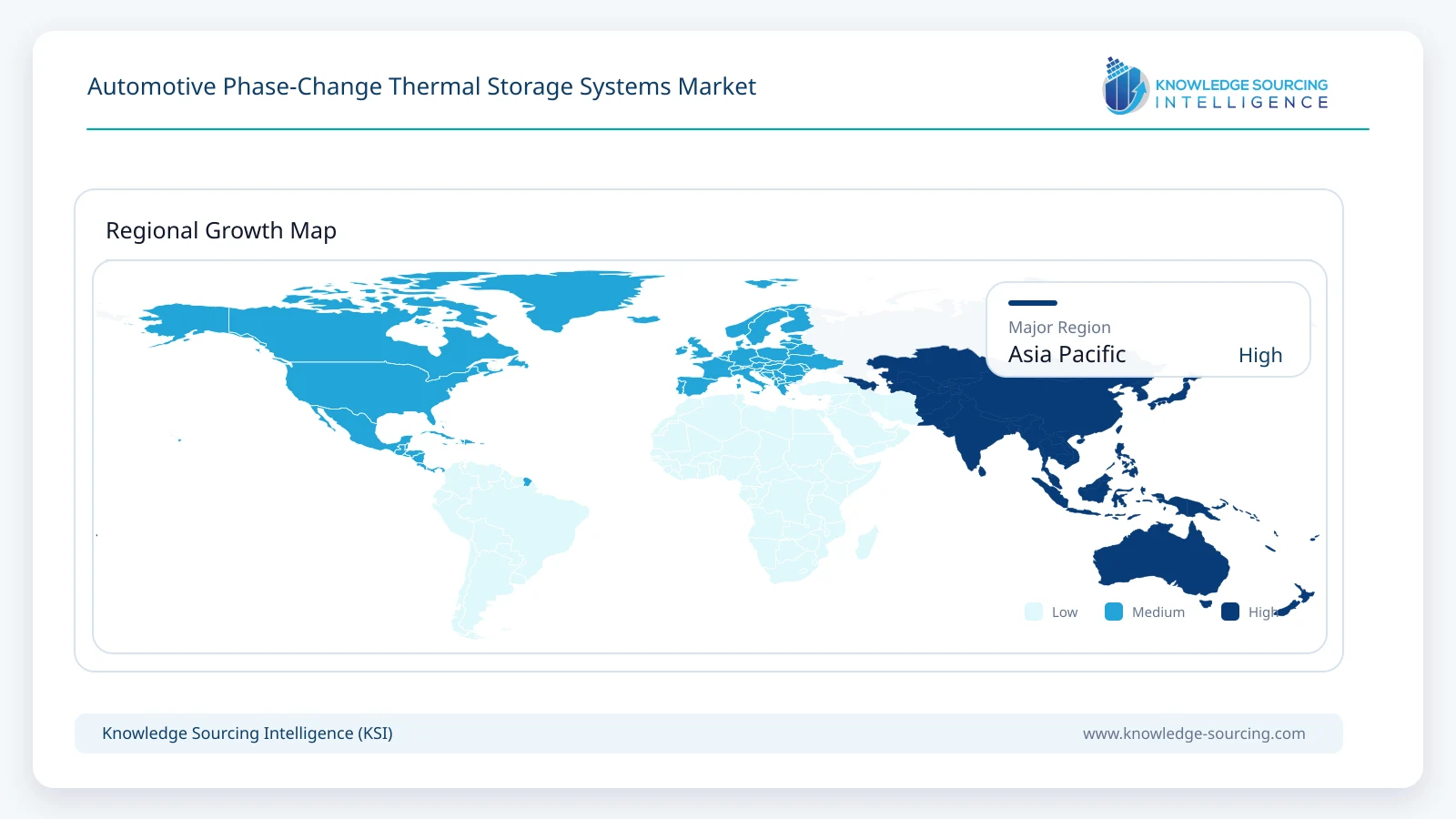
Regional growth will depend on deployment of reliable charging infrastructure for urban cold-chain operations and local manufacture of contained PCM assemblies. China, India, Japan and South Korea also host relevant automotive battery engineering capacity, although battery PCM system revenue must not be inferred from EV production alone. KSI estimates Asia Pacific revenue at approximately USD 241.5 million in 2031.
Europe
Europe represents approximately 28% of modeled 2026 revenue, supported by established refrigerated distribution systems and engineering capabilities in latent-heat storage materials. Carrier Transicold’s Vatna configurations and Thermo King’s eutectic equipment illustrate the established transport segment, while Rubitherm supports specialized cabin and battery development through materials and encapsulation technologies.
European procurement is particularly sensitive to fleet decarbonization, vehicle payload, regional refrigerant restrictions and the availability of charging facilities at logistics depots. Thermal-storage modules can complement the transition to electric transport refrigeration, but full battery-electric refrigeration units remain a viable competing approach. The European market is projected to reach about USD 141.8 million by 2031.
Competitive Landscape
Competition spans complete transport refrigeration integrators, specialist thermal-battery developers and PCM material suppliers. Carrier Transicold and Thermo King operate through vehicle refrigeration equipment and dealer networks, whereas Pluss and Tessol emphasize thermal-storage packages for cold-chain operations. Rubitherm participates further upstream with material formulations and encapsulation options that can be specified by system developers. These roles should not be treated as interchangeable market shares because each supplier sells a different level of the thermal-storage value chain.
A packaged system supplier competes on practical holdover duration, recharge time, available cargo volume, service support and field reliability rather than latent heat capacity alone. Passenger and battery applications demand an additional level of engineering validation around long-life cycling and vehicle integration. The February 2026 alliance between Kalyani Cast Tech and Innovation Thru Energy signals a potential manufacturing route for refrigerated containers, but the agreement does not itself demonstrate completed production or revenue.
Recent Developments
April 2026: A peer-reviewed Next Energy review evaluated PCM-based EV battery thermal management, including composite materials and hybrid heat-transfer structures. Its findings add design evidence but do not establish automotive series deployment.
September 2025: SAE published an IAV-led assessment of PCM as a complementary battery cooling approach that may reduce active cooling under defined operating conditions. The analysis emphasizes duty-cycle dependence rather than universal fitment.
April 2025: SAE published numerical research on bio-based composite PCM and copper fins for LFP cell cooling, demonstrating the importance of conductive enhancements in high-discharge cases.
April 2025: SAE published a numerical design optimization study of phase-change energy storage exchangers for electric-vehicle batteries, addressing fin geometry and heat-transfer limits.
February 2025: SAE published a battery thermal-management study combining phase-change media with liquid cold plates, advancing the evidence base for hybrid battery cooling rather than PCM-only systems.
Market Outlook
The phase-change thermal storage systems market is projected to reach USD 525 million in 2031 as proven transport cold-storage applications are joined by selective passenger thermal-comfort and EV thermal-buffer products. Fleet deployments retain the clearest near-term return-on-investment mechanism because thermal charging can be scheduled, delivery durations are known and service performance can be monitored. The outcome for passenger and battery systems depends more heavily on OEM packaging decisions and demonstrable system-level energy savings.
Commercialization is likely to concentrate on modules that pair repeatable phase-change properties with effective heat exchangers, reliable containment and control of thermal recharge. Systems that cannot dissipate stored heat before a subsequent operating peak will remain limited to infrequent or low-load applications. The broader growth opportunity is therefore in qualified packaged thermal systems, not in assuming that all thermal-interface or EV battery material sales represent rechargeable storage.
Automotive Phase-Change Thermal Storage Systems Market Scope:
| Report Metric | Details |
|---|---|
| Total Market Size in 2026 | USD 185 million |
| Total Market Size in 2031 | USD 525 million |
| Forecast Unit | USD Billion |
| Growth Rate | 23.2% |
| Study Period | 2021 to 2031 |
| Historical Data | 2021 to 2024 |
| Base Year | 2025 |
| Forecast Period | 2026 – 2031 |
| Segmentation | Application, Storage System Architecture, PCM Chemistry, Operating Temperature, Vehicle Type, Thermal Charging Approach, Customer Procurement Channel, Geography |
| Companies |
|
Market Segmentation
By Application
Refrigerated Transport Thermal Storage
Passenger Cabin Cooling and Heating Storage
Battery and Power-Electronics Thermal Buffering
Engine Heat Recovery and Other Vehicle Uses
By Storage System Architecture
Eutectic Plates and Cold Beams
Encapsulated PCM Module Assemblies
PCM Heat-Exchanger and Hybrid Liquid Systems
Other Integrated Thermal Reservoirs
By PCM Chemistry
Inorganic and Eutectic Formulations
Organic and Paraffin-Based Formulations
Composite and Bio-Based Enhanced Formulations
Other Engineered PCM Materials
By Operating Temperature
Sub-Zero Storage
0°C to 15°C Storage
Above 15°C to 45°C Storage
Above 45°C Storage
By Vehicle Type
Light Commercial Vehicles
Medium and Heavy Commercial Vehicles
Passenger Cars
Buses and Other Road Vehicles
By Thermal Charging Approach
Grid or Depot-Preconditioned Storage
Vehicle HVAC and Refrigerant Loop Charging
Hybrid Liquid Loop and Dedicated Charging
Waste Heat and Other Charging Methods
By Customer Procurement Channel
Vehicle OEM-Integrated Systems
Specialist Bodybuilders and Retrofit Integrators
Fleet-Direct and Other Programs
By Geography
Asia Pacific
China
India
Japan
South Korea
Indonesia
Thailand
Others
Europe
Germany
France
United Kingdom
Italy
Spain
Others
North America
United States
Canada
Mexico
South America
Brazil
Argentina
Others
Middle East and Africa
Saudi Arabia
United Arab Emirates
South Africa
Others
Table of Contents
1. EXECUTIVE SUMMARY
2. MARKET SNAPSHOT
2.1. Market Overview
2.2. Market Definition
2.3. Scope of the Study
2.4. Market Segmentation
3. BUSINESS LANDSCAPE
3.1. Market Drivers
3.1.1. Higher Refrigeration Energy Costs on Multi-Stop Routes
3.1.2. Electric Commercial-Vehicle Range Preservation
3.1.3. Passenger Thermal Comfort During Stops
3.1.4. Temperature-Sensitive Urban Logistics
3.1.5. Battery and Electronics Heat-Flux Peaks
3.2. Market Restraints
3.2.1. Mass and Packaging Penalties
3.2.2. Finite Discharge Duration and Recharging Requirements
3.2.3. Low Thermal Conductivity in Some PCM Formulations
3.2.4. Cycling Durability, Leakage and Material Compatibility
3.2.5. Competition From Efficient Active Thermal Systems
3.3. Market Opportunities
3.4. Porter’s Five Forces Analysis
3.5. Industry Value Chain Analysis
3.6. Policies and Regulations
3.7. Strategic Recommendations
4. TECHNOLOGICAL OUTLOOK
4.1. Latent Heat Storage and Temperature Selection
4.2. Organic, Inorganic and Composite PCM Formulations
4.3. Encapsulation and Thermal Interface Design
4.4. Refrigerated Transport Charging and Heat Exchange
4.5. Vehicle Cabin and EV Battery System Integration
5. AUTOMOTIVE PHASE-CHANGE THERMAL STORAGE SYSTEMS MARKET BY APPLICATION
5.1. Introduction
5.2. Refrigerated Transport Thermal Storage
5.3. Passenger Cabin Cooling and Heating Storage
5.4. Battery and Power-Electronics Thermal Buffering
5.5. Engine Heat Recovery and Other Vehicle Uses
6. AUTOMOTIVE PHASE-CHANGE THERMAL STORAGE SYSTEMS MARKET BY STORAGE SYSTEM ARCHITECTURE
6.1. Introduction
6.2. Eutectic Plates and Cold Beams
6.3. Encapsulated PCM Module Assemblies
6.4. PCM Heat-Exchanger and Hybrid Liquid Systems
6.5. Other Integrated Thermal Reservoirs
7. AUTOMOTIVE PHASE-CHANGE THERMAL STORAGE SYSTEMS MARKET BY PCM CHEMISTRY
7.1. Introduction
7.2. Inorganic and Eutectic Formulations
7.3. Organic and Paraffin-Based Formulations
7.4. Composite and Bio-Based Enhanced Formulations
7.5. Other Engineered PCM Materials
8. AUTOMOTIVE PHASE-CHANGE THERMAL STORAGE SYSTEMS MARKET BY OPERATING TEMPERATURE
8.1. Introduction
8.2. Sub-Zero Storage
8.3. 0°C to 15°C Storage
8.4. Above 15°C to 45°C Storage
8.5. Above 45°C Storage
9. AUTOMOTIVE PHASE-CHANGE THERMAL STORAGE SYSTEMS MARKET BY VEHICLE TYPE
9.1. Introduction
9.2. Light Commercial Vehicles
9.3. Medium and Heavy Commercial Vehicles
9.4. Passenger Cars
9.5. Buses and Other Road Vehicles
10. AUTOMOTIVE PHASE-CHANGE THERMAL STORAGE SYSTEMS MARKET BY THERMAL CHARGING APPROACH
10.1. Introduction
10.2. Grid or Depot-Preconditioned Storage
10.3. Vehicle HVAC and Refrigerant Loop Charging
10.4. Hybrid Liquid Loop and Dedicated Charging
10.5. Waste Heat and Other Charging Methods
11. AUTOMOTIVE PHASE-CHANGE THERMAL STORAGE SYSTEMS MARKET BY CUSTOMER PROCUREMENT CHANNEL
11.1. Introduction
11.2. Vehicle OEM-Integrated Systems
11.3. Specialist Bodybuilders and Retrofit Integrators
11.4. Fleet-Direct and Other Programs
12. AUTOMOTIVE PHASE-CHANGE THERMAL STORAGE SYSTEMS MARKET BY GEOGRAPHY
12.1. Introduction
12.2. Asia Pacific
12.2.1. By Country
12.2.1.1. China
12.2.1.2. India
12.2.1.3. Japan
12.2.1.4. South Korea
12.2.1.5. Indonesia
12.2.1.6. Thailand
12.2.1.7. Others
12.3. Europe
12.3.1. By Country
12.3.1.1. Germany
12.3.1.2. France
12.3.1.3. United Kingdom
12.3.1.4. Italy
12.3.1.5. Spain
12.3.1.6. Others
12.4. North America
12.4.1. By Country
12.4.1.1. United States
12.4.1.2. Canada
12.4.1.3. Mexico
12.5. South America
12.5.1. By Country
12.5.1.1. Brazil
12.5.1.2. Argentina
12.5.1.3. Others
12.6. Middle East and Africa
12.6.1. By Country
12.6.1.1. Saudi Arabia
12.6.1.2. United Arab Emirates
12.6.1.3. South Africa
12.6.1.4. Others
13. COMPETITIVE ENVIRONMENT AND ANALYSIS
13.1. Major Players and Strategy Analysis
13.2. Market Share Analysis
13.3. Mergers, Acquisitions, Agreements and Collaborations
13.4. Competitive Dashboard
14. COMPANY PROFILES
14.1. Carrier Transicold
14.2. Thermo King (Trane Technologies)
14.3. Pluss Advanced Technologies
14.4. Tessol
14.5. Rubitherm Technologies
14.6. Innovation Thru Energy
14.7. Rinac India
15. APPENDIX
15.1. Currency
15.2. Assumptions
15.3. Base and Forecast Years Timeline
15.4. Key Benefits for Stakeholders
15.5. Research Methodology
15.6. Abbreviations
Navigate
Trusted by the world's leading organizations