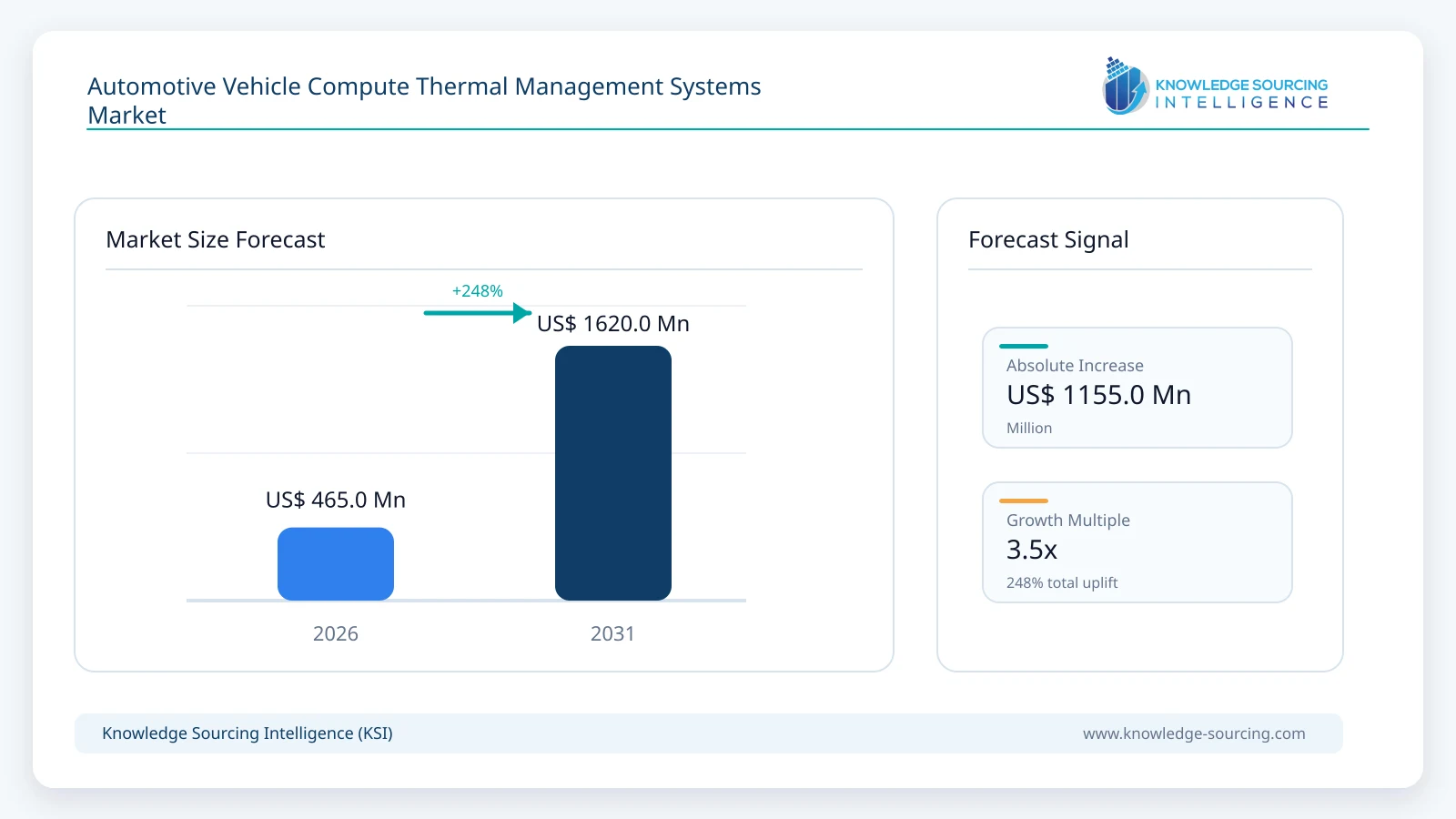
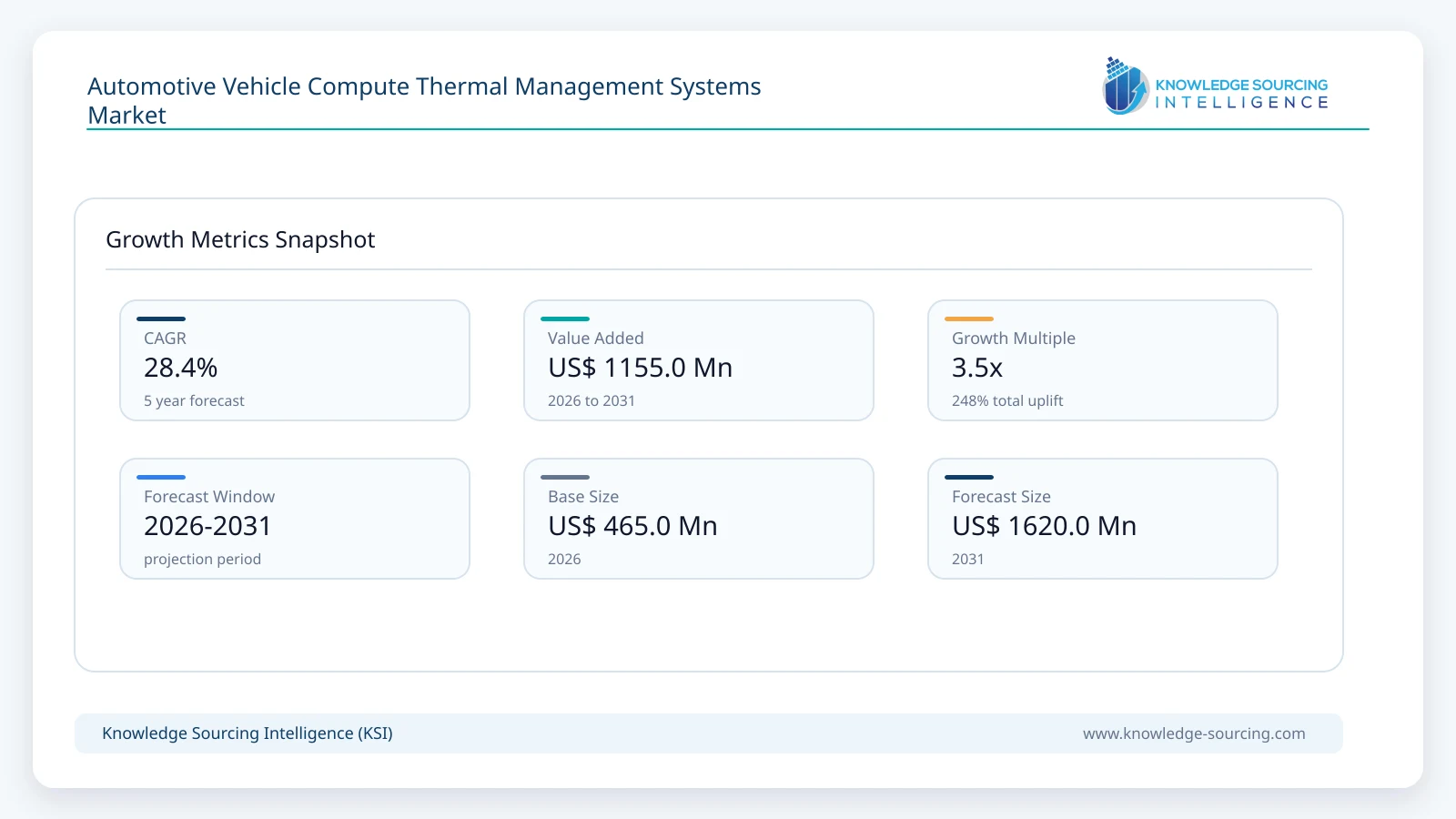
The automotive vehicle compute thermal management systems market is projected to expand at a CAGR of 28.4%, reaching USD 1,620 million in 2031 from USD 465 million in 2026.
Highlights:
- 1Passive cooling remains the largest method in 2026, although liquid-based thermal management captures a larger share as central computers become denser.
- 2ADAS and automated-driving computing accounts for an estimated 42% of the 2026 thermal value and remains the principal application through 2031.
- 3Heat sinks, spreaders and integrated housings represent the largest component group in 2026, while liquid cold plates and interfaces gain importance.
- 4Asia Pacific contributes approximately 44% of 2026 market value, reflecting automotive electronic-module production and increasing ADAS fitment.
- 5Valeo and Calyos are developing passive two-phase chip cooling for software-defined vehicle controllers, but the June 2026 memorandum is not evidence of mass production.
- 6Thermal-cycle reliability, material outgassing, vibration durability and high-volume dispensing remain key supplier qualification requirements.
The automotive vehicle compute thermal management systems market covers heat-transfer components, processor-to-housing thermal interfaces, fan assemblies, liquid cold plates, localized pumps and valves, and the directly attributable engineering and thermal-control hardware used in higher-performance in-vehicle computing platforms. Applications include ADAS computers, digital cockpit processors and consolidated vehicle computers. Battery pack cooling, traction inverter cooling, conventional passenger HVAC and the purchase value of complete computers are outside the market.
Valeo specifies passive, active-air and liquid-cooling configurations for its ADAS domain controller, including a cooling envelope of up to 250 W. AUMOVIO offers fluid-cooled central high-performance computers and identifies liquid cooling as an option for its cockpit HPC. These established offerings show how processor cooling is selected alongside the ECU housing, processing configuration and installation position rather than purchased as an independent vehicle-wide climate system.
Market Overview
Automotive high-performance computers concentrate functions previously distributed across multiple electronic control units, creating localized heat flux at processors, memory devices and power regulators. A sealed vehicle computer cannot always reject this heat through its housing alone, particularly when it is packaged behind a dashboard or near warm underbody components. Processor temperature limits, enclosure surface temperatures and sustained workload requirements consequently determine whether a design uses passive conduction, forced airflow or a connection to a coolant circuit.
Valeo’s ADAS domain controller combines configurable processing capacity with alternative passive, air-cooled and liquid-cooled designs. AUMOVIO’s central HPC platform can incorporate a fluid-cooling system, while its cockpit HPC permits liquid cooling for more demanding configurations. These different approaches allow OEMs to select a thermal solution according to the processor power envelope, operating duty cycle, available coolant routing and physical installation constraints. The choice also affects acoustic noise, serviceability, packaging space and module validation.
Thermal-interface materials link processors and populated circuit boards to spreaders, covers and cooling plates. Henkel’s Bergquist gap fillers, Dow’s DOWSIL products and Parker Chomerics’ automotive thermal gels are designed for electronic modules that must withstand thermal cycling and automated production. As high-performance computers consolidate more functions, suppliers increasingly combine structural enclosure design, interface-material dispensing and electronics thermal simulation to limit hot spots while maintaining repeatable factory assembly.
Market Trends
Liquid Cooling Is Moving Into Higher-Density Compute Platforms
Computing modules that host multiple automated-driving workloads impose sustained thermal loads that may exceed what practical enclosure-mounted fins can reject in restricted installation spaces. Valeo offers an ADAS controller with passive, forced-air and liquid-cooling alternatives, while AUMOVIO identifies integrated fluid cooling for its central computer architecture. Directly cooled housing plates offer greater freedom to locate high-performance electronics away from cabin airflow, but require dependable seals, connections and coolant compatibility.
An OEM that already operates liquid thermal circuits can sometimes use a dedicated electronics branch rather than a self-contained active cooling system. That approach reduces local fan noise, yet introduces routing complexity and potential shared-system dependencies. The thermal assembly therefore competes on total system integration cost and reliability rather than cooling capacity alone.
Two-Phase Heat Transfer Is Being Evaluated for Compact Controllers
Valeo and Calyos announced a memorandum of understanding in June 2026 to develop passive loop-heat-pipe solutions for high-power chips, including centralized vehicle processors. Phase-change heat transport could remove heat without a local mechanical pump, potentially simplifying compact module designs and limiting vibration-related wear. Industrialization, field qualification and vehicle-scale deployment remain to be demonstrated under the collaboration.
Passive two-phase assemblies for vehicle controllers require more extensive application qualification than simple cast-aluminum spreaders. Automotive customers must test transient startup temperatures, orientation effects, sealing and durability across varied weather and road-use conditions before incorporating a new technology into a production compute assembly.
Thermal Interface Materials Are Becoming More Production-Specific
Henkel introduced Bergquist Gap Filler TGF 6500LVO in July 2026 with 6.5 W/m-K conductivity and a low-volatility formulation intended for automotive electronics such as ADAS modules and ECUs. The earlier TGF 2100LVO introduction in July 2025 emphasized low outgassing and dispensing suitability for electronic control modules. The commercial challenge extends beyond laboratory conductivity to repeatable bond-line thickness, compression force, wetting behavior and manufacturability.
Parker Chomerics markets automotive ECU gels that tolerate vibration and temperature cycling while supporting automated dispensing. These formulations help protect densely populated boards from excessive assembly pressure, but their thermal performance depends on actual interface geometry and long-term stability rather than nominal conductivity alone.
Compute Efficiency Is Being Addressed Alongside Mechanical Cooling
DENSO’s March 2026 technology presentation linked next-generation ADAS ECU design to lower-power circuits, workload-adaptive power control and thermal engineering, with air cooling identified as a target for suitably optimized systems. Processor efficiency can defer the need for pumps or coolant connections in cost-sensitive vehicle segments, especially when sufficient performance can be delivered with a smaller thermal budget.
NVIDIA’s May 2026 technical discussion of in-vehicle AI illustrates how local language-model workloads and autonomous-driving functions can coexist in increasingly capable vehicle compute platforms. Integration raises questions about peak versus sustained processor activity, so thermal design must account for actual use cases rather than interpreting theoretical compute throughput as heat output.
Thermal Packaging Is Becoming Part of Computer Platform Design
High-performance vehicle computers combine processing boards, memory, communications and power regulation within environmentally sealed enclosures. Moving the cooling design into the early ECU architecture stage allows engineers to select processor orientation, thermal spreader contact locations and enclosure mounting paths before vehicle integration limits access to heat-rejection surfaces.
As automakers reuse compute platforms across several model lines, modular thermal subassemblies can reduce engineering repetition, provided the mounting geometry and coolant or airflow interfaces remain consistent. Reuse is most valuable when regional temperature extremes and equipment options are considered during the original qualification.
Segment Analysis
By Cooling Technology: Passive Heat Sinks and Heat Pipes
Passive thermal approaches represent approximately 48% of modeled value in 2026 because many cockpit computers and entry-to-midrange ADAS platforms can discharge heat through a metal enclosure, localized heat pipes and appropriate interface materials. Passive assemblies avoid moving components and place fewer demands on power, acoustic performance and field maintenance.
Passive cooling continues to meet the needs of compact cockpit processors and midrange ADAS modules through 2031 even as its revenue share declines. DENSO’s emphasis on compute energy efficiency and air-cooled ADAS designs indicates that processor and packaging improvements can offset some thermal-load growth rather than leading every platform toward liquid cooling.
By Cooling Technology: Pumped Liquid Cooling
Liquid cooling becomes increasingly relevant when multiple processors share a small enclosure or when compute units are installed away from suitable airflow. AUMOVIO’s fluid-cooled central HPC and Valeo’s liquid-cooled ADAS controller show how suppliers are incorporating coolant interfaces into production-oriented architectures, particularly for more advanced automated-driving platforms.
The modeled liquid-cooling share rises from around 21% in 2026 to 36% in 2031. Procurement is influenced by vehicle coolant-system availability, cold-plate corrosion resistance, connector sealing and the service cost of a leak or blocked channel.
By Compute Domain: ADAS and Automated-Driving Compute
ADAS and automated-driving computers account for approximately 42% of market value in 2026 because perception, sensor fusion and decision workloads can impose sustained power consumption. Thermal design must preserve processor behavior during prolonged highway use, high ambient temperature and temporary cooling degradation without compromising safety-relevant function availability.
The segment is projected to remain the largest through 2031 as higher-resolution perception and local AI processing support more sophisticated vehicle automation. Its thermal content grows with processor concentration, not simply with the number of cameras or sensors installed.
By Thermal Revenue Component: Heat Sinks, Spreaders and Housings
Aluminum housings, thermal spreaders and contact structures provide the principal heat-transfer path in many automotive compute modules. Their geometry is developed with the PCB and sealed enclosure to remove heat while limiting mechanical load on packages and connectors. The segment accounts for roughly USD 155 million of 2026 value.
Higher-density designs create more demand for cold plates and coolant-compatible interfaces, while passive housing structures continue to be essential even in liquid-cooled computers. Suppliers therefore compete through die-casting design, joining quality, thermal flatness and assembly yield alongside material performance.
By Compute Thermal Load: 100–250 W Platforms
Compute assemblies in the 100–250 W cooling class sit between passively cooled mainstream systems and very high-output central computers. Valeo’s published ADAS controller specifications illustrate a product family spanning cooling approaches at power envelopes up to 250 W, allowing OEMs to select thermal packages suited to different processing configurations.
The modeled share of this class increases from 35% in 2026 to 42% in 2031. These values represent the qualification envelope for the thermal subsystem, not the actual continuous draw of every processor used in the same controller family.
By Geography: Asia Pacific
Asia Pacific is estimated to account for 44% of 2026 revenue, supported by automotive electronic-module production, vehicle assembly scale and high-performance infotainment and ADAS adoption across China, Japan and South Korea. OICA identifies Asia as a major contributor to the industry’s 2025 production growth, although production totals do not directly establish thermal-system spending.
China’s advanced local vehicle electronics ecosystem and Japanese and Korean component engineering contribute to the regional opportunity. Qualification of locally manufactured interfaces, housings and coolant parts can shape procurement decisions as OEMs introduce common compute architectures across domestic and export vehicle platforms.
Market Drivers
Higher Sustained Power Density in ADAS Computers
Combining perception acceleration, memory and sensor interfaces inside ADAS domain computers raises localized heat density. Thermal engineering must control hotspot temperatures under continuous operation, not only during short performance peaks. Valeo’s range of cooling configurations up to a 250 W envelope illustrates how active liquid designs appear alongside simpler passive units as compute configurations become more demanding.
Consolidation of Previously Distributed Electronic Functions
Centralized and cross-domain computers replace several smaller ECUs with fewer higher-capacity units. AUMOVIO’s modular central HPC architecture highlights the packaging challenge of integrating processing, power supplies and communications inside one system. The reduction in distributed boxes can therefore increase the performance requirement and value of thermal hardware per qualifying module.
Qualification Requirements for Vehicle Electronics
Automotive electronic modules must operate over climatic stresses associated with their actual installation locations, making thermal-cycle durability and material stability important design inputs. ISO 16750-4:2023 addresses climatic environmental testing, while automotive product safety engineering sets additional reliability requirements. Suppliers that document long-term joint, material and seal performance can reduce qualification risk for OEM programs.
Higher Software Workloads Within Cockpit Platforms
Digital cockpits increasingly combine multiple displays, graphics, AI-assisted interactions and communications within integrated computing units. AUMOVIO’s cockpit HPC supports multiple display and camera inputs and permits liquid cooling in higher-demand variants. Long operating periods and restricted dashboard ventilation encourage specialized enclosure and heat-spreader designs.
Production Demand for Stable Thermal Interfaces
ADAS processor cooling performance depends on interfaces that remain stable through vibration, thermal cycling and high-volume assembly. Henkel’s TGF 6500LVO and Parker Chomerics’ ECU thermal materials address conductivity and dispensing requirements together. Standardized interface processing can improve manufacturing yield and reduce the need for corrective thermal rework after module assembly.
Market Restraints
Additional Cost and Integration Work for Liquid Cooling
Liquid cold plates, connectors, seals and coolant routing increase complexity relative to a passive housing. Vehicle makers must demonstrate that the resulting thermal margin is necessary for processor performance and worth the added warranty exposure. The extra cost can limit liquid cooling to higher-value ADAS and consolidated computer configurations.
Sealing, Corrosion and Leak Reliability
A failed cooling interface may compromise sensitive electronic modules while also creating repair and service costs. Automotive cold-plate designs must withstand corrosion, pressure variation, vibration and long service intervals. These requirements extend development cycles and can slow substitution of established air-cooled or passively cooled designs.
Software and Chip Power-Efficiency Improvements
Advances in processor energy efficiency, workload scheduling and package-level heat distribution can reduce the need for more elaborate cooling. DENSO’s 2026 design presentation explicitly links ADAS ECU power optimization to air-cooling feasibility. Thermal suppliers may therefore face lower content per computer than raw processing-performance growth suggests.
Constrained Packaging and Thermal Paths
Dashboard and underbody installation sites provide limited clearance for fans, fins or coolant connectors. Restricted airflow and adjacent heat sources complicate module design, while acoustic requirements can constrain active air cooling in the passenger compartment. Thermal package selection must account for vehicle-level mechanical interfaces early in development.
Long Qualification and Change-Control Cycles
Automakers validate thermal interfaces as part of the electronic module rather than as interchangeable consumables. A change to material, dispenser settings or housing tolerances may require further vibration, climatic and compatibility tests. These validation demands favor established suppliers and can postpone adoption of higher-conductivity or two-phase alternatives.
Regional Outlook
Asia Pacific
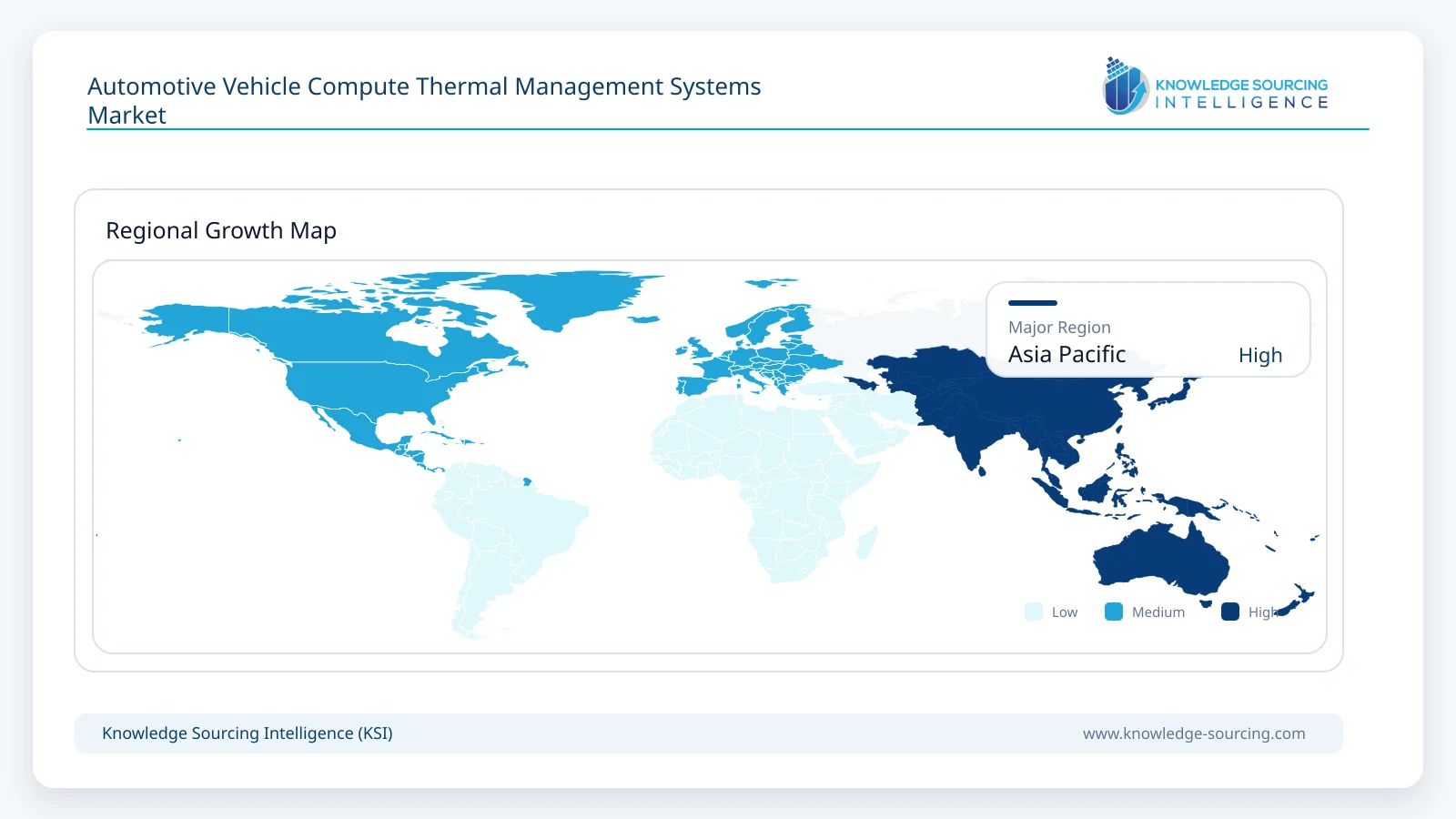
Asia Pacific is the largest modeled region, representing approximately 44% of 2026 market value and rising to 47% by 2031. Chinese vehicle production scale and local development of integrated ADAS and cockpit platforms support demand for thermal housings, interface materials and advanced cooling assemblies. Japan and South Korea add established semiconductor-packaging, electronics and Tier 1 engineering capacity, while India and Southeast Asia contribute a growing base of vehicle electronics manufacturing.
Passenger-vehicle programs with high-output automated-driving processors often demand more thermal capacity than basic cockpit and driver-assistance platforms. High-content electronic architectures support coolant-based solutions, while cost-sensitive vehicles rely more extensively on passive heat spreading and carefully optimized processors. Regional suppliers must demonstrate consistent bond-line control and compatibility with automated assembly processes to qualify across model variants.
Europe
Europe is estimated to represent 28% of the market in 2026, supported by centralized-computing programs and suppliers such as Valeo, AUMOVIO and Henkel. AUMOVIO’s fluid-cooled high-performance computers and Valeo’s controller portfolio reflect a strong engineering base for combining compute packaging with thermal management. Reliability testing and long vehicle-service horizons make module-level integration and validation particularly important to purchasing decisions.
European thermal-system demand is expected to grow as software-defined platforms consolidate more functions in fewer ECUs, although cost pressure and processor efficiency can moderate hardware content per module. The Valeo-Calyos development initiative provides a potential longer-term route toward passive two-phase heat transfer, with production qualification still required before broad adoption.
Competitive Landscape
Competition combines integrated ECU and thermal-system suppliers with specialized materials and heat-transfer technology firms. Valeo and AUMOVIO design vehicle computers with selectable thermal approaches, while DENSO and Aptiv participate through broader automotive compute and electronic-module engineering. Henkel, Dow, DuPont and Parker Chomerics supply thermal-interface or electronic-assembly materials; Calyos concentrates on passive two-phase cooling technology. These supplier roles overlap within an OEM compute assembly, so a supplier of one material or cooling element should not be described as competing across the complete thermal system.
Supplier selection depends on sustained heat flux, installation volume, material reliability, automated production readiness and the ability to validate thermal assemblies together with electronics. Well-integrated passive solutions remain cost competitive in mainstream models, while active liquid systems and advanced two-phase concepts compete where heat flux and limited packaging space justify additional engineering effort.
Recent Developments
July 2026: Henkel launched Bergquist Gap Filler TGF 6500LVO with 6.5 W/m-K thermal conductivity for demanding automotive electronics, including ADAS and ECUs. The launch expands qualified interface options for denser board and enclosure assemblies.
June 2026: Valeo and Calyos signed a memorandum of understanding to develop industrial passive two-phase chip cooling for mobility and computing applications. The announcement relates to an industrialization program, not a confirmed series-production vehicle supply award.
May 2026: NVIDIA outlined in-vehicle AI systems on DRIVE AGX Orin and Thor capable of consolidating local AI and vehicle workloads. The announcement is a compute-demand signal rather than the launch of a dedicated cooling product.
March 2026: DENSO presented ADAS ECU development priorities covering power-optimized processors, adaptive power control and thermal management, including designs intended to enable air cooling. These approaches may limit cooling-system cost for suitable compute tiers.
July 2025: Henkel added Bergquist Gap Filler TGF 2100LVO for automotive electronics and ADAS control modules, emphasizing thermal performance, low outgassing and volume-production dispensing.
January 2025: Valeo showcased ADAS controller architecture with air-cooled and liquid-cooled variants alongside central compute and zonal products at CES 2025, demonstrating that thermal architecture is a differentiated compute-platform choice.
Market Outlook
Global revenue associated with automotive high-performance compute thermal management is projected to rise from approximately USD 465 million in 2026 to USD 1.62 billion by 2031, representing a modeled CAGR of 28.4%. Growth reflects a larger number of vehicles fitted with qualifying ADAS, cockpit and consolidated computers, together with higher thermal content in advanced configurations. The estimate does not assume that every vehicle computer requires liquid cooling or that cooling content increases in direct proportion to processor TOPS.
Pumped-liquid assemblies and the associated cold plates are expected to gain share in higher-density compute systems, while passive housings and interface materials continue to represent major content in mainstream platforms. Thermal choices will depend on sustained duty cycle, enclosure placement and the relationship between processor efficiency and cooling-system cost. New two-phase approaches may offer attractive packaging advantages, but near-term procurement is likely to remain concentrated in established passive, airflow and coolant-based architectures.
Supplier opportunities will increasingly involve the combined qualification of enclosure geometry, interface chemistry and production processes. Vehicle makers that standardize compute modules across several models can reduce development cost through common cooling interfaces, provided reliability is demonstrated for the highest temperature, vibration and workload conditions within the platform family.
Automotive Vehicle Compute Thermal Management Systems Market Scope
| Report Metric | Details |
|---|---|
| Total Market Size in 2026 | USD 465 million |
| Total Market Size in 2031 | USD 1,620 million |
| Forecast Unit | Million |
| Growth Rate | 28.4% |
| Study Period | 2021 to 2031 |
| Historical Data | 2021 to 2024 |
| Base Year | 2025 |
| Forecast Period | 2026 – 2031 |
| Segmentation | Cooling Technology, Thermal Revenue Component, Compute Domain, Compute Thermal Load, Integration Model, Vehicle Type, Propulsion, Geography |
| Companies |
|
Market Segmentation
By Cooling Technology
Passive Heat Sinks and Heat Pipes
Active Air Cooling
Pumped Liquid Cooling
Passive Two-Phase and Advanced Cooling
By Thermal Revenue Component
Heat Sinks, Spreaders and Thermal Housings
Thermal Interface Materials
Liquid Plates and Coolant Interface Hardware
Fans and Airflow Assemblies
Thermal Monitoring and Control Hardware
Direct Thermal Engineering and Lifecycle Services
By Compute Domain
ADAS and Automated-Driving Compute
Cockpit and Infotainment Compute
Cross-Domain Central Compute
Other Qualified Vehicle Compute
By Compute Thermal Load
Below 100 W
100–250 W
Above 250 W
By Integration Model
Computer-Integrated Thermal Assembly
Separately Supplied Thermal Subassembly
Vehicle Coolant-Circuit-Integrated Cooling
By Vehicle Type
Passenger Vehicles
Light Commercial Vehicles
Medium and Heavy Commercial Vehicles
By Propulsion
ICE and Mild-Hybrid Vehicles
Hybrid and Plug-in-Hybrid Vehicles
Battery Electric Vehicles
By Geography
Asia Pacific
China
Japan
South Korea
India
Taiwan
Thailand
Indonesia
Others
Europe
Germany
United Kingdom
France
Italy
Spain
Others
North America
United States
Canada
Mexico
South America
Brazil
Argentina
Others
Middle East and Africa
Saudi Arabia
United Arab Emirates
Israel
South Africa
Others
Table of Contents
1. EXECUTIVE SUMMARY
2. MARKET SNAPSHOT
2.1. Market Overview
2.2. Market Definition
2.3. Scope of the Study
2.4. Market Segmentation
3. BUSINESS LANDSCAPE
3.1. Market Drivers
3.1.1. Higher Sustained Power Density in ADAS Computers
3.1.2. Consolidation of Previously Distributed Electronic Functions
3.1.3. Qualification Requirements for Vehicle Electronics
3.1.4. Higher Software Workloads Within Cockpit Platforms
3.1.5. Production Demand for Stable Thermal Interfaces
3.2. Market Restraints
3.2.1. Additional Cost and Integration Work for Liquid Cooling
3.2.2. Sealing, Corrosion and Leak Reliability
3.2.3. Software and Chip Power-Efficiency Improvements
3.2.4. Constrained Packaging and Thermal Paths
3.2.5. Long Qualification and Change-Control Cycles
3.3. Market Opportunities
3.4. Porter’s Five Forces Analysis
3.5. Industry Value Chain Analysis
3.6. Policies and Regulations
3.7. Strategic Recommendations
4. TECHNOLOGICAL OUTLOOK
4.1. Processor Heat-Transfer Path Design
4.2. Active Air and Forced Convection Cooling
4.3. Liquid Cold Plates and Coolant Circuit Integration
4.4. Passive Two-Phase and Heat-Pipe Technologies
4.5. Thermal Interface Materials and Environmental Qualification
5. AUTOMOTIVE VEHICLE COMPUTE THERMAL MANAGEMENT SYSTEMS MARKET BY COOLING TECHNOLOGY
5.1. Passive Heat Sinks and Heat Pipes
5.2. Active Air Cooling
5.3. Pumped Liquid Cooling
5.4. Passive Two-Phase and Advanced Cooling
6. AUTOMOTIVE VEHICLE COMPUTE THERMAL MANAGEMENT SYSTEMS MARKET BY THERMAL REVENUE COMPONENT
6.1. Heat Sinks, Spreaders and Thermal Housings
6.2. Thermal Interface Materials
6.3. Liquid Plates and Coolant Interface Hardware
6.4. Fans and Airflow Assemblies
6.5. Thermal Monitoring and Control Hardware
6.6. Direct Thermal Engineering and Lifecycle Services
7. AUTOMOTIVE VEHICLE COMPUTE THERMAL MANAGEMENT SYSTEMS MARKET BY COMPUTE DOMAIN
7.1. ADAS and Automated-Driving Compute
7.2. Cockpit and Infotainment Compute
7.3. Cross-Domain Central Compute
7.4. Other Qualified Vehicle Compute
8. AUTOMOTIVE VEHICLE COMPUTE THERMAL MANAGEMENT SYSTEMS MARKET BY COMPUTE THERMAL LOAD
8.1. Below 100 W
8.2. 100–250 W
8.3. Above 250 W
9. AUTOMOTIVE VEHICLE COMPUTE THERMAL MANAGEMENT SYSTEMS MARKET BY INTEGRATION MODEL
9.1. Computer-Integrated Thermal Assembly
9.2. Separately Supplied Thermal Subassembly
9.3. Vehicle Coolant-Circuit-Integrated Cooling
10. AUTOMOTIVE VEHICLE COMPUTE THERMAL MANAGEMENT SYSTEMS MARKET BY VEHICLE TYPE
10.1. Passenger Vehicles
10.2. Light Commercial Vehicles
10.3. Medium and Heavy Commercial Vehicles
11. AUTOMOTIVE VEHICLE COMPUTE THERMAL MANAGEMENT SYSTEMS MARKET BY PROPULSION
11.1. ICE and Mild-Hybrid Vehicles
11.2. Hybrid and Plug-in-Hybrid Vehicles
11.3. Battery Electric Vehicles
12. AUTOMOTIVE VEHICLE COMPUTE THERMAL MANAGEMENT SYSTEMS MARKET BY GEOGRAPHY
12.1. Asia Pacific
12.1.1. China
12.1.2. Japan
12.1.3. South Korea
12.1.4. India
12.1.5. Taiwan
12.1.6. Thailand
12.1.7. Indonesia
12.1.8. Others
12.2. Europe
12.2.1. Germany
12.2.2. United Kingdom
12.2.3. France
12.2.4. Italy
12.2.5. Spain
12.2.6. Others
12.3. North America
12.3.1. United States
12.3.2. Canada
12.3.3. Mexico
12.4. South America
12.4.1. Brazil
12.4.2. Argentina
12.4.3. Others
12.5. Middle East and Africa
12.5.1. Saudi Arabia
12.5.2. United Arab Emirates
12.5.3. Israel
12.5.4. South Africa
12.5.5. Others
13. COMPETITIVE ENVIRONMENT AND ANALYSIS
13.1. Major Players and Strategy Analysis
13.2. Market Share Analysis
13.3. Mergers, Acquisitions, Agreements and Collaborations
13.4. Competitive Dashboard
14. COMPANY PROFILES
14.1. Valeo
14.2. AUMOVIO
14.3. DENSO Corporation
14.4. Calyos
14.5. Henkel
14.6. Parker Hannifin Corporation (Chomerics)
14.7. Dana Incorporated
14.8. Aptiv
14.9. Dow Inc.
14.10. DuPont
15. APPENDIX
15.1. Currency
15.2. Assumptions
15.3. Base and Forecast Years Timeline
15.4. Key Benefits for Stakeholders
15.5. Research Methodology
15.6. Abbreviations
Navigate
Trusted by the world's leading organizations