
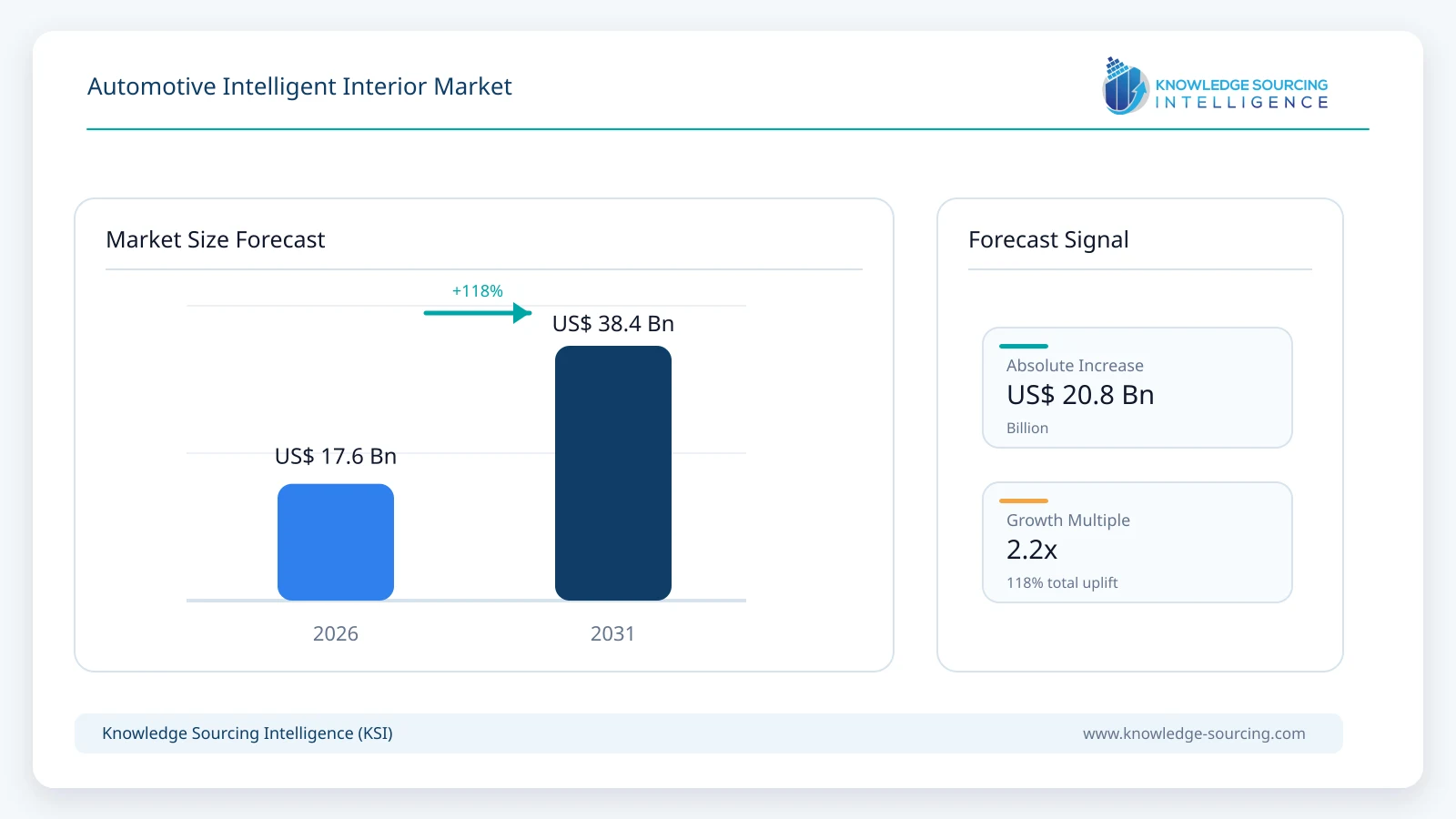
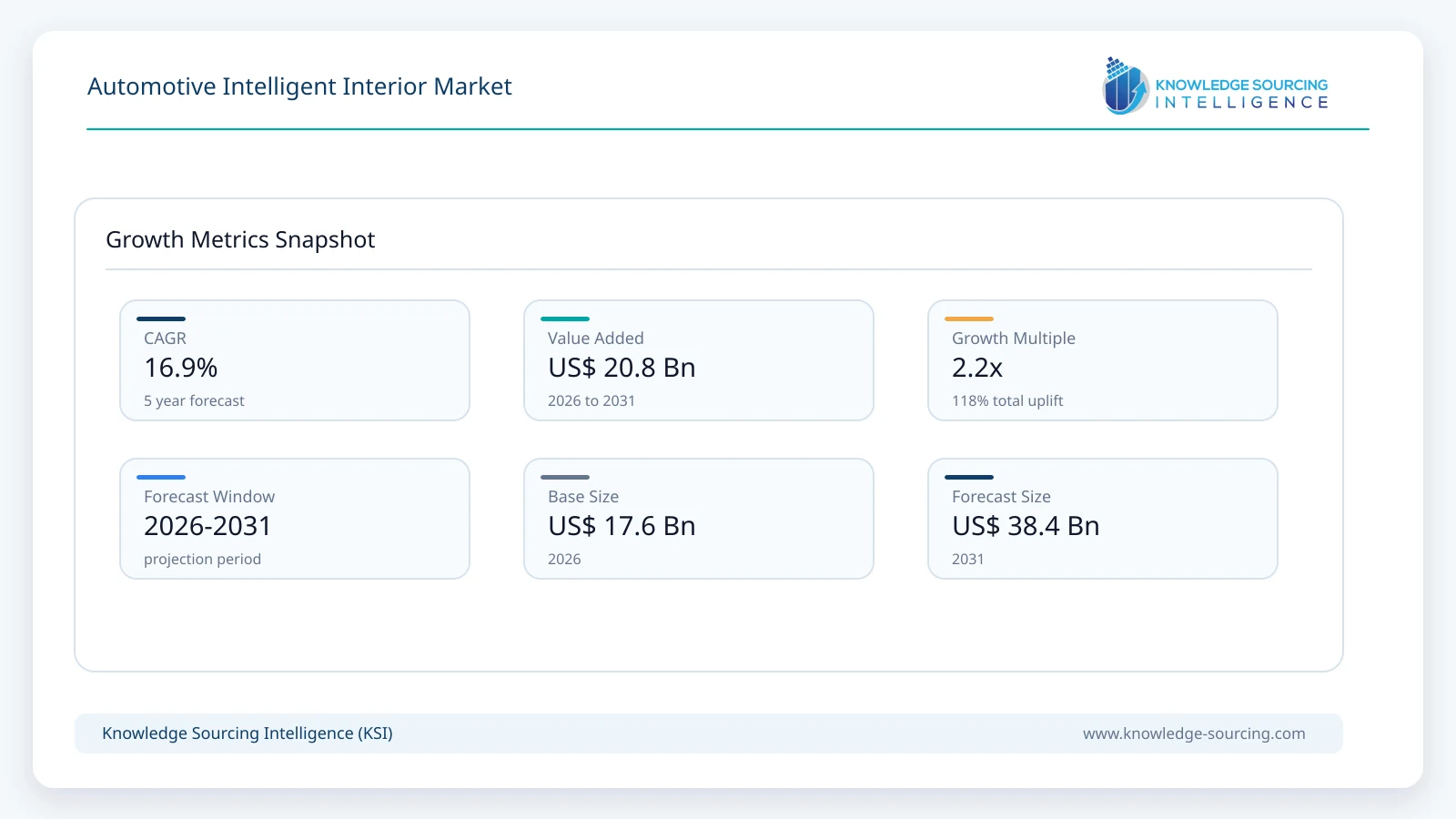
The Automotive Intelligent Interior Market is projected to grow from approximately USD 17.60 billion in 2026 to USD 38.40 billion in 2031, at a CAGR of 16.9% over the forecast period.
Highlights:
- 1Intelligent seating and occupant comfort account for approximately 38% of modeled 2026 market value, supported by powered adjustment, posture response, thermal management and integrated seat intelligence.
- 2Intelligent lighting and interactive illumination represent approximately 33% of 2026 value as networked RGB systems, illuminated trim and functional light communication spread across cabin zones.
- 3Domain-integrated and zonal interior control could rise from approximately 21% of market value in 2026 to 40% by 2031, reflecting consolidation of local electronics and shared occupant data.
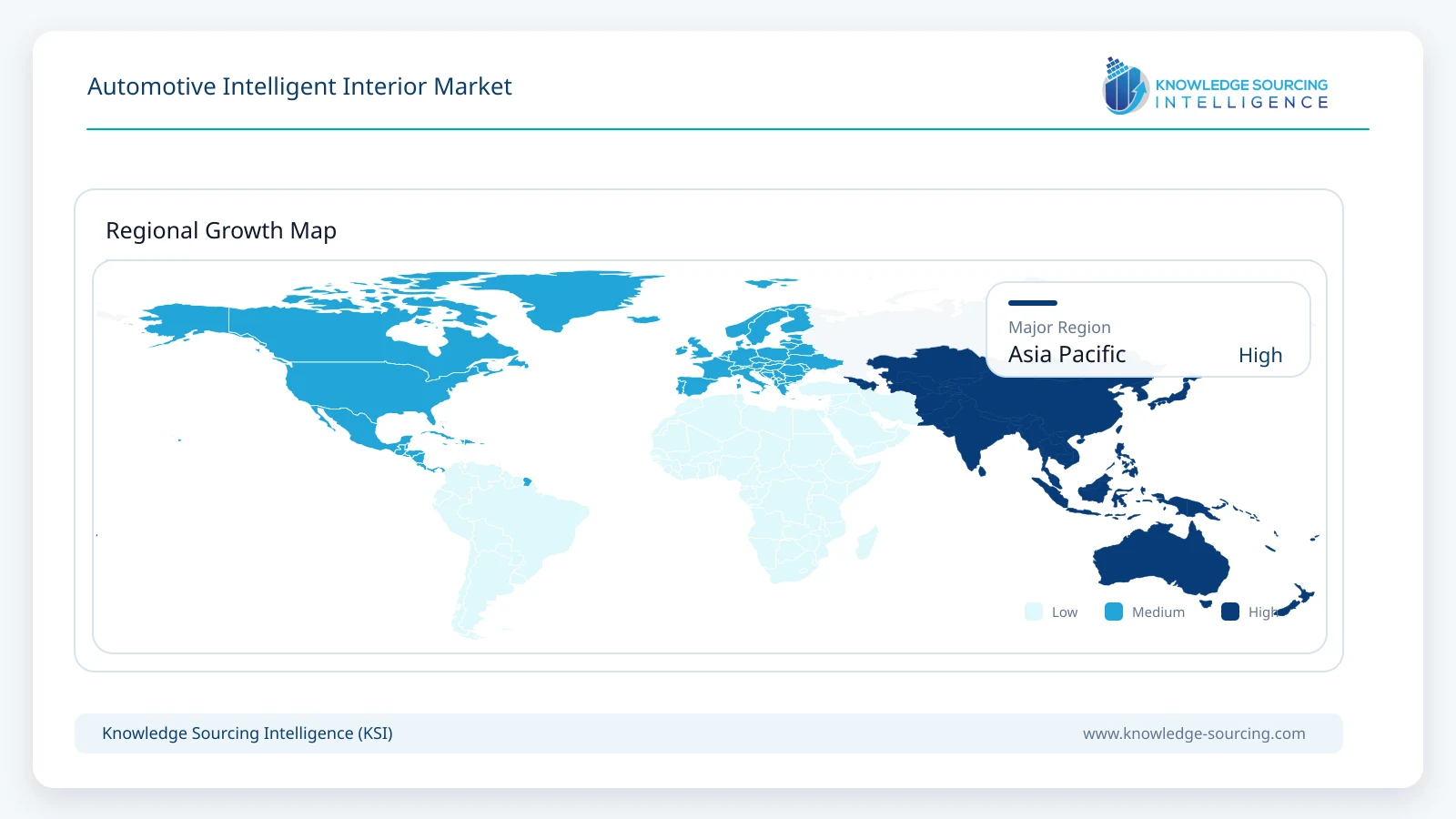
- 4Asia Pacific represents an estimated 46% of the 2026 market, supported by Chinese smart-cabin competition and major automotive seating, lighting and interior-systems supply chains.
- 5New interior interfaces increasingly combine sensing, force feedback, optics and decorative materials, raising the importance of integrated manufacturing and vehicle-level qualification.
Intelligent interior systems include electronically responsive seating, programmable and context-aware illumination, touch- and haptic-enabled decorative surfaces, powered cabin modules and other active interior components that modify their behavior according to occupant input, vehicle status or stored settings. The forecast reflects supplied interior-system content and directly associated embedded electronics and integration.
Interior suppliers increasingly combine familiar mechanical and decorative components with sensors, actuators, lighting electronics and local control software. Lear offers INTU intelligent seating functions for comfort, wellness and safety, while Antolin and UltraSense are engineering thin solid-state control surfaces using touch and force sensing with haptic feedback. Such developments raise the value of interior assemblies without requiring a complete change in the surrounding trim architecture.
Automotive intelligent interior hardware adds active functions to components that occupants see and touch throughout a journey. In seating, sensors, motors, pneumatic elements and software support adjustments to posture, firmness or temperature. Door trims and instrument-panel surfaces can integrate distributed lighting, solid-state controls and haptic confirmation, while consoles and overhead assemblies can incorporate powered movement, adaptive illumination or electrochromic glazing. These functions make the physical passenger compartment an increasingly important extension of the vehicle electronics architecture.
Yanfeng’s June 2026 XiM27 drivable concept illustrates the direction of complete interior-system integration through AI-adaptive seats, interactive LUXkin surfaces, multifunctional consoles and synchronized lighting. The supplier describes components as production-ready, although the demonstration is not equivalent to confirmed mass production of the whole cabin. Lear’s INTU range and Magna’s adaptive-seating engineering provide additional evidence of sustained investment in comfort and occupant-responsive products rather than display-only cockpit features.
Valeo’s January 2026 premium-automaker award for an interior lighting solution based on TactoTek’s in-mold structural electronics represents a more direct vehicle-program commercialization pathway. Toyota Boshoku’s large-area illuminated door trim on the new Lexus ES and Toyoda Gosei’s LIN-controlled lighting unit on the Mazda CX-5 similarly show how embedded illumination and electronics can be incorporated into production components. Sourcing decisions increasingly depend on the ability to deliver appearance quality, tactile performance, electronic reliability and assembly economics together.
Market Trends
Interior Surfaces Are Becoming Embedded Control Interfaces
Antolin and UltraSense announced in September 2026 that their smart-surface HMI collaboration had advanced to a development initiative for a future global vehicle platform. The architecture combines force and touch sensing with visual and haptic feedback, allowing controls to be integrated into thin decorative panels. For OEMs, the appeal lies in greater styling freedom and fewer protruding switches, but successful deployment still depends on predictable tactile guidance and low false-activation rates.
Valeo’s TactoTek-based interior-lighting award demonstrates a complementary manufacturing route in which circuitry and optical functions are embedded within molded structures. Integrated electronics can reduce separate housings and assembly steps, but cosmetic yield, serviceability and long-term thermal performance become more important as decorative components acquire electronic functionality.
Smart Seating Is Shifting toward Continuous Occupant Response
FORVIA presented an intelligent-seat approach in February 2026 that uses sensors and software to adjust multiple comfort parameters according to occupant morphology and driving conditions. Lear’s INTU and Magna’s adaptive-seating work similarly connect posture, local temperature, support and occupant-specific settings. The market opportunity lies in seats that provide tangible improvement during use rather than a growing number of preset functions alone.
Vehicle integration remains important for intelligent seats because powered movement, restraint packaging, thermal loads and occupant monitoring share installation space and electrical resources. Higher-content designs generate supplier value from sensors, actuators, control modules and precision mechanisms, while requiring more demanding durability, crash-safety and electrical-validation programs.
Lighting Is Expanding into Functional Interior Communication
Toyoda Gosei’s LIN-supported illumination unit for the new Mazda CX-5 shows the growing relevance of addressable and networked interior lighting. Beyond selecting color themes, automakers can use software-controlled illumination for seat-zone guidance, alerts, entry sequences and synchronized interactions. Toyota Boshoku’s Lexus ES door trim integrates broad-area illumination that supports animated effects through translucent surface structures.
As interior lighting takes on more functions, suppliers must manage color consistency across materials, night-time distraction, thermal behavior and network diagnostics. Programmable illumination can carry a higher value per vehicle than conventional fixed lamps, although cost-sensitive platforms will retain simpler configurations where additional functionality delivers limited customer benefit.
Physical Personalization Is Extending across Cabin Zones
Gentex and Antolin’s April 2026 agreement to develop dimmable sun visors for European automakers applies electronically variable transparency to a longstanding interior component. Related innovations in movable consoles, occupant-specific seat support and adaptive surfaces demonstrate that personalization extends beyond digital profiles and screens into direct physical changes in the cabin.
Yanfeng’s XiM27 combines movable furniture-like modules, adaptive seating, variable lighting and localized comfort as a single experience concept. Commercial expansion is likely to be selective because complex mechanisms add mass, wiring, qualification cost and maintenance exposure. The most scalable solutions will be those that reuse mechanical platforms and control electronics across several model lines.
Automotive Intelligent Interior Market Segment Analysis
By Intelligent Interior System
Intelligent Seating and Occupant Comfort
Intelligent seating remains the largest modeled system category because each equipped seat can contain multiple high-value mechanisms, sensing points, comfort modules and controllers. Beyond electric adjustment and memory functions, advanced systems manage thermal delivery, posture, lumbar support and automatic response to occupant preferences. Lear, FORVIA and Magna compete through combinations of seat engineering, electronics and occupant-focused software.
Intelligent seating and occupant comfort account for approximately USD 6.69 billion in 2026 and is modeled to reach USD 13.82 billion in 2031. Growth comes from wider fitment across upper-midrange vehicles and higher functionality on existing premium platforms, subject to seat-safety qualification and cost constraints.
By Intelligent Interior System
Intelligent Lighting and Interactive Illumination
Intelligent lighting is the second major product group, serving decorative, communication and functional needs across doors, dashboards, roof areas and consoles. Addressable electronics, optical distribution and material integration distinguish these systems from basic courtesy lighting. Valeo, Toyoda Gosei and Toyota Boshoku illustrate different positions across embedded-electronics manufacturing, networked lighting modules and large-area illuminated trim.
Intelligent lighting and interactive illumination represent approximately USD 5.81 billion in 2026 and is modeled at USD 11.33 billion in 2031. Content growth depends on network complexity, surface coverage and functional communication rather than the number of conventional lamps installed.
By Control Architecture
Domain-Integrated and Zonal Interior Control
Domain-integrated and zonal systems connect interior devices through shared networks and higher-level software instead of assigning independent intelligence to every feature. Shared occupant profiles and vehicle-state messages can coordinate lighting, seat position, comfort and interactive surfaces, helping OEMs reduce the fragmentation of separately sourced electronics.
Domain-integrated and zonal interior control rises from 21% in 2026 to 40% by 2031 as new electrical platforms place more cabin functions under common control. The transition will be gradual because existing vehicle programs retain distributed body-control and local-module designs over multi-year lifecycles.
By Propulsion
Battery Electric Vehicles
Battery electric vehicles provide an attractive launch environment for intelligent interior hardware because manufacturers use seating, lighting, comfort and digital interaction to differentiate otherwise similar electric drivetrains. New electrical architectures can support distributed cabin networks, while range considerations encourage localized and energy-aware thermal functions.
Battery electric vehicles account for an estimated 21% of 2026 intelligent interior revenue and are modeled to reach 36% by 2031. The larger revenue share relative to vehicle volume reflects higher feature content per vehicle and a concentration of smart-interior programs in new EV platforms.
Market Drivers
Premium and Electric-Vehicle Interior Differentiation
Automakers increasingly compete on tangible passenger-compartment features such as intelligent seating, networked illumination and integrated touch surfaces. Chinese EV programs and premium European vehicles are particularly important launch platforms because customers can readily compare visible and physical cabin experiences. Interior suppliers can increase content per vehicle through higher-value electronics and mechanisms when OEMs can demonstrate an acceptable pricing premium.
Adoption of Smart Surfaces and Solid-State HMI
The Antolin–UltraSense collaboration and Valeo’s awarded IMSE program show how touch, force detection, haptics and decorative surfaces can be engineered into production-oriented modules. These technologies provide a pathway to integrate multiple control functions into fewer assemblies while preserving cabin design continuity. Growth depends on the engineering trade-off between styling flexibility, feedback quality and manufacturing yield.
Growth of Occupant-Adaptive Seating
Lear INTU, FORVIA intelligent seats and Magna adaptive seating systems demonstrate supplier investment in functions that modify support, position and thermal comfort according to occupant needs. Advanced electronics and local actuators raise attributable hardware value while facilitating differentiation across trim levels. Adoption should progress first where consumer benefits justify incremental seat cost and package complexity.
Higher Penetration of Networked Intelligent Lighting
LIN-supported light modules and integrated illuminated surfaces enable cabin illumination to move beyond fixed decorative elements toward addressable zones and contextual feedback. Toyoda Gosei’s Mazda CX-5 unit and Toyota Boshoku’s Lexus ES door trim provide production-related examples. Common electronics networks can lower the integration burden of adding new visual functions across platform derivatives.
Integration with Software-Defined Electrical Architectures
Centralized and zonal electrical systems increasingly allow physical interior features to share occupant profiles, vehicle-state information and cabin-setting logic. Suppliers capable of combining actuators, surfaces and vehicle-grade software can support coordinated responses without duplicating every sensor or controller. However, commercial value still resides in the attributable interior hardware and embedded functions rather than the full software-defined vehicle stack.
Market Restraints
Higher Component Cost and Uneven Vehicle-Level Affordability
Advanced seat motors, sensors, intelligent LEDs, high-quality optics and haptic controllers cost more than conventional manual or fixed-function assemblies. OEMs in volume segments may select limited-function variants or reserve full systems for premium trims. The investment case is strongest when multiple visible benefits can be delivered from a shared electronic platform.
Functional Safety and Occupant Protection Requirements
Automatically moving seats and controls located near occupant-restraint systems must work within stringent mechanical and electronic safety constraints. Intelligent surfaces that carry vehicle functions also require dependable fault response and usable emergency behavior. Validation effort can delay adoption where new functions affect seating position, crash packaging or driver attention.
Durability, Serviceability and Electronic Integration
Decorative trim fitted with circuits, emitters and sensors must tolerate abrasion, temperature cycling, UV exposure, spills and long service periods. Repair or replacement may become more expensive if a cosmetic defect requires changing an electronic assembly. Suppliers must validate materials and electronics together rather than qualifying each independently.
Driver Distraction and Haptic Usability
Minimalist solid-state controls can reduce visual clutter but may offer less physical guidance than conventional switches. Touch and force interfaces must distinguish intentional inputs from incidental contact during vibration or vehicle movement. Poor ergonomics can limit OEM acceptance even when the design and technical integration are attractive.
Fragmented OEM Architectures and Qualification Cycles
Interior suppliers often work across model-specific electrical networks, mechanical packages and software interfaces. Automotive qualification and tooling investments can extend several years from nomination to volume supply. Concepts or future-platform development agreements therefore cannot automatically be translated into immediate production revenue.
Regional Outlook
Asia Pacific
Asia Pacific accounts for approximately 46% of modeled intelligent interior revenue in 2026, supported by high vehicle production and an extensive regional supply chain for seats, lighting, electronics and molded cabin components. OICA reports that Asia-Pacific production reached approximately 59.2 million vehicles in 2025. China leads growth in smart-cabin content, while Japan and South Korea contribute advanced component engineering and large automotive supplier networks.
Yanfeng’s XiM27 concept, Toyoda Gosei’s Mazda lighting application and Toyota Boshoku’s illuminated Lexus ES door trim illustrate the breadth of regional innovation, from integrated concept systems to components adopted in specific vehicle models. Asia Pacific is modeled to reach USD 19.20 billion in 2031 as wider fitment and higher-value functionality expand across multiple price segments.
Europe
Europe remains a high-value intelligent interior market because premium vehicle production supports advanced seat adjustments, responsive surfaces, integrated lighting and electronically controlled overhead systems. FORVIA, Antolin and Valeo have established positions in seating, decorative interior assemblies and automotive electronics that are increasingly combined in vehicle interior programs.
Antolin’s work with UltraSense on smart-surface interfaces and its cooperation with Gentex on dimmable visors demonstrate investment in high-integration products for European automakers. The market is modeled to reach USD 9.22 billion in 2031, with adoption influenced by regional premium-model production, electronic-function qualification and the cost of integrating smart content into shared vehicle platforms.
Competitive Landscape
Competition combines complete interior module suppliers, seating manufacturers, lighting specialists and embedded-electronics technology companies. Yanfeng and Antolin participate through integrated cabin and decorative surface systems, while FORVIA, Lear and Magna bring intelligent seating and occupant-comfort capabilities. Valeo and Toyoda Gosei supply lighting and electronic component platforms that are increasingly packaged directly within trim and interior structures.
TactoTek and UltraSense contribute enabling technologies that allow Tier 1 suppliers to incorporate electronics, sensing and interaction into compact surfaces. Gentex participates through electronically dimmable overhead solutions, while Toyota Boshoku supplies advanced seating and illuminated interior trim. Supplier success increasingly depends on commercial program conversion, industrialization quality, interface design, control-system compatibility and cost-effective global production rather than isolated technology demonstrations.
Recent Developments
September 2026: Antolin and UltraSense advanced a smart-surface HMI development initiative for a future global vehicle platform, combining touch and force sensing with haptic and visual feedback. The announcement describes a development program rather than verified vehicle production.
June 2026: Yanfeng unveiled XiM27, a production-ready drivable smart-cabin concept integrating AI-adaptive seating, interactive smart materials and coordinated interior controls. The demonstration establishes technical readiness but not completed mass production of the full concept.
June 2026: Toyota Boshoku announced that its new large-area illuminated door trim was adopted for the Lexus ES, using surface-transmission technology for animated cabin effects and linking smart trim development to a vehicle application.
May 2026: Toyoda Gosei announced use of its LIN-supported full-color interior illumination unit on the new Mazda CX-5, supporting networked color control with flexible vehicle installation.
April 2026: Gentex and Antolin signed a cooperation agreement to bring next-generation dimmable sun visors to the European automotive market, combining electrochromic technology with interior-module integration.
January 2026: Valeo announced a premium-automaker program award for an integrated interior lighting structure using TactoTek IMSE technology and a high-volume manufacturing approach; the award is distinct from completed series-production shipments.
Market Outlook
Intelligent interior systems will gain value as OEMs deploy higher-content seating, intelligent lighting networks, responsive decorative surfaces and electronically adaptable cabin modules across more vehicle platforms. Seat-related comfort hardware will remain a substantial revenue pool, while smart surfaces and zonal interior controls are expected to expand faster as new vehicle architectures consolidate data and coordinate functions across the cabin.
Asia Pacific is expected to remain the largest market through 2031, supported by regional vehicle scale and fast smart-cabin adoption, while Europe maintains high content per vehicle and strong supplier innovation. Future commercial differentiation will depend on how reliably suppliers translate new materials, haptics, actuators and embedded software into durable production assemblies with measurable occupant benefits and controlled installation cost.
Automotive Intelligent Interior Market Scope:
| Report Metric | Details |
|---|---|
| Total Market Size in 2026 | USD 17.60 billion |
| Total Market Size in 2031 | USD 38.40 billion |
| Forecast Unit | USD Billion |
| Growth Rate | 16.9% |
| Study Period | 2021 to 2031 |
| Historical Data | 2021 to 2024 |
| Base Year | 2025 |
| Forecast Period | 2026 – 2031 |
| Segmentation | Intelligent Interior System, Primary Function, Control Architecture, Cabin Zone, Interaction and Response Mode, Vehicle Type, Propulsion, Geography |
| Companies |
|
Market Segmentation
By Intelligent Interior System
Intelligent Seating and Occupant Comfort
Intelligent Lighting and Interactive Illumination
Smart Surfaces and Embedded HMI
Responsive Consoles and Reconfigurable Modules
Active Overhead, Glazing and Other Intelligent Trim
By Primary Function
Adaptive Comfort and Wellness
Touch, Haptic and Surface HMI
Ambience and Personalization
Safety and Contextual Interaction
By Control Architecture
Locally Controlled Intelligent Modules
Networked Distributed Interior Systems
Domain-Integrated and Zonal Interior Control
By Cabin Zone
Seats and Seat-Adjacent Areas
Door Panels and Side Trim
Instrument Panel and Dashboard
Center Console and Floor Modules
Roof, Headliner and Overhead
By Interaction and Response Mode
User-Selectable and Profile-Based
Context-Responsive and Event-Driven
Autonomous Adaptive and Occupant-Aware
Basic Electronically Assisted
By Vehicle Type
Passenger Vehicles
Light Commercial Vehicles
Medium and Heavy Commercial Vehicles and Buses
By Propulsion
ICE and Mild-Hybrid Vehicles
Hybrid and Plug-In Hybrid Vehicles
Battery Electric Vehicles
By Geography
North America
United States
Canada
Mexico
South America
Brazil
Argentina
Others
Europe
Germany
United Kingdom
France
Italy
Spain
Others
Middle East and Africa
Saudi Arabia
UAE
South Africa
Others
Asia Pacific
China
Japan
South Korea
India
Indonesia
Thailand
Others
Table of Contents
1. INTRODUCTION
1.1. Market Overview
1.2. Market Definition
1.3. Scope of the Study
1.4. Market Segmentation
1.5. Currency
1.6. Assumptions
1.7. Base and Forecast Years
1.8. Key Benefits to Stakeholders
2. RESEARCH METHODOLOGY
2.1. Research Design
2.2. Secondary Research
2.3. Primary Research
2.4. Market Estimation
2.5. Segment Modelling
2.6. Data Triangulation and Validation
3. EXECUTIVE SUMMARY
3.1. Key Findings
3.2. Automotive Intelligent Interior Market Size, 2026–2031
3.3. Intelligent Interior System Outlook
3.4. Primary Function Outlook
3.5. Control Architecture Outlook
3.6. Cabin Zone Outlook
3.7. Interaction and Response Mode Outlook
3.8. Vehicle Type Outlook
3.9. Propulsion Outlook
3.10. Regional Opportunity Summary
4. MARKET DYNAMICS
4.1. Market Drivers
4.1.1. Premium and Electric-Vehicle Interior Differentiation
4.1.2. Adoption of Smart Surfaces and Solid-State HMI
4.1.3. Growth of Occupant-Adaptive Seating
4.1.4. Higher Penetration of Networked Intelligent Lighting
4.1.5. Integration with Software-Defined Electrical Architectures
4.2. Market Restraints
4.2.1. Higher Component Cost and Uneven Vehicle-Level Affordability
4.2.2. Functional Safety and Occupant Protection Requirements
4.2.3. Durability, Serviceability and Electronic Integration
4.2.4. Driver Distraction and Haptic Usability
4.2.5. Fragmented OEM Architectures and Qualification Cycles
4.3. Market Opportunities
4.4. Porter’s Five Forces Analysis
4.5. Industry Value Chain Analysis
4.6. Policies and Regulations
4.7. Strategic Recommendations
5. TECHNOLOGY OUTLOOK
5.1. Embedded Touch and Force-Sensing Surfaces
5.2. Haptic and Shy-Tech HMI
5.3. Intelligent Seating and Comfort Actuators
5.4. Networked Interior Lighting
5.5. In-Mold Structural Electronics
5.6. Dimmable Glass and Active Overhead Components
5.7. Local, Zonal and Domain-Integrated Control
5.8. Functional Safety and Interior Electronics Validation
6. AUTOMOTIVE INTELLIGENT INTERIOR MARKET BY INTELLIGENT INTERIOR SYSTEM
6.1. Introduction
6.2. Intelligent Seating and Occupant Comfort
6.3. Intelligent Lighting and Interactive Illumination
6.4. Smart Surfaces and Embedded HMI
6.5. Responsive Consoles and Reconfigurable Modules
6.6. Active Overhead, Glazing and Other Intelligent Trim
7. AUTOMOTIVE INTELLIGENT INTERIOR MARKET BY PRIMARY FUNCTION
7.1. Introduction
7.2. Adaptive Comfort and Wellness
7.3. Touch, Haptic and Surface HMI
7.4. Ambience and Personalization
7.5. Safety and Contextual Interaction
8. AUTOMOTIVE INTELLIGENT INTERIOR MARKET BY CONTROL ARCHITECTURE
8.1. Introduction
8.2. Locally Controlled Intelligent Modules
8.3. Networked Distributed Interior Systems
8.4. Domain-Integrated and Zonal Interior Control
9. AUTOMOTIVE INTELLIGENT INTERIOR MARKET BY CABIN ZONE
9.1. Introduction
9.2. Seats and Seat-Adjacent Areas
9.3. Door Panels and Side Trim
9.4. Instrument Panel and Dashboard
9.5. Center Console and Floor Modules
9.6. Roof, Headliner and Overhead
10. AUTOMOTIVE INTELLIGENT INTERIOR MARKET BY INTERACTION AND RESPONSE MODE
10.1. Introduction
10.2. User-Selectable and Profile-Based
10.3. Context-Responsive and Event-Driven
10.4. Autonomous Adaptive and Occupant-Aware
10.5. Basic Electronically Assisted
11. AUTOMOTIVE INTELLIGENT INTERIOR MARKET BY VEHICLE TYPE
11.1. Introduction
11.2. Passenger Vehicles
11.3. Light Commercial Vehicles
11.4. Medium and Heavy Commercial Vehicles and Buses
12. AUTOMOTIVE INTELLIGENT INTERIOR MARKET BY PROPULSION
12.1. Introduction
12.2. ICE and Mild-Hybrid Vehicles
12.3. Hybrid and Plug-In Hybrid Vehicles
12.4. Battery Electric Vehicles
13. AUTOMOTIVE INTELLIGENT INTERIOR MARKET BY GEOGRAPHY
13.1. North America
13.1.1. United States
13.1.2. Canada
13.1.3. Mexico
13.2. South America
13.2.1. Brazil
13.2.2. Argentina
13.2.3. Others
13.3. Europe
13.3.1. Germany
13.3.2. United Kingdom
13.3.3. France
13.3.4. Italy
13.3.5. Spain
13.3.6. Others
13.4. Middle East and Africa
13.4.1. Saudi Arabia
13.4.2. UAE
13.4.3. South Africa
13.4.4. Others
13.5. Asia Pacific
13.5.1. China
13.5.2. Japan
13.5.3. South Korea
13.5.4. India
13.5.5. Indonesia
13.5.6. Thailand
13.5.7. Others
14. COMPETITIVE ENVIRONMENT AND ANALYSIS
14.1. Major Players and Strategy Analysis
14.2. Market Share Analysis
14.3. Mergers, Acquisitions, Agreements and Collaborations
14.4. Smart Surface and Intelligent Seating Benchmarking
14.5. Commercial Program Developments
14.6. Competitive Dashboard
15. COMPANY PROFILES
15.1. Yanfeng Automotive Interiors
15.2. FORVIA
15.3. Antolin
15.4. Valeo
15.5. Lear Corporation
15.6. Magna International Inc.
15.7. Toyota Boshoku Corporation
15.8. Toyoda Gosei Co., Ltd.
15.9. Gentex Corporation
15.10. TactoTek Oy
15.11. UltraSense Systems, Inc.
15.12. Gentherm Incorporated
16. APPENDIX
16.1. Currency
16.2. Assumptions
16.3. Base and Forecast Years Timeline
16.4. Key Benefits for Stakeholders
16.5. Research Methodology
16.6. Abbreviations
16.7. Data Sources
Navigate
Trusted by the world's leading organizations











