
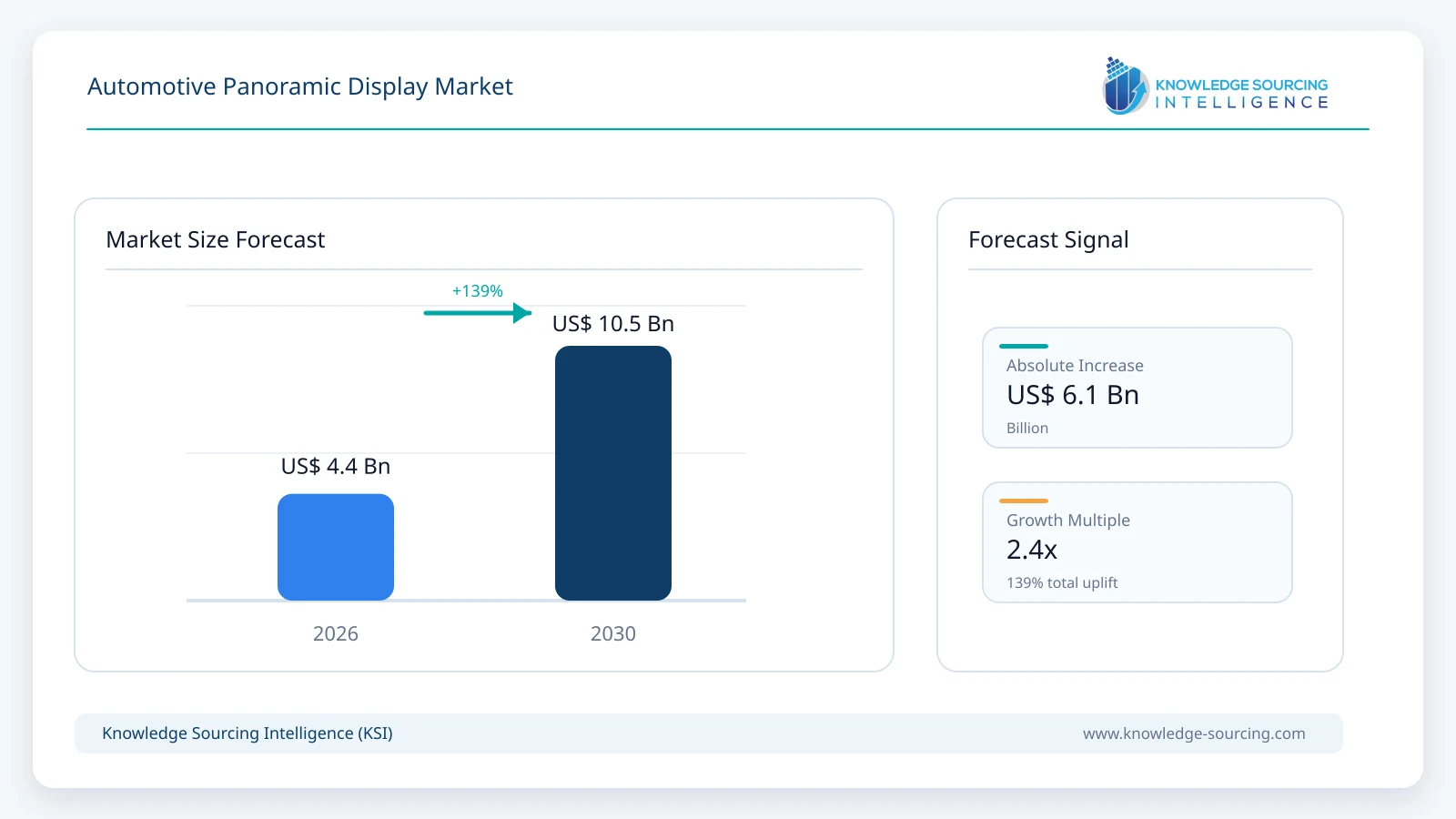
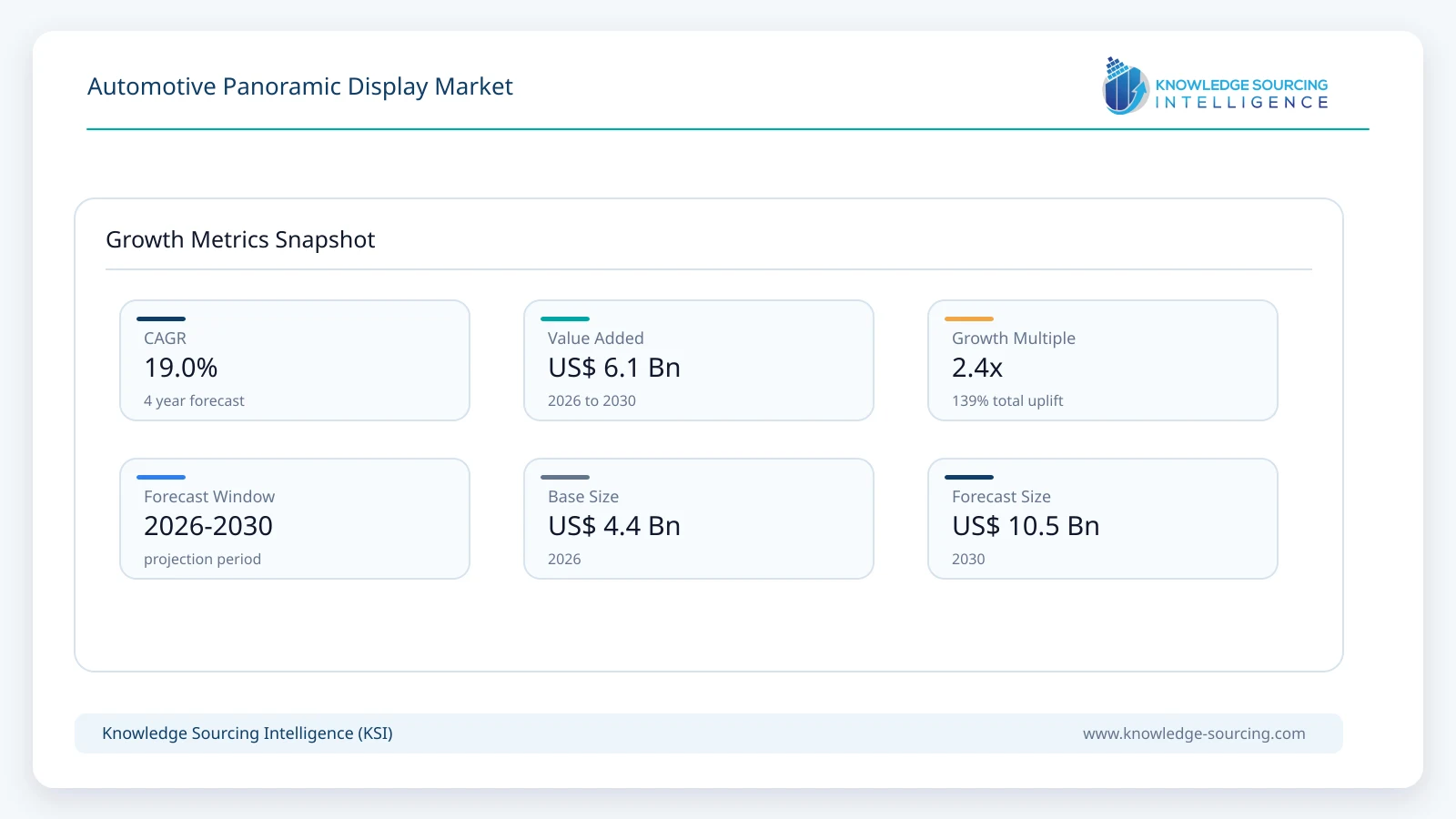
The automotive panoramic display market is estimated at approximately USD 4.40 billion in 2026 and is projected to reach about USD 10.50 billion by 2031, representing a CAGR of 19.0% during the forecast period.
Highlights:
- 1Integrated single-panel and continuous pillar-to-pillar displays account for approximately 46% of global market value in 2026 as premium and upper-midrange vehicles adopt larger uninterrupted visual surfaces across the dashboard.
- 2TFT and oxide LCD technologies represent approximately 46% of 2026 market value because they combine automotive-grade durability, mature supply chains and acceptable cost for large-area panels; OLED and advanced Mini-LED architectures are gaining share in premium applications.
- 3Displays in the 30-40 inch range account for approximately 44% of market value in 2026, supported by high-volume adoption of wide integrated cockpit displays, while above-50-inch systems are expected to grow fastest as single-panel and cross-cockpit formats scale.
- 4Passenger vehicles generate approximately 96% of global panoramic-display value in 2026 because the technology is concentrated in cars, SUVs and MPVs where cockpit design, entertainment and brand differentiation have direct consumer value.
- 5Asia Pacific represents approximately 46% of global market value in 2026, supported by China's vehicle-production scale, rapid smart-cockpit adoption and a dense regional panel, electronics and vehicle-integration supply chain.
- 6Panoramic windshield and projection displays are the fastest-growing architecture, with an implied CAGR of approximately 32.8% through 2031 as BMW-style lower-windshield information surfaces, full-width projection and holographic windshield concepts move toward broader production.
The market is moving beyond paired instrument-cluster and center-information displays toward display surfaces that visually span the cockpit, combine several functional zones and allow software to reconfigure information across the driver and passenger environment. The commercial value therefore includes not only the panel but also curved or bonded cover glass, backlighting, touch integration, display control electronics, optical treatment, privacy functions, thermal management and vehicle-specific system engineering.
Production evidence is broadening quickly. LG Display began mass production of a 40-inch pillar-to-pillar automotive display in 2025 and has since demonstrated 48-inch and 57-inch ultra-wide solutions; AUMOVIO has production experience with cockpit-width display systems and in 2026 introduced full-width surface projection; HARMAN is extending panoramic visual interfaces toward windshield-based Ready Vision QVUE; Hyundai Mobis is developing a holographic windshield display targeted for mass production from 2029; and Visteon, Marelli, Panasonic, Tianma, AUO and BOE are expanding the electronics, panels and compute required to support larger multi-zone cockpit experiences. OEM adoption is also moving down-market as BMW rolls Panoramic iDrive across new model lines and Mercedes-Benz expands seamless Hyperscreen concepts beyond the flagship segment.
The strongest growth is expected in architectures that reduce visible screen boundaries or move information upward toward the windshield. Conventional panoramic assemblies formed from multiple displays under one cover remain important because they balance cost, repairability and supply flexibility. Single-panel ultra-wide displays are gaining as oxide LCD, Mini-LED and automotive OLED technologies improve manufacturing scale, while panoramic projection and holographic windshield systems are expected to grow from a smaller base as automakers seek a cleaner dashboard and a more road-focused information plane.
Market Overview
Panoramic display systems create a wide, continuous or visually unified digital surface that extends substantially beyond a conventional center display. Typical implementations integrate the driver-information area, central infotainment zone and front-passenger content into one wide assembly. The physical implementation can use one ultra-wide panel, several displays bonded beneath a common curved cover lens, or multiple projection engines aligned across the lower windshield or cockpit surface. In each case, the design objective is to replace separate rectangular screens with a more coherent visual architecture.
The market has developed along two parallel paths. The first is the dashboard-mounted pillar-to-pillar or cross-cockpit display, exemplified by large curved assemblies such as Mercedes-Benz Hyperscreen-type systems and new ultra-wide LCD or OLED modules from panel suppliers. The second is the panoramic windshield display, where key information is projected or reflected across a lower windshield band. BMW Panoramic Vision, HARMAN Ready Vision QVUE, AUMOVIO Scenic View-related concepts and Hyundai Mobis holographic windshield technology demonstrate the increasing commercial importance of this second architecture.
Panoramic displays require substantially more engineering than simply increasing panel diagonal size. Large surfaces must maintain brightness uniformity, contrast, low reflectance and legibility across a wide viewing angle while surviving vibration, temperature cycling and long vehicle lifetimes. Curved cover glass and optical bonding introduce yield and repair challenges, while passenger entertainment requires privacy or directional-view technologies that prevent moving content from distracting the driver. Large display areas also increase graphics-processing, video-bandwidth and thermal requirements within the cockpit electronics architecture.
The market definition includes panoramic display panels and modules, integrated cover glass and optical bonding, touch and privacy layers, dedicated backlight or emissive display content, associated display control electronics and the system-level engineering required to deploy the panoramic surface in a production vehicle. Conventional instrument clusters, center displays, rear-seat displays and standalone HUDs are outside the market unless they form part of a panoramic architecture or are specifically engineered as a full-width panoramic visual system.
Market Trends
Pillar-to-Pillar Displays Are Moving from Flagship Vehicles into Broader Model Ranges
The first generation of ultra-wide cockpit displays was concentrated in high-end electric and luxury vehicles because large curved glass, OLED content and high-performance cockpit compute carried substantial cost. The commercial pattern is changing as panel manufacturing scales and OEMs reuse digital-cockpit architectures across multiple vehicles. LG Display began mass production of a 40-inch pillar-to-pillar display in 2025, while Mercedes-Benz is deploying a 39.1-inch seamless Hyperscreen in newer mid-size electric vehicles rather than limiting the format to EQS-class flagships.
BMW is taking a different route by making Panoramic Vision a core element of its next-generation iDrive architecture and extending the system across new model lines. These programs indicate that panoramic display content is becoming a platform decision rather than a one-model design feature. As common cockpit electronics, software and panel modules are reused across vehicle families, the incremental cost per vehicle can fall enough to support upper-midrange and selected mass-market trims.
The Industry Is Splitting between Single-Panel and Visually Unified Multi-Panel Architectures
A true single-panel panoramic display offers a cleaner appearance, fewer visual seams and greater freedom for dynamic software layouts. LG Display has demonstrated ultra-wide single-panel oxide LCD solutions reaching 57 inches, and panel makers are improving large automotive substrates, curved form factors and high-reliability bonding to support this direction. Single-panel systems can also simplify color matching because one panel technology spans the complete visual surface.
Multi-panel assemblies remain commercially important because they allow suppliers to combine established display sizes, isolate a failed module and tailor driver or passenger technologies independently. Mercedes-Benz's original Hyperscreen visually blends multiple displays beneath a large curved cover, illustrating how a continuous user experience can be created without one monolithic emissive panel. Through 2031, both approaches are likely to coexist, with single-panel penetration increasing where yield, serviceability and cost become acceptable.
Panoramic Information Is Moving Upward from the Dashboard to the Windshield
One of the most important design shifts is the movement of primary driving information into the lower windshield. BMW Panoramic Vision displays information from A-pillar to A-pillar across a black-printed windshield zone, while HARMAN Ready Vision QVUE uses a reflective Neo QLED architecture to create a pillar-to-pillar windshield display. AUMOVIO has also demonstrated full-width projection across cockpit surfaces, and Hyundai Mobis is developing a holographic windshield system intended to transform a much larger portion of the windshield into a display surface.
This architecture can reduce the need for a conventional instrument cluster and place speed, navigation and ADAS information closer to the road scene. It also changes the supplier stack because windshield glass, films, projection optics, calibration and display engines become part of the cockpit visual system. The transition will be gradual because optical tolerances and cost are demanding, but windshield-based panoramic displays are expected to capture a larger share of value as production systems mature after 2028.
Passenger Entertainment Is Driving Privacy and Multi-View Display Functions
A panoramic surface creates enough area for driver and passenger content to coexist, but the passenger side introduces a safety problem when video or interactive media is visible to the driver. Suppliers are therefore combining large displays with directional backlights, privacy filters, eye-position sensing or dual-view technologies. LG Display, Continental/AUMOVIO and other display developers have demonstrated technologies that restrict passenger content to the intended viewing angle while preserving navigation and vehicle information for the driver.
This capability increases the economic value of a panoramic display because the front passenger gains a dedicated entertainment zone without requiring a separate screen mounted as an independent component. It also supports software-defined content distribution: the same physical surface can show driving information, media, climate functions or ambient graphics depending on seat occupancy and vehicle state. Privacy control is consequently becoming an important differentiator rather than an optional optical feature.
OLED, Mini-LED and Emerging MicroLED Are Raising the Performance Ceiling
Large automotive displays face a difficult combination of brightness, black level, power, lifetime and temperature requirements. Conventional TFT-LCD remains cost-effective, but premium panoramic systems are increasingly using Mini-LED local dimming or OLED to improve contrast while maintaining thin packaging. HARMAN's Neo QLED automotive displays use advanced backlighting, LG Display continues to expand Tandem OLED for vehicle applications, and BOE, Tianma and AUO are demonstrating flexible OLED, Mini-LED and MicroLED concepts for next-generation cockpits.
Technology selection will remain application-specific. OLED offers strong contrast, flexibility and design freedom but must meet automotive lifetime and cost targets over a very large area. Mini-LED can deliver high brightness and local dimming using a familiar LCD stack, while MicroLED has attractive brightness and durability potential but remains early for large-volume automotive panoramic applications. The result is a multi-technology market in which panel economics and vehicle positioning matter as much as absolute display performance.
Segment Analysis
By Display Architecture: Integrated Single-Panel and Continuous Pillar-to-Pillar Displays
Integrated single-panel and continuous pillar-to-pillar systems form the largest architecture segment because they deliver the strongest visual differentiation and give software designers one large canvas for driver, center and passenger functions. The segment includes ultra-wide LCD, oxide LCD, Mini-LED and OLED modules designed to span most of the dashboard, including systems with a common controller and touch layer. Scale is increasing as panel suppliers move large automotive formats onto more efficient production lines and Tier 1 suppliers standardize wide-display electronics.
The segment is estimated at approximately USD 2.02 billion in 2026 and could reach about USD 4.41 billion by 2031. Its absolute value will grow strongly, although share is expected to moderate from roughly 46% to 42% because panoramic windshield and projection systems expand faster. Single-panel architectures will gain most where OEMs can amortize curved cover glass, optical bonding and vehicle-specific integration across several models rather than treating the display as a one-off flagship feature.
By Display Technology: TFT and Oxide LCD
TFT and oxide LCD remain the largest technology group in 2026 because they combine automotive qualification, broad supplier availability and comparatively predictable cost at large screen sizes. Oxide backplanes improve performance for ultra-wide panels and are increasingly important as suppliers move pillar-to-pillar displays onto larger-generation manufacturing lines. High-quality LCD systems can also be paired with local-dimming backlights and advanced optical films to approach premium contrast without the full cost of large OLED.
The segment represents approximately USD 2.02 billion in 2026 and is projected to reach around USD 3.68 billion by 2031. Its share is expected to decline from roughly 46% to 35% as OLED, Mini-LED-enhanced systems and emerging emissive technologies grow faster. LCD will nevertheless remain important in high-volume panoramic displays because durability, brightness, mature automotive electronics and manufacturing economics continue to favor it in cost-sensitive vehicle programs.
By Display Size: 30-40 Inches
The 30-40 inch class holds the largest value share in 2026 because it covers many current integrated cockpit solutions that combine cluster, center and passenger functions without requiring the extreme glass dimensions of a full 50-inch-plus dashboard. The size range is large enough to create a panoramic effect but remains compatible with many existing instrument-panel structures and with manufacturing processes already used for premium automotive displays.
The segment accounts for approximately USD 1.94 billion in 2026 and is expected to reach about USD 3.57 billion by 2031. Its share should decline from roughly 44% to 34% as 40-50 inch and above-50-inch architectures become more common. The fastest growth will occur in very large systems, but 30-40 inch displays will remain commercially important because they provide a better balance of cost, packaging and cockpit coverage for upper-midrange vehicles.
By Vehicle Type: Passenger Vehicles
Passenger cars, SUVs and MPVs dominate panoramic display demand because large digital interfaces directly influence consumer perception of technology, interior quality and entertainment value. Premium EVs accelerated early adoption, but the addressable market is broadening as software-defined cockpits spread across combustion, hybrid and electric vehicles. Passenger vehicles also offer the strongest commercial case for front-passenger entertainment, personalized themes, multi-user content and brand-specific HMI design.
Passenger vehicles represent approximately USD 4.22 billion of market value in 2026 and are projected to approach USD 9.77 billion by 2031. Commercial vehicles will grow faster from a smaller base as trucks and buses adopt larger integrated driver-information surfaces, camera-mirror feeds and fleet applications, but passenger vehicles will still account for approximately 93% of value by 2031 because the technology remains closely linked to consumer-facing cockpit differentiation.
Market Drivers
Software-Defined Vehicle Architectures and Centralized Cockpit Compute
Panoramic displays become more practical when one cockpit or central computer can render graphics for several visual zones and distribute content across a common high-speed network. Centralized compute reduces the need for separate graphics processors behind the cluster, center display and passenger screen and allows OEMs to manage one software environment across the entire panoramic surface. Visteon, Panasonic, Marelli, HARMAN and other suppliers are moving toward high-performance cockpit controllers that support multiple synchronized displays from one platform.
The architecture also makes the panoramic display more valuable over the vehicle lifecycle. New layouts, widgets, entertainment functions and ADAS visualizations can be introduced through software updates without changing the physical screen. This turns display area into reusable digital real estate and strengthens the commercial case for larger surfaces even when the initial hardware cost is higher than a conventional dual-screen cockpit.
OEM Competition around Interior Design and Digital Brand Identity
Exterior styling and powertrain performance are no longer the only visible differentiators in premium and technology-led vehicles. The first impression inside the vehicle is increasingly defined by screen geometry, graphic design, interaction flow and the way digital surfaces are integrated with trim and lighting. A wide display can therefore act as a brand signature in much the same way as a grille, headlamp graphic or exterior light bar.
Mercedes-Benz Hyperscreen, BMW Panoramic iDrive and large smart-cockpit displays from Chinese OEMs demonstrate how automakers are using the cockpit to communicate a distinct digital identity. This competitive pressure encourages OEMs to adopt wider panels, curved glass and novel windshield interfaces even when a smaller display could technically deliver the same vehicle functions. The result is a structural demand driver for panoramic form factors rather than a purely functional increase in screen area.
Expansion of Passenger Entertainment and Multi-Zone Cockpit Experiences
As charging stops, assisted driving and connected services increase the amount of time occupants spend consuming digital content in the vehicle, the front passenger is becoming an important display user rather than a passive occupant. A panoramic surface can dedicate a large region to streaming, gaming, productivity or navigation support while still preserving critical driver information. Passenger-side content therefore expands the value of the front cockpit display beyond instrument and infotainment functions.
Privacy display technologies and seat-occupancy awareness further support this use case by allowing entertainment to remain visible to the passenger while limiting driver distraction. The commercial implication is significant: a panoramic display can replace multiple discrete displays and provide software-controlled zones that change with occupancy, driving mode and vehicle state. This makes the system attractive to OEMs seeking to add premium features without continuously adding separate screens.
Falling Cost and Improving Manufacturability of Ultra-Wide Automotive Panels
Large automotive panels were historically constrained by low yield, curved-glass complexity and expensive specialty electronics. Panel makers are now applying larger-generation fabs, oxide backplanes, improved bonding and automotive-specific packaging to ultra-wide formats. LG Display has moved pillar-to-pillar products into mass production, while BOE, Tianma, AUO and other suppliers are using scale from broader display manufacturing to improve the economics of advanced vehicle panels.
Cost reduction does not require every panoramic system to become a monolithic OLED. Modular LCD and Mini-LED solutions can deliver a premium visual effect at lower cost, and common cockpit controllers reduce the electronics needed per display zone. These improvements help the technology move from low-volume luxury programs into higher-volume SUVs, crossovers and premium trims, expanding the addressable market faster than global vehicle production itself.
Migration of Driver Information toward the Windshield and Natural Line of Sight
Human-factors engineering increasingly favors placement of essential driving information closer to the road scene. Traditional clusters require a downward glance, while conventional HUDs offer a relatively small field of view. Panoramic windshield displays provide a broader information band that can carry speed, navigation, ADAS state and selected passenger content across a wider area without requiring a large conventional instrument binnacle.
BMW has committed Panoramic Vision to its new iDrive architecture, HARMAN has introduced Ready Vision QVUE, and Hyundai Mobis is developing a holographic windshield display with mass production targeted for 2029. These programs create a credible production roadmap for panoramic projection and windshield-integrated systems. If reliability and optical cost targets are met, the architecture can become a major incremental value pool through the second half of the forecast period.
Market Restraints
High System Cost, Cover-Glass Complexity and Manufacturing Yield
A panoramic display is materially more expensive than a conventional center screen because the panel is larger, the cover lens can be curved and highly finished, optical bonding areas are wider and mechanical tolerances become more difficult to control. Large single-piece glass also increases handling risk during manufacturing and vehicle assembly. A defect in one zone can lead to rejection of a much larger and more expensive component than in a modular display architecture.
These cost pressures are particularly important for mass-market vehicles, where the cockpit bill of materials is tightly controlled. Multi-panel designs can reduce yield risk but introduce color matching, seam management and more electronics. Suppliers therefore need to balance the visual advantage of a continuous surface with repairability, production yield and total system cost, which can slow penetration into entry and lower-midrange vehicles.
Sunlight Readability, Thermal Load and Long-Life Reliability
Automotive displays must operate in direct sunlight, high cabin temperatures, winter cold and repeated thermal cycling over many years. Increasing surface area magnifies these challenges because luminance must remain uniform across a much wider panel and the system can generate more heat at high brightness. OLED lifetime, LCD backlight uniformity, local-dimming calibration and adhesive stability all become more demanding as the display extends across the dashboard.
EV efficiency also creates pressure to reduce display power consumption. A very large high-brightness screen can become a non-trivial electrical load, particularly when several zones are active continuously. Mini-LED, OLED, adaptive brightness and zone-level dimming can improve efficiency, but they add cost and control complexity. OEM validation therefore remains stricter than the rapid product cycles typical in consumer electronics.
Driver Distraction and Safety Limits on Large Visual Surfaces
More display area does not automatically improve usability. A wide cockpit can expose the driver to more animation, passenger content and touch targets, increasing visual search and cognitive load if the information architecture is poorly designed. Regulators and consumer-safety programs are placing greater attention on distraction, essential control access and the amount of visual interaction required for common tasks.
Panoramic displays therefore need strong driver-passenger zoning, contextual content limits and intuitive interaction rules. Privacy technologies can prevent passenger video from entering the driver's line of sight, while software may reduce visual complexity when the vehicle is moving. These requirements can constrain monetization of the display surface and increase HMI validation costs, particularly for systems that combine entertainment and safety information in one continuous area.
Vehicle Packaging, Crash Integration and Serviceability
A display extending across the dashboard competes for space with airbags, ventilation outlets, steering-column movement, instrument-panel structure and decorative surfaces. Curved glass and wide electronics modules must be designed so that they do not create unsafe fragments or interfere with passenger-airbag deployment during a crash. Windshield-based systems add requirements around laminated glass, optical films, replacement calibration and local regulations governing the driver's field of view.
Serviceability is another constraint. Replacing one failed screen in a modular cockpit can be relatively straightforward, whereas a one-piece panoramic assembly may require replacement of a much larger and more expensive module. OEMs must therefore weigh aesthetic integration against repair cost and warranty exposure, especially as vehicles remain in service for more than a decade.
Graphics, Video Bandwidth and Electronics Integration Requirements
A large panoramic surface can contain several high-resolution zones operating at different refresh rates and with separate user contexts. Rendering navigation, 3D ADAS graphics, video and passenger entertainment simultaneously increases GPU, memory and video-link requirements. The display architecture must also meet deterministic startup, cybersecurity and functional-safety expectations when critical telltales or driver information are presented on the same hardware.
Centralized cockpit compute can solve part of the problem but creates its own integration challenge. A controller failure or software fault can potentially affect several display zones at once, so OEMs need partitioning, redundancy and fallback strategies for safety-critical information. High-speed display connectivity, standardized interfaces and robust software abstraction are therefore important enablers, but they add engineering work before a panoramic display can be scaled across vehicle platforms.
Regional Outlook
Asia Pacific
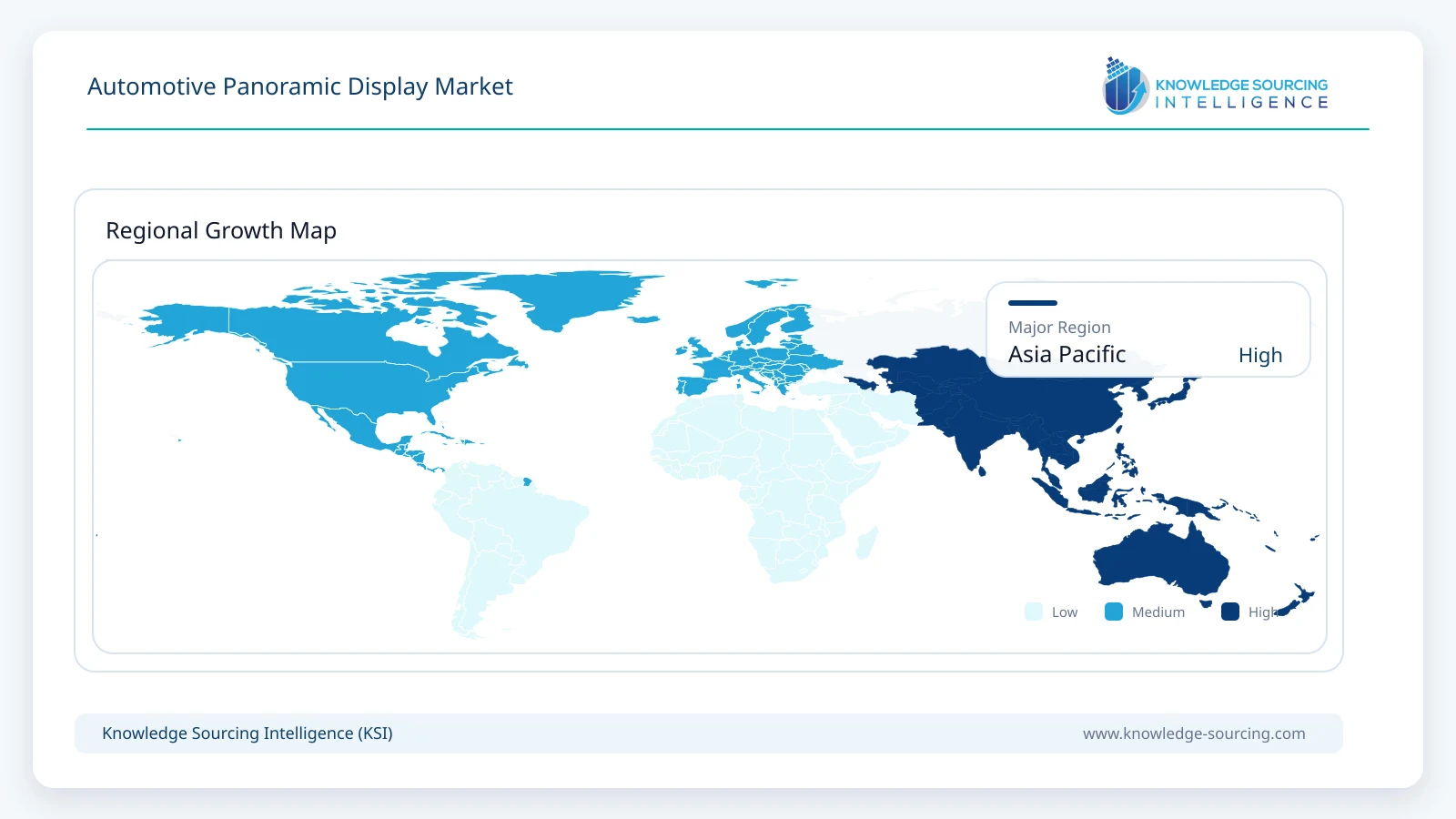
Asia Pacific is the largest regional automotive panoramic display market, accounting for approximately 46% of global value in 2026. The region combines the world's largest vehicle-production base with a dense ecosystem of display panel manufacturers, automotive electronics suppliers and fast-moving smart-cockpit OEMs. China is the principal demand engine, where large integrated screens and passenger-facing digital features are used across a wide range of electric and premium vehicles rather than only at the top of the market.
Regional supply strength is equally important. BOE, Tianma, AUO, Samsung-related display businesses, LG Display and multiple Chinese module suppliers provide large LCD, OLED, Mini-LED and emerging display technologies, while Hyundai Mobis, Panasonic, Visteon and other Tier 1 suppliers integrate cockpit electronics. LG Display's mass production of large pillar-to-pillar panels and Hyundai Mobis' holographic windshield program illustrate how Asia-based companies are influencing both current and next-generation architectures.
Asia Pacific is expected to increase its share to approximately 48% by 2031. Growth will be supported by high production volumes, faster migration of premium digital features into mainstream vehicles and local manufacturing economics for large panels and electronics. Suppliers that can deliver automotive-grade reliability while meeting aggressive Chinese OEM development cycles and cost targets will be particularly well positioned.
Europe
Europe represents approximately 33% of global market value in 2026 and remains the most influential region for premium panoramic-display design. Mercedes-Benz established the Hyperscreen as a recognizable luxury-cockpit feature and is extending seamless wide displays into newer vehicle classes, while BMW is making Panoramic Vision central to its next-generation iDrive concept. European OEMs therefore provide important validation for both dashboard-mounted and windshield-based panoramic architectures.
The regional supplier base is also strong. AUMOVIO has long-standing pillar-to-pillar display expertise and is developing full-width projection, FORVIA HELLA is advancing HUD technologies, and European automotive electronics engineering supports high-performance cockpit integration. Safety expectations are particularly important because large visual surfaces must coexist with Euro NCAP driver-engagement requirements and strict European rules governing driver distraction, cybersecurity and privacy.
Europe's share is expected to moderate to roughly 30% by 2031 as Asia Pacific grows faster, but value per vehicle should remain high. The region is likely to lead adoption of premium OLED, privacy displays, sophisticated optical treatments and windshield-based information systems, while also setting demanding human-factors standards that influence global panoramic-display design.
Competitive Landscape
The automotive panoramic display market spans panel manufacturers, Tier 1 cockpit suppliers, optical and windshield specialists, and high-performance cockpit electronics companies. LG Display, BOE, Tianma and AUO compete through panel technology, size, curvature and manufacturing scale, while AUMOVIO, HARMAN, Visteon, Hyundai Mobis, Marelli and Panasonic compete through system integration, electronics, graphics distribution and OEM production programs. The market is therefore not controlled by one layer of the supply chain; successful programs require close coordination between panel, cover-glass, controller, software and vehicle-interior suppliers.
LG Display has a strong technology position in large automotive panels, with mass-production experience in pillar-to-pillar products and development of 48-inch and 57-inch ultra-wide formats. BOE Varitronix provides a broad automotive display portfolio and benefits from BOE's LCD, OLED and Mini-LED technology base. Tianma and AUO are expanding multi-curved, OLED and integrated cockpit solutions, while HARMAN brings Samsung-derived display technology and a system-level route into OEM programs through Ready Display and Ready Vision.
AUMOVIO differentiates through complete user-experience systems and display architectures, including long-standing pillar-to-pillar work and new projection-based concepts. Hyundai Mobis is building a strategic position in windshield-scale holographic displays through partnerships with ZEISS, tesa and Sekurit, targeting production from 2029. Visteon and Panasonic strengthen the market through cockpit domain controllers that synchronize several displays, while Marelli is working on standards-based high-speed display connectivity that can simplify graphics distribution from centralized compute.
Competitive advantage increasingly depends on more than panel size. Suppliers need automotive-qualified optical performance, high yield, curved or free-form integration, privacy control, power efficiency, thermal durability, multi-display synchronization, cybersecurity and long-term software support. As panoramic displays move into higher-volume vehicles, cost and manufacturing execution will become as important as visual novelty, favoring companies that can combine consumer-display innovation with automotive production discipline.
Recent Developments
11 September 2026: BMW launched the updated 7 Series and i7 in India with BMW Panorama Head-up display, Operating System X and a new passenger-screen architecture, extending Neue Klasse-derived panoramic interface concepts into the brand's flagship production range.
9 September 2026: LG Vehicle Solution highlighted the industry shift from traditional cluster and center-display layouts toward pillar-to-pillar displays, panoramic HUDs, slidable displays and flexible center information displays, reinforcing the diversification of large-format cockpit architectures.
3 September 2026: Marelli and Microchip announced an open-standard ASA Motion Link display-connectivity demonstrator that streams graphics and video directly from centralized vehicle compute to automotive displays, supporting simpler software-defined multi-display architectures.
7 July 2026: Panasonic Automotive Systems announced adoption of its cockpit domain controller for the all-new Mazda CX-5, centrally controlling synchronized infotainment, HUD and instrument-cluster displays and illustrating the compute architecture needed for increasingly unified visual cockpits.
3 February 2026: Hyundai Mobis formed a four-company alliance with ZEISS, tesa and Sekurit to industrialize its holographic windshield display, with mass production targeted from 2029 and separate driver and passenger visual zones across the windshield.
13 January 2026: HARMAN introduced Ready Vision QVUE, a reflective Neo QLED system designed to transform the lower windshield into a crisp pillar-to-pillar display and reduce dependence on conventional clusters and dashboard screens.
5 January 2026: AUMOVIO unveiled Surface Projection at CES 2026, using up to three miniature projectors and software stitching to create a seamless full-width visual surface across the cockpit.
January 2026: Visteon presented its SmartCore HPC and advanced-display portfolio at CES 2026, with high-performance centralized cockpit compute designed to support multi-display experiences and future software-defined vehicle architectures.
Market Outlook
The automotive panoramic display market is expected to expand from approximately USD 4.400 billion in 2026 to about USD 10.500 billion by 2031. Dashboard-mounted pillar-to-pillar systems will remain the largest value pool, but the market mix will diversify as windshield-based panoramic displays, advanced projection and very-large single-panel formats gain production maturity. The strongest value growth will occur in systems that combine large display area with software-defined zoning, passenger privacy and centralized cockpit compute rather than simply increasing diagonal size.
Technology competition will remain active. TFT and oxide LCD will retain a large installed base because of manufacturing maturity, while OLED expands in premium curved applications and Mini-LED supports high-brightness, high-contrast LCD architectures. MicroLED is likely to remain a smaller but fast-growing technology through 2031. At the system level, improved video links, common cockpit controllers and optical integration will lower the cost of driving several high-resolution zones from one compute architecture.
Asia Pacific is expected to remain the largest regional market and increase its share, supported by Chinese smart-cockpit adoption and the concentration of panel manufacturing in East Asia. Europe will continue to influence premium design and human-factors standards. Competitive performance will depend on production yield, brightness and contrast, low reflectance, power efficiency, privacy control, curved-glass integration, software synchronization and the ability to scale one panoramic architecture across multiple vehicle segments without creating excessive warranty or repair cost.
Automotive Panoramic Display Market Scope
| Report Metric | Details |
|---|---|
| Total Market Size in 2026 | USD 4.40 billion |
| Total Market Size in 2030 | USD 10.50 billion |
| Forecast Unit | Billion |
| Growth Rate | 19.0% |
| Study Period | 2021 to 2030 |
| Historical Data | 2021 to 2024 |
| Base Year | 2025 |
| Forecast Period | 2026 – 2030 |
| Segmentation | Display Architecture, Display Technology, Display Size, Vehicle Type, Geography |
| Companies |
|
Market Segmentation
By Display Architecture
Integrated Single-Panel / Continuous Pillar-to-Pillar Display
Multi-Panel Panoramic Display under Unified Cover Surface
Panoramic Windshield and Projection Display
By Display Technology
TFT / Oxide LCD
OLED / POLED
Mini-LED / Quantum-Dot Enhanced LCD
MicroLED and Other Emerging Emissive Displays
By Display Size
30–40 Inches
40–50 Inches
Above 50 Inches
By Vehicle Type
Passenger Vehicles
Light Commercial Vehicles
Medium and Heavy Commercial Vehicles and Buses
By Geography
North America
United States
Canada
Mexico
South America
Brazil
Argentina
Others
Europe
Germany
United Kingdom
France
Italy
Spain
Others
Middle East and Africa
Saudi Arabia
UAE
South Africa
Others
Asia Pacific
China
Japan
South Korea
India
Indonesia
Thailand
Others
Table of Contents
1. INTRODUCTION
1.1. Market Overview
1.2. Market Definition
1.3. Scope of the Study
1.4. Market Segmentation
1.5. Currency
1.6. Assumptions
1.7. Base and Forecast Years
1.8. Key Benefits to Stakeholders
2. RESEARCH METHODOLOGY
2.1. Research Design
2.2. Secondary Research
2.3. Primary Research
2.4. Market Estimation
2.5. Segment Modelling
2.6. Data Triangulation and Validation
3. EXECUTIVE SUMMARY
3.1. Key Findings
3.2. Automotive Panoramic Display Market Size, 2026-2031
3.3. Display Architecture Outlook
3.4. Display Technology Outlook
3.5. Display Size Outlook
3.6. Vehicle Type Outlook
3.7. Regional Opportunity Summary
4. MARKET DYNAMICS
4.1. Market Drivers
4.1.1. Software-Defined Vehicle Architectures and Centralized Cockpit Compute
4.1.2. OEM Competition around Interior Design and Digital Brand Identity
4.1.3. Expansion of Passenger Entertainment and Multi-Zone Cockpit Experiences
4.1.4. Falling Cost and Improving Manufacturability of Ultra-Wide Automotive Panels
4.1.5. Migration of Driver Information toward the Windshield and Natural Line of Sight
4.2. Market Restraints
4.2.1. High System Cost, Cover-Glass Complexity and Manufacturing Yield
4.2.2. Sunlight Readability, Thermal Load and Long-Life Reliability
4.2.3. Driver Distraction and Safety Limits on Large Visual Surfaces
4.2.4. Vehicle Packaging, Crash Integration and Serviceability
4.2.5. Graphics, Video Bandwidth and Electronics Integration Requirements
4.3. Market Opportunities
4.4. Porter's Five Forces Analysis
4.5. Industry Value Chain Analysis
4.6. Panoramic Display Panel, Optics, Electronics and Integration Economics
4.7. Driver-Distraction, Optical Safety and Automotive Reliability Environment
5. TECHNOLOGY OUTLOOK
5.1. Ultra-Wide TFT and Oxide LCD
5.2. Mini-LED and Quantum-Dot Enhanced Backlighting
5.3. Automotive OLED and Plastic OLED
5.4. MicroLED and Emerging Emissive Displays
5.5. Curved and Free-Form Cover Glass
5.6. Optical Bonding, Anti-Reflective and Anti-Glare Treatment
5.7. Privacy, Dual-View and Directional Backlight Technology
5.8. Panoramic Windshield and Lower-Windshield Projection
5.9. Holographic Windshield Display Technology
5.10. High-Speed Automotive Display Connectivity
5.11. Cockpit Domain Controllers and Multi-Display Synchronization
5.12. Touch, Haptics and Integrated HMI Layers
6. AUTOMOTIVE PANORAMIC DISPLAY MARKET BY DISPLAY ARCHITECTURE
6.1. Introduction
6.2. Integrated Single-Panel / Continuous Pillar-to-Pillar Display
6.3. Multi-Panel Panoramic Display under Unified Cover Surface
6.4. Panoramic Windshield and Projection Display
7. AUTOMOTIVE PANORAMIC DISPLAY MARKET BY DISPLAY TECHNOLOGY
7.1. Introduction
7.2. TFT / Oxide LCD
7.3. OLED / POLED
7.4. Mini-LED / Quantum-Dot Enhanced LCD
7.5. MicroLED and Other Emerging Emissive Displays
8. AUTOMOTIVE PANORAMIC DISPLAY MARKET BY DISPLAY SIZE
8.1. Introduction
8.2. 30-40 Inches
8.3. 40-50 Inches
8.4. Above 50 Inches
9. AUTOMOTIVE PANORAMIC DISPLAY MARKET BY VEHICLE TYPE
9.1. Introduction
9.2. Passenger Vehicles
9.3. Light Commercial Vehicles
9.4. Medium and Heavy Commercial Vehicles and Buses
10. AUTOMOTIVE PANORAMIC DISPLAY MARKET BY GEOGRAPHY
10.1. North America
10.1.1. United States
10.1.2. Canada
10.1.3. Mexico
10.2. South America
10.2.1. Brazil
10.2.2. Argentina
10.2.3. Others
10.3. Europe
10.3.1. Germany
10.3.2. United Kingdom
10.3.3. France
10.3.4. Italy
10.3.5. Spain
10.3.6. Others
10.4. Middle East and Africa
10.4.1. Saudi Arabia
10.4.2. UAE
10.4.3. South Africa
10.4.4. Others
10.5. Asia Pacific
10.5.1. China
10.5.2. Japan
10.5.3. South Korea
10.5.4. India
10.5.5. Indonesia
10.5.6. Thailand
10.5.7. Others
11. COMPETITIVE ENVIRONMENT AND ANALYSIS
11.1. Major Players and Strategy Analysis
11.2. Market Share Analysis
11.3. Panoramic Display Technology Benchmarking
11.4. Single-Panel versus Unified Multi-Panel Architecture Comparison
11.5. LCD versus OLED versus Mini-LED versus MicroLED Benchmarking
11.6. Dashboard versus Windshield Panoramic Architecture Comparison
11.7. OEM Programs and Production Readiness
11.8. Competitive Dashboard
12. COMPANY PROFILES
12.1. AUMOVIO SE
12.2. LG Display Co., Ltd.
12.3. HARMAN International
12.4. BOE Varitronix Limited
12.5. Visteon Corporation
12.6. Tianma Microelectronics Co., Ltd.
12.7. AUO Mobility Solutions
12.8. Hyundai Mobis Co., Ltd.
12.9. Marelli Holdings Co., Ltd.
12.10. Panasonic Automotive Systems Co., Ltd.
12.11. FORVIA HELLA
13. APPENDIX
13.1. Currency
13.2. Assumptions
13.3. Base and Forecast Years Timeline
13.4. Key Benefits for Stakeholders
13.5. Research Methodology
13.6. Abbreviations
13.7. Data Sources
Navigate
Trusted by the world's leading organizations











