
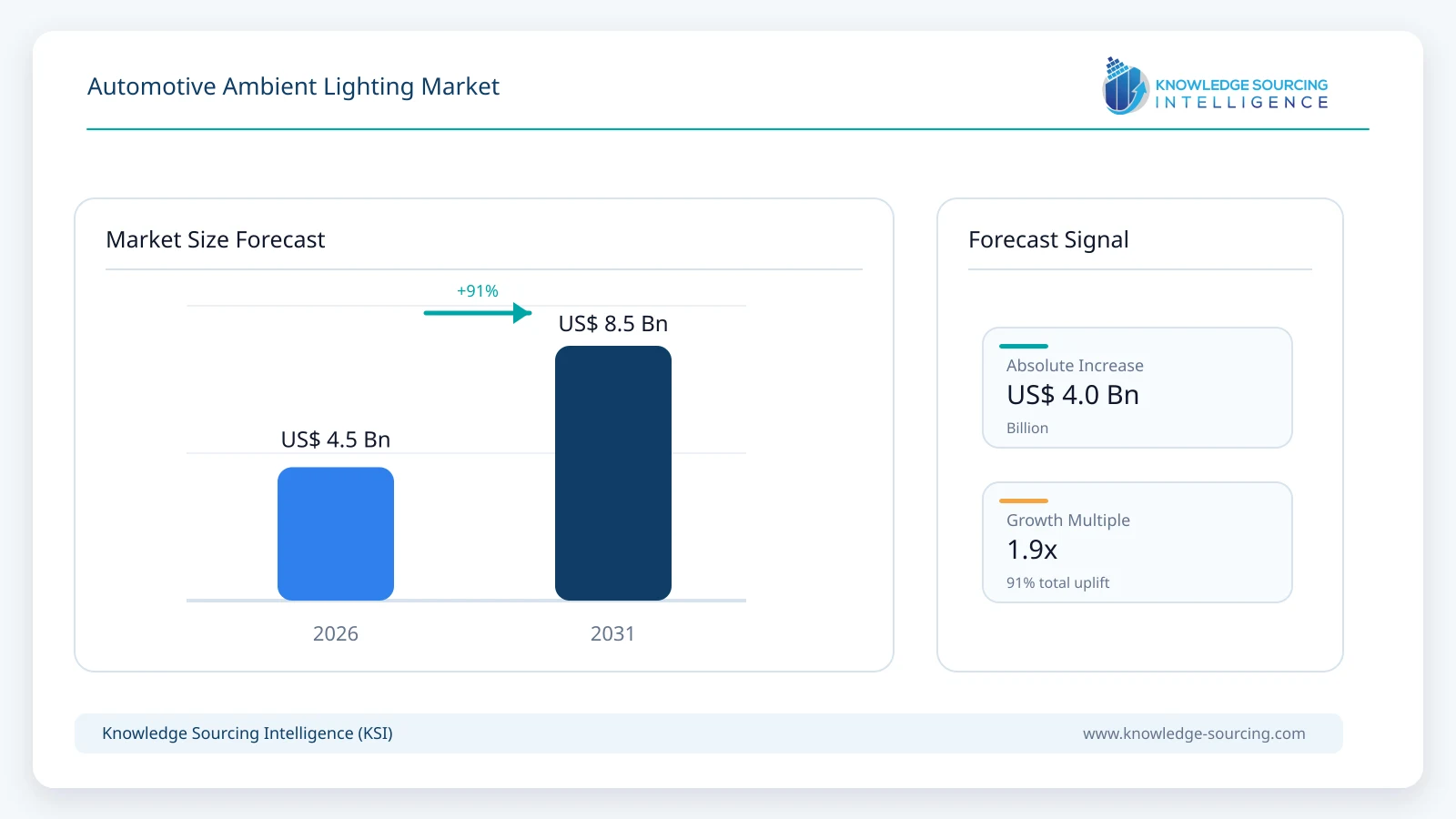
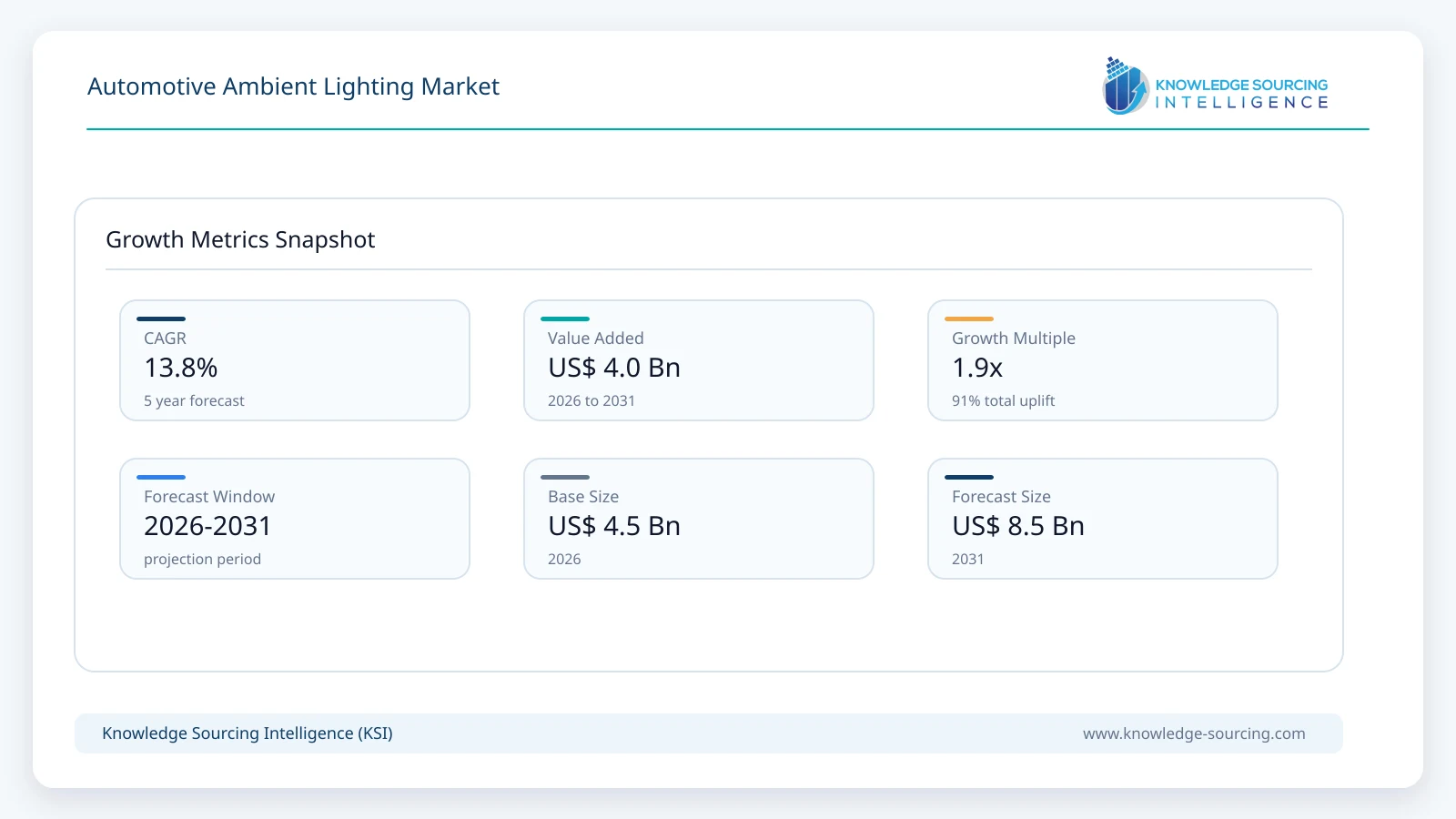
The Automotive Ambient Lighting Market is projected to expand at a CAGR of 13.8%, increasing from USD 4.45 billion in 2026 to USD 8.50 billion by 2031.
Highlights:
- 1Door and side-trim ambient lighting accounts for approximately 31% of global market value in 2026 because long visible contours and broad decorative areas provide the strongest visual impact across front and rear seating rows.
- 2Selectable RGB and RGBW ambient systems represent approximately 44% of 2026 market value, while individually addressable dynamic lighting is the fastest-growing control class.
- 3Contour and light-guide architectures account for approximately 35% of 2026 technology value, supported by mature optical design and broad use across doors, dashboards and consoles.
- 4User-controlled personalization remains the largest functional use case, while software-linked scenes, music synchronization and vehicle-state-linked ambience are gaining share.
- 5Passenger vehicles account for approximately 96% of global market value in 2026, led by premium cars, EVs, SUVs and technology-focused MPVs.
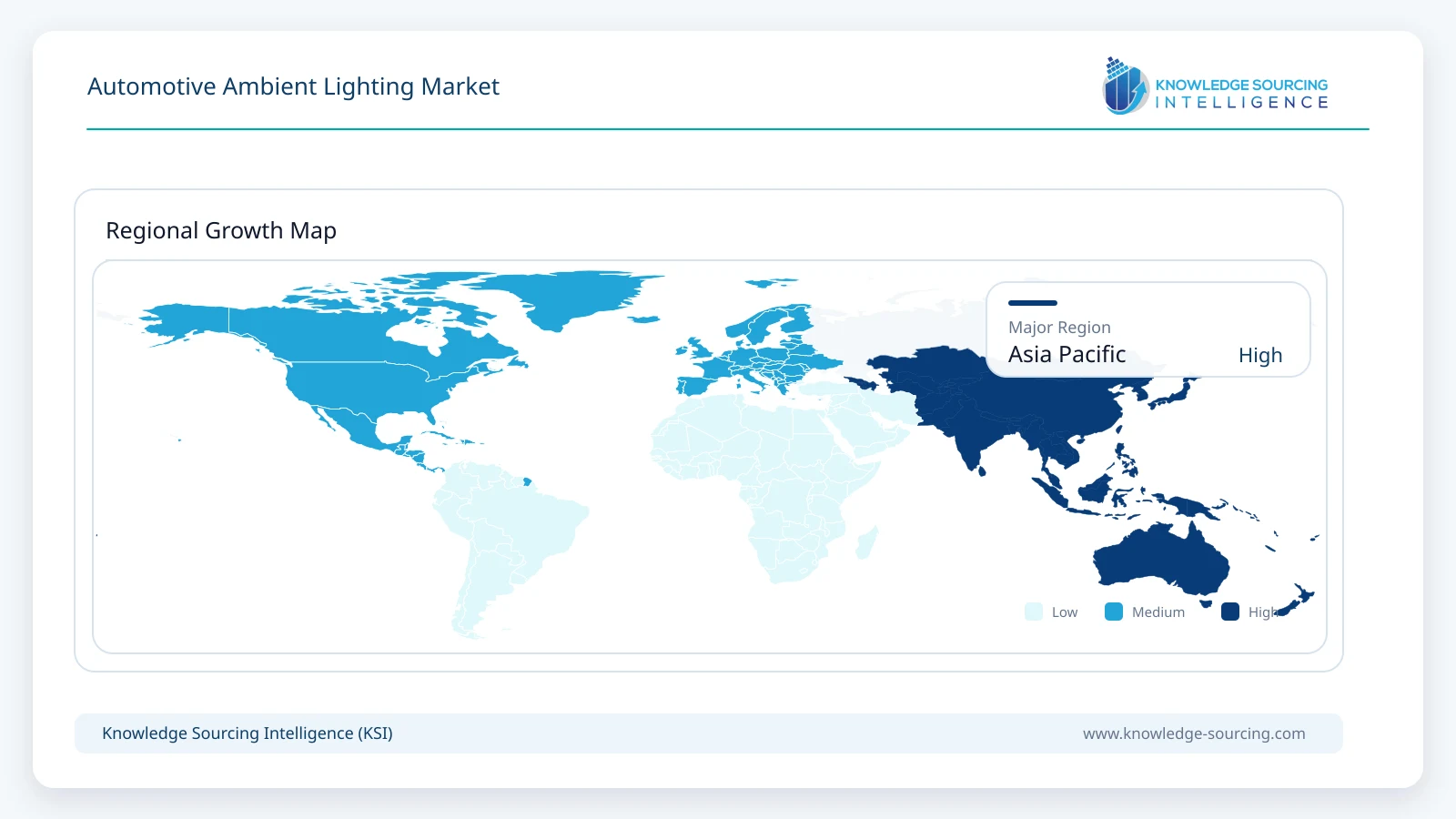
- 6Asia Pacific represents approximately 47% of global market value in 2026, supported by rapid smart-cabin adoption in China and strong regional lighting, electronics and interior-systems manufacturing.
Ambient lighting has moved from a narrow premium accent feature into a broader cabin-design layer that influences how occupants perceive space, materials, and digital content.
Door and dashboard lighting remain the largest value pools because long illuminated contours and large visible surfaces allow OEMs to create a continuous visual theme across the cabin. Higher-content systems add individually addressable RGB devices, animated gradients, coordinated display themes, surface-integrated light and multiple brightness zones, increasing both electronic and software value per vehicle.
The market includes lighting hardware, optical elements, local control electronics and attributable software used primarily for cabin ambience. Conventional dome, map, vanity and cargo lamps, display backlighting, safety-only warning lighting and circadian or wellness functions are excluded when ambience is not their primary purpose, while overlapping mood and interactive lighting categories are treated as functional subsets rather than additive markets.
Market Overview
Indirect lighting changes the perceived depth, width, and material quality of the cabin without requiring another display or visible lamp housing. Light guides, diffusers and concealed RGB modules can emphasize door contours, dashboard edges, storage areas and footwells while keeping the source itself out of direct view, which is central to maintaining a premium interior appearance.
Control capability is now as important as the optical hardware. Simple systems allow users to select a color and brightness level, while higher-end architectures coordinate multiple zones, apply gradients or animations, synchronize with drive modes and entertainment, and store preferences within the driver's digital profile.
The strongest commercial growth is coming from systems that reuse one lighting network across several experience levels. The same RGB hardware can support a basic static theme on one trim grade and more complex animations or display-linked scenes on another, allowing OEMs to differentiate vehicle variants through software without redesigning the complete interior.
Market Trends
Individually Addressable RGB Lighting Is Replacing Broad Zone Control
Integrated RGB devices with local drivers and calibration data are allowing OEMs to control individual light points rather than entire cabin zones as one color block. ams OSRAM's 2026 NIO ES9 deployment illustrates how a distributed network of calibrated RGB LEDs can support immersive and personalized lighting while maintaining consistent color across the instrument panel and door areas.
Higher addressability increases scene quality and reduces visible discontinuities between zones, but it also raises software, diagnostics and thermal-management requirements as the number of controlled light points grows.
Ambient Lighting Is Becoming Part of the Complete Digital Theme
Coordinating ambient light with instrument graphics, infotainment backgrounds and vehicle modes creates a more coherent cabin experience than treating illumination as a separate decorative feature. Mercedes-Benz's 2026 GLA links display styles, control colors and ambient lighting across multiple brightness zones, showing how digital and physical design are increasingly managed together.
Software coordination also gives OEMs more flexibility to refresh the interior through new themes or visual packages after the hardware has entered production.
Surface Illumination Is Expanding Beyond Narrow Light Strips
Large-area door and trim illumination is becoming more practical as translucent skins, surface materials and embedded optical structures improve. Toyota Boshoku's new Lexus ES door trim uses surface and light-transmission technologies to create uniform large-area illumination and animated effects linked to music or selected scenes.
The transition increases the value of illuminated trim because light becomes part of the visible material surface rather than a separate strip positioned around it.
Ambient Lighting Is Moving into More Cabin Zones
Roof structures, headliners, storage areas, cupholders and center consoles are increasingly being added to the same ambient-lighting network that previously focused on doors and dashboards. Genesis' GV90 uses indirect Ambient Glow lighting across the dashboard, doors, headliner, and console to create a more continuous visual environment.
More illuminated zones strengthen immersion but also raise the importance of brightness balance so occupants do not experience glare or inconsistent color between surfaces.
Commercial Vehicles Are Becoming a New Growth Area
Long-haul cabins are increasingly treated as both workplaces and living spaces, creating demand for dimmable, personalized and rest-oriented ambient lighting. FORVIA HELLA's 2026 commercial-vehicle concept combines full-color ambience, dynamic animations and visual communication within integrated cabin surfaces.
Commercial adoption remains small relative to passenger vehicles, but the use case is strong because drivers spend extended periods in the cabin and can benefit from different lighting settings for driving, rest, and parked operation.
Segment Analysis
By Lighting Type: Selectable RGB and RGBW Ambient Lighting
Selectable multicolor systems lead the market because they provide visible personalization without requiring the full software and sensor complexity of highly dynamic lighting. RGB and RGBW modules can support broad color palettes, brightness adjustment, and several preset themes across doors, dashboards, consoles, and footwells.
Selectable RGB and RGBW ambient lighting accounts for approximately USD 1.96 billion in 2026 and is projected to reach about USD 3.48 billion by 2031. Its share will gradually decline as individually addressable and software-adaptive systems grow faster, but it will remain the largest lighting type.
By Technology: Contour and Light-Guide Lighting
Rigid and flexible light guides remain the largest technology platform because they can distribute light evenly over long distances using relatively few LED sources. The architecture is well established across door panels, instrument panels, and center consoles and can be adapted to multiple vehicle geometries.
Contour and light-guide technologies represent approximately USD 1.56 billion in 2026 and are projected to reach about USD 2.72 billion by 2031. Surface-integrated and direct-view smart LED architectures will grow faster, but light guides retain a strong cost and packaging advantage.
By Control Type: User-Selected Ambient Lighting
Manual or profile-based selection remains the dominant control mode because occupants expect ambient lighting to reflect personal preference rather than operate entirely in the background. Color palettes, stored themes, and brightness zones can be selected through infotainment, voice interfaces, or mobile applications.
User-selected control accounts for approximately USD 2.14 billion in 2026 and is expected to reach about USD 3.73 billion by 2031. Dynamic, media-linked and vehicle-state-responsive control will gain share as smart-cabin software becomes more standardized.
By Application Location: Door and Side Trim
Long illuminated contours, strong occupant visibility and close integration with switches, speakers and decorative inserts make doors the largest application area. Door lighting also extends naturally into the rear cabin, helping OEMs create a consistent visual theme across all seating rows.
Door and side-trim ambient lighting accounts for approximately USD 1.38 billion in 2026 and is projected to reach about USD 2.55 billion by 2031. Dashboard and roof applications will grow faster as large-area illumination becomes more common.
By Vehicle Type: Passenger Vehicles
Passenger cars, SUVs and MPVs dominate demand because cabin ambience has become an important perceived-quality feature in premium and increasingly mainstream vehicles. Electric vehicles have accelerated adoption by using lighting to reinforce a digital and lounge-like interior identity.
Passenger vehicles represent approximately USD 4.27 billion in 2026 and are projected to reach about USD 8.10 billion by 2031. Commercial vehicles remain a small share but offer a meaningful long-term opportunity in long-haul trucks, premium vans and buses.
Market Drivers
Interior Experience Is Becoming a Stronger Vehicle Differentiator
As powertrain differences become less visible to occupants, OEMs are placing more emphasis on the cabin as a source of perceived technology and brand character. Ambient lighting provides a highly visible way to change the interior atmosphere without adding large mechanical components or major mass.
The feature also works across multiple trim levels, allowing manufacturers to vary color capability, number of zones and animation complexity while retaining much of the same underlying hardware.
Smart-Cockpit Software Is Increasing the Value of Installed Lighting
Centralized cockpit and zonal architectures allow ambient lighting to receive the same user-profile, drive-mode, media and vehicle-state information as displays and audio. Lighting can therefore become part of a coordinated digital experience rather than a standalone body-electronics feature.
The software layer increases lifetime value because new themes, scenes or synchronization functions can be introduced without redesigning the optical hardware.
Electric Vehicles Are Accelerating Cabin Premiumization
EV manufacturers are using large displays, simplified dashboards, flat floors and richer lighting to create a distinct interior identity, particularly in China. Ambient illumination helps visually connect these elements and can make a relatively simple physical interior feel more premium.
Rapid EV model cycles are also pushing global suppliers to shorten development timelines and create modular lighting systems that can be reused across several vehicle platforms.
Smart LEDs Are Reducing Wiring and Calibration Complexity
RGB devices with integrated drivers, calibration data and serial communication reduce the number of separate electronics needed to control dense lighting networks. Fewer discrete driver components and more consistent factory calibration improve scalability as the number of cabin light points rises.
This architectural improvement is important for mainstream adoption because visual quality must increase without allowing harness mass, connector count and end-of-line adjustment time to grow at the same rate.
Illuminated Surfaces Are Expanding the Addressable Lighting Area
Translucent trim, large-area light guides and surface-integrated modules allow ambience to move beyond thin lines into panels, roof structures and material surfaces. The result is a more immersive cabin and a larger lighting-content opportunity per vehicle.
The same trend supports closer integration with trim suppliers, making ambient lighting part of the interior-system architecture rather than an isolated lamp purchased late in the design process.
Market Restraints
Color Consistency Becomes Harder as the Number of Light Points Increases
Small differences in LED output, temperature, aging and optical material can become visible when several lighting zones display the same color across a large cabin. Premium systems therefore require calibration, thermal compensation and careful control of light-guide and diffuser performance.
The challenge becomes more complex when doors, dashboards and roof modules are supplied by different Tier 1 companies but must appear visually identical in the finished vehicle.
Driver Distraction Limits the Use of Aggressive Dynamic Effects
Bright, fast-moving or high-contrast lighting can draw attention away from the road, particularly at night when the driver's eyes are adapted to low external light levels. Dynamic scenes therefore need clear rules for brightness, animation speed and operating conditions.
Safety-related visual cues must also take priority over decorative effects so occupants do not confuse an ambient animation with a warning or assistance-system message.
Higher Lighting Content Can Be Difficult to Justify in Entry-Level Vehicles
Additional LEDs, optical guides, controllers and illuminated trim increase component cost even when individual semiconductor prices fall. The business case is strongest when the same network supports several trim grades or functions rather than being installed solely as a premium decorative feature.
Mainstream expansion will therefore depend on common electronics, simplified optical architectures and manufacturing scale rather than feature richness alone.
Surface Integration Raises Durability and Repair Requirements
Lighting embedded into door panels, soft trim or consoles must maintain brightness and appearance after heat, vibration, abrasion, cleaning chemicals and repeated touch. A surface defect can also become more visible when backlit than it would be in conventional trim.
Integrated assemblies may cost more to repair because damage to the decorative surface can require replacement of optical or electronic content that remains functional.
Too Many Personalization Options Can Complicate the User Experience
Large menus of colors, zones, animations and synchronization settings can reduce usability if occupants must spend too much time configuring the system. The most effective designs balance customization with a small number of understandable presets and automatic profile recall.
Voice control, saved preferences and coordinated themes can reduce setup effort, but they require reliable software integration across infotainment and body-control systems.
Regional Outlook
Asia Pacific
China's fast smart-cabin development cycle and strong consumer response to highly personalized interiors make Asia Pacific the largest automotive ambient-lighting market in 2026. NIO and other regional EV manufacturers are using dense RGB networks, dynamic scenes and surface lighting as visible technology features, while Japanese and South Korean suppliers contribute strong optical and interior-system expertise.
Regional growth through 2031 will come from both higher content per vehicle and broader adoption below the premium segment. The NIO ES9's intelligent RGB implementation, Toyoda Gosei's new Mazda CX-5 illumination unit and Genesis' Ambient Glow system demonstrate how different regional OEMs are expanding the function from accent lighting into a complete cabin experience.
Europe
European premium OEMs continue to generate high value per vehicle by coordinating ambient lighting with displays, panoramic roofs, trim and audio. Mercedes-Benz's 2026 GLA and AMG GT 4-Door Coupé show how lighting is being distributed across more cabin zones and linked with selectable visual themes rather than remaining a simple door-strip feature.
European suppliers including FORVIA HELLA and Valeo are also advancing scalable RGB architectures and surface-integrated lighting, supporting broader adoption in passenger and commercial vehicles. The region should retain a strong value position even if vehicle-production growth remains slower than Asia.
Competitive Landscape
The market combines lighting Tier 1 suppliers, LED and semiconductor companies, interior-system integrators and smart-surface specialists because high-content ambient lighting requires coordinated optical, electronic and trim engineering. FORVIA HELLA, Valeo, Toyoda Gosei and Marelli compete through lighting modules and vehicle integration, while ams OSRAM supplies intelligent RGB devices and network technology.
Interior suppliers including Yanfeng, Antolin and Toyota Boshoku increase value by integrating lighting directly into doors, dashboards and decorative surfaces. The competitive boundary is therefore moving from individual lamp modules toward complete illuminated zones that combine surface materials, optics and software-controlled electronics.
Supplier advantage will increasingly depend on color consistency, scalable network architecture, thin packaging, manufacturing yield and the ability to support both simple fixed-color ambience and richer dynamic experiences from one platform. OEMs are likely to favor solutions that provide visible differentiation without proportionally increasing wiring, controller count or validation complexity.
Recent Developments
3 September 2026: FORVIA HELLA presented adaptive RGB interior lighting for commercial vehicles, combining homogeneous full-color ambience, dynamic light animations and seamless integration into cabin surfaces.
20 August 2026: Genesis unveiled the GV90 with Ambient Glow mood lighting extending across the dashboard, doors, headliner and console, including sequential door illumination and brightness changes linked to voice recognition and vehicle status.
29 July 2026: Mercedes-Benz introduced the new GLA with 64 ambient-light colors, ten color schemes, 20 brightness levels and three brightness zones, coordinated with display backgrounds and control graphics.
11 June 2026: Toyota Boshoku announced large-area illuminated door trim for the new Lexus ES, using surface and light-transmission technologies to provide uniform lighting and multiple animated effects.
29 May 2026: Toyoda Gosei announced adoption of its LIN-supported interior full-color illumination unit on the new Mazda CX-5, enabling smoother color effects and greater installation flexibility.
12 May 2026: ams OSRAM announced integration of its OSIRE E3731i intelligent RGB LED in the NIO ES9, supporting immersive and personalized dynamic ambient lighting with factory-calibrated color consistency.
Market Outlook
Wider adoption of selectable RGB lighting, larger illuminated surface areas and denser addressable LED networks is strengthening demand for automotive ambient lighting. Doors and dashboards remain the largest application zones, while roof, headliner and surface-integrated lighting are gaining traction. Manufacturers are increasingly integrating customizable color options, dynamic lighting effects and personalized illumination features to enhance cabin aesthetics, passenger comfort and the overall driving experience.
The market will become more software-intensive even as core LED hardware becomes more standardized. A common lighting network will increasingly support several trim grades, user profiles, display themes and entertainment scenarios, allowing OEMs to create differentiated experiences through software rather than unique hardware for every vehicle variant.
Asia Pacific is expected to retain the largest regional position, while Europe continues to generate high value per vehicle through premium integration and coordinated digital themes. Long-term supplier success will depend on color consistency, low wiring complexity, intuitive user controls, durable surface integration and a clear balance between personalization and visual comfort.
Automotive Ambient Lighting Market Scope:
| Report Metric | Details |
|---|---|
| Total Market Size in 2026 | USD 4.45 billion |
| Total Market Size in 2031 | USD 8.50 billion |
| Forecast Unit | USD Billion |
| Growth Rate | 13.8% |
| Study Period | 2021 to 2031 |
| Historical Data | 2021 to 2024 |
| Base Year | 2025 |
| Forecast Period | 2026 – 2031 |
| Segmentation | Lighting Type, Technology, Control Type, Application Location |
| Companies |
|
Market Segmentation
By Lighting Type
Fixed-Color Ambient Lighting
Selectable RGB and RGBW Ambient Lighting
Dynamic and Animated Ambient Lighting
Surface-Integrated Ambient Lighting
By Technology
Contour and Light-Guide Lighting
Direct-View and Addressable LED Lighting
Surface and Backlit Ambient Lighting
Projection, Pattern and Other Ambient Lighting
By Control Type
User-Selected Ambient Lighting
Dynamic and Context-Adaptive Lighting
Media- and Content-Reactive Lighting
Vehicle-State-Linked Ambient Lighting
By Application Location
Door and Side Trim
Instrument Panel and Dashboard
Center Console and Storage Areas
Roof and Headliner
Footwell, Seats and Rear-Passenger Areas
By Vehicle Type
Passenger Vehicles
Light Commercial Vehicles
Medium and Heavy Commercial Vehicles and Buses
By Geography
North America
United States
Canada
Mexico
South America
Brazil
Argentina
Others
Europe
Germany
United Kingdom
France
Italy
Spain
Others
Middle East and Africa
Saudi Arabia
UAE
South Africa
Others
Asia Pacific
China
Japan
South Korea
India
Indonesia
Thailand
Others
Table of Contents
1. INTRODUCTION
1.1. Market Overview
1.2. Market Definition
1.3. Scope of the Study
1.4. Market Segmentation
1.5. Currency
1.6. Assumptions
1.7. Base and Forecast Years
1.8. Key Benefits to Stakeholders
2. RESEARCH METHODOLOGY
2.1. Research Design
2.2. Secondary Research
2.3. Primary Research
2.4. Market Estimation
2.5. Segment Modelling
2.6. Data Triangulation and Validation
3. EXECUTIVE SUMMARY
3.1. Key Findings
3.2. Automotive Ambient Lighting Market Size, 2026-2031
3.3. Lighting Type Outlook
3.4. Technology Outlook
3.5. Control Type Outlook
3.6. Application Location Outlook
3.7. Vehicle Type Outlook
3.8. Regional Opportunity Summary
4. MARKET DYNAMICS
4.1. Market Drivers
4.1.1. Interior Experience Is Becoming a Stronger Vehicle Differentiator
4.1.2. Smart-Cockpit Software Is Increasing the Value of Installed Lighting
4.1.3. Electric Vehicles Are Accelerating Cabin Premiumization
4.1.4. Smart LEDs Are Reducing Wiring and Calibration Complexity
4.1.5. Illuminated Surfaces Are Expanding the Addressable Lighting Area
4.2. Market Restraints
4.2.1. Color Consistency Becomes Harder as the Number of Light Points Increases
4.2.2. Driver Distraction Limits the Use of Aggressive Dynamic Effects
4.2.3. Higher Lighting Content Can Be Difficult to Justify in Entry-Level Vehicles
4.2.4. Surface Integration Raises Durability and Repair Requirements
4.2.5. Too Many Personalization Options Can Complicate the User Experience
4.3. Market Opportunities
4.4. Porter's Five Forces Analysis
4.5. Industry Value Chain Analysis
4.6. Ambient Lighting Hardware, Software and Integration Economics
4.7. Driver-Distraction and Interior Lighting Requirements
5. TECHNOLOGY OUTLOOK
5.1. Fixed-Color and Multicolor LED Ambient Lighting
5.2. RGB and RGBW Ambient Lighting
5.3. Intelligent Addressable RGB LEDs
5.4. Rigid and Flexible Light Guides
5.5. Surface-Integrated and Hidden-Until-Lit Lighting
5.6. Large-Area Illuminated Trim
5.7. Roof and Headliner Ambient Lighting
5.8. Footwell and Storage-Area Ambient Lighting
5.9. Music and Media-Reactive Lighting
5.10. Serial Lighting Networks and Open Protocols
5.11. Color Calibration and Thermal Compensation
5.12. Centralized and Zonal Lighting Control
6. AUTOMOTIVE AMBIENT LIGHTING MARKET BY LIGHTING TYPE
6.1. Introduction
6.2. Fixed-Color Ambient Lighting
6.3. Selectable RGB and RGBW Ambient Lighting
6.4. Dynamic and Animated Ambient Lighting
6.5. Surface-Integrated Ambient Lighting
7. AUTOMOTIVE AMBIENT LIGHTING MARKET BY TECHNOLOGY
7.1. Introduction
7.2. Contour and Light-Guide Lighting
7.3. Direct-View and Addressable LED Lighting
7.4. Surface and Backlit Ambient Lighting
7.5. Projection, Pattern and Other Ambient Lighting
8. AUTOMOTIVE AMBIENT LIGHTING MARKET BY CONTROL TYPE
8.1. Introduction
8.2. User-Selected Ambient Lighting
8.3. Dynamic and Context-Adaptive Lighting
8.4. Media- and Content-Reactive Lighting
8.5. Vehicle-State-Linked Ambient Lighting
9. AUTOMOTIVE AMBIENT LIGHTING MARKET BY APPLICATION LOCATION
9.1. Introduction
9.2. Door and Side Trim
9.3. Instrument Panel and Dashboard
9.4. Center Console and Storage Areas
9.5. Roof and Headliner
9.6. Footwell, Seats and Rear-Passenger Areas
10. AUTOMOTIVE AMBIENT LIGHTING MARKET BY VEHICLE TYPE
10.1. Introduction
10.2. Passenger Vehicles
10.3. Light Commercial Vehicles
10.4. Medium and Heavy Commercial Vehicles and Buses
11. AUTOMOTIVE AMBIENT LIGHTING MARKET BY GEOGRAPHY
11.1. North America
11.1.1. United States
11.1.2. Canada
11.1.3. Mexico
11.2. South America
11.2.1. Brazil
11.2.2. Argentina
11.2.3. Others
11.3. Europe
11.3.1. Germany
11.3.2. United Kingdom
11.3.3. France
11.3.4. Italy
11.3.5. Spain
11.3.6. Others
11.4. Middle East and Africa
11.4.1. Saudi Arabia
11.4.2. UAE
11.4.3. South Africa
11.4.4. Others
11.5. Asia Pacific
11.5.1. China
11.5.2. Japan
11.5.3. South Korea
11.5.4. India
11.5.5. Indonesia
11.5.6. Thailand
11.5.7. Others
12. COMPETITIVE ENVIRONMENT AND ANALYSIS
12.1. Major Players and Strategy Analysis
12.2. Market Share Analysis
12.3. RGB and Addressable LED Technology Benchmarking
12.4. Light-Guide and Surface-Integration Benchmarking
12.5. Dynamic Scene and Personalization Benchmarking
12.6. Color Consistency and Network Architecture Benchmarking
12.7. OEM Programs and Series-Production Readiness
12.8. Competitive Dashboard
13. COMPANY PROFILES
13.1. FORVIA HELLA
13.2. ams OSRAM
13.3. Toyoda Gosei Co., Ltd.
13.4. Valeo
13.5. Marelli
13.6. Yanfeng Automotive Interiors
13.7. Antolin
13.8. Toyota Boshoku Corporation
13.9. Hyundai Mobis
13.10. Stanley Electric Co., Ltd.
14. APPENDIX
14.1. Currency
14.2. Assumptions
14.3. Base and Forecast Years Timeline
14.4. Key Benefits for Stakeholders
14.5. Research Methodology
14.6. Abbreviations
14.7. Data Sources
Navigate
Trusted by the world's leading organizations











