
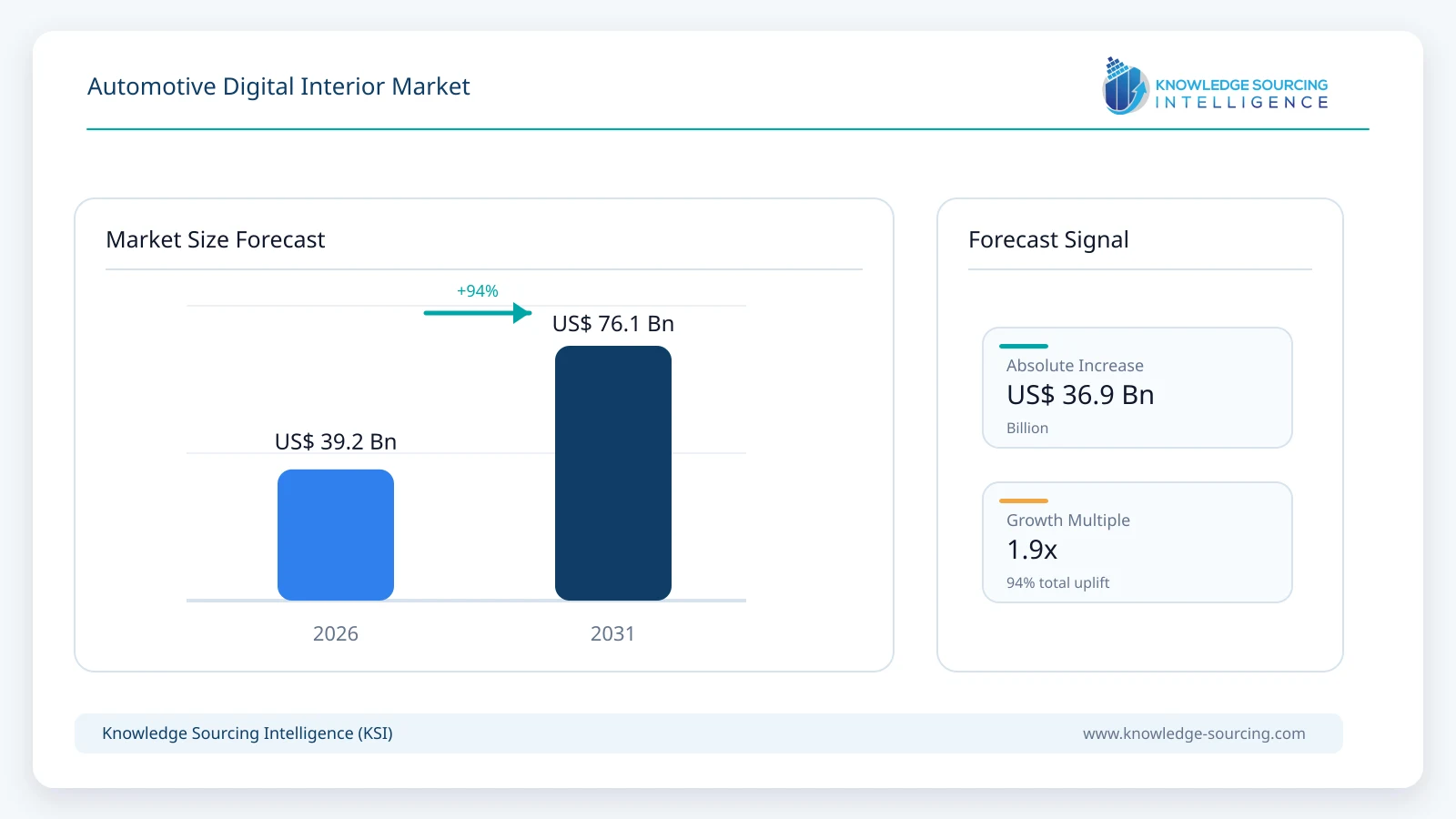
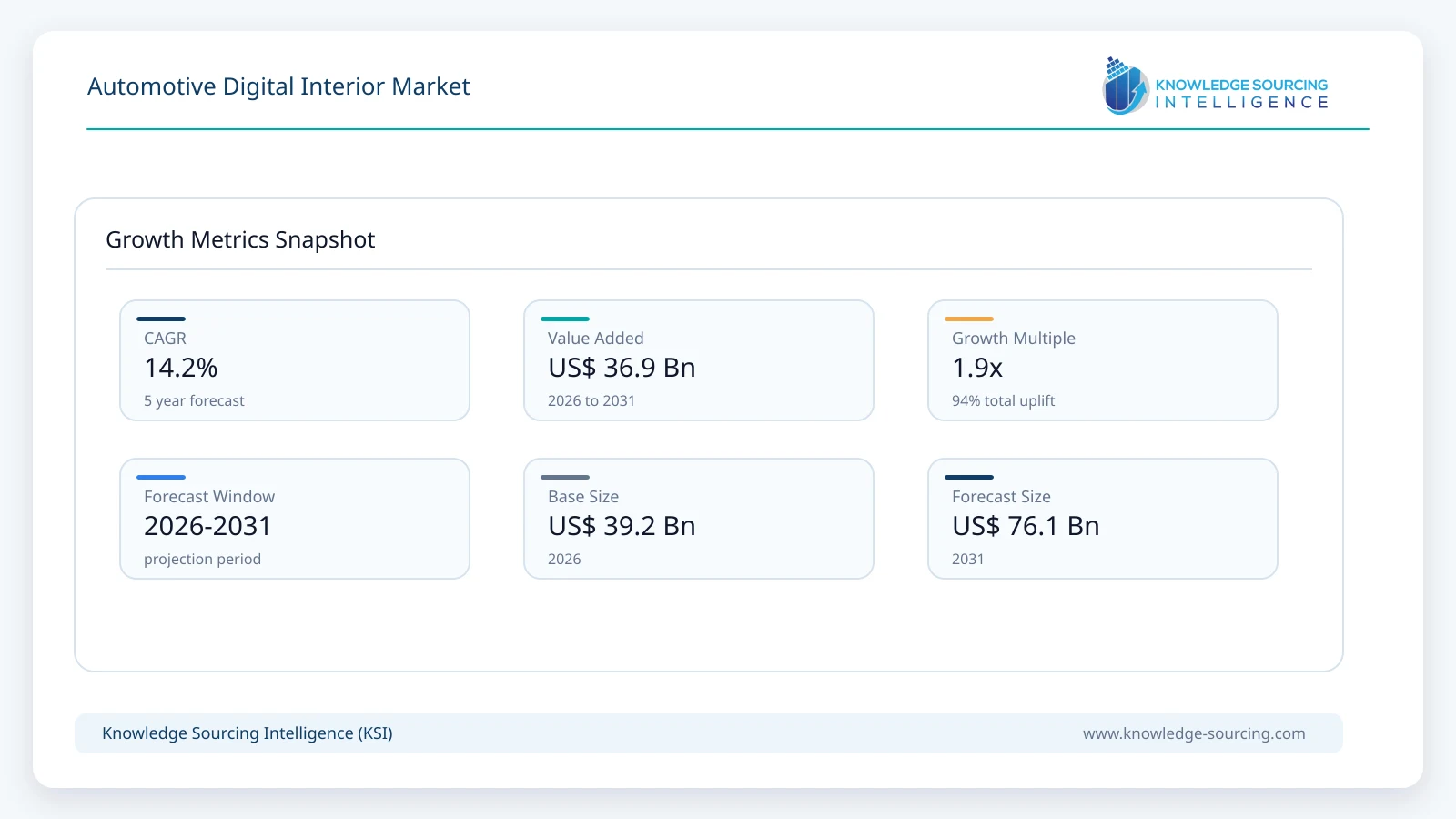
The automotive digital interior market is forecast to increase from approximately USD 39.2 billion in 2026 to USD 76.1 billion in 2031, representing a CAGR of 14.2% during the forecast period.
Highlights:
- 1Cockpit displays and visual interfaces contribute approximately 46% of digital-interior value in 2026, supported by digital clusters, center displays, HUDs and associated graphics electronics.
- 2Centralized cockpit domain controllers increase their estimated share from 35% in 2026 to 45% in 2031 as automakers consolidate front-cabin electronic functions.
- 3Asia Pacific represents approximately 45% of the market in 2026 and is projected to account for 49% in 2031, reflecting vehicle production scale and rapid digital feature deployment.
- 4Passenger vehicles account for approximately 92% of 2026 revenue as consumer vehicle platforms dominate digital display and entertainment installations.
- 5Digital systems extending into rear-seat and cabin-wide control zones will capture a larger proportion of supplier value as multi-occupant interactions expand.
- 6New digital interfaces remain subject to usability, cybersecurity, repairability and automotive qualification constraints, keeping physical controls relevant in many applications.
It includes supplier-delivered digital displays, cockpit computing and interfaces, digitally active trim surfaces, passenger-zone controls and software directly attributable to these installed experiences. The market covers digital features fitted in production vehicles and associated contracted software and content services throughout the vehicle lifecycle.
Vehicle interiors are increasingly organized around linked digital interfaces instead of isolated instrument and entertainment units. BMW Panoramic iDrive combines the dashboard, windshield visual band and steering-wheel interaction; Panasonic Automotive Systems supplies a cockpit domain controller adopted for the Mazda CX-5; and LG supplies cockpit, rear-seat and cabin-control technologies for the Genesis GV90. These programs show how automakers are allocating development responsibility across electronics, software and packaging to a narrower set of integrated platforms.
Market Overview
Digital interior systems combine visible interface equipment with processors, electronic controls, graphics, software and networked integration that determine how occupants interact with vehicle functions. A digitally equipped vehicle may include an instrument cluster, one or more central or passenger screens, a head-up display, touch or haptic switches, rear displays and coordinated interfaces for media, navigation, seats and climate. Commercial value varies substantially according to the number of cabin zones served, panel technology, computing architecture and degree of software integration.
Visteon reported USD 3.768 billion in total 2025 sales and a record USD 7.4 billion of new business wins, including digital cockpit displays, SmartCore computing and clusters. Panasonic Automotive Systems supplies an integrated controller for the Mazda CX-5, while HARMAN presented production-ready automotive display technologies in January 2026. Different procurement structures allow OEMs to buy finished assemblies, electronic subsystems or software stacks, although the revenue counted in this market relates only to attributable digital-interior content.
Automakers increasingly link visual interaction with interior control and passenger services. LG’s October 2026 Genesis GV90 disclosure covers a popup display, cockpit infotainment, rear OLED screen, console touchscreen and central communications unit, demonstrating the extension of digital interfaces beyond the driver. Interior suppliers such as Antolin and FORVIA are also developing surfaces and interaction software for controls embedded in trim. The resulting supplier ecosystem requires coordination between display engineering, plastics and surface technologies, embedded software, automotive electronics and vehicle validation.
Market Trends
Multi-Display Architectures Are Extending Beyond the Driver
BMW Panoramic iDrive combines a windshield-spanning visual band, central display, steering-wheel controls and an optional head-up display under a coordinated operating concept. Its planned adoption across new BMW models places display distribution and interaction consistency at the center of cockpit engineering rather than relying only on an enlarged central touchscreen.
LG Electronics is extending similar digital interaction principles beyond the front cockpit. Its October 2026 Genesis GV90 disclosure includes a rear-seat OLED entertainment system and an eight-inch console touchscreen controlling seat, lighting, media and climate functions. The combination indicates that suppliers can earn digital-interface value from multiple cabin zones on one vehicle platform, particularly where passenger privacy and content delivery justify added hardware.
Cabin Electronics Are Consolidating Around Shared Compute
Panasonic Automotive Systems announced adoption of its cockpit domain controller in the new Mazda CX-5 in July 2026, combining infotainment, head-up display and instrument-cluster functions. Consolidating software on common processors can reduce duplicated electronic control units, but it also shifts more validation responsibility toward supplier software integration and dependable display failover behavior.
Visteon announced its next-generation SmartCore Pro system for Mahindra in January 2026, incorporating three displays alongside surround-view camera and connected functions. Such architectures favor platform suppliers capable of delivering graphics, computing, application software and OEM-specific interfaces in a coordinated package, although processor-sharing economics differ between premium and price-sensitive vehicle programs.
Smart Surfaces Are Adding Digital Functions to Interior Trim
Antolin and UltraSense announced a September 2026 initiative to engineer a solid-state interface using touch and force sensing with visual and haptic feedback for a future global platform. The initiative shows how software-visible controls can migrate into console, door and trim surfaces while retaining tactile confirmation under driving conditions.
Industrial adoption still depends on resolving false activation, glove operation, moisture exposure, manufacturing tolerances and repairability. Conventional mechanical switches retain an important role in frequently used and safety-relevant functions, so digital surfaces are more likely to complement physical controls than replace them across every vehicle segment.
Passenger Content and AI Are Broadening the Digital Experience
LG announced in January 2026 that Prime Video would be integrated into its Automotive Content Platform, creating a defined route for streaming applications on compatible vehicles. Cabin services depend on connectivity, licensing and driver-distraction controls, which means supplier monetization may occur through platform licensing rather than direct consumer subscription ownership.
Qualcomm introduced expanded Snapdragon Digital Chassis collaborations in January 2026 and described agentic AI capable of linking cockpit functions through local computing. AI-assisted interfaces may increase system value, but forecasts must distinguish broadly supplied silicon and integration work from early demonstrations of context-aware experiences that have not entered series production.
Segment Analysis
By Digital System: Cockpit Displays and Visual Interfaces
Cockpit displays and visual interfaces represent approximately 46% of 2026 digital-interior value, reflecting the high unit penetration of digital clusters, center displays, head-up displays and vehicle-specific graphics systems. Visteon supplies digitally integrated cluster and display programs across automakers, while HARMAN positions its Ready Display range around automotive-qualified image performance and interface clarity.
The group is projected to reach approximately USD 31.2 billion by 2031, although its share declines as passenger-zone interfaces, smart surfaces and application services expand faster. Continued growth comes from premium optical performance, multiple displays and supplier integration rather than automatic increases in display area on every vehicle.
By Interior Zone: Driver and Primary Cockpit
Driver and primary-cockpit interfaces account for approximately 65% of 2026 market value because the instrument cluster, center display, HUD and primary vehicle controls concentrate both safety-critical and infotainment content. BMW and Mazda illustrate how vehicle programs increasingly coordinate driver displays through a shared software and control architecture.
By 2031, the primary cockpit remains the largest zone, but its share falls to approximately 56% as rear digital experiences and multi-zone cabin controls are deployed in more vehicle classes. Suppliers able to maintain information priority and consistent interaction across zones will have an advantage over standalone display integrators.
By Control Architecture: Distributed and Dedicated Controllers
Distributed and dedicated controllers still represent approximately 52% of market value in 2026 because many established vehicle platforms retain separate cluster, head-unit, comfort and passenger-interface electronics. Their commercial position reflects long vehicle-platform cycles and the expense of requalifying critical functions when processor and software boundaries change.
Centralized cockpit and cross-domain integration architectures together gain share through 2031 as OEMs consolidate graphics, application software and cockpit control onto fewer, more capable computing platforms. Panasonic’s Mazda CDC adoption is direct evidence of this shift, while lower-cost vehicles may retain distributed configurations for longer than premium programs.
By Vehicle Class: Mass-Market and Entry-Mid Vehicles
Mass-market and entry-mid vehicles contribute approximately 57% of digital-interior revenue in 2026 because global passenger-vehicle volumes outweigh the higher per-vehicle content of luxury brands. Digitized cluster and central-display functions have moved into many mid-price platforms, while the software and electronics behind premium features can be simplified for volume applications.
The segment rises to approximately 60% of revenue by 2031 under the model as regional manufacturers increase digital fitment without adopting every high-cost OLED, projection or sensing feature. Premium vehicles continue to command more content per unit, but wider volume deployment becomes the main source of incremental demand.
By Vehicle Type: Passenger Vehicles
Passenger vehicles represent approximately 92% of 2026 digital-interior market value, supported by the strongest demand for branded digital cockpits, front-passenger screens, rear entertainment and connected comfort interfaces. Visteon’s Lexus and Mahindra programs show that both premium and mainstream passenger platforms support differentiated supplier opportunities.
Commercial vehicles grow from a smaller base through 2031 as digital instrument clusters, fleet-driver HMIs and passenger displays expand in trucks and buses. Vehicle-class requirements remain different, however, because work-oriented interfaces often prioritize durability, legibility and operating cost over broad consumer entertainment features.
By Propulsion: Internal Combustion Engine Vehicles
Internal combustion engine vehicles account for approximately 53% of market value in 2026 because of the large installed production base and continued use of digital clusters, center displays and connected interfaces across conventional powertrains. Cockpit modernization is therefore not confined to battery-electric launches.
Battery-electric vehicles are modeled to gain the strongest share through 2031, moving from approximately 23% to 36%, because software-centric model launches often carry larger digital surfaces, integrated compute and centralized controls. That difference reflects assumed vehicle-content intensity as well as production mix, not a claim that every EV carries high-end digital hardware.
Market Drivers
Rising Digital Content Across Vehicle Classes
Vehicle manufacturers are fitting digital clusters, center displays, multi-function controls and connected interfaces across a wider range of models. Visteon reported USD 3.768 billion of company-wide 2025 sales and 86 product launches, with display and cockpit platforms central to its portfolio. Digital-interior revenue therefore grows through higher electronics content per equipped vehicle as well as wider deployment, although Visteon’s complete sales cannot be assigned to this market.
Centralized Cockpit Computing and Integration
Panasonic Automotive Systems’ adopted cockpit domain controller for the Mazda CX-5 combines several front-cabin functions on a common platform. Consolidation can reduce duplicated controllers and permit common interfaces across screens while creating demand for more capable processors and integration work. OEM program decisions increasingly favor suppliers that can validate software and hardware together rather than supply isolated display panels.
Expansion of Passenger-Specific Digital Features
LG’s Genesis GV90 technology package includes a rear OLED entertainment unit and dedicated console touchscreen controlling multiple cabin functions. Digital interfaces for the second row create supplier value beyond the instrument panel, particularly in premium SUVs, people movers and vehicles with strong chauffeur or family passenger demand. Lower-cost models may adopt simplified versions as screen and controller costs decline.
OEM Differentiation Through Digital Interface Design
BMW Panoramic iDrive links display geometry, personalized graphics and steering-wheel interaction into a recognizable vehicle operating environment. These interface decisions shape supplier bids because display optics, processor selection, cockpit packaging and software have to be developed together. The pressure is strongest when automakers use cabin technology to distinguish platforms that share similar propulsion and mechanical features.
Growing Availability of Automotive Software and Edge AI Platforms
Qualcomm’s Snapdragon Digital Chassis and HARMAN’s production-ready display portfolio give OEMs automotive-qualified building blocks for new interfaces. Platform reuse can improve development economics across model lines while supporting localized voice, contextual graphics and periodic software enhancements. Commercial uptake will depend on validated automotive deployments and OEM procurement, rather than demonstration functions alone.
Market Restraints
Cost and Integration Burden of Multi-Display Systems
Large digital interfaces require automotive-grade panels, optical bonding, computing capacity, graphics software and electrical integration. Added displays also increase thermal, wiring and repair complexity, particularly when large panels are packaged close to airbags or crash-sensitive structures. OEMs serving price-sensitive segments must therefore balance visible digital features against tightly managed bill-of-material targets.
Driver Distraction and Human-Factors Limitations
Touch-heavy cockpit layouts can make frequent functions less accessible without visual attention, creating a need for clear hierarchy, physical shortcuts, haptics and voice alternatives. Validation against distraction and functional-safety requirements adds engineering effort, while negative user experience can prompt automakers to retain or reintroduce conventional switches. Suppliers need to design digital interaction around driving workload rather than screen count.
Cybersecurity and Software Maintenance Requirements
Connected display and control systems introduce update mechanisms, external interfaces, application dependencies and cyberattack surfaces that have to be managed through a long vehicle life. UNECE R155 and R156 influence cybersecurity and software update management requirements in approving markets. Compliance raises the importance of secure software supply chains, documentation and coordinated update validation.
Durability and Serviceability of Integrated Surfaces
Digital smart surfaces combine decorative materials with sensors, light guides and haptic electronics. Heat, sunlight, abrasion, moisture and long-term cabin aging can impair appearance or sensing reliability, while replacement may require an entire trim assembly rather than a low-cost switch. The Antolin-UltraSense development work illustrates active innovation, but a future-platform initiative should not be treated as evidence of broad production fitment.
Uneven Electronic Architecture and Supplier Readiness
Legacy vehicle platforms often use separate infotainment, cluster, body and comfort controllers with different software stacks and supplier interfaces. Transitioning to central compute demands extensive integration, functional isolation and long qualification cycles, which can delay new digital-interior functions. OEM investment priorities and different software capabilities across regions are likely to produce uneven adoption through the forecast period.
Regional Outlook
Asia Pacific
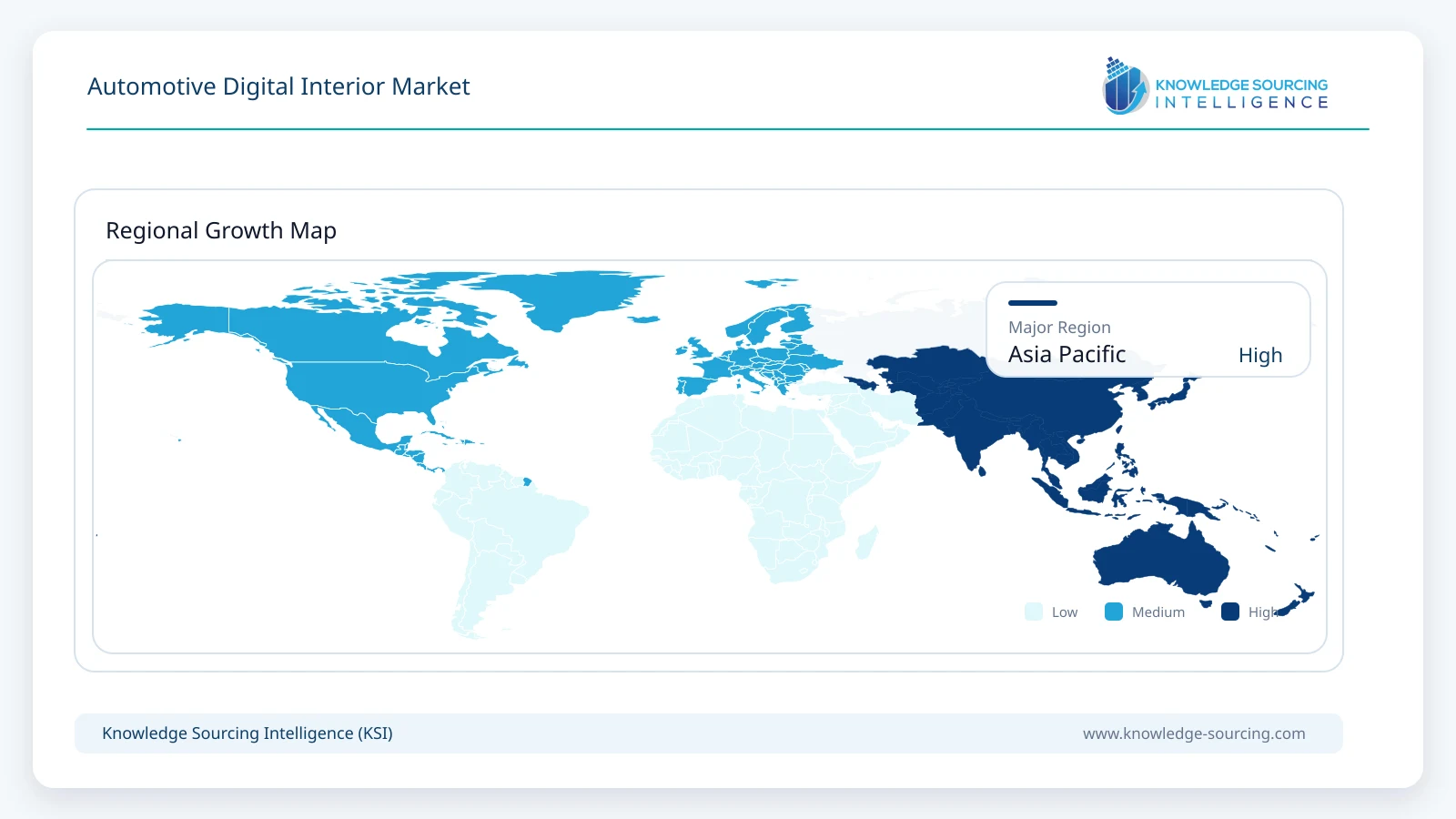
Asia Pacific accounts for approximately 45% of the digital-interior market in 2026, supported by the scale of vehicle manufacturing in China, Japan, South Korea and India and by extensive regional display, semiconductor and cockpit electronics supply chains. China provides strong demand for display-rich and AI-enabled vehicle programs, while Japanese and Korean suppliers support both regional platforms and global OEM launches.
Panasonic Automotive Systems’ Mazda controller award, Visteon’s Mahindra SmartCore Pro program and LG’s Genesis digital-cabin package demonstrate different routes from electronics into production vehicle architecture. The region is forecast to approach 49% of market value by 2031 as mass-market interfaces spread while higher-value Chinese EV and premium systems support content growth.
Europe
Europe accounts for approximately 27% of digital-interior revenue in 2026, with Germany, the United Kingdom, France, Italy and Spain contributing through premium OEMs, multinational supplier engineering and advanced cockpit development. BMW’s Panoramic iDrive program illustrates the regional emphasis on coordinated display ergonomics and brand-specific interaction across multiple vehicle lines.
European suppliers such as FORVIA and Antolin combine digital-interaction engineering with interior modules and smart surfaces. Demand will remain sensitive to vehicle assembly volumes and OEM cost control, but premium digital content, cockpit software validation and usability requirements sustain significant value per vehicle. Europe is modeled at about 23% of global digital-interior value in 2031 as Asia Pacific expands faster.
Competitive Landscape
The automotive digital interior market combines digital cockpit specialists, software and semiconductor suppliers, and interior-system integrators. Visteon, HARMAN, Panasonic Automotive Systems and LG participate through cockpit electronics, visual interfaces and software, while Qualcomm supplies processor platforms integrated by multiple OEMs and Tier 1 suppliers. Antolin, FORVIA, Yanfeng and Marelli connect digital functions to interior surfaces, controls and complete module assemblies.
Visteon’s digital cluster and integrated cockpit programs compete on program execution, graphic performance, optical quality and software integration. HARMAN combines display systems with audiovisual and software capabilities, while LG spans front and rear cabin environments. Panasonic’s Mazda award shows the growing importance of domain controllers that coordinate several screens with vehicle features, and Qualcomm’s platforms support common compute architectures across successive vehicle generations.
Competition increasingly centers on architecture, integration capability and production reliability rather than display size alone. Interfaces embedded into interior trim require expertise in haptics, material durability and industrial manufacturing as well as electronics. OEMs also weigh software maintenance, cybersecurity documentation and supplier responsiveness across long service lives. Reported company-wide sales and design-win pipelines do not directly represent market shares in digital interiors.
Recent Developments
October 2026: LG Electronics announced six integrated in-cabin solutions for the Genesis GV90, including front and rear displays, console controls and communications systems, demonstrating a production-vehicle route for multi-zone digital interfaces.
September 2026: Antolin and UltraSense advanced a solid-state smart-surface HMI development initiative for a future global vehicle platform, combining force and touch sensing with haptic and visual feedback.
July 2026: Panasonic Automotive Systems confirmed adoption of its cockpit domain controller for the all-new Mazda CX-5, bringing instrument cluster, head-up display and infotainment control into a centralized architecture.
January 2026: HARMAN introduced production-ready Ready Display automotive visual technologies designed to enhance picture quality and the clarity of in-cabin information.
January 2026: Qualcomm announced expanded Snapdragon Digital Chassis programs and agentic AI collaborations, strengthening shared compute and software platforms for future automotive digital interfaces.
Market Outlook
Automotive digital interior revenue is expected to increase as more vehicle platforms adopt coordinated instrument, infotainment and passenger interfaces. Cockpit displays retain the largest share of system value, while smart surfaces, rear-seat systems and digital services gain importance as functions migrate into more cabin zones. Platform designs that reconcile cost, glare control, visual priority and haptic response should achieve wider fitment than screen-heavy concepts developed primarily for demonstrations.
Centralized and cross-domain computing will attract a growing proportion of supplier development expenditure because automakers need consistent visual and control behavior across screens and vehicle functions. Production awards from Panasonic and Visteon demonstrate that centralized controller architectures are entering named vehicle programs. Suppliers must still validate functional separation, cybersecurity and update handling across changing software releases and vehicle configurations.
Asia Pacific is expected to remain the largest and fastest-growing regional digital-interior market, supported by China-led cabin technology competition and manufacturing scale. Europe retains a major role in premium HMI design and electronics integration. Across regions, the competitive advantage will favor suppliers able to combine automotive-grade hardware, software reuse, visible interior quality and predictable series-production delivery.
Automotive Digital Interior Market Scope
| Report Metric | Details |
|---|---|
| Total Market Size in 2026 | USD 39.2 billion |
| Total Market Size in 2031 | USD 76.1 billion |
| Forecast Unit | Billion |
| Growth Rate | 14.2% |
| Study Period | 2021 to 2031 |
| Historical Data | 2021 to 2024 |
| Base Year | 2025 |
| Forecast Period | 2026 – 2031 |
| Segmentation | Digital System, Interior Zone, Control Architecture, Vehicle Class, Vehicle Type, Propulsion, Geography |
| Companies |
|
Market Segmentation
By Digital System
Cockpit Displays and Visual Interfaces
Domain Compute and Digital Controls
Smart Surfaces and Haptic Interfaces
Rear-Seat and Passenger Digital Systems
Digital UI and Lifecycle Services
By Interior Zone
Driver and Primary Cockpit
Front Passenger
Rear Occupant Areas
Multi-Zone and Cabin-Wide Interfaces
By Control Architecture
Distributed and Dedicated Controllers
Centralized Cockpit Domain Control
Cross-Domain and Zonal Cabin Integration
By Vehicle Class
Mass-Market and Entry-Mid Vehicles
Premium and Luxury Vehicles
By Vehicle Type
Passenger Vehicles
Light Commercial Vehicles
Medium and Heavy Commercial Vehicles and Buses
By Propulsion
Internal Combustion Engine Vehicles
Hybrid and Plug-In Hybrid Vehicles
Battery Electric Vehicles
By Geography
North America
United States
Canada
Mexico
South America
Brazil
Argentina
Others
Europe
Germany
United Kingdom
France
Italy
Spain
Others
Middle East and Africa
Saudi Arabia
UAE
South Africa
Others
Asia Pacific
China
Japan
South Korea
India
Indonesia
Thailand
Others
Table of Contents
1. INTRODUCTION
1.1. Market Overview
1.2. Market Definition
1.3. Scope of the Study
1.4. Market Segmentation
1.5. Currency
1.6. Assumptions
1.7. Base and Forecast Years
1.8. Key Benefits to Stakeholders
2. RESEARCH METHODOLOGY
2.1. Research Design
2.2. Secondary Research
2.3. Primary Research
2.4. Market Estimation
2.5. Segment Modelling
2.6. Data Triangulation and Validation
3. EXECUTIVE SUMMARY
3.1. Key Findings
3.2. Automotive Digital Interior Market Size, 2026-2031
3.3. Digital System Outlook
3.4. Interior Zone Outlook
3.5. Architecture and Vehicle Outlook
3.6. Regional Opportunity Summary
4. MARKET DYNAMICS
4.1. Market Drivers
4.1.1. Rising Digital Content Across Vehicle Classes
4.1.2. Centralized Cockpit Computing and Integration
4.1.3. Expansion of Passenger-Specific Digital Features
4.1.4. OEM Differentiation Through Digital Interface Design
4.1.5. Growing Availability of Automotive Software and Edge AI Platforms
4.2. Market Restraints
4.2.1. Cost and Integration Burden of Multi-Display Systems
4.2.2. Driver Distraction and Human-Factors Limitations
4.2.3. Cybersecurity and Software Maintenance Requirements
4.2.4. Durability and Serviceability of Integrated Surfaces
4.2.5. Uneven Electronic Architecture and Supplier Readiness
4.3. Market Opportunities
4.4. Porter’s Five Forces Analysis
4.5. Industry Value Chain Analysis
4.6. Digital Interior System Economics
4.7. Policies and Regulations
4.8. Strategic Recommendations
5. TECHNOLOGY OUTLOOK
5.1. Multi-Display and Windshield Interfaces
5.2. Cockpit Domain Controllers
5.3. Smart Surfaces and Haptic Controls
5.4. Rear-Seat Digital Systems
5.5. Cabin HMI and Interaction Software
5.6. Edge AI and Digital Services
6. AUTOMOTIVE DIGITAL INTERIOR MARKET BY DIGITAL SYSTEM
6.1. Introduction
6.2. Cockpit Displays and Visual Interfaces
6.3. Domain Compute and Digital Controls
6.4. Smart Surfaces and Haptic Interfaces
6.5. Rear-Seat and Passenger Digital Systems
6.6. Digital UI and Lifecycle Services
7. AUTOMOTIVE DIGITAL INTERIOR MARKET BY INTERIOR ZONE
7.1. Introduction
7.2. Driver and Primary Cockpit
7.3. Front Passenger
7.4. Rear Occupant Areas
7.5. Multi-Zone and Cabin-Wide Interfaces
8. AUTOMOTIVE DIGITAL INTERIOR MARKET BY CONTROL ARCHITECTURE
8.1. Introduction
8.2. Distributed and Dedicated Controllers
8.3. Centralized Cockpit Domain Control
8.4. Cross-Domain and Zonal Cabin Integration
9. AUTOMOTIVE DIGITAL INTERIOR MARKET BY VEHICLE CLASS
9.1. Introduction
9.2. Mass-Market and Entry-Mid Vehicles
9.3. Premium and Luxury Vehicles
10. AUTOMOTIVE DIGITAL INTERIOR MARKET BY VEHICLE TYPE
10.1. Introduction
10.2. Passenger Vehicles
10.3. Light Commercial Vehicles
10.4. Medium and Heavy Commercial Vehicles and Buses
11. AUTOMOTIVE DIGITAL INTERIOR MARKET BY PROPULSION
11.1. Introduction
11.2. Internal Combustion Engine Vehicles
11.3. Hybrid and Plug-In Hybrid Vehicles
11.4. Battery Electric Vehicles
12. AUTOMOTIVE DIGITAL INTERIOR MARKET BY GEOGRAPHY
12.1. North America
12.1.1. United States
12.1.2. Canada
12.1.3. Mexico
12.2. South America
12.2.1. Brazil
12.2.2. Argentina
12.2.3. Others
12.3. Europe
12.3.1. Germany
12.3.2. United Kingdom
12.3.3. France
12.3.4. Italy
12.3.5. Spain
12.3.6. Others
12.4. Middle East and Africa
12.4.1. Saudi Arabia
12.4.2. UAE
12.4.3. South Africa
12.4.4. Others
12.5. Asia Pacific
12.5.1. China
12.5.2. Japan
12.5.3. South Korea
12.5.4. India
12.5.5. Indonesia
12.5.6. Thailand
12.5.7. Others
13. COMPETITIVE ENVIRONMENT AND ANALYSIS
13.1. Major Players and Strategy Analysis
13.2. Market Share Analysis
13.3. Mergers, Acquisitions, Agreements, and Collaborations
13.4. Competitive Dashboard
14. COMPANY PROFILES
14.1. HARMAN International
14.2. Visteon Corporation
14.3. LG Electronics Vehicle Solution Company
14.4. Panasonic Automotive Systems Co., Ltd.
14.5. Robert Bosch GmbH
14.6. FORVIA
14.7. Antolin
14.8. Yanfeng Automotive Interiors
14.9. Hyundai Mobis Co., Ltd.
14.10. Marelli Holdings Co., Ltd.
14.11. Qualcomm Technologies, Inc.
14.12. Gentex Corporation
15. APPENDIX
15.1. Currency and Conversion
15.2. Assumptions
15.3. Base and Forecast Years
15.4. Research Methodology
15.5. Abbreviations
Navigate
Trusted by the world's leading organizations











