
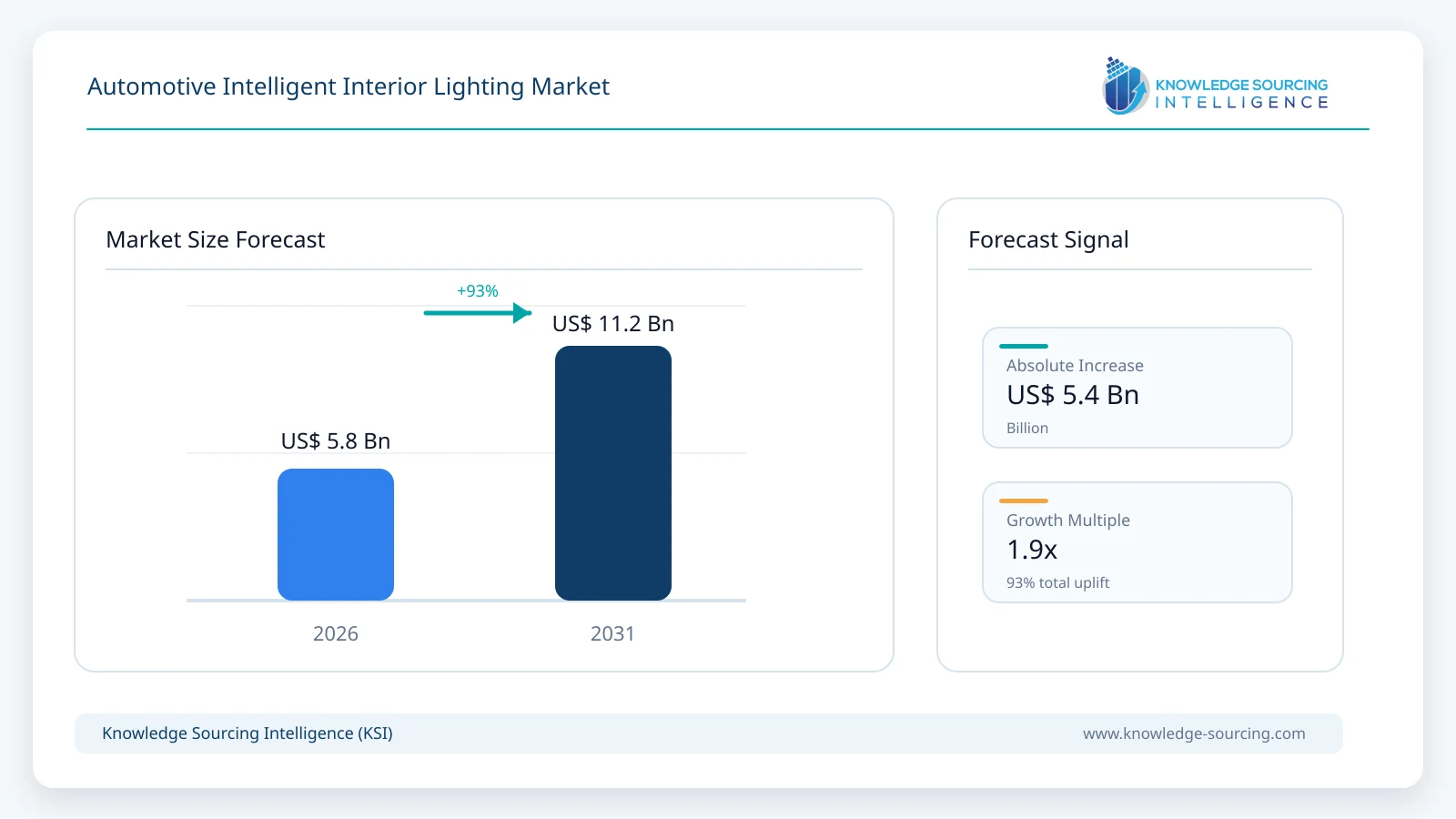
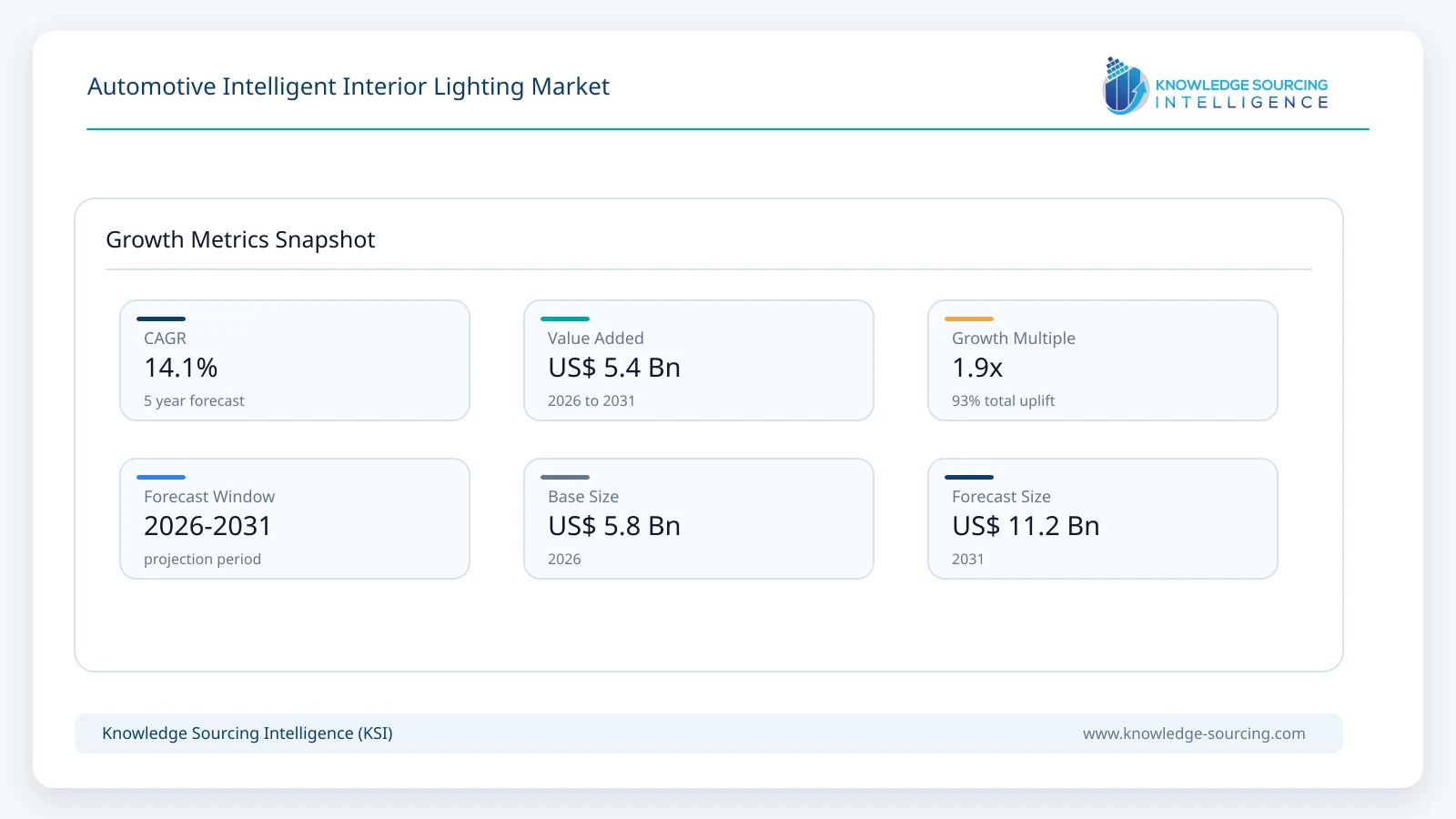
The Automotive Intelligent Interior Lighting Market is projected to expand at a CAGR of 14.1%, increasing from USD 5.8 billion in 2026 to USD 11.2 billion by 2031.
Highlights:
- 1Dynamic RGB ambient and contour lighting accounts for approximately 36% of global market value in 2026 because it forms the core programmable lighting layer across doors, instrument panels, consoles and footwells.
- 2Intelligent LED networks with distributed addressable control represent approximately 34% of 2026 system architecture value and are gaining share as OEMs reduce wiring and improve color consistency across large cabins.
- 3Comfort and personalization applications account for approximately 38% of 2026 market value, while safety, warning and HMI communication functions are the fastest-growing use case.
- 4Door panels and instrument-panel/console zones together account for approximately 57% of 2026 demand because these locations provide the largest continuous surfaces for dynamic illumination and hidden-until-lit functions.
- 5Passenger vehicles represent approximately 94% of global market value in 2026, supported by premium, EV and smart-cockpit adoption.
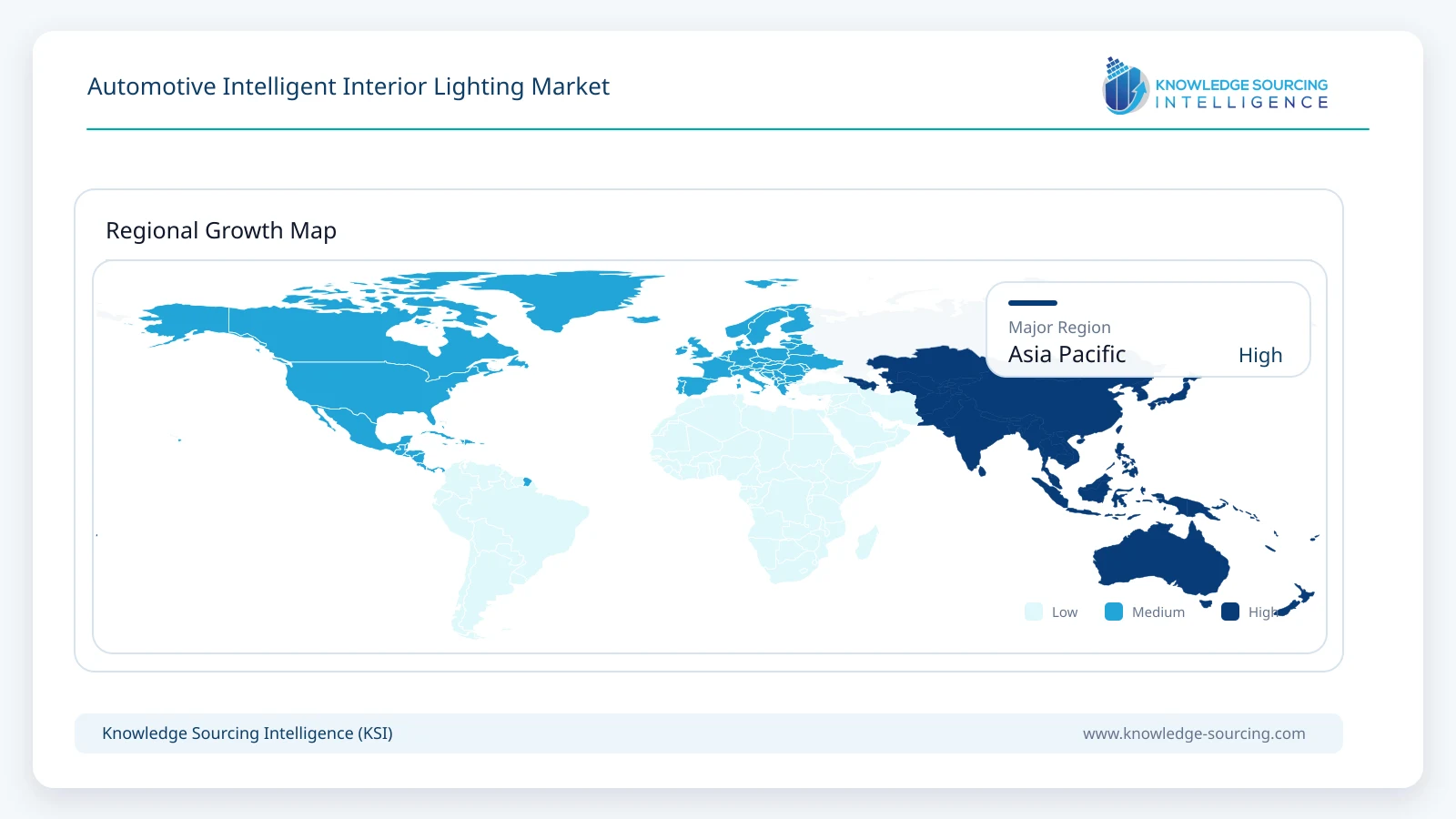
- 6Asia Pacific represents approximately 47% of global market value in 2026, led by fast adoption of highly animated and personalized cabin lighting among Chinese EV and premium vehicle manufacturers.
The automotive intelligent interior lighting is moving beyond fixed ambient light strips toward programmable cabin networks that combine personalization, alerts, navigation cues, ADAS status, occupant interaction and wellness functions. Rising software content is increasing the value of control logic and distributed electronics alongside the physical light sources.
Addressable RGB lighting remains the largest value pool because its wide color range, local dimming and animation capability support both immersive cabin themes and contextual communication. Embedded drivers, calibration memory and serial-bus interfaces are reducing wiring and color-matching complexity, while flexible light guides, LED-on-foil systems and in-mold electronics are allowing controlled illumination to spread across doors, consoles, roof structures and other curved surfaces.
Commercial value is concentrated in the incremental lighting hardware, control electronics and software that enable adaptive or personalized behavior. Static dome, map, vanity and cargo lamps fall outside the core market unless they participate in an intelligent control network, while display backlighting and illuminated trim are counted only to the extent that their lighting functionality is part of an adaptive cabin-lighting system.
Market Overview
Software-addressable control is turning interior lighting from a collection of independent lamps into a coordinated cabin interface capable of managing hundreds of RGB or white light points by location, brightness, color, and timing. Central or zonal controllers can synchronize illumination with drive modes, infotainment, navigation, and occupant settings while also triggering localized visual cues from vehicle-state and safety data.
Distributed lighting architectures are gaining importance as intelligent RGB LEDs place drivers, calibration data and communication interfaces directly at the light source, reducing the number of discrete control components needed across the cabin. Daisy-chain networks can then combine ambient-light sensors, occupant-monitoring inputs, seat occupancy and user profiles to adapt lighting automatically without routing every function through a centralized driver stage.
Integration with smart surfaces is broadening the role of interior lighting beyond conventional lamp modules, particularly where illuminated graphics remain concealed behind wood-like trim, textiles, translucent skins or molded decorative structures until activated. Combining lighting with touch and haptic sensing allows the same surface to support appearance, interaction and feedback, positioning intelligent lighting as part of the wider HMI and software-defined cabin architecture.
Market Trends
Individually Addressable RGB Lighting Is Becoming the Core Architecture
Networks of individually addressable RGB devices are replacing centrally driven color zones because each light point can be calibrated, dimmed and animated independently, allowing smoother gradients, localized alerts and tighter color consistency across the cabin. This architecture also gives OEM software greater control over how lighting responds to user profiles, drive modes and real-time vehicle events.
Open communication protocols and intelligent LED devices are reducing controller count and simplifying the scaling of large lighting networks, making high-density addressable systems more practical beyond flagship vehicles. As semiconductor integration improves, the cost and wiring penalty of adding new light points declines, supporting broader adoption across upper-midrange and mainstream platforms.
Smart Surfaces Are Integrating Light, Touch and Electronics
In-mold structural electronics and hidden-until-lit surfaces are embedding lighting, conductors and touch functions directly into decorative interior structures, allowing flush interfaces that appear passive until interaction is required. The same approach can reduce separate switches, bezels and lamp housings while creating a more continuous visual language across doors, consoles and instrument-panel surfaces.
Closer integration of lighting with trim, materials and HMI engineering is therefore becoming a core design requirement, especially where optical performance depends on surface thickness, translucency, grain and touch-sensor placement. Suppliers able to co-engineer the full illuminated surface rather than only the light source can capture a larger share of the system value.
Interior Lighting Is Becoming an HMI and Safety Channel
Dynamic cabin lighting is increasingly being used to reinforce blind-spot alerts, assistance-system states, charging status, navigation cues and attention direction, extending the function of ambient light into peripheral HMI communication. Color, intensity, spatial location and movement can convey information without adding another display element in already screen-dense cockpits.
Multimodal warning strategies generate the strongest functional value when lighting complements rather than replaces acoustic and visual alerts, allowing information to be localized near the relevant hazard or vehicle zone. This creates room for OEM-specific styling while still requiring disciplined color hierarchies, timing logic and human-factors validation.
Flexible and Conformal Lighting Is Expanding the Addressable Surface Area
Omni-bendable light guides, flexible LED foils and thin RGB modules are allowing controlled illumination to follow curved doors, roof structures, seat contours and console geometries that are difficult to serve with rigid optical components. Reduced packaging depth also helps lighting migrate from narrow accent strips into broader surfaces without adding visible hardware bulk.
Larger illuminated areas become commercially viable as conformal technologies improve optical uniformity, bend radius and assembly integration, particularly in premium and EV cabins where continuous surface treatment is a visible design differentiator. The result is higher lighting content per vehicle rather than simple replacement of one lamp technology with another.
Human-Centric and Circadian Functions Are Emerging within Premium Systems
Tunable-white and spectrum-controlled lighting is introducing time-of-day, journey-phase and occupant-preference adaptation into premium cabin programs, linking interior illumination with alertness, relaxation and sleep-readiness use cases. Although these functions remain a smaller share of intelligent lighting than RGB personalization, they require more precise spectral control, calibration and sensing.
Human-centric lighting is therefore emerging as a distinct high-value layer within intelligent interior lighting, particularly in long-distance, premium rear-seat and future automated-driving environments. Adoption will depend on whether OEMs can demonstrate perceptible comfort benefits without materially increasing system complexity or distracting occupants.
Segment Analysis
By Lighting Type: Dynamic RGB Ambient and Contour Lighting
Dynamic RGB ambient and contour lighting holds the largest segment share because it combines visible personalization with animation and localized communication across doors, instrument panels, consoles, and footwells. Individually addressable devices allow gradients, moving effects and zone-specific cues to be generated from the same hardware platform rather than through separate decorative and functional lighting systems.
Representing approximately USD 2.09 billion in 2026 and potentially approaching USD 3.85 billion by 2031, dynamic RGB lighting is expected to expand through both wider penetration in mid-range vehicles and higher light-point density per vehicle. Growth is increasingly tied to networked control and software content rather than to the number of conventional lamp assemblies alone.
By Control Architecture: Intelligent Distributed LED Networks
Distributed intelligent LED networks are gaining share because embedding drivers, calibration memory, and serial communication at the light source can reduce harness complexity and centralized driver requirements. Daisy-chain architectures also allow OEMs to add addressable light points across multiple cabin zones without redesigning the full electrical system for each model derivative.
Valued at approximately USD 1.97 billion in 2026, distributed intelligent LED architectures could exceed USD 4.25 billion by 2031 as smart LEDs and open interior-lighting protocols scale across shared vehicle platforms. The architecture benefits most from high-content cabins where color consistency, diagnostics, and synchronized effects would otherwise require substantial centralized electronics.
By Function: Comfort and Personalization
Comfort and personalization remains the largest functional category because occupants directly experience color themes, welcome sequences, drive-mode-linked lighting and profile-specific settings every time they enter the vehicle. Premium EV programs have accelerated the use of these features as a visible way to differentiate the cabin when traditional powertrain cues carry less branding value.
Approximately USD 2.20 billion of 2026 market value is attributable to comfort and personalization functions, with absolute demand continuing to rise through 2031 even as safety communication, adaptive HMI and wellness applications grow faster. The segment's durability reflects its strong perceived-value contribution and its ability to share the same RGB hardware with other software-defined functions.
By Application Location: Door Panels
Door panels form the largest application location because their long illuminated contours, broad decorative areas and proximity to switches, handles, speakers and safety indicators support both immersive effects and localized functional cues. Visibility to front and rear passengers also makes the door a natural surface for synchronized color themes and hidden-until-lit interaction.
Door-panel intelligent lighting accounts for approximately USD 1.74 billion in 2026 and is expected to remain the largest application through 2031 as light guides, smart surfaces and surface-integrated RGB modules become more common. Higher content per door, rather than simple vehicle-volume growth, will drive much of the value increase.
By Vehicle Type: Passenger Vehicles
Passenger vehicles dominate demand because smart lighting is increasingly standard on premium and upper-midrange cars, SUVs and MPVs, while Chinese EV manufacturers are pushing dense, highly animated cabin-lighting architectures into broader price bands. Consumer-facing personalization and smart-cockpit differentiation are substantially stronger purchasing drivers in passenger vehicles than in conventional commercial platforms.
Approximately USD 5.45 billion of 2026 market value is generated by passenger vehicles, leaving commercial applications as a smaller but expanding niche. Driver cabins, premium buses and multi-purpose commercial interiors are adding visual communication, rest-mode ambience and safety-related lighting where the operational benefit can justify higher electronics content.
Market Drivers
Smart-Cockpit and Software-Defined Vehicle Expansion
Centralized cockpit and zonal electrical architectures are allowing interior lighting to use the same vehicle-state, user-profile and ADAS data streams as displays, audio and other digital cabin systems. Lighting can therefore be orchestrated as part of the software-defined user experience, enabling synchronized behavior without relying on isolated body-control logic for every illuminated zone.
Shared data and software layers also support feature reuse across multiple vehicle lines and create scope for differentiation after common hardware has been installed. OEMs can vary themes, animations and selected functional behaviors by trim level or software package while limiting changes to the physical lighting architecture.
Consumer Demand for Personalization and Immersive Cabin Experiences
Color themes, animated welcome sequences and drive-mode-linked effects have become visible indicators of premium technology, particularly in EVs where interior experience carries more of the brand differentiation traditionally associated with powertrain sound and mechanical character. Higher consumer expectations are pushing OEMs toward denser lighting layouts, smoother transitions and more individualized zone control.
Rising personalization demand increases the value of calibration, network control and software because visible inconsistency across a large cabin can undermine the intended premium effect. Suppliers therefore compete not only on emitter cost but also on color matching, animation quality and the ability to scale user-specific behavior across many light points.
Growth of Lighting-Based HMI and Safety Communication
Lighting-based HMI can direct attention toward a hazard, indicate an assistance-system state or reinforce navigation and communication events without adding another screen or audible prompt. Spatially located color and motion cues are particularly useful in large digital cockpits where visual overload can make conventional display warnings easier to miss.
Peripheral light cues become more valuable as ADAS complexity increases and occupants need rapid context about which side of the vehicle or cabin requires attention. This expands the addressable market beyond ambience and brings lighting suppliers into closer collaboration with HMI, safety and cockpit-software teams.
Advances in Smart LEDs, Flexible Light Guides and In-Mold Electronics
Intelligent RGB devices, flexible optical components and embedded electronics are reducing the packaging and wiring burden associated with complex lighting systems while enabling higher resolution and tighter surface integration. Thin light guides, LED-on-foil structures and molded electronics can place illumination in zones that previously required separate housings or deep optical assemblies.
Lower integration burden improves the economics of scaling intelligent lighting from flagship programs into higher-volume platforms because common modules and repeatable network architectures can serve multiple interior surfaces. The cost advantage becomes stronger when smart-lighting hardware replaces separate trim, switch, or indicator content rather than being added purely as decoration.
Expansion of Wellness and Human-Centric Cabin Functions
Tunable-white, circadian and relaxation-oriented lighting is adding a wellness dimension to cabin design as long journeys, premium rear-seat environments and future automated-driving use cases create more varied rest, work and alertness requirements. These functions require calibrated spectral output and tighter coordination with time-of-day, seat occupancy and other contextual inputs.
Wellness-oriented lighting remains smaller than RGB personalization but can carry higher system value because it depends on sensing, software and controlled white-light quality rather than simple color selection. The commercial opportunity is strongest in vehicles where lighting is already integrated with climate, seating, audio and other comfort systems.
Market Restraints
Color Consistency across Large Multi-LED Networks
Small differences in LED output, junction temperature and aging become increasingly visible when hundreds of light points are viewed together across continuous interior surfaces, making color uniformity a system-level challenge rather than a component specification. Premium applications therefore depend on calibration data, thermal compensation and optical design that can preserve consistent appearance over the vehicle life.
Variation in light guides, translucent skins, decorative films and trim thickness further complicates validation because the same calibrated emitter can produce a different visible result in each cabin zone. Maintaining brand-specific color targets across materials and temperatures adds engineering time and cost as illuminated surface area expands.
Higher Wiring, Electronics and Software Complexity
Dense intelligent lighting networks require drivers, communication interfaces, diagnostics and software coordination in addition to the LED hardware, creating more potential failure points than conventional static cabin lighting. Poorly optimized architectures can increase harness mass, connector count, software integration effort and fault-diagnosis complexity.
Distributed smart-LED protocols reduce some of this burden by moving control intelligence closer to the light source, but they also introduce dependence on automotive semiconductors, network standards and software validation. OEMs must balance architectural simplification against new cybersecurity, sourcing and interoperability requirements.
Distraction and Human-Factors Concerns
Rapid animation, excessive brightness or poorly differentiated color behavior can distract drivers at night and weaken the meaning of functional alerts when decorative effects use similar visual patterns. Intelligent lighting therefore requires human-factors discipline as system capability grows, particularly where ambient, HMI and safety functions share the same light points.
Clear priority rules, adaptive dimming and region-specific HMI behavior are needed to ensure functional cues override entertainment or personalization effects when necessary. The stronger the lighting system becomes as a communication channel, the less freedom OEMs have to treat color and motion solely as styling elements.
Cost Pressure in High-Volume Vehicle Segments
Intelligent RGB devices, optical guides, embedded surface structures and network controllers carry a higher bill of materials than conventional static lighting, which can limit adoption in price-sensitive vehicle segments. The economics become less attractive when advanced lighting is added only for decoration and does not replace switches, indicators or other cabin content.
Platform modularity and shared electronics are therefore critical to mainstream expansion because common controllers, LED families and optical architectures can amortize engineering cost across multiple models. Suppliers that can scale the same system from premium to mid-range derivatives are better positioned as OEMs seek visible features without proportional cost growth.
Durability and Integration Challenges in Smart Surfaces
Lighting embedded behind soft trim, films or molded decorative surfaces must maintain brightness, color and cosmetic quality through heat, UV exposure, abrasion and repeated touch, creating durability requirements that extend beyond conventional lamp qualification. Adhesives, coatings and multilayer optical structures can also complicate repairability and end-of-life separation.
Successful production qualification increasingly requires joint validation by lighting, trim, materials and electronics suppliers because failures can originate anywhere in the illuminated surface stack. The need for cross-supplier coordination can lengthen development cycles and raise tooling risk, particularly for novel in-mold or flexible constructions.
Regional Outlook
Asia Pacific
China's rapid smart-cabin development cycle and high adoption of dense RGB ambient lighting in new energy vehicles make Asia Pacific the largest regional market in 2026, with NIO, Zeekr and other manufacturers using individually addressable light points, coordinated animations and smart-surface illumination as visible product differentiators. High domestic EV model turnover also shortens the path from concept lighting to series deployment.
A dense regional supply base in LEDs, semiconductors, electronics, optical components and interior systems reinforces Asia Pacific's scale advantage and supports faster cost reduction as architectures mature. Growth through 2031 is expected to come primarily from migration into higher-volume models and rising content per vehicle rather than vehicle production alone.
Europe
Extensive use of adaptive ambient lighting, hidden-until-lit HMI, safety communication and human-centric white lighting in premium European vehicles sustains a high regional value per vehicle even as overall production grows slowly. FORVIA HELLA, Valeo and other European suppliers are also advancing modular and surface-integrated architectures that combine personalization with functional communication.
European demand will increasingly emphasize driver-distraction management, optical quality and sustainable integration with interior materials, favoring systems that deliver functional value without creating excessive visual complexity. Strong premium-brand exposure should keep Europe commercially important even if Asia Pacific remains the larger volume market.
Competitive Landscape
Competition spans lighting Tier 1 suppliers, semiconductor and LED companies, interior-system integrators and smart-surface specialists, with FORVIA HELLA, Valeo and Toyoda Gosei supplying complete lighting modules and vehicle-program integration while ams OSRAM provides intelligent RGB LEDs, tunable-white devices and network technology for high-density addressable systems. The value chain is therefore distributed across emitters, optics, electronics, surfaces and software rather than concentrated in a single component category.
Antolin and Yanfeng extend competition into integrated door panels, instrument panels and decorative surfaces, while TactoTek's in-mold structural electronics combine conductors, lighting and controls within thin molded structures. As the competitive boundary moves from standalone lamps toward illuminated surfaces and coordinated cabin networks, suppliers with cross-domain material, electronics and software capability gain an advantage.
Color consistency, network scalability, packaging depth, surface integration and software control are becoming more important differentiators than raw LED output alone, particularly when the same architecture must support both personalization and safety-relevant communication. OEM program wins increasingly depend on the ability to industrialize these functions at stable quality across multiple vehicle derivatives.
Recent Developments
3 September 2026: FORVIA HELLA presented an adaptive RGB interior-lighting concept for commercial vehicles that combines ambience, visual communication and safety-related functions within seamlessly integrated cabin surfaces.
5 August 2026: FORVIA HELLA highlighted its Cora Light and Smart Light interior-lighting technologies, including omni-bendable integration and individually addressable high-resolution RGB effects for communication and ADAS-related cues.
29 May 2026: Toyoda Gosei announced that its LIN-supported interior full-color illumination unit was adopted on the new Mazda CX-5, adding networked color control and broader installation flexibility.
12 May 2026: ams OSRAM announced deployment of its OSIRE E3731i intelligent RGB LED with Open System Protocol in the NIO ES9, supporting immersive and personalized dynamic cabin lighting.
20 January 2026: Valeo announced a major premium-automaker interior-lighting program using TactoTek IMSE technology to integrate lighting and electronics into a single production-ready smart structure.
8 January 2026: Toyoda Gosei introduced Dynamic Shadowy Illumination for the Lexus RZ, using multiple LED lamp units and patterned optical plates to generate moving light effects across interior door surfaces.
Market Outlook
Growth will be driven by dynamic RGB lighting, distributed intelligent LED networks, smart-surface illumination and lighting-based HMI communication as software-defined cockpit architectures mature. Dynamic RGB lighting will remain a key application, while value creation increasingly shifts toward control electronics, network intelligence and embedded surface integration. These advancements will support greater customization, improved driver interaction, and seamless integration of lighting functions across vehicle interiors. Automakers and suppliers are increasingly focusing on software-controlled lighting systems that enhance cabin aesthetics, enable intuitive communication and support personalized driving experiences. As intelligent cockpit technologies evolve, integration with vehicle sensors, digital interfaces and centralized electronic architectures will further expand the role of interior lighting in next-generation automotive design.
Coordinated cabin-lighting networks with hundreds of addressable points are replacing isolated light strips, allowing illumination to respond to vehicle state, occupant profile, sensor inputs and ADAS context in real time. This transition raises the software and control-electronics share of system value and makes scalability, diagnostics and color calibration central purchasing criteria for OEMs.
Asia Pacific is expected to retain the largest regional position through 2031, while Europe continues to generate high value per vehicle through premium, functional and human-centric applications. Suppliers that combine scalable network architecture, low wiring complexity, smart-surface integration and disciplined human-factors design will be best positioned as intelligent lighting expands from decorative differentiation into a broader cabin-interface function.
Automotive Intelligent Interior Lighting Market Scope:
| Report Metric | Details |
|---|---|
| Total Market Size in 2026 | USD 5.8 billion |
| Total Market Size in 2031 | USD 11.2 billion |
| Forecast Unit | USD Billion |
| Growth Rate | 14.1% |
| Study Period | 2021 to 2031 |
| Historical Data | 2021 to 2024 |
| Base Year | 2025 |
| Forecast Period | 2026 – 2031 |
| Segmentation | Lighting Type, Control Architecture, Function, Application Location - |
| Companies |
|
Market Segmentation
By Lighting Type
Dynamic RGB Ambient and Contour Lighting
Adaptive Functional and Task Lighting
Smart-Surface and Hidden-Until-Lit Lighting
Interior Projection and Pattern Lighting
Human-Centric and Circadian Lighting
By Control Architecture
Intelligent Distributed LED Networks
Centralized Lighting Controller Architectures
Zonal and Domain-Integrated Lighting
Local Smart-Surface and Embedded Controllers
By Function
Comfort and Personalization
Safety, Warning and HMI Communication
Navigation and Vehicle-State Guidance
Wellness, Relaxation and Circadian Support
Branding and Immersive Entertainment
By Application Location
Door Panels
Instrument Panel and Dashboard
Center Console and Storage Areas
Roof, Headliner and Overhead Modules
Footwell, Seats and Rear-Passenger Areas
By Vehicle Type
Passenger Vehicles
Light Commercial Vehicles
Medium and Heavy Commercial Vehicles and Buses
Shared and Autonomous Mobility Vehicles
By Geography
North America
United States
Canada
Mexico
- South America
Brazil
Argentina
Others
Europe
Germany
United Kingdom
France
Italy
Spain
Others
Middle East and Africa
Saudi Arabia
UAE
South Africa
Others
Asia Pacific
China
Japan
South Korea
India
Indonesia
Thailand
Others
Table of Contents
1. INTRODUCTION
1.1. Market Overview
1.2. Market Definition
1.3. Scope of the Study
1.4. Market Segmentation
1.5. Currency
1.6. Assumptions
1.7. Base and Forecast Years
1.8. Key Benefits to Stakeholders
2. RESEARCH METHODOLOGY
2.1. Research Design
2.2. Secondary Research
2.3. Primary Research
2.4. Market Estimation
2.5. Segment Modelling
2.6. Data Triangulation and Validation
3. EXECUTIVE SUMMARY
3.1. Key Findings
3.2. Automotive Intelligent Interior Lighting Market Size, 2026-2031
3.3. Lighting Type Outlook
3.4. Control Architecture Outlook
3.5. Function Outlook
3.6. Application Location Outlook
3.7. Vehicle Type Outlook
3.8. Regional Opportunity Summary
4. MARKET DYNAMICS
4.1. Market Drivers
4.1.1. Smart-Cockpit and Software-Defined Vehicle Expansion
4.1.2. Consumer Demand for Personalization and Immersive Cabin Experiences
4.1.3. Growth of Lighting-Based HMI and Safety Communication
4.1.4. Advances in Smart LEDs, Flexible Light Guides and In-Mold Electronics
4.1.5. Expansion of Wellness and Human-Centric Cabin Functions
4.2. Market Restraints
4.2.1. Color Consistency across Large Multi-LED Networks
4.2.2. Higher Wiring, Electronics and Software Complexity
4.2.3. Distraction and Human-Factors Concerns
4.2.4. Cost Pressure in High-Volume Vehicle Segments
4.2.5. Durability and Integration Challenges in Smart Surfaces
4.3. Market Opportunities
4.4. Porter's Five Forces Analysis
4.5. Industry Value Chain Analysis
4.6. Intelligent Lighting Hardware, Software and Integration Economics
4.7. Functional Safety, Driver-Distraction and Interior Material Requirements
5. TECHNOLOGY OUTLOOK
5.1. Intelligent RGB LEDs and Distributed Control
5.2. Tunable-White and Human-Centric Lighting
5.3. Flexible and Omni-Bendable Light Guides
5.4. LED-on-Foil and Thin Flexible Lighting
5.5. In-Mold Structural Electronics and Smart Surfaces
5.6. Hidden-Until-Lit and Material Illumination
5.7. Interior Projection and Pattern Lighting
5.8. Ambient-Light and Occupant-Sensor Integration
5.9. Lighting-Based HMI and Safety Communication
5.10. Centralized and Zonal Lighting Control
5.11. Serial Lighting Protocols and Diagnostics
5.12. Color Calibration, Thermal Compensation and Lifecycle Validation
6. AUTOMOTIVE INTELLIGENT INTERIOR LIGHTING MARKET BY LIGHTING TYPE
6.1. Introduction
6.2. Dynamic RGB Ambient and Contour Lighting
6.3. Adaptive Functional and Task Lighting
6.4. Smart-Surface and Hidden-Until-Lit Lighting
6.5. Interior Projection and Pattern Lighting
6.6. Human-Centric and Circadian Lighting
7. AUTOMOTIVE INTELLIGENT INTERIOR LIGHTING MARKET BY CONTROL ARCHITECTURE
7.1. Introduction
7.2. Intelligent Distributed LED Networks
7.3. Centralized Lighting Controller Architectures
7.4. Zonal and Domain-Integrated Lighting
7.5. Local Smart-Surface and Embedded Controllers
8. AUTOMOTIVE INTELLIGENT INTERIOR LIGHTING MARKET BY FUNCTION
8.1. Introduction
8.2. Comfort and Personalization
8.3. Safety, Warning and HMI Communication
8.4. Navigation and Vehicle-State Guidance
8.5. Wellness, Relaxation and Circadian Support
8.6. Branding and Immersive Entertainment
9. AUTOMOTIVE INTELLIGENT INTERIOR LIGHTING MARKET BY APPLICATION LOCATION
9.1. Introduction
9.2. Door Panels
9.3. Instrument Panel and Dashboard
9.4. Center Console and Storage Areas
9.5. Roof, Headliner and Overhead Modules
9.6. Footwell, Seats and Rear-Passenger Areas
10. AUTOMOTIVE INTELLIGENT INTERIOR LIGHTING MARKET BY VEHICLE TYPE
10.1. Introduction
10.2. Passenger Vehicles
10.3. Light Commercial Vehicles
10.4. Medium and Heavy Commercial Vehicles and Buses
10.5. Shared and Autonomous Mobility Vehicles
11. AUTOMOTIVE INTELLIGENT INTERIOR LIGHTING MARKET BY GEOGRAPHY
11.1. North America
11.1.1. United States
11.1.2. Canada
11.1.3. Mexico
11.2. South America
11.2.1. Brazil
11.2.2. Argentina
11.2.3. Others
11.3. Europe
11.3.1. Germany
11.3.2. United Kingdom
11.3.3. France
11.3.4. Italy
11.3.5. Spain
11.3.6. Others
11.4. Middle East and Africa
11.4.1. Saudi Arabia
11.4.2. UAE
11.4.3. South Africa
11.4.4. Others
11.5. Asia Pacific
11.5.1. China
11.5.2. Japan
11.5.3. South Korea
11.5.4. India
11.5.5. Indonesia
11.5.6. Thailand
11.5.7. Others
12. COMPETITIVE ENVIRONMENT AND ANALYSIS
12.1. Major Players and Strategy Analysis
12.2. Market Share Analysis
12.3. RGB and Tunable-White Technology Benchmarking
12.4. Intelligent LED Network and Control Architecture Benchmarking
12.5. Smart-Surface and Hidden-Until-Lit Integration Benchmarking
12.6. HMI, Safety Communication and Human-Centric Function Benchmarking
12.7. OEM Programs and Series-Production Readiness
12.8. Competitive Dashboard
13. COMPANY PROFILES
13.1. FORVIA HELLA
13.2. Valeo
13.3. ams OSRAM
13.4. Toyoda Gosei Co., Ltd.
13.5. Antolin
13.6. Yanfeng Automotive Interiors
13.7. TactoTek Oy
13.8. Marelli
13.9. Hyundai Mobis
13.10. Stanley Electric Co., Ltd.
14. APPENDIX
14.1. Currency
14.2. Assumptions
14.3. Base and Forecast Years Timeline
14.4. Key Benefits for Stakeholders
14.5. Research Methodology
14.6. Abbreviations
14.7. Data Sources
Navigate
Trusted by the world's leading organizations











