
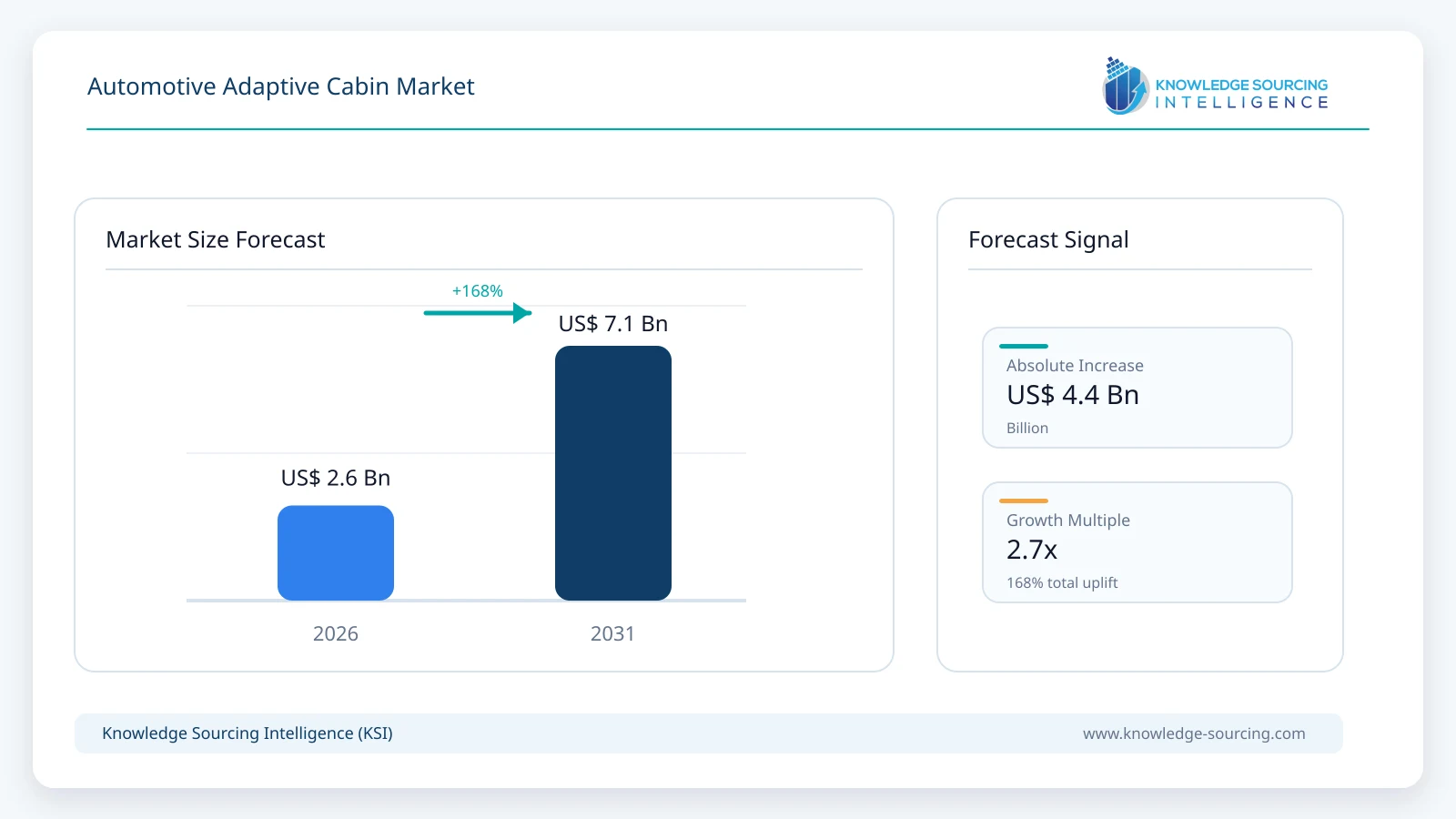
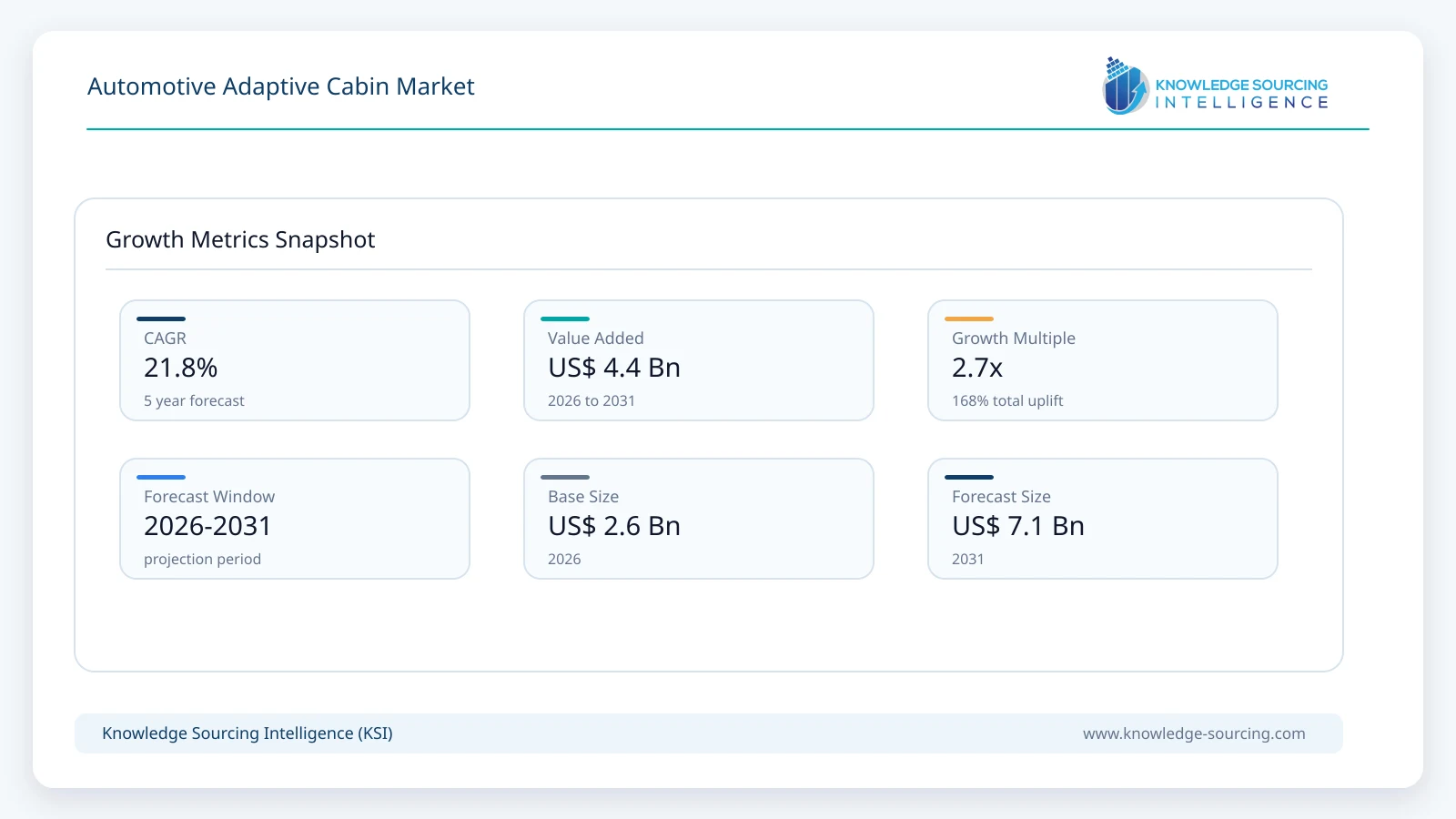
The automotive adaptive cabin market is growing at a CAGR of 21.8%, from USD 2.65 billion in 2026 to USD 7.10 billion by 2031.
Highlights:
- 1Adaptive thermal and microclimate functions represent an estimated 31% of 2026 value, supported by seat-zone conditioning, targeted airflow and coordinated HVAC control.
- 2Adaptive seating and postural support account for approximately 25% of 2026 revenue as powered adjustment, sensor-informed lumbar systems and comfort functions expand.
- 3Saved profiles and scenario presets remain the largest adaptation mechanism in 2026 at 35%, while predictive and learning-based adaptation grows faster through 2031.
- 4Premium and luxury vehicles generate approximately 47% of qualifying value in 2026; mid-range vehicles gain share as modular system costs decline.
- 5Asia Pacific represents approximately 46% of 2026 value, supported by Chinese smart-cabin programs and the Japanese and South Korean supply base.
- 6Global vehicle production reached 96.4 million units in 2025, providing a substantial manufacturing base for additional software-controlled adaptive cabin content.
Adaptive cabin systems use occupant information, environmental sensors and software-defined operating modes to adjust several interior functions or a qualified adaptive subsystem. The market includes attributable sensing, control software, electronically controlled comfort components and integration supplied for automatic cabin adaptation, rather than the full value of complete seats, cockpit hardware or interior modules.
Yanfeng, Toyota Boshoku, FORVIA, HARMAN, Lear and Gentherm are advancing different parts of the adaptive cabin architecture. Yanfeng XiM27 coordinates spatial layouts, seating and sensory functions; Toyota Boshoku LOUNZE+ links seating and interior trim by use scenario; and Gentherm ClimateSense uses thermal models to regulate occupant-specific heating and cooling. The ability to combine proven actuators with sensing and cabin control software is becoming more important than the addition of individual convenience features.
Market Overview
Automotive adaptive cabins connect occupant sensing and electronic control with physical interior responses. A driver profile may recall a seating position and preferred temperature, while richer systems combine cabin cameras, pressure sensors, outside conditions and driving context to change support, airflow, lighting or interaction modes. The higher-value configurations use a shared software layer so multiple comfort domains respond coherently without separate user commands for each feature.
Production technologies cover a range of maturity levels. Gentherm offers ClimateSense for zonal microclimate optimization; Lear develops INTU intelligent seating and configurable interior products; and FORVIA has presented sensor-based intelligent seats that can adjust multiple parameters. Yanfeng XiM27 and Toyota Boshoku LOUNZE+ illustrate the direction of more comprehensive cabin coordination, although concept readiness should not be confused with confirmed high-volume vehicle fitment.
The commercial supply chain includes sensors, control units, embedded software, seat and thermal actuators, interior electronics and system engineering. Automakers need validated interactions across these layers because adaptive responses affect energy consumption, passenger comfort, distraction and vehicle electrical architecture. Suppliers offering repeatable control interfaces and modular hardware platforms are positioned to scale beyond limited premium programs.
Market Trends
Cabin Functions Are Being Connected Through Shared Control Logic
Vehicle platforms increasingly allow seating, HVAC, lighting and sound systems to exchange signals with a centralized or coordinated cabin control layer. Bosch demonstrates that a natural-language request about temperature can initiate both seat heating and HVAC adjustment, while Yanfeng connects multiple XiM27 interior functions to a shared electronics architecture. Integration shortens the sequence of actions needed to change cabin conditions, but creates a greater requirement for stable interfaces and system validation.
Thermal Adaptation Is Becoming Occupant-Specific
Conventional cabin conditioning often treats the passenger compartment as one temperature zone even when occupants have different thermal preferences. Gentherm ClimateSense combines modeled thermal sensation with localized heating and cooling effectors to control conditions by seat and occupant. Automotive OEMs can use localized approaches to improve electric-vehicle energy efficiency, provided the additional hardware and control costs remain justified by customer value.
Seat-Based Sensing Is Expanding into Active Comfort
Adaptive seating adds software-led adjustments to established powered seat functions. FORVIA describes intelligent seating that uses morphology and road-condition information to change comfort parameters, while Lear INTU can respond to occupant discomfort with dynamic support and thermal control. Greater sensing depth may support premium differentiation, but automakers require reliable occupant classification and mechanisms that remain comfortable during frequent small adjustments.
Scenario-Based Cabin Modes Are Moving Beyond Concept Displays
Yanfeng XiM27 links face-to-face layouts, resting positions and work-oriented arrangements with sensory settings for corresponding travel conditions. Toyota Boshoku LOUNZE+ similarly coordinates seats, door trim and center-console functions around selected activities. Commercial rollout will depend on packaging, restraint geometry, homologation and the available driving mode, since freely reconfigurable interiors cannot be assumed suitable during all road-use conditions.
Segment Analysis
By Adaptive Function: Adaptive Thermal and Microclimate
Adaptive thermal and microclimate systems account for approximately 31% of qualifying market value in 2026. Zonal conditioning combines seat ventilation, surface heating, airflow and embedded control logic, creating measurable occupant benefits without requiring full cockpit redesign. Gentherm’s ClimateSense platform illustrates the integration of effectors and human thermal models, while EV operating efficiency strengthens the argument for reducing unnecessary whole-cabin heating or cooling.
By Adaptation Mechanism: Predictive and Learning-Based Adaptation
Predictive and learning-based functions represent an estimated 16% of 2026 adaptive cabin value, with a projected share of 27% by 2031. Such systems interpret behavior or journey context rather than relying entirely on selected presets. LG’s AI Cabin Platform combines in-vehicle perception with context-sensitive assistance, although wider application to physical cabin actuators will require deterministic controls, data minimization and careful treatment of uncertain inferences.
By Offering: Adaptive Actuators and Incremental Hardware
Adaptive actuators and qualifying incremental hardware contribute approximately 54% of value in 2026 because physical changes still require motors, valves, thermal effectors, sensors and control electronics. Hardware share is modeled to decline toward 46% in 2031 as reusable software platforms and orchestration functions capture more value. The transition does not imply falling actuator volumes: the forecast assumes both broader hardware installation and faster growth in software attributable to cross-domain coordination.
By Vehicle Class: Premium and Luxury Vehicles
Premium and luxury models account for about 47% of 2026 market value through relatively high feature content per vehicle and earlier availability of multi-zone climate, sensing and powered interiors. Mass-market adoption requires lower-cost architectures and fewer dedicated components, particularly when features must be included in standard equipment. Mid-range vehicles are therefore modeled to gain share as automakers combine common hardware with software-selected comfort modes.
By Vehicle Type: Passenger Vehicles
Passenger vehicles generate approximately 91% of adaptive cabin revenue in 2026. Sedans, SUVs and multipurpose vehicles offer the largest production base and the clearest opportunity for differentiated comfort features across multiple seats. Commercial vehicle applications remain smaller but relevant for prolonged driver exposure, fatigue management and cabin temperature control in vocational use.
Market Drivers
Integration of Software-Defined Cabin Functions
Centralized and domain-integrated electronics allow automakers to coordinate interior functions without a dedicated control stack for every feature. Bosch’s AI cockpit demonstration connects natural language with several vehicle responses, showing how software can combine existing hardware capabilities into coherent actions. Broader use of common application programming interfaces and OTA-managed functions should increase software content in cabin upgrades while reducing duplicated integration work across vehicle platforms.
Demand for Personalized Thermal Comfort and Energy Efficiency
Electric-vehicle customers place increasing value on efficient cabin climate management because occupant heating and cooling affect usable range. Gentherm ClimateSense and Lear thermal comfort technologies emphasize zonal rather than uniformly distributed conditioning, allowing different occupants to receive different heat or airflow levels. Automakers may therefore evaluate adaptive thermal systems against both user comfort and vehicle energy consumption, supporting adoption where savings justify incremental parts cost.
Greater Availability of Occupant Sensing
Camera, pressure and other in-cabin sensors already support occupant monitoring and safety functions on selected platforms. Adaptation software can use appropriately validated signals to alter seat support, comfort profiles and interface presentation without requiring every sensing component to be procured solely for convenience. The strongest commercial pathway uses shared hardware responsibly, with functional separation between regulated detection tasks and optional comfort responses.
Interior Differentiation in Premium and Electric Vehicles
Automakers increasingly differentiate cabins through comfort and interaction as propulsion and basic display capabilities become more standardized. FORVIA’s intelligent seating work and Yanfeng’s scenario-based XiM27 architecture show how adaptive functions extend beyond traditional trim appearance. Suppliers benefit when automakers specify coordinated seating, lighting and controls during the vehicle architecture stage rather than purchasing discrete premium options late in development.
Modularization of Cabin Hardware and Software
Lear, Gentherm and other major suppliers market modular comfort and actuation technologies that can be configured across multiple vehicle classes. Common control logic and scalable hardware make it easier to introduce a basic adaptive profile on mid-range models while reserving more sophisticated sensing or prediction for premium trims. This manufacturing flexibility should support higher vehicle penetration without requiring entirely different cabin engineering for each price level.
Market Restraints
High Cost of Multi-Domain System Integration
Adaptive cabin systems span mechanical components, electronics, software, thermal engineering and occupant interaction design. Coordinating these subsystems adds vehicle validation effort, supplier interfaces and warranty exposure beyond the cost of any individual actuator. Entry-level vehicles remain particularly sensitive to cost unless OEMs can reuse controllers and combine adaptive features with hardware already needed for safety or conventional comfort.
Functional Safety and Occupant-Protection Constraints
Powered seat movement, movable consoles and scenario-based interior layouts must remain compatible with restraints, airbag deployment, driver visibility and approved seating positions. A concept demonstrating a lounge layout cannot automatically be treated as a production feature available during normal driving. Validation limits the pace at which highly reconfigurable adaptive interiors move into high-volume vehicle programs, particularly where road legality varies by jurisdiction.
Privacy and Cybersecurity Requirements
Occupant recognition and learning functions can rely on personally sensitive behavioral, image or preference data. Vehicle manufacturers must minimize data retention, manage consent where applicable and protect software control paths against unauthorized commands. The implementation of UN Regulations 155 and 156 in applicable markets reinforces the need for disciplined cybersecurity and software-update management, increasing the qualification work for connected adaptive cabin systems.
Complexity of Human-Factors Validation
Automatic adjustments can frustrate occupants when predicted preferences differ from actual needs or repeated system changes are distracting. Comfort algorithms must account for individual differences, transient conditions and easy manual override rather than assuming one preferred setting is always correct. Human-factors testing and control calibration can lengthen development cycles, especially for combined light, audio, thermal and seating responses.
Uneven Feature Uptake Across Vehicle Segments
Higher-content cabin packages remain concentrated in premium vehicles and selected EV platforms, while many mass-market models prioritize standard HVAC and manual or basic powered seats. The range of available adaptive configurations therefore varies substantially by region, vehicle price and supplier relationship. The market forecast relies on gradual feature penetration rather than assuming that every connected cockpit automatically qualifies as an adaptive cabin.
Regional Outlook
Asia Pacific
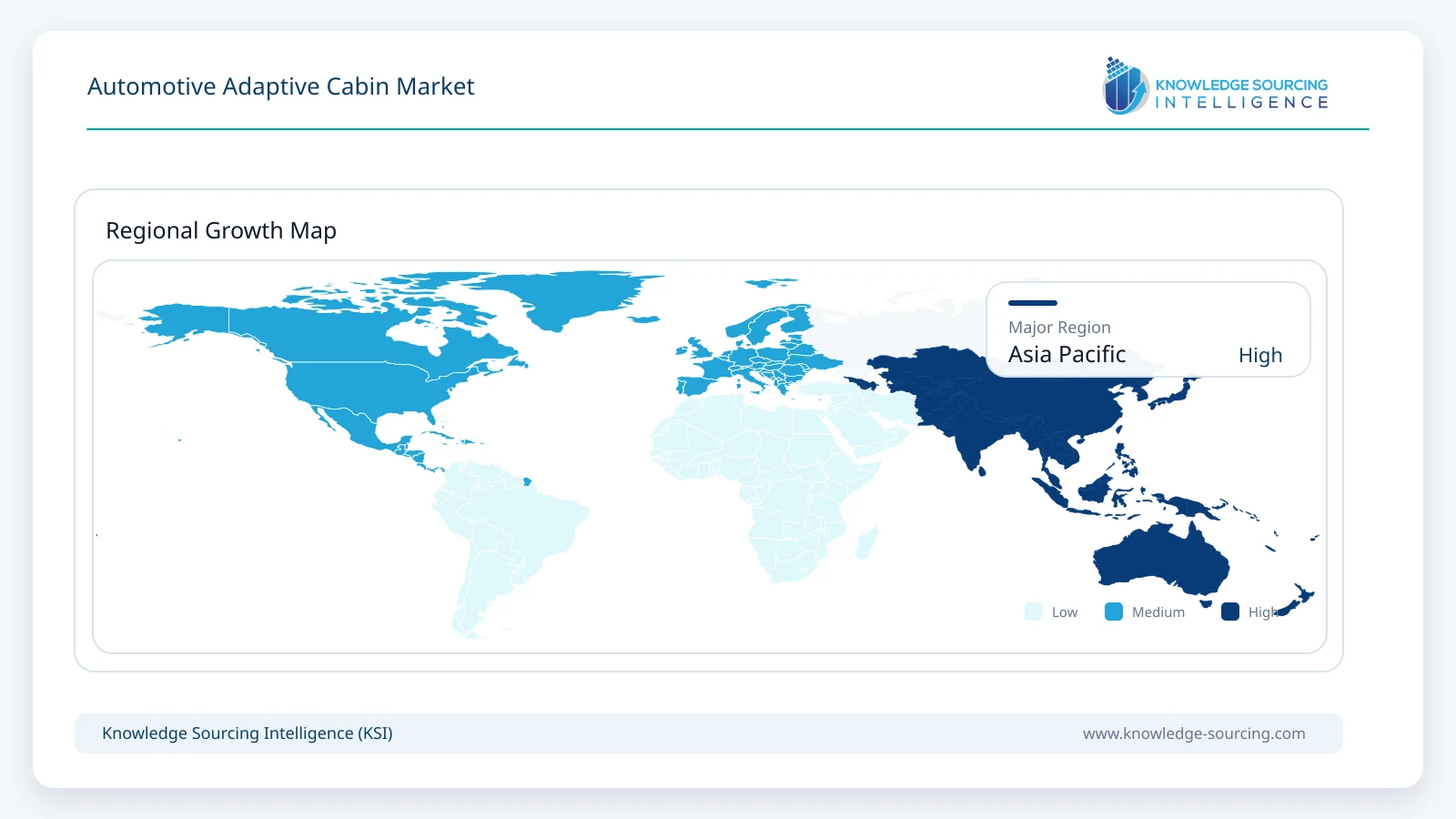
Asia Pacific represents an estimated 46% of Automotive Adaptive Cabin Market value in 2026 and is projected to retain the leading position through 2031. Chinese automakers are competing on cabin functionality and differentiated EV interiors, while Yanfeng’s XiM27 demonstrates coordinated spatial, seating and sensory technologies. Japan contributes vehicle-interior systems expertise through Toyota Boshoku, and South Korea supports infotainment, sensing and electronic integration. The region combines a large production base with strong smart-cabin engineering capabilities, although implementation still differs considerably between premium and entry-level models.
Europe
Europe accounts for approximately 28% of market value in 2026, supported by premium vehicle platforms, advanced seat systems and software integration capabilities. FORVIA’s intelligent seating strategy and Bosch’s cockpit software architecture are relevant examples of European supplier participation, while thermal comfort and occupant monitoring continue to evolve in regional OEM programs. European commercialization is also shaped by cybersecurity, functional validation and privacy requirements, favoring suppliers capable of integrating adaptive functions through traceable automotive-grade controls.
Competitive Landscape
The Automotive Adaptive Cabin Market combines complete interior integrators, seating and thermal suppliers, cockpit-software providers and specialized sensing/control companies. Yanfeng and Toyota Boshoku emphasize scenario-based physical-cabin integration; FORVIA, Lear, Magna and Gentherm contribute responsive seating, mechanical flexibility and localized comfort; and HARMAN, Bosch and LG develop contextual electronics and cross-domain cabin interfaces. Participation therefore differs substantially by supplier, and no single disclosed revenue figure captures the market as defined here.
Competitive advantage increasingly depends on whether suppliers can control several cabin functions safely using scalable interfaces. Yanfeng integrates intelligent seating and interior systems, Gentherm contributes thermal modeling and actuation, and HARMAN provides occupant-aware software that can trigger selected cabin responses. Suppliers with validated OEM programs and configurable software are better positioned than companies offering only conceptual demonstrations, while co-development with automakers remains essential for system-level differentiation.
Recent Developments
29 June 2026: Yanfeng presented XiM27, a drivable production-ready smart-cabin concept combining AI-adaptive seating, movable interior architecture and coordinated sensory functions. The announcement indicates product-development maturity but does not establish high-volume fitment.
23 April 2026: Toyota Boshoku detailed LOUNZE+ at Auto China 2026, demonstrating scene-based coordination of seats, door trims and center-console elements for different in-vehicle activities. The exhibit highlights integrated use-mode design.
24 February 2026: FORVIA’s Capital Markets Day materials described intelligent seating using posture and road-condition monitoring to adjust multiple seat parameters. The initiative expands the integration of sensors, software and pneumatic seat functions.
13 January 2026: HARMAN announced new Ready Care and Ready Aware capabilities, extending in-cabin occupant intelligence and safety awareness. The update supports broader use of sensing platforms that can also inform personalized cabin functions.
18 December 2025: Bosch introduced its AI extension platform ahead of CES 2026, showing an AI cockpit that can coordinate seat heating and climate settings from a contextual request. The system advances cross-domain software control.
11 December 2025: LG Electronics announced its AI Cabin Platform for CES 2026, using on-device models to interpret driver and road context and personalize in-vehicle interfaces. The platform remains an enabling technology rather than proof of universal physical-cabin actuation.
Market Outlook
Automotive adaptive cabin revenue is projected to reach approximately USD 7.10 billion by 2031 as automakers expand the use of occupant sensing, comfort actuation and software-led scenario control. Adaptive thermal and seating functions should remain major hardware value pools, while prediction and integrated orchestration gain a larger share of future revenue. The commercial progression is expected to be uneven because hardware cost, validation and vehicle class strongly influence feature availability.
Greater use of contextual software will make cabin responses more coordinated and reduce the reliance on manually selecting several settings. The strongest production systems will combine deterministic actuator commands, occupant override and carefully bounded interpretation of sensor information. Reliable low-latency integration will matter more than adding complex AI functions that cannot be validated over a vehicle’s operating life.
Asia Pacific is expected to remain the largest region, with Europe retaining an important engineering and premium-vehicle position. Companies that can support modular hardware, traceable software updates, data protection and repeatable OEM integration are likely to secure the most durable programs. Concept demonstrations will continue to influence design, but the forecast is anchored to a gradual transition into qualified production applications.
Automotive Adaptive Cabin Market Scope
| Report Metric | Details |
|---|---|
| Total Market Size in 2026 | USD 2.65 billion |
| Total Market Size in 2031 | USD 7.10 billion |
| Forecast Unit | Billion |
| Growth Rate | 21.8% |
| Study Period | 2021 to 2031 |
| Historical Data | 2021 to 2024 |
| Base Year | 2025 |
| Forecast Period | 2026 – 2031 |
| Segmentation | Adaptive Function, Adaptation Mechanism, Offering, Vehicle Class, Vehicle Type, Geography |
| Companies |
|
Market Segmentation
By Adaptive Function
Adaptive Thermal and Microclimate
Adaptive Seating and Postural Support
Lighting, Audio and Sensory Adaptation
Adaptive HMI and Journey Modes
Cabin Layout and Physical Reconfiguration
By Adaptation Mechanism
Saved Profiles and Scenario Presets
Identity and Occupant Recognition
Context and Sensor-Triggered Adaptation
Predictive and Learning-Based Adaptation
By Offering
Adaptive Actuators and Incremental Hardware
Occupant/Environment Sensing Attribution
Cabin Control and Orchestration Software
System Engineering and Integration
By Vehicle Class
Premium and Luxury Vehicles
Mid-Range Vehicles
Mass-Market and Economy Vehicles
By Vehicle Type
Passenger Vehicles
Light Commercial Vehicles
Medium and Heavy Commercial Vehicles
By Geography
North America
United States
Canada
Mexico
South America
Brazil
Argentina
Others
Europe
Germany
United Kingdom
France
Italy
Spain
Others
Middle East and Africa
Saudi Arabia
United Arab Emirates
South Africa
Others
Asia Pacific
China
Japan
South Korea
India
Others
Table of Contents
1. EXECUTIVE SUMMARY
2. MARKET SNAPSHOT
2.1. Market Overview
2.2. Market Definition
2.3. Scope of the Study
2.4. Market Segmentation
3. BUSINESS LANDSCAPE
3.1. Market Drivers
3.1.1. Software-Defined Cabin Integration
3.1.2. Occupant-Level Thermal Efficiency
3.1.3. Availability of In-Cabin Sensing
3.1.4. Premium Vehicle Interior Differentiation
3.1.5. Modular Hardware and Software Platforms
3.2. Market Restraints
3.2.1. High Multi-Domain Integration Cost
3.2.2. Occupant-Safety and Reconfiguration Constraints
3.2.3. Cybersecurity and Data Privacy
3.2.4. Human-Factors and System Validation
3.2.5. Uneven Uptake by Vehicle Class
3.3. Market Opportunities
3.4. Porter’s Five Forces Analysis
3.5. Industry Value Chain Analysis
3.6. Policies and Regulations
3.7. Strategic Recommendations
4. TECHNOLOGICAL OUTLOOK
4.1. Cabin Sensor Fusion and Occupant State Interpretation
4.2. Cross-Domain Cabin Orchestration Software
4.3. Adaptive Thermal and Postural Actuation
4.4. Predictive and Context-Aware Personalization
4.5. Scene-Based Cabin Controls and Reconfigurable Interiors
4.6. Safety, Cybersecurity and Software Updates
5. AUTOMOTIVE ADAPTIVE CABIN MARKET BY ADAPTIVE FUNCTION
5.1. Introduction
5.2. Adaptive Thermal and Microclimate
5.3. Adaptive Seating and Postural Support
5.4. Lighting, Audio and Sensory Adaptation
5.5. Adaptive HMI and Journey Modes
5.6. Cabin Layout and Physical Reconfiguration
6. AUTOMOTIVE ADAPTIVE CABIN MARKET BY ADAPTATION MECHANISM
6.1. Introduction
6.2. Saved Profiles and Scenario Presets
6.3. Identity and Occupant Recognition
6.4. Context and Sensor-Triggered Adaptation
6.5. Predictive and Learning-Based Adaptation
7. AUTOMOTIVE ADAPTIVE CABIN MARKET BY OFFERING
7.1. Introduction
7.2. Adaptive Actuators and Incremental Hardware
7.3. Occupant/Environment Sensing Attribution
7.4. Cabin Control and Orchestration Software
7.5. System Engineering and Integration
8. AUTOMOTIVE ADAPTIVE CABIN MARKET BY VEHICLE CLASS
8.1. Introduction
8.2. Premium and Luxury Vehicles
8.3. Mid-Range Vehicles
8.4. Mass-Market and Economy Vehicles
9. AUTOMOTIVE ADAPTIVE CABIN MARKET BY VEHICLE TYPE
9.1. Introduction
9.2. Passenger Vehicles
9.3. Light Commercial Vehicles
9.4. Medium and Heavy Commercial Vehicles
10. AUTOMOTIVE ADAPTIVE CABIN MARKET BY GEOGRAPHY
10.1. Introduction
10.2. North America
10.2.1. United States
10.2.2. Canada
10.2.3. Mexico
10.3. South America
10.3.1. Brazil
10.3.2. Argentina
10.3.3. Others
10.4. Europe
10.4.1. Germany
10.4.2. United Kingdom
10.4.3. France
10.4.4. Italy
10.4.5. Spain
10.4.6. Others
10.5. Middle East and Africa
10.5.1. Saudi Arabia
10.5.2. United Arab Emirates
10.5.3. South Africa
10.5.4. Others
10.6. Asia Pacific
10.6.1. China
10.6.2. Japan
10.6.3. South Korea
10.6.4. India
10.6.5. Others
11. COMPETITIVE ENVIRONMENT AND ANALYSIS
11.1. Major Players and Strategy Analysis
11.2. Market Share Analysis
11.3. Mergers, Acquisitions, Agreements and Collaborations
11.4. Competitive Dashboard
12. COMPANY PROFILES
12.1. Yanfeng
12.2. FORVIA
12.3. Toyota Boshoku Corporation
12.4. HARMAN International
12.5. Gentherm Incorporated
12.6. Lear Corporation
12.7. Robert Bosch GmbH
12.8. LG Electronics Vehicle Solution Company
12.9. Magna International Inc.
13. APPENDIX
13.1. Currency
13.2. Assumptions
13.3. Base and Forecast Years Timeline
13.4. Key Benefits for Stakeholders
13.5. Research Methodology
13.6. Abbreviations
Navigate
Trusted by the world's leading organizations











