
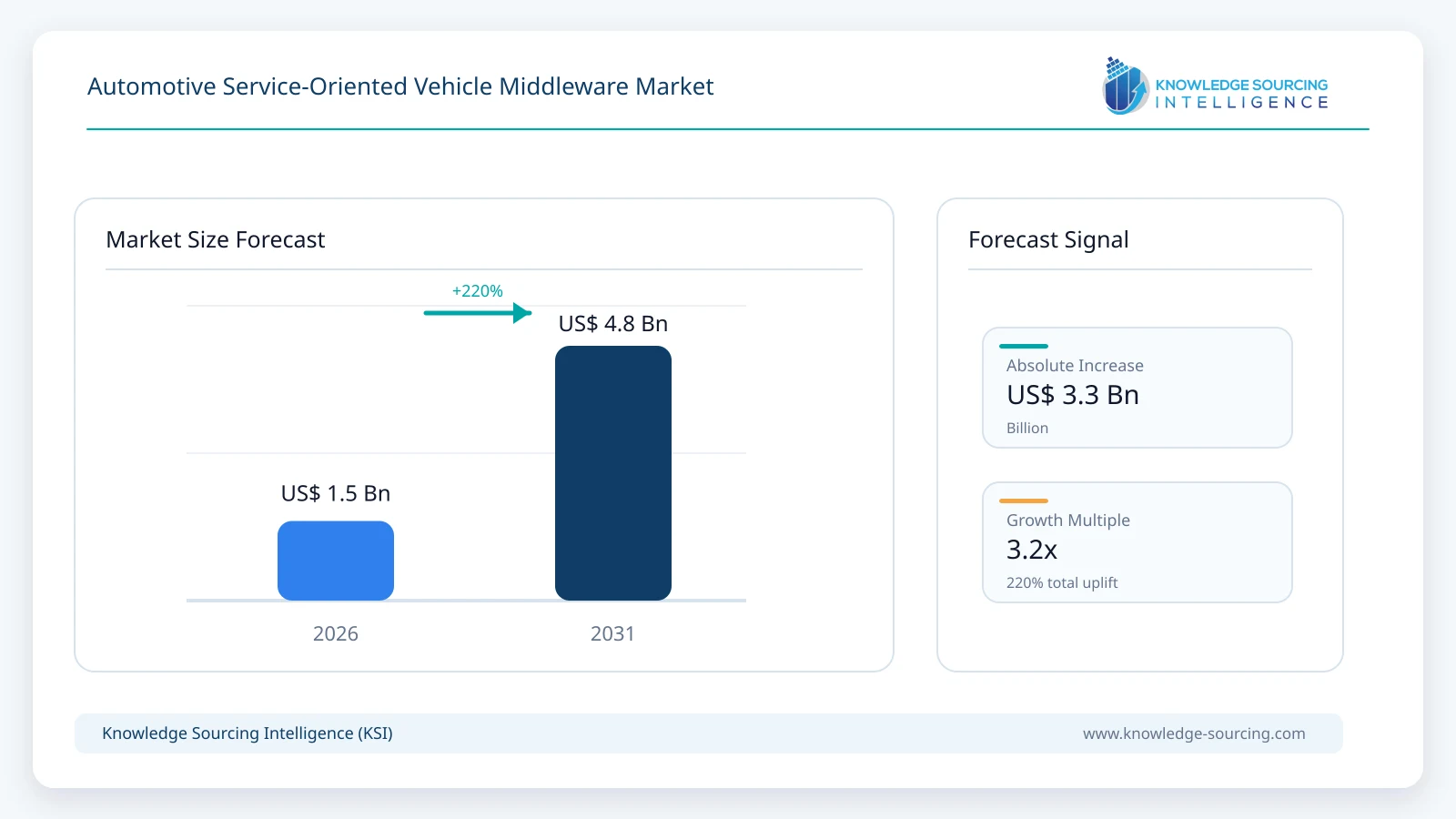
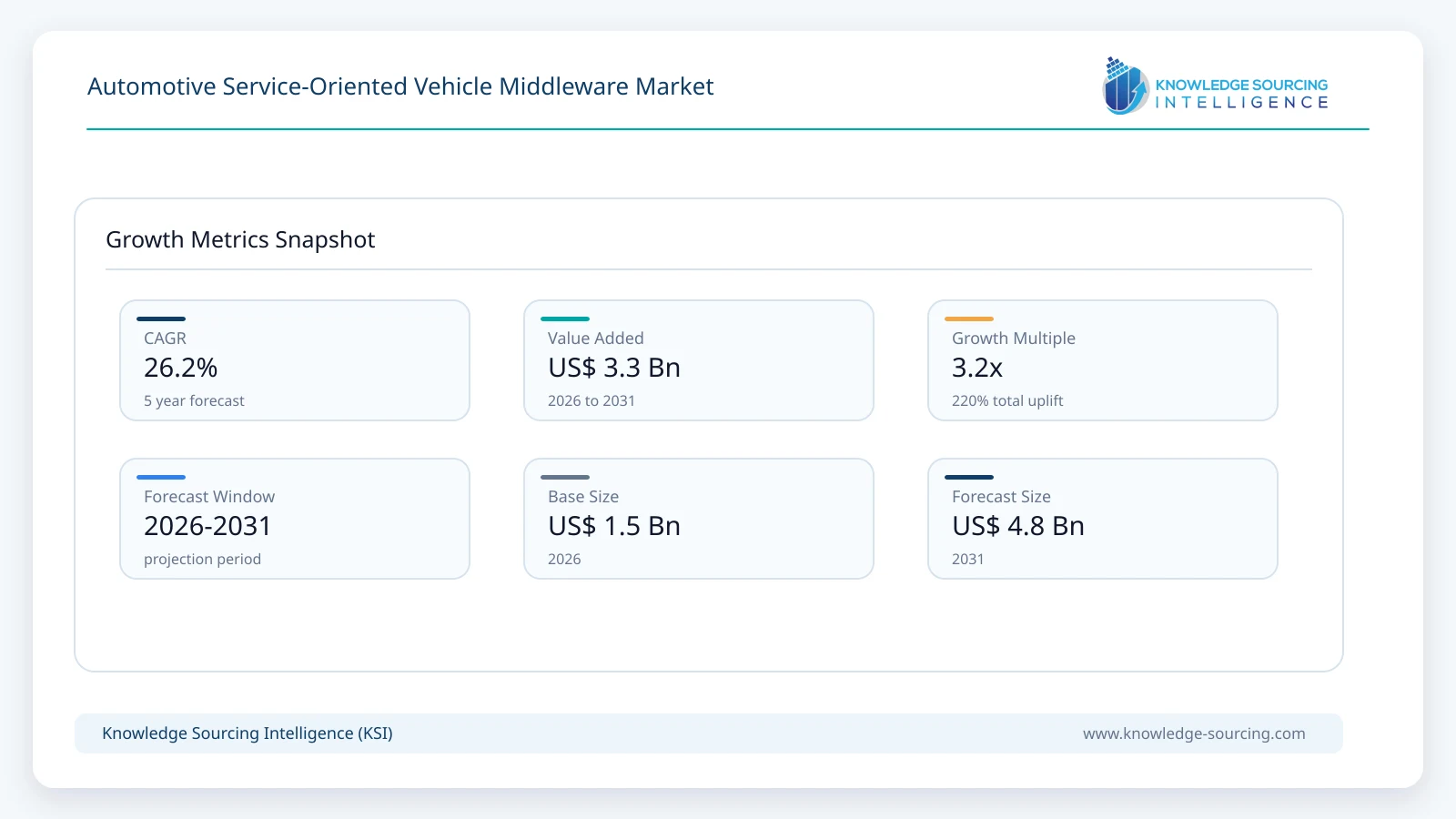
The Automotive Service-Oriented Vehicle Middleware Market is projected to expand at a CAGR of 26.2%, increasing from USD 1.50 billion in 2026 to USD 4.80 billion by 2031.
Highlights:
- 1Global market value is estimated at USD 1.50 billion in 2026 and USD 4.80 billion in 2031, with 26.2% implied annual growth.
- 2Production runtime and middleware licensing contributes about 72% of 2026 value; integration and engineering account for the remainder.
- 3Communication and data distribution is the largest software-function group, supported by SOME/IP and DDS implementation requirements.
- 4AUTOSAR Adaptive/SOME/IP-based frameworks hold the largest primary-framework position in 2026, while DDS-based software gains share.
- 5Consolidated domain computers account for approximately 45% of 2026 deployment value; central and zonal systems grow in importance.
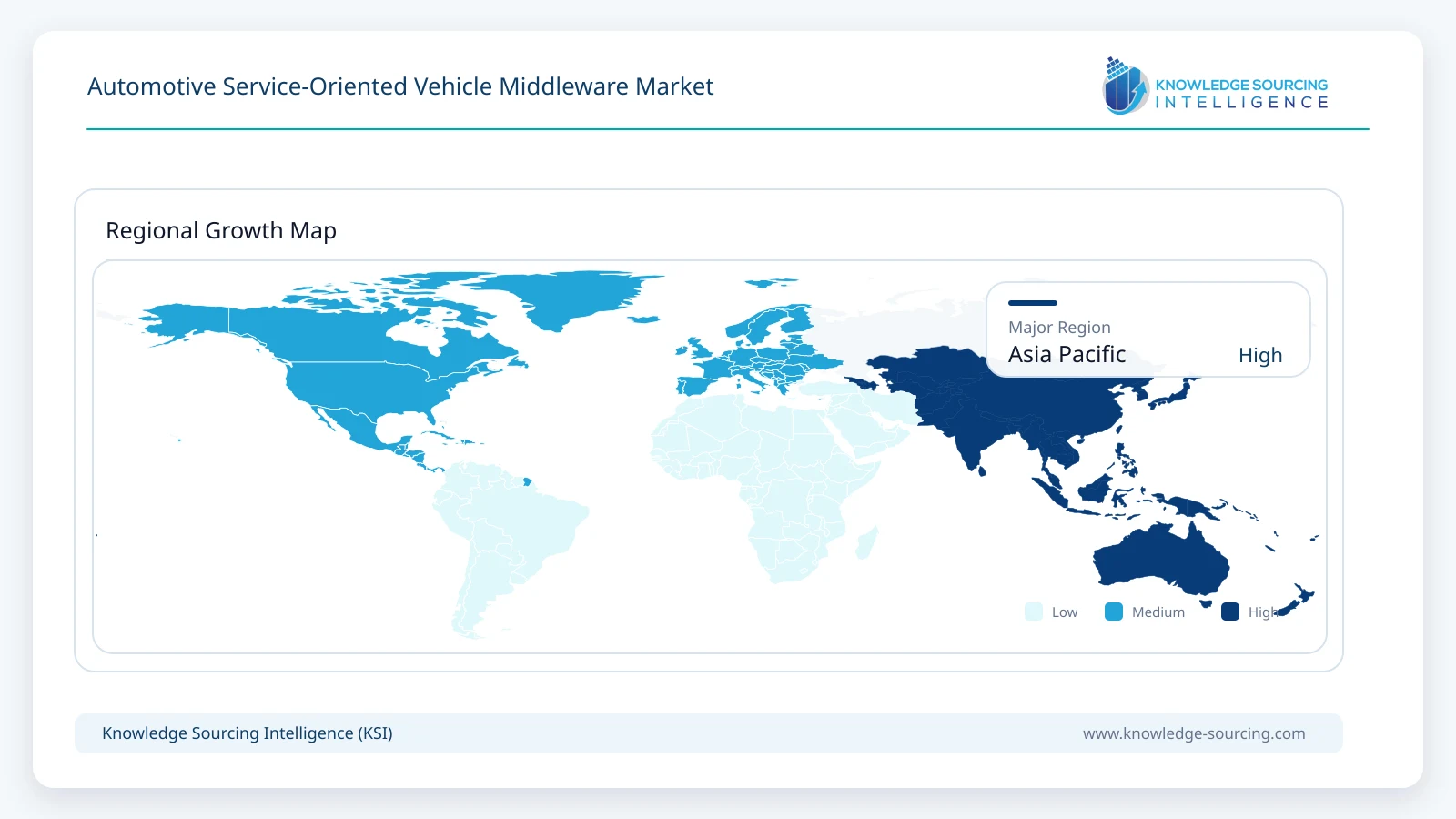
- 6Asia Pacific leads modeled regional revenue, followed by Europe, reflecting vehicle program activity and automotive software supply.
The main products are in-vehicle communication frameworks that support service discovery, messaging, data distribution, interface management, and connectivity between existing vehicle controllers and new software applications. Suppliers also earn revenue from adapting these frameworks to processor families and vehicle programs.
Vector MICROSAR Adaptive, Elektrobit EB corbos AdaptiveCore, ETAS Vehicle Software Platform and RTI Connext Drive address different parts of this requirement. They help vehicle makers connect applications through common interfaces while meeting practical needs for timing, reliability, and security. Customer spending includes production software licenses and clearly attributable integration, not the value of complete computers or unrelated vehicle applications.
Market Overview
AUTOSAR Adaptive allows software providers and consumers to find and connect with each other at runtime. Its communication-management functions are designed for applications spread across high-performance computers and vehicle networks, unlike many traditional ECU arrangements built around fixed signals. Service discovery, serialization, and event delivery become important when a feature uses information from several controllers or needs to remain usable after a processor change.
Vector MICROSAR Adaptive and Elektrobit's EB corbos AdaptiveCore provide commercially supported service-oriented middleware for high-performance vehicle computers. Elektrobit supports SOME/IP and integration with AUTOSAR Classic, while ETAS supplies modular vehicle software with dedicated SOME/IP communication components. RTI Connext Drive uses DDS for data distribution between vehicle software functions and has reported installed vehicle deployments. Each product takes a somewhat different route to the same purchasing requirement: dependable communication across changing vehicle systems.
Automakers usually combine middleware with existing network software, operating systems, and applications. KPIT and Technica Engineering reported in January 2026 that SOME/IP was already used in more than 40 million vehicles, indicating an established deployed base rather than a wholly new technology. Competitive value is shifting toward implementation quality, portability, service compatibility, and support for longer vehicle software lifecycles.
Market Trends
Central vehicle computers need common service interfaces
Vehicle functions hosted on consolidated computers still rely on body, chassis, powertrain and zonal controllers that may use different communication methods. AUTOSAR Adaptive's service interfaces allow applications to discover and use vehicle data without hard-coding every network endpoint. Suppliers must connect the service layer to real CAN, Ethernet and software environments rather than just demonstrate messaging between two test applications.
ETAS and Elektrobit position their middleware for high-performance platforms where applications and communication services evolve separately. Migration is typically gradual. A new central computer may require a service-oriented interface to legacy sensors and control units for several vehicle generations, increasing the value of integration engineering alongside reusable runtime software.
Open software foundations are changing middleware procurement
AUTOSAR released CAPI 1.0 in August 2026 with shared code and generation tools for the Adaptive Platform. ETAS separately introduced an Eclipse S-CORE-enabled software suite in June 2026, and iSOFT contributed implementation components to the AUTOSAR initiative. These developments give automakers additional starting points for platform development and may reduce the amount of basic functionality rewritten by individual suppliers.
AUTOSAR CAPI and Eclipse S-CORE still require verified communication behavior, hardware-specific performance, security configuration, compatibility testing and long-term maintenance in individual OEM programs. Vendors able to deliver these production services can remain competitive even where the base implementation becomes more open.
DDS gains relevance for data-intensive vehicle applications
RTI's Connext Drive 4.0 extends a DDS-based communication framework across zonal controllers, high-performance computing and development environments. DDS can help distribute sensor and application data when publishers and subscribers change during operation. OEMs may choose it for selected assistance, perception, and vehicle-data workloads rather than replace every existing SOME/IP interface.
RTI reported more than one million installed vehicles using Connext Drive in March 2025 and later announced broader product capability. This establishes practical adoption, although installed-base disclosures do not reveal yearly middleware sales. Competition between messaging approaches should therefore be evaluated by timing, tooling and interoperability for each vehicle function rather than as a simple technology replacement.
Classic-to-Adaptive bridges are a persistent integration requirement
Most vehicle lines continue to contain many AUTOSAR Classic controllers while newer computers run Adaptive software. The two environments have different communication and execution models, so service proxies, signal conversion, and gateway configuration are needed for applications to exchange information. KPIT's KSAR Adaptive provides signal-to-service and inter-process communication functions, while Elektrobit offers links between Android, Classic and Adaptive systems.
Gateway integration can remain part of supplier contracts for many years because vehicle architecture changes take place over successive model cycles. Middleware companies that supply validated bridging tools can support older controller assets while OEMs adopt more modular software on new platforms.
Release compatibility matters more as software changes after sale
Service interfaces need versioning, consistent data formats and clear failure behavior when several applications depend on the same vehicle function. A change to one data provider can affect cockpit displays, connected diagnostics and assistance functions unless dependencies are tested. Standards provide common design rules, but each implementation must still manage timeouts, degraded communication and changes in network topology.
Vehicle makers are therefore asking suppliers for stable APIs, traceable configurations, and tools that reproduce in-vehicle behavior during integration testing. This supports continuing middleware maintenance revenue, although update transport and cloud delivery themselves belong to different software products.
Segment Analysis
By Software Function: Communication and Data Distribution
Communication and data distribution are modeled as the largest software-function group, accounting for approximately 42% of market value in 2026. The category includes message handling, serialization, event delivery and service-to-service data exchange. Vector, Elektrobit, ETAS and RTI provide products addressing these functions through SOME/IP, AUTOSAR Adaptive and DDS-based software.
Central computers exchanging more data with external vehicle controllers are raising requirements for dependable message transport. Commercial value depends on operation in actual networks and qualification for the application, not simply messaging throughput in a development environment. The segment remains the largest through 2031, although gateway and interface management gain relative share.
By Revenue Component: Embedded Middleware Licenses
Embedded middleware licensing represents about 72% of the modeled market in 2026. Vehicle makers buy runtime libraries and associated support for production systems, sometimes through a broader electronic-controller agreement. Licensed frameworks are reused across vehicle platforms, while implementation rights, software versions and support terms differ between suppliers.
Embedded licenses increase their modeled revenue share to approximately 76% by 2031 as qualifying installations rise and common frameworks are adopted across model lines. Integration services continue to contribute material revenue, particularly when automakers introduce new central-to-zonal architectures or need to preserve communication with previous-generation controllers.
By Communication Framework: AUTOSAR Adaptive and SOME/IP
AUTOSAR Adaptive and SOME/IP-based implementations account for the largest primary-framework share in 2026. The technology is supported by standardized communication services, broad supplier offerings and deployed high-performance vehicle controllers. Vector MICROSAR Adaptive, Elektrobit EB corbos AdaptiveCore, ETAS software and KPIT KSAR provide examples across licensing and systems engineering.
DDS-based frameworks gain share in data-intensive applications, while gateways that translate legacy signals remain important for vehicle platforms transitioning between architectures. No single interface is expected to serve every control and data-transfer requirement; OEMs typically select a principal framework and integrate complementary communication methods.
By Compute Deployment: Consolidated Domain Computers
Consolidated domain computers are the largest 2026 deployment category at approximately 45% of market revenue. Cockpit, gateway, and assistance controllers have provided early opportunities for service-oriented middleware because they exchange information across applications while operating within a defined system boundary. Suppliers can validate service interfaces before distributing them across more complex vehicle-wide architectures.
Cross-domain central computing gains share through 2031 as OEMs coordinate more functions through a smaller number of processors. Central-to-zonal networks also raise demand for stable service gateways, although deployment depends on the availability and maturity of zonal controllers on each vehicle platform.
Market Drivers
Central and zonal architectures need reusable communication software
Automakers are reducing duplication between individual control units and placing more applications on central or domain computers. Those applications still need vehicle signals, actuator status, and diagnostics information from other controllers. A defined service interface allows teams to change a processing module without rewriting every application that consumes its data.
Vector and Elektrobit already sell Adaptive middleware for these higher-performance computing environments. As new vehicle programs adopt central-to-zonal networks, middleware suppliers gain opportunities in licenses and in the practical work of connecting different software stacks. The opportunity depends on production architecture decisions, not on theoretical processor capability alone.
Standardized service interfaces support software reuse across models
Vehicle groups commonly develop applications for several nameplates and regional configurations. Reusing a function becomes difficult when each electronic architecture exposes information through a different set of proprietary messages. AUTOSAR Adaptive service interfaces and defined data formats help engineering teams use the same application design across more programs.
AUTOSAR's CAPI 1.0 release and ETAS's S-CORE work are intended to reduce repeated platform development. Standardization can put pressure on fees for basic components, but it also creates demand for tested implementations and integration support. Production software reuse is valuable only when interface behavior remains stable as hardware and operating systems change.
High-volume vehicle data needs reliable publish-and-subscribe transport
Assistance functions, camera-processing applications and centralized vehicle computers exchange data at rates and volumes that differ from traditional body signals. DDS-based communication can distribute information to multiple consumers and manage changing publishers without creating one interface for each application pair. RTI Connext Drive provides a commercially established example for these uses.
The framework has already been selected for production vehicle programs, including XPENG's next-generation architecture. Suppliers benefit when vehicle makers need latency control, data compatibility and dependable fault handling, rather than a generic network stack. Middleware spending rises with qualified deployment and application integration.
Legacy ECU migration sustains gateway and bridge development
Vehicle platforms cannot economically replace every existing controller when a new central computer is introduced. Low-cost body and powertrain ECUs often remain in production for years, creating a need to translate their fixed signals into services understood by newer software. Classic-to-Adaptive gateways and protocol adapters address this transition.
KPIT's KSAR platform and Elektrobit's integration products show that signal conversion is a commercial engineering activity. Vehicle suppliers often need to develop mappings, perform conformance testing, and maintain interfaces throughout the model life. The work extends middleware demand beyond the initial runtime license.
Longer software support periods increase platform-maintenance requirements
Automakers increasingly issue updates and revise vehicle applications after production starts. A middleware service must preserve its contract with other applications through those changes, including failure response, diagnostics, and security permissions. Version incompatibility can interrupt unrelated functions even when the updated application works on its own.
Supplier maintenance, validation, and compatibility testing become important parts of platform procurement. OEMs with several vehicle generations on the road may prefer a common middleware vendor or software foundation to reduce the number of incompatible interfaces under support. This benefits qualified providers with reliable release and defect-management processes.
Market Restraints
Safety and timing verification across service boundaries is costly
Vehicle services can carry status and control information used by functions with different timing requirements. A network delay, stale message, or failed service discovery may be tolerable for an entertainment feature but unacceptable for a safety-related display or control decision. Middleware configuration must therefore be assessed within the complete vehicle system.
Engineering teams have to verify worst-case behavior, recoveries and resource use on the chosen hardware. Even a standard-compliant communication library does not establish a complete vehicle-level safety case. These tests lengthen integration programs and can discourage smaller OEM projects from adopting complex service architectures.
Existing vehicle software is not easily converted to service interfaces
Many body, chassis and powertrain functions use mature signal-based interfaces built around controller-specific software. Converting them into services requires careful mapping of signal meaning, timing and diagnostic behavior. A translation layer can create additional failure points if older applications and new service clients interpret data differently.
Automakers must often maintain both old and new communication paths over several model generations. Software teams that are focused on near-term production deadlines may retain established interfaces instead of undertaking broad migration. The result is a gradual transition rather than an immediate replacement of Classic AUTOSAR and network-signal designs.
Vendor-specific APIs can undermine portability
Two middleware products may support a common communication standard while differing in configuration tools, fault handling, resource behavior, and optional interfaces. Switching vendors can require changes to service definitions and test environments. Hardware-dependent performance tuning adds another source of lock-in even when the messaging specification is open.
Automakers need to weigh reuse benefits against the cost of qualifying a replacement stack. Open projects such as AUTOSAR CAPI can lower some barriers, but suppliers still provide proprietary production tooling, documentation and long-term maintenance. Procurement flexibility improves only when actual application compatibility is demonstrated.
Security and update governance add integration work
Service discovery and remote messaging increase the number of interfaces that can expose vehicle information or trigger actions. Developers need authentication, access rules, network separation and protections against unexpected or malformed traffic. The requirements become harder when services communicate across zonal gateways and multiple operating systems.
OEMs must test how each middleware update affects previously released applications and deployed vehicles. Cybersecurity requirements support specialist development and validation services but add schedule and cost pressures for customers. A low-cost library without adequate lifecycle controls is unlikely to meet a full vehicle-program requirement.
Platform ownership and open-source adoption pressure license pricing
Large vehicle manufacturers increasingly invest in their own software foundations or contribute to common middleware projects. AUTOSAR CAPI and Eclipse S-CORE aim to provide shared implementations that can be adapted by several companies. This may reduce demand for repeated development of basic communication code and make pricing more competitive.
Independent middleware suppliers retain value through safety evidence, efficient implementations and accountable support, but cannot assume each new vehicle platform will pay for a complete proprietary stack. Growth in qualified installations may consequently outpace growth in revenue per unit for standardized functions.
Regional Outlook
Asia Pacific
Asia Pacific is modeled as the largest regional market, with approximately 42% of 2026 global revenue. Chinese automakers are adopting new electronic architectures across electric and connected vehicle ranges, while Japan and South Korea provide established vehicle electronics, semiconductor and software engineering capacity. KPIT, RTI and regional Adaptive platform providers support middleware integration for programs sourced across the region.
China remains the largest country allocation in the regional forecast. RTI's announced XPENG program, HiRain's Adaptive software products and supplier investments in China provide examples of the commercial ecosystem. Adoption is expected to widen as centrally managed functions appear in additional vehicle segments; customer-specific integration remains a meaningful revenue source even with standardized communication software.
Europe
Europe is modeled at approximately 29% of 2026 revenue, supported by software companies and Tier 1 suppliers with established experience in AUTOSAR, middleware and vehicle-network integration. Vector, Elektrobit and ETAS provide important commercial products, and KPIT's German automotive Ethernet operations participate in interface standardization. European OEM programs tend to place substantial emphasis on documentation and long-term support.
European middleware demand increases as vehicle platforms combine Adaptive and Classic software across central and distributed controllers. The region should maintain a strong engineering and licensing position through 2031, although Asia Pacific is expected to grow faster in aggregate. Supplier differentiation will depend on dependable execution, tooling and compatibility rather than on the number of advertised software modules alone.
Competitive Landscape
Automotive service-oriented middleware is supplied by independent basic-software vendors, data-communication specialists and vehicle-software integrators. Vector, Elektrobit and ETAS provide AUTOSAR-oriented platform software. RTI competes with DDS-based data distribution, while KPIT, Tata Elxsi, Aptiv and HiRain offer relevant middleware products or engineering integration. They do not all earn revenue from the same contract layer, and their shares cannot be established from group-level company revenues.
Supplier choice depends on standard support, integration with existing ECUs, communication timing, target-processor portability and the ability to maintain a platform through production. Open implementations could reduce differentiation in base service-discovery functions, while automotive qualification, customer engineering and ongoing support remain commercially important. Some OEMs will develop more middleware internally, but still require tools, testing and external integration resources.
Recent Developments
20 August 2026: AUTOSAR released CAPI 1.0 with a shared Adaptive Platform implementation and code generators. The release offers OEMs and suppliers a common software starting point for integrating vehicle services.
10 June 2026: ETAS presented its Vehicle Software Platform Suite enabled by Eclipse S-CORE at Bosch Connected World. An initial distribution was available; the event was a platform announcement, not a claimed vehicle-production start.
10 June 2026: AUTOSAR and iSOFT announced the contribution of production-oriented Adaptive components to CAPI, including support for service-oriented communication. The contribution strengthens the shared implementation effort.
27 May 2026: Elektrobit and ETAS demonstrated a jointly integrated ADAS software foundation combining EB corbos Linux for Safety Applications with ETAS middleware. The announcement concerns a production-oriented software offering, not a disclosed OEM shipment total.
2 April 2026: RTI announced an agreement with Macnica to distribute and support Connext and Connext Drive in Japan, expanding local access to DDS software and integration services for automotive customers.
8 January 2026: KPIT Technologies and Technica Engineering announced plans to open the full SOME/IP specification. The companies described an established vehicle-installed base, illustrating a move toward broader interface adoption.
Market Outlook
Service-oriented communication should become more common as new vehicle platforms share data between domain, central and zonal computers. AUTOSAR Adaptive and SOME/IP remain established choices for many production architectures, while DDS-based frameworks broaden options for data-intensive applications. Suppliers with reliable gateways to existing vehicle controllers should continue to serve both newer and older architectures.
The market is forecast to reach USD 4.80 billion in 2031 as qualifying deployment rises and production software retains value beyond initial integration. Open-source and common-code initiatives may limit prices for basic middleware components, but customer-specific validation, service compatibility and long-term maintenance should remain important differentiators. Asia Pacific is expected to lead revenue, while Europe remains a major software-development and qualification center.
Automotive Service-Oriented Vehicle Middleware Market Scope:
| Report Metric | Details |
|---|---|
| Total Market Size in 2026 | USD 1.50 billion |
| Total Market Size in 2031 | USD 4.80 billion |
| Forecast Unit | USD Billion |
| Growth Rate | 26.2% |
| Study Period | 2021 to 2031 |
| Historical Data | 2021 to 2024 |
| Base Year | 2025 |
| Forecast Period | 2026 – 2031 |
| Segmentation | Software Function, Primary Communication Framework, Compute Deployment, Vehicle Type |
| Companies |
|
Market Segmentation
By Software Function
Service Discovery and Registry
Communication and Data Distribution
Vehicle API and Gateway Integration
Service Governance and Health
By Primary Communication Framework
AUTOSAR Adaptive / SOME/IP
DDS-Based Middleware
Classic-to-Service Gateways
Other Vehicle Service Frameworks
By Compute Deployment
Consolidated Domain Computers
Cross-Domain Central Compute
Central-to-Zonal Systems
Distributed Service Gateways
By Vehicle Type
Passenger Vehicles
Light Commercial Vehicles
Medium and Heavy Commercial Vehicles
By Geography
North America
United States
Canada
Mexico
South America
Brazil
Argentina
Others
Europe
Germany
United Kingdom
France
Italy
Spain
Others
Middle East and Africa
Saudi Arabia
United Arab Emirates
Israel
South Africa
Others
Asia Pacific
China
India
Japan
South Korea
Indonesia
Thailand
Australia
Taiwan
Others
Table of Contents
1. EXECUTIVE SUMMARY
1.1. Key Findings
1.2. Global Market Size and Growth, 2026–2031
1.3. Software Function Outlook
1.4. Regional Opportunity Summary
2. MARKET SNAPSHOT
2.1. Market Overview
2.2. Market Definition
2.3. Scope of the Study
2.4. Market Segmentation
3. BUSINESS LANDSCAPE
3.1. Market Drivers
3.1.1. Central and zonal architectures need reusable communication software
3.1.2. Standardized service interfaces support software reuse across models
3.1.3. High-volume vehicle data needs reliable publish-and-subscribe transport
3.1.4. Legacy ECU migration sustains gateway and bridge development
3.1.5. Longer software support periods increase platform-maintenance requirements
3.2. Market Restraints
3.2.1. Safety and timing verification across service boundaries is costly
3.2.2. Existing vehicle software is not easily converted to service interfaces
3.2.3. Vendor-specific APIs can undermine portability
3.2.4. Security and update governance add integration work
3.2.5. Platform ownership and open-source adoption pressure license pricing
3.3. Market Opportunities
3.4. Porter's Five Forces Analysis
3.5. Industry Value Chain Analysis
3.6. Policies and Regulations
3.7. Strategic Recommendations
4. TECHNOLOGICAL OUTLOOK
4.1. AUTOSAR Adaptive Communication Management and SOME/IP
4.2. DDS-Based Data Distribution and Real-Time Publish/Subscribe
4.3. Service Discovery, Registration and Versioning
4.4. Classic-to-Adaptive Protocol Bridging
4.5. Vehicle APIs, Service Security and Health Monitoring
5. AUTOMOTIVE SERVICE-ORIENTED VEHICLE MIDDLEWARE MARKET BY SOFTWARE FUNCTION
5.1. Introduction
5.2. Service Discovery and Registry
5.3. Communication and Data Distribution
5.4. Vehicle API and Gateway Integration
5.5. Service Governance and Health
6. AUTOMOTIVE SERVICE-ORIENTED VEHICLE MIDDLEWARE MARKET BY PRIMARY COMMUNICATION FRAMEWORK
6.1. Introduction
6.2. AUTOSAR Adaptive / SOME/IP
6.3. DDS-Based Middleware
6.4. Classic-to-Service Gateways
6.5. Other Vehicle Service Frameworks
7. AUTOMOTIVE SERVICE-ORIENTED VEHICLE MIDDLEWARE MARKET BY COMPUTE DEPLOYMENT
7.1. Introduction
7.2. Consolidated Domain Computers
7.3. Cross-Domain Central Compute
7.4. Central-to-Zonal Systems
7.5. Distributed Service Gateways
8. AUTOMOTIVE SERVICE-ORIENTED VEHICLE MIDDLEWARE MARKET BY VEHICLE TYPE
8.1. Introduction
8.2. Passenger Vehicles
8.3. Light Commercial Vehicles
8.4. Medium and Heavy Commercial Vehicles
9. AUTOMOTIVE SERVICE-ORIENTED VEHICLE MIDDLEWARE MARKET BY GEOGRAPHY
9.1. North America
9.1.1. United States
9.1.2. Canada
9.1.3. Mexico
9.2. South America
9.2.1. Brazil
9.2.2. Argentina
9.2.3. Others
9.3. Europe
9.3.1. Germany
9.3.2. United Kingdom
9.3.3. France
9.3.4. Italy
9.3.5. Spain
9.3.6. Others
9.4. Middle East and Africa
9.4.1. Saudi Arabia
9.4.2. United Arab Emirates
9.4.3. Israel
9.4.4. South Africa
9.4.5. Others
9.5. Asia Pacific
9.5.1. China
9.5.2. India
9.5.3. Japan
9.5.4. South Korea
9.5.5. Indonesia
9.5.6. Thailand
9.5.7. Australia
9.5.8. Taiwan
9.5.9. Others
10. COMPETITIVE ENVIRONMENT AND ANALYSIS
10.1. Major Players and Strategy Analysis
10.2. Market Share Analysis
10.3. Mergers, Acquisitions, Agreements and Collaborations
10.4. Competitive Dashboard
11. COMPANY PROFILES
11.1. Vector Informatik GmbH
11.2. Elektrobit Automotive GmbH
11.3. ETAS GmbH
11.4. Real-Time Innovations, Inc.
11.5. KPIT Technologies Limited
11.6. Aptiv PLC
11.7. Tata Elxsi Limited
11.8. Beijing Jingwei Hirain Technologies Co., Ltd.
11.9. Technica Engineering GmbH
11.10. iSOFT (China)
12. APPENDIX
12.1. Currency
12.2. Assumptions
12.3. Base and Forecast Years Timeline
12.4. Key Benefits to Stakeholders
12.5. Research Methodology
12.6. Abbreviations
Navigate
Trusted by the world's leading organizations











