
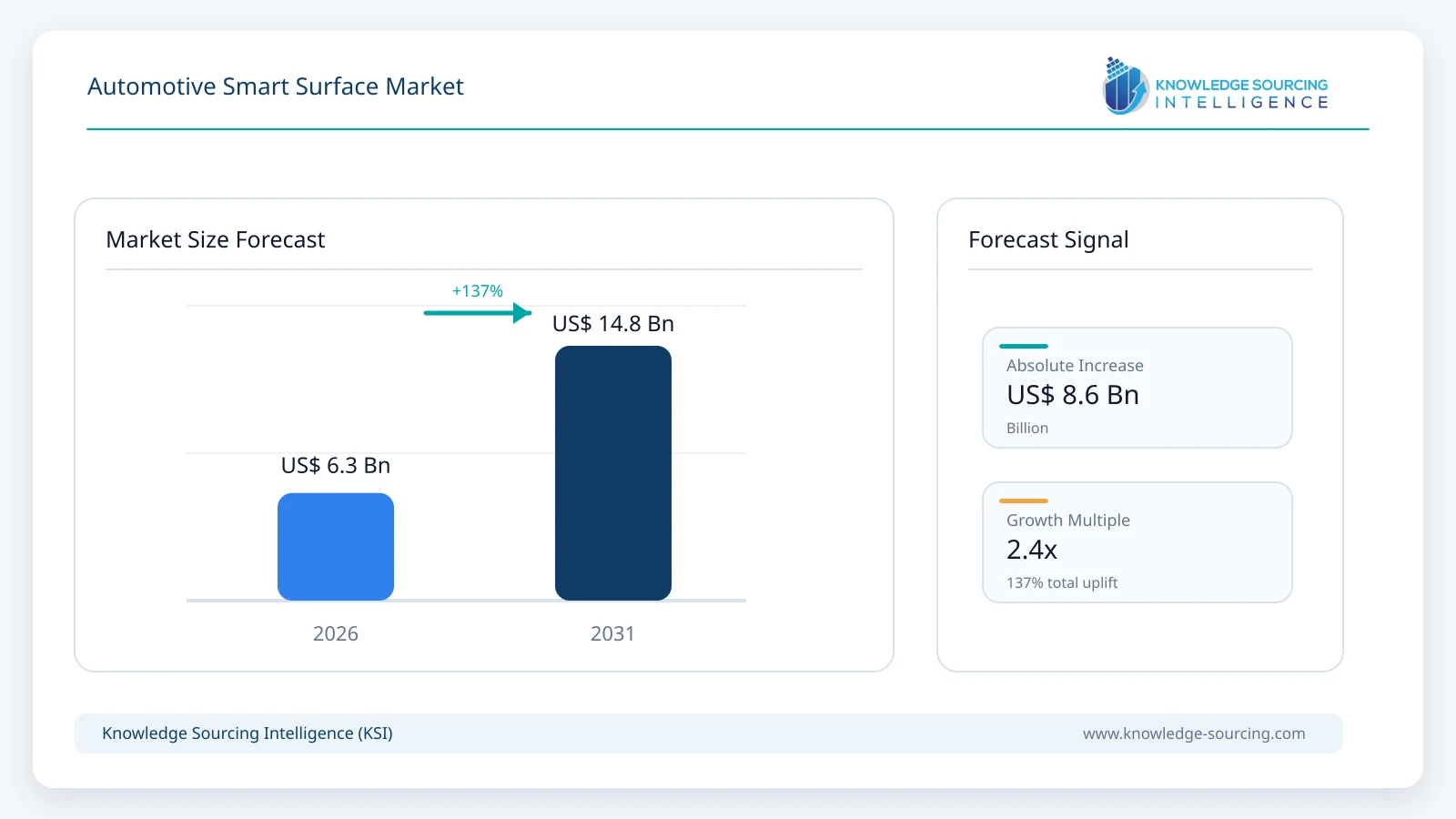
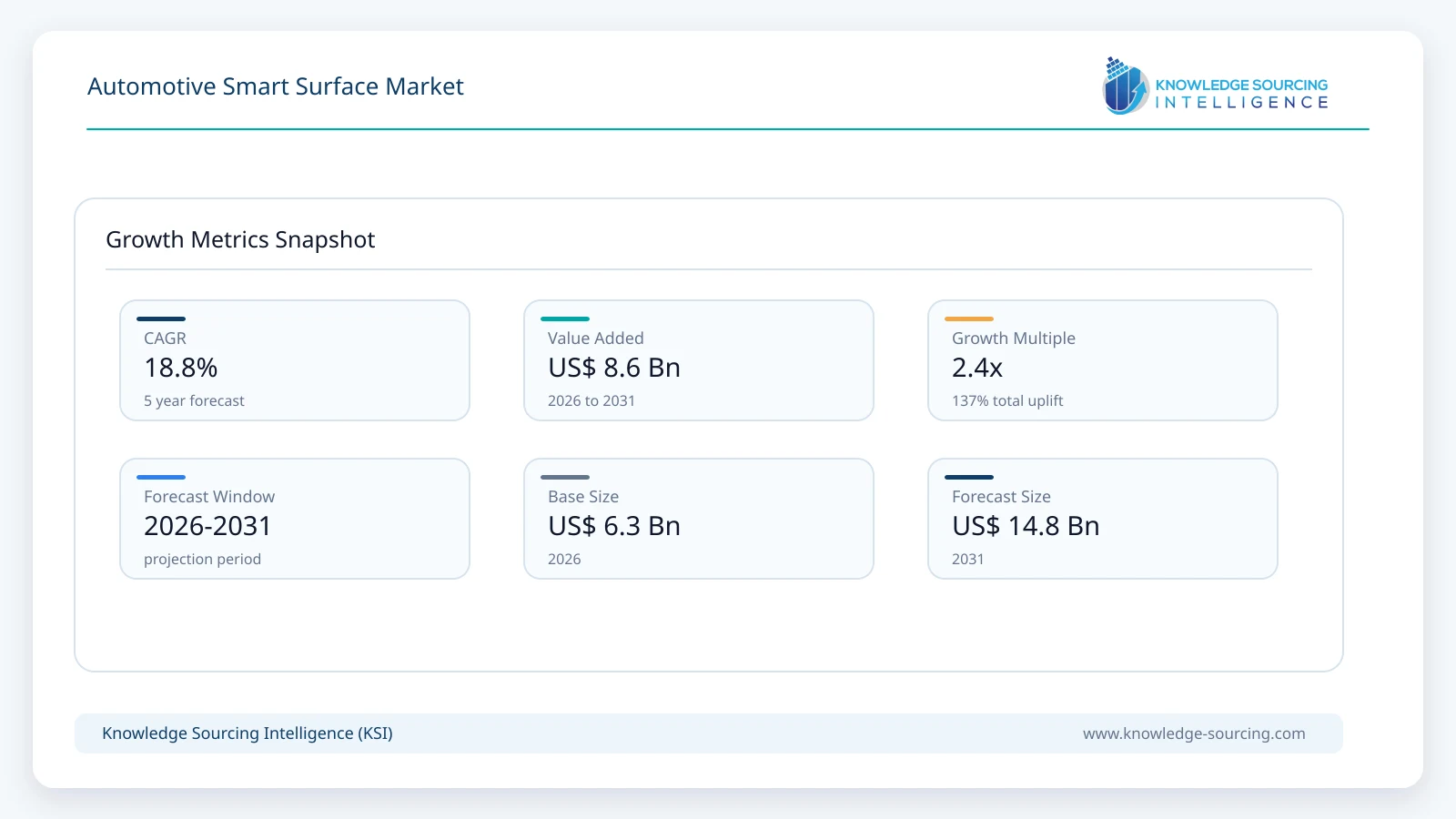
The automotive smart surface market is estimated at USD 6.25 billion in 2026 and is forecast to reach USD 14.80 billion in 2031, a compound annual growth rate of 18.8% during the forecast period.
Highlights:
- 1Interior smart surfaces represent an estimated 81.6% of total 2026 value, with exterior applications accounting for the remaining 18.4%.
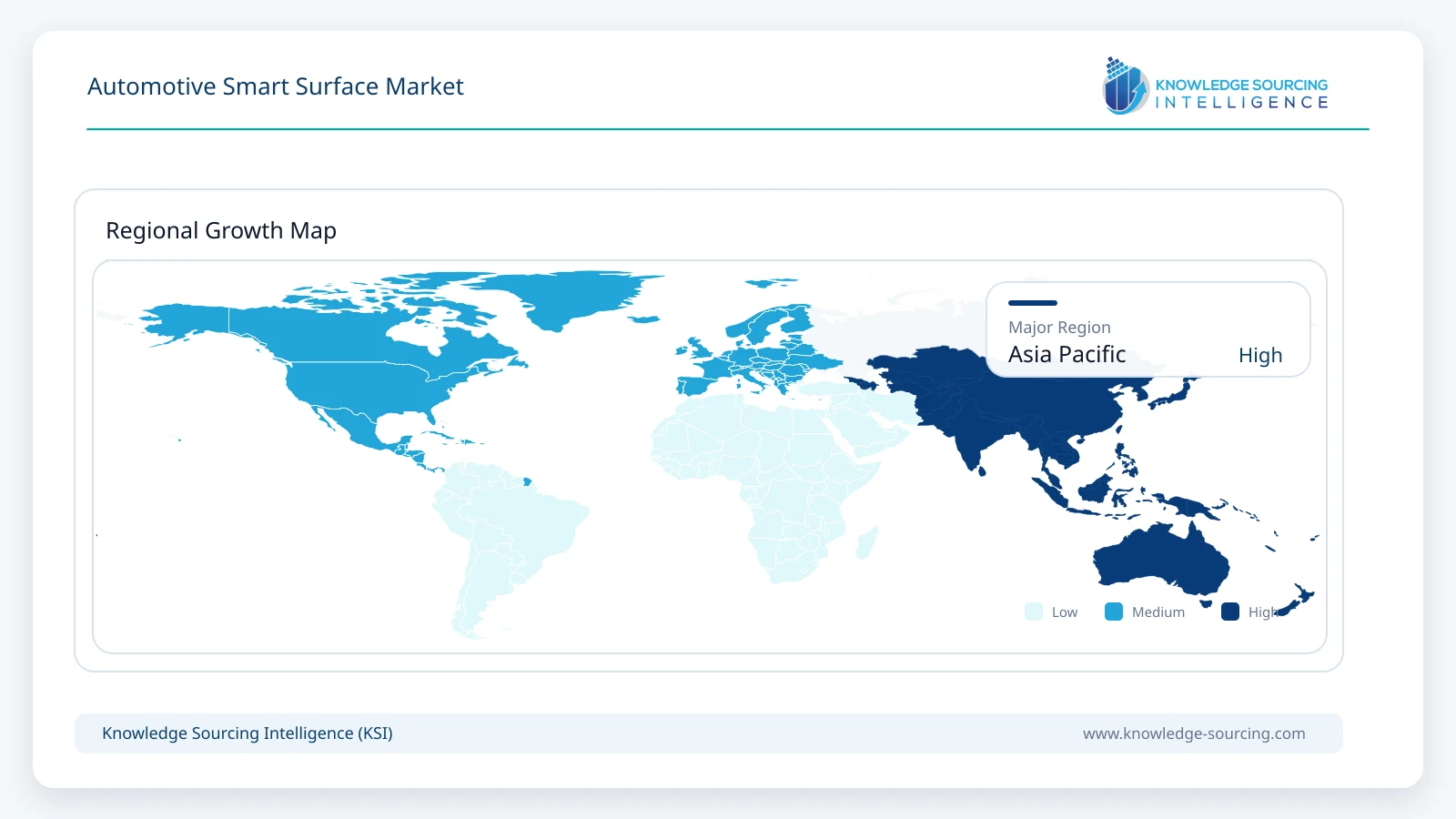
- 2Asia Pacific represents approximately 48.2% of global 2026 supplier revenue on a modeled end-market allocation basis.
- 3In-mold structural electronics contribute USD 1.40 billion in 2026 and are forecast to reach USD 4.90 billion in 2031.
- 4Illumination and personalization form the largest current primary-function category; multifunctional sensing and HMI gain relative weight through 2031.
- 5Commercial growth relies on production awards, tested part yields and vehicle-level nominations rather than the number of technology demonstrations.
Revenue comprises electronically functional finished surfaces fitted to vehicle interiors and qualifying exterior panels, where illumination, touch sensing, haptic response or information display is structurally integrated with the decorative or molded surface. Interior installations account for USD 5.10 billion of the 2026 market, while exterior smart surfaces contribute USD 1.15 billion.
Door panels, consoles and instrument-panel trim form the largest group of applications because these surfaces can combine lighting, control functions and premium appearance in one physical component. Exterior applications increasingly include illuminated grilles, emblems and fascia sections whose visible geometry and electronics are designed together.
Valeo's January 2026 awarded IMSE interior program and NBHX's June 2026 exterior IMSE nomination indicate two separate commercialization channels for surface-integrated electronics. Nissha, Marelli, Antolin and Yanfeng also demonstrate complementary routes to supplying molded functional panels. These developments are relevant to the forecast, but an announced license or production award is not equivalent to disclosed sales volume; much of the market remains distributed across conventional embedded modules, films, optical systems and integration suppliers.
Market Overview
Smart surfaces move electrical and optical functions into visible automotive material layers that were previously treated as decorative finishes. Molded polymer carriers, translucent skins, printed conductive circuits, capacitive sensing electrodes and local lighting electronics can be combined to create a part that communicates vehicle status or accepts an occupant's input without a conspicuous switch bank. The commercial product is typically a qualified surface assembly, although selected film and electronics subsystems may be supplied independently.
Marelli distinguishes decorative, informative and interactive smart surfaces, a useful reflection of the industry's different functional requirements. Decorative light guides emphasize uniformity and styling; informative surfaces need legibility and correct warning states; interactive surfaces require reliable touch discrimination and feedback. Nissha's in-mold electronics combine functional elements with curved plastic panels, while UltraSense and Antolin are developing solid-state controls with sensing and haptic confirmation.
Interior applications currently dominate supplier revenue, but exterior surfaces have a distinct design and durability challenge. An illuminated emblem or fascia panel must withstand weather, wash chemicals, stone impact and extended ultraviolet exposure while maintaining the original visual appearance. NBHX's 2026 exterior IMSE program nomination shows that electronics-integrated exterior panels are moving toward series production; however, product qualification and the pace of OEM launch schedules remain decisive for revenue realization.
Market Trends
In-Mold Electronics Is Expanding beyond Interior Decor
Valeo's January 2026 premium-automaker award combines lighting and electronic functionality within an in-mold structural electronics assembly rather than attaching all functional elements after molding. The production approach can simplify wiring and reduce local package depth, but requires coordinated design across circuitry, films, adhesives, tooling and surface finishing.
NBHX's June 2026 exterior IMSE nomination extends the same technology family into illuminated vehicle-body surfaces. Environmental sealing, repairability and optical aging become more demanding outside the cabin, so program transfer is not a simple reuse of interior parts. Automotive suppliers able to validate both film conversion and final molded-part testing can capture more of the delivered assembly economics.
Surface Interaction Is Shifting toward Concealed Controls
Antolin and UltraSense disclosed a September 2026 program-development initiative combining touch and force sensing with haptic and visual feedback. Concealed controls are attractive for wide door and console panels because they reduce visible switch apertures while allowing configurable interaction zones.
Driver usability places a practical limit on indiscriminate touch substitution. Solid-state controls require predictable actuation force, rejection of accidental contact and feedback that can be recognized without prolonged visual attention. OEMs are therefore likely to combine hidden surface interfaces with retained physical controls for selected safety-critical functions, rather than replace every conventional switch.
Illuminated Door Surfaces Are Becoming Vehicle Features
Toyota Boshoku confirmed that newly developed large-area illuminated door trim was adopted in the Lexus ES announced in June 2026. The supplier described surface materials and light-transmission technology that produce uniform illumination and animated cabin effects.
Door surfaces provide large visible areas but impose difficult requirements on gap alignment, scratch resistance, reflectivity and durability through repeated passenger contact. Suppliers with competence in polymer skins, optical design and electronic integration can manage these constraints within one assembly. Animated warning or status functions may add value, provided the resulting signals remain interpretable and do not compete with essential driver information.
Exterior Identity Surfaces Are Becoming Electronic Systems
Vehicle front-end design increasingly uses illuminated emblems, accent panels and patterned grilles to differentiate electric and premium models. Surface-level light output allows styling teams to work with continuous illuminated areas rather than individual lamp points, while electronic drivers and local communication interfaces govern animation and status behavior.
The cost of qualifying an exterior smart surface is materially different from that of an ambient-lighting insert inside the cabin. Water ingress, salt spray, abrasion, thermal cycling and local regulations can require additional protective layers and testing. These costs favor platform-level design commitments and make rapid aftermarket replacement of integrated smart panels less straightforward than replacing a conventional decorative badge.
Segment Analysis
By Surface Location: Interior Smart Surfaces
Interior applications account for USD 5.10 billion, or 81.6% of 2026 market revenue, spanning instrument panels, doors, consoles, pillars and overhead trim. Door and side-trim surfaces are the largest individual location category because broad visible panel areas combine decorative skins, lighting and user controls. The interior forecast reaches USD 11.75 billion by 2031 as higher electronic content migrates into a larger proportion of mainstream vehicles.
A complete door or console smart surface carries materially greater supplier value than an isolated conductive film or LED component. OEM program sourcing nevertheless differs by vehicle platform: some automakers purchase integrated panels from interior-system suppliers, while others separate decorative molding, optical elements and sensing electronics.
By Surface Location: Exterior Smart Surfaces
Exterior smart surfaces contribute an estimated USD 1.15 billion in 2026 and are expected to reach USD 3.05 billion in 2031 as illuminated front-end elements and electronics-ready trim become more common. Exterior growth is supported by distinctive vehicle identities and improved integration of lighting, surface materials and local electronics, particularly on electric-vehicle architectures with fewer conventional grille constraints.
NBHX's nominated IMSE exterior program in China is a concrete indicator of commercial investment, but its awarded status should not be interpreted as an industry shipment total. Suppliers must demonstrate lifetime weather resistance and optical stability while keeping repair costs acceptable.
By Technology: In-Mold Structural Electronics
In-mold structural electronics account for an estimated USD 1.40 billion of 2026 smart-surface value, increasing to USD 4.90 billion by 2031. The estimated technology share rises from 22.4% to 33.1% as more touch, illumination and sensor functions are embedded into the molded part. This allocation is consistent with KSI's established automotive in-mold electronics model and its interior and exterior application split.
Nissha supplies film-integrated electronic technologies suited to curved molded surfaces, while Valeo, Motherson and NBHX provide examples of OEM program delivery and manufacturing investment using licensed IMSE architecture. Qualification yield, scrap losses and potential design changes after mold tooling commitment remain important constraints on the speed at which high-volume vehicle platforms adopt these assemblies.
By Function: Illumination and Personalization
Illumination and personalization contribute an estimated USD 2.59 billion of 2026 revenue, the largest functional category, reflecting the commercial maturity of backlit decorative surfaces and visible identity panels. Lighting can support cabin atmosphere, branded exterior elements and location-specific cues without requiring a complete touch-control architecture. The value proposition is strongest where a surface delivers a uniform optical effect and can be manufactured with consistent color and brightness.
The functional mix becomes more sophisticated toward 2031 as OEMs add interaction and contextual status functions. Illuminated surfaces remain significant, but sensing, touch feedback and multifunctional structures gain share because they require more electronic and integration content.
Market Drivers
Concealed HMI Integration across Large Interior Panels
Automakers are integrating touch and force controls within door trim, center consoles and instrument-panel surfaces to reduce separate switch packs and create more continuous cabin styling. Antolin's collaboration with UltraSense illustrates how electronics, firmware, decorative structures and tactile confirmation must be engineered as a coordinated product. Supplier value rises when the awarded part replaces several formerly discrete controls and their mounting interfaces.
Hidden control programs also allow automakers to differentiate trim levels through electronic configurations while maintaining a shared underlying panel architecture. This can reduce visible part proliferation, although the cost benefit depends on tooling amortization and warranty performance. Platform-wide awards, rather than individual concept demonstrations, are most important for the revenue outlook.
Vehicle Brand Identity and Illuminated Exterior Panels
Electric and premium vehicle manufacturers increasingly use the vehicle front face and emblem area for distinctive illuminated design. Thin electronic lighting surfaces help integrate these effects with grille or fascia geometry, creating demand for optics, surface films, electronic drivers and qualified molded structures. NBHX's exterior IMSE nomination in China confirms supplier investment in this application class.
Exterior programs can generate higher value per installed part than conventional badges because their electronic and environmental specifications are more demanding. Growth nevertheless depends on a sufficiently large number of series-production model launches; styling demonstrations alone cannot support the modeled 2031 installed base.
Manufacturing Scale-Up through IMSE Licensing
TactoTek's licensing ecosystem now includes large Tier 1 manufacturers capable of designing and producing film-integrated molded electronics across global automotive platforms. Valeo's awarded program and Motherson's 2026 license illustrate different commercialization steps: an OEM nomination establishes specific program demand, whereas a license increases potential supplier manufacturing access.
A broader manufacturing base may lower sourcing risk for automakers that require multiple production sites and long-term part support. Manufacturers still need to validate process yields, printed circuit integrity and decorative finish quality at the actual nominated plant. Successful industrialization creates capacity for repeat platform awards, supporting the longer-term market forecast.
Premium-to-Midmarket Transfer of Functional Trim
Premium vehicles have helped establish integrated ambient lighting, information cues and concealed controls across large cabin surfaces. Lower-cost optical films, control electronics and automated assembly can gradually extend these functions to higher-volume vehicle segments. The market therefore expands through both additional equipped vehicles and greater surface content on already equipped models.
The transition will not be uniform across every region or trim level. High-volume platforms tend to prioritize robust functions with clear cost or user-experience benefits, while expensive combinations of haptic feedback and display layers may remain option-dependent. Feature uptake will depend on the functional value achieved within each vehicle platform’s cost and validation requirements.
Greater Functional Density within Molded Parts
Combining light guides, sensors, conductive films and decorative skins within a qualified surface can remove secondary assembly operations and reduce the space reserved for discrete modules. Nissha's IME portfolio demonstrates the ability to incorporate electronic functions into curved molded plastic. Higher functional density also opens new packaging options for thin consoles, door panels and illuminated exterior pieces.
Tier 1 suppliers can capture more value when they deliver a tested integrated assembly rather than a single material layer, provided production yield offsets tooling and process complexity. OEMs gain a cleaner system interface, but the supplier assumes more responsibility for optical defects, firmware behavior and long-term reliability. This trade-off favors manufacturing partners with both electronics and surface-engineering capabilities.
Market Restraints
High Qualification Cost and Production Yield Sensitivity
Molded electronic surfaces combine processes with different sources of manufacturing variability, including circuit printing, film forming, component placement, injection molding and decorative finishing. A defect late in the sequence can scrap a much more expensive integrated part than a conventional trim insert. Process capability and first-pass yield therefore materially influence the supplier's achievable margin.
OEM qualification also requires testing of electrical stability, vibration, thermal cycling, abrasion and visible-surface appearance. Suppliers may need to commit to production tooling before final volume forecasts are certain, lengthening investment recovery. These constraints slow adoption by price-sensitive programs and favor manufacturers with proven quality systems.
Usability and Functional-Safety Limitations of Touch-Only Controls
Touch-sensitive surfaces can create interaction uncertainty when drivers operate them without looking or while wearing gloves. Force detection and haptic confirmation improve feedback, but must remain consistent across temperature changes, surface wear and accidental contact. A physically simple panel does not automatically provide a better interface than well-positioned conventional buttons.
Automakers also face pressure to preserve direct access to essential driving and visibility functions. The most credible supplier architectures therefore combine configurable touch surfaces with appropriate physical or voice alternatives rather than assuming unrestricted elimination of switches. Safety validation and human-factors testing can extend development cycles.
Exterior Durability and Repair Economics
An illuminated exterior grille or emblem experiences direct exposure to moisture, temperature swings, road debris, ultraviolet light and washing chemicals. Protective surface stacks and sealed electrical interfaces add cost and may restrict optical design. A failure affecting only a decorative section could nevertheless require replacement of a larger integrated assembly.
Insurance repair costs and serviceability can influence automaker decisions, particularly where an electronic fascia sits in a common collision-damage zone. Suppliers need modular repair strategies, stable finishes and accessible diagnostic interfaces to make higher-content parts acceptable in volume programs. These requirements temper adoption beyond premium vehicle applications.
Material Compatibility and End-of-Life Separation
Decorative skins, adhesives, conductive traces, electronic chips and polymer substrates have different thermal expansion, recycling and bonding characteristics. Complex material stacks can delaminate or show visible color variation after aging, making long-life qualification harder than for ordinary injection-molded trim. Surface uniformity is especially difficult when illuminated graphics span large curved panels.
Circularity requirements create another design trade-off because permanently embedded electronics can be harder to separate during recycling. Manufacturers must improve material identification, disassembly and controlled recycling while maintaining robust electrical and moisture protection. These changes can increase near-term engineering expenditure even when they reduce future environmental impacts.
Program Concentration and Slower-than-Expected Launch Conversion
Automotive smart-surface revenue is concentrated in multi-year vehicle programs with lengthy nomination, tooling and validation periods. A supplier announcing a partnership, licensing agreement or prototype has not necessarily secured a production purchase order. Forecasting based only on such announcements can overstate the pace of near-term market conversion.
Platform delays, lower-than-planned build volumes or removal of optional lighting and HMI content can reduce realized revenue after engineering investment is committed. Suppliers need a diversified OEM customer base and flexible capacity to manage these risks. This exposure is particularly important for younger printed-electronics providers that depend on a small number of application launches.
Regional Outlook
Asia Pacific
Asia Pacific accounts for an estimated USD 3.01 billion, or about 48.2% of global smart-surface supplier value in 2026. Regional vehicle production, Chinese premium and electric-vehicle launches, and proximity to electronics and decorative-film manufacturing support relatively rapid adoption of cabin and exterior functional panels. NBHX's Chinese exterior IMSE nomination and Japanese suppliers' expertise in molded optics and material integration exemplify this production ecosystem.
China is the largest country market within the region, while Japan and South Korea retain strong capabilities in materials, displays and lighting components. India and Southeast Asia provide longer-term opportunities as higher-feature interiors spread into locally produced vehicle models.
Europe
Europe represents an estimated USD 1.52 billion in 2026, supported by premium interior engineering, advanced automotive lighting suppliers and the industrialization of IMSE production. Valeo, Antolin, Marelli and TactoTek-linked manufacturing partners participate in different portions of the value chain. European OEMs place significant emphasis on material appearance, functional safety, lifetime durability and the quality of integrated user feedback.
Regional market growth is supported by premium-vehicle surface content and the gradual use of integrated electronic trim on mainstream platforms. Commercial success still depends on tooling efficiency and the economic case for reducing discrete parts.
Competitive Landscape
Automotive smart-surface supply combines interior trim specialists, exterior plastic-panel suppliers, optical and lighting companies, sensing developers and in-mold electronics technology licensors. Valeo, Antolin, Marelli, Yanfeng and Motherson compete through vehicle integration and production delivery, while Nissha, TactoTek and UltraSense provide important capabilities in functional films, embedded electronics and sensing. NBHX participates in automotive body and interior surface programs, including a nominated exterior IMSE application.
Competition is organized increasingly around awarded programs and plant-level manufacturing readiness rather than isolated material patents. OEM customers need a supplier capable of delivering a visually consistent and electrically tested assembly with controlled tooling tolerances.
The most attractive suppliers can integrate decorating, optical engineering and electronic functions while managing repairability, emissions and end-of-life material requirements. Premium cabin surfaces and exposed exterior identity features have different quality targets, making a single universal manufacturing solution unlikely. Geographic localization and control of high-yield conversion processes remain important competitive differentiators.
Recent Developments
20 January 2026: Valeo announced a premium-automaker interior lighting program award using TactoTek IMSE technology and a planned automated high-volume production solution.
21 May 2026: Motherson signed a license agreement for TactoTek IMSE technology, expanding production capability for interior and exterior smart-surface components.
11 June 2026: Toyota Boshoku confirmed adoption of large-area illuminated door trim in the Lexus ES, incorporating light-transmission and animated visual effects.
29 June 2026: NBHX disclosed a Chinese OEM mass-production nomination for an exterior illuminated smart surface based on TactoTek IMSE technology.
8 September 2026: Antolin and UltraSense announced an integrated smart-surface HMI development initiative using touch and force sensing with haptic and visual feedback.
Market Outlook
Automotive smart-surface supplier value is forecast to increase from USD 6.25 billion in 2026 to USD 14.80 billion by 2031 as electronically functional surface content spreads from premium cabins to more vehicle segments and exterior brand-identity applications. Interior surfaces will retain the majority of value, while exterior illuminated and information-bearing panels gain share as molded electronics and durable optical technologies mature.
Large door panels, instrument panels and consoles will remain important revenue pools because they support multiple functions in one high-visibility part. In-mold structural electronics is expected to outgrow conventional modular assembly as awarded programs move through tooling and production qualification.
Asia Pacific is expected to remain the largest region by supplier content, with Europe retaining a substantial role in premium HMI and optical engineering. Suppliers that demonstrate consistent visible quality, automotive-grade electronics performance and repeatable high-volume production will capture the strongest opportunities. Commercial forecasts should still distinguish production programs from technology licenses and demonstrators when evaluating the speed of market conversion.
Automotive Smart Surface Market Scope
| Report Metric | Details |
|---|---|
| Total Market Size in 2026 | USD 6.25 billion |
| Total Market Size in 2031 | USD 14.80 billion |
| Forecast Unit | Billion |
| Growth Rate | 18.8% |
| Study Period | 2021 to 2031 |
| Historical Data | 2021 to 2024 |
| Base Year | 2025 |
| Forecast Period | 2026 – 2031 |
| Segmentation | Surface Location, Primary Function, Electronic Integration, Surface Material, Supplier Configuration, Vehicle Type, Propulsion, Geography |
| Companies |
|
Market Segmentation
By Surface Location
Door and Side-Trim Surfaces
Instrument Panel and Dashboard Surfaces
Center and Floor Console Surfaces
Headliner, Pillars and Other Interior Surfaces
Exterior Grille, Emblem, Fascia and Body Surfaces
By Primary Function
Illumination and Personalization
Touch and Haptic Control
Status, Warning and Information
Embedded Proximity and Sensor Functions
Multifunctional Surface Systems
By Electronic Integration
Conventional Modules within Smart Surfaces
Laminated Circuits and Functional Foils
In-Mold Structural Electronics
Printed and Other Embedded Electronics
By Surface Material
Molded Polymer and Decorated Substrates
Soft-Touch Skins and Synthetic Leather
Functional Films and Optical Layers
Textiles and Light-Permeable Soft Materials
Natural-Fiber and Other Sustainable Surface Materials
By Supplier Configuration
Integrated Smart-Surface Assemblies
Surfaces with Modular Electronics
Functional-Foil and Electronics Subsystems
By Vehicle Type
Passenger Vehicles
Light Commercial Vehicles
Medium and Heavy Commercial Vehicles and Buses
By Propulsion
Internal-Combustion-Only Vehicles
Hybrid and Plug-In Hybrid Vehicles
Battery Electric Vehicles
By Geography
North America
United States
Canada
Mexico
South America
Brazil
Argentina
Others
Europe
Germany
United Kingdom
France
Italy
Spain
Others
Middle East and Africa
Saudi Arabia
UAE
South Africa
Others
Asia Pacific
China
Japan
South Korea
India
Indonesia
Thailand
Others
Table of Contents
1. EXECUTIVE SUMMARY
1.1. Key Findings
1.2. Automotive Smart Surface Market Size, 2026-2031
1.3. Technology and Surface Function Outlook
1.4. Regional Opportunity Summary
2. MARKET SNAPSHOT
2.1. Market Overview
2.2. Market Definition
2.3. Scope of the Study
2.4. Market Segmentation
2.5. Currency
2.6. Assumptions
2.7. Base and Forecast Years
2.8. Key Benefits to Stakeholders
3. BUSINESS LANDSCAPE
3.1. Market Drivers
3.1.1. Concealed HMI Integration across Large Interior Panels
3.1.2. Vehicle Brand Identity and Illuminated Exterior Panels
3.1.3. Manufacturing Scale-Up through IMSE Licensing
3.1.4. Premium-to-Midmarket Transfer of Functional Trim
3.1.5. Greater Functional Density within Molded Parts
3.2. Market Restraints
3.2.1. High Qualification Cost and Production Yield Sensitivity
3.2.2. Usability and Functional-Safety Limitations of Touch-Only Controls
3.2.3. Exterior Durability and Repair Economics
3.2.4. Material Compatibility and End-of-Life Separation
3.2.5. Program Concentration and Slower-than-Expected Launch Conversion
3.3. Market Opportunities
3.4. Porter’s Five Forces Analysis
3.5. Industry Value Chain Analysis
3.6. Cost and Integration Economics
3.7. Policies, Regulations and Safety Requirements
3.8. Strategic Recommendations
4. TECHNOLOGICAL OUTLOOK
4.1. Capacitive and Force-Sensing Surface Controls
4.2. Hidden-Until-Lit Optical Layers and Light Guides
4.3. Haptic Actuation and Surface Feedback
4.4. In-Mold Structural Electronics
4.5. Printed Conductors and Functional Films
4.6. Illuminated Exterior Grille and Emblem Structures
4.7. Smart-Surface Controllers and Vehicle Network Integration
5. AUTOMOTIVE SMART SURFACE MARKET BY SURFACE LOCATION
5.1. Introduction
5.2. Door and Side-Trim Surfaces
5.3. Instrument Panel and Dashboard Surfaces
5.4. Center and Floor Console Surfaces
5.5. Headliner, Pillars and Other Interior Surfaces
5.6. Exterior Grille, Emblem, Fascia and Body Surfaces
6. AUTOMOTIVE SMART SURFACE MARKET BY PRIMARY FUNCTION
6.1. Introduction
6.2. Illumination and Personalization
6.3. Touch and Haptic Control
6.4. Status, Warning and Information
6.5. Embedded Proximity and Sensor Functions
6.6. Multifunctional Surface Systems
7. AUTOMOTIVE SMART SURFACE MARKET BY ELECTRONIC INTEGRATION
7.1. Introduction
7.2. Conventional Modules within Smart Surfaces
7.3. Laminated Circuits and Functional Foils
7.4. In-Mold Structural Electronics
7.5. Printed and Other Embedded Electronics
8. AUTOMOTIVE SMART SURFACE MARKET BY SURFACE MATERIAL
8.1. Introduction
8.2. Molded Polymer and Decorated Substrates
8.3. Soft-Touch Skins and Synthetic Leather
8.4. Functional Films and Optical Layers
8.5. Textiles and Light-Permeable Soft Materials
8.6. Natural-Fiber and Other Sustainable Surface Materials
9. AUTOMOTIVE SMART SURFACE MARKET BY SUPPLIER CONFIGURATION
9.1. Introduction
9.2. Integrated Smart-Surface Assemblies
9.3. Surfaces with Modular Electronics
9.4. Functional-Foil and Electronics Subsystems
10. AUTOMOTIVE SMART SURFACE MARKET BY VEHICLE TYPE
10.1. Introduction
10.2. Passenger Vehicles
10.3. Light Commercial Vehicles
10.4. Medium and Heavy Commercial Vehicles and Buses
11. AUTOMOTIVE SMART SURFACE MARKET BY PROPULSION
11.1. Introduction
11.2. Internal-Combustion-Only Vehicles
11.3. Hybrid and Plug-In Hybrid Vehicles
11.4. Battery Electric Vehicles
12. AUTOMOTIVE SMART SURFACE MARKET BY GEOGRAPHY
12.1. North America
12.1.1. United States
12.1.2. Canada
12.1.3. Mexico
12.2. South America
12.2.1. Brazil
12.2.2. Argentina
12.2.3. Others
12.3. Europe
12.3.1. Germany
12.3.2. United Kingdom
12.3.3. France
12.3.4. Italy
12.3.5. Spain
12.3.6. Others
12.4. Middle East and Africa
12.4.1. Saudi Arabia
12.4.2. UAE
12.4.3. South Africa
12.4.4. Others
12.5. Asia Pacific
12.5.1. China
12.5.2. Japan
12.5.3. South Korea
12.5.4. India
12.5.5. Indonesia
12.5.6. Thailand
12.5.7. Others
13. COMPETITIVE ENVIRONMENT AND ANALYSIS
13.1. Major Players and Strategy Analysis
13.2. Market Share Analysis
13.3. Mergers, Acquisitions, Agreements and Collaborations
13.4. Smart-Surface Supplier and Technology Benchmarking
13.5. Production Programs and Manufacturing Readiness
13.6. Competitive Dashboard
14. COMPANY PROFILES
14.1. Valeo SA
14.2. Marelli
14.3. Antolin
14.4. Yanfeng Automotive Interiors
14.5. Motherson Group
14.6. Ningbo Huaxiang Electronic Co., Ltd. (NBHX)
14.7. TactoTek Oy
14.8. UltraSense Systems, Inc.
14.9. Nissha Co., Ltd.
14.10. Toyota Boshoku Corporation
14.11. FORVIA HELLA
14.12. Preh GmbH
14.13. Toyoda Gosei Co., Ltd.
15. APPENDIX
15.1. Research Methodology
15.2. Abbreviations
15.3. Data Sources
Navigate
Trusted by the world's leading organizations











