
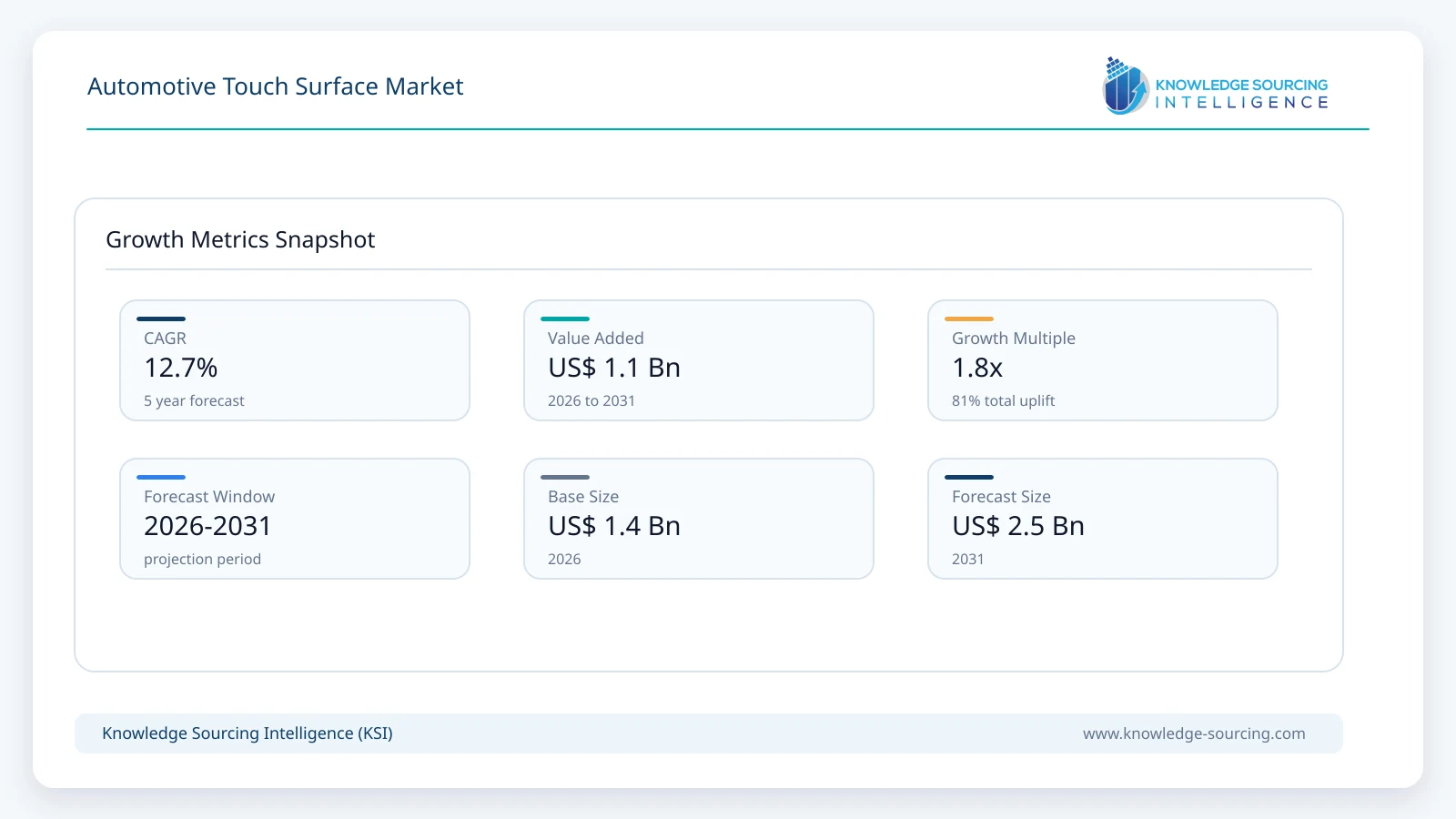
The automotive touch surface market is forecast to grow at a CAGR of 12.7%, increasing from USD 1.35 billion in 2026 to USD 2.45 billion by 2031.
Highlights:
- 1Capacitive-only surfaces account for USD 0.6944 billion in 2026, while touch-and-force controls contribute USD 0.6510 billion.
- 2Combined touch-and-force control value is projected to reach USD 1.4334 billion by 2031 and gain share of the touch-specific mix.
- 3Center consoles and center stacks contribute the largest 2026 application-zone allocation.
- 4In-mold structural electronics gain modeled share as manufacturers integrate sensing and decoration in common molded components.
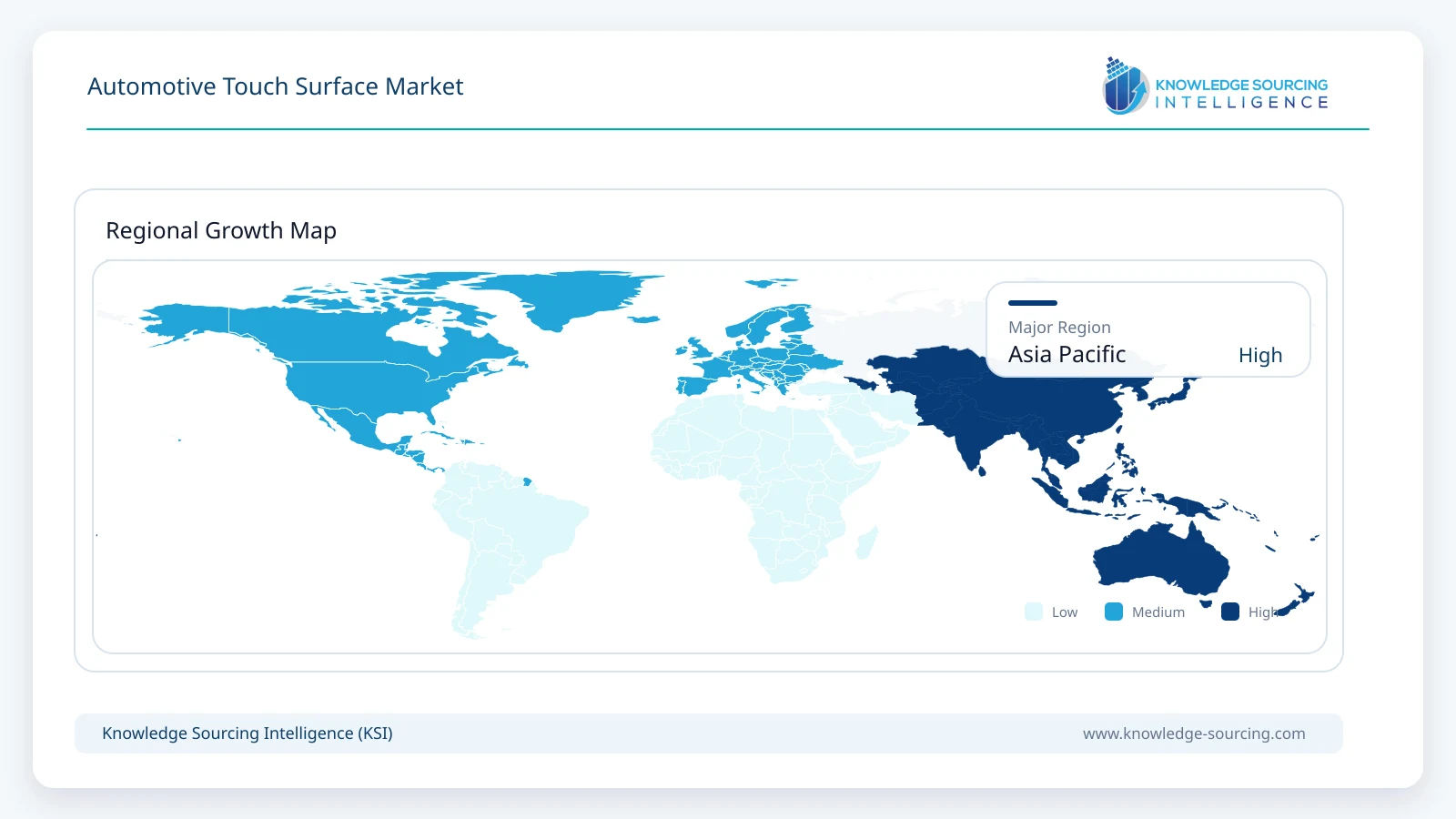
- 5Asia Pacific leads regional revenue in both modeled years, driven by electronics-rich interior programs and production concentration.
- 6Euro NCAP’s 2026 assessments support direct physical controls for basic driving tasks, limiting unconditional substitution by touch.
- 7Production touch-bar activity at Mobase–UltraSense provides stronger commercialization evidence than licensing announcements alone.
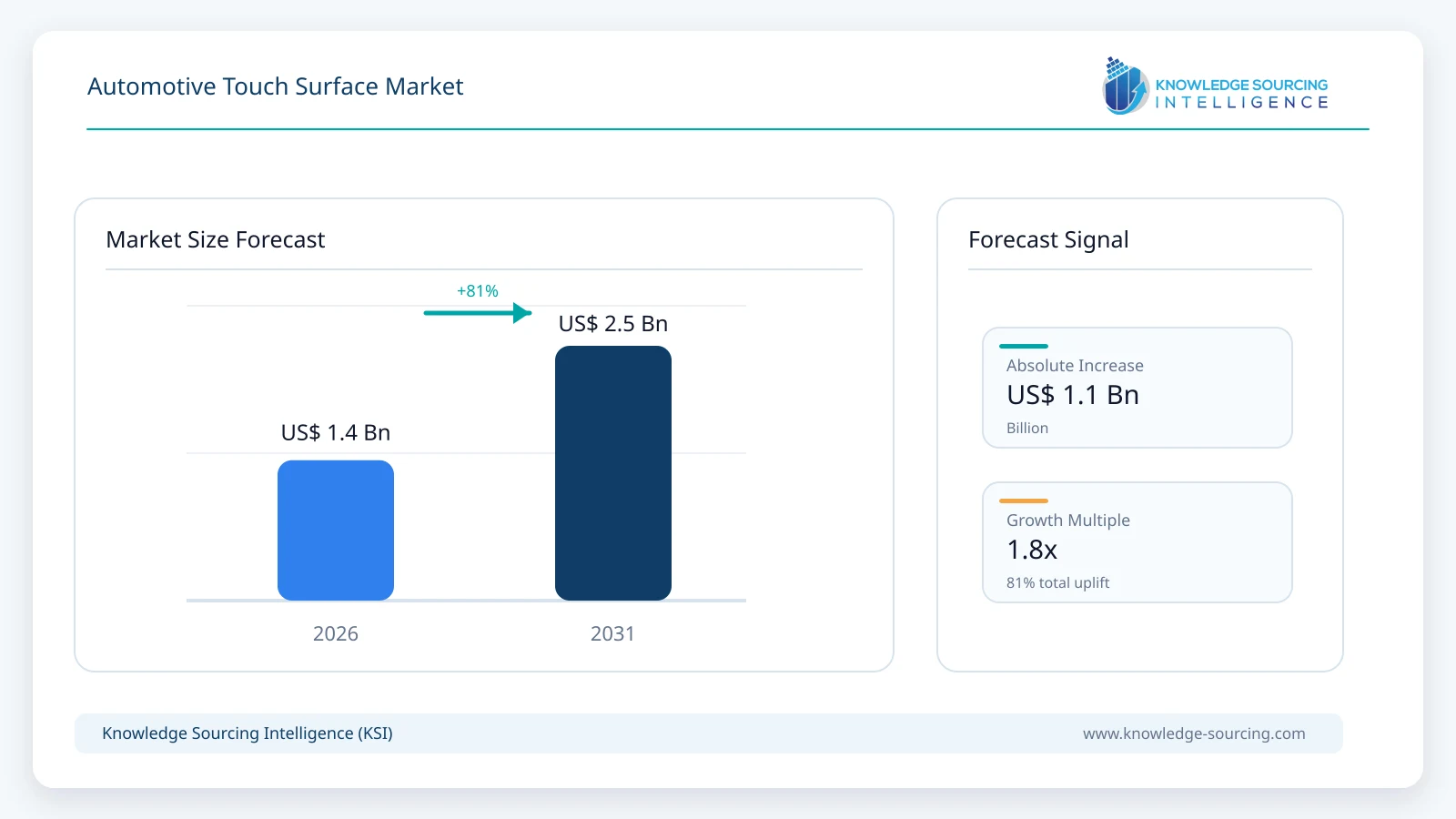
Automotive touch surface suppliers combine conductive electrodes, force detection, control circuitry and engineered cover materials to provide input functions in cabin trim. Control zones in center consoles currently contribute the largest share, while integrated door and passenger-side controls expand across vehicle platforms.
Preh supplies production-oriented touch controls and haptic-enabled center stacks, while PolyIC offers transparent conductive foils and Nissha integrates sensing films into molded interior components. UltraSense and Mobase disclosed an infotainment touch-bar production ramp in October 2025. These examples illustrate several supplier routes, from sensor materials and electronic controllers to complete functional interior modules.
Market Overview
Capacitive touch surfaces detect changes in an electric field when an occupant contacts a controlled area, while combined touch-and-force solutions require a more deliberate input. Touch electrodes may sit beneath glass, molded polymer, coated decorative film or other substrates. Vehicle manufacturers specify surface finish, target location, sensor thresholds and confirmation behavior together because a visually seamless part still needs reliable operation under vibration, dirt, moisture and temperature variation.
Nissha identifies automotive applications for its in-mold electronics, combining touch sensors and functional components within plastic panels, while PolyIC supplies bendable conductive foils for three-dimensional trim geometries. TactoTek licenses in-mold structural electronics that place circuitry and control functions into molded components. Supplier integration decisions affect qualification responsibility, available styling shapes and whether electronic components can be serviced independently after a surface is damaged.
Euro NCAP introduced more explicit 2026 HMI assessments and published October 2026 findings favoring direct physical controls for essential driving functions. The commercial implication is selective adoption rather than universal replacement of switches: touch surfaces remain attractive for infotainment, comfort, seat adjustment and passenger functions, but primary safety-related inputs face greater scrutiny. Specifying clear tactile landmarks or retaining dedicated mechanical controls can change the architecture and cost of a cabin program.
Market Trends
Touch Controls Are Being Integrated into Decorative Trim
Yanfeng describes smart surfaces that combine capacitive touch input with concealed graphics and haptic feedback across doors, instrument panels and overhead controls. Concealed iconography gives designers more freedom over material continuity, while touch sensing permits a single trim architecture to support different control layouts. The value opportunity is greatest where suppliers can deliver an automotive-grade decorated assembly rather than a standalone electrode film.
Preh and Valeo use touch-enabled control systems alongside other input mechanisms, showing that the commercial direction is hybrid interface design rather than an immediate elimination of buttons. Localized backlighting, defined press zones and audio or tactile confirmation make flat inputs easier to identify. Integration cost depends on how many dedicated buttons are replaced and whether a molded touch module can use a common vehicle electronics platform.
Force Confirmation Is Differentiating Higher-Value Touch Zones
Mobase Electronics and UltraSense began ramping a solid-state infotainment touch bar in 2025 using capacitive touch and piezoelectric force sensing with localized feedback. A force threshold can reduce unintended activation compared with simple proximity or contact detection, particularly for controls operated while the vehicle moves. Sensing algorithms and mechanical stack design therefore command value beyond the conductive film alone.
Antolin and UltraSense announced a September 2026 development initiative for a future global vehicle platform that combines touch, force and haptic response. The announcement establishes a development pathway, not confirmed mass-production revenue for the future platform. Suppliers able to validate robust press recognition across decorative coatings and curved surfaces are better placed to win multi-model programs as OEMs standardize control architectures.
In-Mold Electronics Are Changing the Supply Chain
TactoTek manufacturing agreements in 2026 expanded industrial access to in-mold structural electronics, including licensing with Global Technology Ventures and manufacturing cooperation with Symbiose. IMSE places touch circuitry and other components within the geometry of a molded part, potentially reducing separately installed pieces. The gain depends on high molding yields, predictable film deformation and reliable electrical connections after thermal cycling.
Motherson signed an IMSE license agreement in May 2026, adding Tier 1 integration capability to the technology ecosystem. Automobile manufacturers can source larger integrated modules through established interiors suppliers, while upstream sensor-film and ink vendors become more dependent on approved manufacturing routes. Engineering awards and licensing agreements enlarge capacity but should not be interpreted as installations until specific production milestones are reached.
Safety Assessment Is Reinforcing Mixed Control Architectures
Euro NCAP’s October 2026 testing commentary favored physical buttons or controls for basic driving functions and reported weaker control scores for models relying heavily on touchscreen interaction. The assessment changes the design incentives for indicators, hazard lights, horn and related essential functions. Touch surfaces consequently compete most effectively in adjustable comfort, infotainment and convenience controls where a flat interface can be designed for predictable confirmation.
Preh’s production touch-control portfolio illustrates the continuing use of rotary elements, shaped zones and active haptics alongside capacitive inputs. These mixed arrangements preserve familiar operating cues while allowing aesthetic consolidation elsewhere. Suppliers that demonstrate tactile identification, sufficiently separated targets and controlled input thresholds can defend their content value even when OEMs restore selected physical switch functions.
Segment Analysis
By Interface Type: Capacitive-Only and Combined Touch-and-Force
Capacitive-only surface controls contribute USD 0.6944 billion in 2026, or approximately 51.6% of the touch-surface market. Their cost and packaging advantages suit climate panels, sliders, audio adjustments and less safety-critical functions. Combined touch-and-force solutions represent the remaining USD 0.6510 billion, and their share increases in the forecast as deliberate-press functionality supports safer interaction on flat decorative surfaces.
Combined touch-and-force supplier content is projected to reach USD 1.4334 billion by 2031 compared with USD 1.0173 billion for capacitive-only controls. UltraSense provides a production example through Mobase, while Nissha’s product portfolio includes both touch and force sensing. The faster-growing configuration earns higher content per installed surface but also requires more mechanical and software calibration.
By Application Zone: Center Stack and Center Console
Center-stack and center-console applications account for an estimated 35% of the 2026 market, reflecting their concentration of climate, audio, navigation and vehicle-setting controls. Their central location provides an established wiring and electronics integration point, so control suppliers can offer grouped modules rather than distribute every function through separate door or dashboard wiring runs.
Preh supplies touch-oriented central HMI systems and Valeo markets seamless control faceplates with capacitive sliders and programmable feedback. Door panels and armrests increase their projected value share because seat, window, ambient-light and passenger-comfort functions can be embedded in larger decorative surfaces. Program economics depend on the number of controls integrated per door and the serviceability of the module.
By Electronic Integration: In-Mold Structural Electronics
In-mold structural electronics account for an estimated 24% of touch-surface value in 2026, with a modeled rise to 36% by 2031. The technology integrates conductive circuits or sensor elements into formed and molded parts, reducing the need for a separately mounted control board in selected applications. Its financial appeal strengthens when several touch zones share one decorated substrate.
TactoTek’s 2026 licensing and manufacturing arrangements, together with Motherson’s adoption of its technology platform, provide evidence of expanding industrial capability. Conventional laminated films and modular electronics remain significant because automotive programs value repairability, established yields and sourcing flexibility. The forecast therefore assumes gradual migration rather than a complete replacement of conventional interfaces.
Market Drivers
Interior Design Demand for Flush Functional Surfaces
Automakers increasingly request control functions within continuous decorative skins so a console or door panel can carry inputs without multiple cutouts. Yanfeng’s smart-surface designs and Valeo’s seamless faceplate portfolio demonstrate that the control interface can be treated as part of the trim design rather than a separate switch assembly. Interior engineering teams must coordinate control markings, surface wear and switch reliability before finalizing the decorative part.
Combining graphics, sensing and surface finishing can reduce visible part boundaries and permit equipment-level customization. Suppliers benefit when a common base module supports several trim appearances, although any cost saving depends on tooling volume, electronics content and assembly yield.
Broader Access to Production-Oriented Sensor Technologies
PolyIC produces conductive metal-mesh foils that can be shaped for three-dimensional automotive trim, while Nissha integrates touch sensors through in-mold processes. These routes address the packaging limitations of traditional flat touch boards and allow more functions to be carried on curved interior surfaces. The same conductive architecture may support several panel geometries, but molded curvatures still require qualification.
TactoTek licensing agreements with GTV, Symbiose and Motherson during 2026 widen potential manufacturing routes for functional molded electronics. Qualification and nomination schedules still determine the timing of shipments, but a broader supply base can reduce concentration risk for automakers planning common touch-control platforms.
Rising Need for Deliberate Press Recognition
UltraSense’s force-sensing controller and Mobase’s production touch-bar application demonstrate a path to distinguish intentional selection from casual surface contact. Where mechanical switches are removed, an additional force threshold can protect controls against inadvertent activation and reduce user uncertainty. The reported production case is especially relevant because it shows the control stack is not restricted to concepts.
Touch-and-force configurations gain modeled share through 2031 as feedback and press detection are specified together. The extra electronics and integration work also increases content per qualified surface, supporting stronger supplier revenue than capacitive-only control films.
Extension of Controls into Door and Passenger Zones
Antolin’s smart-surface collaboration identifies door controls, overhead systems and cabin convenience interfaces as candidates for integrated electronics. Power-seat adjustment, rear-zone climate and passenger media functions provide opportunities beyond the central infotainment stack. Door-module programs often involve multiple vehicle grades, requiring the touch zones to function across differing trims.
Tier 1 interiors suppliers can combine door-trim design, decorative finishing and touch electronics in one program. Larger module responsibility can support more value per vehicle, provided testing covers repeated contact, abrasion, moisture and wiring interfaces throughout the component life.
Platform Reuse and Software Configurability
Vehicle manufacturers can reuse a touch-control hardware platform while changing assigned functions, illumination and software mapping across trim grades. Valeo’s configurable faceplate approach and Yanfeng’s smart-surface concepts demonstrate how common electronics can support several interior identities. Configurable control logic can also support distinct passenger permissions and visual themes within the same vehicle family.
Program reuse improves the return on tooling and controller development when touch zones operate consistently across model variants. Larger recurring volumes remain dependent on OEM design decisions and safety requirements, not simply the technical ability to remap an input.
Market Restraints
Driver Distraction and Physical-Control Expectations
Euro NCAP’s October 2026 results highlight the disadvantage of relying on screens or poorly identifiable flat controls for essential driving tasks. A touch-only surface without a clear landmark can require visual search, especially when the vehicle is moving or the driver wears gloves. The October 2026 test commentary offers a current example of safety assessment directly influencing interface specification.
OEMs may retain physical controls for critical functions and limit flat touch surfaces to comfort or convenience inputs. This curtails the addressable control count on some platforms even as higher-value touch-and-force systems gain adoption in other locations.
Calibration Challenges across Decorative Materials
Capacitive sensitivity varies with cover thickness, material dielectric properties, nearby wiring and environmental conditions. Force sensing adds mechanical-stack and deformation requirements, particularly when the same electronics must operate behind curved plastic, coated glass or fabric-like surfaces. Testing must consider sensor grounding and ambient electrical noise alongside conventional material and dimensional stability.
Qualification teams must validate reliable actuation with wet or gloved fingers, vibration and temperature cycling. Each new decorative layer can require updated sensitivity settings or mechanical compensation, lengthening engineering work and making apparently simple trim changes commercially costly.
Repairability and Replacement Cost
Functional films or electronic inserts embedded in molded trim can be difficult to repair separately after a local surface defect. A broken sensor connection, cosmetic scratch or liquid intrusion may require replacement of a complete console or door-control module rather than a low-cost switch. Integrated parts can also complicate end-of-life disassembly where electronics are bonded directly to decorative materials.
Automakers and service networks therefore weigh integration benefits against warranty exposure and spare-part logistics. Modular touch electronics remain attractive on vehicles where frequent trim variants, aftermarket repairs or low-cost servicing outweigh gains from fully embedded construction.
Cost Pressure from Conventional Switchgear
Mechanical buttons and mature capacitive switch modules remain inexpensive for basic on-off and volume functions. A more elaborate touch-and-force surface adds sensing electronics, actuator or confirmation content, environmental testing and software configuration that can exceed the cost of a standard mechanical assembly. Purchase departments compare these alternatives at fully validated module level rather than by sensor-film cost alone.
High-volume compact vehicles require a visible improvement in perceived quality, component count or packaging to justify the incremental bill of materials. The forecast consequently assumes slower penetration in entry-level applications than in premium and upper-midrange interiors.
Long Nomination and Industrialization Cycles
Automotive-grade touch panels must pass electrical, electromagnetic, environmental and durability requirements before a nominated program enters production. In-mold circuitry introduces additional risks involving film stretch, conductive-track continuity, molding pressure and process yield. Changes in resin, decorative film or supplier tooling can create approval work even after the electronic design is stable.
TactoTek’s manufacturing-license announcements and Antolin’s future-platform development work establish capacity and engineering readiness, but not immediate volume shipments for every partnership. A delay in one OEM launch can shift revenue recognition across forecast years without indicating a change in the underlying technology opportunity.
Regional Outlook
Asia Pacific
Asia Pacific represents approximately 43% of modeled touch-surface revenue in 2026 and rises to 48% by 2031. China contributes the largest national share of regional demand, while Japan and South Korea host suppliers with electronics, molding and film-processing expertise. OICA reported that Asia-Oceania vehicle output expanded in 2025 even as Europe and the Americas contracted.
Growing electronic content in Chinese and Korean vehicle interiors supports integration of touch controls beyond central displays. Nissha supplies automotive touch-film and molded-electronics technologies, while Mobase and UltraSense have disclosed a production touch-bar program. Country allocations remain working estimates, not published sales distributions.
Europe
Europe holds an estimated 29% of 2026 market value, supported by premium OEM programs and a supplier network that includes Preh, Valeo, Antolin and TactoTek’s European partners. Interior designers pursue continuous surfaces with controlled tactile feedback, but approval cycles and safety assessments influence which vehicle functions can move to touch-only operation.
Euro NCAP’s 2026 control assessments strengthen demand for clearly identifiable physical or direct controls for driving-critical functions. European programs may therefore retain conventional switches while deploying touch surfaces in climate, passenger and secondary-control zones. The regional share is modeled to moderate toward 25% by 2031 as Asia Pacific grows more rapidly.
Competitive Landscape
Preh and Valeo compete in finished HMI faceplates and central-control modules, where control feel, surface quality and integration with vehicle electronics influence program selection. Antolin, Yanfeng and Motherson bring interior-module engineering and production scale that can convert a sensor design into a finished console or door component.
PolyIC and Nissha supply conductive or molded touch technologies, while UltraSense differentiates through force recognition, control electronics and algorithms. TactoTek licenses an integration platform rather than competing solely as a finished-parts manufacturer. Comparing these companies requires distinguishing film suppliers, electronics developers, process licensors and Tier 1 module suppliers.
Automotive touch-surface competition increasingly centers on manufacturing yield, long-term input reliability, clear feedback and the ability to customize a common control system across models. Production disclosures and awarded programs are more informative than concept demonstrations, particularly where premium visual design must coexist with cost and functional-safety requirements.
Recent Developments
12 October 2026: Euro NCAP published 2026 safety-test findings that favor easily operated physical controls for basic driving functions; the results constrain touch-only substitution in critical vehicle inputs.
8 September 2026: Antolin and UltraSense announced development of a smart-surface HMI for a future global vehicle platform, integrating touch and force sensing with haptic and visual feedback; volume production has not been established by this announcement.
21 May 2026: Motherson licensed TactoTek IMSE technology to expand industrial availability of molded smart surfaces; the agreement adds manufacturing capability but does not establish realized vehicle installations.
25 February 2026: TactoTek and Symbiose announced a manufacturing partnership for IMSE-related functional films and automotive applications, with qualification and industrialization preceding prospective serial output.
2 February 2026: Global Technology Ventures signed an IMSE licensing agreement with TactoTek to add North American prototyping, tooling and manufacturing capacity for touch-enabled molded structures.
5 January 2026: UltraSense reported more than three million automotive shipments of its AEC-Q100-qualified HMI controller, providing evidence of an established electronics shipment base rather than a market-revenue figure.
Market Outlook
Automotive touch-surface revenue is being driven by the growing integration of electronic trim across vehicle interiors, extending beyond traditional center-stack inputs. Combined touch-and-force systems are contributing to this shift by improving user confirmation, enhancing interaction accuracy, and increasing electronic functionality across installed surfaces.
In-mold electronics and conductive-film advances should expand the range of curved and decorative materials that can carry embedded controls. Program awards, partner manufacturing capacity and process yields will determine how rapidly these technologies move from qualified designs to recurring production shipments.
Euro NCAP’s 2026 findings suggest a durable role for physical controls in safety-critical functions, limiting blanket replacement of buttons by flat interfaces. The strongest opportunities remain defined comfort, infotainment and passenger functions where responsive touch zones can be made reliable, identifiable and economically attractive.
Automotive Touch Surface Market Scope
| Report Metric | Details |
|---|---|
| Total Market Size in 2026 | USD 1.35 billion |
| Total Market Size in 2031 | USD 2.45 billion |
| Forecast Unit | Billion |
| Growth Rate | 12.7% |
| Study Period | 2021 to 2031 |
| Historical Data | 2021 to 2024 |
| Base Year | 2025 |
| Forecast Period | 2026 – 2031 |
| Segmentation | Interface Type, Application Zone, Electronic Integration, Primary Control Function, Surface Material, Vehicle Type, Propulsion, Geography |
| Companies |
|
Market Segmentation
By Interface Type
Capacitive-Only Touch Surface Controls
Combined Touch-and-Force Surface Controls
By Application Zone
Center Stack and Center Console
Door Panels and Armrests
Dashboard and Instrument Panel Trim
Roof and Overhead Trim
Rear Passenger and Seat-Adjacent Surfaces
By Electronic Integration
Laminated Sensor Films and Foils
In-Mold Structural Electronics
Modular Electronics Behind Trim
Printed and Hybrid Embedded Circuits
By Primary Control Function
Climate and Comfort Controls
Media, Navigation and Information
Vehicle Setting and Convenience
Seat and Door Controls
Rear Passenger and Entertainment
By Surface Material
Molded Polymers and Decorative Composites
Glass and Glass-Composite Covers
Wood-Look and Natural-Finish Surfaces
Textiles, Soft Skins and Other Materials
By Vehicle Type
Passenger Vehicles
Light Commercial Vehicles
Medium and Heavy Commercial Vehicles and Buses
By Propulsion
ICE and Mild-Hybrid Vehicles
Hybrid and Plug-In Hybrid Vehicles
Battery Electric Vehicles
By Geography
North America
United States
Canada
Mexico
South America
Brazil
Argentina
Others
Europe
Germany
United Kingdom
France
Italy
Spain
Others
Middle East and Africa
Saudi Arabia
United Arab Emirates
South Africa
Others
Asia Pacific
China
Japan
South Korea
India
Indonesia
Thailand
Others
Table of Contents
1. EXECUTIVE SUMMARY
1.1. Key Findings
1.2. Market Size and Growth, 2026–2031
1.3. Interface Technology and Commercialization
1.4. Regional Opportunity Summary
2. MARKET SNAPSHOT
2.1. Market Overview
2.2. Market Definition
2.3. Scope of the Study
2.4. Market Segmentation
3. BUSINESS LANDSCAPE
3.1. Market Drivers
3.1.1. Interior Design Demand for Flush Functional Surfaces
3.1.2. Broader Access to Production-Oriented Sensor Technologies
3.1.3. Rising Need for Deliberate Press Recognition
3.1.4. Extension of Controls into Door and Passenger Zones
3.1.5. Platform Reuse and Software Configurability
3.2. Market Restraints
3.2.1. Driver Distraction and Physical-Control Expectations
3.2.2. Calibration Challenges across Decorative Materials
3.2.3. Repairability and Replacement Cost
3.2.4. Cost Pressure from Conventional Switchgear
3.2.5. Long Nomination and Industrialization Cycles
3.3. Market Opportunities
3.4. Porter’s Five Forces Analysis
3.5. Industry Value Chain Analysis
3.6. Policies and Regulations
3.7. Strategic Recommendations
4. TECHNOLOGICAL OUTLOOK
4.1. Capacitive Electrode and Sensor Architecture
4.2. Touch-and-Force Sensing and Calibration
4.3. Laminated Films and Transparent Conductive Foils
4.4. In-Mold Structural Electronics
4.5. Glass, Polymer and Decorated Cover Materials
4.6. Haptic, Visual and Audio Confirmation Interfaces
4.7. Embedded Controllers and Software Adaptation
4.8. Automotive Durability and EMC Qualification
5. AUTOMOTIVE TOUCH SURFACE MARKET BY INTERFACE TYPE
5.1. Introduction
5.2. Capacitive-Only Touch Surface Controls
5.3. Combined Touch-and-Force Surface Controls
6. AUTOMOTIVE TOUCH SURFACE MARKET BY APPLICATION ZONE
6.1. Introduction
6.2. Center Stack and Center Console
6.3. Door Panels and Armrests
6.4. Dashboard and Instrument Panel Trim
6.5. Roof and Overhead Trim
6.6. Rear Passenger and Seat-Adjacent Surfaces
7. AUTOMOTIVE TOUCH SURFACE MARKET BY ELECTRONIC INTEGRATION
7.1. Introduction
7.2. Laminated Sensor Films and Foils
7.3. In-Mold Structural Electronics
7.4. Modular Electronics Behind Trim
7.5. Printed and Hybrid Embedded Circuits
8. AUTOMOTIVE TOUCH SURFACE MARKET BY PRIMARY CONTROL FUNCTION
8.1. Introduction
8.2. Climate and Comfort Controls
8.3. Media, Navigation and Information
8.4. Vehicle Setting and Convenience
8.5. Seat and Door Controls
8.6. Rear Passenger and Entertainment
9. AUTOMOTIVE TOUCH SURFACE MARKET BY SURFACE MATERIAL
9.1. Introduction
9.2. Molded Polymers and Decorative Composites
9.3. Glass and Glass-Composite Covers
9.4. Wood-Look and Natural-Finish Surfaces
9.5. Textiles, Soft Skins and Other Materials
10. AUTOMOTIVE TOUCH SURFACE MARKET BY VEHICLE TYPE
10.1. Introduction
10.2. Passenger Vehicles
10.3. Light Commercial Vehicles
10.4. Medium and Heavy Commercial Vehicles and Buses
11. AUTOMOTIVE TOUCH SURFACE MARKET BY PROPULSION
11.1. Introduction
11.2. ICE and Mild-Hybrid Vehicles
11.3. Hybrid and Plug-In Hybrid Vehicles
11.4. Battery Electric Vehicles
12. AUTOMOTIVE TOUCH SURFACE MARKET BY GEOGRAPHY
12.1. Introduction
12.2. North America
12.3. South America
12.4. Europe
12.5. Middle East and Africa
12.6. Asia Pacific
12.2.1. United States
12.2.2. Canada
12.2.3. Mexico
12.3.1. Brazil
12.3.2. Argentina
12.3.3. Others
12.4.1. Germany
12.4.2. United Kingdom
12.4.3. France
12.4.4. Italy
12.4.5. Spain
12.4.6. Others
12.5.1. Saudi Arabia
12.5.2. United Arab Emirates
12.5.3. South Africa
12.5.4. Others
12.6.1. China
12.6.2. Japan
12.6.3. South Korea
12.6.4. India
12.6.5. Indonesia
12.6.6. Thailand
12.6.7. Others
13. COMPETITIVE ENVIRONMENT AND ANALYSIS
13.1. Major Players and Strategy Analysis
13.2. Market Share Analysis
13.3. Mergers, Acquisitions, Agreements and Collaborations
13.4. Touch-Control Technology Benchmarking
13.5. Automotive Production and Qualification Readiness
13.6. Competitive Dashboard
14. COMPANY PROFILES
14.1. Preh GmbH
14.2. Valeo
14.3. Antolin
14.4. UltraSense Systems, Inc.
14.5. Nissha Co., Ltd.
14.6. PolyIC GmbH
14.7. TactoTek Oy
14.8. Motherson Group
14.9. Yanfeng Automotive Interiors
14.10. Mobase Electronics Co., Ltd.
15. APPENDIX
15.1. Currency
15.2. Assumptions
15.3. Base and Forecast Years Timeline
15.4. Key Benefits for Stakeholders
15.5. Research Methodology
15.6. Abbreviations
15.7. Data Sources
Navigate
Trusted by the world's leading organizations











