
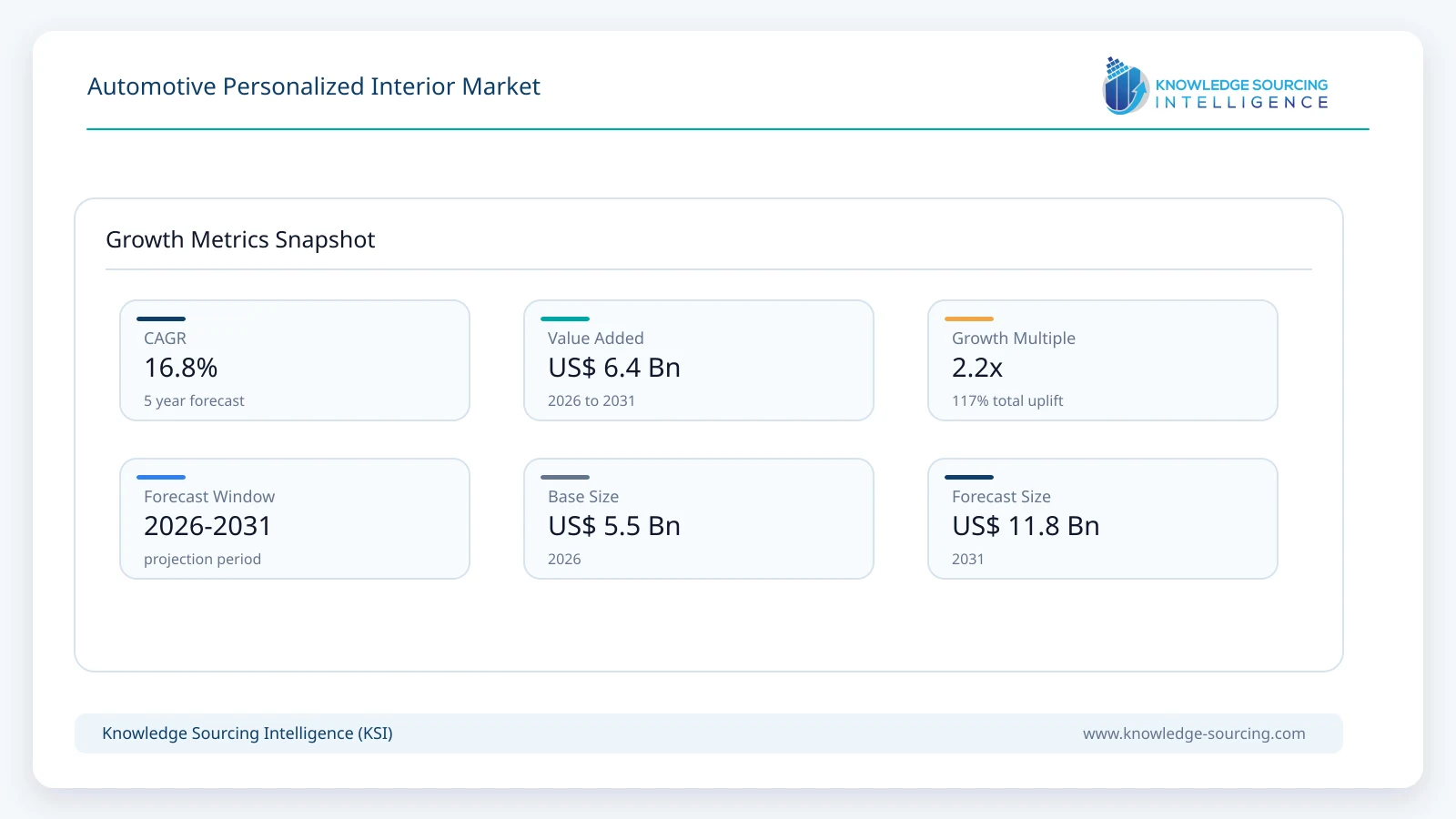
The Automotive Personalized Interior Market is expected to grow from USD 5.45 billion in 2026 to USD 11.85 billion by 2031, at an implied CAGR of 16.81% during forecast period.
Highlights:
- 1Comfort and seating personalization represents an estimated 22% of 2026 market value, encompassing qualifying bespoke seating finishes and user-specific seat and comfort settings.
- 2Interior trim and material personalization contributes approximately 25% of 2026 value, reflecting the realized premium from customized cabin surface packages.
- 3Infotainment and connectivity personalization accounts for approximately 22% in 2026 and is expected to gain share as user profiles and display themes become more accessible.
- 4Passenger vehicles generate an estimated 88% of 2026 market value, with high-content premium models and increasingly configurable mainstream vehicles supporting demand.
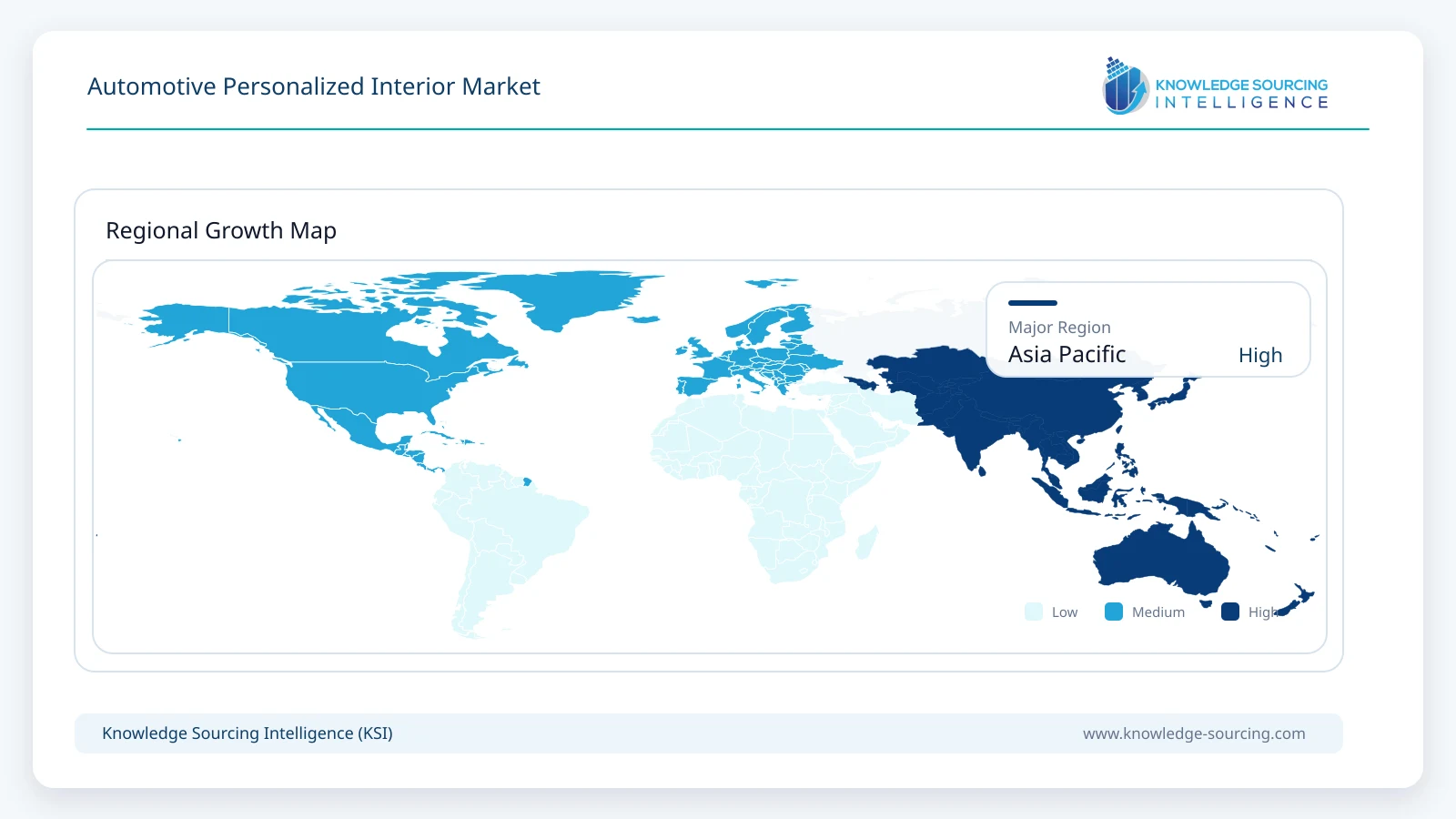
- 5Asia Pacific is estimated to account for 43% of global value in 2026, while Europe remains important for premium materials and bespoke specification programs.
- 6AI and adaptive personalization are projected to gain within the enabling-technology mix, although user profiles and fixed design packages remain important throughout the forecast period.
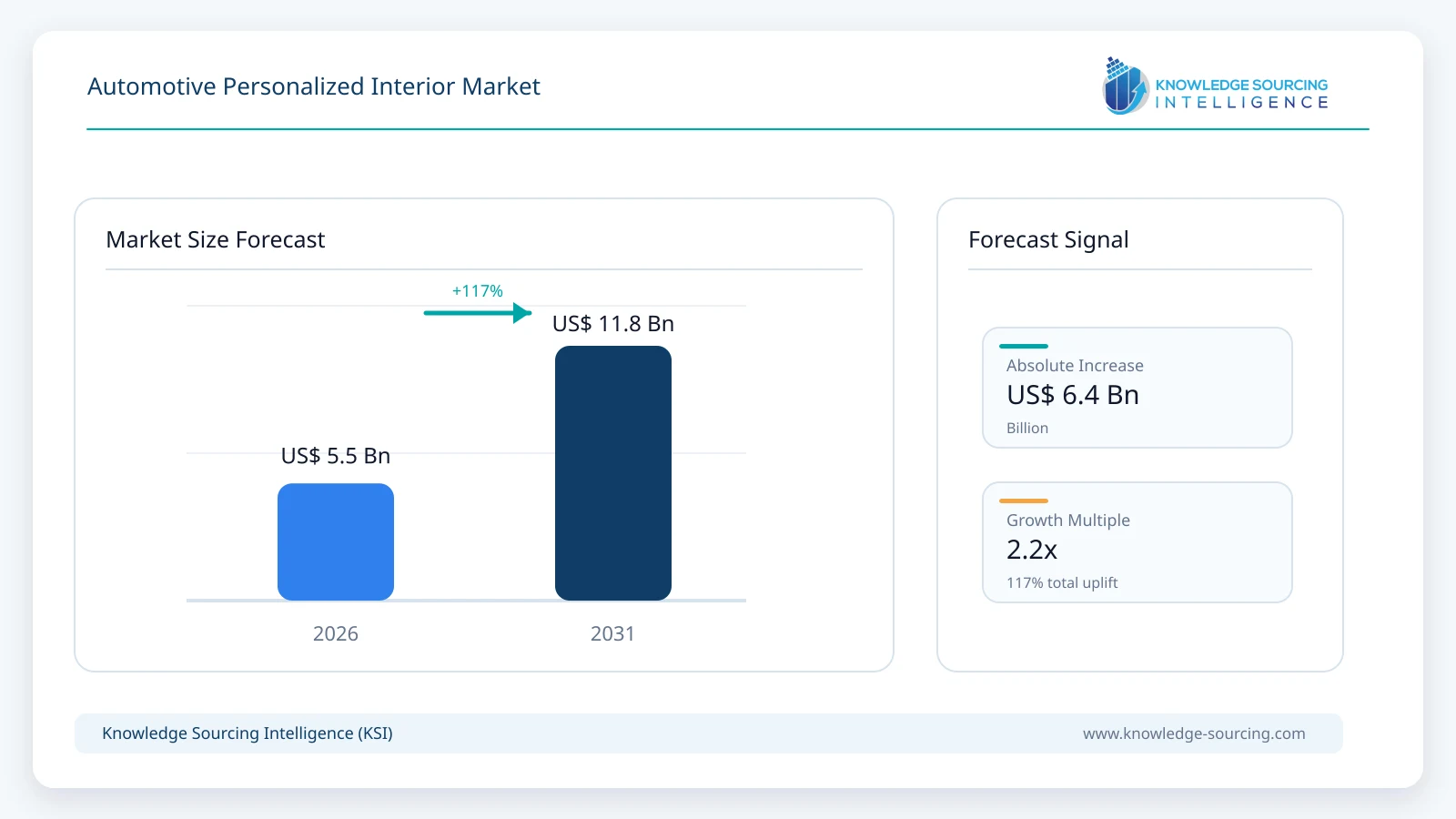
Revenue comprises the attributable premium or incremental supplier content associated with factory-selected cabin design and user-adjustable interior settings, including trim materials, seating and comfort features, lighting, audio, infotainment and personalized HMI functions. Higher electronic and software content per equipped vehicle, alongside broader availability of configurable cabins, is expected to account for most of the increase.
BMW's 7 Series and Porsche's Cayenne Electric illustrate how selectable cabin materials can be combined with configurable displays, lighting and occupant settings within a single vehicle program. Such combinations support both one-time production revenue from differentiated trim and recurring engineering demand for software-supported configuration. The broadening range of choices also increases manufacturing complexity, requiring vehicle manufacturers and suppliers to manage material variants, electronics and digital user identity across multiple equipment levels.
BMW Individual, Mercedes-Benz MANUFAKTUR and Porsche Exclusive Manufaktur offer factory-configured upholstery, stitching, decorative trim and cabin color combinations, making personalization part of vehicle specification before delivery. Material premiums and distinctive manufacturing operations support incremental content value for seats, door panels, instrument panels and other visible cabin elements. OEMs frequently rely on shared engineering and tooling platforms to control the cost of producing many aesthetic variants.
BMW Operating System X and comparable user-profile architectures allow driver and passenger settings to be recalled rather than re-entered on each trip. Saved seat positions, lighting scenes, display themes and media preferences can connect separate cabin subsystems to one occupant identity. Additional sensors and control software create demand for integration and testing even where much of the underlying seat, climate or infotainment hardware already exists.
Decorative trim variants and software-configurable cabin functions have different cost and revenue structures. Colored surfaces, stitching and material substitutions generally generate manufacturing and option-package revenue, whereas profile-based functions require controllers, software maintenance and secure data handling. Vehicle manufacturers must coordinate both streams without charging the complete price of a seat, display or HVAC system to personalization alone.
Market Trends
Factory-Customized Materials Are Being Integrated with Digital Themes
Porsche Cayenne Electric combines differentiated upholstery and decorative interior selections with a Themes application that changes the visual appearance of several cabin displays. BMW 7 Series likewise offers BMW Individual trim combinations alongside customizable interface colors, widgets and account-specific settings. Consistent color and design coordination between digital and physical surfaces gives automakers a stronger differentiation proposition than standalone upholstery or wallpaper choices. Interior suppliers must therefore align physical material programs with the evolving requirements of electronics and interface teams.
Multi-Occupant Profiles Are Extending Beyond the Driver
BMW's user-account features and HARMAN's Ready StreamShare illustrate the growing importance of independently managed preferences for drivers and other occupants. Passenger-zone audio, seat settings and content can be adjusted to suit several users within one shared vehicle without treating all passengers as a single account. Supporting independent profiles requires consistent identity management, permissions and interfaces between cockpit software and cabin controls, particularly in family and premium vehicles.
Adaptive Sensory Environments Are Developing in Higher-Value Vehicles
Lexus announced Sensory Concierge for the new NX in September 2026, with configurable cabin lighting and fragrance to shape the interior atmosphere. Yanfeng XiM27 demonstrates a broader approach combining seating, audio, climate and adaptive lighting within a scenario-driven cabin concept. The new NX announcement concerns a vehicle planned for introduction from late 2026, while XiM27 is a functional concept rather than evidence of confirmed full-scale production fitment. Different commercialization stages should remain visible when assessing the growth outlook for advanced personalized environments.
Automotive Personalized Interior Market Segment Analysis
By Personalization Type
Interior Trim and Material Personalization
Interior trim and material personalization accounts for approximately 25% of market value in 2026, reflecting the price premiums attached to upholstery, stitching, decorative surfaces and coordinated cabin design packages. Porsche Exclusive Manufaktur offers carefully matched leather, accent and interior-color treatments, while BMW Individual maintains multiple materials and color combinations. Supplier revenue comes from qualifying customization premiums and added production content, rather than the full standard cost of every fitted cabin panel. Relative share is expected to moderate as digital configuration and identity-linked services expand.
By Personalization Type
Infotainment and Connectivity Personalization
Infotainment and connectivity personalization represents approximately 22% of market value in 2026, supported by saved media preferences, user-specific display configurations, downloadable themes and linked content services. Porsche's Themes application illustrates how the visual appearance of digital surfaces can be changed without replacing the underlying display hardware, while HARMAN's individualized audio solutions extend user choice to listening zones. The segment gains share through 2031 as cockpit software platforms support more multi-user functions and post-production updates.
By Technology
AI and Adaptive Personalization
AI-based and context-responsive personalization remains less widely fitted than stored user settings and factory-selected cabin packages, but its share of enabling technology value is expected to rise. Yanfeng's XiM27 concept demonstrates how learned seating preferences, climate and lighting could be coordinated through a common interior controller, while Lexus's announced NX Sensory Concierge uses personalized lighting and fragrance to shape cabin ambience. Suppliers still face verification, data-permission and cost challenges before advanced features are deployed across high-volume vehicle programs.
By Vehicle Type
Passenger Vehicles
Passenger vehicles account for an estimated 88% of global market value in 2026 because passenger-car platforms support a substantially wider range of personalized design, comfort and entertainment functions than commercial vehicles. Premium sedans and SUVs lead in upholstery variants and seat-memory packages, while higher-volume models increasingly offer ambient lighting and configurable digital interfaces. Electric passenger vehicles provide important opportunities for cabin electronics, although battery-electric vehicles remain a propulsion category rather than a separate vehicle-type segment.
Market Drivers
Expansion of Factory-Configured Cabin Variants
BMW's expanded 7 Series cabin choices and Porsche's configurable Cayenne Electric interior illustrate how automakers can differentiate vehicles through finish, upholstery and digitally coordinated design packages. Interior suppliers can supply related parts using common structural tooling and variant-specific surface treatments, reducing the need for a completely new interior architecture for every option. Wider portfolios still require manufacturing discipline to manage quality, color consistency and order-specific procurement.
Growth of Linked Driver and Occupant Profiles
BMW Operating System X and other identity-linked cockpit architectures can preserve a driver's preferences across seating, displays and selected comfort functions. Profile persistence reduces repetitive manual adjustment and gives automakers a basis for extending convenience features into shared vehicles. The engineering challenge lies in reliably matching the correct occupant with the correct settings while maintaining privacy, permissions and fallback behavior when devices or cloud connections are unavailable.
Migration of Premium Features into Higher-Volume Vehicles
Configurable ambient lighting, display themes and saved personal settings increasingly appear outside the highest-priced vehicle classes as electronics platforms are reused across several model lines. Standardized controllers and shared software foundations reduce the marginal cost of offering additional user options, particularly where the underlying hardware is already fitted. Automakers still have to distinguish between valuable functional customization and purely cosmetic digital features whose pricing power may be weaker.
Integration of Personalized Sensory and Comfort Functions
Lexus's September 2026 NX announcement and HARMAN's personal audio technologies illustrate two paths toward occupant-specific comfort and sensory features. The Lexus Sensory Concierge concept links lighting and fragrance, while HARMAN's multi-zone audio approach addresses different listening preferences among occupants. Coordinating several cabin systems can expand component and software integration requirements, but the commercial case depends on customer demand and the extent of production fitment.
Software-Defined Interfaces and Update Capability
Porsche's Themes app and BMW's user-specific operating-system functions allow portions of the cockpit experience to be configured without physical changes to cabin hardware. Remote software delivery can broaden theme choices and improve interfaces after vehicle production, while the value of personalized functions increasingly depends on reliable software platforms. Suppliers must support compatibility across model-year hardware and security updates, making sustained software engineering an important part of the product lifecycle.
Market Restraints
Fragmented Configurations and Manufacturing Complexity
Broader ranges of upholstery, stitching, decorative treatments and electronic configuration choices increase the number of part variants that interior suppliers must produce and qualify. Material color matching, tooling changeovers, procurement and order synchronization become harder as optional specifications multiply. Vehicle manufacturers therefore need modular manufacturing and disciplined variant management to keep customization profitable.
Privacy, Consent and Profile Portability Requirements
Identity-linked cabin personalization may depend on account information, voice preferences, device pairing and, for more advanced features, occupant sensing. Such data require robust consent, privacy controls and protection against unauthorized profile access. Cross-border cloud services add operational and regulatory complexity for vehicle programs sold in several markets.
Cost and Fitment Constraints in Entry-Level Segments
Premium upholstery, illuminated surfaces, powered comfort functions and richer interfaces add direct material and engineering cost to vehicle specifications. Low-price segments generally prioritize safety, basic connectivity and total vehicle affordability, limiting the penetration of extensive customization packages. Suppliers must therefore offer scalable software functions and modular options rather than relying exclusively on high-cost components.
Cross-Domain Integration and Functional Reliability
Integrated user profiles must often communicate with seat controllers, climate equipment, lighting systems, displays and media platforms supplied by different vendors. Timing and safety constraints make coordination more complex than changing the appearance of one display. Hardware generations, failed profile retrieval, multiple occupants and incompatible third-party software can all affect system reliability and require substantial OEM validation.
Uncertain Monetization of Digital Customization
Automakers may bundle digital themes and saved profiles into standard vehicle features, sell broader experience packages at purchase or offer eligible upgrades afterward. Consumer willingness to pay for visual personalization may differ substantially from demand for convenient seat recall, temperature control and premium cabin materials. Uncertain recurring revenue can make supplier monetization harder to forecast even when software engagement rises.
Regional Outlook
Asia Pacific
Asia Pacific accounts for an estimated 43% of market value in 2026, supported by the region's high vehicle-manufacturing concentration and growing demand for connected, configurable passenger cabins. China combines substantial new-energy vehicle production with local suppliers developing interior electronics and differentiated trim systems, while Japan and South Korea retain strong component, seating and cockpit supply bases. India adds volume potential as connected infotainment and configurable ambient features extend across more vehicle price tiers.
Yanfeng's XiM27 program demonstrates the breadth of interior integration capabilities available in China, including adaptive seating, configurable cabin environments and coordinated electronics, although the unveiled vehicle is a production-ready concept rather than a confirmed series-program shipment. Toyota Boshoku and regional automotive suppliers contribute seating, surface materials and module engineering to vehicle manufacturers in Japan and neighboring markets. Larger production volumes will support personalization revenues only where qualifying options or control content are actually fitted and purchased.
Europe
BMW, Mercedes-Benz and Porsche support European demand through extensive customer-selected upholstery, decorative trim and interior color combinations, accompanied by user-configurable digital features. German premium-car production provides a substantial market for higher-value interior materials and seating systems, while broader vehicle programs adopt standardized profile and display functions. Supplier opportunities depend on balancing customer differentiation with shared architectures and cost control.
European cabin suppliers face intricate order configurations and strict quality requirements when manufacturing tailored leather, decorative surfaces, seat treatments and electronics for premium programs. Shared material specifications, digital build-order systems and modular interior assemblies can reduce waste and production disruption. Development costs remain substantial where customized components must satisfy safety, durability and recyclability requirements across several model lines.
Competitive Landscape
FORVIA, Yanfeng, Lear, Toyota Boshoku and Adient address different portions of the cabin personalization chain through seating, materials, cockpit modules and integrated interiors, while HARMAN and Visteon contribute software-enabled interface and audio functions. Established production relationships and qualification capabilities help large suppliers coordinate variant-heavy customer programs. Competition centers on design flexibility, reliable subsystem integration and the ability to manage multiple option configurations without excessive part proliferation.
Yanfeng's XiM27 brings AI-adaptive seating and coordinated interior modes together in one demonstrator, illustrating integrated supplier capabilities without establishing mass-production revenue for the complete concept. HARMAN specializes in occupant-specific audio and software-driven experiences, while Gentherm participates through thermal comfort technologies. Material and trim suppliers compete on surface quality, customization breadth, delivery performance and premium-program qualification.
Recent Developments
September 2026: Porsche widened Cayenne Electric interior personalization with the Extended Interior Style Package, including further upholstery and decorative-stitching choices; premium custom-trim content can grow independently of software features.
September 2026: Lexus announced the new NX with Sensory Concierge, coordinating interior lighting and fragrance; the development supports integrated sensory customization, while rollout is scheduled to begin from late 2026.
June 2026: Yanfeng unveiled XiM27, a functioning production-ready concept with AI-adaptive seats and individually managed cabin conditions; the platform illustrates supplier capability, not confirmed series-program revenue.
April 2026: BMW presented the updated 7 Series with BMW Individual Merino interior options and Operating System X identity-linked themes, demonstrating physical and digital customization in the same nameplate.
January 2026: HARMAN introduced personalized, software-driven in-car audio technologies and Ready StreamShare for individualized and shared listening; the announcement expands OEM-ready software functionality.
September 2025: Porsche detailed the Cayenne Electric with differentiated interior color packages, decorative materials and screen-theme choices, connecting build-time design options with user-adjustable digital appearance.
Market Outlook
Automotive personalized interiors are expected to expand through a combination of premium factory-selected cabin specifications and wider adoption of occupant-linked digital functions. Interior trim and seating retain substantial revenue importance, while infotainment preferences, HMI themes and sensor-assisted comfort take a larger role as common vehicle software platforms mature. Asia Pacific gains market share with higher production and electronics penetration, whereas European demand remains closely tied to premium design and material customization. Supplier success will depend on managing physical option complexity and software integration without duplicating the value of complete cabin systems.
Automotive Personalized Interior Market Scope:
| Report Metric | Details |
|---|---|
| Total Market Size in 2026 | USD 5.45 billion |
| Total Market Size in 2031 | USD 11.85 billion |
| Forecast Unit | USD Billion |
| Growth Rate | 16.81% |
| Study Period | 2021 to 2031 |
| Historical Data | 2021 to 2024 |
| Base Year | 2025 |
| Forecast Period | 2026 – 2031 |
| Segmentation | Personalization Type, Technology, Vehicle Type, Propulsion, Geography |
| Companies |
|
Market Segmentation
By Personalization Type
Comfort and Seating Personalization
Ambient Lighting Personalization
Infotainment and Connectivity Personalization
Climate-Control Personalization
Interior Trim and Material Personalization
Voice, Gesture and HMI Personalization
By Technology
Physical Specification and Decorative Customization
Sensor- and Rule-Based Personalization
Cloud-Connected Profile and Personalization Services
AI, Machine-Learning and Adaptive Personalization
By Vehicle Type
Passenger Vehicles
Light Commercial Vehicles
Medium and Heavy Commercial Vehicles
By Propulsion
Internal Combustion and Mild-Hybrid Vehicles
Hybrid and Plug-in Hybrid Vehicles
Battery Electric Vehicles
By Geography
North America
By Personalization Type
By Vehicle Type
By Technology
By Country
United States
Canada
Mexico
South America
By Personalization Type
By Vehicle Type
By Technology
By Country
Brazil
Argentina
Others
Europe
By Personalization Type
By Vehicle Type
By Technology
By Country
Germany
France
United Kingdom
Spain
Others
Middle East and Africa
By Personalization Type
By Vehicle Type
By Technology
By Country
Saudi Arabia
United Arab Emirates
Israel
Others
Asia Pacific
By Personalization Type
By Vehicle Type
By Technology
By Country
China
India
South Korea
Taiwan
Thailand
Indonesia
Japan
Others
Table of Contents
1. INTRODUCTION
1.1. Market Overview
1.2. Market Definition
1.3. Scope of the Study
1.4. Market Segmentation
1.5. Currency
1.6. Assumptions
1.7. Base and Forecast Years
1.8. Key Benefits to Stakeholders
2. RESEARCH METHODOLOGY
2.1. Research Design
2.2. Secondary Research
2.3. Primary Research
2.4. Market Estimation
2.5. Segment Modelling
2.6. Data Triangulation and Validation
3. EXECUTIVE SUMMARY
3.1. Key Findings
3.2. Automotive Personalized Interior Market Size, 2026–2031
3.3. Personalization Type Outlook
3.4. Technology Outlook
3.5. Vehicle Type Outlook
3.6. Regional Opportunity Summary
4. MARKET DYNAMICS
4.1. Market Drivers
4.1.1. Expansion of Factory-Configured Cabin Variants
4.1.2. Growth of Linked Driver and Occupant Profiles
4.1.3. Migration of Premium Features into Higher-Volume Vehicles
4.1.4. Integration of Personalized Sensory and Comfort Functions
4.1.5. Software-Defined Interfaces and Update Capability
4.2. Market Restraints
4.2.1. Fragmented Configurations and Manufacturing Complexity
4.2.2. Privacy, Consent and Profile Portability Requirements
4.2.3. Cost and Fitment Constraints in Entry-Level Segments
4.2.4. Cross-Domain Integration and Functional Reliability
4.2.5. Uncertain Monetization of Digital Customization
4.3. Market Opportunities
4.4. Porter’s Five Forces Analysis
4.5. Industry Value Chain Analysis
4.6. Policies and Regulations
4.7. Strategic Recommendations
5. TECHNOLOGY OUTLOOK
5.1. Factory Design and Configuration Systems
5.2. User Identity and Saved Preference Management
5.3. Sensor and Rule-Based Cabin Control
5.4. Connected Profile Synchronization
5.5. AI and Context-Aware Personalization
5.6. Cross-Domain Cabin Experience Integration
6. AUTOMOTIVE PERSONALIZED INTERIOR MARKET BY PERSONALIZATION TYPE
6.1. Introduction
6.2. Comfort and Seating Personalization
6.3. Ambient Lighting Personalization
6.4. Infotainment and Connectivity Personalization
6.5. Climate-Control Personalization
6.6. Interior Trim and Material Personalization
6.7. Voice, Gesture and HMI Personalization
7. AUTOMOTIVE PERSONALIZED INTERIOR MARKET BY TECHNOLOGY
7.1. Introduction
7.2. Physical Specification and Decorative Customization
7.3. Sensor- and Rule-Based Personalization
7.4. Cloud-Connected Profile and Personalization Services
7.5. AI, Machine-Learning and Adaptive Personalization
8. AUTOMOTIVE PERSONALIZED INTERIOR MARKET BY VEHICLE TYPE
8.1. Introduction
8.2. Passenger Vehicles
8.3. Light Commercial Vehicles
8.4. Medium and Heavy Commercial Vehicles
9. AUTOMOTIVE PERSONALIZED INTERIOR MARKET BY PROPULSION
9.1. Introduction
9.2. Internal Combustion and Mild-Hybrid Vehicles
9.3. Hybrid and Plug-in Hybrid Vehicles
9.4. Battery Electric Vehicles
10. AUTOMOTIVE PERSONALIZED INTERIOR MARKET BY GEOGRAPHY
10.1. North America
10.1.1. By Personalization Type
10.1.2. By Vehicle Type
10.1.3. By Technology
10.1.4. By Country
10.1.4.1. United States
10.1.4.2. Canada
10.1.4.3. Mexico
10.2. South America
10.2.1. By Personalization Type
10.2.2. By Vehicle Type
10.2.3. By Technology
10.2.4. By Country
10.2.4.1. Brazil
10.2.4.2. Argentina
10.2.4.3. Others
10.3. Europe
10.3.1. By Personalization Type
10.3.2. By Vehicle Type
10.3.3. By Technology
10.3.4. By Country
10.3.4.1. Germany
10.3.4.2. France
10.3.4.3. United Kingdom
10.3.4.4. Spain
10.3.4.5. Others
10.4. Middle East and Africa
10.4.1. By Personalization Type
10.4.2. By Vehicle Type
10.4.3. By Technology
10.4.4. By Country
10.4.4.1. Saudi Arabia
10.4.4.2. United Arab Emirates
10.4.4.3. Israel
10.4.4.4. Others
10.5. Asia Pacific
10.5.1. By Personalization Type
10.5.2. By Vehicle Type
10.5.3. By Technology
10.5.4. By Country
10.5.4.1. China
10.5.4.2. India
10.5.4.3. South Korea
10.5.4.4. Taiwan
10.5.4.5. Thailand
10.5.4.6. Indonesia
10.5.4.7. Japan
10.5.4.8. Others
11. COMPETITIVE ENVIRONMENT AND ANALYSIS
11.1. Major Players and Strategy Analysis
11.2. Market Share Analysis
11.3. Mergers, Acquisitions, Agreements and Collaborations
11.4. Competitive Dashboard
12. COMPANY PROFILES
12.1. Yanfeng Automotive Interiors
12.2. FORVIA
12.3. Lear Corporation
12.4. Toyota Boshoku Corporation
12.5. Adient plc
12.6. Antolin
12.7. DRÄXLMAIER Group
12.8. HARMAN International
12.9. Gentherm Incorporated
12.10. Visteon Corporation
12.11. Panasonic Automotive Systems
12.12. Novem Group
13. APPENDIX
13.1. Currency
13.2. Assumptions
13.3. Base and Forecast Years Timeline
13.4. Key Benefits to Stakeholders
13.5. Research Methodology
13.6. Abbreviations
Navigate
Trusted by the world's leading organizations











