
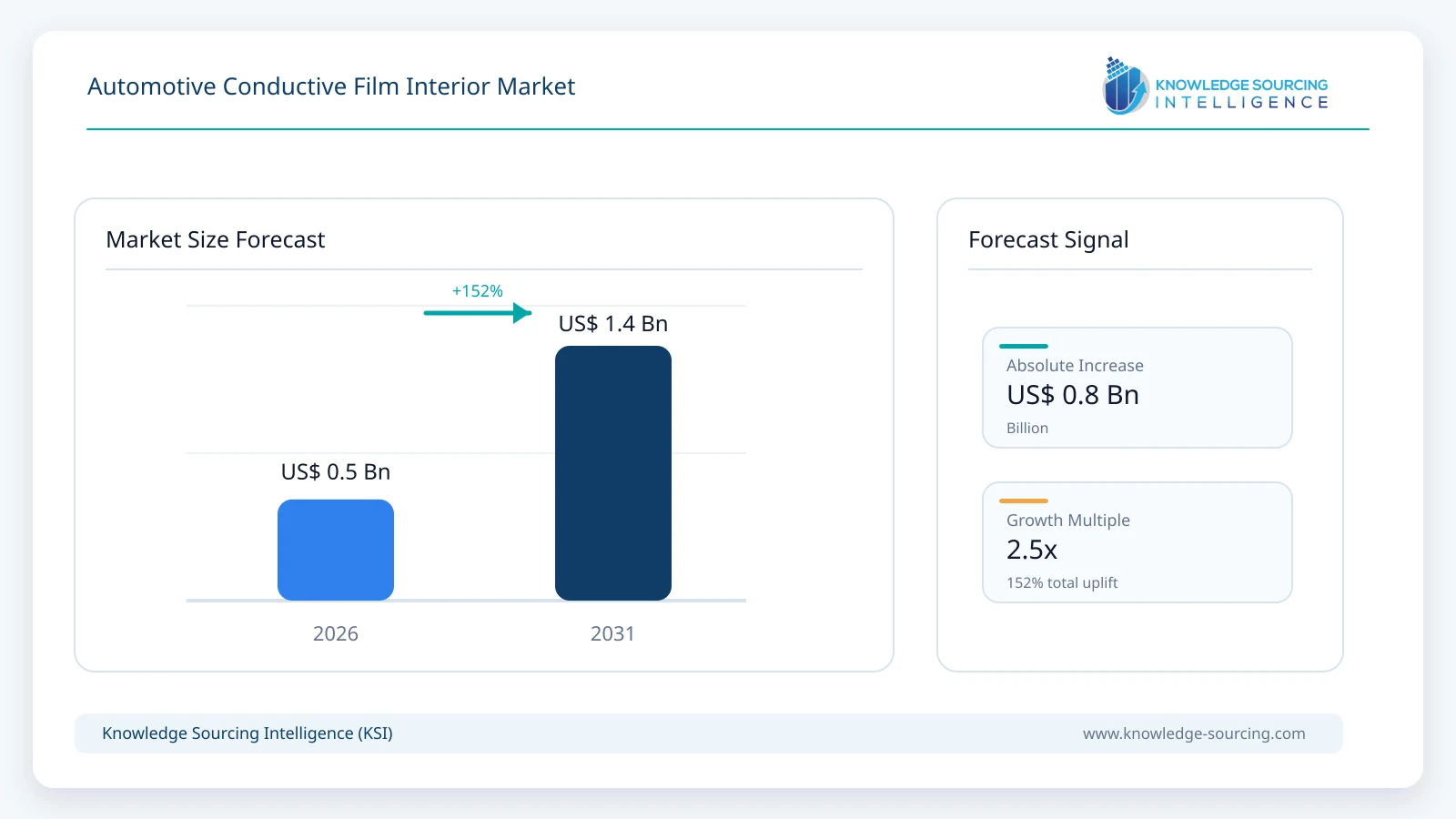
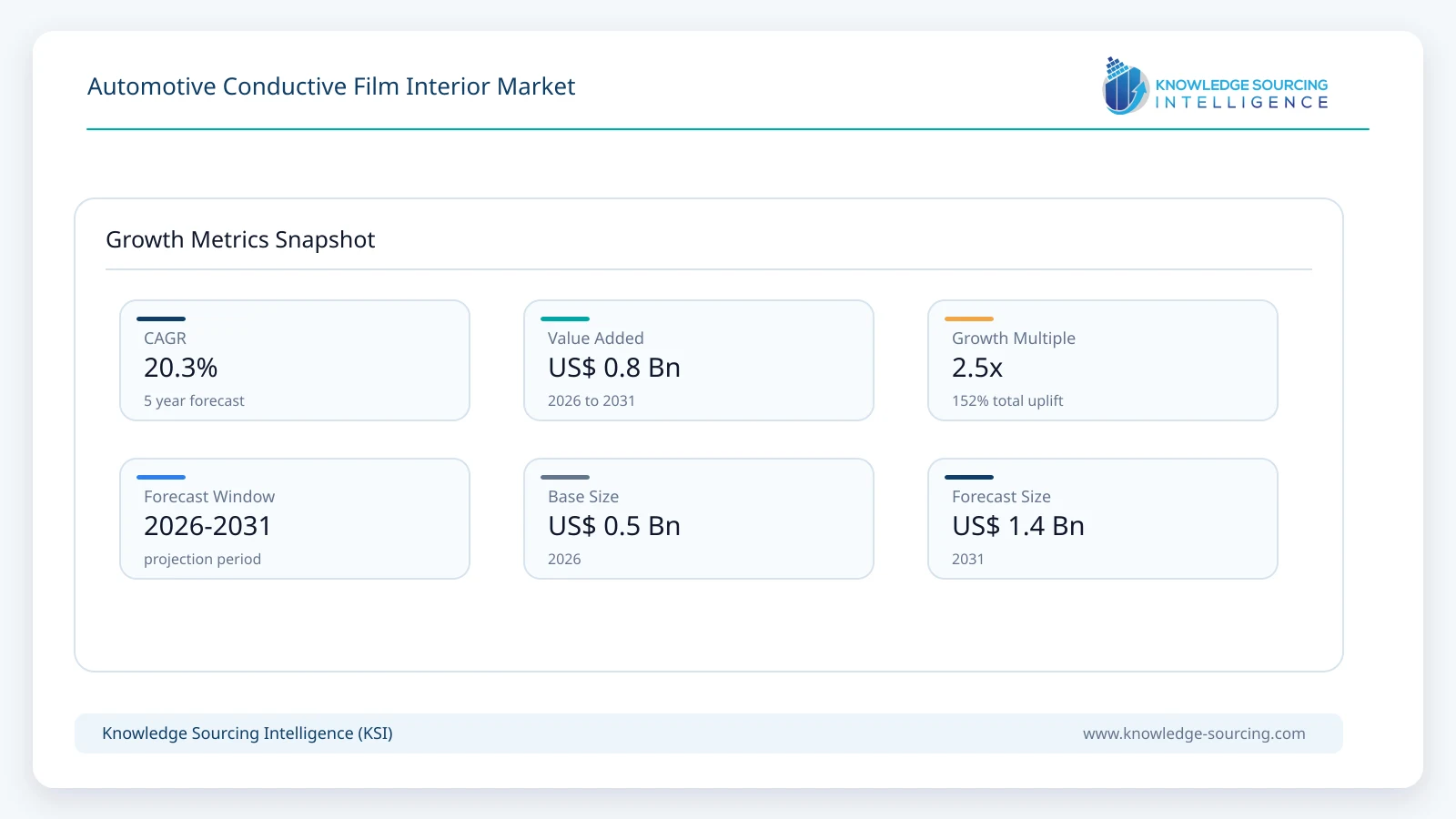
The automotive conductive film interior market is projected to expand at a CAGR of 20.3%, increasing from USD 0.54 billion in 2026 to USD 1.36 billion by 2031.
Highlights:
- 1The conductive film interior market is estimated at USD 0.540 billion in 2026 and forecast at USD 1.360 billion in 2031.
- 2Touch and force-sensing films account for approximately 47% of 2026 market value, supported by console, dashboard and door-surface controls.
- 3Printed metallic trace systems hold approximately 36% of the 2026 conductor mix, while CNT films are expected to increase their share through 2031.
- 4Patterned conductive sensor and circuit films represent approximately 49% of the 2026 market, reflecting film-level conversion requirements.
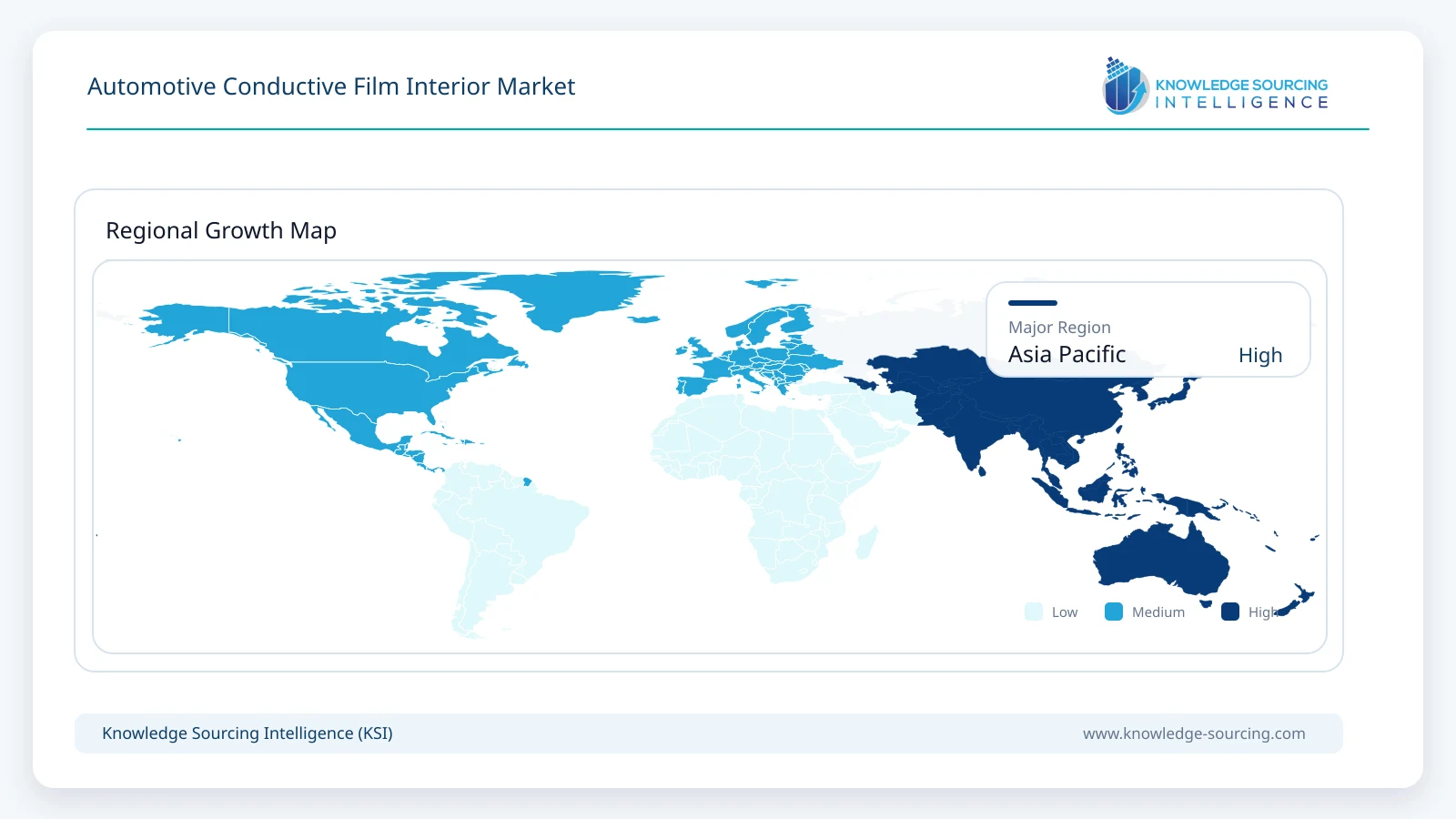
- 5Asia Pacific accounts for an estimated 48% of 2026 demand and is expected to rise to approximately 52% by 2031.
- 6Recent Valeo, Motherson, Symbiose and TK Group agreements strengthen the manufacturing ecosystem but differ in production maturity.
Revenue covers electrically functional film and directly attributable patterned-film conversion supplied for cabin touch control, electronic trim, localized heating and related surface applications. Electrically passive decorative films, complete finished door or cockpit panels, conventional display assemblies and exterior glass heaters are outside the market valuation.
Automotive film suppliers employ printed metal traces, transparent metal meshes, conductive oxides, carbon nanotubes and other conductor systems on polymer carriers. Curved dashboard and console surfaces require films that preserve electrical performance after forming, molding, thermal cycling and long service exposure. PolyIC markets transparent metal-mesh touch-sensor foils, Nissha supplies in-mold electronic integration, and DuPont offers silver-nanowire materials for transparent conductive applications.
Market Overview
Conductive film technology supplies electrical functionality to surfaces that are increasingly formed, textured and visually integrated into the cabin. A transparent or patterned conductive layer can register a touch input behind a decorative skin, distribute current to a local heater or carry connections to embedded light sources. Because the film follows the surface geometry, OEMs can reduce the need for separate mechanical switch housings in selected applications without eliminating the supporting electronics required for safe operation.
PolyIC's PolyTC metal-mesh sensor foils use conductive patterns on transparent PET carriers suited to illuminated controls. Nissha combines film decoration and molding with integrated touch, force and other electronic functions, while Henkel develops printable conductive and dielectric materials compatible with thermoformed structures. DuPont's silver-nanowire and transparent conducting materials offer another route where film clarity and flexibility matter to surface design. These product platforms compete on optical appearance, durability, process yields and circuit reliability rather than conductivity alone.
Market Trends
Printed Electronics and In-Mold Integration Are Replacing Separate Circuit Subassemblies
TactoTek's in-mold structural electronics process incorporates printed circuits and selected components into a formed polymer structure, allowing functions that formerly occupied separate housings or cable-connected substrates to move closer to the visible surface. Valeo's January 2026 premium-OEM program award shows that a Tier 1 supplier is investing in automated manufacturing for integrated lighting and electronics rather than relying only on concept demonstrations. The corresponding conductive film demand arises upstream, during material printing, circuit patterning and conversion before final molding.
Automotive conductive film manufacturers must align printing chemistry with substrate forming temperature, adhesion and component attachment. TactoTek's February 2026 manufacturing agreement with Symbiose and May 2026 licensing agreement with Motherson broaden the firms able to execute that production sequence. The expansion is commercially relevant because repeated qualification of an IMSE-compatible process can lower the engineering burden for later cabin programs, even though production transfer and serial launch remain OEM-program dependent.
Transparent Conductors Are Supporting Hidden and Backlit Controls
PolyIC positions metal-mesh sensor foils for backlit automotive touch interfaces where high visible transparency and reliable sensing must coexist. Metal mesh and silver-nanowire films offer alternative conductor architectures to conventional oxide coatings, particularly where a curved surface or flexible construction imposes mechanical strain. Surface optical quality matters because conductive patterns must not create visible artifacts or impair decorative finishes under direct sunlight and night-time illumination.
DuPont's silver-nanowire mobility portfolio and Canatu's carbon-nanotube touch materials demonstrate the range of transparent-conductor choices available to designers. These materials are not interchangeable: optical haze, sheet resistance, cost, pattern resolution and bending tolerance vary across processes. Higher-value adoption is most likely in trim areas where hiding the user interface or preserving a continuous decorative finish creates a tangible design benefit.
Functional Foil Suppliers Are Expanding Regional Manufacturing Routes
TactoTek's July 2025 agreement with TK Group established an automotive-grade electrically functional film supply-chain route in China. The subsequent 2026 licensing and manufacturing partnerships in North America and Europe show that supplier localization matters as much as a single materials breakthrough. Film printing, thermal forming and injection molding often require closely coupled process control, so local automotive-grade capacity can shorten qualification loops and reduce freight exposure for sensitive converted inserts.
Asia Pacific combines high vehicle production with a growing set of electronics and molded-surface suppliers. OICA reported approximately 59.2 million vehicles produced in the region during 2025, giving manufacturers a significant potential program base. Film supplier revenue will nevertheless be driven by the share of vehicles using qualified electronic surfaces and the complexity of the conductor layers, not by regional vehicle assembly volumes alone.
Segment Analysis
By Conductor Platform: Printed Metallic Trace Films
Printed metallic traces account for an estimated 36% of conductive interior film revenue in 2026, reflecting established use of silver and other conductive inks for sensor electrodes, circuit interconnects and embedded functional layers. Henkel's printable conductive ink portfolio illustrates the process ecosystem supporting formed electronic films, while TactoTek's IMSE production chain uses patterned circuitry integrated into molded components. The technology benefits from established screen-printing and conversion techniques that can be adapted to varied cabin geometries.
The category remains important through 2031 but cedes some share to transparent conductor and nanotube constructions as surface designs become optically demanding. Material loading, conductor width and print registration are recurring cost and yield considerations. Where the conductor is concealed beneath trim, printed traces can remain cost-effective without meeting the transparency required for a visible control zone.
By Film Product: Touch and Force-Sensing Films
Touch and force-sensing conductive films constitute the largest product group, modeled at 47% of the global market in 2026. Demand concentrates in door switches, center-console controls and decorative panel interfaces where a patterned electrode layer can replace a discrete touch-sensor module. PolyIC supplies automotive sensor foils, and Nissha integrates sensing functions into three-dimensional film-molded components. The most valuable uses combine tactile or lighting feedback with a surface that must retain a continuous design finish.
The group is expected to remain the largest through 2031 even as conductive circuits for integrated lighting and heaters expand faster. Force sensing often requires additional sensor architecture beyond a simple capacitive electrode, so film supply value depends on how much of that architecture is printed or integrated on the film. The forecast does not treat an entire completed haptic control panel as film revenue.
By Supply Configuration: Patterned Film Circuits
Patterned film circuits make up approximately 49% of conductive film interior value in 2026 because automotive buyers frequently require predefined electrodes, traces and connector features rather than generic material rolls. Film conversion creates measurable value through printing precision, registration, electrical testing and trace continuity. PolyIC's metal-mesh foils and the electrically functional film supply arrangements in TactoTek's ecosystem illustrate why conversion capabilities can be commercially distinct from upstream polymer film manufacturing.
By 2031 the strongest mix gain is expected in thermoformed and IMSE-ready inserts as OEM programs shift further functions into three-dimensional trim. These parts demand additional forming and insert-process control, but film-layer revenue should still be measured before the finished injection-molded assembly is sold. Tier 1 suppliers increasingly qualify integrated structures, while specialist film converters can remain suppliers to several competing Tier 1 programs.
Market Drivers
Expansion of Seamless Touch Controls in Cabin Trim
OEM interior programs increasingly use low-profile touch zones instead of separate mechanical-button assemblies for selected secondary cabin functions. Transparent metal-mesh foils and patterned film electrodes allow those controls to sit beneath decorative or backlit surfaces. PolyIC's automotive sensor foil portfolio provides an established example of this supply route, while Nissha's in-mold electronics capabilities extend the concept to curved components.
Higher functional density can increase the amount of electrically active film installed in each qualifying vehicle, particularly in door panels and center consoles. Adoption is constrained by usability requirements, so mechanical buttons will remain important for some frequently operated functions. The forecast therefore assumes selective substitution rather than the disappearance of physical controls.
Industrialization of In-Mold Electronic Manufacturing
Valeo's January 2026 awarded interior program and TactoTek's manufacturing partnerships demonstrate growing interest in integrating electrical circuits into molded surface structures. The main demand mechanism is additional film printing and conversion before an in-mold assembly is completed. Motherson's licensing agreement adds Tier 1 program execution capacity, while Symbiose offers specialist functional-foil manufacturing experience.
Automotive programs adopting a common process platform can support repeat orders for printed films, tooling services and quality-controlled inserts. Commercial scale depends on qualification and serial production timing rather than the date of a license announcement. Suppliers with repeatable patterning and molding-compatible materials are consequently better placed to grow with OEM platform awards.
Increasing Value of Transparent and Flexible Conductors
Transparent conductive systems from DuPont, PolyIC and Canatu address surfaces where the circuit must remain optically unobtrusive or accommodate tight bending geometries. Metal mesh, nanowire and carbon-nanotube networks present alternatives to rigid or brittle conductor layouts in selected uses. The design benefit is strongest when the visible finish, lighting and electronic controls are integrated in the same passenger touchpoint.
More demanding optical and mechanical specifications can support higher material value even when individual film areas are modest. These alternatives also introduce cost, uniformity and qualification tradeoffs, so the supplier mix is expected to evolve gradually instead of switching wholesale to one conductor chemistry.
Growing Functional Content in Electric and Premium Vehicles
Battery-electric and upper-trim vehicle programs frequently provide multiple cabin interaction zones and differentiated lighting or comfort features. Conductive films serve as enabling layers for those systems, including touch electrodes and localized low-profile heating elements. The film demand contribution comes from the number and value of qualifying surfaces installed, rather than propulsion architecture itself requiring a conductive film.
As advanced cabin functions diffuse across vehicle classes, mid-range platforms can contribute increasing volumes while premium models continue to carry more complex film content. Regionally, China, Japan and South Korea provide substantial vehicle-electronics manufacturing capabilities, supporting local material qualification and conversion.
Expansion of Film Conversion and Automotive Supply Chains
TactoTek's 2025 TK Group agreement and 2026 partnerships with Symbiose and Motherson show suppliers investing in local production routes for film-based electronic structures. Those relationships are commercially important because automotive film conversion requires print repeatability, thermoforming knowledge and quality systems compatible with final part assembly. A design validated in one factory is not automatically transferable without process qualification.
Additional qualified converters can improve OEM sourcing flexibility and reduce dependence on a small number of specialist plants. Competitive pricing may narrow margins over time, but broader manufacturing access expands the practical number of vehicle programs that can use film-based controls.
Market Restraints
Trace Reliability after Thermoforming and Molding
Conductive films must preserve stable resistance across bends, local thickness changes, adhesive interfaces and injection-molding temperatures. Microscopic trace cracking or connector misalignment can lead to intermittent user-interface failures that are difficult to correct after the trim assembly has been molded. Standard electrical tests on flat films therefore do not fully establish performance in a finished three-dimensional automotive part.
Tighter process windows increase manufacturing qualification time and reject risk, especially for fine-pitch metal traces and transparent conductors. Suppliers with limited automotive molding experience may face repeated validation cycles before qualifying a production insert.
Sensitivity to Film Yield, Materials Cost and Patterning Complexity
Silver-based conductive inks, specialized optical coatings and precision patterning can raise film conversion costs above those of simpler molded trim constructions. Surface curvature, print resolution and electrical test requirements influence material waste and usable yield. A film that performs well in laboratory conditions may require additional protective layers or redesigned traces before reaching acceptable automotive production scrap rates.
OEM purchasing pressure is particularly strong when electronic features migrate from premium vehicles into higher-volume trims. Suppliers must reduce conductor loading and cycle time while preserving durability. The economics can favor conventional flexible printed circuits or discrete sensor components in simple, low-area applications.
Human-Factors Limits on Hidden Controls
Touch-sensitive decorative surfaces can demand greater visual attention than tactile mechanical controls when drivers operate frequently used functions. OEMs are therefore cautious about replacing high-priority physical inputs with unmarked or deeply menu-based interfaces. Conductive film integration offers appearance flexibility, but it cannot on its own provide the feedback, discoverability or fail-safe behavior required for every cabin control.
Some interior programs combine film touch sensing with separate haptic or physical elements, increasing system complexity and total qualification cost. The most predictable adoption occurs in secondary controls and interfaces where placement, illumination and tactile confirmation have been carefully engineered.
Qualification Time and Vehicle-Platform Design Lock-In
Automotive interior suppliers must complete environmental, electrical, durability and appearance validation before a film design can enter series production. Printed conductive networks may be sensitive to cleaning chemicals, abrasion, humidity ingress and thermal cycling, while connector locations must be compatible with downstream assembly processes. Changes late in a vehicle program can require a fresh film pattern and new tooling.
Automotive film qualification and vehicle-platform approval can delay meaningful supplier revenue recognition well beyond initial partnership announcements. Suppliers that win an initial program may benefit from longer platform life, but development expenditure and capacity readiness precede the purchase volumes associated with vehicle launches.
Concentrated Technical Know-How and IP Dependencies
Advanced film structures often depend on licensed conductor designs, proprietary printing processes, specialized inks or integration know-how. TactoTek's IMSE ecosystem illustrates how intellectual property and manufacturing partnerships can be valuable while also creating process and royalty dependencies for participating manufacturers. Qualification files may be difficult to transfer when an OEM changes the material or converting route.
The supply base can therefore be narrower than the number of general-purpose decorative film companies suggests. Customers may require dual-sourcing and long-term technical support, imposing additional cost on emerging film converters and limiting rapid adoption of unproven alternatives.
Regional Outlook
Asia Pacific
Asia Pacific is estimated to represent 48% of conductive film interior market value in 2026, reflecting the concentration of automotive production and electronics-conversion capacity in China, Japan and South Korea. OICA recorded approximately 59.2 million vehicles produced in Asia-Pacific during 2025, and leading material and sensor-film suppliers operate within regional electronics supply chains. Nissha's Japanese automotive film capabilities and TK Group's Chinese IMSE film-supply arrangements illustrate the regional production infrastructure supporting this market.
Asia Pacific's share is projected to rise to 52% by 2031 as automotive electronic-surface content grows alongside localized manufacturing and a broader range of qualified films. China is expected to deliver substantial incremental program volume, while Japanese and Korean suppliers remain important in sensor and specialty materials technology. The regional outlook depends on OEM adoption and product mix, not only the total number of vehicles assembled.
Europe
European vehicle-interior development combines demanding appearance requirements with an established ecosystem of printed electronics, polymer films and mechatronics suppliers. PolyIC and Henkel supply conductor and printing technologies, while TactoTek and Symbiose provide process IP and industrial conversion capabilities. These suppliers address applications where automotive styling teams want hidden controls and illuminated surfaces without compromising the surface quality of decorative trim.
Europe is projected to retain a material market position through 2031 even as Asia Pacific gains share. OEM platform qualification, product reliability and film-to-mold process integration create opportunities for specialist European converters, but higher production costs and long approval cycles can restrain faster unit growth. The competitive advantage is most durable where supplier expertise lowers quality risk or supports designs that are difficult to manufacture using conventional electronics.
Competitive Landscape
The conductive film interior market spans conductor-material manufacturers, film patterning specialists, industrial converters and the suppliers that integrate films into molded cabin systems. PolyIC competes through transparent metal-mesh sensor foils, DuPont through advanced conductive materials including silver-nanowire systems, and Canatu through carbon-nanotube films. Henkel supplies functional ink chemistry, while Covestro provides polymer film platforms compatible with printed electronics. These positions should not be equated with equal shares of completed automotive interior assemblies.
Nissha combines film decoration, in-mold electronic sensing and molded component manufacturing for automotive cabin touchpoints. TactoTek licenses an IMSE technology platform to multiple industrial partners, including Motherson and Symbiose, allowing differentiated manufacturing routes for patterned functional foils. Valeo's awarded IMSE-based interior lighting program highlights demand from an established Tier 1 supplier, but its complete lighting assemblies are downstream of the film-level market measured here.
Recent Developments
15 September 2026: TactoTek and EDAG. TactoTek licensed IMSE technology to EDAG to support engineering and industrialization of smart surfaces. This expands implementation support but does not constitute a newly disclosed interior-film production volume.
21 May 2026: TactoTek and Motherson. Motherson obtained an IMSE technology license, expanding the potential production route for electronically functional molded automotive surfaces and their printed-film inserts.
25 February 2026: TactoTek and Symbiose. The companies signed a manufacturing partner agreement that brings printed electronics, flexible circuitry and functional-foil capability into the IMSE supply ecosystem.
2 February 2026: TactoTek and Global Technology Ventures. The companies announced a North American licensing partnership to incorporate IMSE into customer programs, adding an engineering and low-volume production route.
20 January 2026: Valeo and TactoTek. Valeo disclosed a major premium-automaker interior program award involving high-volume IMSE manufacturing, an industrial procurement milestone rather than evidence of all shipments already completed.
10 July 2025: TactoTek and TK Group. TK Group joined the IMSE ecosystem as a licensee, establishing a China-based automotive-grade electrically functional film supply route.
Market Outlook
Conductive interior film demand is forecast to advance as more touch, lighting and low-profile electronic functions are incorporated directly into cabin surfaces. Printed metallic traces should retain a broad installed base because of their practical processing economics, while transparent conductive meshes and nanotube films gain attention for optically demanding controls. The fastest commercial adoption will occur where a qualified film eliminates a separate sensor or wiring subassembly without compromising reliability.
Automotive-grade manufacturing capacity is becoming more distributed as TactoTek's licensees and partners invest in localized conversion and in-mold production. Industrialization can improve the availability of patterned films for larger OEM programs, although newly announced partnerships cannot be treated as completed vehicle installations. Supplier pricing and production yield remain as important as the number of announced design wins.
Automotive Conductive Film Interior Market Scope
| Report Metric | Details |
|---|---|
| Total Market Size in 2026 | USD 0.54 billion |
| Total Market Size in 2031 | USD 1.36 billion |
| Forecast Unit | Billion |
| Growth Rate | 20.3% |
| Study Period | 2021 to 2031 |
| Historical Data | 2021 to 2024 |
| Base Year | 2025 |
| Forecast Period | 2026 – 2031 |
| Segmentation | Conductor Platform, Film Product, Supply Configuration, Cabin Zone, Vehicle Type, Propulsion, Geography |
| Companies |
|
Market Segmentation
By Conductor Platform
Printed Metallic Traces and Circuits
Transparent Metal-Mesh Films
Carbon Nanotube Films
Transparent Conductive Oxides
Other Conductive Polymer and Carbon Films
By Film Product
Touch and Force-Sensing Films
Integrated Lighting and Circuit Films
Interior Heating Films
EMI and Antenna Films
Other Functional Conductive Films
By Supply Configuration
Unpatterned Functional Film Rolls and Sheets
Patterned Conductive Sensor and Circuit Films
Thermoformed and IMSE-Ready Film Inserts
By Cabin Zone
Center Console
Instrument Panel and Dashboard
Door Panels
Headliner and Pillars
Seating and Other Interior Zones
By Vehicle Type
Passenger Cars
Light Commercial Vehicles
Medium and Heavy Commercial Vehicles
By Propulsion
Internal Combustion Engine
Hybrid Electric Vehicle
Plug-in Hybrid Electric Vehicle
Battery Electric Vehicle
By Geography
North America
United States
Canada
Mexico
South America
Brazil
Argentina
Others
Europe
Germany
France
United Kingdom
Italy
Spain
Others
Middle East and Africa
Saudi Arabia
UAE
South Africa
Others
Asia Pacific
China
India
Japan
South Korea
Indonesia
Thailand
Others
Table of Contents
1. EXECUTIVE SUMMARY
1.1. Key Findings
1.2. Market Size and Forecast, 2026-2031
1.3. Conductive Film Technology Outlook
1.4. Application and Regional Outlook
2. MARKET SNAPSHOT
2.1. Market Overview
2.2. Market Definition
2.3. Scope of the Study
2.4. Market Segmentation
3. BUSINESS LANDSCAPE
3.1. Market Drivers
3.1.1. Expansion of Seamless Touch Controls in Cabin Trim
3.1.2. Industrialization of In-Mold Electronic Manufacturing
3.1.3. Increasing Value of Transparent and Flexible Conductors
3.1.4. Growing Functional Content in Electric and Premium Vehicles
3.1.5. Expansion of Film Conversion and Automotive Supply Chains
3.2. Market Restraints
3.2.1. Trace Reliability after Thermoforming and Molding
3.2.2. Sensitivity to Film Yield, Materials Cost and Patterning Complexity
3.2.3. Human-Factors Limits on Hidden Controls
3.2.4. Qualification Time and Vehicle-Platform Design Lock-In
3.2.5. Concentrated Technical Know-How and IP Dependencies
3.3. Market Opportunities
3.4. Porter’s Five Forces Analysis
3.5. Industry Value Chain Analysis
3.6. Policies and Regulations
3.7. Strategic Recommendations
4. TECHNOLOGICAL OUTLOOK
4.1. Printed Conductive Ink and Metallic Trace Technology
4.2. Transparent Metal-Mesh Sensor Films
4.3. Silver-Nanowire and CNT Conductive Film Systems
4.4. In-Mold Electronics and Thermoformed Circuit Films
4.5. Polymer Substrate, Lamination and Surface Protection
4.6. Conductor Patterning, Electrical Testing and Reliability
5. AUTOMOTIVE CONDUCTIVE FILM INTERIOR MARKET BY CONDUCTOR PLATFORM
5.1. Introduction
5.2. Printed Metallic Traces and Circuits
5.3. Transparent Metal-Mesh Films
5.4. Carbon Nanotube Films
5.5. Transparent Conductive Oxides
5.6. Other Conductive Polymer and Carbon Films
6. AUTOMOTIVE CONDUCTIVE FILM INTERIOR MARKET BY FILM PRODUCT
6.1. Introduction
6.2. Touch and Force-Sensing Films
6.3. Integrated Lighting and Circuit Films
6.4. Interior Heating Films
6.5. EMI and Antenna Films
6.6. Other Functional Conductive Films
7. AUTOMOTIVE CONDUCTIVE FILM INTERIOR MARKET BY SUPPLY CONFIGURATION
7.1. Introduction
7.2. Unpatterned Functional Film Rolls and Sheets
7.3. Patterned Conductive Sensor and Circuit Films
7.4. Thermoformed and IMSE-Ready Film Inserts
8. AUTOMOTIVE CONDUCTIVE FILM INTERIOR MARKET BY CABIN ZONE
8.1. Introduction
8.2. Center Console
8.3. Instrument Panel and Dashboard
8.4. Door Panels
8.5. Headliner and Pillars
8.6. Seating and Other Interior Zones
9. AUTOMOTIVE CONDUCTIVE FILM INTERIOR MARKET BY VEHICLE TYPE
9.1. Introduction
9.2. Passenger Cars
9.3. Light Commercial Vehicles
9.4. Medium and Heavy Commercial Vehicles
10. AUTOMOTIVE CONDUCTIVE FILM INTERIOR MARKET BY PROPULSION
10.1. Introduction
10.2. Internal Combustion Engine
10.3. Hybrid Electric Vehicle
10.4. Plug-in Hybrid Electric Vehicle
10.5. Battery Electric Vehicle
11. AUTOMOTIVE CONDUCTIVE FILM INTERIOR MARKET BY GEOGRAPHY
11.1. North America
11.1.1. United States
11.1.2. Canada
11.1.3. Mexico
11.2. South America
11.2.1. Brazil
11.2.2. Argentina
11.2.3. Others
11.3. Europe
11.3.1. Germany
11.3.2. France
11.3.3. United Kingdom
11.3.4. Italy
11.3.5. Spain
11.3.6. Others
11.4. Middle East and Africa
11.4.1. Saudi Arabia
11.4.2. UAE
11.4.3. South Africa
11.4.4. Others
11.5. Asia Pacific
11.5.1. China
11.5.2. India
11.5.3. Japan
11.5.4. South Korea
11.5.5. Indonesia
11.5.6. Thailand
11.5.7. Others
12. COMPETITIVE ENVIRONMENT AND ANALYSIS
12.1. Major Players and Strategy Analysis
12.2. Market Share Analysis
12.3. Mergers, Acquisitions, Agreements and Collaborations
12.4. Competitive Dashboard
13. COMPANY PROFILES
13.1. PolyIC GmbH & Co. KG
13.2. Nissha Co., Ltd.
13.3. DuPont de Nemours, Inc.
13.4. Canatu Plc
13.5. Henkel AG & Co. KGaA
13.6. Covestro AG
13.7. TactoTek Oy
13.8. Symbiose SAS
13.9. TK Group (Holdings) Limited
13.10. Samvardhana Motherson International Limited
13.11. Valeo SE
14. APPENDIX
14.1. Currency
14.2. Assumptions
14.3. Base and Forecast Years
14.4. Key Benefits for Stakeholders
14.5. Research Methodology
14.6. Abbreviations
Navigate
Trusted by the world's leading organizations











