
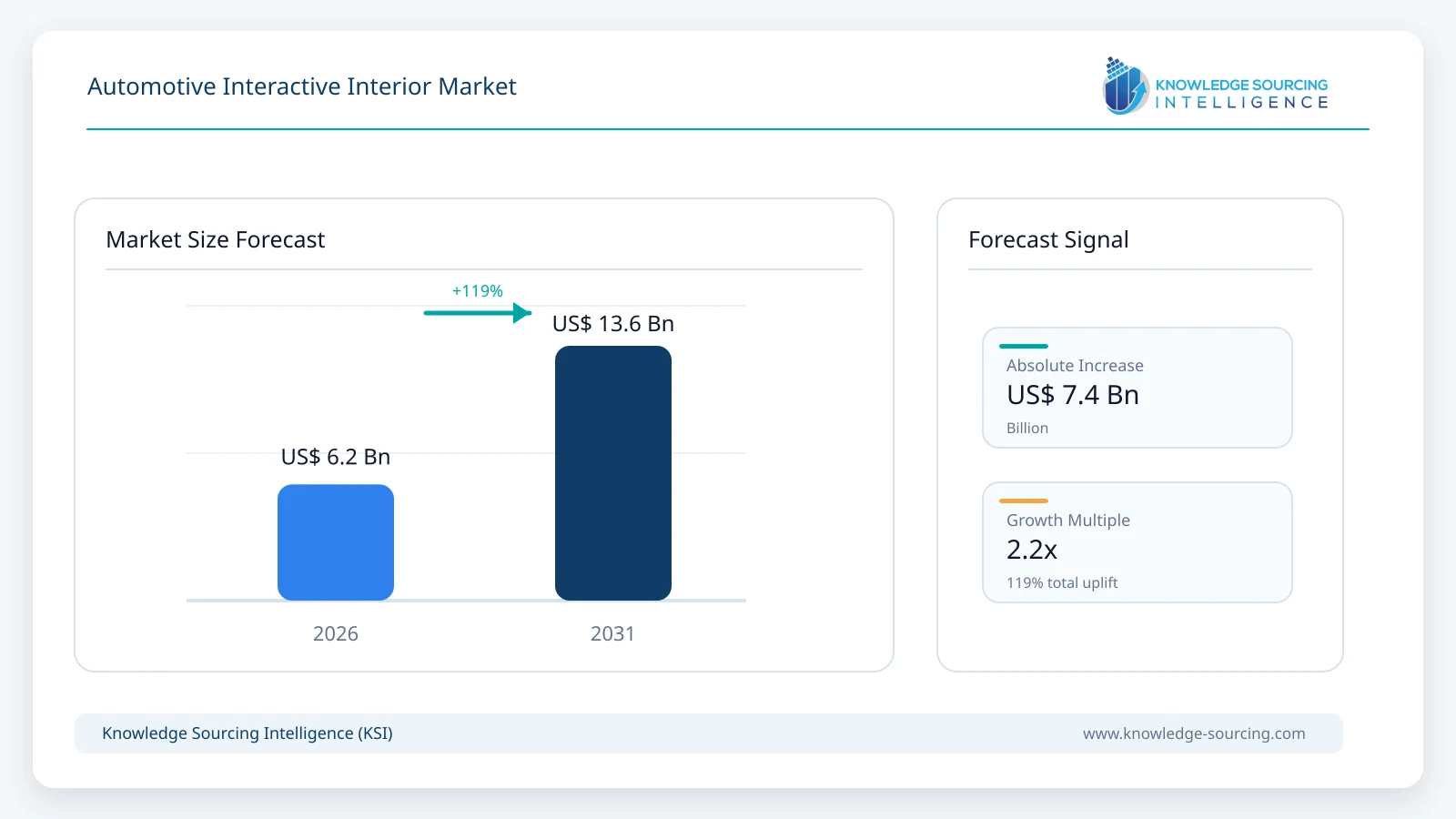
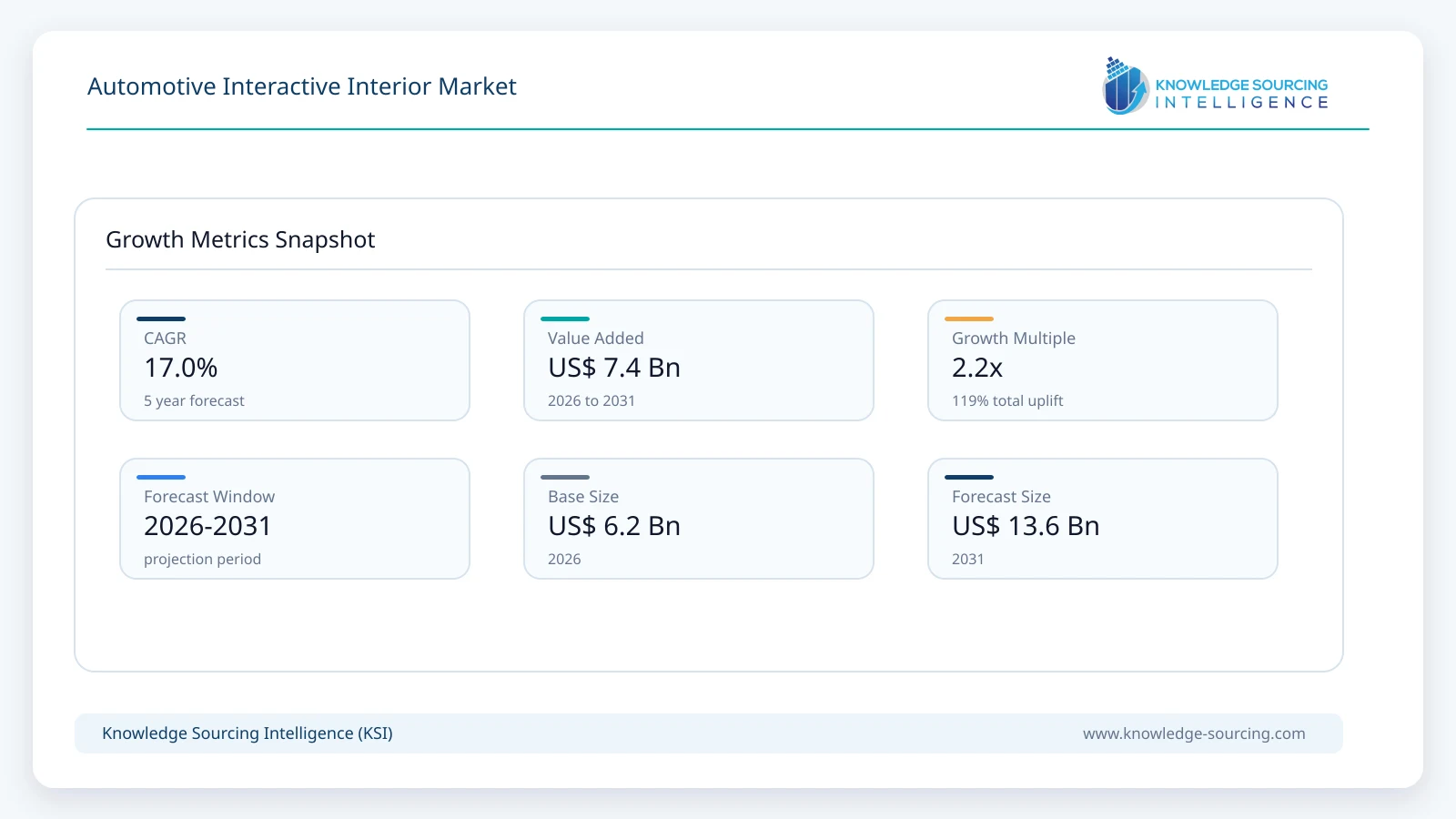
The automotive interactive interior market is projected to grow from USD 6.20 billion in 2026 to USD 13.60 billion by 2031, at a CAGR of 17.0% during forecast period.
Highlights:
- 1Touch and force-sensing smart surfaces account for an estimated 35% of 2026 market value, reflecting installed interaction electronics across consoles, fascia and decorative trim.
- 2Center-stack and center-console interfaces represent approximately 37% of market value in 2026, while door and rear-passenger systems gain share toward 2031.
- 3Passenger vehicles account for approximately 93% of 2026 value because digital cabin differentiation is concentrated in cars, SUVs and MPVs.
- 4Asia Pacific represents around 44% of 2026 market value, supported by vehicle production scale and electronics-intensive model launches.
- 5Zonal and centrally coordinated interfaces gain share through 2031 as OEMs consolidate controls and reduce separate hardware modules.
Demand covers touch- and force-sensitive surfaces, haptic controls, gesture and proximity modules, distributed passenger interfaces and electronics that connect physical inputs with responsive visual or tactile feedback. Installation of additional interaction zones, together with higher electronic content per equipped vehicle, supports growth as manufacturers redesign consoles, door panels and other high-contact cabin components.
Antolin and UltraSense are developing thin smart-surface controls that combine force sensing, touch inputs and coordinated feedback within vehicle-interior trim, while Valeo has disclosed an awarded program for in-mold structural electronics. Those supplier initiatives illustrate the movement toward interior assemblies that combine previously separate control, lighting and decorative functions. BMW’s Panoramic iDrive provides a vehicle-level example of how active haptic steering-wheel buttons, display information and voice operation can serve complementary roles without relying on touchscreens alone.
Capacitive electrodes, force sensors and localized haptic actuators allow automotive interior trim to recognize a deliberate input and confirm the selected function without relying entirely on conventional mechanical switches. The electronic layers are increasingly integrated into door panels, consoles and decorative surfaces, where a controller also coordinates illumination, sound or a related display response. Automotive deployment nonetheless requires reliable activation through different coverings and finishes, with components engineered to withstand cabin temperature changes, vibration, cleaning agents and repeated contact over the vehicle’s service life.
TactoTek integrates conductive circuitry, sensors and light sources within molded automotive surfaces through its in-mold structural electronics technology, and its May 2026 license with Motherson broadens the manufacturing route for such parts. Valeo disclosed a program award in January 2026 alongside investment in automated production capability, indicating a more advanced commercial commitment for an integrated interior smart structure. Antolin and UltraSense are pursuing a separate force-sensing interface initiative for a future vehicle platform, where technical validation and OEM scheduling will govern progress from development into series applications.
BMW Group’s Panoramic iDrive coordinates central-display input, windshield projection, steering-wheel haptics and voice operation while retaining dedicated physical controls for certain regularly used functions. The combination demonstrates why interactive interior development depends on predictable operation as well as visual integration: occupants must be able to identify available functions and receive confirmation without excessive visual attention. Suppliers therefore compete on feedback response, force calibration, long-term surface appearance, controller integration and repairability rather than merely on the number of touch-sensitive positions.
Market Trends
Smart Surfaces Are Replacing Selected Mechanical Control Assemblies
Antolin’s September 2026 initiative with UltraSense combines force sensing, solid-state touch electronics and coordinated feedback in a thin vehicle-interior surface, with doors and consoles among the principal application areas. Integration can remove switch openings and consolidate lighting and control functions within decorative trim, reducing separate parts and assembly steps when the underlying design is industrialized. Commercial adoption depends on whether a single qualified surface replaces multiple conventional controls at an acceptable cost while maintaining consistent detection across materials, temperatures and production tolerances.
Valeo’s in-mold structural electronics program and the manufacturing arrangements around TactoTek technology point toward greater integration of circuitry with molded interior components instead of separately assembled electronic boards and decorative panels. Reduced part count and thinner packaging create clear design advantages, but thermal cycling, abrasion, electrical reliability and service replacement still require automotive-grade validation. Suppliers capable of meeting those requirements can increase the value of selected surface assemblies without assuming that every interior panel will need integrated controls.
Haptic and Multimodal Feedback Are Improving Control Certainty
BMW’s multifunction steering-wheel controls coordinate active haptic feedback with illuminated function indicators, allowing occupants to recognize the state of a control without a permanent array of mechanical switches. In vehicle interfaces used while driving, confirmation that an input has registered is often as important as sensing the initial touch or applied force. Actuator tuning, force thresholds and audio cues consequently become part of the core engineering specification, particularly for functions that should be operated with limited visual attention.
Preh, Valeo and other automotive control specialists are developing programmable feedback for flat panels, touch zones and alternatives to conventional rotary controls, where one location may operate different functions as the software state changes. Reliable interaction requires the available command and its tactile or visual confirmation to remain understandable when switching between media, climate or seating functions. Vehicle manufacturers are therefore likely to retain clear, dedicated controls for frequently used tasks while concentrating configurable interfaces in areas where their packaging and functional flexibility provide a demonstrable benefit.
Interactive Functionality Is Spreading Beyond the Driver
Yanfeng’s XiM27 drivable concept, unveiled in June 2026, presents a cabin with coordinated electronic features and adaptable passenger activities, illustrating possible applications for interaction beyond the driver’s immediate controls. As a concept vehicle, XiM27 indicates a direction of development rather than an established series-production volume, but it draws attention to door trim, armrests and rear consoles as locations for future electronic functions. Suppliers targeting those positions must connect passenger inputs with lighting, entertainment and comfort systems without sacrificing usability or cabin-material durability.
Rear-seat and passenger-side interaction modules introduce additional engineering demands because a vehicle may need to accommodate several occupants, variable seat positions and different permissions for accessing cabin functions. Door and armrest electronics are also exposed to moving parts, frequent contact and longer distributed wiring paths than a conventional center-stack control. Reliable electromagnetic performance, mechanical endurance and coordination with vehicle networks will determine the value of these distributed systems more than the simple addition of touch-sensitive locations.
Automotive Interactive Interior Market Segment Analysis
By Interface System
Touch and Force-Sensing Smart Surfaces
Touch- and force-sensing smart surfaces account for an estimated 35% of the automotive interactive interior market in 2026, making them the largest interface-system segment. Consoles, door trim, fascia and decorative panels offer sufficient surface area to combine concealed controls with illumination or haptic confirmation while reducing separate switches. Antolin and UltraSense are developing integrated sensing solutions, while TactoTek’s IMSE technology provides a manufacturing approach for placing sensors and light sources within molded components.
Demand for electronically interactive trim is forecast to take the smart-surface segment to approximately USD 4.62 billion by 2031 as more vehicle programs include controls in doors, armrests and passenger areas. Wider fitment in mid-range models can increase total installed volumes even when the cost of an individual control location declines with manufacturing scale. Suppliers will capture the greatest value where sensor, feedback and controller content is tightly integrated with a durable, visually finished assembly.
By Interaction Technology
Capacitive and Force Sensing
Capacitive and force-sensing technologies represent approximately 34% of 2026 market value, reflecting the broad use of touch detection in both conventional cabin electronics and newer interactive surfaces. Force measurement helps distinguish an intentional command from accidental contact on flat or concealed controls, particularly where interfaces sit beneath decorative materials. Controllers must compensate for moisture, temperature variation and electrical interference, and software calibration also needs to accommodate differences in surface thickness and mechanical response.
Capacitive and force-sensing content is expected to retain a substantial share of revenue through 2031, although gesture controls and coordinated feedback applications are projected to expand more quickly from smaller bases. Integrating several inputs within one electronic module can reduce cost per location, while precise force discrimination and difficult trim geometries increase calibration and engineering requirements. Manufacturing yield and repeatability will remain important competitive factors as the technology moves from premium installations toward higher-volume vehicle programs.
By Application
Media, Navigation and Information Controls
Media, navigation and information controls represent approximately 30% of 2026 application revenue because steering-wheel interfaces, touch surfaces and center-console inputs are already fitted across a wide range of vehicles. Configurable controls allow users to navigate software functions and confirm selections without requiring a dedicated switch for each on-screen command. BMW’s Panoramic iDrive illustrates how touch, voice and haptic input can operate together while retaining discrete physical controls for selected functions.
Comfort, climate, passenger-experience and safety-information interfaces are expected to add interaction content outside conventional media and navigation control locations through 2031. Media functions should remain a large application because of their broad installation base, although their relative market share is expected to ease as controls become more common in door panels, overhead modules and rear seating areas. Suppliers able to adapt common sensing and feedback hardware for several cabin functions will be better placed to support that wider application mix.
By Cabin Zone
Center Stack and Center Console
Center-stack and center-console interfaces account for approximately 37% of 2026 automotive interactive interior revenue, reflecting frequent occupant use and the high electronic content concentrated around these assemblies. Capacitive panels, touchpads and electronically active decorative surfaces can make use of existing wiring and computing resources, generally simplifying installation compared with newly distributed control locations. Their position near the driver and front passenger also supports continued demand for dependable haptic confirmation and clear function selection.
Door panels, armrests and rear-passenger areas are expected to gain revenue share as automakers extend interactive functions beyond the central instrument-panel area and introduce more localized controllers. The center-stack and console category is nevertheless forecast to remain the largest zone, with its estimated share declining from 37% in 2026 to 32% in 2031. Supplier opportunities will increasingly depend on coordinating multiple cabin locations while avoiding unnecessary duplication of controllers, wiring and user-interface functions.
By Control Architecture
Zonal Integrated Control
Zonal integrated controls are forecast to increase from 31% of automotive interactive interior revenue in 2026 to 42% in 2031 as more interfaces share localized power, communications and processing resources. Combining touch detection, illumination and haptic response under a zonal controller can reduce separate wiring runs and improve the consistency of function management. Automotive qualification must still ensure predictable feedback timing and suitable isolation between functions with different safety or availability requirements.
Self-contained control modules retain commercial relevance in cost-sensitive vehicle programs and applications where independent operation or straightforward service replacement is especially valuable. Centrally coordinated interfaces can provide more consistent operation across premium cabins, but their benefits depend on reliable communication with the larger vehicle electronic architecture. OEM platform choices will therefore influence supplier content mix, with integrated systems gaining share without eliminating the need for local control hardware.
Market Drivers
Expansion of Digitally Controlled Cabin Functions
Automakers are transferring selected media, climate, seat, lighting and convenience functions to electronically managed controls, increasing demand for sensors, localized feedback and embedded interface electronics throughout the cabin. Each additional control zone can create revenue for capacitive or force-sensing devices, haptic actuators and controller integration, particularly where several functions share a finished interior assembly. Tier 1 suppliers gain an opportunity to deliver qualified modules rather than stand-alone switches when they can demonstrate dependable operation and lower combined packaging complexity.
Smart Surface Integration and Cleaner Cabin Packaging
Valeo’s awarded IMSE interior program and the production arrangements surrounding TactoTek technology illustrate the industrial investment supporting controls integrated into doors, consoles and decorative panels. Electrically active trim can replace visible switch openings and combine multiple lighting or input functions within one assembly while meeting the aesthetic requirements of modern interiors. Cost savings are most credible where common tooling and qualified electronics replace several separate components rather than adding an expensive sensing layer to existing trim.
Vehicle User-Experience Differentiation
BMW’s coordinated steering-wheel, display and voice controls illustrate how consistent tactile response and interface behavior contribute to a vehicle manufacturer’s cabin identity. Premium and upper-mid-range programs increasingly specify the quality of haptic confirmation, input response and variable illumination alongside the appearance of interior surfaces. Suppliers that engineer actuators, sensing logic, embedded firmware and material finishes together can offer a more differentiated module than a conventional standalone switch package.
Expansion of Passenger and Rear-Cabin Control Zones
Rear-passenger displays, seat-side controls and connected comfort functions are increasing the number of places where occupants can adjust cabin settings without reaching a central dashboard interface. Doors and armrests can integrate functions for seat adjustment, media selection and local lighting, provided the touch locations remain accessible and resistant to incidental activation. Premium, family and multipurpose vehicles offer particular opportunities for additional per-vehicle content as passenger-zone equipment becomes more widely specified.
Platform Reuse and Programmable Interface Electronics
Common capacitive and force-sensing controller families can be reused across vehicle grades and model programs, with software defining available functions and calibrating the behavior of individual input locations. Reusable electronic hardware reduces variant-specific development effort, while different surface finishes, haptic responses and illuminated graphics allow brands to maintain their design identities. Suppliers that provide stable firmware and scalable manufacturing can move these functions into higher-volume programs without rebuilding the control architecture for every trim package.
Market Restraints
Driver Distraction and Interaction Clarity
Replacing distinct mechanical switches with flat, software-configurable controls can increase the time occupants spend locating a function visually, particularly where the meaning of an input changes between operating modes. Automotive touch and haptic systems must provide clear localization and confirmation so that exterior appearance does not come at the expense of dependable use. OEM teams may therefore retain physical switches for frequently used controls, constraining the value of fully touch-based solutions in some cabin locations.
High Qualification and Integration Cost
Electronics-integrated door and console surfaces must combine sensors, decorative materials, light guides, feedback devices and firmware while meeting vehicle lifetime requirements for heat, vibration and repeated use. Variations in molded material thickness and assembly tolerance can change sensor sensitivity or the quality of illumination, increasing the burden of testing and calibration. High tooling investment and qualification cost may restrict adoption to premium or shared-platform programs until manufacturing processes demonstrate consistent yield at competitive volumes.
Repairability and Replacement Economics
A decorative cabin panel containing embedded sensors and electronics can carry higher replacement costs than an individual mechanical switch when a single input device fails. Vehicle manufacturers and service organizations must evaluate whether control electronics can be diagnosed or replaced without discarding a larger finished component. Modular electronic carriers may improve warranty and repair economics, although they can offset some of the packaging and design benefits of fully integrated smart surfaces.
False Activation, Moisture and Electromagnetic Interference
Capacitive and proximity interfaces can register unintended signals in the presence of moisture, gloves, electromagnetic noise or incidental occupant contact, creating a calibration challenge for controls embedded under trim. Force thresholds and confirmation behavior must remain stable despite aging, vibration and prolonged temperature exposure. Incorrect operation of convenience or more consequential vehicle functions can lead to customer complaints and repeated validation cycles, increasing the cost of reaching series-production reliability.
Fragmented OEM Architecture and Cost Pressure
Interactive cabin modules are required to communicate with vehicle networks, software policies and central or zonal control architectures that vary among automakers and model platforms. These differences increase the amount of customer-specific software and system engineering, particularly where one control surface manages several functions. Conventional switches remain cheaper for straightforward inputs, so wider adoption depends on reusable electronic designs and measurable advantages in packaging, functionality or perceived quality.
Regional Outlook
Asia Pacific
Asia Pacific represents an estimated 44% of automotive interactive interior revenue in 2026, led by China’s large vehicle-production base and increasingly electronics-intensive passenger-car programs. OICA’s 2025 production statistics indicate the manufacturing scale across the region that supports deployment of smart controls in both premium and higher-volume vehicles. Local electronics supply chains and interior manufacturing capabilities reinforce opportunities for illuminated trim, haptic modules and distributed passenger interfaces.
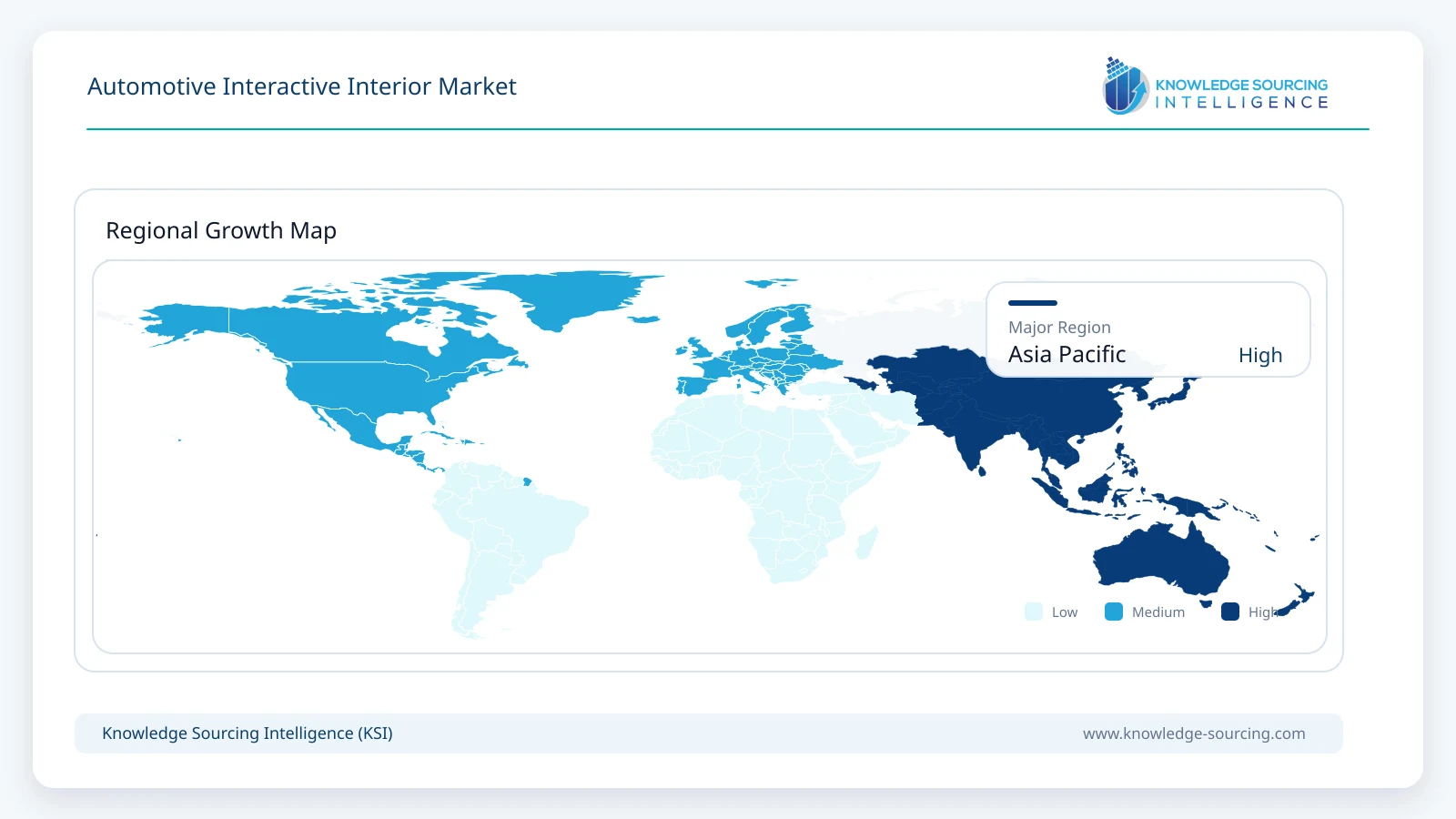
China, South Korea, Japan and India contribute through different combinations of vehicle-production scale, domestic electronics capability, premium-cabin adoption and increasing feature content in mainstream models. Asia Pacific’s estimated share rises to 49% by 2031 as touch and feedback functions are extended into additional vehicle classes and cabin zones. Price competition will remain significant, making local sourcing, manufacturing yield and the cost of haptic actuators important factors in suppliers’ regional performance.
Europe
Europe accounts for an estimated 27% of global interactive interior revenue in 2026, supported by premium vehicle specifications, specialist HMI suppliers and stringent expectations for control quality and ergonomics. Antolin, Valeo, Preh and FORVIA participate through smart trim, cockpit controls and integrated electronics, while BMW’s Panoramic iDrive demonstrates the combination of touch, steering-wheel haptics and voice operation in a commercial vehicle interface. European programs remain important for validating tactile performance and durable integration with premium interior finishes.
European OEM development work places considerable emphasis on the tactile response, control location and durability of electronic interfaces embedded in decorative trim, particularly in applications where drivers use functions without prolonged visual attention. Regional revenue is expected to expand through 2031 despite a gradual moderation in share, as higher electronic content per vehicle helps offset slower vehicle-production growth. Supplier competitiveness will depend on reliable sensors and clear operating logic rather than a proliferation of touch-sensitive decorative features.
Competitive Landscape
Automotive interactive interior supply is divided among interior integrators, automotive HMI and electronics manufacturers, and specialist technology developers whose components are incorporated into larger vehicle modules. Antolin, Yanfeng, FORVIA and Motherson bring trim engineering and assembly capabilities, while Valeo, Preh, AUMOVIO and Bosch supply relevant electronic control expertise. TactoTek and UltraSense provide embedded-surface technologies, with HARMAN and LG Electronics participating in wider integrated digital interface systems.
Antolin’s development work with UltraSense combines interior-surface integration with dedicated force-sensing electronics and algorithms, while Valeo’s awarded IMSE program includes investment in automated manufacturing. Motherson’s agreement to license TactoTek technology broadens the potential production base for molded electronic surfaces, although commercial rollout will depend on OEM program nominations and validation. Competition is therefore shaped by a supplier’s ability to convert promising interface designs into repeatable automotive parts, not simply by ownership of a touch or sensing technology.
Tier 1 interior suppliers with established OEM relationships can combine qualified materials, sensor calibration and system integration into complete smart-control modules, while specialist developers typically contribute intellectual property and enabling electronics. Buyers are likely to prioritize reliable touch recognition, consistent haptic and visual response, long service life and module cost across multiple vehicle platforms. Production yield, warranty performance and low integration risk should consequently matter more in supplier selection than the number of functions demonstrated in a prototype.
Recent Developments
September 2026: Antolin and UltraSense advanced a smart-surface HMI development initiative for a future global vehicle platform, combining touch and force sensing with haptic and visual feedback. The announcement concerns development, not verified series production.
May 2026: Motherson licensed TactoTek’s in-mold structural electronics technology, expanding the Tier 1 manufacturing route available for smart interior surfaces.
February 2026: TactoTek announced a strategic manufacturing-development partnership with Symbiose focused on scalable industrial use of integrated structural electronics.
January 2026: Valeo announced a premium OEM program award and dedicated automated manufacturing capability for an IMSE-based interior lighting and smart-structure solution.
August 2025: UltraSense and Mankiewicz announced a collaboration combining hidden-until-lit coatings with integrated HMI controllers for seamless smart surfaces.
Market Outlook
Touch- and force-sensing surfaces are expected to remain the largest interactive interior category through 2031 as controls are incorporated into door panels, armrests and passenger zones beyond the center console. Greater coordination of sensing, haptic feedback and connected cabin software allows a single surface to manage several functions while maintaining tactile confirmation of user inputs. Manufacturers with validated molding, electronics and surface-finishing processes should gain opportunities as awarded programs advance toward production, although concept demonstrations will continue to outnumber confirmed volume launches.
Zonal electronic architectures are expected to support more coordinated interaction across the cabin while reducing the number of stand-alone modules needed to manage related control functions. Established automotive suppliers can use their validation and manufacturing capabilities to compete for integrated smart-surface assemblies, with specialist firms contributing sensing, haptic and in-mold electronic technologies. Progress in higher-volume vehicles will depend on predictable operation, repair economics and costs that compare favorably with conventional input hardware.
Asia Pacific is forecast to generate the largest absolute increase in interactive interior revenue through 2031, supported by large vehicle programs and expanding use of electronic cabin controls, while Europe retains a strong base of premium HMI engineering. Suppliers will increasingly compete through consistency of force response, coordinated visual and tactile feedback, manufacturing quality and system integration across multiple cabin zones. The strongest commercial propositions will improve the usability and packaging of controls without introducing unnecessary component cost or complicated interaction steps.
Automotive Interactive Interior Market Scope:
| Report Metric | Details |
|---|---|
| Total Market Size in 2026 | USD 6.20 billion |
| Total Market Size in 2031 | USD 13.60 billion |
| Forecast Unit | USD Billion |
| Growth Rate | 17.0% |
| Study Period | 2021 to 2031 |
| Historical Data | 2021 to 2024 |
| Base Year | 2025 |
| Forecast Period | 2026 – 2031 |
| Segmentation | Interface System, Interaction Technology, Application, Cabin Zone, Input and Feedback Modality, Control Architecture, Vehicle Type, Propulsion, Geography |
| Companies |
|
Market Segmentation
By Interface System
Touch and Force-Sensing Smart Surfaces
Haptic Interactive Controls
Touch-Enabled Cabin Control Modules
Gesture and Proximity Interaction Modules
Distributed and Rear-Cabin Interfaces
By Interaction Technology
Capacitive and Force Sensing
Electromechanical and Piezoelectric Haptics
Gesture and Proximity Sensing
Integrated Lighting and Visual Feedback
Multimodal Control and Embedded Intelligence
By Application
Media, Navigation and Information Controls
Comfort and Climate Interaction
Vehicle Function and Access Controls
Safety and Occupant Information Feedback
Passenger Entertainment and Cabin Experiences
By Cabin Zone
Center Stack and Center Console
Steering Wheel and Driver Controls
Doors, Armrests and Side Trim
Roof and Overhead Controls
Rear Seats and Passenger Zones
By Input and Feedback Modality
Touch and Force Input
Active Haptic Feedback
Gesture and Proximity Input
Voice-Linked Interface Controls
Contextual Visual and Light Feedback
By Control Architecture
Local Self-Contained Interface Modules
Zonal Integrated Control
Centrally Coordinated Interfaces
By Vehicle Type
Passenger Vehicles
Light Commercial Vehicles
Medium and Heavy Commercial Vehicles
By Propulsion
Internal Combustion and Mild-Hybrid Vehicles
Hybrid and Plug-in Hybrid Vehicles
Battery Electric Vehicles
By Geography
North America
United States
Canada
Mexico
South America
Brazil
Argentina
Others
Europe
Germany
United Kingdom
France
Italy
Spain
Others
Middle East and Africa
Saudi Arabia
UAE
South Africa
Others
Asia Pacific
China
Japan
South Korea
India
Indonesia
Thailand
Others
Table of Contents
1. INTRODUCTION
1.1. Market Overview
1.2. Market Definition
1.3. Scope of the Study
1.4. Market Segmentation
1.5. Currency
1.6. Assumptions
1.7. Base and Forecast Years
1.8. Key Benefits to Stakeholders
2. RESEARCH METHODOLOGY
2.1. Research Design
2.2. Secondary Research
2.3. Primary Research
2.4. Market Estimation
2.5. Segment Modelling
2.6. Data Triangulation and Validation
3. EXECUTIVE SUMMARY
3.1. Key Findings
3.2. Automotive Interactive Interior Market Size, 2026–2031
3.3. Interface System Outlook
3.4. Interaction Technology Outlook
3.5. Application Outlook
3.6. Cabin Zone Outlook
3.7. Vehicle Type Outlook
3.8. Regional Opportunity Summary
4. MARKET DYNAMICS
4.1. Market Drivers
4.1.1. Expansion of Digitally Controlled Cabin Functions
4.1.2. Smart Surface Integration and Cleaner Cabin Packaging
4.1.3. Vehicle User-Experience Differentiation
4.1.4. Expansion of Passenger and Rear-Cabin Control Zones
4.1.5. Platform Reuse and Programmable Interface Electronics
4.2. Market Restraints
4.2.1. Driver Distraction and Interaction Clarity
4.2.2. High Qualification and Integration Cost
4.2.3. Repairability and Replacement Economics
4.2.4. False Activation, Moisture and Electromagnetic Interference
4.2.5. Fragmented OEM Architecture and Cost Pressure
4.3. Market Opportunities
4.4. Porter’s Five Forces Analysis
4.5. Industry Value Chain Analysis
4.6. HMI Usability and Driver Distraction
4.7. Vehicle Electronics and Functional Safety Requirements
4.8. Strategic Recommendations
5. TECHNOLOGY OUTLOOK
5.1. Capacitive and Force-Sensing Surfaces
5.2. Haptic Actuation and Programmable Feedback
5.3. In-Mold Structural Electronics
5.4. Hidden-Until-Lit HMI Surfaces
5.5. Gesture and Proximity Sensors
5.6. Multimodal Control Electronics
5.7. Zonal and Centralized Interface Integration
5.8. Interface Calibration and Diagnostic Software
6. AUTOMOTIVE INTERACTIVE INTERIOR MARKET BY INTERFACE SYSTEM
6.1. Introduction
6.2. Touch and Force-Sensing Smart Surfaces
6.3. Haptic Interactive Controls
6.4. Touch-Enabled Cabin Control Modules
6.5. Gesture and Proximity Interaction Modules
6.6. Distributed and Rear-Cabin Interfaces
7. AUTOMOTIVE INTERACTIVE INTERIOR MARKET BY INTERACTION TECHNOLOGY
7.1. Introduction
7.2. Capacitive and Force Sensing
7.3. Electromechanical and Piezoelectric Haptics
7.4. Gesture and Proximity Sensing
7.5. Integrated Lighting and Visual Feedback
7.6. Multimodal Control and Embedded Intelligence
8. AUTOMOTIVE INTERACTIVE INTERIOR MARKET BY APPLICATION
8.1. Introduction
8.2. Media, Navigation and Information Controls
8.3. Comfort and Climate Interaction
8.4. Vehicle Function and Access Controls
8.5. Safety and Occupant Information Feedback
8.6. Passenger Entertainment and Cabin Experiences
9. AUTOMOTIVE INTERACTIVE INTERIOR MARKET BY CABIN ZONE
9.1. Introduction
9.2. Center Stack and Center Console
9.3. Steering Wheel and Driver Controls
9.4. Doors, Armrests and Side Trim
9.5. Roof and Overhead Controls
9.6. Rear Seats and Passenger Zones
10. AUTOMOTIVE INTERACTIVE INTERIOR MARKET BY INPUT AND FEEDBACK MODALITY
10.1. Introduction
10.2. Touch and Force Input
10.3. Active Haptic Feedback
10.4. Gesture and Proximity Input
10.5. Voice-Linked Interface Controls
10.6. Contextual Visual and Light Feedback
11. AUTOMOTIVE INTERACTIVE INTERIOR MARKET BY CONTROL ARCHITECTURE
11.1. Introduction
11.2. Local Self-Contained Interface Modules
11.3. Zonal Integrated Control
11.4. Centrally Coordinated Interfaces
12. AUTOMOTIVE INTERACTIVE INTERIOR MARKET BY VEHICLE TYPE
12.1. Introduction
12.2. Passenger Vehicles
12.3. Light Commercial Vehicles
12.4. Medium and Heavy Commercial Vehicles
13. AUTOMOTIVE INTERACTIVE INTERIOR MARKET BY PROPULSION
13.1. Introduction
13.2. Internal Combustion and Mild-Hybrid Vehicles
13.3. Hybrid and Plug-in Hybrid Vehicles
13.4. Battery Electric Vehicles
14. AUTOMOTIVE INTERACTIVE INTERIOR MARKET BY GEOGRAPHY
14.1. North America
14.1.1. United States
14.1.2. Canada
14.1.3. Mexico
14.2. South America
14.2.1. Brazil
14.2.2. Argentina
14.2.3. Others
14.3. Europe
14.3.1. Germany
14.3.2. United Kingdom
14.3.3. France
14.3.4. Italy
14.3.5. Spain
14.3.6. Others
14.4. Middle East and Africa
14.4.1. Saudi Arabia
14.4.2. UAE
14.4.3. South Africa
14.4.4. Others
14.5. Asia Pacific
14.5.1. China
14.5.2. Japan
14.5.3. South Korea
14.5.4. India
14.5.5. Indonesia
14.5.6. Thailand
14.5.7. Others
15. COMPETITIVE ENVIRONMENT AND ANALYSIS
15.1. Major Players and Strategy Analysis
15.2. Market Share Analysis
15.3. Mergers, Acquisitions, Agreements, and Collaborations
15.4. Competitive Dashboard
16. COMPANY PROFILES
16.1. Antolin
16.2. Yanfeng
16.3. Valeo
16.4. Motherson Group
16.5. TactoTek Oy
16.6. UltraSense Systems, Inc.
16.7. Preh GmbH
16.8. FORVIA
16.9. HARMAN International
16.10. Robert Bosch GmbH
16.11. AUMOVIO SE
16.12. LG Electronics Vehicle Solution Company
17. APPENDIX
17.1. Currency
17.2. Assumptions
17.3. Base and Forecast Years
17.4. Key Benefits to Stakeholders
17.5. Research Methodology
17.6. Abbreviations
Navigate
Trusted by the world's leading organizations











