
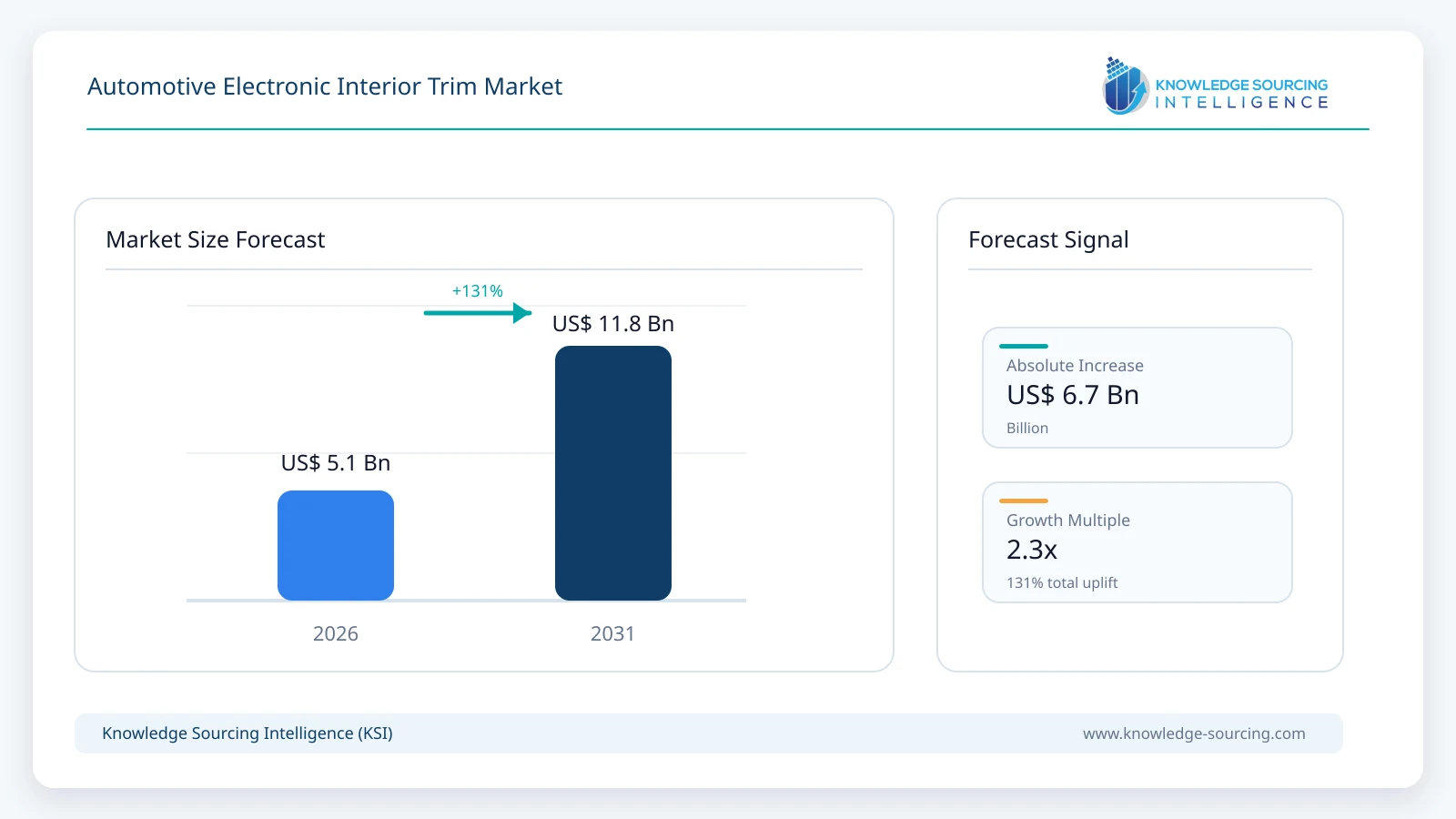
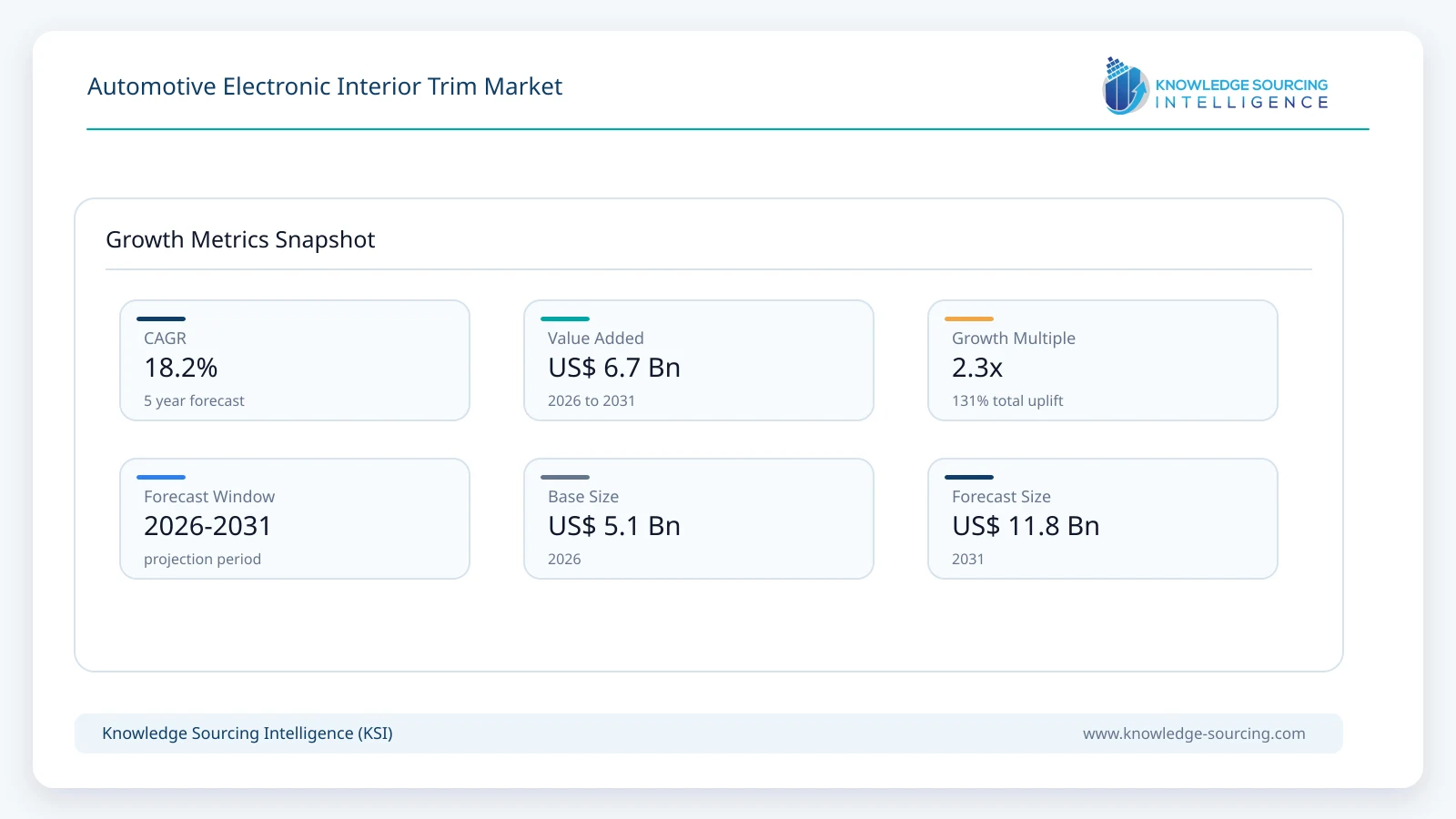
The Automotive Electronic Interior Trim Market is projected to expand at a CAGR of 18.2%, increasing from USD 5.1 billion in 2026 to USD 11.8 billion by 2031.
Highlights:
- 1Door panels and door-surface trim account for an estimated 38% of 2026 global market value because they accommodate broad functional surfaces, lighting and concealed controls.
- 2Illumination and personalization represent approximately 38% of 2026 demand, while combined sensing and multifunctional surfaces gain share through 2031.
- 3In-mold structural electronics are estimated to represent 23% of supplier value in 2026 and are projected to reach 35% by 2031 as awarded programs and production capabilities broaden.
- 4Asia Pacific represents an estimated 48% of 2026 value, supported by regional vehicle output and rapid smart-cabin development cycles.
- 5Automotive qualification and process yield remain central to the economics of integrating circuitry into finished trim surfaces.
The market comprises trim surfaces supplied with integral lighting, embedded electronic controls, sensors, circuit films or electronically enabled interface functions, including the attributable electronic content and qualified physical carrier. Door panels, instrument panels and center consoles form the principal revenue applications.
Integrating circuits and control elements within visible trim changes the manufacturing sequence. Decorative films, capacitive sensing layers, optical features, printed conductors and molded carriers may be validated as a single assembly, reducing the number of separately mounted bezels and switches. The integration also increases the need for electrical reliability, electromagnetic compatibility, surface durability and reliable sensing across temperature and moisture exposure.
Valeo's January 2026 awarded program using TactoTek's in-mold structural electronics demonstrates the move toward high-volume electronic surface manufacturing, while Toyota Boshoku's illuminated door trim on the Lexus ES shows a finished trim application identified for a production vehicle. Motherson's IMSE licensing agreement and Antolin's work with UltraSense point to wider industrial capability, although technology licensing and platform development do not, on their own, establish vehicle-level production volumes.
Market Overview
Electronic interior trim combines traditional cabin surface functions such as protection, appearance and tactile finish with electrical or optical functions engineered into the same component. LED light guides, touch electrodes, pressure-sensing layers, local control boards and printed circuit structures may be integrated beneath molded polymer, translucent film, soft-touch skin or wrapped trim. The supplier typically delivers a validated surface assembly rather than a loose sensor or decorative layer.
Marelli's smart-surface portfolio distinguishes decorative, informative, and interactive functions, including translucent switches with capacitive and haptic capability. FORVIA HELLA supplies surface-backlighting and interior lighting systems designed for integration with door carriers, while Valeo has identified in-mold electronics as a route to combined lighting and electronic functionality. Supplier offerings illustrate distinct commercial routes: packaged lighting, electronically functional decoration and complete HMI-enabled trim.
Electronically functional door, console and dashboard trim requires closer cooperation between interior suppliers and the teams responsible for electronics, software, illumination and automotive network architecture. New features can raise supplier value per installed surface, but savings from eliminating stand-alone buttons are not automatic because electronic trim carries process-yield, testing, thermal and service-replacement requirements. Qualification and launch execution determine whether integration improves total cabin cost and quality.
Market Trends
In-Mold Electronics Are Changing the Trim Supply Chain
Valeo's January 2026 award from a premium automaker specifies a high-volume manufacturing approach built around TactoTek's in-mold structural electronics. Integrating lighting and electronic features within a shaped structure gives designers more freedom to create flush panels without separate visible control elements. The program award is evidence of OEM procurement interest, although its announcement does not establish the date or rate of mass production.
Motherson's May 2026 IMSE licensing agreement extends the manufacturing route to a large Tier 1 supplier with automotive engineering and global production capabilities. Licensing reduces the need for every OEM program to establish an entirely new electronics-forming process, but each application must still pass durability and electrical qualification. The strongest commercial impact is expected where common circuit architectures can be reused across vehicle variants.
Door Trim Is Becoming a Larger Electronic Surface
Toyota Boshoku's large-area illuminated door-trim construction adopted for the newly announced Lexus ES combines surface materials and light transmission to distribute animated illumination over a broad visible area. Toyota Gosei separately reports dynamic patterned illumination used on the Lexus RZ, illustrating the use of programmed light to create vehicle-specific interior effects. Such applications expand the role of door surfaces beyond narrow ambient-light strips.
Large visible panels are difficult optical and electronic products because reflected daylight, color matching, local hot spots, light-guide thickness and surface texture can affect quality. Suppliers with polymer-processing, optical engineering and electronics competencies can capture a greater share of the assembly, although warranty and replacement costs also increase when multiple functions are consolidated.
Hidden Controls Are Entering Functional Trim
Antolin and UltraSense announced in September 2026 a future-platform smart-surface HMI development initiative that combines force and touch sensing with visual and haptic feedback. The work highlights growing OEM demand for controls that appear only when required and preserve continuity across instrument panels and consoles. The initiative remains a development program and should not be treated as an established global-series fitment.
Hidden control zones can reduce the number of mechanical openings in a decorative part, but their usability depends on tactile confirmation, accidental-activation rejection, and controls that remain recognizable in demanding driving conditions. Surface electronics suppliers must therefore coordinate design, electronics and human factors rather than rely on appearance alone.
Segment Analysis
By Trim Application: Door Panels and Door-Surface Trim
Door surfaces account for an estimated 38% of electronic interior trim value in 2026 because front and rear doors can carry illuminated inserts, seat and window-adjacent interface surfaces, contextual visual cues and concealed touch zones. Large surface area makes door trim a natural integration point, although the functional content differs markedly between economy and premium vehicle programs.
Toyota Boshoku's Lexus ES program and Toyoda Gosei's Lexus RZ lighting application indicate how different optical technologies enter door environments. Door-panel share is projected to reach 36% by 2031 as consoles and dashboard interfaces expand more rapidly, even as its absolute supplier value continues to rise.
By Electronic Function: Illumination and Personalization
Illumination and personalization are expected to represent approximately 38% of 2026 electronic trim revenue because backlit surfaces are a relatively mature and highly visible application of surface integration. Qualified illuminated trim combines optical components and electronic controls within finished surfaces, with a more integrated procurement and validation process than stand-alone lighting modules.
Programmable lighting remains commercially important through 2031, but embedded sensing, surface controls and multifunctional electronic structures gain relative weight. The illumination-related share is therefore projected to reach 32% as the average electronic trim assembly carries more diverse functionality.
By Technology: In-Mold Structural Electronics
In-mold structural electronics account for an estimated 23% of the 2026 technology mix, with a projected increase to 35% by 2031 as manufacturing partners expand capacity and OEM programs migrate from stand-alone circuit modules to formed functional surfaces. Conventional PCBs remain widely used in high-volume trim, while IMSE adoption is concentrated in applications that benefit from three-dimensional integration.
TactoTek's technology licensing with Motherson and Valeo's announced OEM program point to a wider manufacturing ecosystem. Yield management, connection durability, electronics placement and optical repeatability remain central to industrialization economics, particularly when the same process must support several decorative variants.
By Surface Material: Molded Polymer and Decorated Substrates
Molded polymer and decorated surface carriers account for an estimated 58% of 2026 value because injection-molded and decorated interior substrates provide structural control, cost efficiency and compatibility with electronic inserts. Their use spans instrument-panel sections, center consoles, door trim and small decorative control panels.
Functional films and optical layers grow faster through 2031 as OEMs specify concealed icons, patterned illumination and laminated conductors. Material selection nevertheless depends on heat aging, scratch resistance, dimensional stability and light transmission; these requirements keep conventional polymer substrates commercially relevant.
By Supplier Model: Integrated Electronic Trim Assemblies
Integrated electronic trim assemblies are estimated to represent 42% of revenue in 2026 and are projected to reach 54% by 2031 as automotive suppliers combine trim engineering with electronics and optical modules. A complete supplied surface can simplify program interfaces for an OEM, provided the Tier 1 supplier has robust electrical validation and component traceability.
Suppliers specializing in films, sensors, or circuit manufacturing remain important, especially where an OEM's established interior supplier sources the electronic layer separately. Direct supply of complete functional surfaces can simplify warranty accountability, while specialist circuit and film providers remain important within tiered manufacturing arrangements.
Market Drivers
Reduction of Visible Mechanical Controls
Instrument panels, door inserts and center consoles increasingly incorporate hidden control zones that allow OEMs to reduce exposed switch packs without removing everyday functions. Embedded touch sensing and haptic response preserve an interface at the point of contact while freeing design space for continuous decorative surfaces.
Embedded surface controls shift supplier value toward trim assemblies with validated electronics rather than the decorative films that merely cover conventional control modules. Adoption is strongest where control reliability and driver usability can be demonstrated over automotive temperature and vibration cycles.
Premium Cabin Differentiation and Feature Migration
Premium vehicles continue using electronically lit surfaces and integrated trim controls to distinguish cabin variants, while scalable lighting and circuit architectures support selective adoption on mid-range models. Door-light signatures, translucent icons and animated status functions offer differentiation without redesigning every structural panel.
Standardized circuit films, optical parts and molded carriers reduce the incremental cost of offering additional trim grades. Suppliers that can control variant complexity are better positioned to gain volume without exposing OEMs to excessive inventory and part-number proliferation.
Commercialization of In-Mold Electronic Manufacturing
Valeo's awarded IMSE-based program and Motherson's technology-licensing arrangement support broader availability of formed electronic surfaces from established automotive suppliers. Their commercial importance lies in creating industrial supply routes that combine decoration, circuitry, molding and final inspection.
Automated integration can eliminate separate brackets and circuit housings for selected features, although cost benefits depend on scrap rates and production quality. Continued supplier investment should therefore shift demand from prototypes toward qualified, repeatable components over the forecast period.
Expansion of Functional Cabin Illumination
Toyota Boshoku's illuminated door trim and Toyoda Gosei's patterned Lexus RZ lighting illustrate practical applications of electronic visual functions within finished interior surfaces. These products extend illumination beyond static ambience into programmable effects and recognizable information cues.
Electronic trim suppliers can increase content per vehicle when one assembly supports decorative appearance, personalization and state-related feedback. This mechanism benefits optical surface integration while creating stricter requirements for brightness uniformity and electronic performance.
Electrified and Digitally Coordinated Cabin Platforms
Battery-electric and hybrid platforms increasingly support electronically coordinated occupant functions, cabin themes and configurable feature packages. Electronically active door, console and dashboard trims provide physical points of interaction that complement digital cockpit controls without requiring the full cockpit hardware value to be included in surface trim revenue.
Cross-platform software coordination supports updates to lighting behaviors and interface states, but physical trim hardware still requires complete vehicle-level qualification. Revenue therefore follows installed electronic surfaces and their attributable integration, not the value of all software-defined vehicle platforms.
Market Restraints
High Functional-Surface Qualification Costs
Electronic trim combines polymer aging, abrasion, gloss, electrical safety, EMC and interface performance within one part approval process. A defect in an embedded film or sensor may require replacement of a larger decorated assembly, increasing potential warranty cost compared with a stand-alone switch.
OEM qualification schedules can lengthen when newly integrated systems must pass simultaneous surface and electronics validation. Smaller programs may retain conventional controls until suppliers demonstrate repeatable production yields and repair economics.
Capacitive and Haptic Usability Limitations
Touch-sensitive surfaces can be difficult to operate without visual attention when a driver expects the physical landmark of a conventional button. Gloves, moisture, vibration and unintended hand contact create additional reliability requirements for concealed surface controls.
Suppliers are incorporating force sensing and haptic feedback to improve confidence, but every added function raises bill-of-materials complexity. Programs with safety-critical controls may limit the use of fully hidden interfaces or retain physical alternatives.
Electronics Yield and Repair Complexity
In-mold electronics and laminated circuit technologies require reliable connections, precision placement, and process windows that protect circuits during forming and molding. A cosmetic reject can also scrap an electronic layer, while an electrical reject can waste a finished decorative carrier.
Repair and replacement economics become more difficult when an electronics fault is inseparable from a door or console surface. Suppliers need robust testability, modular connectors, and failure analysis before scalable production advantages can be realized.
Material and Thermal Performance Constraints
High-temperature cycling, direct sunlight, ultraviolet exposure and repeated cabin-cleaning chemicals can affect decorative films, adhesives, optical layers and touch-sensor calibration. Combinations of soft-touch skins and electronic layers may introduce delamination or light-transmission variation over product life.
Decorative electronic-trim prototypes may require extensive redesign for durability and process stability before OEM launch approval. Material restrictions are particularly important in door and dashboard applications with broad visible surfaces and tight color consistency requirements.
Price Pressure and Fragmented Supplier Accountability
High-volume automotive platforms impose recurring price-down requirements while electronic trim suppliers must integrate components sourced from optical, semiconductor, film, and molded-plastic partners. Cost control becomes difficult when development responsibility is split among companies with different quality systems and commercial agreements.
Integrated Tier 1 suppliers can simplify accountability, yet smaller electronics specialists often provide the core innovation. Contracts need clear boundaries for tooling, software interfaces, warranty responsibilities, and revision control to avoid delayed launches.
Regional Outlook
Asia Pacific
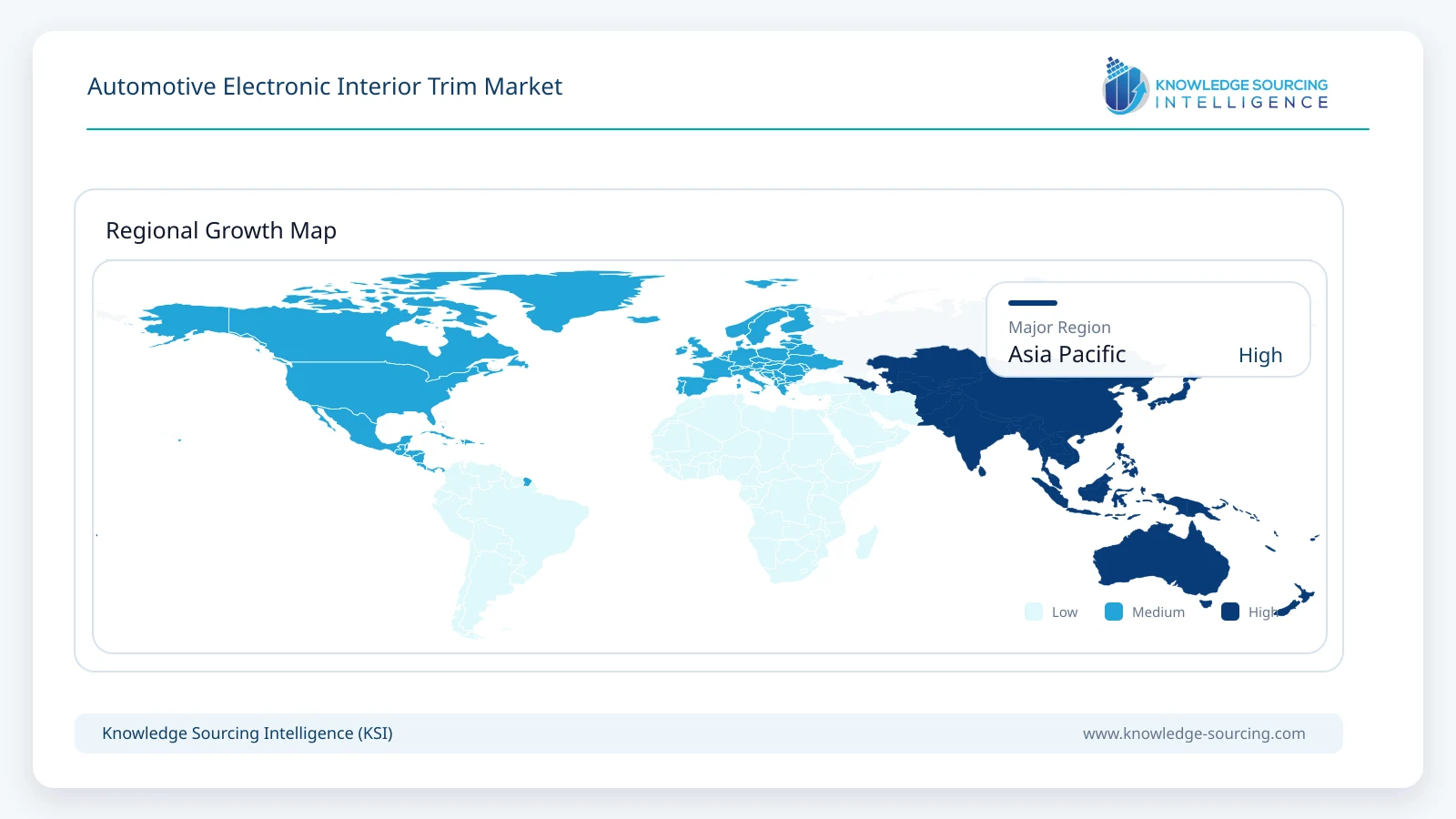
Asia Pacific is the largest regional market, accounting for about 48% of electronic interior trim value in 2026, supported by vehicle-production scale and intensive smart-cabin competition in China. Electronic trim demand extends from programmable lighting on visible door panels to embedded controls on consoles and instrument panels, with Japan and South Korea contributing mature optical and electronics supply chains.
Toyota Boshoku and Toyoda Gosei provide documented Japanese vehicle-program examples, while Yanfeng's XiM27 concept reflects continuing Chinese experimentation with coordinated functional surfaces. The regional forecast rises to about 50% of global value by 2031 as localized manufacturing and selective adoption in India and Southeast Asia broaden the addressable vehicle base. Concept demonstrations are not assumed to translate directly into current production revenue.
Europe
Europe remains an important high-content market because premium OEMs place considerable emphasis on integrated controls, decorative quality, material traceability and human-machine interaction. Antolin's smart-surface development with UltraSense, Valeo's awarded IMSE program and the European manufacturing ecosystem around TactoTek illustrate distinct paths to electronic trim commercialization.
European suppliers must balance surface integration with strict durability, chemical and vehicle-electronics requirements, especially as functional films and illuminated substrates become more complex. Europe accounts for an estimated 24% of global value in 2026 and is projected to represent 23% in 2031; the modest share decline reflects faster regional expansion in Asia, not contraction in European demand.
Competitive Landscape
Electronic interior trim brings together interior Tier 1 suppliers, automotive lighting and electronics companies, and specialists in functional-film or sensing technologies. Antolin, Yanfeng, Valeo, Marelli, Toyota Boshoku and Motherson can participate through trim assembly engineering or full-system integration. TactoTek and UltraSense provide enabling technologies that enter OEM programs through licensees or manufacturing partners.
Valeo's awarded program indicates an OEM procurement route for IMSE-based illuminated structures, while Antolin's UltraSense collaboration targets touch, force sensing and feedback within a future-platform surface. Toyota Boshoku and Toyoda Gosei provide vehicle-linked lighting examples. The competitive evidence therefore spans current applications, awarded programs and development activity rather than one uniform stage of commercialization.
Supplier competition is likely to center on automotive qualification, functional integration, optical finish and global program execution. A decorative surface with embedded electronics must satisfy appearance requirements and electrical performance simultaneously; the ability to maintain yield and provide traceability across multi-site production can matter more than the novelty of a demonstration.
Recent Developments
8 September 2026: Antolin and UltraSense advanced a smart-surface HMI development initiative for a future global vehicle platform, combining touch and force sensing with visual and haptic feedback.
29 June 2026: Yanfeng unveiled the drivable XiM27 smart-cabin concept, incorporating integrated surfaces and coordinated electronics as part of a broader cabin architecture.
11 June 2026: Toyota Boshoku announced that its large-area illuminated door trim had been adopted for the new Lexus ES, combining surface transmission and dynamic illumination.
21 May 2026: Motherson signed a license for TactoTek IMSE technology to support industrial-scale smart-surface manufacturing for automotive applications.
20 January 2026: Valeo announced a premium-automaker program award for an interior lighting solution using TactoTek IMSE, with a high-volume manufacturing approach.
8 January 2026: Toyoda Gosei reported that its patterned Dynamic Shadowy Illumination is used on the Lexus RZ battery-electric vehicle.
Market Outlook
Electronic interior trim demand is supported by the growing integration of lighting, sensing and electronic interaction across door panels, dashboards and centre consoles. This trend reflects the automotive industry's shift toward connected cabin environments, enhanced user interfaces and multifunctional interior surfaces. Automakers and suppliers are increasingly incorporating illuminated trim, touch-sensitive controls and integrated electronic components to improve aesthetics, convenience and functionality. Adoption is driven primarily by the increasing number of electronically equipped interior surfaces per vehicle and the transition toward integrated functional assemblies, rather than a comparable increase in global vehicle production.
In-mold structural electronics and functional films are expected to gain a larger role in trim manufacturing as OEMs seek reduced assembly complexity and seamless surfaces. Conventional LED and PCB modules will remain important for cost-sensitive applications, while more integrated architectures must demonstrate competitive yield, reliability and repairability before displacing mature designs.
Asia Pacific is positioned to remain the largest regional market, with Europe retaining significant high-content demand from advanced interior suppliers and premium programs. Companies that can combine decorative quality, electronics validation and scalable industrialization should benefit most from the transition, although procurement and warranty risks will temper the pace of adoption.
Automotive Electronic Interior Trim Market Scope:
| Report Metric | Details |
|---|---|
| Total Market Size in 2026 | USD 5.1 billion |
| Total Market Size in 2031 | USD 11.8 billion |
| Forecast Unit | USD Billion |
| Growth Rate | 18.2% |
| Study Period | 2021 to 2031 |
| Historical Data | 2021 to 2024 |
| Base Year | 2025 |
| Forecast Period | 2026 – 2031 |
| Segmentation | Trim Application, Primary Electronic Function, Electronic Integration Technology, Surface Material Platform |
| Companies |
|
Market Segmentation
By Trim Application
Door Panels and Door-Surface Trim
Instrument Panel and Dashboard Trim
Center and Floor Console Trim
Headliner and Overhead Trim
Pillars and Other Electronic Trim
By Primary Electronic Function
Illumination and Personalization
Touch and Haptic Control
Status, Warning and Information
Embedded Proximity and Occupant Sensing
Multifunctional Surface Systems
By Electronic Integration Technology
Conventional PCB and LED Modules
Laminated Circuits and Functional Foils
In-Mold Structural Electronics
Printed and Other Embedded Electronics
By Surface Material Platform
Molded Polymer and Decorated Substrates
Soft-Touch Skins and Synthetic Leather
Functional Films and Optical Layers
Textiles and Light-Permeable Soft Surfaces
Natural-Fiber and Other Sustainable Platforms
By Supplier Integration Model
Integrated Electronic Trim Assemblies
Trim with Modular Electronics
Functional-Foil and Electronics Subassemblies
By Vehicle Type
Passenger Vehicles
Light Commercial Vehicles
Medium and Heavy Commercial Vehicles and Buses
By Propulsion
Internal-Combustion-Only Vehicles
Hybrid and Plug-In Hybrid Vehicles
Battery Electric Vehicles
By Geography
North America
United States
Canada
Mexico
South America
Brazil
Argentina
Others
Europe
Germany
United Kingdom
France
Italy
Spain
Others
Middle East and Africa
Saudi Arabia
UAE
South Africa
Others
Asia Pacific
China
Japan
South Korea
India
Indonesia
Thailand
Others
Table of Contents
1. EXECUTIVE SUMMARY
1.1. Key Findings
1.2. Market Size and Forecast, 2026–2031
1.3. Segment and Regional Highlights
2. MARKET SNAPSHOT
2.1. Market Overview
2.2. Market Definition
2.3. Scope of the Study
2.4. Market Segmentation
3. BUSINESS LANDSCAPE
3.1. Market Drivers
3.1.1. Reduction of Visible Mechanical Controls
3.1.2. Premium Cabin Differentiation and Feature Migration
3.1.3. Commercialization of In-Mold Electronic Manufacturing
3.1.4. Expansion of Functional Cabin Illumination
3.1.5. Electrified and Digitally Coordinated Cabin Platforms
3.2. Market Restraints
3.2.1. High Functional-Surface Qualification Costs
3.2.2. Capacitive and Haptic Usability Limitations
3.2.3. Electronics Yield and Repair Complexity
3.2.4. Material and Thermal Performance Constraints
3.2.5. Price Pressure and Fragmented Supplier Accountability
3.3. Market Opportunities
3.4. Porter's Five Forces Analysis
3.5. Industry Value Chain Analysis
3.6. Policies and Regulations
3.7. Strategic Recommendations
4. TECHNOLOGICAL OUTLOOK
4.1. In-Mold Structural Electronics
4.2. Capacitive, Force and Haptic Sensing
4.3. Translucent and Hidden-Until-Lit Surfaces
4.4. Functional Films and Printed Circuits
4.5. Surface Lighting and Optical Integration
4.6. Zonal Integration and Electronic Diagnostics
5. AUTOMOTIVE ELECTRONIC INTERIOR TRIM MARKET BY TRIM APPLICATION
5.1. Introduction
5.2. Door Panels and Door-Surface Trim
5.3. Instrument Panel and Dashboard Trim
5.4. Center and Floor Console Trim
5.5. Headliner and Overhead Trim
5.6. Pillars and Other Electronic Trim
6. AUTOMOTIVE ELECTRONIC INTERIOR TRIM MARKET BY PRIMARY ELECTRONIC FUNCTION
6.1. Introduction
6.2. Illumination and Personalization
6.3. Touch and Haptic Control
6.4. Status, Warning and Information
6.5. Embedded Proximity and Occupant Sensing
6.6. Multifunctional Surface Systems
7. AUTOMOTIVE ELECTRONIC INTERIOR TRIM MARKET BY ELECTRONIC INTEGRATION TECHNOLOGY
7.1. Introduction
7.2. Conventional PCB and LED Modules
7.3. Laminated Circuits and Functional Foils
7.4. In-Mold Structural Electronics
7.5. Printed and Other Embedded Electronics
8. AUTOMOTIVE ELECTRONIC INTERIOR TRIM MARKET BY SURFACE MATERIAL PLATFORM
8.1. Introduction
8.2. Molded Polymer and Decorated Substrates
8.3. Soft-Touch Skins and Synthetic Leather
8.4. Functional Films and Optical Layers
8.5. Textiles and Light-Permeable Soft Surfaces
8.6. Natural-Fiber and Other Sustainable Platforms
9. AUTOMOTIVE ELECTRONIC INTERIOR TRIM MARKET BY SUPPLIER INTEGRATION MODEL
9.1. Introduction
9.2. Integrated Electronic Trim Assemblies
9.3. Trim with Modular Electronics
9.4. Functional-Foil and Electronics Subassemblies
10. AUTOMOTIVE ELECTRONIC INTERIOR TRIM MARKET BY VEHICLE TYPE
10.1. Introduction
10.2. Passenger Vehicles
10.3. Light Commercial Vehicles
10.4. Medium and Heavy Commercial Vehicles and Buses
11. AUTOMOTIVE ELECTRONIC INTERIOR TRIM MARKET BY PROPULSION
11.1. Introduction
11.2. Internal-Combustion-Only Vehicles
11.3. Hybrid and Plug-In Hybrid Vehicles
11.4. Battery Electric Vehicles
12. AUTOMOTIVE ELECTRONIC INTERIOR TRIM MARKET BY GEOGRAPHY
12.1. North America
12.1.1. United States
12.1.2. Canada
12.1.3. Mexico
12.2. South America
12.2.1. Brazil
12.2.2. Argentina
12.2.3. Others
12.3. Europe
12.3.1. Germany
12.3.2. United Kingdom
12.3.3. France
12.3.4. Italy
12.3.5. Spain
12.3.6. Others
12.4. Middle East and Africa
12.4.1. Saudi Arabia
12.4.2. UAE
12.4.3. South Africa
12.4.4. Others
12.5. Asia Pacific
12.5.1. China
12.5.2. Japan
12.5.3. South Korea
12.5.4. India
12.5.5. Indonesia
12.5.6. Thailand
12.5.7. Others
13. COMPETITIVE ENVIRONMENT AND ANALYSIS
13.1. Major Players and Strategy Analysis
13.2. Market Share Analysis
13.3. Mergers, Acquisitions, Agreements and Collaborations
13.4. Competitive Dashboard
14. COMPANY PROFILES
14.1. Antolin
14.2. Yanfeng Automotive Interiors
14.3. Valeo
14.4. Marelli
14.5. Toyota Boshoku Corporation
14.6. Toyoda Gosei Co., Ltd.
14.7. Motherson Group
14.8. FORVIA HELLA
14.9. TactoTek Oy
14.10. UltraSense Systems, Inc.
15. APPENDIX
15.1. Currency
15.2. Assumptions
15.3. Base and Forecast Years Timeline
15.4. Key Benefits for Stakeholders
15.5. Research Methodology
15.6. Abbreviations
Navigate
Trusted by the world's leading organizations











