
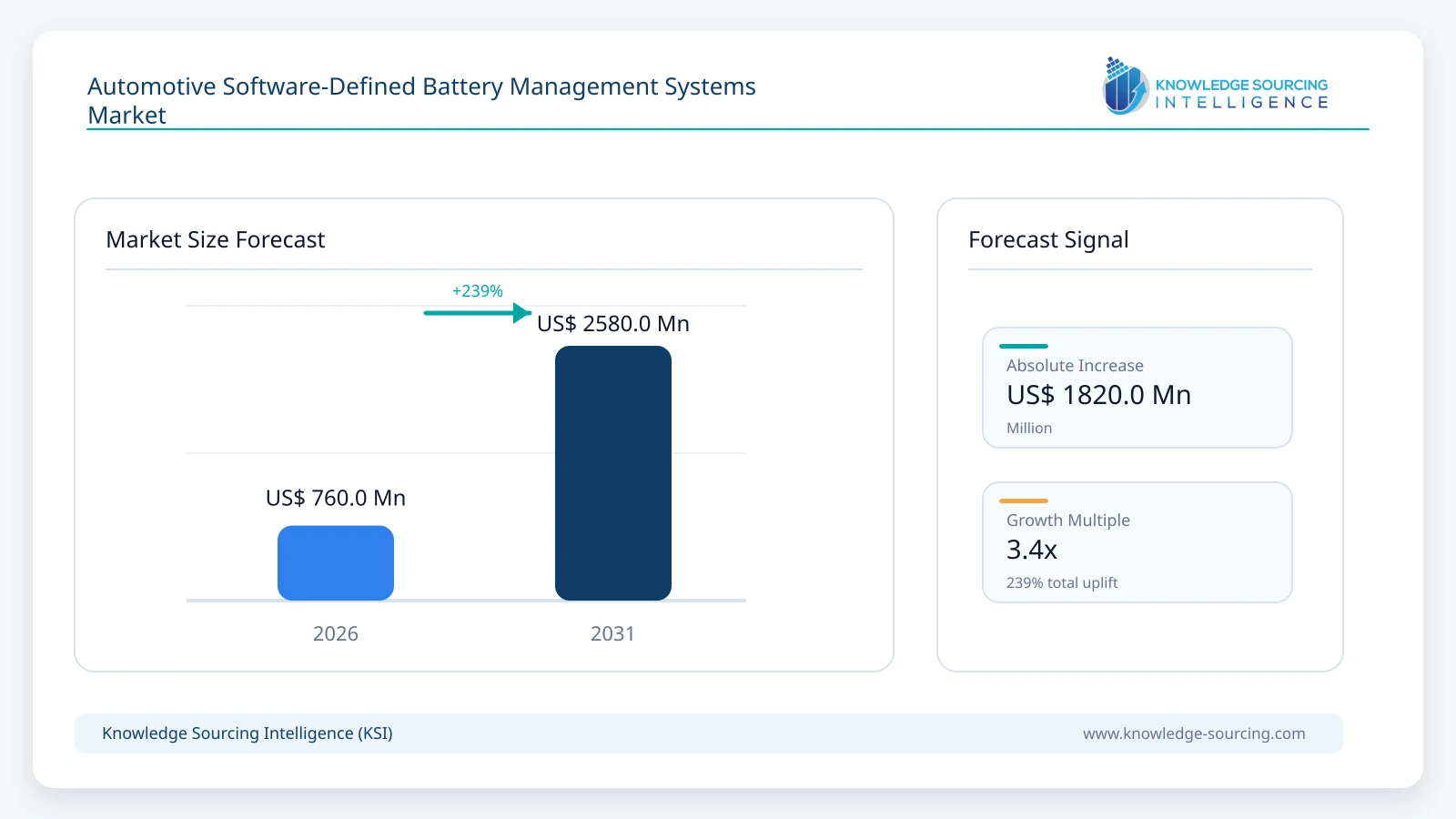
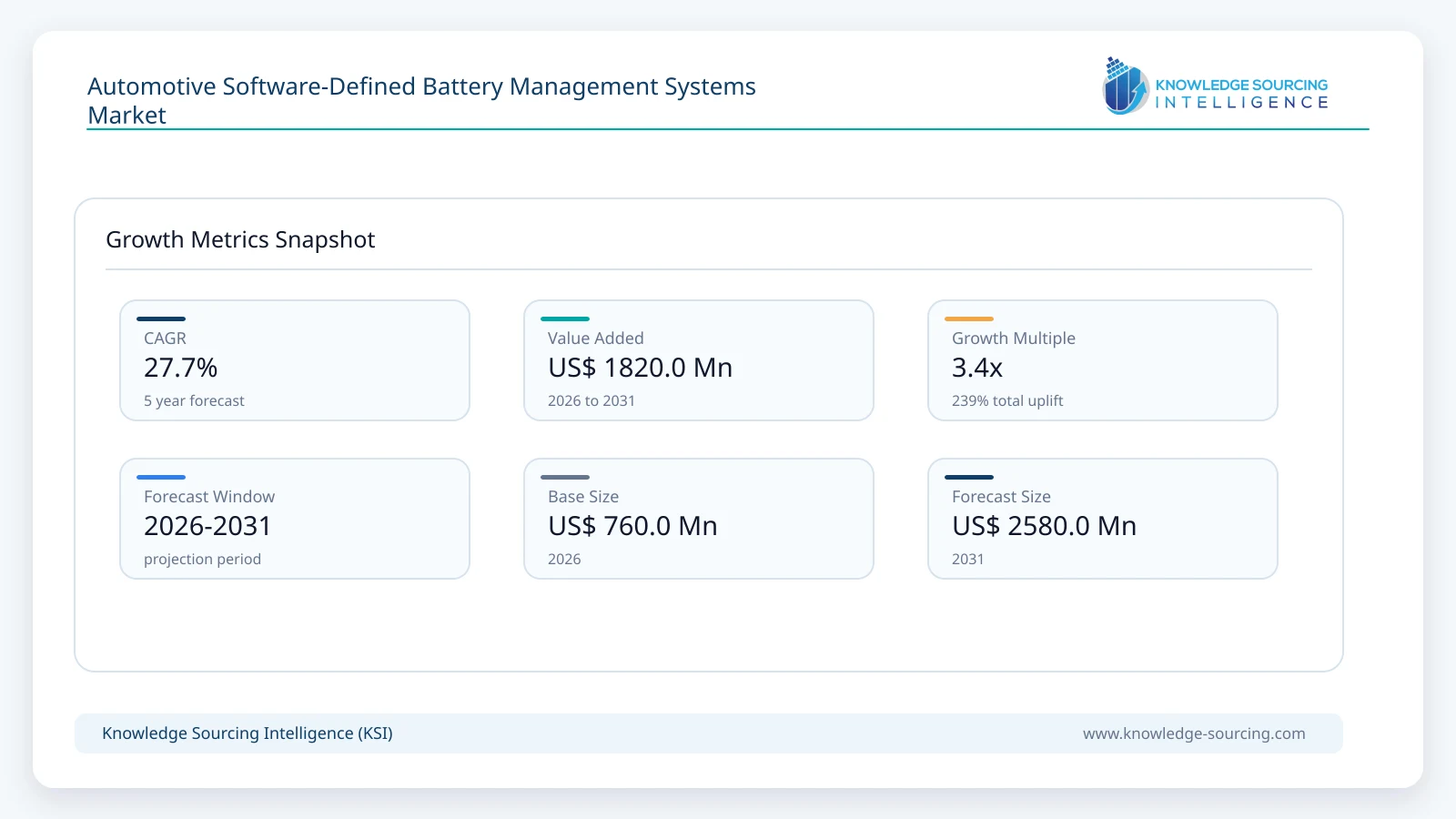
The automotive software-defined battery management systems market is projected to expand at a CAGR of 27.7%, increasing from USD 760 million in 2026 to USD 2,580 million by 2031.
Highlights:
- 1Embedded BMS application software accounts for approximately 34% of modeled 2026 revenue, ahead of individually attributable adaptive models and diagnostic packages.
- 2Dedicated central BMS architectures represent the largest installed value in 2026, while domain-hosted applications and modular distributed systems gain share by 2031.
- 3Battery electric vehicles account for approximately 74% of 2026 market value because high-voltage pack protection, charging and usable-range estimation create the strongest commercial need.
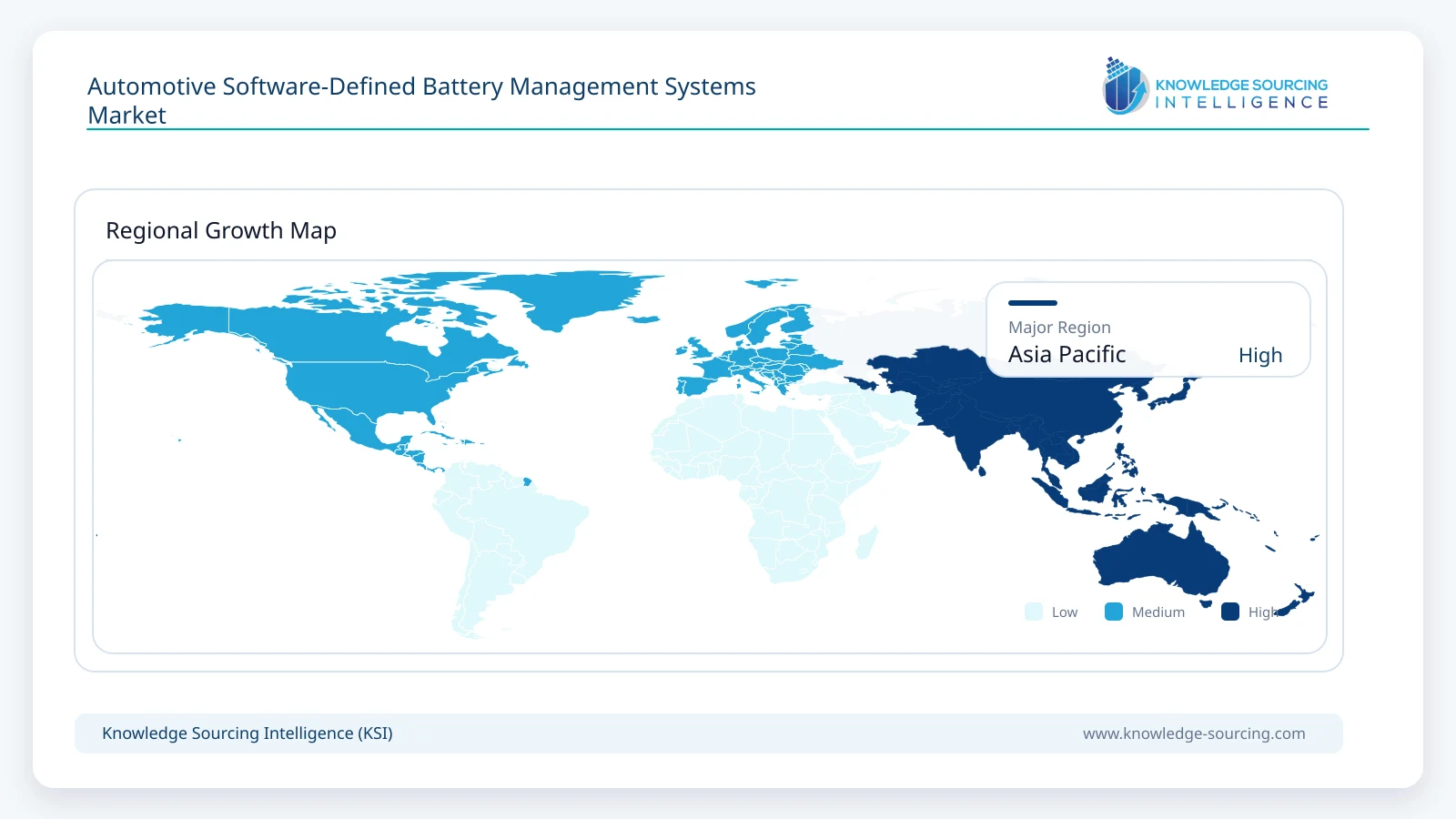
- 4Asia Pacific is the largest regional market, supported by China’s electric vehicle production base and battery-software development across Japan, South Korea and other manufacturing hubs.
- 5Production BMS procurement remains tied to functional safety and hardware qualification; software modularity improves reuse but does not remove controller validation and fault-response requirements.
- 6Battery-twin analytics and cloud monitoring support broader software-defined BMS capability, but the overlapping application value is counted only once within each commercial transaction.
Revenue covers reusable embedded BMS application software, configurable safety and charge-control functions, attributable BMS supervisory-controller content, battery-specific adaptive diagnostics and directly associated software calibration and integration. The market serves battery-electric, plug-in hybrid and selected hybrid vehicle programs using software-configurable traction battery control rather than a conventional fixed-function monitoring implementation.
LG Energy Solution’s B.around portfolio combines in-vehicle battery-management software with diagnostic and lifecycle services, including adaptations for software-defined vehicle architectures. NXP and Elektrobit have jointly developed an AUTOSAR-based platform that separates high-voltage BMS application development from the detailed communications between battery controllers and cell-monitoring devices. These offerings illustrate alternative commercialization routes: an integrated battery-software package from an energy-storage specialist or reusable software and development infrastructure assembled into an OEM’s own controller.
Market Overview
Traction-battery controllers measure cell voltage, current and temperature while maintaining protection limits during charging, driving and fault conditions. Software-defined systems retain these time-critical responsibilities but separate more functions into validated, configurable software modules that can be adapted for different cell chemistries, pack capacities and vehicle configurations. The architecture typically combines measurement interfaces and local protection electronics with a supervisory controller carrying state estimation, balancing coordination, charge permission and health diagnostics.
LG Energy Solution’s software-defined battery approach relocates selected calculations from dedicated hardware or cloud environments to higher-performance vehicle computers, allowing suppliers to deploy advanced algorithms without making every battery pack a separate control-software project. Elektrobit and NXP’s Classic AUTOSAR work makes communication between the BMS MCU and cell controllers easier to abstract, while Renesas supplies automotive BMS application models and driver software for state estimation and functional-safety development. Analog Devices provides wired and wireless monitoring architectures whose configurability can reduce repeated pack-specific engineering, although wireless communication itself does not establish a fully software-defined BMS.
OEM sourcing differs considerably between vertically integrated manufacturers and automakers that purchase battery modules from Tier 1 suppliers. A vertically integrated program may license specialized estimation or charge-control algorithms while retaining ownership of safety functions; another vehicle program may contract for a ready-to-integrate BMS controller, licensed application stack and calibration. As software becomes more portable, validation evidence, chemistry-specific data and the ability to manage several released software versions become commercially important alongside monitoring accuracy and hardware cost.
Market Trends
Reusable BMS Software Is Reducing Pack-Specific Rework
NXP and Elektrobit’s high-voltage reference software abstracts interactions between battery controller and cell-monitor ICs using Classic AUTOSAR components. Reusable software allows engineering teams to carry established communication, diagnostic and safety mechanisms into new pack designs while adjusting configuration and protection parameters for each vehicle. This reduces repeated development work, although every material hardware or battery-chemistry change still requires integration tests and safety analysis.
LG Energy Solution’s B.around strategy similarly offers standardized and customized BMS solutions alongside separate safety and life-prediction applications. The commercial opportunity is strongest among OEMs using common electrical platforms for several vehicle models, where a stable software base can support multiple battery capacities without reproducing every control function from the beginning.
Battery Health Algorithms Are Moving Closer to the Control Loop
Infineon and Eatron extended their battery-management collaboration in February 2025, combining embedded compute with algorithms that estimate state of charge, remaining life and emerging safety risks. Eatron’s automotive Battery Optimisation Suite also addresses fast charging and battery-health prediction. These functions use the same cell measurements as a conventional BMS, but adaptive models can refine the operating window as battery behavior changes rather than relying entirely on static calibration tables.
Real-time deployment requires defined fail-safe limits because a learned estimate must not override independently validated hardware protection. Qnovo’s automotive software combines charging optimization with health and safety functions, providing another example of algorithms becoming a separately procured BMS capability. Supplier value increasingly depends on validated estimation performance, battery-data access and the ability to maintain consistent control behavior throughout the vehicle lifecycle.
Vehicle Computing Consolidation Is Changing BMS Integration
Battery-control applications are increasingly being considered within domain and centralized computing strategies, particularly where charging coordination and energy management already exchange vehicle-wide operating information. LG Energy Solution has described moving selected battery-management algorithms into high-performance vehicle computing platforms. The architecture can reduce duplicated computation and support cross-domain coordination, provided hard real-time isolation, fault supervision and communication continuity remain intact.
BorgWarner’s February 2026 BMS program expansion shows that dedicated production controllers remain commercially relevant even as software modularity advances. The supplier confirmed ongoing series production and applications planned from 2029 across BEV and PHEV vehicles. Consequently, the forecast includes both conventional form-factor controllers with configurable application stacks and newer software partitions hosted by higher-level vehicle computers, rather than assuming a complete hardware replacement.
Segment Analysis
By BMS Software Capability: Core Monitoring and Protection
Core protection, fault supervision and state estimation remain the largest functional revenue pool because all software-defined battery programs require reliable measurement interpretation and deterministic operating limits. Infineon’s functional-safety application guidance and Renesas’s model-based BMS software show that even relatively standardized functions demand careful control of sensor errors, startup behavior, diagnostics and processor safety mechanisms. The segment is estimated at USD 260 million in 2026 and USD 680 million by 2031.
Configurable charging and balancing functions increase in importance where OEMs want to support different pack capacities or chemistries on shared platforms. Advanced health and adaptive-performance algorithms are forecast to grow faster than core protection functions, reflecting demand for battery-life estimation and charging refinement, although these models remain subordinate to validated safety limits.
By Revenue Component: Embedded BMS Application Software
Embedded application software represents the largest revenue component as automakers source reusable state estimation, balancing supervision, diagnostic and charge-control functions. The modeled segment is expected to grow from USD 260 million in 2026 to USD 980 million by 2031. Supplier offerings differ between OEM-owned software stacks supported by specialist libraries and Tier 1 controllers containing a configured software package; upstream chips and complete controller transactions are not counted separately within the same installation.
Attributable supervisory electronics remain substantial because local fault detection and secure control cannot be replaced by cloud analytics. Advanced diagnostic and adaptive models gain share as larger operating datasets improve calibration, while integration and lifecycle engineering is sustained by chemistry changes, model updates and the need to prove continued safe operation after software revisions.
By Control Architecture: Dedicated Central BMS Controllers
Dedicated central BMS controllers remain the largest configuration in 2026 because their hardware and application software are integrated with established pack-monitoring networks and protection mechanisms. BorgWarner’s scalable series-production BMS demonstrates the durability of centralized, safety-qualified procurement. As platforms evolve, distributed BMS configurations and central-compute-hosted applications gain value through improved functional partitioning and reusable control software.
A domain-hosted application is not equivalent to moving all battery safety functions to a central computer. High-integrity measurement, protective shutoff and certain monitoring loops must remain local or independently supervised, leaving a hybrid architecture in which higher-level optimization and configuration can move without compromising the pack’s immediate fault response.
By Propulsion Type: Battery Electric Vehicles
Battery electric vehicles are estimated to account for USD 560 million in 2026 market value, reflecting larger traction packs and greater exposure to fast charging, range-sensitive energy management and battery warranty costs. As software-defined platforms spread, OEMs can reuse estimation algorithms while adapting pack-specific calibration to LFP and nickel-rich chemistries. Plug-in and range-extended hybrids also require high-voltage protection but generally involve different charging patterns and integration priorities.
Commercial adoption depends on measurable program economics rather than a universal shift to advanced algorithms. For cost-sensitive vehicle lines, a compact fixed-function BMS may remain appropriate, whereas higher-volume programs can justify software modularity through reduced development time, shared validation assets and continuing improvement of battery performance.
Market Drivers
Growing EV Production and Battery Diversity
The IEA reports more than 20 million electric-car sales in 2025 and projects approximately 23 million for 2026. The growing variety of pack voltages, capacities and battery chemistries creates demand for software that can be reused across vehicle programs without starting BMS application engineering from the beginning. Battery suppliers and OEMs gain flexibility when they can preserve validated communication and protection functions while adapting operating models to the next pack generation.
OEM Shift Toward Shared Electrical and Software Platforms
Manufacturers consolidating vehicle electrical architectures need battery software that can interface with thermal control, charging, domain computers and diagnostics through stable software contracts. LG Energy Solution’s SDV-oriented BMS approach and NXP–Elektrobit’s AUTOSAR platform support reuse across control hardware and vehicle models. Platform reuse is particularly valuable when several electric vehicles share a production schedule but carry distinct battery capacities.
Demand for Adaptive Charging and Battery Health Control
Qnovo and Eatron offer algorithms that refine state estimates, charging behavior and battery life prediction beyond conventional static BMS thresholds. More accurate knowledge of current battery condition can support usable range and charging performance without breaching calibrated limits. Suppliers monetizing these functions increasingly deliver specialized software and calibration rather than only additional sensing channels.
Need for Safer and Traceable Software Updates
UN Regulation No. 156 establishes processes for vehicle software-update management, including identification, integrity and compatibility controls. Battery software that changes charge current, protection calibration or thermal priorities is a particularly sensitive update target. Automakers therefore require robust release traceability, regression testing and rollback planning alongside the application software, supporting paid integration and lifecycle engineering.
Production Programs Require Longer Software Support
BorgWarner’s 2026 expanded BMS award identifies additional BEV and PHEV applications scheduled from 2029, illustrating multi-year production and application-support cycles. A configurable BMS can preserve tested software assets as programs extend into new vehicles, but suppliers must maintain compatibility with sensors, memory and safety-monitoring revisions. Extended lifecycle support creates recurring engineering opportunities beyond the first controller delivery.
Market Restraints
Functional-Safety Revalidation Across Software Releases
Changes to charging, balancing or state-estimation logic can affect protective decisions and must be tested against ISO 26262 safety goals, operating faults and hardware assumptions. Reusable components reduce duplicated work but cannot eliminate application-specific verification. The need for extensive battery and vehicle testing slows deployment of advanced functions and increases supplier engineering costs.
Limited Processor and Memory Resources in Installed BMS Hardware
Many established battery controllers were dimensioned for fixed diagnostics and protection algorithms rather than computation-intensive adaptive models. More complex health estimation can require additional memory, processing headroom and monitoring interfaces. Retrofitting these functions to an existing ECU may be uneconomic when control hardware cannot meet timing or safety requirements.
Battery Chemistry and Cell-to-Cell Variability
Algorithms trained for one chemistry or supplier cell cannot automatically be reused across LFP, nickel-rich and emerging battery formats. Differing charge acceptance, aging patterns and temperature responses require new datasets and calibrated model parameters. OEMs may postpone shared software rollout when validated battery data is incomplete or pack specifications continue to change.
Supplier Data Access and Intellectual-Property Constraints
Cell manufacturers, battery pack integrators and vehicle OEMs control different portions of battery engineering and field-use data. Specialist software suppliers cannot always obtain the measurements or failure outcomes needed to validate health predictions across vehicle populations. Licensing restrictions and uncertainty around ownership of calibration files can lengthen procurement and reduce the portability expected from software-defined architectures.
Cost Pressure and Integration Ownership
Automakers pursuing entry-level electric vehicles can favor mature fixed-function BMS solutions when extra software licenses, cybersecurity review and update-management work would increase cost. Vertically integrated OEMs also develop critical algorithms internally rather than paying independent software suppliers. These sourcing choices limit the directly addressable third-party revenue pool even as vehicle software capability expands.
Regional Outlook
Asia Pacific
China’s large electric-vehicle manufacturing ecosystem provides the principal regional demand base for battery-management software, while Japan and South Korea contribute cell technology, advanced automotive semiconductor development and vehicle platform engineering. The IEA estimates China accounted for nearly three-quarters of global electric-car production in 2025. The market is supported by OEM programs seeking common BMS software across several battery configurations, particularly where LFP and nickel-rich chemistries coexist in different vehicles.
Asian suppliers vary between vertically integrated manufacturers with proprietary battery data and independent engineering or software providers that offer reusable algorithms. India and Southeast Asia add longer-term opportunities as local electric-vehicle manufacturing develops, although the achievable third-party software spend depends on local pack production, program scale and whether OEMs license or develop control applications internally.
Europe
European OEMs and Tier 1 suppliers place substantial emphasis on functional safety, cybersecurity and evidence of controlled software change. BorgWarner’s global production BMS activities, Elektrobit’s AUTOSAR development tools and Eatron’s adaptive battery software illustrate different layers of the regional value chain. Vehicle producers deploying both BEV and PHEV lines benefit from software platforms that can maintain shared protection and communication functions while accommodating battery-specific calibration.
Europe’s transition toward software-defined vehicle architectures favors suppliers able to document version compatibility, diagnostic performance and the safety case for changed algorithms. Regulatory software-update requirements reinforce process discipline, but they do not create an automatic obligation to buy a separate battery software platform. Suppliers that can integrate into existing OEM software environments and validate several cell chemistries are better positioned to win long-lived programs.
Competitive Landscape
Competition combines BMS system integrators, embedded software-platform providers and specialists in battery-state algorithms. LG Energy Solution pairs battery manufacturing data with B.around’s in-vehicle and connected software; BorgWarner supplies production BMS systems for OEM programs; Elektrobit provides automotive software infrastructure with NXP; and Eatron and Qnovo concentrate on higher-value estimation, battery safety and charging algorithms. Analog Devices, Infineon and Renesas enable software-configurable implementations through controller, monitoring and reference-software technology, but their entire semiconductor revenue is not equivalent to the market’s application-software value.
OEMs increasingly evaluate the software supplier’s access to chemistry-specific data, ability to pass functional-safety review and capability to manage software changes across several vehicle releases. The resulting competitive environment includes in-house stacks and licensed component software as much as complete BMS module contracts. Public disclosures do not support a reliable ranking of standalone software-defined BMS revenue shares across suppliers.
Recent Developments
August 2026: Schaeffler and CATL announced a memorandum of understanding to jointly develop battery management systems and integrated power-electronics solutions, with an initial European focus. The agreement is a development commitment, not confirmed series production.
August 2026: Electra AI and Omega Seiki Mobility announced a strategic partnership to bring real-time battery-health intelligence and predictive analytics into Omega Seiki’s electric-vehicle ecosystem. The release did not quantify fitted production volumes.
February 2026: BorgWarner announced expansion of a BMS series-production program already supplied since 2023, with additional BEV and PHEV vehicle applications planned to begin in 2029.
June 2025: Qnovo reported achieving Automotive SPICE process capability for development of its battery-intelligence software, strengthening its positioning with OEMs that require disciplined automotive development processes.
April 2025: Sibros and Electra Vehicles announced an integration partnership connecting vehicle data collection with battery intelligence and adaptive-control technology for software-defined vehicles; partner deployment volumes were not specified.
February 2025: Infineon and Eatron extended their earlier automotive AI-BMS partnership into industrial and consumer battery applications, showing how configurable estimation and diagnostic software can be ported to adjacent systems.
Market Outlook
Automakers are increasing purchases of reusable BMS application software, configurable diagnostics, and specialized calibration support as electric-vehicle programs adopt shared hardware and software platforms. Software portability and validated battery-control models are supporting market expansion beyond standalone hardware-linked firmware. Safety-critical protection functions continue to require rigorous local execution and application-specific verification.
Battery management architectures are likely to remain mixed. Dedicated controllers will retain a major role in production, while selected estimation and energy-coordination applications migrate to domain or central vehicle compute platforms. Suppliers that combine battery engineering data, validated safety functions and software-maintenance capability can participate in a broader range of OEM programs than firms limited to one controller generation.
Market Scope
| Report Metric | Details |
|---|---|
| Total Market Size in 2026 | USD 760 million |
| Total Market Size in 2031 | USD 2,580 million |
| Forecast Unit | Million |
| Growth Rate | 27.7% |
| Study Period | 2021 to 2031 |
| Historical Data | 2021 to 2024 |
| Base Year | 2025 |
| Forecast Period | 2026 – 2031 |
| Segmentation | BMS Software Capability, Revenue Component, Control Architecture, Software Execution Environment, Battery Chemistry, Propulsion Type, Vehicle Type, Geography |
| Companies |
|
Market Segmentation
By BMS Software Capability
Core Monitoring, Protection and State Estimation
Configurable Charge and Cell-Balancing Control
Embedded Safety and Fault Diagnostics
Battery Health and Adaptive Performance
Software Lifecycle and Configuration Functions
By Revenue Component
Embedded BMS Application Software
Attributable BMS Control Electronics
Advanced Diagnostic and Adaptive Models
BMS Integration, Calibration and Lifecycle Engineering
By Control Architecture
Dedicated Central BMS Controller
Modular Distributed BMS with Central Supervision
Central-Compute or Domain-Hosted BMS Applications
By Software Execution Environment
Local Embedded BMS Execution
Connected Edge-Cloud Battery Control
Central Vehicle Compute-Hosted Application
By Battery Chemistry
Lithium Iron Phosphate (LFP)
Nickel-Rich Lithium-Ion (NMC/NCA)
Other Lithium and Emerging Chemistries
By Propulsion Type
Battery Electric Vehicles
Plug-In Hybrid and Range-Extended Electric Vehicles
Full and Mild Hybrid Vehicles
By Vehicle Type
Passenger Vehicles
Light Commercial Vehicles
Buses and Medium/Heavy Commercial Vehicles
By Geography
Asia Pacific
China
Japan
South Korea
India
Thailand
Indonesia
Others
Europe
Germany
United Kingdom
France
Italy
Spain
Others
North America
United States
Canada
Mexico
South America
Brazil
Argentina
Others
Middle East and Africa
Saudi Arabia
United Arab Emirates
South Africa
Others
Table of Contents
1. EXECUTIVE SUMMARY
1.1. Market Opportunity and Key Findings
1.2. Software-Defined BMS Market Outlook
2. MARKET SNAPSHOT
2.1. Market Overview
2.2. Market Definition
2.3. Scope of the Study
2.4. Market Segmentation
3. BUSINESS LANDSCAPE
3.1. Market Drivers
3.1.1. Growing EV Production and Battery Diversity
3.1.2. OEM Shift Toward Shared Electrical and Software Platforms
3.1.3. Demand for Adaptive Charging and Battery Health Control
3.1.4. Need for Safer and Traceable Software Updates
3.1.5. Production Programs Require Longer Software Support
3.2. Market Restraints
3.2.1. Functional-Safety Revalidation Across Software Releases
3.2.2. Limited Processor and Memory Resources in Installed BMS Hardware
3.2.3. Battery Chemistry and Cell-to-Cell Variability
3.2.4. Supplier Data Access and Intellectual-Property Constraints
3.2.5. Cost Pressure and Integration Ownership
3.3. Market Opportunities
3.4. Porter’s Five Forces Analysis
3.5. Industry Value Chain Analysis
3.6. Policies and Regulations
3.7. Strategic Recommendations
4. TECHNOLOGICAL OUTLOOK
4.1. Modular AUTOSAR BMS Architecture
4.2. Safety-Qualified State Estimation
4.3. Software-Configurable Cell Balancing
4.4. Embedded Battery Intelligence
4.5. BMS Software Updates and Lifecycle Management
5. AUTOMOTIVE SOFTWARE-DEFINED BATTERY MANAGEMENT SYSTEMS MARKET BY BMS SOFTWARE CAPABILITY
5.1. Introduction
5.2. Core Monitoring, Protection and State Estimation
5.3. Configurable Charge and Cell-Balancing Control
5.4. Embedded Safety and Fault Diagnostics
5.5. Battery Health and Adaptive Performance
5.6. Software Lifecycle and Configuration Functions
6. AUTOMOTIVE SOFTWARE-DEFINED BATTERY MANAGEMENT SYSTEMS MARKET BY REVENUE COMPONENT
6.1. Introduction
6.2. Embedded BMS Application Software
6.3. Attributable BMS Control Electronics
6.4. Advanced Diagnostic and Adaptive Models
6.5. BMS Integration, Calibration and Lifecycle Engineering
7. AUTOMOTIVE SOFTWARE-DEFINED BATTERY MANAGEMENT SYSTEMS MARKET BY CONTROL ARCHITECTURE
7.1. Introduction
7.2. Dedicated Central BMS Controller
7.3. Modular Distributed BMS with Central Supervision
7.4. Central-Compute or Domain-Hosted BMS Applications
8. AUTOMOTIVE SOFTWARE-DEFINED BATTERY MANAGEMENT SYSTEMS MARKET BY SOFTWARE EXECUTION ENVIRONMENT
8.1. Introduction
8.2. Local Embedded BMS Execution
8.3. Connected Edge-Cloud Battery Control
8.4. Central Vehicle Compute-Hosted Application
9. AUTOMOTIVE SOFTWARE-DEFINED BATTERY MANAGEMENT SYSTEMS MARKET BY BATTERY CHEMISTRY
9.1. Introduction
9.2. Lithium Iron Phosphate (LFP)
9.3. Nickel-Rich Lithium-Ion (NMC/NCA)
9.4. Other Lithium and Emerging Chemistries
10. AUTOMOTIVE SOFTWARE-DEFINED BATTERY MANAGEMENT SYSTEMS MARKET BY PROPULSION TYPE
10.1. Introduction
10.2. Battery Electric Vehicles
10.3. Plug-In Hybrid and Range-Extended Electric Vehicles
10.4. Full and Mild Hybrid Vehicles
11. AUTOMOTIVE SOFTWARE-DEFINED BATTERY MANAGEMENT SYSTEMS MARKET BY VEHICLE TYPE
11.1. Introduction
11.2. Passenger Vehicles
11.3. Light Commercial Vehicles
11.4. Buses and Medium/Heavy Commercial Vehicles
12. AUTOMOTIVE SOFTWARE-DEFINED BATTERY MANAGEMENT SYSTEMS MARKET BY GEOGRAPHY
12.1. Introduction
12.2. Asia Pacific
12.2.1. China
12.2.2. Japan
12.2.3. South Korea
12.2.4. India
12.2.5. Thailand
12.2.6. Indonesia
12.2.7. Others
12.3. Europe
12.3.1. Germany
12.3.2. United Kingdom
12.3.3. France
12.3.4. Italy
12.3.5. Spain
12.3.6. Others
12.4. North America
12.4.1. United States
12.4.2. Canada
12.4.3. Mexico
12.5. South America
12.5.1. Brazil
12.5.2. Argentina
12.5.3. Others
12.6. Middle East and Africa
12.6.1. Saudi Arabia
12.6.2. United Arab Emirates
12.6.3. South Africa
12.6.4. Others
13. COMPETITIVE ENVIRONMENT AND ANALYSIS
13.1. Major Players and Strategy Analysis
13.2. Market Share Analysis
13.3. Mergers, Acquisitions, Agreements and Collaborations
13.4. Competitive Dashboard
14. COMPANY PROFILES
14.1. LG Energy Solution, Ltd.
14.2. BorgWarner Inc.
14.3. Robert Bosch GmbH
14.4. Elektrobit Automotive GmbH
14.5. NXP Semiconductors N.V.
14.6. Eatron Technologies Ltd.
14.7. Qnovo Inc.
14.8. Electra Vehicles, Inc.
14.9. Analog Devices, Inc.
14.10. Infineon Technologies AG
14.11. Renesas Electronics Corporation
14.12. Schaeffler AG
15. APPENDIX
15.1. Currency
15.2. Assumptions
15.3. Base and Forecast Years Timeline
15.4. Key Benefits for Stakeholders
15.5. Research Methodology
15.6. Abbreviations
Navigate
Trusted by the world's leading organizations











