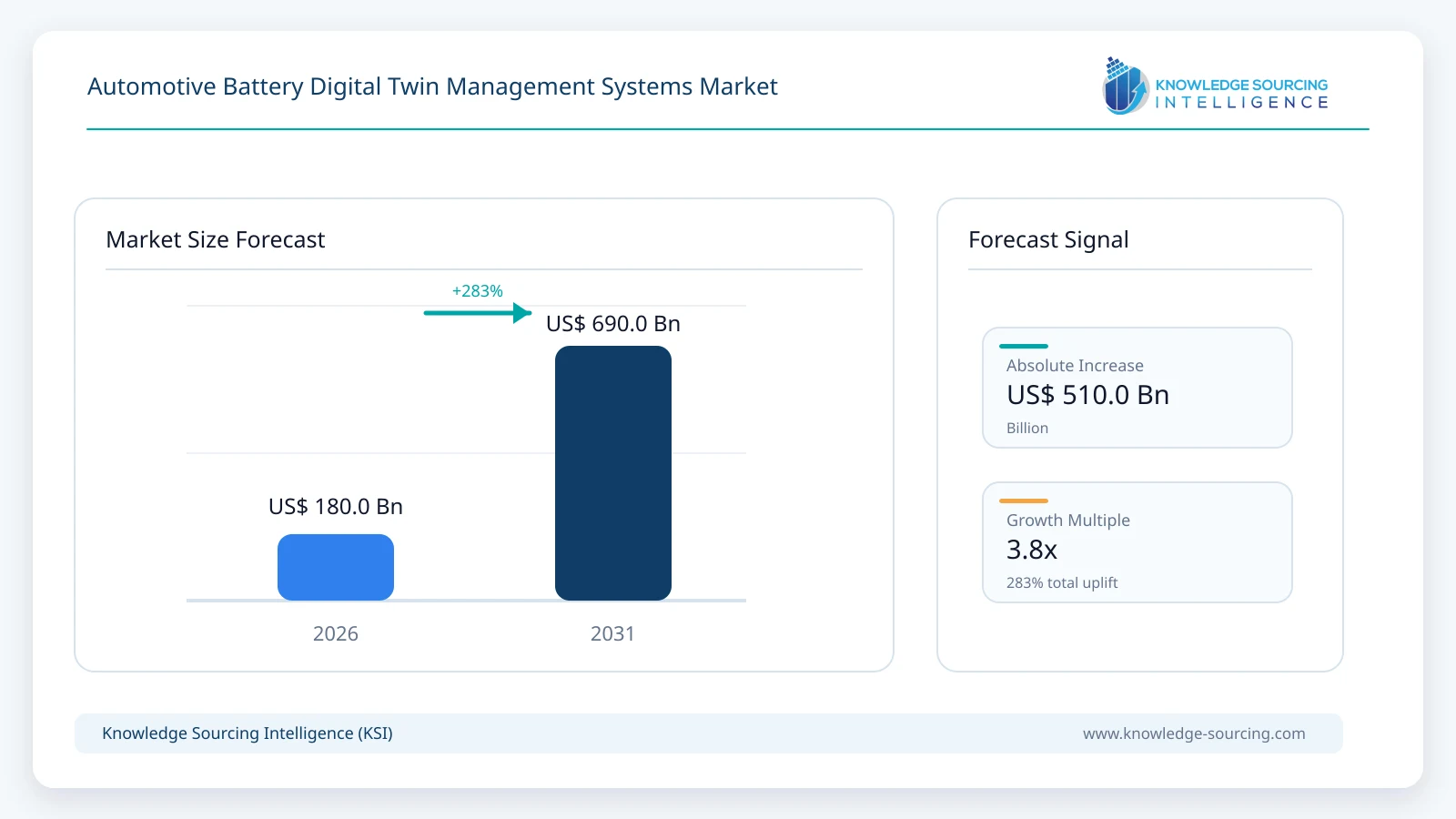
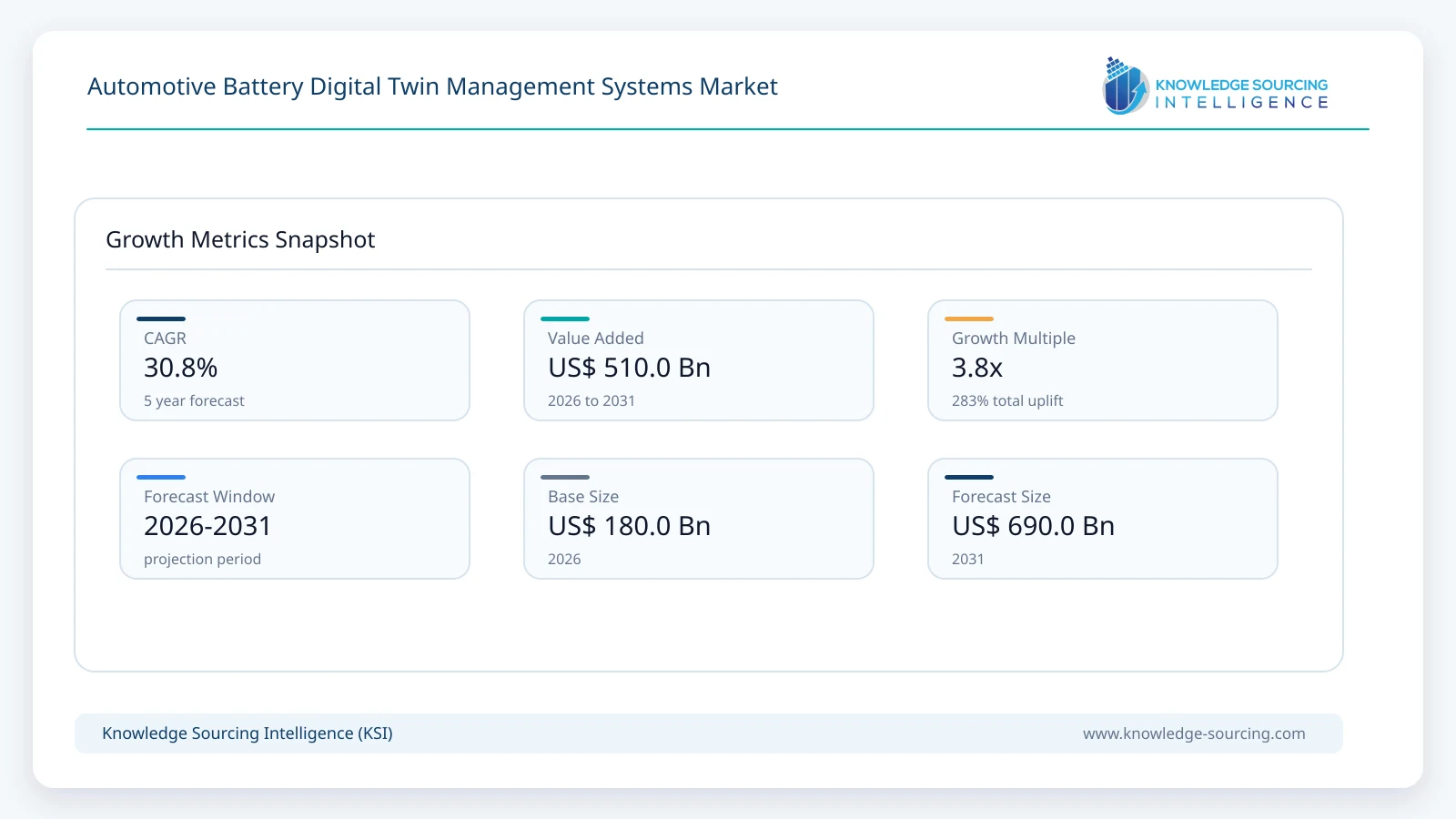
The automotive battery digital twin management systems market is projected to grow from USD 180 million in 2026 to USD 690 million by 2031, at a CAGR of 30.8% during the forecast period.
Highlights:
- 1Physics-informed hybrid models hold the largest modeled share of software value in 2026, reflecting the need to interpret battery behavior outside well-observed operating conditions.
- 2Battery health and degradation estimation accounts for approximately 37% of 2026 market revenue.
- 3Cloud-hosted systems lead current deployments, while embedded digital-twin functions gain share as vehicle computing and diagnostics mature.
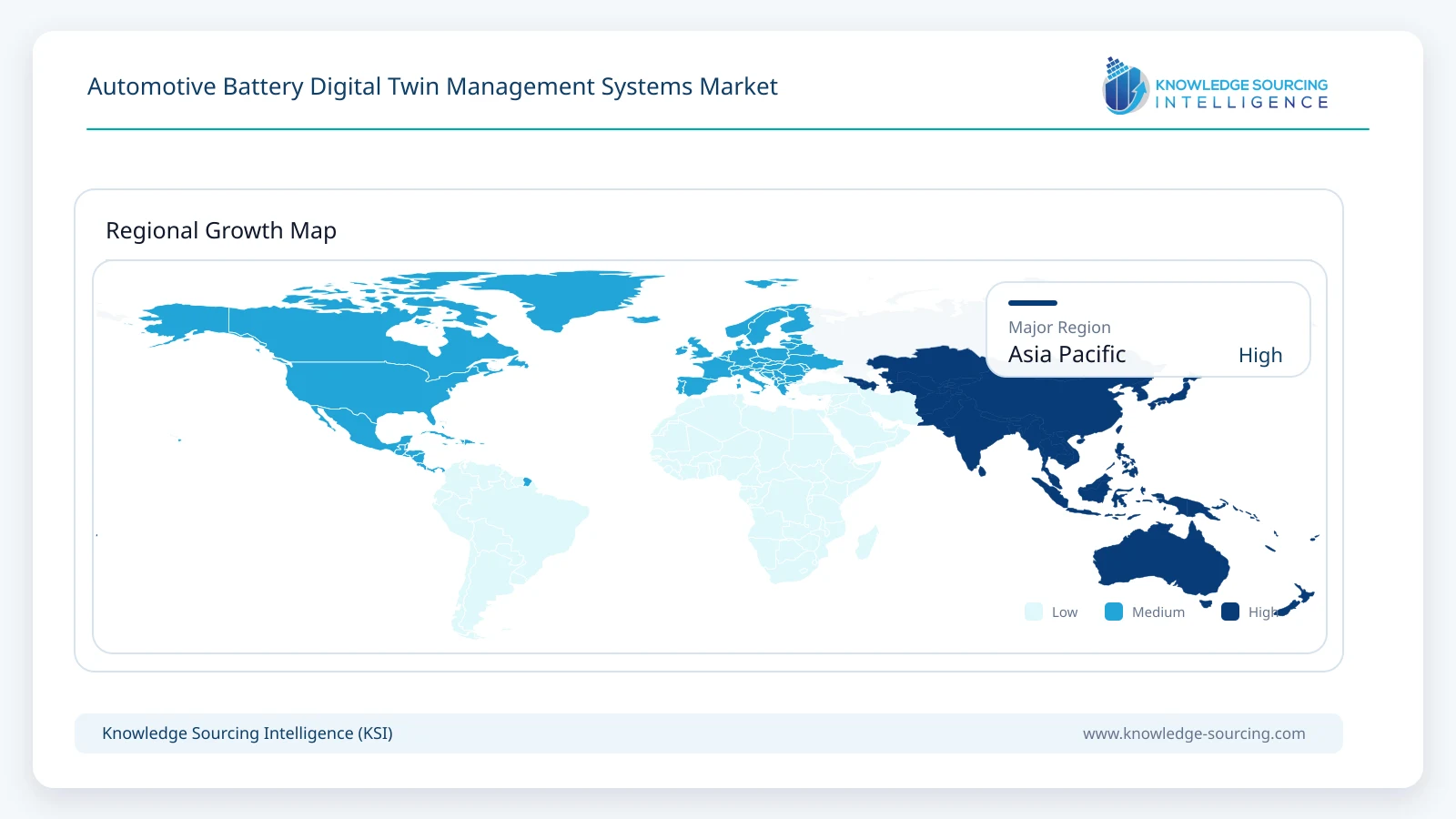
- 4Asia Pacific leads the regional market in 2026, reflecting electric-vehicle manufacturing scale and expanding local battery-software capability.
- 5Recurring in-service analytics represent an increasing revenue opportunity as connected electric-vehicle fleets accumulate operating histories.
- 6European battery-passport requirements strengthen the value of traceable battery data without mandating a predictive digital twin.
Electric-vehicle batteries age differently depending on charging speed, thermal exposure, cell chemistry and operating patterns. A digital twin connects these measured histories to a physics-based or learned battery model, allowing the software to estimate state of health and project the consequences of future use. Unlike a fixed design-stage simulation, an operating digital twin is updated with data from a particular vehicle or fleet and can refine its prediction when measured performance departs from prior assumptions.
Bosch's connected battery services use the vehicle telematics path to support individual battery twins in the cloud, including anomaly analysis at cell and module level. Electra combines EnPower battery models with EVE-Ai fleet analytics and embedded adaptive control, while Eatron positions SOH and remaining-life estimation across edge and cloud environments. The supplier approaches differ in where models execute and whether results are used principally for warranty management, safety diagnosis or direct charging optimization; they share a dependence on high-quality operating data and calibration to actual cell behavior.
Automakers can maintain the core BMS and contract for additional diagnostic models, or purchase a broader analytics service that periodically processes historical telemetry. Engineering firms such as AVL and tool providers such as MathWorks and Batemo support model construction, validation and adaptation to different chemistries. As large fleets begin to supply useful aging records, competitive advantage shifts from simply collecting voltage and temperature data toward testing models against real failure and degradation outcomes, while protecting battery data and managing software across vehicle generations.
Market Trends
Battery Models Are Moving from Design Validation into In-Service Use
Battery digital twins originated partly in the engineering requirement to reproduce cell aging under different temperatures, currents and duty cycles. AVL uses fleet data alongside aging simulations to predict battery lifetime, while Bosch applies battery-specific models to connected vehicles during normal operation. Moving a model into service changes its commercial value: OEMs can use actual battery behavior to evaluate warranty exposure, identify abnormal degradation and prioritize service interventions rather than relying solely on test-bench averages.
Model maintenance becomes a recurring responsibility once the initial vehicle leaves the factory. Changes in software, charging hardware, cell suppliers and driving patterns can alter the relationship between measured signals and predicted health. Battery analytics providers therefore need robust version control and continued validation across pack variants, creating demand for long-running customer contracts rather than one-off modeling studies.
Edge and Cloud Execution Are Becoming Complementary
Qnovo's automotive software can execute on battery-management electronics, while Bosch's individual battery twins use cloud processing and vehicle telemetry. Onboard estimation offers low-latency decisions and can preserve essential functions when connectivity is unavailable; remote analytics brings larger fleet datasets, heavier model computation and cross-vehicle benchmarking. Electra's embedded EVE-Ai architecture and Eatron's edge-cloud approach illustrate how suppliers are combining the two execution environments.
OEM deployment choices depend on processor resources, cyber-security architecture, data transmission costs and the consequence of a delayed warning. Safety-critical decisions must continue locally where necessary, while cloud services can update prediction parameters and detect population-level deterioration patterns. The most commercially valuable integrations allow models to improve without moving the entire battery data stream or interfering with validated real-time BMS protection loops.
Battery Condition Evidence Is Extending into Resale and Warranty Decisions
European battery-passport obligations scheduled from February 2027 make battery-specific records more important to manufacturers and downstream operators. A passport is a regulated information record, whereas a predictive digital twin uses historical and current measurements to estimate hidden wear or future performance. Qnovo's September 2026 Battery Genome application pilot is directed at battery health and residual-value assessment, illustrating the opportunity to provide stronger condition evidence beyond static vehicle age and mileage.
For used-vehicle sellers, a model-based health record can reduce uncertainty if the underlying telemetry is complete and the method is independently validated. Insurers and warranty providers may also use degradation forecasts to distinguish normal aging from abnormal risk. Commercial adoption will depend on auditability, model error bounds and access to vehicle data; a proprietary score that cannot be explained or transferred may have limited value outside the original manufacturer.
Chemistry-Specific Calibration Is Becoming a Differentiator
Lithium iron phosphate and nickel-rich lithium-ion batteries display different voltage signatures, aging profiles and thermal sensitivities. AVL emphasizes improved LFP state estimation in its battery software offering, while specialized physical models from Batemo can characterize specific commercial cells across temperature and charge conditions. Digital-twin providers need chemistry-aware models because one generalized aging curve cannot reliably support every pack design or charging regime.
Manufacturers changing cell sources or using multiple chemistries within the same vehicle platform must pay for parameter identification, validation and software maintenance. These tasks favor companies with battery domain expertise and access to laboratory and road datasets. Rapid chemistry changes also increase the usefulness of modular models that can be updated without replacing the full vehicle control software stack.
Automotive Battery Digital Twin Management Systems Market Segment Analysis
By Digital Twin Function
Battery Health and Degradation Estimation
Battery health and degradation estimation accounts for approximately 37% of 2026 revenue because it provides the core state information needed by many subsequent predictive functions. A useful twin estimates battery-specific capacity and resistance trends against charging history, temperature exposure and power demand. Bosch's connected battery model combines electrochemical and data-driven calculations, demonstrating the commercial importance of continued observation rather than a single diagnostic snapshot.
Manufacturers purchase aging-model calibration to support warranty provisions and service decisions, while fleet operators need comparable health readings across mixed-duty assets. As fault prediction and charging recommendations become more specialized, health estimation remains the model foundation but represents a smaller share of total spending by 2031. Competition depends on robustness across varying temperature conditions and cell chemistries rather than on a headline accuracy claim alone.
By Deployment Architecture
Cloud-Hosted Battery Digital Twins
Cloud-hosted battery twins represent approximately 47% of the 2026 market because central analysis can combine long operating histories with battery chemistry models and fleet-wide reference data. Bosch transfers preprocessed vehicle data to the cloud to generate condition and risk insights for individual packs. A single model platform can serve multiple vehicle generations when telemetry formatting, pack identification and access permissions are well managed.
Edge execution is expected to gain share as embedded processing supports richer health estimation and faster local decisions. Remote platforms will remain important for multi-year warranty surveillance and population-level anomaly detection, particularly when individual failure events are rare. Supplier integration work increasingly includes secure data pipelines, model distribution and consistency checks between on-vehicle and cloud estimates.
By Modeling Technology
Physics-Informed Hybrid Models
Physics-informed hybrid modeling combines battery behavior represented by electrochemical or equivalent-circuit principles with data-driven estimates of parameters that change over time. The approach represents about 43% of 2026 revenue, reflecting the need to predict degradation under operating patterns not densely represented in a training dataset. Bosch explicitly describes mixed electrochemical and learning-based models for battery anomaly detection; AVL also couples field observations with simulations.
Battery manufacturers and automakers must validate physical-model assumptions under low temperatures, high-power charging and changing states of charge. The hybrid segment is modeled to exceed half of industry revenue by 2031 as sophisticated battery condition services gain adoption. Commercial differentiation lies in computational efficiency and traceable prediction behavior as much as in the sophistication of the underlying algorithm.
By Vehicle Application
Battery Electric Passenger Vehicles
Battery electric passenger vehicles account for approximately 62% of market value in 2026 because their traction batteries are central to vehicle range, residual value and warranty exposure. Their growing connected installed base supports large-scale learning from real driving and charging histories. Qnovo's discussions with automotive manufacturers and Electra's EV-oriented modeling platforms demonstrate the importance of software that is portable across vehicle and cell configurations.
Commercial electric fleets contribute a distinct growth opportunity, since duty-cycle intensity makes available capacity and unplanned downtime costly. Battery electric passenger vehicles nevertheless retain the largest revenue position through 2031 as the largest population of eligible connected packs. The value captured per vehicle depends on whether health analytics are embedded at production or subscribed to later by a fleet operator.
Market Drivers
Increasing Connected Electric-Vehicle Deployment
The IEA reports that electric-car sales exceeded 20 million in 2025 and expects approximately 23 million in 2026, providing an expanding population of traction batteries whose condition can be monitored through software. More connected packs generate longer records of charging, temperature and performance, which improve opportunities to calibrate battery-specific models.
Vehicle OEMs can deploy predictive diagnostics on selected platforms and expand coverage once telemetry, calibration and warranty benefits are established. This gradual deployment raises recurring software demand without requiring every new electric vehicle to have a dedicated commercial digital twin.
Battery Warranty and Residual-Value Exposure
Traction battery replacement and capacity degradation create material warranty uncertainty for automakers, particularly where high-mileage use produces outcomes different from laboratory duty cycles. Bosch's aging prediction and battery condition services allow manufacturers to review stress factors and estimate degradation on connected vehicles.
Warranty teams need traceable information that identifies potentially abnormal aging early enough for engineering or service intervention. Fleet owners and remarketing businesses also gain value from defensible battery condition estimates that can distinguish heavily used packs from well-preserved batteries of the same age.
Software-Defined Battery Management
Qnovo's cooperation with Sonatus and Electra's partnership with Sibros demonstrate supplier efforts to integrate predictive battery analytics into more flexible vehicle-software architectures. Digital models can run in embedded controllers or rely on data obtained from connected vehicle platforms, reducing the need to redesign an entire BMS for each analytics function.
OEMs that separate diagnostic applications from basic battery protection can test new models on specific vehicles before wider rollout. Additional software functions become commercially viable when integration and validation are repeatable across successive vehicle platforms.
European Battery Lifecycle Transparency Requirements
The EU Battery Regulation requires an electronic battery passport from 18 February 2027 for EV batteries placed on the EU market, with information that includes individual usage-related data. Manufacturers therefore have a stronger incentive to maintain consistent identification and health records through the battery lifecycle.
Digital twins are not compulsory under the law, but predictive models can strengthen the underlying evidence used for battery condition, second-life planning and warranty assessment. Suppliers that connect approved data governance to credible health modeling may gain demand beyond minimum regulatory recordkeeping.
More Commercial Options for Specialist Battery Analytics
Eatron and NEXTY reported several battery-software projects advancing into commercial implementation in Japan during 2026, while Qnovo announced an investment from Hyundai Motor and Kia to advance battery intelligence. These developments show both specialist software sourcing and strategic OEM interest in improving battery-specific analytics.
Independent software providers can serve multiple automakers by maintaining reusable model libraries and application interfaces. Demand depends on measured improvements in diagnostics, lifetime prediction and charge optimization, rather than on broad adoption of a digital-twin label alone.
Market Restraints
Incomplete and Inconsistent Battery Telemetry
Digital-twin accuracy depends on continuous, trustworthy current, temperature and voltage measurements, yet older vehicles and lower-cost BMS platforms may expose only limited battery data. Missing operating history can conceal damaging events such as prolonged high states of charge or repeated fast charging at low temperature.
Model providers must build uncertainty controls and data-quality screening into their systems. More sensors or higher-frequency logging can improve diagnosis but add vehicle integration, communications and storage costs, particularly across mixed fleet brands.
Chemistry and Pack-Design Revalidation
Cell chemistry, module design, cooling layout and control software alter the relationship between measured pack signals and internal degradation. A model calibrated on one battery may perform poorly after an OEM changes suppliers or adopts a different cell format.
Automakers require laboratory testing, vehicle trials and long-duration field checks before relying on predictions for warranty or safety decisions. Frequent model revalidation raises engineering expenditure and can delay wide deployments despite the software-centric nature of the product.
Cybersecurity, Privacy and Data Ownership
Cloud battery twins frequently require telemetry tied to a vehicle identifier, location or detailed driving and charging patterns. Manufacturers must apply access controls, secure transfer, retention policies and data-use agreements while limiting unnecessary disclosure of personal or commercially sensitive information.
Fleet operators may not own the raw signals needed for an independent model if the OEM controls diagnostic interfaces. Incomplete rights to battery data reduce the number of vehicles a third-party provider can assess consistently and complicate cross-brand battery-health comparisons.
Model Explainability and Prediction Liability
A digital twin can estimate battery remaining useful life, but the result is uncertain because degradation depends on future operating conditions and rare failure mechanisms. Insurers and service managers cannot treat an unqualified risk score as conclusive proof that a battery is safe or defective.
Suppliers need documented validation ranges, drift detection and governance for model revisions. Where predictions trigger charge limits, warranty decisions or customer warnings, OEMs must retain clear responsibility for safety functions and verify that an updated model does not introduce unacceptable behavior.
Difficulty Monetizing Embedded and Existing BMS Functions
Automakers already purchase BMS electronics and baseline SOH estimation as part of a battery-pack program. A separate digital-twin supplier must show incremental value beyond those functions or risk having its software treated as a feature included within the existing BMS price.
Commercial negotiations can therefore involve limited per-vehicle license revenue, shared intellectual property, or engineering payments rather than a full standalone analytics subscription. Long procurement cycles and OEM control of connected-vehicle data can constrain independent suppliers' pricing power.
Regional Outlook
Asia Pacific
China's large electric-vehicle manufacturing base and growing installed fleet make Asia Pacific the largest modeled regional market, accounting for approximately 38% of global revenue in 2026. Vehicle manufacturers can generate significant battery-operating datasets from common platforms, supporting repeated calibration and detection of aging differences across cell suppliers. Japan and South Korea contribute established battery engineering capabilities, while India's emerging electric-vehicle fleets widen the longer-term application base.
Software developers entering the region must adapt to local data rules, OEM-owned software architectures and chemistry mixes that differ from European platforms. Eatron and NEXTY's Japan collaboration illustrates how local commercial partners can bridge specialist modeling capability and domestic vehicle programs. Faster adoption is expected where digital-twin analytics can be integrated into existing BMS and connected-vehicle platforms without additional pack hardware.
Europe
European automakers and engineering suppliers are important purchasers of battery-condition modeling because long battery warranties and residual-value considerations create demand for robust life-cycle evidence. Bosch, AVL, TWAICE and specialist UK battery-software suppliers contribute development capabilities spanning physics-based models, cloud analytics and embedded controls. Europe represents approximately 32% of modeled 2026 revenue, with a comparatively high share of engineering and validation activity.
The EU's 2027 battery-passport requirement increases demand for traceable identity and usage records, although the regulation does not prescribe predictive twin software. Models that can document degradation assumptions and share appropriate condition information will be better positioned for warranty, second-life and remarketing applications. Regulatory data governance and cross-OEM access remain commercial constraints that favor established integration partnerships.
Competitive Landscape
Bosch's battery-in-the-cloud offering illustrates how a large automotive supplier can combine battery engineering, vehicle connectivity and cloud services into a single customer relationship. Qnovo, Electra Vehicles and Eatron position predictive battery models as software products that can be added to existing BMS and connected-car architectures. Their competition centers on quality of SOH and failure forecasts, model portability and the strength of OEM validation, not on ownership of the BMS semiconductor hardware.
AVL, MathWorks and Batemo participate at the engineering and model-development layer, supplying simulations and battery knowledge that can support production digital-twin programs. TWAICE offers battery analytics expertise, with its mobility capabilities commercially distinct from its growing stationary-storage business. Breathe Battery Technologies contributes battery-aware charging software, an adjacent function that overlaps the market only where continuous battery state models are deployed and separately monetized.
OEMs control much of the telematics path and can elect to develop their own health models. Specialist vendors therefore benefit from demonstrating a measurable improvement over internal BMS algorithms and from negotiating access to the vehicle data necessary for continued tuning. Public disclosures do not support a defensible global supplier revenue ranking in this narrowly defined market.
Recent Developments
September 2026: Qnovo: Announced a Battery Genome-based software application in pilot for battery condition, defect risk and residual-value evaluation; the program had not been reported as a broad production rollout.
March 2026: Qnovo, Hyundai Motor and Kia: Announced strategic OEM investment to develop battery intelligence software; the investment is not a quantified series-production award.
January 2026: Electra Vehicles: Announced validation of EVE-Ai embedded AI battery management capabilities; validation is distinct from a disclosed fleet-wide deployment.
October 2025: Qnovo and Sonatus: Announced integration of predictive battery diagnostics with Sonatus AI Director to simplify deployment within software-defined vehicle architectures.
April 2025: Electra Vehicles and Sibros: Announced a connected-vehicle data and battery digital-twin analytics partnership connecting telemetry collection with Electra EVE-Ai models.
Market Outlook
Digital-twin management is expected to shift toward continuously maintained battery models that operate across embedded and cloud environments. Advanced health estimation will remain the foundation, but OEM procurement is likely to give greater value to validated anomaly prognosis, charging optimization and software that connects battery condition to service or warranty actions. Emerging LFP and nickel-rich battery architectures will require distinct model calibration rather than a universal prediction library.
As electric-vehicle fleets age, the addressable volume of batteries needing in-service health assessment increases independently of annual new-car production. Vendors that can access reliable history data, provide transparent model error limits and maintain coverage across multiple OEM platforms will be positioned to win recurring software contracts. The pace of growth will remain limited by data rights, embedded BMS functionality and the difficulty of attributing value when analytics are bundled into broader vehicle software.
Automotive Battery Digital Twin Management Systems Market Scope:
| Report Metric | Details |
|---|---|
| Total Market Size in 2026 | USD 180 million |
| Total Market Size in 2031 | USD 690 million |
| Forecast Unit | USD Billion |
| Growth Rate | 30.8% |
| Study Period | 2021 to 2031 |
| Historical Data | 2021 to 2024 |
| Base Year | 2025 |
| Forecast Period | 2026 – 2031 |
| Segmentation | Digital Twin Function, Deployment Architecture, Revenue Stream, Modeling Technology, Vehicle Application, Customer Type, Battery Chemistry, Geography |
| Companies |
|
Market Segmentation
By Digital Twin Function
Battery Health and Degradation Estimation
Anomaly Detection and Safety Prognostics
Remaining Useful Life Forecasting
Charging and Operating Strategy Optimization
Residual Value and Lifecycle Assessment
By Deployment Architecture
Cloud-Hosted Battery Digital Twins
Embedded and Edge Digital Twins
Hybrid Edge-Cloud Platforms
By Revenue Stream
New-Vehicle Software and Digital Twin Licensing
In-Service Fleet Analytics and Renewals
Calibration, Integration and Validation Services
By Modeling Technology
Physics-Informed Hybrid Models
Data-Driven Predictive Models
Equivalent-Circuit and Reduced-Order Models
By Vehicle Application
Battery Electric Passenger Vehicles
Plug-in Hybrid Passenger Vehicles
Electric Light Commercial Vehicles
Electric Buses, Trucks and Specialized Vehicles
By Customer Type
Vehicle OEMs
Fleet and Mobility Operators
Aftermarket Diagnostics and Remarketing Providers
Battery Manufacturers and Tier-1 Integrators
By Battery Chemistry
Lithium Iron Phosphate (LFP)
Nickel-Rich Lithium-Ion (NMC/NCA)
Other Lithium-Ion Chemistries
By Geography
Asia Pacific
China
Japan
South Korea
India
Australia
Thailand
Indonesia
Others
Europe
Germany
United Kingdom
France
Italy
Spain
Others
North America
United States
Canada
Mexico
South America
Brazil
Argentina
Others
Middle East and Africa
United Arab Emirates
Saudi Arabia
Israel
South Africa
Others
Table of Contents
1. EXECUTIVE SUMMARY
1.1. Market Opportunity and Key Findings
1.2. Battery Digital Twin Technology and Commercial Outlook
2. MARKET SNAPSHOT
2.1. Market Overview
2.2. Market Definition
2.3. Scope of the Study
2.4. Market Segmentation
3. BUSINESS LANDSCAPE
3.1. Market Drivers
3.1.1. Increasing Connected Electric-Vehicle Deployment
3.1.2. Battery Warranty and Residual-Value Exposure
3.1.3. Software-Defined Battery Management
3.1.4. European Battery Lifecycle Transparency Requirements
3.1.5. More Commercial Options for Specialist Battery Analytics
3.2. Market Restraints
3.2.1. Incomplete and Inconsistent Battery Telemetry
3.2.2. Chemistry and Pack-Design Revalidation
3.2.3. Cybersecurity, Privacy and Data Ownership
3.2.4. Model Explainability and Prediction Liability
3.2.5. Difficulty Monetizing Embedded and Existing BMS Functions
3.3. Market Opportunities
3.4. Porter’s Five Forces Analysis
3.5. Industry Value Chain Analysis
3.6. Policies and Regulations
3.7. Strategic Recommendations
4. TECHNOLOGICAL OUTLOOK
4.1. Physics-Informed Electrochemical Models
4.2. Edge and Cloud State Synchronization
4.3. Vehicle Telemetry and Model Recalibration
4.4. Health, Degradation and Remaining Useful Life Estimation
4.5. Digital-Twin Validation and Cybersecurity
5. MARKET BY DIGITAL TWIN FUNCTION
5.1. Introduction
5.2. Battery Health and Degradation Estimation
5.3. Anomaly Detection and Safety Prognostics
5.4. Remaining Useful Life Forecasting
5.5. Charging and Operating Strategy Optimization
5.6. Residual Value and Lifecycle Assessment
6. MARKET BY DEPLOYMENT ARCHITECTURE
6.1. Introduction
6.2. Cloud-Hosted Battery Digital Twins
6.3. Embedded and Edge Digital Twins
6.4. Hybrid Edge-Cloud Platforms
7. MARKET BY REVENUE STREAM
7.1. Introduction
7.2. New-Vehicle Software and Digital Twin Licensing
7.3. In-Service Fleet Analytics and Renewals
7.4. Calibration, Integration and Validation Services
8. MARKET BY MODELING TECHNOLOGY
8.1. Introduction
8.2. Physics-Informed Hybrid Models
8.3. Data-Driven Predictive Models
8.4. Equivalent-Circuit and Reduced-Order Models
9. MARKET BY VEHICLE APPLICATION
9.1. Introduction
9.2. Battery Electric Passenger Vehicles
9.3. Plug-in Hybrid Passenger Vehicles
9.4. Electric Light Commercial Vehicles
9.5. Electric Buses, Trucks and Specialized Vehicles
10. MARKET BY CUSTOMER TYPE
10.1. Introduction
10.2. Vehicle OEMs
10.3. Fleet and Mobility Operators
10.4. Aftermarket Diagnostics and Remarketing Providers
10.5. Battery Manufacturers and Tier-1 Integrators
11. MARKET BY BATTERY CHEMISTRY
11.1. Introduction
11.2. Lithium Iron Phosphate (LFP)
11.3. Nickel-Rich Lithium-Ion (NMC/NCA)
11.4. Other Lithium-Ion Chemistries
12. MARKET BY GEOGRAPHY
12.1. Introduction
12.2. Asia Pacific
12.2.1. China
12.2.2. Japan
12.2.3. South Korea
12.2.4. India
12.2.5. Australia
12.2.6. Thailand
12.2.7. Indonesia
12.2.8. Others
12.3. Europe
12.3.1. Germany
12.3.2. United Kingdom
12.3.3. France
12.3.4. Italy
12.3.5. Spain
12.3.6. Others
12.4. North America
12.4.1. United States
12.4.2. Canada
12.4.3. Mexico
12.5. South America
12.5.1. Brazil
12.5.2. Argentina
12.5.3. Others
12.6. Middle East and Africa
12.6.1. United Arab Emirates
12.6.2. Saudi Arabia
12.6.3. Israel
12.6.4. South Africa
12.6.5. Others
13. COMPETITIVE ENVIRONMENT AND ANALYSIS
13.1. Major Players and Strategy Analysis
13.2. Market Share Analysis
13.3. Mergers, Acquisitions, Agreements and Collaborations
13.4. Competitive Dashboard
14. COMPANY PROFILES
14.1. Robert Bosch GmbH
14.2. Qnovo Inc.
14.3. Electra Vehicles, Inc.
14.4. Eatron Technologies Limited
14.5. TWAICE Technologies GmbH
14.6. AVL List GmbH
14.7. Batemo GmbH
14.8. The MathWorks, Inc.
14.9. Breathe Battery Technologies Limited
15. APPENDIX
15.1. Currency
15.2. Assumptions
15.3. Base and Forecast Years Timeline
15.4. Key Benefits for Stakeholders
15.5. Research Methodology
15.6. Abbreviations
Navigate
Trusted by the world's leading organizations