
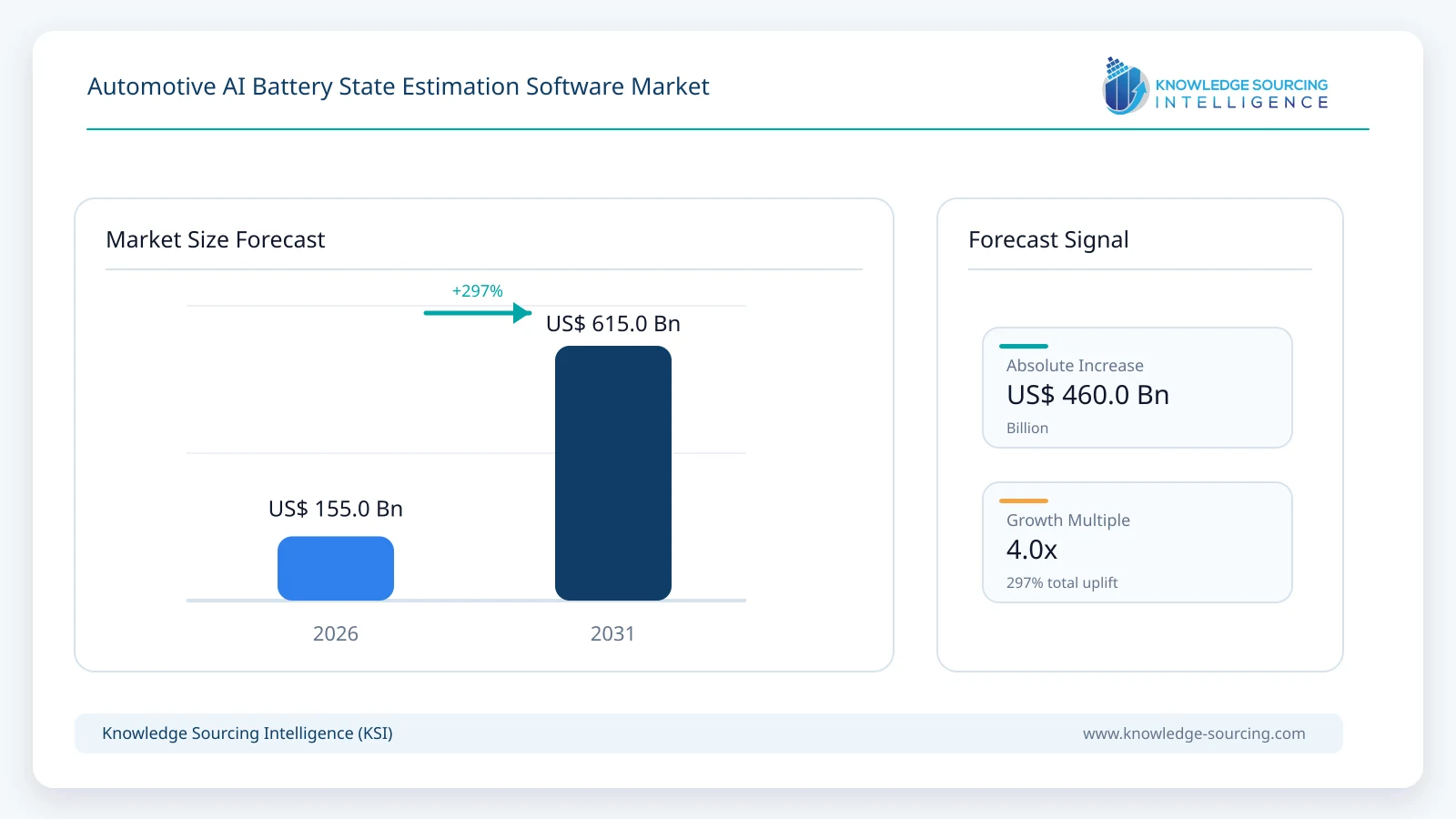
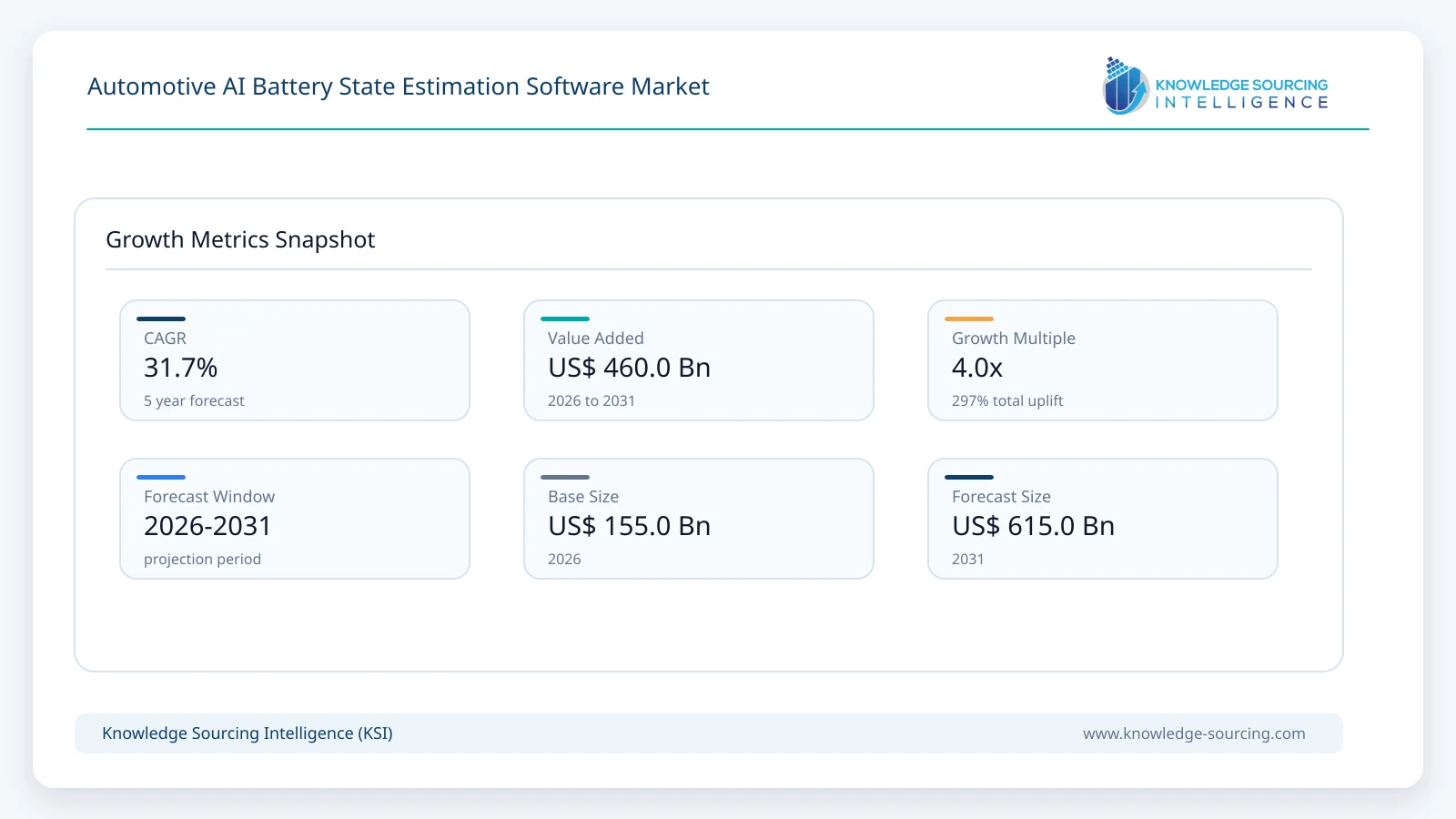
The global automotive AI battery state estimation software market is projected to expand at a CAGR of 31.7%, increasing from USD 155.0 million in 2026 to USD 615.0 million by 2031.
Highlights:
- 1Physics-informed hybrid AI accounts for an estimated 41% of 2026 software revenue and is forecast to remain the leading algorithm category.
- 2State-of-charge estimation represents approximately 37% of 2026 value, while health and remaining-life estimation expand their relative importance.
- 3Embedded and edge execution holds the largest standalone deployment share in 2026; connected services supply model updates and in-service condition evidence.
- 4Battery electric vehicles account for an estimated 84% of 2026 value, reflecting the commercial value of accurate traction-battery estimation.
- 5Asia Pacific leads regional demand through China’s electric-vehicle production scale, while Europe remains an important automotive validation and battery-software cluster.
- 6Battery chemistry variation, functional safety and incomplete lifetime data are central commercial barriers to wider model deployment.
The automotive AI battery state estimation software market covers model-based and machine-learning applications that determine state of charge, state of health, state of power, usable energy, and condition forecasts for traction batteries in electrified road vehicles. Products include embedded estimation libraries, connected battery-condition services, and vehicle-program calibration and validation work. The software operates alongside essential cell sensing, hardware protection and deterministic battery-control functions; it does not replace those systems or encompass the complete battery-management hardware assembly.
Electra Vehicles validated its EVE-Ai Adaptive Controls Embedded SoXe platform in January 2026, with real-time estimates of charge, health and power states. Bosch combines fleet operating data with artificial intelligence and electrochemical models for connected battery-health assessment, while LG Energy Solution’s B.around portfolio integrates condition estimation into wider battery-lifecycle services. These offerings create distinct procurement opportunities for OEMs, Tier 1 battery suppliers and fleet operators, although the estimation function is frequently bundled within broader BMS or analytics contracts.
Market Overview
Lithium-ion batteries cannot reveal their remaining capacity or available power from a single voltage reading because voltage response changes with temperature, current, rest time, and accumulated degradation. Conventional BMS estimators combine coulomb counting, lookup tables, and electrochemical or equivalent-circuit models, but their parameters can diverge when cells age or operate outside familiar conditions. AI state estimators use learned relationships in operating data to correct or augment these models, helping vehicle controllers maintain dependable information during rapid charging, cold starts, and long service lives.
Electra’s Embedded SoXe platform applies adaptive algorithms directly within a BMS to estimate state of charge, health, and power, while Eatron has demonstrated AI-SOC software intended to improve estimation accuracy. AVL’s battery-controls portfolio similarly incorporates nonlinear state-of-charge modeling and durability-aware state-of-health estimation. Bosch’s Battery in the Cloud follows a connected architecture, where vehicle data is analyzed against fleet experience and electrochemical models. OEM selection depends on the estimator’s ability to work with the available sensors and compute resources, not simply the sophistication of its algorithm.
Battery-cell diversity increases the engineering value of portable estimation software. Lithium iron phosphate exhibits a comparatively flat open-circuit voltage region across much of its usable charge range, complicating voltage-based state-of-charge assessment, while nickel-rich chemistries have different degradation and power-limitation behavior. Manufacturers therefore need chemistry-specific training, parameter identification, robust uncertainty handling, and repeatable test results over seasons and aging cycles. Licensing arrangements range from embedded libraries purchased through BMS integrators to connected estimation services used after sale, with vehicle-program calibration continuing to represent an important source of supplier work.
Market Trends
Physics-Informed AI Is Taking Priority over Black-Box Estimation
Bosch’s connected battery-health software combines physical battery models with AI to predict state of health and future degradation from actual operating histories. This hybrid approach reduces dependence on learned correlations alone, which may behave poorly when training datasets underrepresent extreme weather, novel chemistries, or unusual charging patterns. Embedded suppliers face an additional constraint: estimation outputs must remain stable under processor, memory, and timing limits within the BMS.
Eatron’s AI-SOC demonstration and Electra’s validated Embedded SoXe platform illustrate the shift toward model correction and adaptive state inference. OEMs generally preserve independent voltage, current, temperature, and protection limits, using AI estimates to improve observability and operational decisions rather than permitting an unconstrained model to overrule battery safety functions. Supplier advantage increasingly rests on demonstrated performance over the full battery aging envelope.
Battery Health Estimation Is Extending into Warranty and Resale
Qnovo’s September 2026 Battery Genome pilot uses charging history, environmental exposure, and cell-level behavior to assess hidden degradation and battery condition. Bosch’s battery services similarly offer health prediction and condition certificates based on connected-vehicle data. These applications are commercially relevant because warranty reserves, leasing residual values, and decisions about battery reuse depend on actual condition rather than vehicle mileage alone.
Vehicle manufacturers can incorporate health estimates into service and warranty processes without buying a complete new battery-management platform. The commercial boundary is the chargeable estimation algorithm and its supporting calibration or analytics, not every data storage, telematics or digital-passport component. Assessments also require consistent definitions of usable capacity and measurement conditions if outputs are to be compared across vehicles and cell chemistries.
Embedded Estimators Are Being Linked to Fleet Learning
Electra and Sibros announced an April 2025 integration collaboration connecting high-frequency vehicle data collection with AI battery algorithms, illustrating how engineering teams can refine models using operational evidence. Cloud-connected products can detect estimation drift, recalibrate parameters, or identify unusual aging patterns across many batteries, while vehicle-side software retains the ability to provide immediate states when connectivity is unavailable.
A production BMS cannot wait for a cloud response to determine charge acceptance or available traction power. Consequently, hybrid edge-and-cloud designs usually leave safety-relevant estimation and fallback locally, with remote analytics used for model monitoring, feature improvement, or additional condition reports. Data cost, software updates, vehicle cybersecurity, and consent arrangements determine how much information can be used throughout the vehicle life cycle.
Segment Analysis
By AI Estimation Function: State-of-Charge Estimation
State-of-charge estimation accounts for an estimated 37% of market value in 2026 because every qualifying electric-vehicle program needs dependable information about available battery charge for range calculation, charging control and protection margins. AI methods add particular value during rapid load transitions and in chemistries where voltage offers limited information about the remaining charge. Electra and Eatron specifically position intelligent SoC estimates as battery-control functions rather than solely retrospective fleet reports.
State-of-health estimation gains commercial weight over the forecast period as connected vehicles accumulate deeper operating histories and OEMs expand warranty-oriented diagnostics. Its modeled share increases from 28% in 2026 to 29% in 2031, while state-of-charge remains the largest single functional category. The classification assigns combined-function licenses to their principal contracted deliverable so that multifunctional packages are not counted separately under every estimated state.
By Algorithm Approach: Physics-Informed Hybrid AI
Physics-informed hybrid AI is estimated to represent 41% of global revenue in 2026, supported by the automotive preference for estimators whose outputs can be checked against known electrochemical behavior. Bosch’s blend of aging models and artificial intelligence, alongside Electra’s physics-informed embedded design, demonstrates the technical appeal of combining interpretable physical constraints with data-driven adaptation. This approach can reduce the volume of data required to validate an entirely unconstrained estimator.
Deep-learning methods have a distinct role where rich cell data, repeated operating patterns and adequate processing resources support neural inference. Hybrid methods nevertheless remain attractive for vehicle platforms spanning multiple cell suppliers, climates and software generations, with their modeled share rising to 46% by 2031. Customer qualification emphasizes out-of-distribution performance, reproducibility and uncertainty treatment rather than a single benchmark accuracy number reported under favorable test conditions.
By Execution Architecture: Embedded or Edge Estimation
Embedded or edge estimation represents approximately 47% of 2026 revenue because state-of-charge and state-of-power outputs need to remain available in real time inside the vehicle. Electra’s validated embedded estimator illustrates how adaptive models can run within battery-management electronics rather than depend entirely on remote infrastructure. Edge implementations limit ongoing data-transfer costs and help preserve deterministic response, but require careful optimization of processor load, memory footprint and model updates.
Cloud-hosted estimation remains commercially important for aging histories and fleet-level comparisons, while combined edge-cloud approaches allow local states to be checked against longer operational patterns. Bosch’s connected services provide a reference for the cloud side of this arrangement. The selected execution architecture can change a supplier’s revenue from one-time licensing toward recurring analytics and long-term maintenance without requiring additional physical sensors.
By Battery Chemistry: Lithium Iron Phosphate
Lithium iron phosphate battery adoption is increasing the need for estimation approaches that address a broad, relatively flat voltage plateau and operating-state uncertainty. Software suppliers can distinguish their models through adaptive use of current history, temperature response, and dynamic voltage behavior, rather than relying heavily on static voltage-to-charge relationships. Automotive engineering groups must still validate these methods across suppliers because nominally similar LFP cells can vary in resistance and aging profiles.
Nickel-rich lithium-ion designs retain the larger estimated 2026 market share at 53%, reflecting existing programs and high-value applications. LFP rises from 39% of value in 2026 to 51% by 2031 as its role in mass-market electric vehicles increases. This is a revenue segmentation by the battery chemistry served, not a claim that algorithm prices or adoption rates are identical across the two chemistry groups.
Market Drivers
Expanding Electric-Vehicle Volumes and Battery Diversity
The IEA recorded more than 20 million global electric-car sales in 2025 and expects around 23 million in 2026, widening the potential installation base for software-based battery estimates. High-volume OEM platforms increasingly accommodate several pack sizes and cell suppliers, creating demand for estimators that can be recalibrated without redesigning the entire controller.
Different voltage profiles, aging rates, and thermal behavior make one fixed estimator difficult to deploy across every battery program. Software reuse can reduce duplicated development effort, but the actual commercial value depends on the number of validated chemistries and customers paying for the function.
More Accurate Charge and Power Limits under Variable Conditions
Fast charging and cold-weather operation expose weaknesses in estimators tuned mainly to standard laboratory cycles. Battery-management software must calculate usable charge and permissible current as internal resistance and temperature change, and errors can lead either to unnecessary power restriction or inadequate protection margins.
Electra’s embedded adaptive software targets state-of-charge, health, and power inference together, illustrating why advanced estimation can affect vehicle experience rather than merely the precision of a displayed percentage. OEM engineering teams can justify licensing where improved estimates support more consistent charging and range behavior.
Battery Warranty and Condition-Assessment Economics
Bosch’s connected health services use vehicle operating history to forecast battery condition, while Qnovo’s Battery Genome pilot targets hidden aging and risk indicators. These products respond to the commercial cost of uncertain battery replacement and the need to differentiate normal aging from unusual degradation.
Long-lived battery programs generate recurring demand for monitoring and recalibration after the vehicle enters service. Fleet operators, leasing companies and manufacturers are potential customers where dependable health estimates support service planning, warranty decisions or residual-value assessment.
Software-Defined BMS Architectures and Algorithm Reuse
LG Energy Solution’s B.around offering combines in-vehicle battery software, AI analysis and lifecycle services. Infineon and Eatron’s collaboration also connects battery-optimization algorithms with automotive microcontroller platforms, showing how estimation software can be developed independently of individual sensing components.
Modular architectures allow validated software to be carried across related platforms and revised when new operational evidence becomes available. Purchasing can shift from one-off pack engineering to licensed libraries, integration packages and supported updates, provided functional-safety responsibilities remain clearly assigned.
Vehicle Data Connectivity and Fleet-Level Learning
Electra and Sibros linked battery intelligence with high-frequency vehicle data acquisition in their 2025 partnership. Connected usage data can expose drift in health estimates, reveal unusual operating combinations and support improvements that are difficult to obtain from abbreviated laboratory cycles.
Bosch’s fleet-oriented battery analytics demonstrates a commercial channel for state estimation after initial vehicle sale. Suppliers capable of managing data quality, model updates and customer-specific service terms can generate revenue beyond the first embedded software license.
Market Restraints
Functional Safety and Estimator Validation Burden
AI-generated battery states may influence charging-current limits, usable power and remaining-range decisions, so OEM approval requires documented behavior under sensor faults and unusual operating conditions. Estimator error cannot substitute for independent cell overvoltage, undervoltage, and thermal protection.
Vehicle programs need traceable test results, fallback methods and carefully controlled model releases. Training data that works on one chemistry or seasonal profile is insufficient evidence for a vehicle platform expected to operate across several years and markets.
Limited Observability of Internal Cell Conditions
Battery controllers primarily receive terminal current, voltage and temperature measurements rather than direct observations of electrochemical state. Even sophisticated models must infer inaccessible variables from noisy sensors and incomplete usage histories, and the problem becomes harder after long periods without reliable calibration events.
LFP voltage behavior illustrates why real-time charge estimation is technically demanding. Learned corrections may improve accuracy but cannot create information absent from the measurements, particularly during steady conditions with little diagnostic excitation.
Chemistry Changes and Dataset Shift
Battery chemistry, cell supplier, module design and manufacturing variability alter the relationship between measurable signals and internal states. A model trained on nickel-rich cells may not generalize to LFP packs without substantial retraining or additional physical constraints.
Automakers may be reluctant to introduce a third-party estimator if each new cell sourcing decision triggers expensive requalification. Commercial licensing therefore depends on how efficiently a provider can adapt its algorithm and document performance across aging and temperature distributions.
In-Vehicle Compute and Update Constraints
Embedded BMS controllers have finite processing capacity and must execute diagnostic and protection tasks predictably. Neural estimators with large memory requirements can compete with established control functions, while over-the-air revisions create obligations for version management and rollback.
Cloud execution can handle heavier models but network connectivity is not guaranteed when battery decisions are time-sensitive. Hybrid deployments require careful separation of immediate on-board calculations from remote learning and reporting, adding integration and testing effort.
Data Access, Cybersecurity and Commercial Ownership
Connected battery estimation depends on permission to use detailed current, temperature and charging histories. Data contracts must address vehicle owner rights, cloud storage, cross-border access and the confidentiality of cell suppliers’ degradation characteristics.
OEMs developing proprietary battery software may retain critical training datasets and estimator intellectual property internally. Specialist software vendors must demonstrate interoperability and clear value without assuming open access to the vehicle telemetry needed for continuous model improvement.
Regional Outlook
Asia Pacific
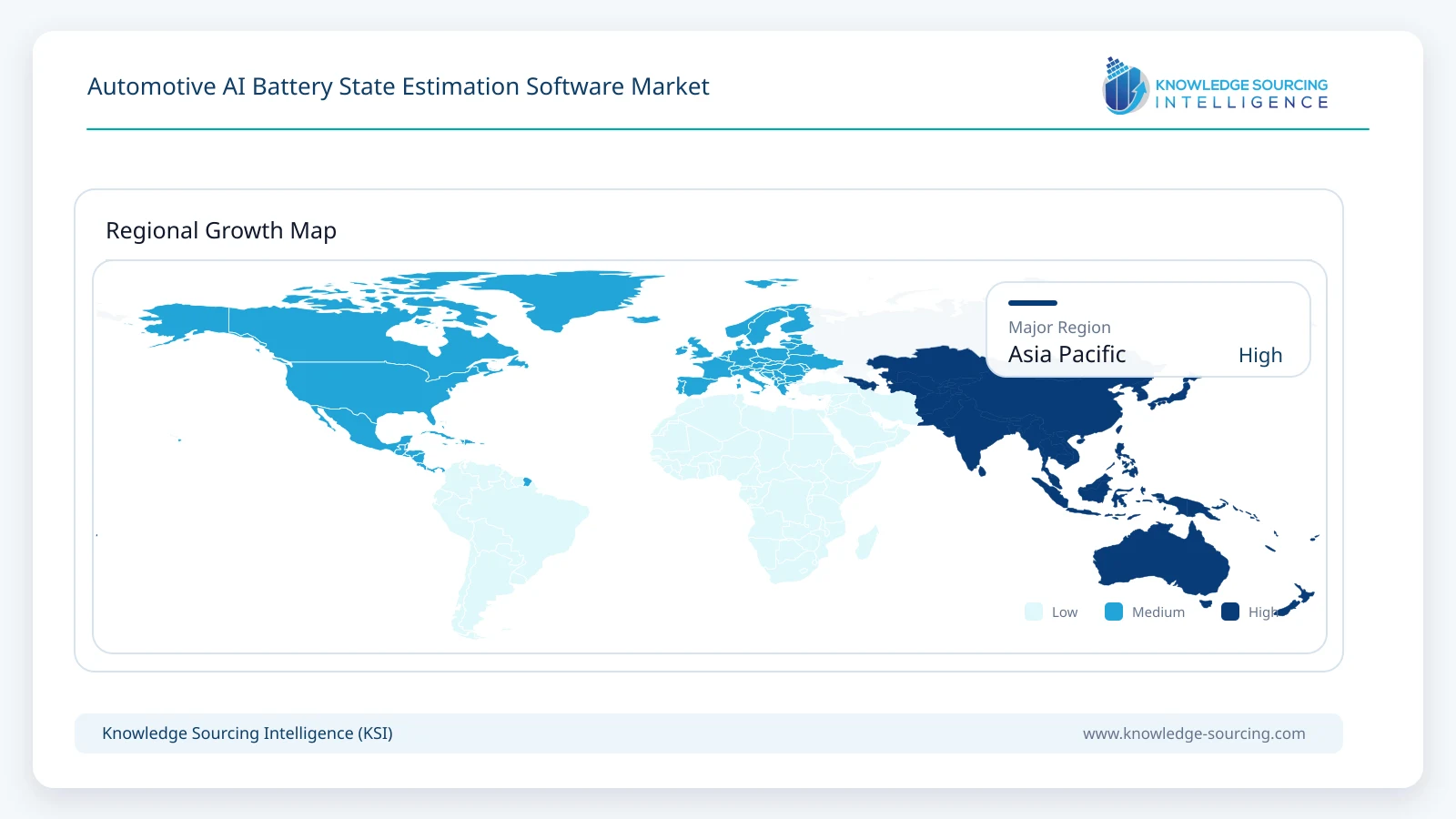
China’s large electric-vehicle production base and extensive battery-cell manufacturing ecosystem support Asia Pacific’s leading estimated position, at 47% of 2026 revenue. Regional programs span mass-market LFP vehicles and higher-performance nickel-rich designs, creating demand for chemistry-specific charge and health estimators. LG Energy Solution’s software offering and Asian OEM engagement with battery-intelligence developers also demonstrate the region’s role in both product supply and adoption.
Japan and South Korea contribute battery-control engineering, validation and supplier development, while India and Southeast Asia offer longer-term opportunities as electric-vehicle platforms and connected service networks expand. The regional forecast assumes that qualifying AI estimation functions grow faster than total vehicle sales, but avoids treating every battery-management controller as an AI installation. Local data access and OEM decisions about internally developed software remain important factors in supplier participation.
Europe
Germany and other European automotive engineering centers support a substantial market for battery software because OEMs need qualified algorithms across cell suppliers, climates and vehicle architectures. Bosch and AVL offer distinct paths into the market through connected battery-health analytics and automotive state-estimation engineering, while specialized software firms seek adoption through modular BMS and fleet-service integrations.
European requirements for battery traceability increase attention to credible state-of-health information, although a battery passport alone does not require a machine-learning estimator. Suppliers must support auditable condition calculations and cybersecurity practices while keeping vehicle-side protection deterministic. Europe accounts for an estimated 25% of 2026 value, with growth increasingly linked to in-service health assessment as well as new production programs.
Competitive Landscape
LG Energy Solution and Bosch compete from broader battery and vehicle-system positions, embedding estimation software within lifecycle platforms and connected services. Electra Vehicles, Eatron Technologies and Qnovo focus more directly on intelligent battery algorithms, with differentiated approaches to local execution, adaptive estimation and health analytics. AVL supplies control-development and validation expertise that can support automaker-owned models as well as licensed implementations.
Competition remains fragmented by procurement model rather than defined by a credible global market-share ranking. OEM-developed software, bundled Tier 1 controllers and specialist algorithm licenses often perform overlapping functions but are not transacted as comparable products. Qualification breadth across chemistries, field-data access, model update support and ownership of calibration work are likely to matter more than headline inference-accuracy claims.
Recent Developments
September 2026: Qnovo introduced a pilot Battery Genome application using operating history and cell-level behavior to assess battery health and degradation risk, extending in-vehicle condition estimation toward residual-value decisions.
March 2026: Qnovo announced strategic investment from Hyundai Motor and Kia to advance deployment of battery intelligence software. The disclosure did not quantify production installations.
January 2026: Electra Vehicles reported validation of EVE-Ai Embedded SoXe for real-time SoC, SoH and SoP estimation. The announcement describes a validated platform, not a stated worldwide installed base.
October 2025: Qnovo and Sonatus announced integration of battery diagnostics with an SDV software platform, aiming to shorten application integration cycles.
April 2025: Sibros and Electra announced a partnership connecting connected-vehicle data collection with AI battery intelligence for vehicle and fleet applications.
February 2025: Infineon and Eatron expanded their established automotive AI-BMS collaboration into other battery applications, demonstrating portability of battery-optimization software beyond a single vehicle program.
Market Outlook
Battery-estimation software growth through 2031 is expected to come from two channels: broader qualification of adaptive on-board algorithms in new electric vehicles and continued analysis of batteries already in service. Physics-informed methods are likely to retain a strong position because they combine the adaptability of AI with engineering constraints useful for automotive validation. State-of-health and usable-power estimates will gain commercial importance as battery warranties mature and fast-charging demands increase.
A forecast of USD 615 million in 2031 assumes that software suppliers capture a narrowly defined value for estimation, rather than the complete BMS or connected analytics platform. OEMs with large in-house algorithm teams may continue to develop their own estimators, while suppliers with validated chemistry libraries, connected data capabilities and long-term software support can compete for repeat vehicle programs. The principal uncertainty is the pace at which advanced learned estimation becomes a separately purchased function.
Automotive AI Battery State Estimation Software Market Scope:
| Report Metric | Details |
|---|---|
| Total Market Size in 2026 | USD 155.0 million |
| Total Market Size in 2031 | USD 615.0 million |
| Forecast Unit | USD Billion |
| Growth Rate | 31.7% |
| Study Period | 2021 to 2031 |
| Historical Data | 2021 to 2024 |
| Base Year | 2025 |
| Forecast Period | 2026 – 2031 |
| Segmentation | AI Estimation Function, Algorithm Approach, Execution Architecture, Revenue Component |
| Companies |
|
Market Segmentation
By AI Estimation Function
State-of-Charge Estimation
State-of-Health and Degradation Estimation
State-of-Power and Charge-Acceptance Estimation
State-of-Energy and Usable-Range Estimation
Remaining-Life and Condition Forecasting
By Algorithm Approach
Physics-Informed Hybrid AI
Deep Learning and Neural Networks
Adaptive Statistical Machine Learning
Ensemble and Other AI Estimators
By Execution Architecture
Embedded or Edge Estimation
Cloud-Hosted Estimation
Hybrid Edge-and-Cloud Estimation
By Revenue Component
Embedded New-Vehicle Software Licenses
Recurring In-Service Estimation Analytics
Calibration, Integration and Model Validation
By Battery Chemistry
Nickel-Rich Lithium-Ion (NMC and NCA)
Lithium Iron Phosphate (LFP)
Other Lithium-Ion and Emerging Chemistries
By Propulsion Type
Battery Electric Vehicles
Plug-In Hybrid Electric Vehicles
Full Hybrid and Other Electrified Vehicles
By Vehicle Type
Passenger Cars and SUVs
Light Commercial Vehicles
Buses and Medium/Heavy Commercial Vehicles
By Geography
Asia Pacific
China
Japan
South Korea
India
Thailand
Indonesia
Others
Europe
Germany
United Kingdom
France
Italy
Spain
Others
North America
United States
Canada
Mexico
South America
Brazil
Argentina
Others
Middle East and Africa
Saudi Arabia
United Arab Emirates
South Africa
Others
Table of Contents
EXECUTIVE SUMMARY
1.1. Market Opportunity and Key Findings
1.2. Global Market Outlook
1.3. Strategic Supplier and Technology Developments
MARKET SNAPSHOT
2.1. Market Overview
2.2. Market Definition
2.3. Scope of the Study
2.4. Market Segmentation
BUSINESS LANDSCAPE
3.1. Market Drivers
3.1.1. Expanding Electric-Vehicle Volumes and Battery Diversity
3.1.2. More Accurate Charge and Power Limits under Variable Conditions
3.1.3. Battery Warranty and Condition-Assessment Economics
3.1.4. Software-Defined BMS Architectures and Algorithm Reuse
3.1.5. Vehicle Data Connectivity and Fleet-Level Learning
3.2. Market Restraints
3.2.1. Functional Safety and Estimator Validation Burden
3.2.2. Limited Observability of Internal Cell Conditions
3.2.3. Chemistry Changes and Dataset Shift
3.2.4. In-Vehicle Compute and Update Constraints
3.2.5. Data Access, Cybersecurity and Commercial Ownership
3.3. Market Opportunities
3.4. Porter’s Five Forces Analysis
3.5. Industry Value Chain Analysis
3.6. Policies and Regulations
3.7. Strategic Recommendations
TECHNOLOGICAL OUTLOOK
4.1. Physics-Informed AI and State Observers
4.2. Neural and Statistical Estimators
4.3. On-Board Model Execution
4.4. Cloud-Based Fleet Learning and Update Validation
5. AUTOMOTIVE AI BATTERY STATE ESTIMATION SOFTWARE MARKET BY AI ESTIMATION FUNCTION
5.1. Introduction
5.2. State-of-Charge Estimation
5.3. State-of-Health and Degradation Estimation
5.4. State-of-Power and Charge-Acceptance Estimation
5.5. State-of-Energy and Usable-Range Estimation
5.6. Remaining-Life and Condition Forecasting
6. AUTOMOTIVE AI BATTERY STATE ESTIMATION SOFTWARE MARKET BY ALGORITHM APPROACH
6.1. Introduction
6.2. Physics-Informed Hybrid AI
6.3. Deep Learning and Neural Networks
6.4. Adaptive Statistical Machine Learning
6.5. Ensemble and Other AI Estimators
7. AUTOMOTIVE AI BATTERY STATE ESTIMATION SOFTWARE MARKET BY EXECUTION ARCHITECTURE
7.1. Introduction
7.2. Embedded or Edge Estimation
7.3. Cloud-Hosted Estimation
7.4. Hybrid Edge-and-Cloud Estimation
8. AUTOMOTIVE AI BATTERY STATE ESTIMATION SOFTWARE MARKET BY REVENUE COMPONENT
8.1. Introduction
8.2. Embedded New-Vehicle Software Licenses
8.3. Recurring In-Service Estimation Analytics
8.4. Calibration, Integration and Model Validation
9. AUTOMOTIVE AI BATTERY STATE ESTIMATION SOFTWARE MARKET BY BATTERY CHEMISTRY
9.1. Introduction
9.2. Nickel-Rich Lithium-Ion (NMC and NCA)
9.3. Lithium Iron Phosphate (LFP)
9.4. Other Lithium-Ion and Emerging Chemistries
10. AUTOMOTIVE AI BATTERY STATE ESTIMATION SOFTWARE MARKET BY PROPULSION TYPE
10.1. Introduction
10.2. Battery Electric Vehicles
10.3. Plug-In Hybrid Electric Vehicles
10.4. Full Hybrid and Other Electrified Vehicles
11. AUTOMOTIVE AI BATTERY STATE ESTIMATION SOFTWARE MARKET BY VEHICLE TYPE
11.1. Introduction
11.2. Passenger Cars and SUVs
11.3. Light Commercial Vehicles
11.4. Buses and Medium/Heavy Commercial Vehicles
12. AUTOMOTIVE AI BATTERY STATE ESTIMATION SOFTWARE MARKET BY GEOGRAPHY
12.1. Asia Pacific
12.1.1. China
12.1.2. Japan
12.1.3. South Korea
12.1.4. India
12.1.5. Thailand
12.1.6. Indonesia
12.1.7. Others
12.2. Europe
12.2.1. Germany
12.2.2. United Kingdom
12.2.3. France
12.2.4. Italy
12.2.5. Spain
12.2.6. Others
12.3. North America
12.3.1. United States
12.3.2. Canada
12.3.3. Mexico
12.4. South America
12.4.1. Brazil
12.4.2. Argentina
12.4.3. Others
12.5. Middle East and Africa
12.5.1. Saudi Arabia
12.5.2. United Arab Emirates
12.5.3. South Africa
12.5.4. Others
13. COMPETITIVE ENVIRONMENT AND ANALYSIS
13.1. Major Players and Strategy Analysis
13.2. Market Share Analysis
13.3. Mergers, Acquisitions, Agreements and Collaborations
13.4. Competitive Dashboard
14. COMPANY PROFILES
14.1. LG Energy Solution
14.2. Robert Bosch GmbH
14.3. Electra Vehicles
14.4. Eatron Technologies
14.5. Qnovo
14.6. AVL List GmbH
14.7. TWAICE Technologies
14.8. volytica diagnostics
15. APPENDIX
15.1. Currency
15.2. Assumptions
15.3. Base and Forecast Years Timeline
15.4. Key Benefits for Stakeholders
15.5. Research Methodology
15.6. Abbreviations
Navigate
Trusted by the world's leading organizations











