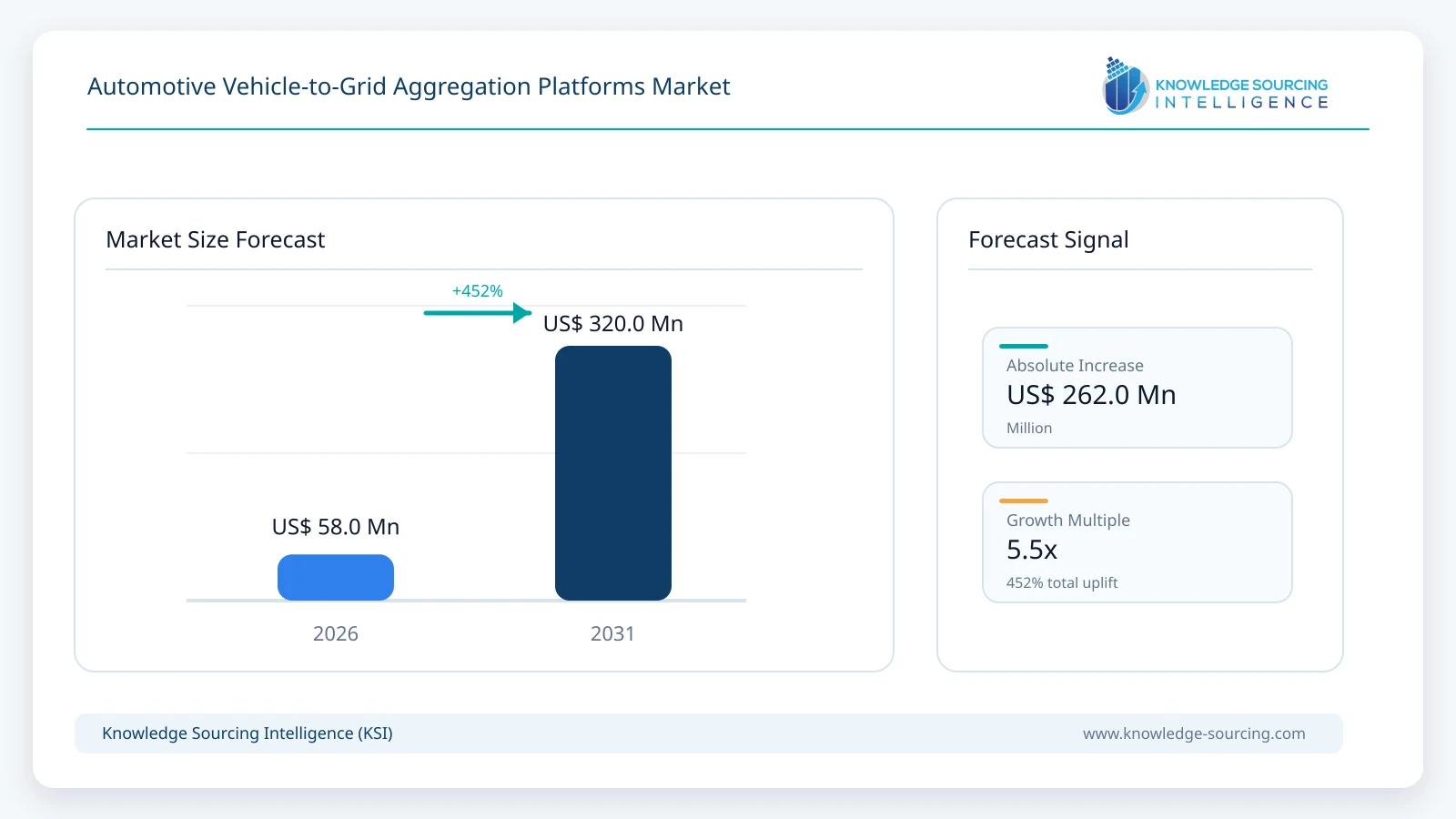
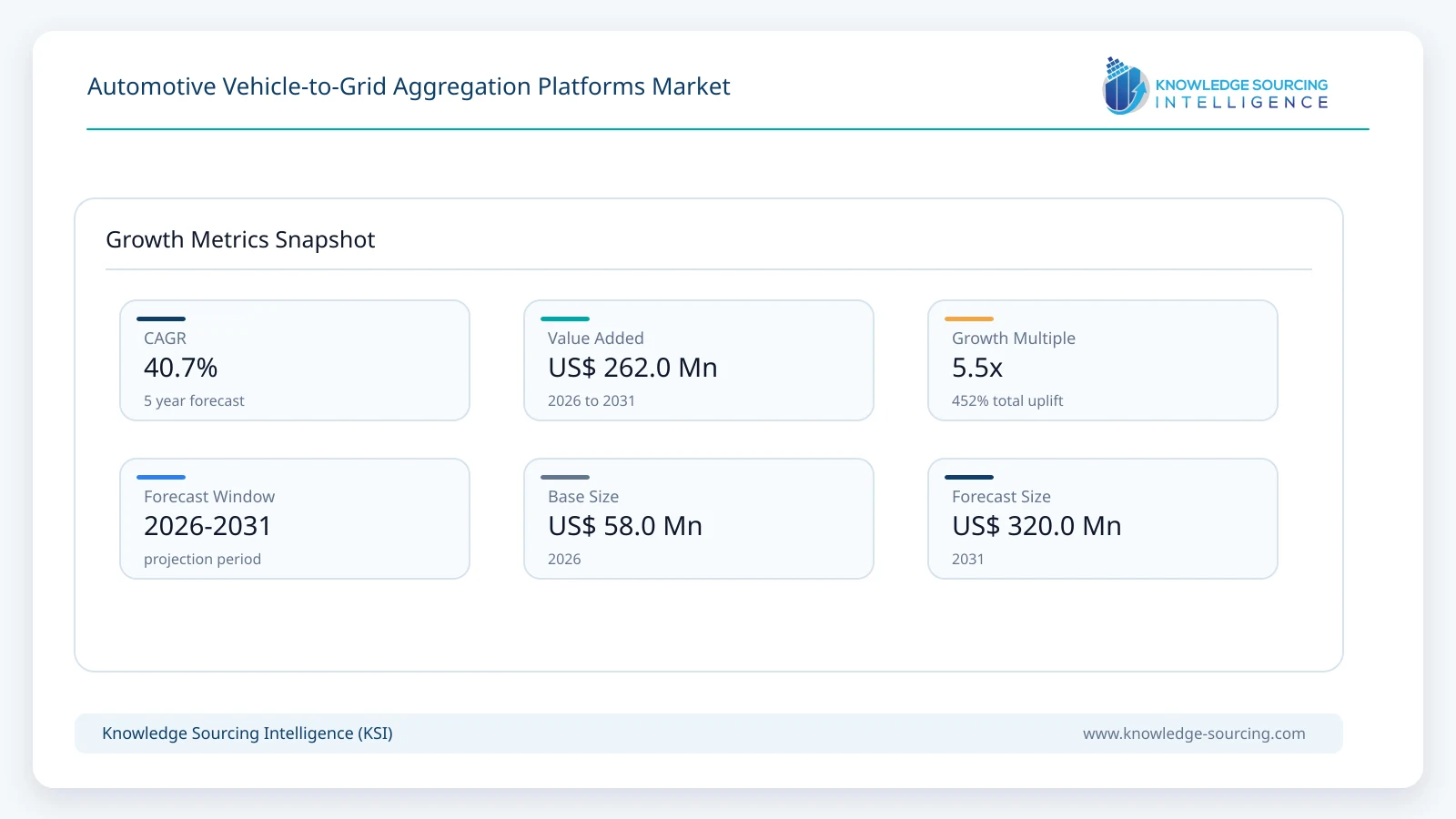
The automotive vehicle-to-grid aggregation platforms market is projected to expand from USD 58 million in 2026 to USD 320 million in 2031, at a CAGR 40.7% over the forecast period.
Highlights:
- 1Grid-facing dispatch and bidding is the largest modeled 2026 software function, representing 30% of global value.
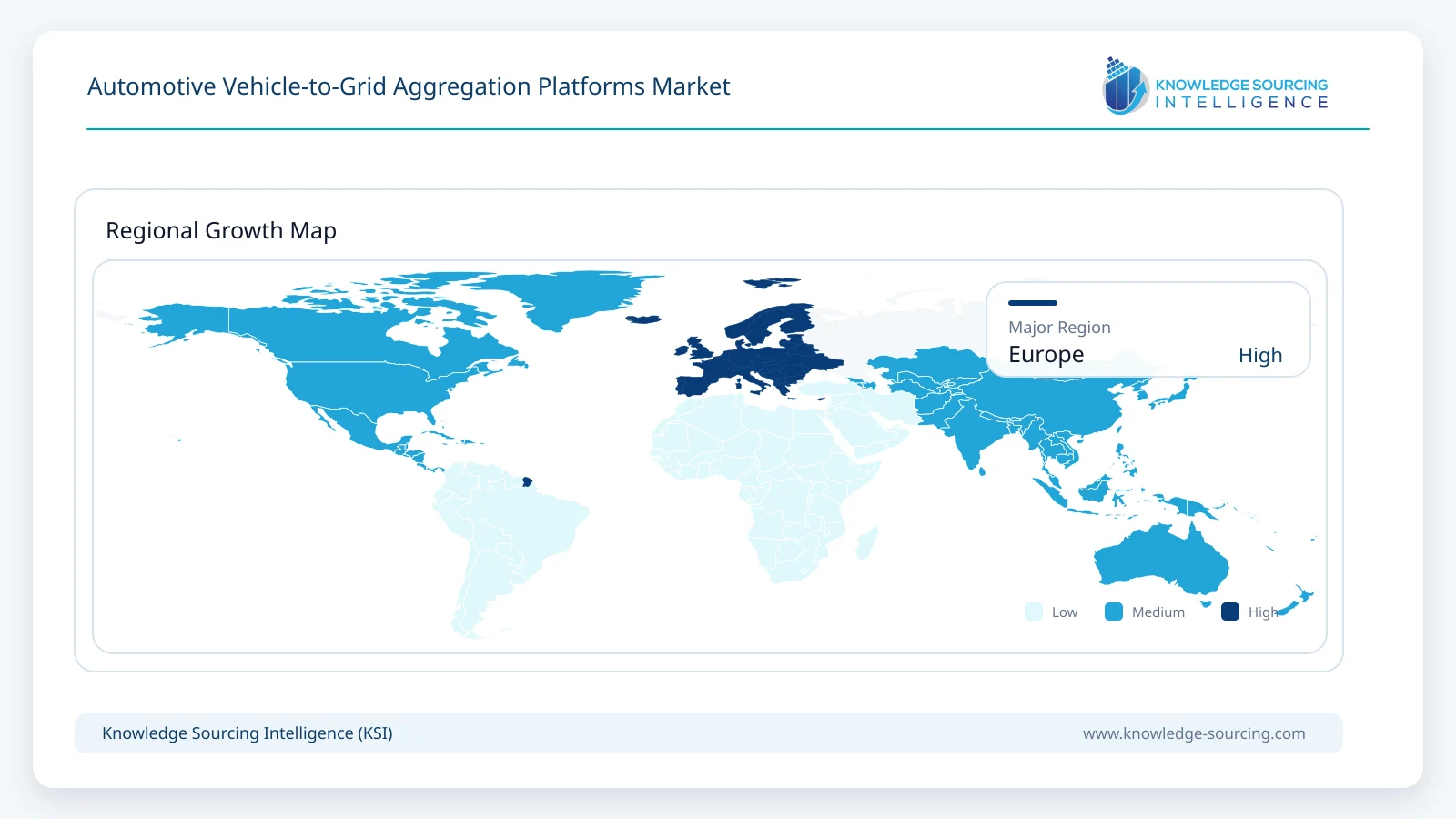
- 2Europe leads the modeled 2026 market with 38% of revenue; Asia Pacific is projected to reach 35% by 2031.
- 3Fleet and depot programs form the largest 2026 V2G application, while residential aggregation gains share as commercial tariffs expand.
- 4Independent aggregators hold the largest modeled share by business model in 2026; OEM–energy service platforms strengthen through 2031.
- 5Commercial offerings remain tied to limited vehicle–charger–tariff combinations, constraining the pool of active export-capable assets.
- 6Platform value increasingly reflects availability forecasting, market settlement and verified performance, not only remote charging commands.
A fleet of bidirectional electric vehicles can supply grid flexibility only when an operator knows which vehicles are connected, what energy each can safely export and how their combined response will satisfy a market instruction. Battery state of charge, arrival and departure time, charger limits, distribution-grid permission and contractual reserve levels affect the capacity that can be offered. Aggregation platforms translate these changing conditions into a portfolio commitment and then measure the actual response for settlement.
Nuvve’s GIVe software aggregates EV batteries across sites and fleets to support grid services, while The Mobility House combines charge planning with flexibility aggregation and energy trading. In France, Renault’s commercial V2G offer connects an automaker-led customer service to specialist trading software. Volkswagen Group’s Elli business is extending this arrangement through an integrated package in Germany, supported by The Mobility House Energy technology. Each model assigns dispatch authorization, customer management and electricity-market participation to different parties.
Charger manufacturers and vehicle OEMs control important lower-level functions, but the grid-facing platform must coordinate many heterogeneous assets and preserve a defensible audit trail. Utility buyers require accurate available-capacity forecasts and settlement data, rather than theoretical vehicle battery capacity. Commercial contracts consequently combine recurring software activity with market onboarding, testing and integration services, with expenditure influenced by the number of active connected vehicles and grid markets served.
Market Trends
Grid Aggregation Is Moving from Demonstrations to Defined Commercial Programs
The Mobility House began offering a utility-oriented aggregation layer in North America through its January 2026 Cascade announcement. The product is designed to coordinate EV chargers as a portfolio, allowing demand and bidirectional export resources to respond to utility instructions rather than acting as isolated charging points. The technical requirement is a reliable view of how much power can be committed at any instant, adjusted for driver departure plans and communication losses.
Renault's Utrecht car-sharing program provides a practical example of connecting many mobile batteries to grid-facing operations. Its significance is operational rather than its absolute scale: an aggregator must reconcile fleet bookings, charger availability and export limits before reporting credible flexibility to a grid buyer.
Vehicle Manufacturers and Energy Companies Are Linking Aggregation to Tariffs
Volkswagen Group's June 2026 Elli announcement connects compatible MEB vehicles with an electricity tariff, bidirectional charger, customer application and energy-market optimization. Elli is responsible for bringing eligible battery capacity together and marketing that flexibility, while The Mobility House Energy supplies technology to support the activity. The arrangement shows how a vehicle manufacturer can retain the customer relationship but outsource part of the specialist aggregation stack.
The number of technically prepared vehicles is substantially larger than the active commercial pool. Volkswagen reported approximately one million MEB vehicles in Europe prepared for bidirectional charging, but that figure is not a count of participating V2G customers. Aggregation-platform revenue therefore follows activated service contracts rather than the theoretical energy capacity of the installed vehicle fleet.
Market Settlement and Local Grid Rules Are Shaping Software Design
FERC Order No. 2222 provides a framework for distributed energy resource aggregation in US organized wholesale markets, but implementation schedules and qualifying rules vary across grid operators. Energy and ancillary-service products impose different bidding, telemetry, locational and measurement requirements. Aggregation platforms consequently need market adapters and settlement logic that can be reused in principle but configured to each market's participation conditions.
European commercial offers also depend on country-specific metering rules, balancing responsibilities and tariff design. Software vendors that document performance and revenue allocation transparently are better placed to support both utilities and vehicle owners.
Interoperability Is Shifting Attention toward Multi-Party Validation
ISO 15118-20 provides an important communications foundation for bidirectional charging, but it does not by itself guarantee that different vehicles and charging stations will export power through a particular national grid. The IEA found that 2026 commercial offers remain concentrated in specific vehicle, charger and tariff combinations. Aggregators that operate across manufacturers require additional testing and certification of the full sequence from vehicle command to metered grid response.
Virta joined the IEA's Task 53 interoperability effort in April 2025, reflecting industry attention to standardized behavior among vehicles, chargers and distribution grids. Verification tools, device onboarding and exception monitoring become recurring operational expenses as managed portfolios expand.
Automotive Vehicle-to-Grid Aggregation Platforms Market Segment Analysis
By Aggregation Function
Multi-Asset Dispatch and Grid Bidding
Grid bidding and dispatch represent the largest individual function in the 2026 model because many EV batteries must be transformed into a single resource with a deliverable power commitment. Nuvve's multi-site VPP approach and The Mobility House's flexibility aggregation software illustrate the commercial role. The platform needs to distinguish registered capacity from available energy, preserve mobility requirements and translate a market instruction into charger commands distributed across sites.
The segment is modeled at 30% of 2026 market value, with a rising role for automated availability forecasting and settlement as the customer base grows. A smaller aggregator may instead license the grid interface from a specialist while retaining direct customer relationships.
By V2G Program Type
Commercial Fleets and Residential Aggregation
Fleet and depot programs account for the largest modeled 2026 application share because they can enroll multiple vehicles under one commercial agreement and align charging around planned operations. Nuvve's school-bus use case and utility-facing aggregation products depend on predictable charging dwell and dispatch availability. Fleet managers are generally unwilling to commit stored energy without clear operational reserve protections and a method for verifying resulting revenue.
Residential aggregation is expected to gain share through 2031 as OEM-backed energy services combine vehicles, compatible chargers, metering and utility tariffs. Residential economics are sensitive to the number of hours plugged in and the value of grid services available in the local market.
By Aggregator Business Model
Independent and Energy-Supplier Platforms
Independent aggregators retain a large early share through specialized software, utility relationships and the ability to pool different vehicle brands. Nuvve and The Mobility House have developed grid-facing operations that sit above chargers and vehicles, while energy retailers can integrate aggregation into existing electricity customer contracts. Each model assigns battery access, dispatch responsibility and settlement processing to a different participant.
OEM-led energy platforms are projected to increase their share as manufacturers use telematics and battery permissions to control which services drivers can activate. Platform providers may compete on open interoperability or secure long-term positions through deeper OEM partnerships.
Market Drivers
Commercial Utility Demand for Dispatchable Flexible Capacity
Electricity-system operators face growing variation between renewable generation and customer demand, creating a practical need for resources that can adjust output rapidly. A pool of EV batteries can contribute power or reduce charging load only if the operator can verify a deliverable quantity at the time of a grid instruction. Aggregation software performs this conversion from individual vehicles into a contracted resource.
The IEA identifies frequency regulation, energy arbitrage and distribution-level flexibility as potential remuneration channels for V2G. Commercial demand nonetheless depends on winning eligible contracts rather than simply observing higher EV sales.
Expansion of OEM and Electricity-Retailer V2G Packages
Volkswagen Group and Elli's June 2026 V2G package connects a compatible vehicle, bidirectional charger, tariff and customer app with energy-market optimization. Renault's relationship with The Mobility House uses a comparable division of responsibilities, linking a vehicle-led customer experience to specialist flexibility aggregation. Such arrangements establish identifiable buyers for software that validates battery availability and markets pooled capacity.
OEM and retailer participation can lower the cost of enrolling drivers because the parties already manage vehicles or electricity accounts. Aggregator suppliers with documented interfaces to these ecosystems may win recurring platform contracts rather than single pilot-engineering assignments.
Growth in Commercial and Public Electric Fleets
School buses, delivery vans and municipal fleets spend predictable intervals at depots where charging interfaces can be controlled. Nuvve's long-running fleet-focused software addresses this duty cycle, including setting the charge needed for the next route before allowing a grid dispatch. Multiple vehicles under one operator can reduce acquisition and support cost per enrolled asset.
The Australian Renewable Energy Agency's October 2026 funding for the REVS2 project, covering up to 130 government fleet vehicles and bidirectional chargers, demonstrates continued movement toward field evaluation. Successful fleet programs can nevertheless produce repeatable site templates and longer platform-service contracts.
Rules Supporting Distributed Resource Aggregation
FERC Order No. 2222 requires US organized wholesale markets to accommodate qualifying distributed-resource aggregations, subject to detailed implementation rules. The framework addresses the problem that individual EVs are generally too small and operationally variable to enter electricity markets alone. An aggregator assembles their capabilities and handles relevant bidding and measurement obligations.
Country-specific European market access also supports the development of commercial flexibility services, especially where qualified aggregation and billing arrangements are established. This favors software stacks that can update market adapters without rebuilding their core scheduling system.
Revenue-Sharing Models Encouraging Vehicle Participation
Battery owners are more likely to permit grid dispatch when the expected energy-service benefit is visible and the vehicle remains ready for use. Commercial offers in France provide a practical link between customer charging expenditure and participation in an aggregated resource. The Mobility House's services combine availability forecasts, flexibility trading and customer-facing service terms to support that proposition.
Settlement software determines how market earnings, charging costs, taxes and operator fees are allocated among participants. Better reporting can improve retention and the proportion of vehicles available for repeated dispatch, expanding recurring platform value without requiring equal growth in new chargers.
Market Restraints
Limited Interoperable V2G Vehicle-Charger Pairings
The IEA's May 2026 assessment found that only 22 EV models offered V2G capability, representing less than 1.5% of EV models, and that commercial services generally relied on specific vehicle and charger combinations. This sharply narrows the active asset base an aggregator can control, even in markets with large EV fleets. Vehicles prepared for bidirectional operation do not necessarily have approved charging equipment installed.
Multi-brand portfolios create additional integration and testing work because implementation of ISO 15118-20 remains inconsistent and grid-code validation varies by location. These constraints delay conversion of technical compatibility into contracted aggregation revenue.
Uneven Access to Electricity and Ancillary-Service Markets
Aggregation economics depend on the ability to participate in a specific market product, but national tariff rules and wholesale participation frameworks differ. In the United States, FERC Order No. 2222 implementation varies across regional transmission organizations. In other jurisdictions, export metering, network charges or customer-provider roles may prevent otherwise compatible vehicles from providing remunerated grid services.
Grid operators also impose minimum bids, settlement intervals, performance testing and telemetry standards. These fixed costs can make small localized fleets uneconomic until a sufficient pool of committed vehicles is available.
Uncertain Battery Availability and Driver Participation
Electric cars can depart unexpectedly, arrive with low battery charge or remain unplugged during the precise interval when a grid operator requests export. An aggregator must discount the theoretical battery capacity of its fleet when converting it into firm bids. School-bus and depot fleets are not immune because emergency shifts, irregular routes and charging faults also affect their availability.
Frequent forecast errors can trigger penalties or require costly replacement energy, weakening returns for the platform provider. Forecasting tools and conservative bidding policies partly manage these risks but cannot eliminate the mobility-first nature of the asset.
Cost of Bidirectional Hardware, Metering and Commissioning
Commercial V2G participation often requires certified bidirectional charging equipment and installation, metering and utility acceptance. The IEA reports that DC bidirectional chargers can cost several thousand dollars, which is material relative to the annual benefits projected for many households. The platform fee must fit within the value remaining after those equipment and installation costs.
Fleet depots face additional interconnection assessments and may need electrical upgrades or communication gateways. Delays in hardware commissioning defer recurring software revenue even when the aggregation platform is technically ready.
Performance, Cybersecurity and Settlement Accountability
Grid-facing aggregation platforms exchange commands among a utility, cloud software, charging equipment and vehicles. Failure or compromise at any point can lead to an incorrect dispatch quantity, unauthorized export or inaccurate customer accounting. Market operators consequently demand authenticated control, time-stamped metering and dependable fallback behavior, which are more complex than basic managed charging.
Disagreements over meter data, dispatch performance and revenue sharing can create commercial liability for the aggregator. Those lifecycle obligations increase operating cost and place smaller software vendors at a disadvantage when serving large, multi-territory electricity customers.
Regional Outlook
Europe
Europe accounts for approximately 38% of modeled 2026 aggregation-platform value, supported by functioning flexibility markets and early consumer V2G offers. Renault and The Mobility House launched an integrated French service in 2024, while Renault's Utrecht fleet went live in 2025. Volkswagen and Elli's 2026 initiative broadens the group of automakers developing retail offers in which available vehicle batteries can be pooled for energy-market participation.
France, the Netherlands and the United Kingdom have relatively favorable conditions for initial commercial deployment, according to the IEA, but tariff and equipment requirements remain country-specific. Europe retains a strong platform and software ecosystem, although the growth of contracted assets will be slower than the increase in technically prepared EV models.
Asia Pacific
China's EV production and charging ecosystem provide considerable potential for aggregated storage, yet large-scale commercial V2G faces incomplete communications and dispatch arrangements. The IEA identified 2025 pilot projects across nine Chinese cities and plans to reach 5,000 V2G charging facilities by the end of 2027. These targets indicate direction but should not be treated as existing paid aggregation subscriptions.
Australia is testing a further commercial step through ARENA's October 2026 REVS2 funding, while Japan brings an established history of CHAdeMO-based bidirectional power use. Regional platforms will still need local telemetry, certification and settlement adaptations before scale economies become meaningful.
Competitive Landscape
Nuvve and The Mobility House are the clearest specialist competitors in grid-facing EV aggregation. Nuvve's April 2025 acquisition of Fermata Energy assets brought complementary intellectual property and customer relationships into the same group; Fermata is therefore not treated as an independent global competitor for this model.
Electricity suppliers and OEM-related platforms create a second competitive structure. Volkswagen Group's Elli business provides the energy-customer relationship, tariff and aggregation activities, with The Mobility House Energy serving as a technology partner. ChargeScape's present platform emphasizes broader VGI and managed charging, so its entire revenue cannot be equated with bidirectional aggregation.
Virta offers EV charging and energy-management software with V2G and virtual-power-plant capabilities, but its charging-network scale is not evidence of an equal volume of active V2G export assets. Providers offering generic V1G demand response without verified export control occupy an adjacent position rather than the core market.
Technology ownership is divided among vehicle OEMs controlling battery and driver permissions, charger manufacturers handling certified power conversion, utilities supplying market signals, and aggregators providing portfolio logic. The lack of audited product-level revenue also makes precise global competitive market-share rankings inappropriate at this stage.
Recent Developments
October 2026: Australian Renewable Energy Agency, ARENA announced AUD 4 million support for JET Charge’s REVS2 project, targeting up to 130 government-fleet EVs and bidirectional chargers. The project is a funded deployment plan, not an already completed installation.
October 2026: Renault Group and EDF Group, The parties announced a French smart-charging partnership using EDF, IZI by EDF and DREEV capabilities, including bidirectional charging within an integrated consumer energy offer.
June 2026: Volkswagen Group and Elli, The group presented its multi-brand V2G product package with a tariff, charger and background energy-market optimization; The Mobility House Energy supports aggregation technology.
January 2026: The Mobility House North America: The company unveiled Cascade EV Aggregator for utilities to coordinate EV chargers across residential and fleet asset classes. This was a platform launch announcement.
June 2025: Renault Group, We Drive Solar and MyWheels: The partners launched the Utrecht V2G car-sharing service, with 50 vehicles initially available and a planned pool of 500 vehicles.
April 2025: Nuvve Holding Corp.: Nuvve announced the acquisition of substantially all net assets of Fermata Energy, consolidating relevant V2G software and intellectual property.
Market Outlook
Commercial aggregation platforms are expected to move from narrowly configured vehicle-and-charger portfolios toward larger pools operated through OEM energy partners, utilities and specialist software providers. The revenue mix should shift from expensive initial market and device integration toward recurring asset management and platform contracts as enrolled vehicles become more numerous. Battery reserve and driver authorization will remain important, but the grid buyer will increasingly evaluate the accuracy of deliverable capacity, dispatch performance and settlement records.
European energy markets are likely to remain the principal near-term reference for residential V2G, while Asia Pacific offers significant longer-term scale if regional pilots mature into permitted dispatch programs. Grid regulation, interconnection procedures and multiparty interoperability will determine when technically ready vehicles can be converted into active aggregated assets. Vendors with reusable market adapters and reliable cross-brand integration will have a commercial advantage over platforms limited to one pilot configuration.
Fleet contracts will continue to support early activity because depots can coordinate charging infrastructure and vehicle schedules under one operator. Residential aggregation can expand more sharply after the economic value of bidirectional export exceeds equipment, connection and participation costs for a larger group of drivers. Consolidation and partnership activity should persist as OEMs, utilities and independent aggregators decide which parts of the technology stack to own and which to procure.
Automotive Vehicle-to-Grid Aggregation Platforms Market Scope:
| Report Metric | Details |
|---|---|
| Total Market Size in 2026 | USD 58 million |
| Total Market Size in 2031 | USD 320 million |
| Forecast Unit | USD Million |
| Growth Rate | 40.7% |
| Study Period | 2021 to 2031 |
| Historical Data | 2021 to 2024 |
| Base Year | 2025 |
| Forecast Period | 2026 – 2031 |
| Segmentation | Aggregation Function, Revenue Component, V2G Program Type, Grid Service, Aggregator Business Model, Deployment Architecture, Vehicle Pool, Market Interface, Geography |
| Companies |
|
Market Segmentation
By Aggregation Function
Multi-Asset Dispatch and Grid Bidding
Availability and Capacity Forecasting
Metering, Verification and Telemetry
Settlement and Revenue Allocation
Asset Enrollment and Market Qualification
By Revenue Component
Vehicle-Level Aggregation Service
Platform and Utility Program Contracts
Program Engineering and Integration
By V2G Program Type
Commercial Fleet and Depot Programs
Residential Aggregated Programs
Municipal and School Bus Fleets
Shared Mobility and Public Programs
By Grid Service
Frequency and Ancillary Services
Distribution Congestion and Local Flexibility
Utility Peak and Capacity Programs
Energy Arbitrage and Wholesale Trading
By Aggregator Business Model
Independent Aggregator
Utility or Retail Energy Supplier
Fleet Services and Depot Operator
OEM and Energy Joint Platform
By Deployment Architecture
Cloud-Native Grid Dispatch Platform
Hybrid Cloud and Site Controller
On-Premise or Site Edge
By Vehicle Pool
Electric School Buses
Delivery Vans and Commercial EVs
Residential Passenger EVs
Shared and Municipal Passenger Fleets
By Market Interface
Wholesale and Balancing Markets
Bilateral Utility and Retail Programs
Local Flexibility and Behind-Meter Markets
By Geography
Europe
Germany
France
United Kingdom
Netherlands
Denmark
Spain
Others
North America
United States
Canada
Mexico
Asia Pacific
China
Japan
South Korea
Australia
India
Indonesia
Others
South America
Brazil
Argentina
Others
Middle East and Africa
United Arab Emirates
Saudi Arabia
South Africa
Others
Table of Contents
1. EXECUTIVE SUMMARY
1.1. Market Opportunity and Key Findings
1.2. Market Size and Growth Outlook
2. MARKET SNAPSHOT
2.1. Market Overview
2.2. Market Definition
2.3. Scope of the Study
2.4. Market Segmentation
3. BUSINESS LANDSCAPE
3.1. Market Drivers
3.1.1. Commercial Utility Demand for Dispatchable Flexible Capacity
3.1.2. Expansion of OEM and Electricity-Retailer V2G Packages
3.1.3. Growth in Commercial and Public Electric Fleets
3.1.4. Rules Supporting Distributed Resource Aggregation
3.1.5. Revenue-Sharing Models Encouraging Vehicle Participation
3.2. Market Restraints
3.2.1. Limited Interoperable V2G Vehicle-Charger Pairings
3.2.2. Uneven Access to Electricity and Ancillary-Service Markets
3.2.3. Uncertain Battery Availability and Driver Participation
3.2.4. Cost of Bidirectional Hardware, Metering and Commissioning
3.2.5. Performance, Cybersecurity and Settlement Accountability
3.3. Market Opportunities
3.4. Porter’s Five Forces Analysis
3.5. Industry Value Chain Analysis
3.6. Policies and Regulations
3.7. Strategic Recommendations
4. TECHNOLOGICAL OUTLOOK
4.1. Multi-Asset Availability Forecasting
4.2. Grid Bidding and Dispatch Interfaces
4.3. Bidirectional Vehicle and EVSE Communications
4.4. Meter Data, Verification and Settlement
4.5. Cybersecurity and Fail-Safe Controls
5. MARKET BY AGGREGATION FUNCTION
5.1. Introduction
5.2. Multi-Asset Dispatch and Grid Bidding
5.3. Availability and Capacity Forecasting
5.4. Metering, Verification and Telemetry
5.5. Settlement and Revenue Allocation
5.6. Asset Enrollment and Market Qualification
6. MARKET BY REVENUE COMPONENT
6.1. Introduction
6.2. Vehicle-Level Aggregation Service
6.3. Platform and Utility Program Contracts
6.4. Program Engineering and Integration
7. MARKET BY V2G PROGRAM TYPE
7.1. Introduction
7.2. Commercial Fleet and Depot Programs
7.3. Residential Aggregated Programs
7.4. Municipal and School Bus Fleets
7.5. Shared Mobility and Public Programs
8. MARKET BY GRID SERVICE
8.1. Introduction
8.2. Frequency and Ancillary Services
8.3. Distribution Congestion and Local Flexibility
8.4. Utility Peak and Capacity Programs
8.5. Energy Arbitrage and Wholesale Trading
9. MARKET BY AGGREGATOR BUSINESS MODEL
9.1. Introduction
9.2. Independent Aggregator
9.3. Utility or Retail Energy Supplier
9.4. Fleet Services and Depot Operator
9.5. OEM and Energy Joint Platform
10. MARKET BY DEPLOYMENT ARCHITECTURE
10.1. Introduction
10.2. Cloud-Native Grid Dispatch Platform
10.3. Hybrid Cloud and Site Controller
10.4. On-Premise or Site Edge
11. MARKET BY VEHICLE POOL
11.1. Introduction
11.2. Electric School Buses
11.3. Delivery Vans and Commercial EVs
11.4. Residential Passenger EVs
11.5. Shared and Municipal Passenger Fleets
12. MARKET BY MARKET INTERFACE
12.1. Introduction
12.2. Wholesale and Balancing Markets
12.3. Bilateral Utility and Retail Programs
12.4. Local Flexibility and Behind-Meter Markets
13. MARKET BY GEOGRAPHY
13.1. Introduction
13.2. Europe
13.2.1. Germany
13.2.2. France
13.2.3. United Kingdom
13.2.4. Netherlands
13.2.5. Denmark
13.2.6. Spain
13.2.7. Others
13.3. North America
13.3.1. United States
13.3.2. Canada
13.3.3. Mexico
13.4. Asia Pacific
13.4.1. China
13.4.2. Japan
13.4.3. South Korea
13.4.4. Australia
13.4.5. India
13.4.6. Indonesia
13.4.7. Others
13.5. South America
13.5.1. Brazil
13.5.2. Argentina
13.5.3. Others
13.6. Middle East and Africa
13.6.1. United Arab Emirates
13.6.2. Saudi Arabia
13.6.3. South Africa
13.6.4. Others
14. COMPETITIVE ENVIRONMENT AND ANALYSIS
14.1. Major Players and Strategies
14.2. Market Share Analysis
14.3. Mergers, Acquisitions and Collaborations
14.4. Competitive Dashboard
15. COMPANY PROFILES
15.1. Nuvve Holding Corp.
15.2. The Mobility House Energy
15.3. Volkswagen Group Charging GmbH (Elli)
15.4. Renault Group / Mobilize
15.5. ChargeScape LLC
15.6. Virta Ltd.
15.7. DREEV (EDF Group)
15.8. We Drive Solar
15.9. JET Charge Pty Ltd
16. APPENDIX
16.1. Currency and Reporting Units
16.2. Assumptions
16.3. Base and Forecast Years
16.4. Stakeholder Benefits
16.5. Research Methodology
16.6. Abbreviations
Navigate
Trusted by the world's leading organizations