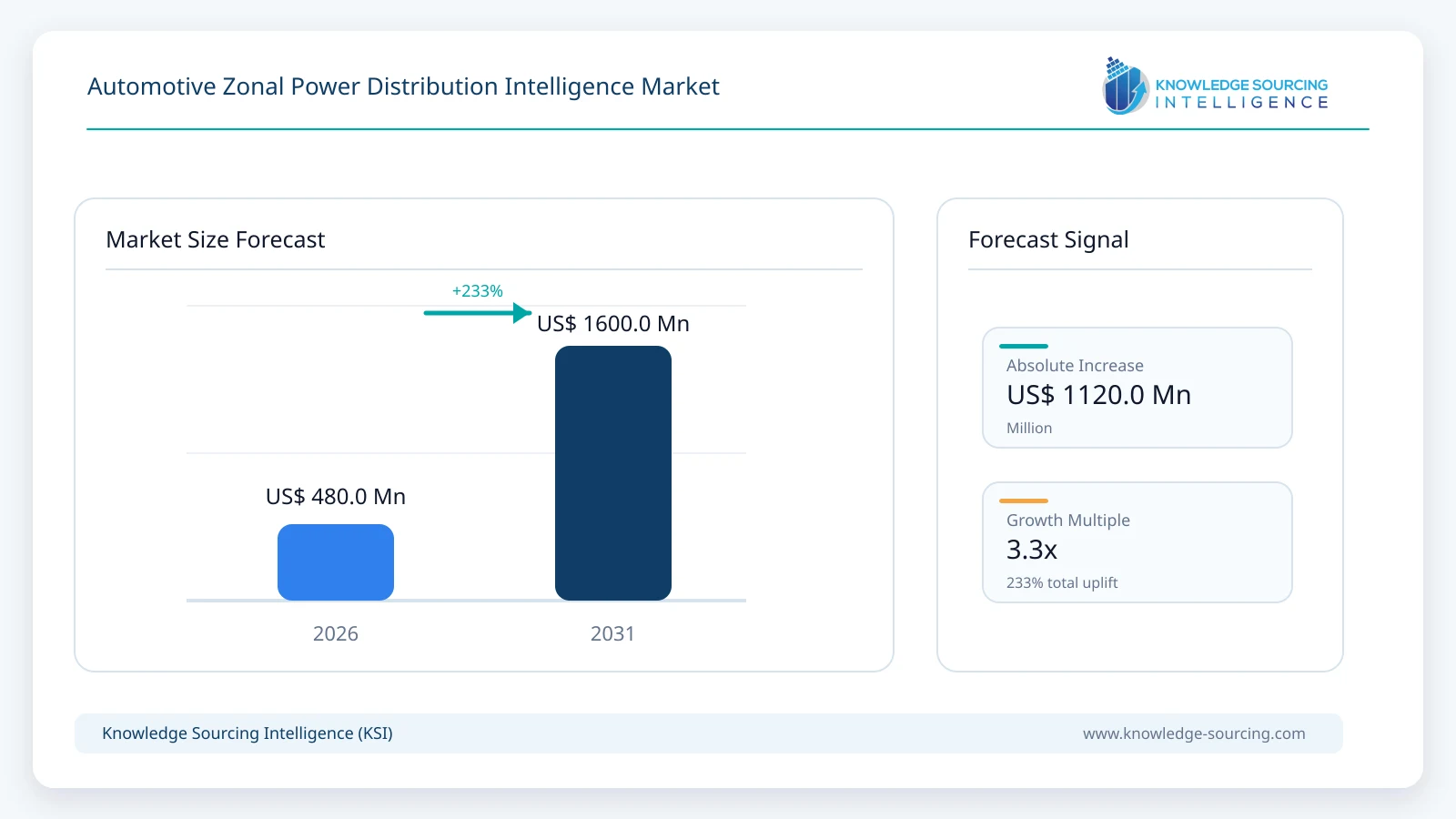
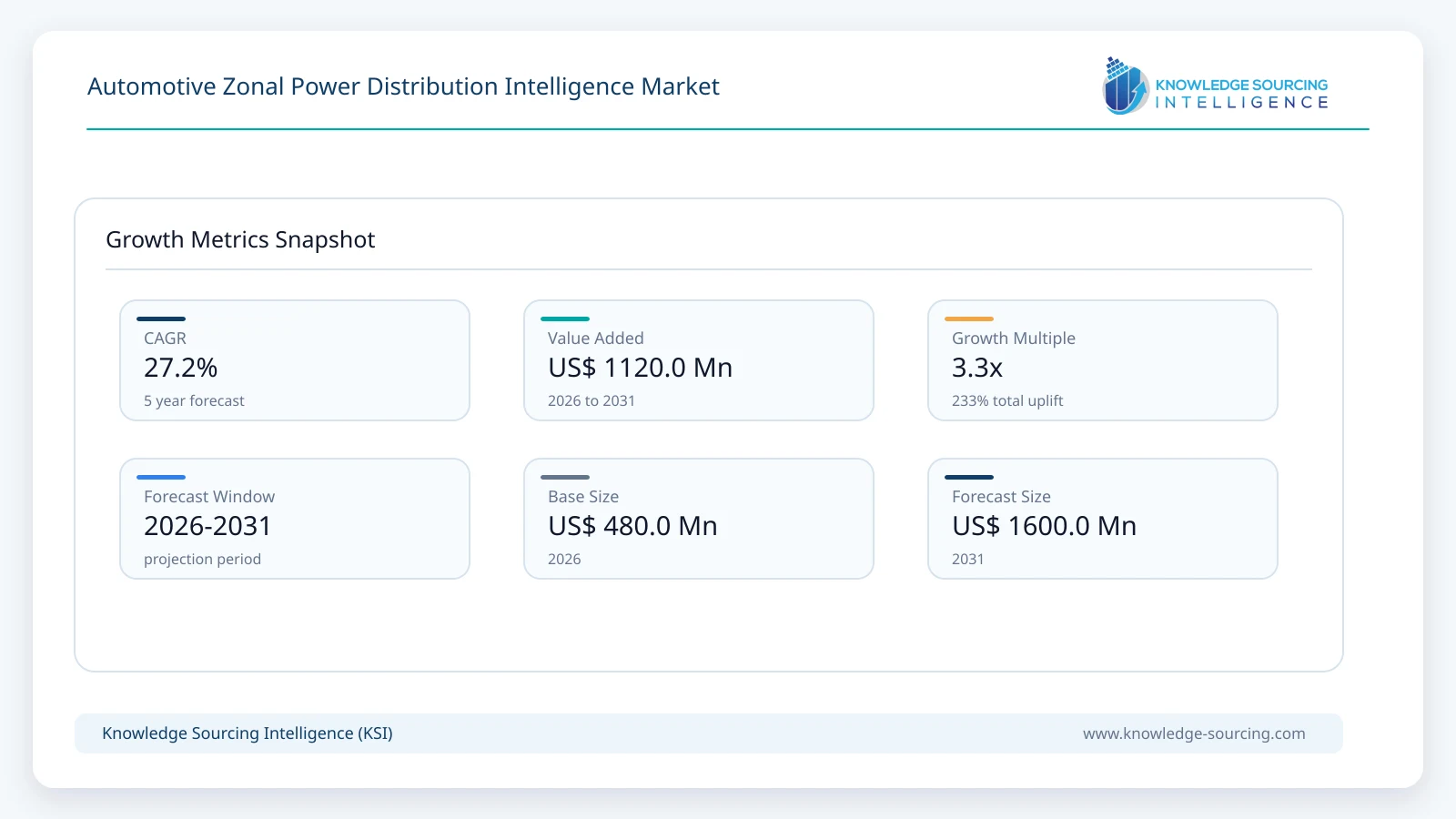
The automotive zonal power distribution intelligence market is projected to expand at a CAGR of 27.2%, reaching USD 1,600 million in 2031 from USD 480 million in 2026.
Highlights:
- 1Programmable switching and electronic-fuse control accounts for approximately 41% of modeled 2026 value, reflecting semiconductor-intensive low-voltage protection.
- 2Zone controller-integrated intelligent distribution represents approximately 48% of revenue in 2026 and is projected to reach 66% by 2031 as separate modules are consolidated.
- 312 V architectures retain the largest 2026 installed-revenue position, while mixed 12 V/48 V networks gain share on new zonal platforms.
- 4Asia Pacific accounts for an estimated 45% of market value in 2026, supported by vehicle production scale and electrical-architecture upgrades in China, Japan and South Korea.
- 5Battery electric vehicles represent around 38% of estimated 2026 value, rising to 53% by 2031 as electrical load management becomes more demanding.
- 6Supplier differentiation is moving toward accurate fault selectivity, low quiescent current, configurable wire protection and functional-safety evidence.
It includes the attributable value of programmable power-switching and electronic-fuse devices, current and thermal diagnostic circuitry, zonal power-control functions, configuration software and directly associated integration services installed in low-voltage zonal and hybrid vehicle architectures. The estimate excludes complete zonal computers, passive fuse boxes, vehicle wiring harnesses, battery high-voltage PDUs and power-conversion equipment unrelated to zonal low-voltage load control.
Infineon reported in February 2026 that BMW Group’s Neue Klasse uses three zone control units alongside its central computers, with PROFET smart eFuses supporting electronically controlled power distribution. BMW’s architecture replaces up to 150 conventional fuses per vehicle and allows selected consumers to be switched off according to operating state. FORVIA HELLA has also moved its intelligent Power Distribution Module into series production, demonstrating demand for fault monitoring and fail-operational supply beyond demonstration platforms.
Market Overview
Vehicle manufacturers historically routed low-voltage electrical power through central fuse and relay boxes, with numerous cables branching toward loads distributed around the body. Zonal architectures shorten those routes by combining local networking, actuation and power management close to doors, lighting, sensors and other endpoints. Semiconductor switching allows individual channels to monitor current, respond to abnormal loads and restore operation under predefined conditions, while a central controller retains oversight of vehicle-wide priorities.
Infineon’s PROFET Wire Guard devices integrate electronic wire protection and diagnostic feedback, while Texas Instruments supplies smart high-side switches with resettable fault handling for automotive zonal modules. AUMOVIO’s zone-control offering combines power-stage monitoring with software-based load prioritization and reactivation after faults. FORVIA HELLA’s iPDM and its iConF development with Analog Devices extend this integration toward dedicated electronic-fuse hardware and configurable control software. The resulting supply chain spans semiconductor protection, integrated power modules and the software needed to coordinate their operation across vehicle zones.
Manufacturers using smart primary distribution modules retain a central protection stage ahead of their zone controllers, whereas more consolidated electrical platforms integrate secondary switching into each local zone. Moving to mixed 12 V/48 V networks further changes the protection requirement because higher-current auxiliary loads, computing systems and safety-related actuators cannot share one undifferentiated supply policy. Procurement therefore depends on the number of controlled channels, required availability, degree of functional integration and the value of independently supplied semiconductor and software content.
Market Trends
Electronic Fuses Are Replacing Serviceable Protection in Selected Zones
Infineon’s PROFET Wire Guard family uses current-dependent wire-protection characteristics and fault reporting to replace conventional melting fuses in suitable circuits. BMW’s Neue Klasse is a production illustration: its software-controlled fuses can disconnect nonessential consumers according to vehicle operating state, rather than leaving all loads permanently powered. Hardware fault response remains essential because circuit protection cannot wait for remote software or network communication.
FORVIA HELLA’s series-production iPDM provides another commercial implementation of electronic protection. Its use of monitored channels supports early fault identification and supply continuity for systems with availability requirements. Zonal integration extends that benefit when the switch and protected wire are closer to each electrical load, although the final economics depend on device cost, harness design and the amount of redundancy.
12 V and 48 V Networks Are Converging Around Local Distribution Control
NXP introduced its CoreRide Z248 reference system in March 2026 to combine 48 V energy management and vehicle communications on a validated zonal foundation. A mixed-voltage architecture changes the protection and conversion topology because some loads remain at 12 V while higher-power consumers may operate on a 48 V network. Power-control intelligence must coordinate these branches without compromising transient behavior or diagnostic coverage.
Infineon’s 48 V-capable smart switches and related gate-drive components support this transition, but supplier designs must still account for thermal dissipation, connector limits and inrush currents. OEMs are consequently specifying local distribution by actual load characteristics rather than moving the entire vehicle to one voltage level at once.
Fail-Operational Fault Isolation Is Raising Control Content
Steer-by-wire, brake-by-wire and automated-driving features depend on preserving selected electrical supplies when another circuit develops a short or draws excessive current. Power networks serving these functions require selective disconnection, appropriate redundancy and evidence that failures will not propagate into unaffected loads. The resulting architecture can increase semiconductor monitoring and controller content even when the number of conventional fuses declines.
FORVIA HELLA’s iConF program with Analog Devices combines an eFuse, associated electronics and application software for upcoming zone-controller production. The company expects series production in 2028 for a premium vehicle program; that timing supports the medium-term outlook and is expected to add higher integration of electronic protection and control software.
Diagnostic Data Are Becoming Part of Vehicle-Wide Energy Management
AUMOVIO’s zone-control system exposes electrical current, voltage and temperature information to support load prioritization and predictive balancing. Such data can help a central energy manager distinguish a failed branch from a temporary overload and decide whether a comfort load should be disconnected to preserve more important functions. Device-level measurement quality and local processing remain necessary even when supervisory algorithms run elsewhere in the vehicle.
Texas Instruments’ zonal smart-fuse portfolio similarly combines switch protection with status feedback. Automakers benefit most when electrical protection data can be reused across fault diagnosis, service workflows and parked-vehicle power management without adding multiple separate measurement circuits.
Segment Analysis
By Intelligent Power Function: Software-Configurable Load Switching and eFusing
Software-configurable load switching and electronic fusing represents approximately 41% of 2026 market revenue. The segment covers protected semiconductor channels that can be configured for wire characteristics, operating conditions and controlled restart. Infineon’s PROFET Wire Guard family is relevant because it performs time-dependent wire protection in hardware while providing diagnostic data for higher-level control.
Software-configurable switching is expected to account for approximately 36% of global value by 2031. Its absolute revenue grows as intelligent channels spread across additional vehicle lines, although advances in integration and pricing reduce its share relative to selective isolation, software configuration and related diagnostic content.
By Revenue Component: Smart Switching and eFuse Devices
Smart switching and eFuse devices provide the largest discrete supplier revenue pool, estimated at 44% in 2026. They replace relays and fuses with electronic switching, overload monitoring and restart functions in zonal power branches. Texas Instruments, Infineon, Renesas and STMicroelectronics compete through switching performance, protection features, current range, package integration and automotive qualification.
By 2031, smart-switch devices are expected to hold approximately 42% of revenue as power-control processors, sensing devices and embedded software take a larger portion of total content. Higher integration enables suppliers to offer more compact protection circuitry and expand diagnostics without proportionally increasing board area.
By Power Distribution Architecture: Zone Controller-Integrated Power Distribution
Zone controller-integrated distribution accounts for around 48% of 2026 value because increasingly centralized vehicle computing retains local power switching in body zones. Aptiv and AUMOVIO describe controllers combining network connectivity, load actuation and software-controlled electrical protection. These functions shorten wiring routes while limiting the number of independent body-electronics modules.
Zone controller-integrated distribution is expected to rise to 66% of revenue by 2031 as broader platform rollouts move secondary distribution circuitry into local controllers. Dedicated intelligent secondary PDUs remain commercially useful for loads that require physical separation, high channel density or vehicle platforms that have not consolidated body functions.
By Low-Voltage Architecture: 12 V
The 12 V category captures approximately 76% of modeled 2026 revenue because most passenger-car body loads and zonal electrical architectures continue to use a 12 V low-voltage network. Vehicle manufacturers can introduce semiconductor protection and load diagnostics without replacing the entire electrical system or adding a new auxiliary battery architecture.
The 12 V segment is projected to account for 56% of revenue in 2031 as 48 V-capable architectures expand. The transition will be gradual: many OEMs are expected to retain 12 V accessories and integrate 48 V for selected high-power loads, placing greater value on coordinating mixed-voltage distribution.
By Controlled Load Application: Body, Comfort and Convenience
Body, comfort and convenience applications comprise an estimated 35% of 2026 value because lighting, windows, door controls, seating, pumps and similar loads form a large population of individually protected circuits. Local switching enables zone controllers to serve these loads without separate relay boxes or extensive point-to-point wiring.
Body, comfort and convenience remains the largest application group in 2031 at approximately 29% of revenue as active safety, chassis and thermal loads command more demanding availability and monitoring requirements. Unit counts alone do not explain segment value because protection requirements differ significantly between a comfort motor and a redundant steering power feed.
By Vehicle Type: Passenger Vehicles
Passenger vehicles account for approximately 90% of modeled 2026 demand, supported by higher production volumes and active rollout of zonal architectures among passenger EV and premium-platform manufacturers. BMW’s Neue Klasse and the broader pipeline of integrated low-voltage distribution platforms provide concrete examples of this shift toward software-managed vehicle power networks.
Passenger vehicles remain dominant in 2031 at approximately 89%, while commercial vehicles gain modest share as fleet operators place greater emphasis on electrical uptime and fault isolation. Commercial adoption remains sensitive to platform replacement cycles, heavy-duty 24 V architectures and the benefits of separately maintainable equipment.
By Propulsion: Battery Electric Vehicles
Battery electric vehicles contribute an estimated 38% of 2026 revenue despite representing a smaller share of overall vehicle production. New BEV platforms offer manufacturers more opportunity to redesign low-voltage wiring, integrate high-performance computers and coordinate large numbers of electrical auxiliaries. Infineon’s BMW and Stellantis relationships illustrate supplier involvement in next-generation power architectures.
Battery electric vehicle applications are projected to reach 53% of revenue by 2031 as more BEV platforms introduce integrated zone controllers and mixed-voltage power networks. Electrification alone does not guarantee zonal adoption, however; conventional and hybrid platforms can also use smart switches and eFuses when wiring optimization or electrical availability justifies the cost.
Market Drivers
Reduction of Wiring Length and Electrical Architecture Complexity
Large vehicle electrical architectures can route dozens of circuits from centralized fuse boxes to distant body loads. Localized zonal distribution shortens these runs and allows OEMs to reduce some wiring, connector and service-access requirements. Infineon reported that the BMW iX3 Neue Klasse wiring harness is approximately 600 metres shorter and 30% lighter than in earlier generations; this is a vehicle-platform outcome rather than a universal industry saving.
Power management contributes to that redesign because electronic protection can be situated closer to the loads and adjusted for the characteristics of each branch. The benefit depends on the cost of semiconductor channels and on whether the zone controller already provides the required processing and communication interfaces.
Increasing Use of Semiconductor eFuses and Programmable Protection
Smart high-side switches reduce dependence on replaceable mechanical fuses by measuring current and providing resettable overload protection. Infineon’s PROFET portfolio and FORVIA HELLA’s iPDM demonstrate that the technology is commercially available across semiconductor and module levels. For vehicle manufacturers, fewer accessible fuse locations can support additional freedom in where electrical components are installed.
As protection moves from fixed fuse ratings toward electronic models, suppliers compete on discrimination between normal inrush events and genuine faults. The resulting demand supports smart-switch ICs, sensors and validated control software rather than just higher semiconductor unit shipments.
Demand for Fail-Operational Supply in Safety-Relevant Systems
Automated driving, electrically assisted chassis functions and safety-relevant computing place greater emphasis on retaining supply to unaffected circuits when one branch fails. Functional-safety engineering therefore requires selective protection, clear diagnostic states and properly designed redundant paths instead of a simple central fuse arrangement.
FORVIA HELLA positions its iPDM for preserving core driving functions under fault conditions, while Infineon describes primary and secondary distribution systems designed for high availability. Vehicle programs with these requirements can support higher-value protection electronics per controlled channel.
Growth of Zonal and Software-Defined Vehicle Platforms
Infineon’s November 2025 investor presentation estimated that approximately 10% of light vehicles produced in 2025 used mixed domain/zonal architecture and projected roughly 40% by 2030. That trajectory points toward greater use of electronic switching and protection in new vehicle platforms, although individual OEM adoption schedules will differ.
NXP’s March 2026 Z248 reference architecture combines 48 V power distribution with zonal communications, showing how silicon vendors are attempting to lower OEM integration effort. Adoption of such platforms broadens the addressable base for configurable low-voltage power switches and diagnostic modules.
Expanding Electrical Loads and Operating-State Energy Management
Modern vehicles carry numerous compute, sensing, thermal and comfort loads with different requirements during driving, parking, charging and software servicing. Electronic power control allows nonessential functions to be disconnected when inactive, potentially reducing standby draw and protecting priority circuits.
BMW attributed approximately 20% energy-efficiency improvement in the described power-distribution context to its smart electronic power management implementation, but the figure should not be generalized to vehicle-wide consumption or applied indiscriminately to other models. The relevant market driver is the growing need for controllable channels and operating-state logic.
Market Restraints
Electronic Protection Cost Versus Mature Fuse-and-Relay Solutions
Conventional protection systems remain inexpensive, widely qualified and easy to source at scale. Adding monitored high-side switches, current sensing and control software increases direct electronic content, making full zonal protection less attractive for low-cost vehicle platforms with limited electrical complexity.
OEMs therefore often introduce programmable protection selectively on circuits with a clear availability, diagnostic or harness benefit. A widespread replacement of every basic fuse is neither required nor assumed within the forecast.
Functional-Safety Verification and Fault Selectivity
Fail-operational electrical distribution requires proof that a short circuit, switch malfunction or erroneous command cannot remove power from unrelated critical loads. Designers must validate selectivity, restart policy, thermal limits and redundant supply behavior across operating conditions.
The hardware and software testing burden increases when several load classes share a zone controller. Supplier development kits and safety documentation can reduce integration work, but they do not replace OEM-level verification of the final power network.
Thermal Dissipation and High-Current Switching Constraints
Semiconductor switching devices dissipate heat, particularly when low-voltage loads draw substantial current through compact modules. Junction-temperature limits, connector ratings and inrush characteristics can restrict consolidation of many channels onto one board.
High-current 48 V applications require suitable switch topology and protection coordination rather than simply reusing a 12 V smart-fuse design. Thermal management and fault-energy requirements can preserve demand for separate primary or secondary power modules.
Platform Redesign Timelines and Installed Architecture Lock-In
Zonal power distribution is typically decided at the electrical-architecture design stage because it affects harness topology, controller interfaces and service procedures. A late switch from a central fuse box can require extensive redesign and qualification.
Vehicle lines already engineered around conventional domain controllers will adopt intelligent power control in stages, and some smart secondary PDUs will coexist with older architectures. Forecast growth therefore reflects new-platform adoption rather than immediate retrofitting of the installed fleet.
Supplier Integration and Revenue Bundling
OEMs may purchase complete zone controllers or intelligent PDUs at negotiated module prices rather than separate licenses for protection logic and switching devices. Semiconductor vendors and Tier 1 integrators consequently compete through different commercial models, reducing the visibility of the individual power-control function.
The high degree of integration can intensify cost pressure on component suppliers when vehicle manufacturers standardize platforms. Differentiation must come from fault performance, qualification and integration efficiency rather than treating every electrical feature as an independently billable module.
Regional Outlook
Asia Pacific
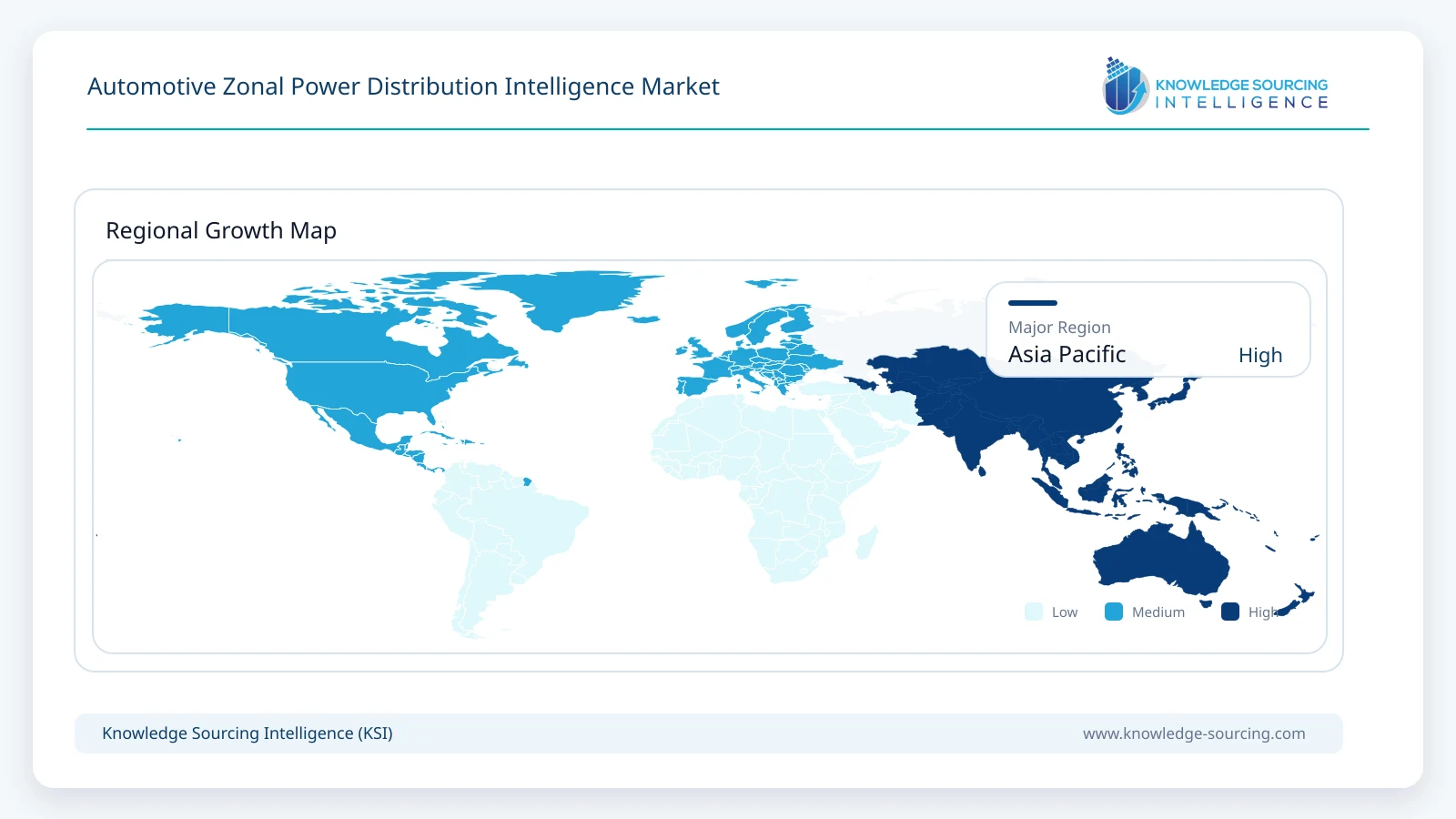
Asia Pacific represents approximately 45% of 2026 market value, supported by China’s large automotive production base, the concentration of electric vehicle manufacturing and electronic-architecture investment across Japan and South Korea. The region combines local OEM platform development with semiconductor, electronics and module supply chains. New vehicle programs create opportunities to introduce localized power control without carrying over legacy fuse-box layouts unchanged.
Asia Pacific is projected to reach approximately USD 784 million in 2031, or 49% of global value. China remains the principal contributor as domestically developed electrical platforms spread across higher-volume vehicles, while Japan, South Korea and India contribute through local production and supplier engineering programs. Growth is nevertheless sensitive to pricing pressure and the proportion of vehicles that implement programmable zonal power management rather than only consolidated data networks.
Europe
Europe accounts for an estimated 27% of revenue in 2026, reflecting activity among premium vehicle manufacturers, safety-system suppliers and specialist power-electronics producers. BMW’s Neue Klasse provides a production example of three zonal controllers supporting localized switching and fault handling, while FORVIA HELLA’s iPDM has entered series manufacture for a premium OEM. European supplier ecosystems also support functional-safety assessment and mixed-voltage architecture development.
European revenue is projected at approximately USD 400 million in 2031 as more vehicle platforms integrate smart secondary power distribution. The region’s share moderates to 25% because Asian automotive electronics deployment is expected to increase faster. European vehicle programs should continue to command substantial value per application where safety qualification and dependable power requirements are demanding.
Competitive Landscape
Infineon, Texas Instruments, STMicroelectronics, Renesas, NXP and Analog Devices compete across switching, monitoring and control silicon, while integrated vehicle-electronics suppliers contribute module engineering and control software. FORVIA HELLA, Aptiv, AUMOVIO and Lear compete through integrated power modules and body or zonal electronics, although the level of direct power-control participation varies by platform.
Infineon combines smart-switch products with microcontrollers and power-management circuits, while FORVIA HELLA integrates electronic-fuse technologies with iPDM and zone-controller programs. Aptiv’s zone controllers couple power and communications, and AUMOVIO offers software-based priority control and diagnostic monitoring. Aptiv spun off its former Electrical Distribution Systems business as Versigent in April 2026; the separation matters when distinguishing vehicle controller engineering from passive electrical distribution and harness operations.
Recent Developments
September 10, 2026: FORVIA HELLA presented its intelligent Power Distribution Module for commercial vehicles alongside wider energy-management offerings. The announcement broadens supplier positioning beyond passenger-car platforms but does not establish mass commercial-vehicle shipments of the concept.
March 10, 2026: NXP introduced the CoreRide Z248 48 V zonal reference system, integrating zonal data functions with intelligent power distribution and protection. The validated design combines 48 V power and communications functions intended to support subsequent vehicle platform development.
February 16, 2026: Infineon detailed its contribution to BMW Group’s Neue Klasse architecture, including three zone controllers and PROFET smart eFuses. BMW reported replacement of up to 150 conventional fuses and substantially shorter wiring on its associated vehicle platform.
February 10, 2026: STMicroelectronics introduced the Stellar P3E microcontroller with hardware AI acceleration, targeting multifunction automotive ECUs including zonal body functions. The device supports local-control integration but is not itself an intelligent distribution module.
January 13, 2026: FORVIA HELLA announced a development cooperation with Analog Devices for iConF electronic fuses, with expected series production in 2028 for a premium OEM program. The agreement combines switching silicon and control software for local protection.
September 16, 2025: FORVIA HELLA confirmed series production of its intelligent Power Distribution Module and stated that the combined lifetime customer-project volume for iPDM and Zone Controller exceeded EUR 1 billion. The confirmed orders provide evidence of sustained customer investment in electronic protection and new vehicle power architectures.
Market Outlook
Electronic protection and monitored low-voltage switching will reach more passenger-vehicle platforms as automakers redesign their electrical architectures around local zones. New vehicle platforms are expected to expand the number of models using intelligent zonal power systems, and supported electrical functions become more integrated within common modules. Software-configurable protection is likely to extend from early premium platforms toward selected higher-volume vehicle lines.
The extent of conventional fuse replacement, number of branches needing selective isolation, and balance between integrated modules and configurable software will determine supplier revenue growth. Safety-critical circuits and mixed-voltage architectures are expected to command additional control content, while volume passenger applications will increase pressure on per-channel cost.
Asia Pacific is likely to extend its lead as new-platform production scales, while Europe retains a substantial role in advanced protection and fail-operational development. The long-term supplier opportunity lies in delivering validated, configurable power networks that improve wiring efficiency and circuit availability without multiplying controller hardware unnecessarily.
Automotive Zonal Power Distribution Intelligence Market Scope
| Report Metric | Details |
|---|---|
| Total Market Size in 2026 | 480 million |
| Total Market Size in 2031 | USD 1,600 million |
| Forecast Unit | Million |
| Growth Rate | 27.2% |
| Study Period | 2021 to 2031 |
| Historical Data | 2021 to 2024 |
| Base Year | 2025 |
| Forecast Period | 2026 – 2031 |
| Segmentation | Intelligent Power Function, Revenue Component, Power Distribution Architecture, Low-Voltage Architecture, Controlled Load Application, Vehicle Type, Propulsion, Geography |
| Companies |
|
Market Segmentation
By Intelligent Power Function
Software-Configurable Load Switching and eFusing
Current, Voltage and Thermal Monitoring
Selective Fault Isolation and Fail-Operational Control
Power-State Optimization and Load Shedding
Remote Configuration and Self-Test
By Revenue Component
Smart Switching and eFuse Devices
Attributable Zonal Power Control Electronics
Diagnostic and Current-Sensing Devices
Embedded Control and Configuration Software
Integration and Lifecycle Support
By Power Distribution Architecture
Zone Controller-Integrated Power Distribution
Distributed Smart Secondary Power Distribution Unit
Hybrid Primary and Secondary Intelligent Distribution
By Low-Voltage Architecture
12 V
Mixed 12 V and 48 V
48 V-Focused
24 V Commercial and Other Low-Voltage
By Controlled Load Application
Body, Comfort and Convenience
Active Safety and Chassis
Infotainment, Connectivity and Compute
Thermal and Energy Auxiliaries
Other Vehicle Loads
By Vehicle Type
Passenger Vehicles
Light Commercial Vehicles
Medium and Heavy Commercial Vehicles
By Propulsion
Internal Combustion and Mild Hybrid
Full Hybrid and Plug-in Hybrid
Battery Electric
By Geography
Asia Pacific
China
Japan
South Korea
India
Thailand
Indonesia
Others
Europe
Germany
France
United Kingdom
Italy
Spain
Others
North America
United States
Mexico
Canada
South America
Brazil
Argentina
Others
Middle East and Africa
South Africa
Saudi Arabia
United Arab Emirates
Others
Table of Contents
1. EXECUTIVE SUMMARY
2. MARKET SNAPSHOT
2.1. Market Overview
2.2. Market Definition
2.3. Scope of the Study
2.4. Market Segmentation
3. BUSINESS LANDSCAPE
3.1. Market Drivers
3.1.1. Reduction of Wiring Length and Electrical Architecture Complexity
3.1.2. Increasing Use of Semiconductor eFuses and Programmable Protection
3.1.3. Demand for Fail-Operational Supply in Safety-Relevant Systems
3.1.4. Growth of Zonal and Software-Defined Vehicle Platforms
3.1.5. Expanding Electrical Loads and Operating-State Energy Management
3.2. Market Restraints
3.2.1. Electronic Protection Cost Versus Mature Fuse-and-Relay Solutions
3.2.2. Functional-Safety Verification and Fault Selectivity
3.2.3. Thermal Dissipation and High-Current Switching Constraints
3.2.4. Platform Redesign Timelines and Installed Architecture Lock-In
3.2.5. Supplier Integration and Revenue Bundling
3.3. Market Opportunities
3.4. Porter's Five Forces Analysis
3.5. Industry Value Chain Analysis
3.6. Policies and Regulations
3.7. Strategic Recommendations
4. TECHNOLOGICAL OUTLOOK
4.1. Semiconductor eFuses and Smart High-Side Switching
4.2. Wire Protection, Fault Detection and Selectivity
4.3. Zonal Controller Integration
4.4. 12 V / 48 V Powernet Management
4.5. Fail-Operational Power Control
5. AUTOMOTIVE ZONAL POWER DISTRIBUTION INTELLIGENCE MARKET BY INTELLIGENT POWER FUNCTION
5.1. Introduction
5.2. Software-Configurable Load Switching and eFusing
5.3. Current, Voltage and Thermal Monitoring
5.4. Selective Fault Isolation and Fail-Operational Control
5.5. Power-State Optimization and Load Shedding
5.6. Remote Configuration and Self-Test
6. AUTOMOTIVE ZONAL POWER DISTRIBUTION INTELLIGENCE MARKET BY REVENUE COMPONENT
6.1. Introduction
6.2. Smart Switching and eFuse Devices
6.3. Attributable Zonal Power Control Electronics
6.4. Diagnostic and Current-Sensing Devices
6.5. Embedded Control and Configuration Software
6.6. Integration and Lifecycle Support
7. AUTOMOTIVE ZONAL POWER DISTRIBUTION INTELLIGENCE MARKET BY POWER DISTRIBUTION ARCHITECTURE
7.1. Introduction
7.2. Zone Controller-Integrated Power Distribution
7.3. Distributed Smart Secondary Power Distribution Unit
7.4. Hybrid Primary and Secondary Intelligent Distribution
8. AUTOMOTIVE ZONAL POWER DISTRIBUTION INTELLIGENCE MARKET BY LOW-VOLTAGE ARCHITECTURE
8.1. Introduction
8.2. 12 V
8.3. Mixed 12 V and 48 V
8.4. 48 V-Focused
8.5. 24 V Commercial and Other Low-Voltage
9. AUTOMOTIVE ZONAL POWER DISTRIBUTION INTELLIGENCE MARKET BY CONTROLLED LOAD APPLICATION
9.1. Introduction
9.2. Body, Comfort and Convenience
9.3. Active Safety and Chassis
9.4. Infotainment, Connectivity and Compute
9.5. Thermal and Energy Auxiliaries
9.6. Other Vehicle Loads
10. AUTOMOTIVE ZONAL POWER DISTRIBUTION INTELLIGENCE MARKET BY VEHICLE TYPE
10.1. Introduction
10.2. Passenger Vehicles
10.3. Light Commercial Vehicles
10.4. Medium and Heavy Commercial Vehicles
11. AUTOMOTIVE ZONAL POWER DISTRIBUTION INTELLIGENCE MARKET BY PROPULSION
11.1. Introduction
11.2. Internal Combustion and Mild Hybrid
11.3. Full Hybrid and Plug-in Hybrid
11.4. Battery Electric
12. AUTOMOTIVE ZONAL POWER DISTRIBUTION INTELLIGENCE MARKET BY GEOGRAPHY
12.1. Asia Pacific
12.1.1. China
12.1.2. Japan
12.1.3. South Korea
12.1.4. India
12.1.5. Thailand
12.1.6. Indonesia
12.1.7. Others
12.2. Europe
12.2.1. Germany
12.2.2. France
12.2.3. United Kingdom
12.2.4. Italy
12.2.5. Spain
12.2.6. Others
12.3. North America
12.3.1. United States
12.3.2. Mexico
12.3.3. Canada
12.4. South America
12.4.1. Brazil
12.4.2. Argentina
12.4.3. Others
12.5. Middle East and Africa
12.5.1. South Africa
12.5.2. Saudi Arabia
12.5.3. United Arab Emirates
12.5.4. Others
13. COMPETITIVE ENVIRONMENT AND ANALYSIS
13.1. Major Players and Strategy Analysis
13.2. Market Share Analysis
13.3. Product Development, Agreements and Collaborations
13.4. Competitive Dashboard
14. COMPANY PROFILES
14.1. Infineon Technologies AG
14.2. FORVIA HELLA
14.3. NXP Semiconductors N.V.
14.4. STMicroelectronics N.V.
14.5. Texas Instruments Incorporated
14.6. Renesas Electronics Corporation
14.7. Aptiv PLC
14.8. AUMOVIO SE
14.9. Lear Corporation
14.10. Analog Devices, Inc.
15. APPENDIX
15.1. Currency
15.2. Assumptions
15.3. Base and Forecast Years Timeline
15.4. Key Benefits for Stakeholders
15.5. Research Methodology
15.6. Abbreviations
Navigate
Trusted by the world's leading organizations