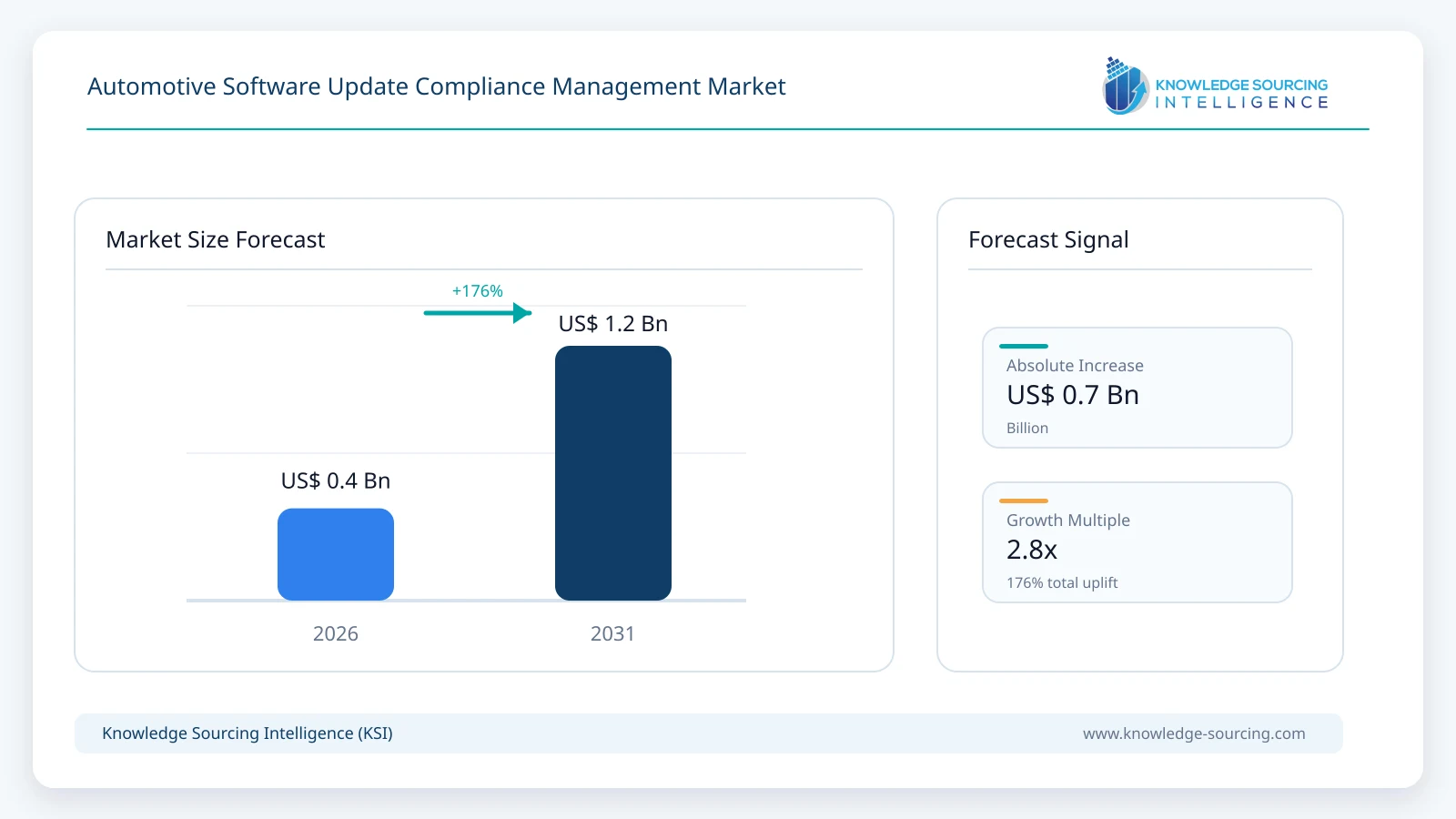
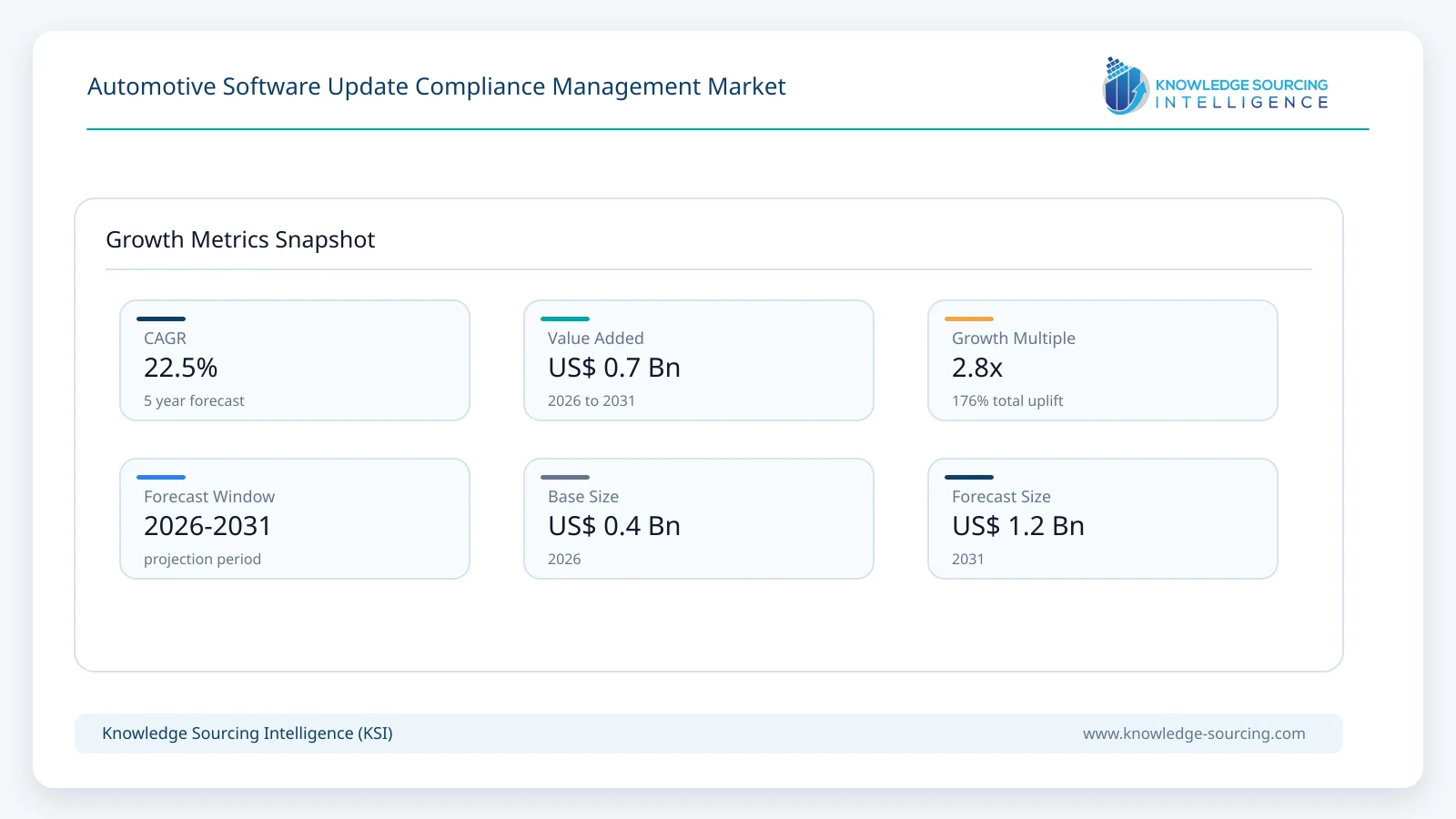
The automotive software update compliance management market is forecast to grow at a CAGR of 22.5%, reaching approximately USD 1.160 billion by 2031 from USD 0.420 billion in 2026.
Highlights:
- 1Approval workflow and release-evidence management accounts for approximately 32% of 2026 market revenue.
- 2Governance software licensing represents approximately 49% of 2026 revenue, reflecting enterprise and vehicle-program platform contracts.
- 3Cloud-managed deployments account for approximately 37% in 2026; hybrid integration grows as engineering evidence must cross controlled environments.
- 4ADAS and automated driving contribute approximately 31% of 2026 spending because approval-relevant changes require detailed validation.
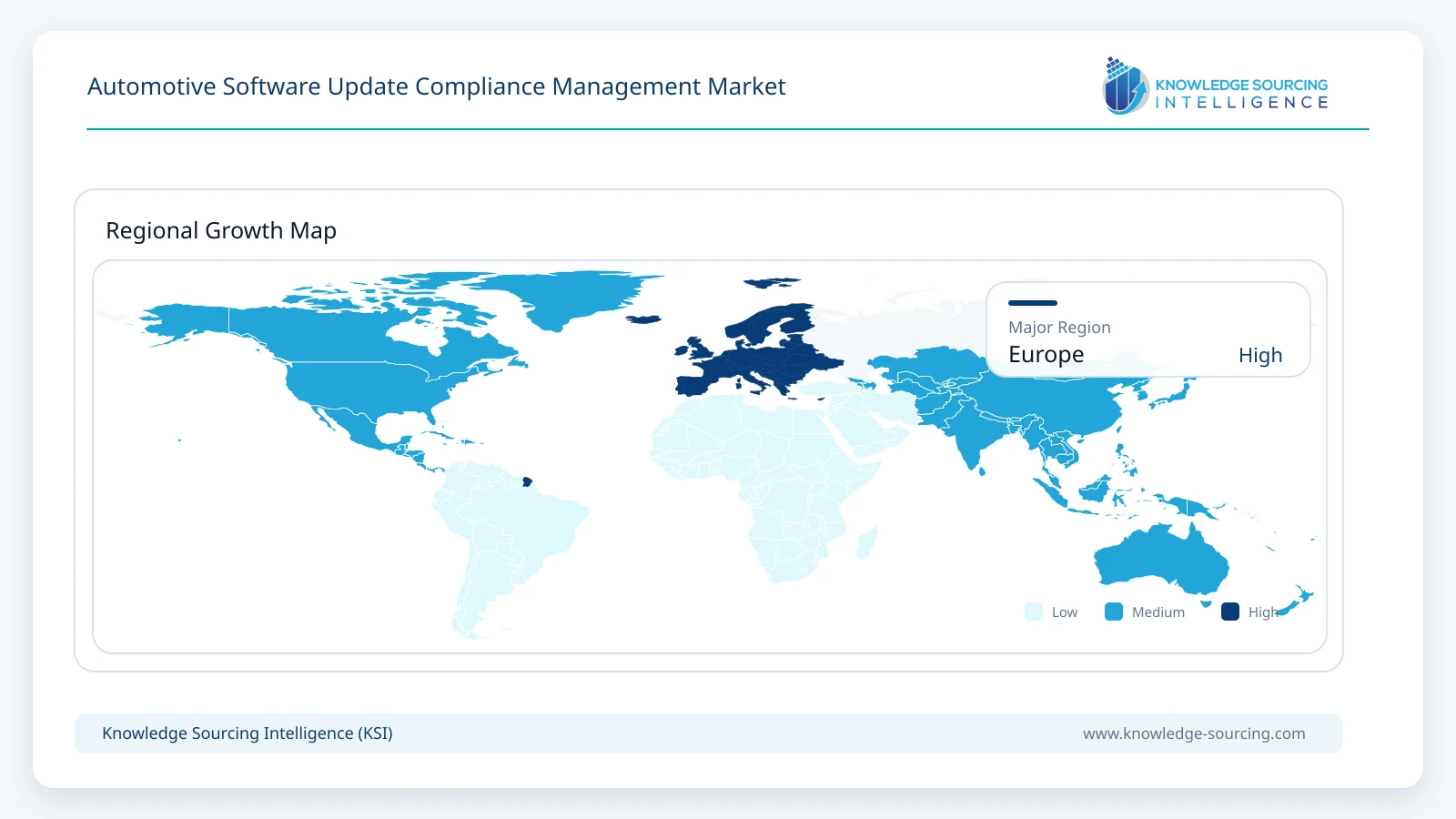
- 5Europe accounts for approximately 38% of the global market in 2026, supported by the EU software-update approval framework.
- 6Asia Pacific is expected to increase its market share through 2031 as connected vehicle software programs spread across production platforms.
Revenue arises from platforms and engineering services that establish control over software identity, change authorization, impact assessment, audit evidence and the outcome of vehicle software updates. Buyers increasingly require a consistent compliance record across vehicle programs because update decisions made after production can alter safety functions, configuration eligibility and approved vehicle characteristics.
Automakers are integrating software-update governance with engineering release pipelines and in-service vehicle records. Vector's vehicle update and diagnostics offerings, Sibros' compliance-supporting connected vehicle platform and HARMAN's validation and deployment toolchain illustrate several supplier routes into this demand. Manufacturers retain the responsibility for vehicle type approval and the effectiveness of their Software Update Management Systems, which makes workflow integration and evidence quality central commercial differentiators.
Market Overview
Software Update Management Systems formalize the relationship between approved vehicle software, update decisions and the records available to technical services or approval authorities. UN Regulation No. 156 requires manufacturers to document relevant software versions, preserve integrity information and control changes affecting vehicle type approval. A practical compliance platform therefore needs to link engineering artifacts and intended changes to the vehicles, components and approvals they concern, rather than treating an update campaign as a standalone download activity.
ISO 24089:2023 provides a complementary engineering framework covering update work at organizational and project levels, from infrastructure and electronic control units to the construction and deployment of update packages. Its scope extends beyond wireless distribution, which matters for workshop programming and other service channels. Vector's Update Manager identifies hardware and software dependencies and organizes execution across heterogeneous ECUs; dedicated governance software can use that execution evidence to maintain release histories and confirm the approved vehicle configuration.
The commercial purchasing decision is increasingly shared among software engineering, functional safety, homologation, IT security and aftersales organizations. Suppliers that connect these fragmented records without replacing every engineering tool can reduce manual reconciliation and help maintain consistent evidence across vehicle platforms and regional operations.
Market Trends
Software identity and approval traceability are becoming continuous engineering functions
Manufacturers increasingly need to associate every released software package with the relevant hardware combination, vehicle family and type-approved function. UN Regulation No. 156 addresses access to software-version and integrity information, including the RXSWIN identifier where applicable. This creates regular demand for software bill-of-material mappings, controlled release records and reconciliation between approved baselines and configurations actually installed in vehicles.
The shift is especially important for shared control software that spans ADAS, braking, energy management and cockpit functions. A change that appears minor in a development repository may alter an approval-relevant behavior when installed on a different ECU or vehicle variant. Compliance platforms gain value by making these dependencies visible early enough for engineers and homologation specialists to evaluate them before release.
Regulatory evidence is moving closer to release and validation workflows
Engineering and regulatory teams need a traceable account of why an update was approved, which functions were affected and what testing supports the decision. When evidence resides in separate requirements databases, test reports and change tickets, release reviews become slower and post-release audits more demanding. Connected governance workflows can associate each approval decision with a defined package, vehicle configuration and validation record.
HARMAN's January 2026 Ready CQuence developments connect software validation with lifecycle deployment, while Siemens describes the growing importance of coordinated OTA engineering workflows. Requirements traceability and consistent release gates are becoming part of the operational software toolchain.
A unified update history is expanding beyond wireless delivery
Manufacturers therefore need one governed record of software configuration and the resulting approval status regardless of how the package reached the ECU. ISO 24089 applies to software update engineering more broadly than OTA transmission, while UN R156 addresses software-update management for relevant vehicle approvals.
Vector's vService combines remote, workshop and OTA-related aftersales functions and supports connections to software-update management environments. Its architecture illustrates why compliance records must incorporate completed installations, partial failures and subsequent remedial work. Manufacturers that reconcile these outcomes centrally are better positioned to detect configuration divergence and maintain reliable field evidence.
Variant complexity is increasing the value of automated eligibility checks
Global vehicle programs distribute common software components across models with different sensors, actuators, calibration sets and regulatory specifications. A single update package may be suitable for some variants but inappropriate for others, particularly when approval requirements differ between markets. Automated compatibility and eligibility checks can prevent unauthorized combinations and reduce the amount of manual vehicle-by-vehicle review.
The transition toward centralized computing reduces some hardware duplication but increases interdependence among software services. Vector's embedded update-management system maps controllers and dependencies before sequencing installations. Compliance-management tools need to combine that technical information with release authorizations and vehicle-approval constraints, allowing suppliers to offer greater value than a simple software inventory.
Ongoing vehicle support is creating recurring compliance workloads
Manufacturers may issue security corrections, performance refinements and regulatory remediation updates long after initial production. Each material change can require renewed evidence of version integrity, intended scope and completed deployment, particularly for safety-related software. Support for several generations of vehicles creates demand for maintained approval histories, audit access and documented exception handling.
Tata Motors' 2026 deployment of Excelfore's OTA and diagnostics platform demonstrates how ongoing software services are becoming part of production vehicle programs. Continuing campaigns can generate software support and engineering activity after initial deployment. The commercial opportunity favors platforms that preserve historical traceability as vehicles and supplier software evolve.
Segment Analysis
By Platform Function: Approval Workflow and Evidence Management
Approval and release-evidence workflows represent approximately 32% of the 2026 market because automakers must review software changes and retain a defensible record before authorizing affected configurations. These tools associate risk assessments, requirements and tests with release identities while supporting cross-functional sign-off. Regulatory teams benefit when technical records are presented in a consistent form across programs and approving authorities.
Through 2031, approval workflows remain important even as their relative share moderates. Automated configuration and field-outcome traceability are expected to capture more incremental spending as the number of supported vehicle variants increases. Suppliers able to connect approval evidence to actual update execution should hold stronger positions than providers offering isolated electronic checklists.
By Revenue Component: Platform Licensing and Governance Software
Platform licensing accounts for approximately 49% of 2026 revenue, reflecting demand for permission controls, release records, evidence workflows and software identification. Licensing can be contracted at OEM, business-unit or vehicle-program level rather than priced as a fixed item on each produced vehicle. Dedicated engineering and integration remain material where OEMs need to link existing PLM, test, OTA and homologation systems.
The corresponding engineering requirement does not disappear, particularly where historic vehicle platforms must be connected to modern software inventories. Long-term commercial value depends on renewal and multi-program expansion rather than a one-time compliance certificate.
By Deployment Environment: Cloud and Hybrid Governance
Cloud-managed environments represent around 37% of 2026 demand as manufacturers look to provide development teams and regional organizations with synchronized approval workflows. Centralized evidence repositories can reduce inconsistencies between release branches and simplify access to completed testing and version records. However, sensitive vehicle configurations, proprietary calibration data and engineering test equipment still support substantial on-premises spending.
Hybrid architectures are forecast to expand particularly quickly because they connect controlled local laboratories with shared cloud-based governance. Integration quality, access management and evidence integrity matter more than the location of the dashboard itself. Suppliers offering both data-control flexibility and reliable synchronization can address manufacturers with complex regional engineering structures.
By Vehicle Software Domain: ADAS and Automated Driving
ADAS and automated-driving functions account for approximately 31% of 2026 compliance-management spending because changes can affect safety behavior, sensor dependencies and approved vehicle capabilities. Release approval typically involves extensive testing, traceable requirements and checks against the target hardware configuration. As software-defined systems evolve, the governance workload becomes more demanding than maintaining a version label alone.
Growth in supervised automation and continuously improving perception software will make ADAS a major source of incremental compliance work through 2031. Powertrain, energy management and cross-domain vehicle services will also require structured release evidence, but their testing and update cadence can differ materially. Suppliers need configurable domain-specific gates rather than an identical approval form for every software change.
Market Drivers
Application of UNECE software-update management requirements
The EU type-approval framework applies UN Regulation No. 156 through defined transitional dates and vehicle categories, creating a recurring need to demonstrate software-update governance. Manufacturers must show that relevant records, controls and processes are established and maintained rather than simply confirming that an update mechanism exists.
This gives compliance workflows a direct connection to market access for applicable vehicle programs. Suppliers benefit when they help manufacturers link the update process to vehicle configuration, regulatory evidence and execution outcomes, while the OEM remains accountable to the approval authority.
Rising frequency of updates across connected vehicle platforms
Software-defined architectures allow manufacturers to revise functions after a vehicle enters service, increasing the number of release decisions made during its operating life. Each additional eligible update can create new obligations for version tracking, validation, authorization and post-installation evidence.
Repeated compliance activity strengthens demand for common software tools and maintained records across model generations. The advantage is most visible for manufacturers managing several regional fleets and control-system variants, where manual approval workflows become costly and inconsistent.
More complex ECU dependencies and software configurations
Modern vehicle functions often span networked ECUs, high-performance computers and shared services, so changing a software component can affect other functions and previously tested combinations. Manufacturers need a reliable way to assess dependencies before allowing deployment to particular vehicle variants.
Software configuration mapping and automated eligibility checks can shorten reviews while lowering the risk of installing unsupported combinations. Platforms that integrate engineering bills of material, release records and execution data can therefore command value beyond basic documentation storage.
Pressure to connect homologation with engineering execution
Software engineers, safety teams and homologation functions typically maintain different tools and evidence repositories, even when their work relates to one vehicle update. Delays arise when teams must manually establish which test outcomes support a release and whether an affected approval must be revisited.
A shared compliance workflow can connect requirements, test results, software identifiers and signed approvals. The resulting improvement is operational rather than merely administrative because it reduces uncertainty during a release decision and simplifies subsequent audit requests.
Expansion of lifecycle support and field remediation
An installed vehicle population continues receiving security patches, service corrections and performance updates after initial sale, extending governance requirements across multiple years. Workshop updates and partially completed OTA campaigns also need records that explain which software was successfully installed.
Maintained update histories support fleet diagnostics, service operations and responses to emerging defects. Suppliers offering durable records and integrations with OEM aftersales systems can generate recurring software and engineering revenue beyond the original launch of a vehicle platform.
Market Restraints
Integration with fragmented OEM engineering systems
Many manufacturers already use established requirements, change-management, PLM, simulation and OTA systems from several vendors. Compliance platforms must exchange version identifiers and test evidence without introducing conflicting source records or disrupting active release programs.
Integration projects may require extensive customization for legacy controllers and vehicle lines. These costs can delay purchasing decisions, particularly where an OEM believes its toolchain can be extended instead of replaced by a governance product.
Difficulty proving that software changes do not alter approved characteristics
A change to code, calibration or ECU configuration can affect several vehicle functions and may have different consequences across model variants. Demonstrating the complete impact of a proposed update requires engineering analysis and validation, not only a digital approval signature.
Software platforms can organize evidence but cannot replace the required testing or manufacturer's technical judgment. Complex releases therefore create residual verification workloads, limiting the extent to which automated compliance tools can reduce approval costs.
Limited visibility into third-party software and supplier records
Vehicle manufacturers depend on Tier 1 suppliers, embedded software vendors and component developers for release data that may sit outside OEM repositories. Differences in software-identification formats and rights to underlying verification records can leave gaps in a complete approval history.
Obtaining dependable evidence may require new supplier contracts, interfaces and record-retention arrangements. Platform deployments that cannot address supplier boundaries risk producing polished audit dashboards without the information needed to substantiate critical decisions.
Data governance and access-control obligations across jurisdictions
Compliance records can contain sensitive configuration details, software hashes, security information and proprietary testing results. Manufacturers operating multiple development centers must determine which teams and partners can access those records and where they may be stored.
Restrictions on cloud use and organizational security reviews can slow enterprise deployment. Suppliers may need hybrid hosting, granular permissions and strong evidence-integrity controls, raising implementation effort for customers with heterogeneous regional infrastructure.
Uncertain standalone pricing and overlapping procurement budgets
Software-update governance is often purchased as part of a larger release-engineering, OTA or PLM agreement rather than through an isolated software line item. OEMs may also maintain substantial internal engineering capacity to manage approval procedures.
Vendors must demonstrate that a specialist tool reduces duplicated effort and improves the completeness of evidence. Where existing software suites already provide adequate traceability, separate compliance-management contracts may be smaller or slower to materialize than the overall regulatory workload suggests.
Regional Outlook
Europe
Europe accounts for approximately 38% of the 2026 market because the EU approval framework has incorporated UN Regulation No. 156 and manufacturers must maintain demonstrable software-update processes for applicable vehicle types. German, French and other European manufacturers typically operate complex vehicle families and extensive supplier networks, creating demand for structured release evidence and controlled update histories. Assessment services and specialist engineering tools complement the software platforms used across vehicle development and service organizations.
Spending is likely to expand as manufacturers support longer-lived software-rich models and more updateable safety functions. European customers may favor solutions that bring homologation, vehicle-version information and OTA/workshop outcomes together in a documented process. Suppliers that can work within existing OEM toolchains and satisfy strict access controls should be best positioned for larger multi-program contracts.
Asia Pacific
Asia Pacific represents approximately 33% of 2026 revenue, with China, Japan and South Korea contributing substantial vehicle-electronics engineering activity and India developing more connected production platforms. Regional OEMs are expanding OTA, remote diagnostics and software-defined capabilities, although regulatory requirements differ by jurisdiction and are not identical to the EU framework. The region's diverse model programs support demand for version management, change approval and platform integration.
Asia Pacific is projected to gain share through 2031 as software-update functions spread beyond premium vehicles and engineering organizations establish repeatable release governance across product families. Excelfore's 2026 Tata Sierra program demonstrates production use of a modern OTA and diagnostics platform in India, although its full contract value is not disclosed. Regulatory interoperability and evidence consistency will matter to manufacturers exporting software-rich vehicles into multiple approval regimes.
Competitive Landscape
Competition spans established automotive software suppliers, specialist connected-vehicle platform companies and independent assessment organizations. Vector combines embedded vehicle update management with software-defined development and aftersales tools, while Sibros and Excelfore emphasize connected-vehicle operations and OTA capabilities that can feed compliance evidence. HARMAN, Aptiv, ETAS and Siemens provide broader engineering or software lifecycle environments into which approval governance may be integrated.
Specialist suppliers compete on traceability across software components and vehicle programs, the ease of connecting with existing tools, and the capacity to maintain a reliable audit trail after software enters the field. Commercial contracts may combine platform access, integration and recurring support, with different parties responsible for regulatory assessment and final approval.
Independent technical services have a distinct role from software platform vendors. TÜV SÜD and similar organizations assess manufacturers' update-management procedures and support conformity processes, but they do not transfer the vehicle manufacturer's responsibility for compliance. OEM-owned software factories are also meaningful alternatives to purchased systems, so third-party providers increasingly offer modular tools and services that integrate into manufacturer-controlled release environments.
Recent Developments
September 2025: Vector introduced SDx Cloud as a connected software-defined systems platform linking embedded devices and backend workflows. This extends the infrastructure available for coordinating update-related data.
January 2026: HARMAN expanded its Ready CQuence toolchain with validation and lifecycle execution elements, connecting software development to fleet-scale updating. The release expands engineering support for controlled post-production updates.
April 2026: Excelfore announced deployment of an OTA and remote-diagnostics platform for Tata Motors Passenger Vehicles, debuting in the Tata Sierra. The supplier described a production program with lifecycle update management.
May 2026: Aptiv announced participation in SDVerse, making LINC and related software platforms accessible to OEM and supplier buyers. The announcement broadens distribution for engineering environments that can interface with controlled software releases.
July 2026: Vector introduced its SOVD toolchain for service-oriented vehicle diagnostics, covering specification through implementation and use. The program improves technical connectivity between service evidence and update-management systems.
September 2026: Sonatus and Hagiwara Electronics announced collaboration to distribute and integrate software-defined vehicle technologies in multiple markets. The agreement expands regional systems-integration channels.
Market Outlook
Software update compliance management is expected to become a routine part of vehicle software operations as manufacturers maintain more approval-relevant code after production. The strongest near-term spending will follow the integration of release authorization, variant eligibility and evidence retention into software engineering workflows. Suppliers that can demonstrate dependable connections to vehicle configuration and field-update results will be better placed than products limited to preparing documents for an occasional audit.
Commercial growth through 2031 is likely to favor reusable governance platforms supported by targeted engineering and lifecycle services. Regulatory obligations will remain a durable driver in applicable markets, while supplier competition and in-house tooling will constrain the amount of value independently purchased. The market's long-term position will depend on whether compliance records become embedded in daily release decisions and aftersales processes rather than remaining a separate reporting activity.
Automotive Software Update Compliance Management Market Scope:
| Report Metric | Details |
|---|---|
| Total Market Size in 2026 | USD 0.420 billion |
| Total Market Size in 2031 | USD 1.160 billion |
| Forecast Unit | USD Billion |
| Growth Rate | 22.5% |
| Study Period | 2021 to 2031 |
| Historical Data | 2021 to 2024 |
| Base Year | 2025 |
| Forecast Period | 2026 – 2031 |
| Segmentation | Platform Function, Revenue Component, Deployment Environment, Compliance Workload, Vehicle Software Domain, Vehicle Program, Geography |
| Companies |
|
Market Segmentation
By Platform Function
Approval Workflow and Release Evidence
Version and RXSWIN Traceability
Configuration and Eligibility Controls
Audit Reporting and Conformity Records
Field Update Outcome Monitoring
By Revenue Component
Governance Software Licensing
Integration and Validation Engineering
Compliance and Lifecycle Support
By Deployment Environment
Cloud-Managed
On-Premises
Hybrid
By Compliance Workload
Update Impact and Approval
Version/RXSWIN Identity
Audit and Conformity Evidence
Campaign and Field Outcome
By Vehicle Software Domain
ADAS and Automated Driving
Powertrain and Energy Systems
Cabin and Infotainment
Body and Cross-Domain
Connected Services and Other
By Vehicle Program
Passenger Vehicle Programs
Light Commercial Vehicle Programs
Medium and Heavy Commercial Programs
By Geography
North America
United States
Canada
Mexico
South America
Brazil
Argentina
Others
Europe
Germany
United Kingdom
France
Italy
Spain
Others
Middle East and Africa
Saudi Arabia
United Arab Emirates
Israel
South Africa
Others
Asia Pacific
China
Japan
South Korea
India
Taiwan
Thailand
Indonesia
Others
Table of Contents
1. EXECUTIVE SUMMARY
1.1. Key Findings
1.2. Market Opportunity and Commercial Outlook
1.3. Major Regional and Regulatory Developments
2. MARKET SNAPSHOT
2.1. Market Overview and Definition
2.2. Revenue Scope and Industry Segmentation
2.3. Market Size and Forecast, 2026–2031
2.4. Historical Development, 2021–2025
3. BUSINESS LANDSCAPE
3.1. Market Drivers
3.1.1. Application of UNECE software-update management requirements
3.1.2. Rising frequency of updates across connected vehicle platforms
3.1.3. More complex ECU dependencies and software configurations
3.1.4. Pressure to connect homologation with engineering execution
3.1.5. Expansion of lifecycle support and field remediation
3.2. Market Restraints
3.2.1. Integration with fragmented OEM engineering systems
3.2.2. Difficulty proving that software changes do not alter approved characteristics
3.2.3. Limited visibility into third-party software and supplier records
3.2.4. Data governance and access-control obligations across jurisdictions
3.2.5. Uncertain standalone pricing and overlapping procurement budgets
3.3. Market Opportunities
3.4. Porter’s Five Forces Analysis
3.5. Industry Value Chain Analysis
3.6. Software Update Governance and Approval Landscape
3.7. Strategic Recommendations
4. TECHNOLOGICAL OUTLOOK
4.1. Release Authorization and Evidence Orchestration
4.2. RXSWIN and Software Inventory Traceability
4.3. Configuration Eligibility and Dependency Analysis
4.4. OTA, Workshop and Factory Update Data Integration
4.5. Audit Trail, Access Control and Security Architecture
5. AUTOMOTIVE SOFTWARE UPDATE COMPLIANCE MANAGEMENT MARKET BY PLATFORM FUNCTION
5.1. Introduction
5.2. Approval Workflow and Release Evidence
5.3. Version and RXSWIN Traceability
5.4. Configuration and Eligibility Controls
5.5. Audit Reporting and Conformity Records
5.6. Field Update Outcome Monitoring
6. AUTOMOTIVE SOFTWARE UPDATE COMPLIANCE MANAGEMENT MARKET BY REVENUE COMPONENT
6.1. Introduction
6.2. Governance Software Licensing
6.3. Integration and Validation Engineering
6.4. Compliance and Lifecycle Support
7. AUTOMOTIVE SOFTWARE UPDATE COMPLIANCE MANAGEMENT MARKET BY DEPLOYMENT ENVIRONMENT
7.1. Introduction
7.2. Cloud-Managed
7.3. On-Premises
7.4. Hybrid
8. AUTOMOTIVE SOFTWARE UPDATE COMPLIANCE MANAGEMENT MARKET BY COMPLIANCE WORKLOAD
8.1. Introduction
8.2. Update Impact and Approval
8.3. Version/RXSWIN Identity
8.4. Audit and Conformity Evidence
8.5. Campaign and Field Outcome
9. AUTOMOTIVE SOFTWARE UPDATE COMPLIANCE MANAGEMENT MARKET BY VEHICLE SOFTWARE DOMAIN
9.1. Introduction
9.2. ADAS and Automated Driving
9.3. Powertrain and Energy Systems
9.4. Cabin and Infotainment
9.5. Body and Cross-Domain
9.6. Connected Services and Other
10. AUTOMOTIVE SOFTWARE UPDATE COMPLIANCE MANAGEMENT MARKET BY VEHICLE PROGRAM
10.1. Introduction
10.2. Passenger Vehicle Programs
10.3. Light Commercial Vehicle Programs
10.4. Medium and Heavy Commercial Programs
11. AUTOMOTIVE SOFTWARE UPDATE COMPLIANCE MANAGEMENT MARKET BY GEOGRAPHY
11.1. Introduction
11.2. North America
11.2.1. Market Size and Forecast
11.2.2. By Country
11.2.2.1. United States
11.2.2.2. Canada
11.2.2.3. Mexico
11.3. South America
11.3.1. Market Size and Forecast
11.3.2. By Country
11.3.2.1. Brazil
11.3.2.2. Argentina
11.3.2.3. Others
11.4. Europe
11.4.1. Market Size and Forecast
11.4.2. By Country
11.4.2.1. Germany
11.4.2.2. United Kingdom
11.4.2.3. France
11.4.2.4. Italy
11.4.2.5. Spain
11.4.2.6. Others
11.5. Middle East and Africa
11.5.1. Market Size and Forecast
11.5.2. By Country
11.5.2.1. Saudi Arabia
11.5.2.2. United Arab Emirates
11.5.2.3. Israel
11.5.2.4. South Africa
11.5.2.5. Others
11.6. Asia Pacific
11.6.1. Market Size and Forecast
11.6.2. By Country
11.6.2.1. China
11.6.2.2. Japan
11.6.2.3. South Korea
11.6.2.4. India
11.6.2.5. Taiwan
11.6.2.6. Thailand
11.6.2.7. Indonesia
11.6.2.8. Others
12. COMPETITIVE ENVIRONMENT AND ANALYSIS
12.1. Major Players and Strategy Analysis
12.2. Market Share Analysis
12.3. Mergers, Acquisitions, Partnerships and Agreements
12.4. Competitive Dashboard
13. COMPANY PROFILES
13.1. Vector Informatik
13.2. Sibros
13.3. Excelfore
13.4. HARMAN International
13.5. ETAS
13.6. Siemens Digital Industries Software
13.7. Aptiv
13.8. Sonatus
13.9. Elektrobit
13.10. KPIT Technologies
13.11. TÜV SÜD
14. APPENDIX
14.1. Currency
14.2. Assumptions
14.3. Base and Forecast Years Timeline
14.4. Key Benefits to Stakeholders
14.5. Research Methodology
14.6. Abbreviations
14.7. Sources and References
Navigate
Trusted by the world's leading organizations