
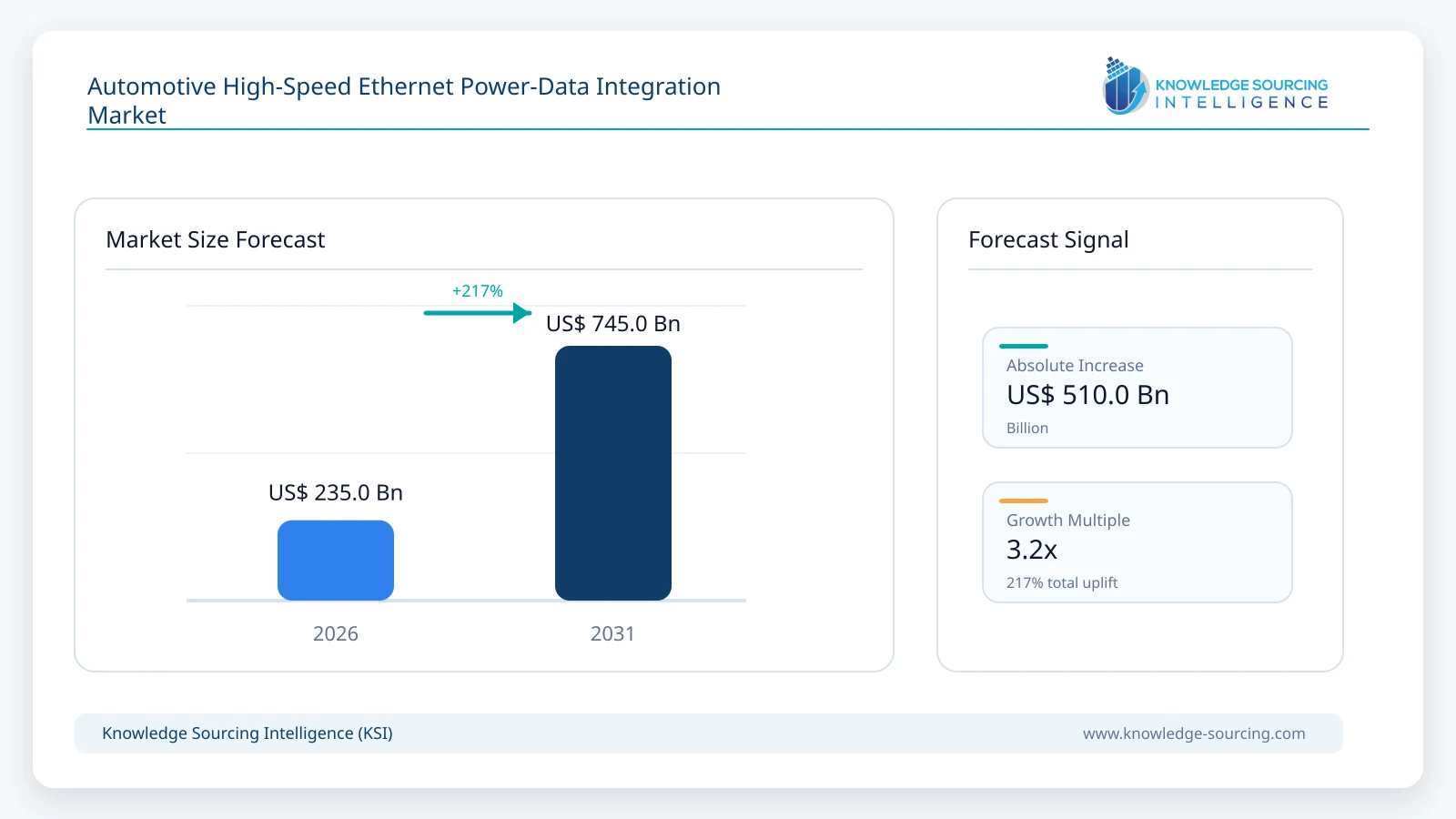
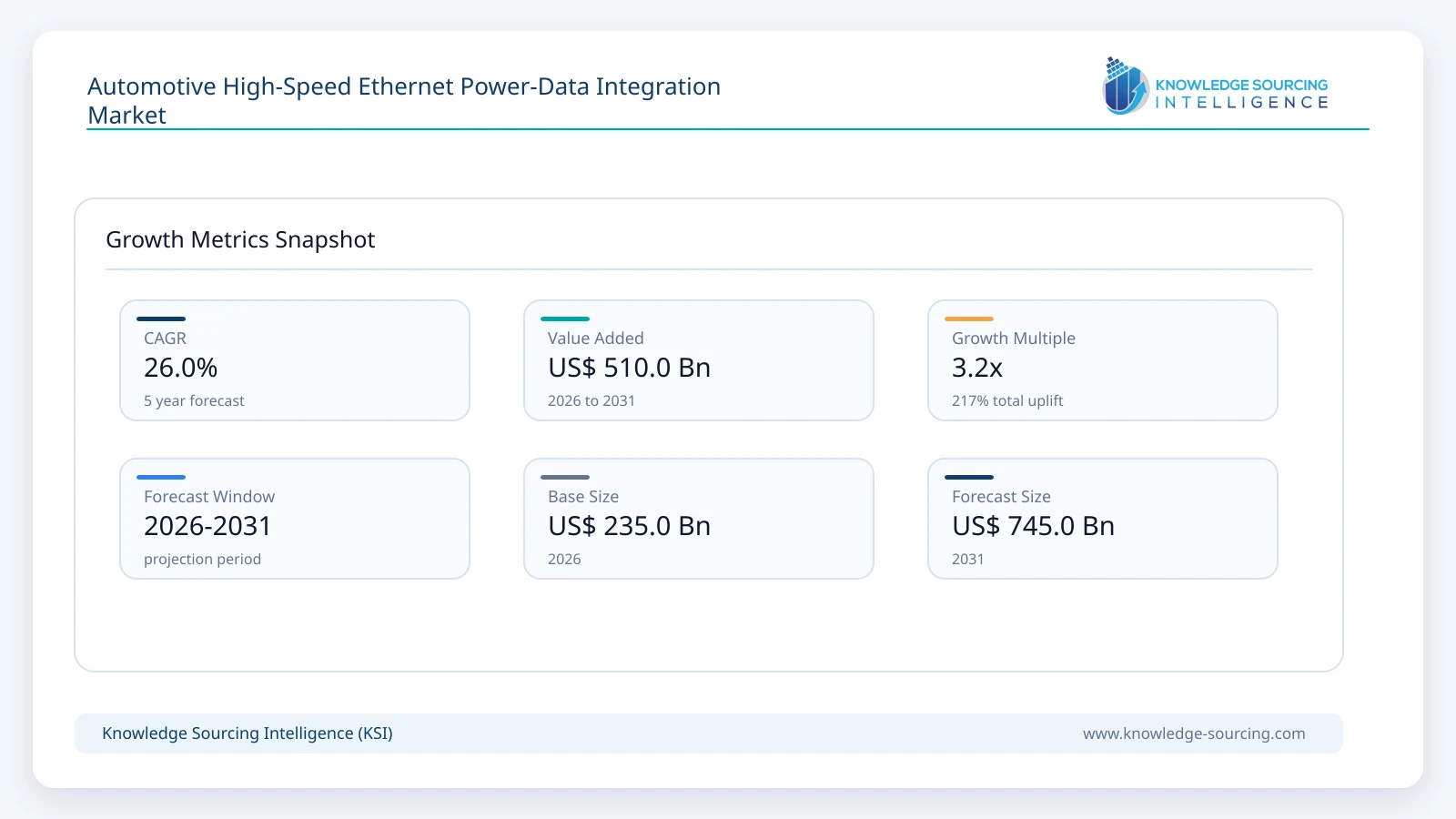
The Automotive High-Speed Ethernet Power-Data Integration Market is projected to expand at a CAGR of 26.0%, increasing from USD 235.0 million in 2026 to USD 745.0 million by 2031.
Highlights:
- 1Hybrid power-plus-Ethernet interfaces account for approximately 65% of modeled 2026 revenue; PoDL-specific content expands faster from a smaller installed base.
- 2Hybrid connector and terminal content is the largest functional revenue group, representing about 35% of the 2026 estimate.
- 3Up-to-1-Gbps applications remain central to early integration economics, particularly for peripheral cameras, gateways and localized controllers.
- 4Passenger vehicles provide approximately 78% of 2026 modeled revenue, with specialized commercial-vehicle integration adding a smaller, technically differentiated opportunity.
- 5Asia Pacific accounts for approximately 43% of 2026 modeled demand; Europe remains a major engineering and qualification center.
- 6Selective power-data integration is most attractive where harness simplification and connector assembly savings outweigh added filtering and qualification costs.
Revenue covers the attributable power-injection and power-extraction electronics, filtering and protection circuits, qualified hybrid Ethernet-power connector assemblies and directly related engineering. Conventional Ethernet transceivers, complete cable harnesses, network switches and full zonal computers are outside this scope.
Texas Instruments demonstrates 100BASE-T1 and 1000BASE-T1 PoDL designs using separate power-sourcing and powered-device circuits, with coupling networks that allow power to share a differential data pair. TE Connectivity and Aptiv address another requirement through mixed-contact housings that combine high-speed links with dedicated power and signal contacts. PoDL can eliminate an additional power pair at an eligible endpoint, while hybrid connections simplify mechanical installation without putting direct-current power on the Ethernet conductors.
Market Overview
Single-pair automotive Ethernet transports data using one balanced twisted pair, enabling compact cabling for cameras, sensors, and networked control units. PoDL adds direct-current delivery to compatible links through coupling and decoupling networks at both ends. Texas Instruments’ automotive reference designs combine PHYs, power-side switching and filtering to demonstrate operation at 100 Mbps and 1 Gbps. Production vehicle designs must also qualify connector losses, conducted emissions, reverse-polarity behavior and protection at the receiving device before the added circuitry can replace conventional wiring.
Aptiv’s modular high-speed connector range and TE Connectivity’s NET-AX+ system bring Ethernet data, power and signal terminations into common housings without requiring PoDL. Rosenberger’s H-MTD+ adds dedicated power contacts alongside differential data connectivity, giving vehicle designers another mechanical option for combining interfaces. Procurement is generally tied to a specific OEM electrical architecture, because the number of ports, current ratings, shielding requirements, and connector positions change between body, camera, cockpit, and zonal applications.
Integrated Ethernet-power interfaces are predominantly specified during vehicle-platform design and are not normally replaced throughout the installed vehicle fleet. Most qualifying revenue occurs with vehicle production, module programs, and harness or connector supply contracts, supplemented by qualification and engineering work during platform development. Expansion through 2031 is therefore tied primarily to the share of new vehicles using eligible integration points and the value of those points per vehicle, rather than to growth in total Ethernet traffic alone.
Market Trends
Power-over-data designs are moving toward defined endpoint use cases
Texas Instruments’ TIDA-020060 and TIDA-020061 reference designs illustrate how an automotive gateway can power a peripheral device across a 100/1000BASE-T1 link. The designs use dedicated coupling networks, protection circuitry and a power-source/powered-device arrangement rather than relying on the PHY alone. Engineering teams must evaluate the load’s peak consumption and voltage drop at the maximum cable length before removing a separate power connection.
Cameras and localized electronic modules offer a plausible starting point when the electrical load fits the selected cable and thermal conditions. Higher-power compute nodes still often need dedicated supply conductors, even when Ethernet remains the principal data interface. Selective powered-link installations are therefore more practical than vehicle-wide adoption, particularly when the required current or startup behavior varies between electronic modules.
Hybrid connectors are consolidating vehicle interfaces
TE Connectivity’s NET-AX+ and Aptiv’s hybrid connector families address the assembly burden created by separate Ethernet, signal and power mating points. Both suppliers emphasize combining multiple interface types within a shared connector footprint, which can reduce manual connection steps and packaging pressure around zone controllers and high-performance computers. The power contacts remain physically distinct from the Ethernet conductors in these configurations.
Hybrid solutions can gain adoption even where PoDL is technically unattractive because a module draws more current than a shared pair can efficiently provide. Commercial success depends on terminal density, environmental sealing, insertion force, robotic assembly access and service replacement rather than on data-rate specifications alone.
Central-to-zonal networks are changing connector placement
NXP’s CoreRide Z248 reference system combines 48 V distribution and zonal data handling, reflecting a wider architectural move to localized electrical aggregation. The reference system demonstrates integrated design direction, not evidence that its Ethernet lines directly carry power. As automakers consolidate controllers, more power and communication lines terminate at common zonal points where hybrid interconnects and selective PoDL endpoints can offer packaging advantages.
Zonal concentration can reduce long cross-car power and data runs while increasing connector density and validation requirements at the controller. Connector makers and semiconductor suppliers that work jointly on shielding, power filtering, and fault behavior are consequently well placed to compete for new electrical-platform programs.
Segment Analysis
By Integration Approach: Hybrid Ethernet-Power Interfaces
Hybrid interfaces hold an estimated 65% of 2026 revenue because separate power contacts can accommodate a wider range of current requirements than shared-conductor powering. TE Connectivity’s NET-AX+ and Rosenberger’s H-MTD+ illustrate commercially available ways to group the data and power interfaces in a compact assembly. The design is particularly relevant for centrally located controllers and modules whose power requirement would complicate PoDL protection or thermal design.
PoDL gains are modeled to be shared by 2031 as more peripheral devices can be designed around the power and EMC limits of a shared twisted pair. Nevertheless, hybrids remain the larger category because data bandwidth and device supply current are separate engineering constraints. Multi-gigabit Ethernet does not necessarily support power on the data conductors, and these installations primarily rely on mechanically integrated power contacts.
By Revenue Component: Hybrid Connectors and Terminals
Hybrid connector bodies, contacts, and interface modules represent approximately 35% of market revenue in 2026. These parts capture value when a connector incorporates qualified differential Ethernet paths and separate power terminals for the same module. Demand is tied to actual installed connection points, not to the number of Ethernet PHY ports shipped by semiconductor suppliers.
Coupling, filtering, and power-control content gains importance where OEMs adopt true PoDL. Each powered link can require protection and separation functions at both the source and device ends, but implementation cost must remain below the avoided wiring and assembly expense. This favors integrated designs and qualification reuse across vehicle platforms.
By Data-Rate Class: 1000BASE-T1 and Related Gigabit Links
Gigabit-class single-pair Ethernet provides a practical balance between sensor data requirements, cable complexity and component availability in many new automotive platforms. TI’s PoDL reference designs explicitly support 1000BASE-T1 alongside a 100BASE-T1 option. High-resolution cameras and gateway endpoints can therefore justify powered-link evaluation without requiring a transition to 2.5GBASE-T1 or faster protocols.
Faster-than-gigabit connectivity primarily contributes through hybrid connection assemblies in this market definition. Not every multi-gigabit automotive connector is power-data integrated, and the value of a standard data-only multi-gigabit connection is excluded. The speed mix will follow actual endpoint designs rather than the maximum rating advertised for a connector family.
By Installation Point: Sensors and Peripheral Modules
Exterior cameras, localized sensing units and small electronic modules are important addressable endpoints because simplifying a power and data connection can reduce connector handling and installation effort. Power budget, cable length, sleep-state behavior, and camera startup reliability remain the main qualifying conditions. An OEM may select PoDL for one remote unit while retaining separate supply conductors elsewhere in the same vehicle.
Zone-controller and central-compute terminations create additional revenue for hybrid connectors that aggregate many data, signal and power lines. Their greater current demands generally favor dedicated power contacts, so the architecture segment mix differs from the PoDL endpoint mix.
By Vehicle Type: Passenger Vehicles
Passenger cars contribute approximately 78% of the modeled 2026 market because of their larger production base and the growing number of camera, connectivity and distributed electronic functions in new platforms. Adoption is uneven across vehicle classes, with higher-electronics models more likely to justify specialized power-data assemblies than price-sensitive variants using existing harness designs.
Commercial vehicles contribute through rugged hybrid links, sensors and distributed body electronics. Rosenberger’s 2026 HSI-to-H-MTD solution for trailer electronics indicates a distinct use case where cable length, environmental sealing and serviceability shape the connector decision.
Market Drivers
Rising integration density around zonal controllers
Vehicle manufacturers are grouping data, power and signal connections at fewer electronic nodes as electrical architecture moves toward zonal layouts. TE Connectivity and Aptiv offer hybrid connectors designed to reduce separate mating points and installation space in these environments. The value proposition is strongest where additional circuits can share one housing without compromising maintainability or fault isolation.
More Ethernet-connected cameras and electronic sensors
High-resolution cameras and localized electronic modules increasingly require Ethernet bandwidth while continuing to draw low-voltage power. Combined connector formats remove duplicate housings, and eligible low-power devices can be evaluated for PoDL. Platform economics depend on real connector and wiring avoidance rather than assuming that every additional camera produces a powered Ethernet link.
Manufacturing pressure to simplify harness assembly
Automotive harness installation involves many keyed connections in restricted body areas. Aptiv identifies automation and reduced connector count as reasons for modular hybrid designs. Fewer separate mating operations can reduce installation complexity, but the saving must exceed the incremental price of the integrated connection.
Standardization of single-pair Ethernet power interfaces
IEEE 802.3bu establishes technical foundations for delivering power over a balanced single pair. TI’s 100/1000BASE-T1 reference designs show how the underlying power-source, protection and endpoint circuits may be assembled for automotive operating conditions. A common technical basis can lower redesign work while still leaving automotive EMC and qualification to each program.
Development of 48 V and mixed-voltage vehicle electrical systems
NXP’s CoreRide Z248 incorporates 48 V distribution with zonal data handling, while power suppliers and connector manufacturers offer interfaces for more varied low-voltage requirements. Hybrid connectors can accommodate separate current-rated contacts beside Ethernet connections. Selective PoDL remains more dependent on endpoint power limits and line-protection design.
Market Restraints
EMC interaction between injected power and gigabit data
PoDL coupling inductors, filtering and protective devices must preserve the link’s impedance and insertion-loss limits across the specified environment. Automotive conducted emissions, adjacent harness noise and transient conditions raise test costs. A design that works on a laboratory board may still require considerable revision before vehicle qualification.
Power-budget and cable-loss limitations
Longer cable runs, high peripheral load currents and startup transients can undermine the case for sharing the Ethernet conductors. Some camera and computing systems need separate power lines for electrical or thermal reasons, regardless of their data rate. These applications tend to retain hybrid connections with dedicated supply contacts.
Qualification and platform redesign costs
Vehicle manufacturers usually freeze connector layouts, harness routing, and critical power interfaces early in a development program. Changing to PoDL or a different hybrid mating design can trigger electromagnetic, thermal, ingress and service-life testing. Platform changeovers therefore matter more than near-term retrofit demand.
Competing system architectures and proprietary interfaces
Vehicle architectures vary between distributed modules, domain aggregation and central-to-zonal networks. The same connector system or power-delivery circuit will not fit every endpoint because voltage, current and shielding needs differ. Supplier qualification may be fragmented by OEM and platform even when the Ethernet data standard is common.
Limited savings when conventional harnesses are already optimized
Low-cost vehicle programs often use mature connector families and established harness routing with little incentive to alter their electrical interfaces. Adding PoDL circuitry or a new hybrid connector can increase component and validation cost when only one small power lead would otherwise be removed. Integrators therefore need a demonstrated manufacturing or packaging benefit at each qualifying connection point.
Regional Outlook
Asia Pacific
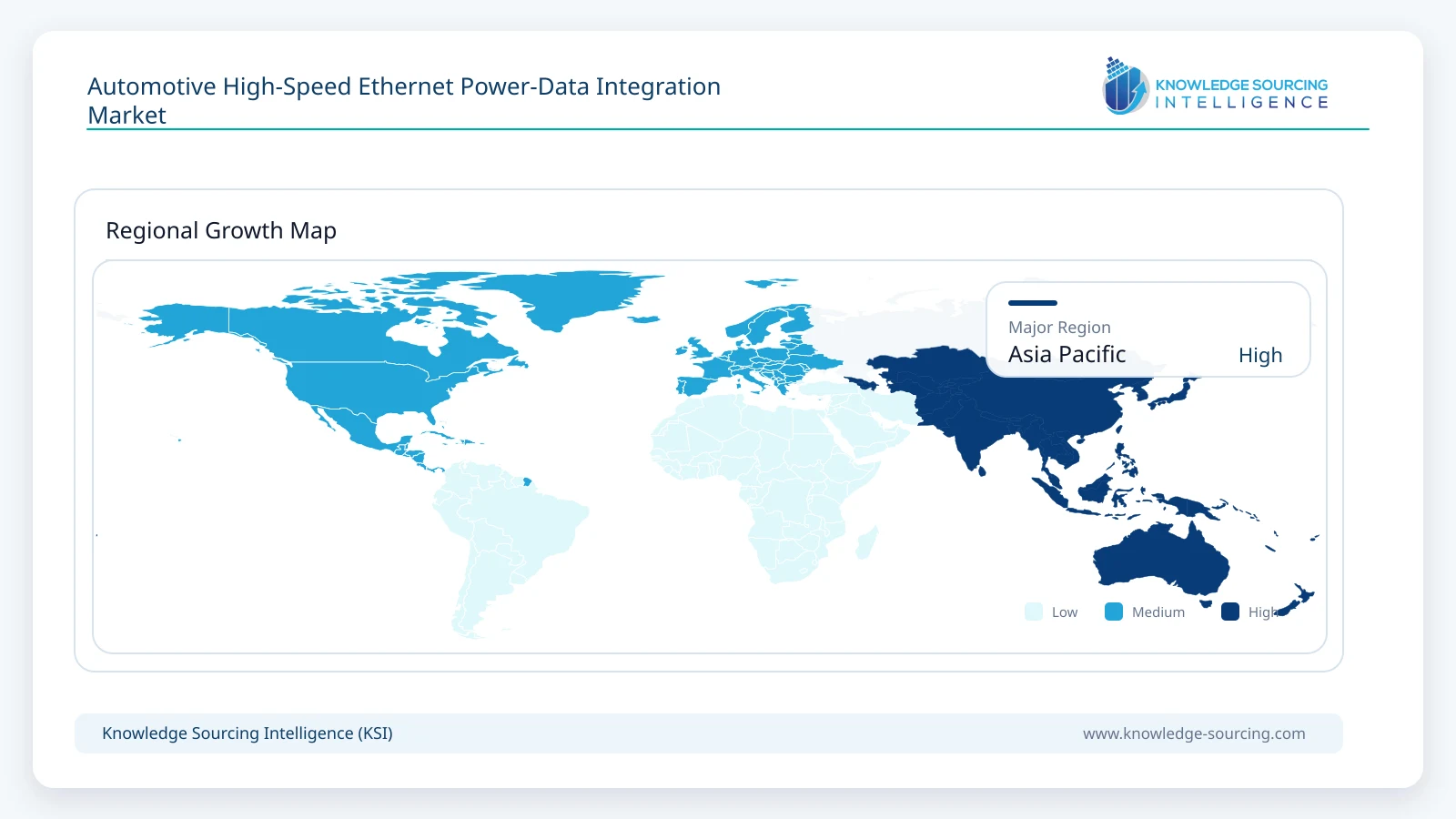
Asia Pacific accounts for an estimated 43% of 2026 market revenue, supported by the concentration of vehicle manufacturing and electronic-system production in China, Japan and South Korea. Ethernet-connected camera and cockpit platforms provide a technical base for selective hybrid and powered-link adoption, while mainland Chinese EV development supports relatively rapid electrical architecture changes. Electric-vehicle adoption increases opportunities for electrical architecture redesign, but uptake of powered Ethernet still depends on the load, connector layout and economics of individual vehicle programs.
China is expected to remain the largest country demand pool through 2031, with Japan and South Korea contributing through automotive electronics suppliers and established vehicle programs. The regional mix is forecast to rise to approximately 46% as more locally designed platforms incorporate zonal and integrated interconnect architectures. Vehicle assembly and electronic-system sourcing patterns will influence which countries capture demand for the finished interfaces.
Europe
European demand reflects established connector, power-electronics and vehicle-system engineering capabilities. Rosenberger, TE Connectivity’s European operations and major OEM development programs place considerable emphasis on high-speed signal integrity, robust housings and electrical-system qualification. The region represents approximately 29% of modeled 2026 demand, including both passenger and commercial vehicle applications.
Germany provides a concentration of electrical architecture development and qualified connectivity supply. European vehicle programs increasingly combine Ethernet with zonal or mixed-voltage distribution, but their production timing and platform-specific design freezes can delay large-scale adoption. Europe remains a major technical market through 2031, although Asia Pacific contributes a larger share of incremental production-volume demand.
Competitive Landscape
Competition separates into automotive hybrid-interface suppliers and semiconductor or passive-component manufacturers supporting direct power-over-data designs. TE Connectivity, Aptiv and Rosenberger supply hybrid connector systems with qualified high-speed data paths and dedicated power-contact configurations. Texas Instruments provides the clearest directly documented 100/1000BASE-T1 PoDL reference implementations among the reviewed sources, supported by automotive power-management and Ethernet components.
NXP, Microchip and Infineon compete in the wider automotive Ethernet component ecosystem, while STMicroelectronics, Würth Elektronik and TDK supply relevant protection and filtering technologies. Protection and filtering providers compete on signal integrity, automotive qualification and component density, while Ethernet semiconductor vendors must work with the power-interface suppliers responsible for the complete link.
Recent Developments
May 2026: Microchip introduced LAN878x and LAN888x 100/1000BASE-T1 PHY families with MACsec, time-sensitive networking and functional-safety features. The devices extend design options for automotive links used alongside separately engineered power interfaces.
May 2026: NXP announced a collaboration with Quanta for deterministic zonal networking using S32-based technology. The work advances controller-level network integration, increasing the relevance of compact mixed power-data interfaces.
March 2026: NXP introduced its CoreRide Z248 reference system combining 48 V distribution and zonal data routing. The architecture concentrates power and network interfaces around zonal control units.
January 2026: Rosenberger presented the HSI-to-H-MTD hybrid assembly for trailer electronics, combining power and high-speed communications in a vehicle-specific link with robust interconnect requirements.
August 2025: Infineon completed its acquisition of Marvell’s Automotive Ethernet business, expanding the company’s networking capabilities alongside its automotive microcontroller and power portfolios.
Market Outlook
Hybrid high-speed connectors should remain the largest revenue group through 2031 because they can consolidate power, signal and Ethernet interfaces while preserving separate conductors for higher-current equipment. Automotive design decisions will prioritize qualification, mechanical packaging and assembly economics. Power over Data Lines is expected to gain adoption mainly in peripheral devices where sharing a pair removes more cost and weight than it introduces in coupling and protection hardware.
Central-to-zonal architectures increase the number of potential integration decisions but will not convert every Ethernet port into a powered endpoint. New vehicle programs can employ PoDL for selected cameras, hybrids for control assemblies and standard data-only Ethernet for higher-speed backbone links. Supplier growth therefore depends on program design wins, automotive-grade validation and manufacturing scale rather than on network-data growth alone.
Automotive High-Speed Ethernet Power-Data Integration Market Scope:
| Report Metric | Details |
|---|---|
| Total Market Size in 2026 | USD 235.0 million |
| Total Market Size in 2031 | USD 745.0 million |
| Forecast Unit | USD Billion |
| Growth Rate | 26.0% |
| Study Period | 2021 to 2031 |
| Historical Data | 2021 to 2024 |
| Base Year | 2025 |
| Forecast Period | 2026 – 2031 |
| Segmentation | Integration Approach, Revenue Component, Data-rate Class, Installation Point |
| Companies |
|
Market Segmentation
By Integration Approach
Power over Data Lines (PoDL)
Hybrid Ethernet and Dedicated-Power Interfaces
By Revenue Component
Power-Sourcing and Powered-Device Interface Electronics
Coupling, EMC and Protection Components
Hybrid Connector and Terminal Systems
Integrated Cable and Module Assemblies
Program Engineering and Qualification
By Data-rate Class
100BASE-T1 and Comparable Links
1000BASE-T1 Gigabit Links
Multi-Gigabit Hybrid Data Interfaces
By Installation Point
Sensors and Peripheral Electronic Modules
Zonal and Edge Controllers
Central Compute and Gateway Assemblies
Commercial-Vehicle Specialized Interfaces
By Vehicle Type
Passenger Vehicles
Light Commercial Vehicles
Medium and Heavy Commercial Vehicles
By Low-voltage Architecture
12 V Vehicle Networks
48 V Vehicle Networks
Mixed 12 V and 48 V Networks
By Procurement Channel
Production Hardware and Assemblies
Program Engineering and Qualification Services
By Geography
North America
United States
Canada
Mexico
South America
Brazil
Argentina
Others
Europe
Germany
United Kingdom
France
Italy
Spain
Others
Middle East and Africa
Saudi Arabia
UAE
Israel
South Africa
Others
Asia Pacific
China
Japan
South Korea
India
Taiwan
Thailand
Indonesia
Others
Table of Contents
1. EXECUTIVE SUMMARY
2. MARKET SNAPSHOT
2.1. Market Overview
2.2. Market Definition
2.3. Scope of the Study
2.4. Market Segmentation
3. BUSINESS LANDSCAPE
3.1. Market Drivers
3.1.1. Rising Integration Density Around Zonal Controllers
3.1.2. Ethernet-Connected Cameras and Electronic Sensors
3.1.3. Harness Assembly Simplification
3.1.4. Single-Pair Power Interface Standardization
3.1.5. Mixed-Voltage Electrical Architectures
3.2. Market Restraints
3.2.1. Power and Data EMC Interaction
3.2.2. Power Budget and Cable Loss
3.2.3. Automotive Qualification Cost
3.2.4. Differing Electrical Architectures
3.2.5. Limited Savings on Optimized Conventional Harnesses
3.3. Market Opportunities
3.4. Porter’s Five Forces Analysis
3.5. Industry Value Chain Analysis
3.6. Policies and Regulations
3.7. Strategic Recommendations
4. TECHNOLOGICAL OUTLOOK
4.1. IEEE 802.3bu PoDL for Single-Pair Ethernet
4.2. 100BASE-T1 and 1000BASE-T1 Powered Links
4.3. Hybrid Ethernet-Power Connectors
4.4. Coupling, Filtering and EMC Design
4.5. Fault Protection and Power Management
5. AUTOMOTIVE HIGH-SPEED ETHERNET POWER-DATA INTEGRATION MARKET BY INTEGRATION APPROACH
5.1. Power over Data Lines (PoDL)
5.2. Hybrid Ethernet and Dedicated-Power Interfaces
6. AUTOMOTIVE HIGH-SPEED ETHERNET POWER-DATA INTEGRATION MARKET BY REVENUE COMPONENT
6.1. Power-Sourcing and Powered-Device Interface Electronics
6.2. Coupling, EMC and Protection Components
6.3. Hybrid Connector and Terminal Systems
6.4. Integrated Cable and Module Assemblies
6.5. Program Engineering and Qualification
7. AUTOMOTIVE HIGH-SPEED ETHERNET POWER-DATA INTEGRATION MARKET BY DATA-RATE CLASS
7.1. 100BASE-T1 and Comparable Links
7.2. 1000BASE-T1 Gigabit Links
7.3. Multi-Gigabit Hybrid Data Interfaces
8. AUTOMOTIVE HIGH-SPEED ETHERNET POWER-DATA INTEGRATION MARKET BY INSTALLATION POINT
8.1. Sensors and Peripheral Electronic Modules
8.2. Zonal and Edge Controllers
8.3. Central Compute and Gateway Assemblies
8.4. Commercial-Vehicle Specialized Interfaces
9. AUTOMOTIVE HIGH-SPEED ETHERNET POWER-DATA INTEGRATION MARKET BY VEHICLE TYPE
9.1. Passenger Vehicles
9.2. Light Commercial Vehicles
9.3. Medium and Heavy Commercial Vehicles
10. AUTOMOTIVE HIGH-SPEED ETHERNET POWER-DATA INTEGRATION MARKET BY LOW-VOLTAGE ARCHITECTURE
10.1. 12 V Vehicle Networks
10.2. 48 V Vehicle Networks
10.3. Mixed 12 V and 48 V Networks
11. AUTOMOTIVE HIGH-SPEED ETHERNET POWER-DATA INTEGRATION MARKET BY PROCUREMENT CHANNEL
11.1. Production Hardware and Assemblies
11.2. Program Engineering and Qualification Services
12. AUTOMOTIVE HIGH-SPEED ETHERNET POWER-DATA INTEGRATION MARKET BY GEOGRAPHY
12.1. North America
12.1.1. United States
12.1.2. Canada
12.1.3. Mexico
12.2. South America
12.2.1. Brazil
12.2.2. Argentina
12.2.3. Others
12.3. Europe
12.3.1. Germany
12.3.2. United Kingdom
12.3.3. France
12.3.4. Italy
12.3.5. Spain
12.3.6. Others
12.4. Middle East and Africa
12.4.1. Saudi Arabia
12.4.2. UAE
12.4.3. Israel
12.4.4. South Africa
12.4.5. Others
12.5. Asia Pacific
12.5.1. China
12.5.2. Japan
12.5.3. South Korea
12.5.4. India
12.5.5. Taiwan
12.5.6. Thailand
12.5.7. Indonesia
12.5.8. Others
13. COMPETITIVE ENVIRONMENT AND ANALYSIS
13.1. Major Players and Strategy Analysis
13.2. Market Share Analysis
13.3. Mergers, Acquisitions, Agreements and Collaborations
13.4. Competitive Dashboard
14. COMPANY PROFILES
14.1. TE Connectivity plc
14.2. Aptiv PLC
14.3. Rosenberger Hochfrequenztechnik GmbH & Co. KG
14.4. Texas Instruments Incorporated
14.5. NXP Semiconductors N.V.
14.6. Microchip Technology Incorporated
14.7. Infineon Technologies AG
14.8. STMicroelectronics N.V.
14.9. Würth Elektronik eiSos GmbH & Co. KG
14.10. TDK Corporation
15. APPENDIX
15.1. Currency
15.2. Assumptions
15.3. Base and Forecast Years Timeline
15.4. Key Benefits for Stakeholders
15.5. Research Methodology
15.6. Abbreviations
Navigate
Trusted by the world's leading organizations











